Horticulturists are by nature, nonconforming. I happen to find it difficult to conform to what makes us nonconforming. Trends are fleeting. Old technology that has worked for decades or centuries is still best. Although I am not totally against chemicals, I find that almost all are unnecessary for responsible home gardening. Pruning is underappreciated, and fixes many problems.
Although I can not be certain, I believe that this is prickly lettuce.
Pretty weeds do not get my attention like they do for others. They look too much like weeds to me. If I want to appreciate them, I must do so with intention. Sometimes, I do actually try. I did happen to notice these two weeds. However, now that I got their pictures, I have no use for either of them. Neither is readily useful for the gardening column. I will just share them here.
The yellow flower pictured above is most likely prickly lettuce. I really do not know. I know it as yellow chicory; but chicory does not bloom yellow. Some people think of it as dandelion, since the flowers are similar. These flowers stand much higher though, with only minimal foliage below. For the picture, I plucked this flower and stuck it in the ground…
The wrong flowers are nonetheless pretty. Pretty flowers distract from unsightly foliage. Neighborly ground squirrels are people too.
1. ‘Red King Humbert’ Canna was one of only two canna that I ever purchased. I still feel guilty about spending about $6 for ‘Australia’ years ago. This second purchase for thirty rhizomes late last season was not so inexpensive. I was so displeased as virused foliage emerged. I tried to believe that this discoloration was from starting so late in the season.
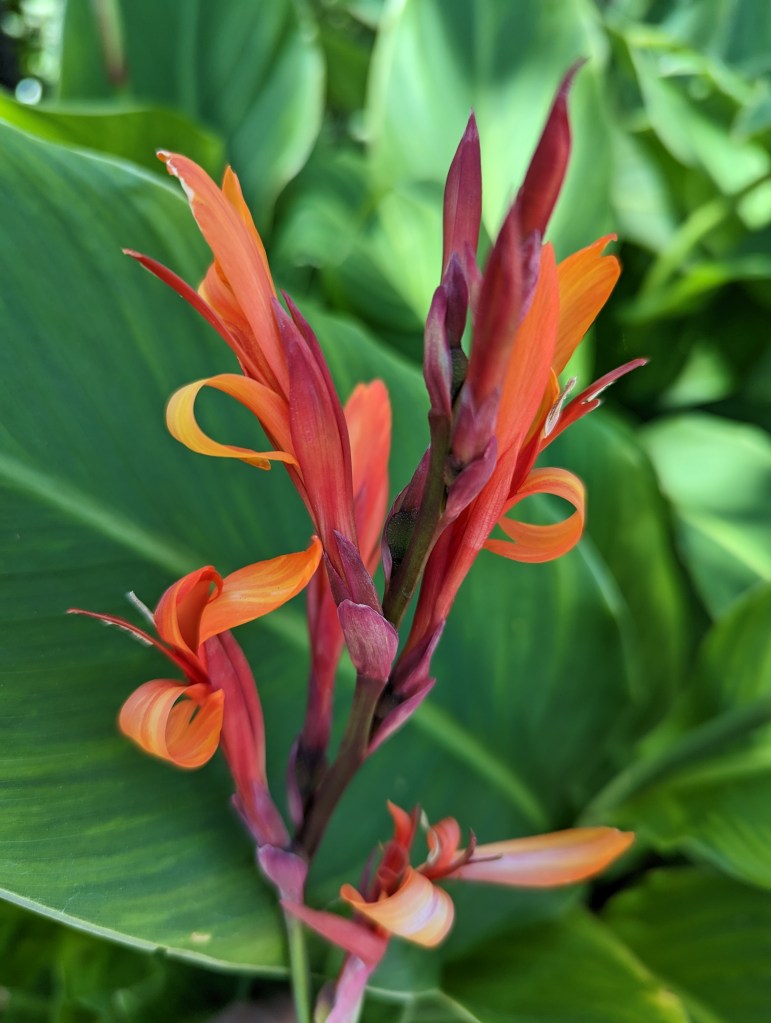
2. ‘Red King Humbert’ Canna gets about six feet tall, with billowy and bright red bloom. Because it started so late last year, it barely grew, and did not bloom. Now it blooms like this, and is only about two feet tall. It is all virused. It definitely is not what it should be.
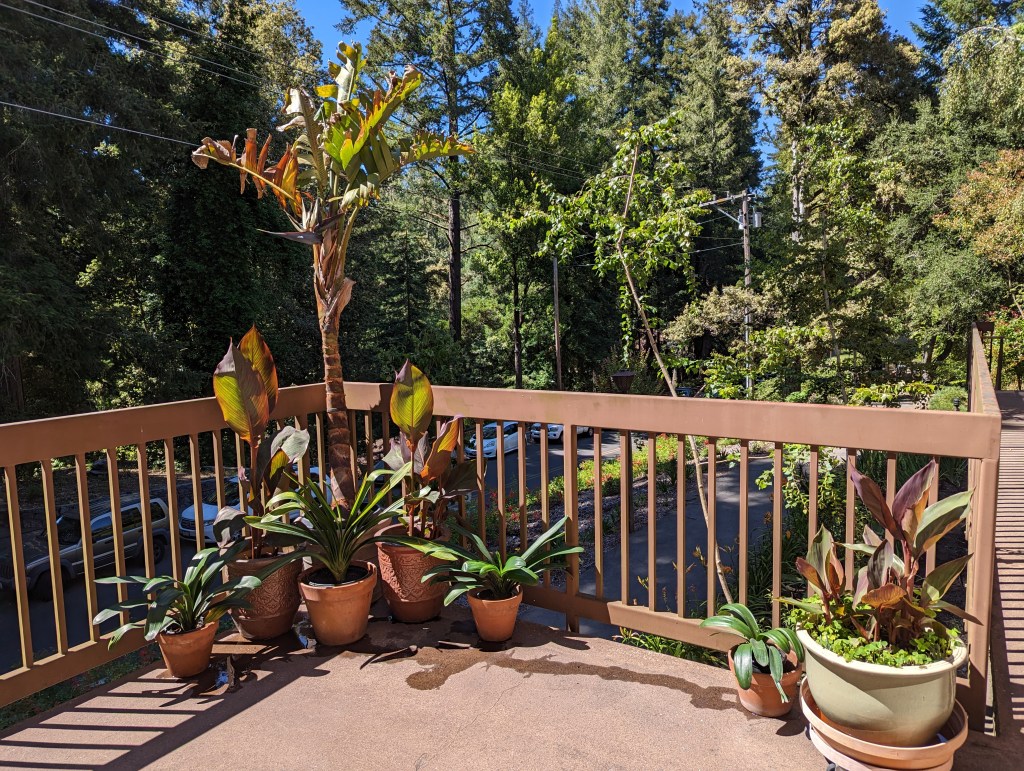
3. An assortment of formerly unappreciated canna, Kaffir lily and giant bird of Paradise temporarily inhabit this otherwise uninteresting deck at work. A gardener found them to be too appealing to leave in obscurity within the nursery yard, so brought them here and set their cans into more appealing pots. Only the canna to the right is original to the site.
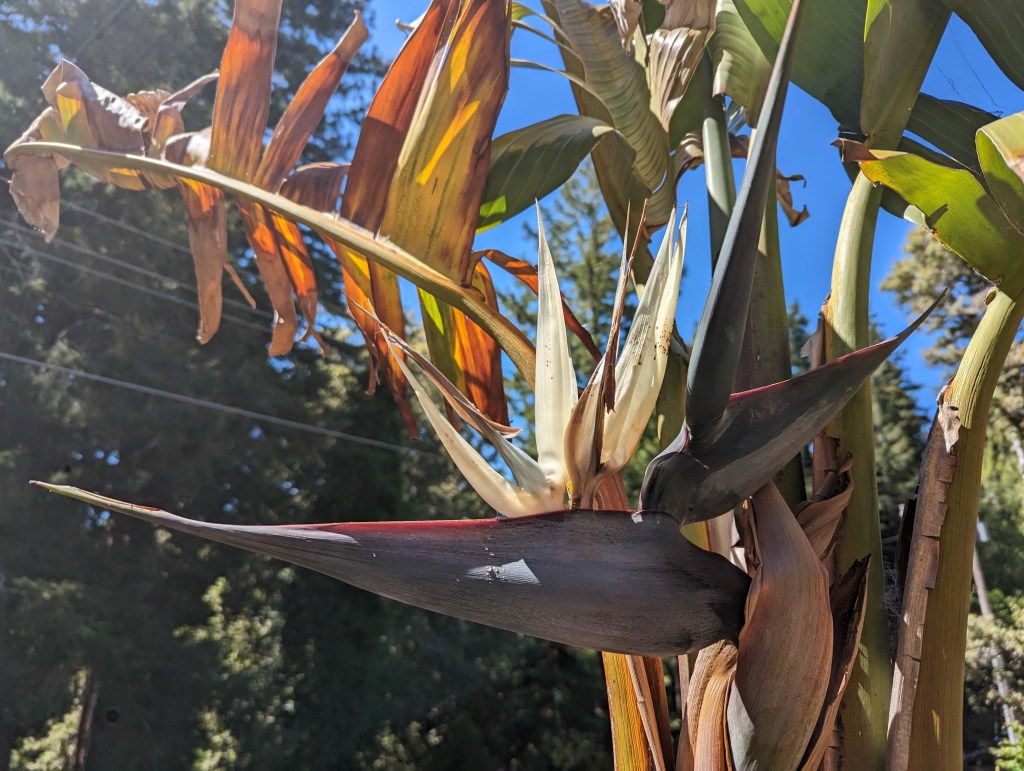
4. Strelitzia nicolai, giant bird of Paradise is shabby though. The worst of its few roasted leaves is to the upper left. However, only I notice it! Everyone else notices its rad bloom.
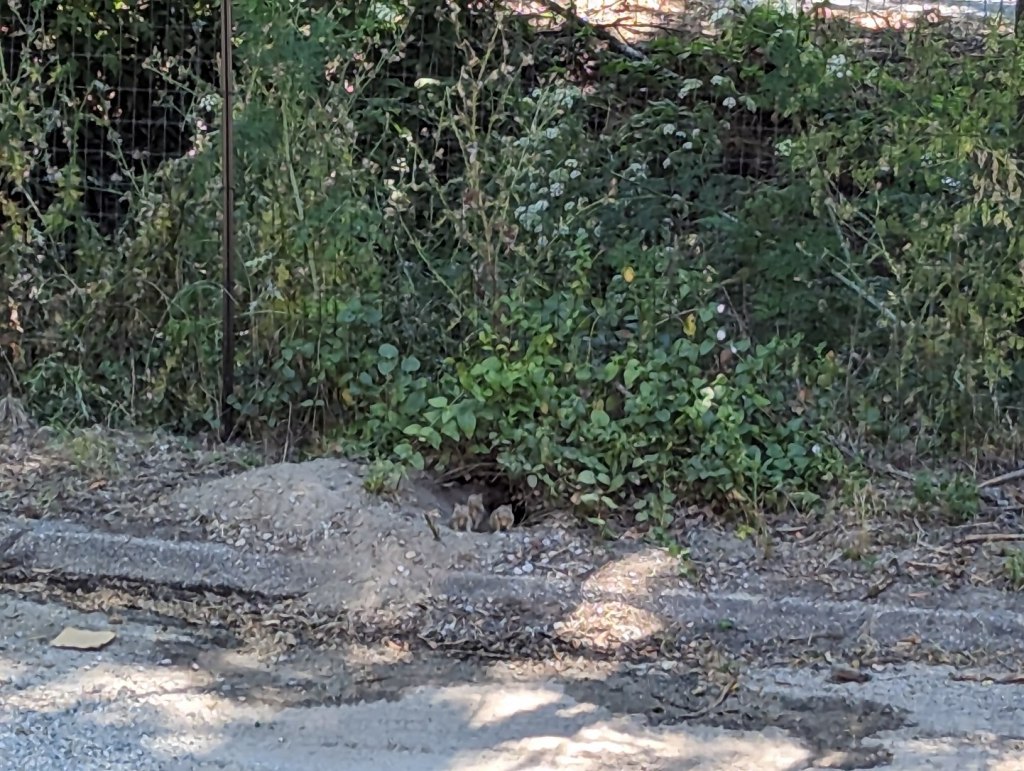
5. Alvin, Simon and Theodore are the new neighbors. I yelled at them initially. They just came out to stare at me. More of their friends and family moved in. They do not damage desirable vegetation though. Actually, they are eating undesirable weeds with brambles!
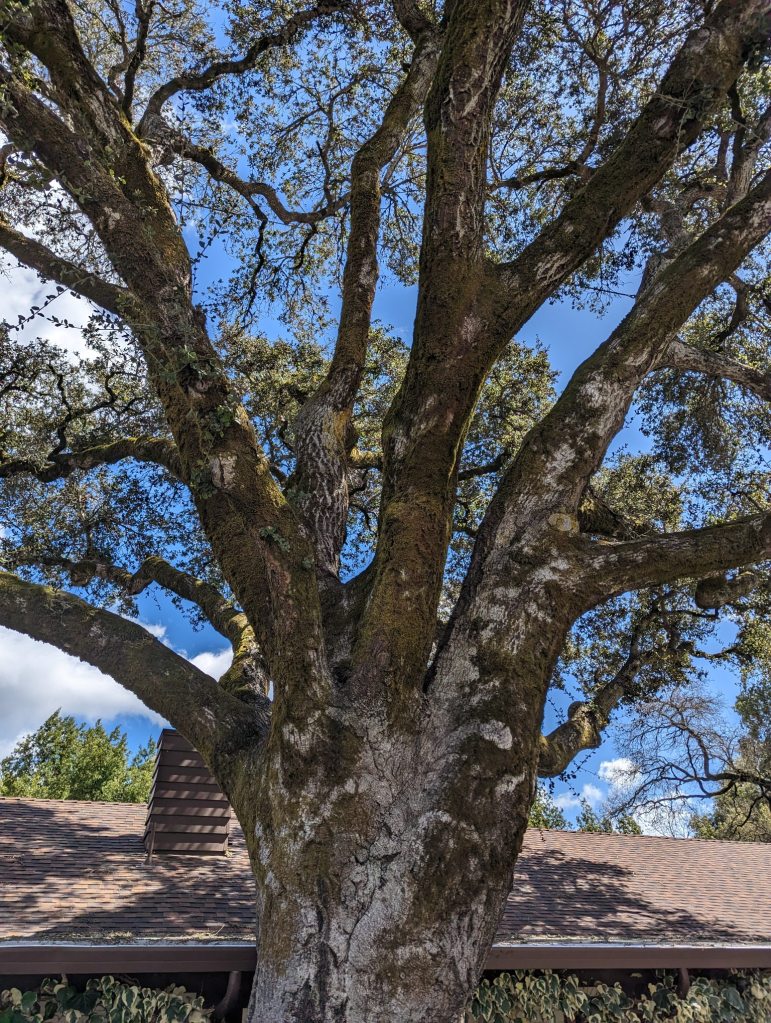
6. After recycling an article about the vandalism of the Memorial Tree in Felton Covered Bridge Park two Wednesdays ago, I should post this new picture of how happy it is now.
Most big China doll trees were formerly docile houseplants.
It is hard to believe that the original variety of the familiar China doll, Radermachera sinica, that grows so slowly to reach an eight foot high ceiling as a houseplant, can actually grow into a substantial fifty foot tall tree with a three foot wide trunk, where protected from frost. Modern varieties with more billowy foliage take even longer to reach the ceiling, and do not go much higher. The finely textured and very glossy foliage is bipinnately compound, which means that each of the half to two foot long leaves are divided into smaller leaflets, which are also divided into even smaller leaflets that are about an inch or so long. Trusses of tubular white flowers that resemble big catalpa flowers are almost never seen among houseplants or modern varieties, but are quite showy on big old trees.
Rats, mice, squirrels, racoons, opossums, skunks, deer, pigeons and more; it just never ends! There are so many other life forms who often enjoy our gardens more than we do. While visiting my colleague in Los Angeles, his garden became overrun by a swarm of bees! Fortunately, they did no damage and left the same day.
The worst problem in his garden is cats. His neighbor hoards ‘unaltered’ feral cats that have proliferated into a substantial herd. Instead of exterminating rodents from the neighborhood, the overfed cats ignore the droves of rats that are drawn to the cat food left out on the porches. The rats attract opossums. Fleas are everywhere!
All this wildlife brings all sorts of other problems. The well kept domestic cats that live inside the home of my colleague are frequently afflicted with illness transmitted by the sickly feral cats. Flat roofs and basement crawl spaces of several adjacent homes have become litterboxes. The overpowering aroma is horrendous.
Fortunately, such proliferation of cats is rare. Most of us do not mind when a neighborhood cat, or even a few cats, visit the garden. However, when cats become a problem, they are nearly as difficult to remedy as vermin.
Although most municipalities have limited the number of domestic cats that can reside at individual residences, feral cats come and go freely, so are considered to be wild animals who are exempt from such limits. Besides, no one wants to enforce such ordinances with their neighbors, even if the problematic cats happen to be domestic house cats. All we can do is try to limit the problems in our own gardens and homes.
Flat roofs sometimes get used as litterboxes because they commonly have gravel on them and tend to accumulate a bit of other debris. If this is a problem, and if possible, access to flat roofs should be obstructed. Tree limbs and vines should be pruned back.
Basements and crawl spaces are easier to obstruct access to by simply repairing vent screens and exterior basement access. Cats like to use crawlspaces as litterboxes because the soil is always dry and dusty. Around the garden, dry spots are less attractive to cats if sometimes watered, even if there are no plants present. Adding spreading plants is even better. In a small dusty area behind the garage, I spread out a bit of firewood over the soil. By the time the firewood gets used, it will be raining and too muddy for cats.
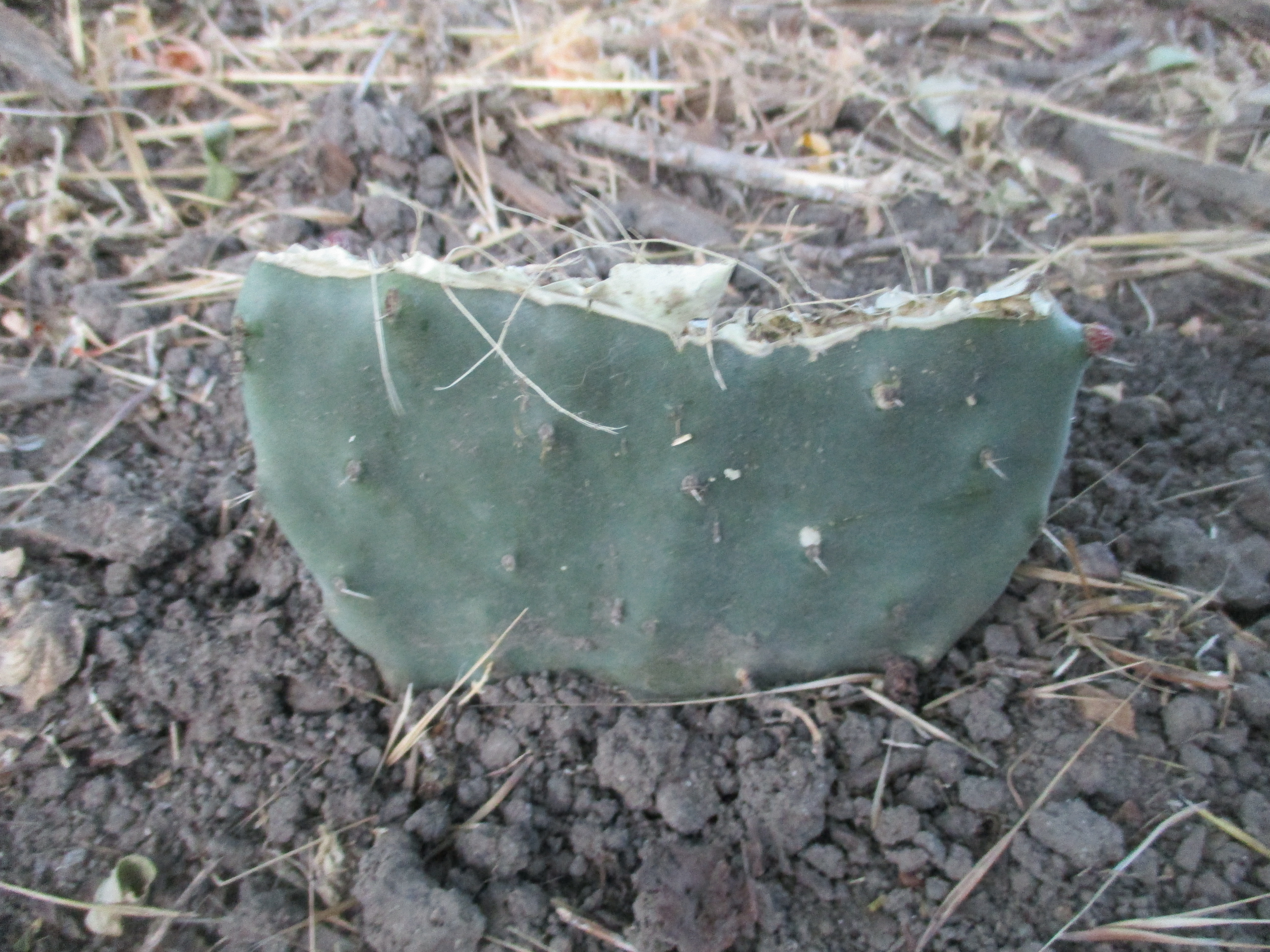
This is one recycled episode of Horridculture that did not get a happy ending within the past three years. The prickly pear never recovered as it was cut down with every weed whacking procedure, and eventually succumbed to decay and died. I did not know that prickly pear could be killed!
This neatly sliced prickly pear is too silly to rant about. There is another just like it. Two others were not sliced, as if, after the first two, someone realized that there was more to the roadside meadow than combustible dry grass. The prickly pear were put out there just last winter. They each extended only a single pad half a foot or so above grade, so were obscured by the grass.
Realistically, the damage is minimal and tolerable here. The priority of the crew who performed the vegetation management was to cut down all the combustibles. They did an efficient job of it. They did not expect to encounter anything that had been intentionally installed out there, or even any desirable vegetation. Besides, this prickly pear will recover as if nothing happened.
Unfortunately, damage caused by weed whackers is rarely so innocuous. Weed…
Most trees behave very differently in cultivation than in the wild. Colorado blue spruce, Picea pungens, is naturally a grand tree. It slowly but surely grows almost a hundred feet tall in the Rocky Mountains. Locally, if not competing with taller trees, it rarely gets as tall as thirty feet. Mild winter weather does not stimulate much more than necessary growth.
Furthermore, most home garden Colorado blue spruce are densely compact cultivars. Most are plumply conical. A few are quite rounded or globular. They function more as big shrubbery than trees. They are less conducive to major pruning than shrubbery though. Removal of low limbs for clearance compromises their strict but naturally elegant form.
Foliar color is as appealing as form and foliar texture. Obviously, Colorado blue spruce should be blue. Some are a bit more silvery or grayish. Trees that grow from seed tend to be greener and a bit less dense than cultivars. Such seedlings are sometimes available online. The stiff and prickly needles of Colorado blue spruce are only about an inch long.
Trees are generally the most significant living components within a home garden. Even treeless gardens benefit from nearby trees. Some old redwoods contain more wood than the homes that they shade. Some old oaks inhabited their gardens centuries before their gardens did. With few exceptions, nothing in a garden is as big or permanent as a tree.
Japanese maples, citrus trees and other small trees can be among the exceptions. They might be smaller than some of the shrubbery they share their gardens with. Papayas and other herbaceous trees can also be exceptions. Some live for only a few brief years. The definition of what a tree is can be vague. Variable interpretations complicate this matter.
A tree is a woody perennial plant with a single tall trunk and branches. However, banana trees develop several unbranched herbaceous trunks. Palms and tree ferns are neither woody nor branched. Arboriform yuccas are no woodier than palms. Many trees develop many trunks. Banyans use roots as trunks. This definition does not even describe ‘tall’.
Ultimately, the characteristics of a tree are more important than its definition. Shade trees near homes should be deciduous to let warm sunshine through in winter. Evergreens are better for obscuring unwanted scenery throughout the year. Evergreens are messier than most deciduous vegetation though. Their shedding is not so limited to distinct seasons.
Fruit trees are some of the most misunderstood inhabitants of home gardens. Not many grow big enough to function as shade trees. Fruit is difficult to harvest from those that do. Almost all require intensive and specialized pruning and maintenance. Few get it. Most eventually succumb to neglect. Citrus and avocados are some of the least demanding.
Palms, whether or not they qualify as a type of tree, are also misunderstood. They lack branches, so are not conducive to pruning away from utility cables. Their single terminal buds grow only upward. Removal is the only option for palms that encroach too closely to high voltage cables. Even the best palms need grooming from professional arborists. Most quickly grow beyond reach from the ground or even a ladder, and are dangerous to climb.
For the same reason that the lily of the Nile that were described yesterday are blooming so late this year, both sun scald and scorch are less of a problem this summer.
There are two types of horticultural sunburn. Sun scald is what happens to formerly shaded bark if it suddenly becomes too exposed. (As I mentioned in my gardening column for this week, which posted last Monday here, sun scald that occurs during winter in colder climates is caused more by frost than by sunlight.) Scorch is what happens to overly exposed sensitive foliage.
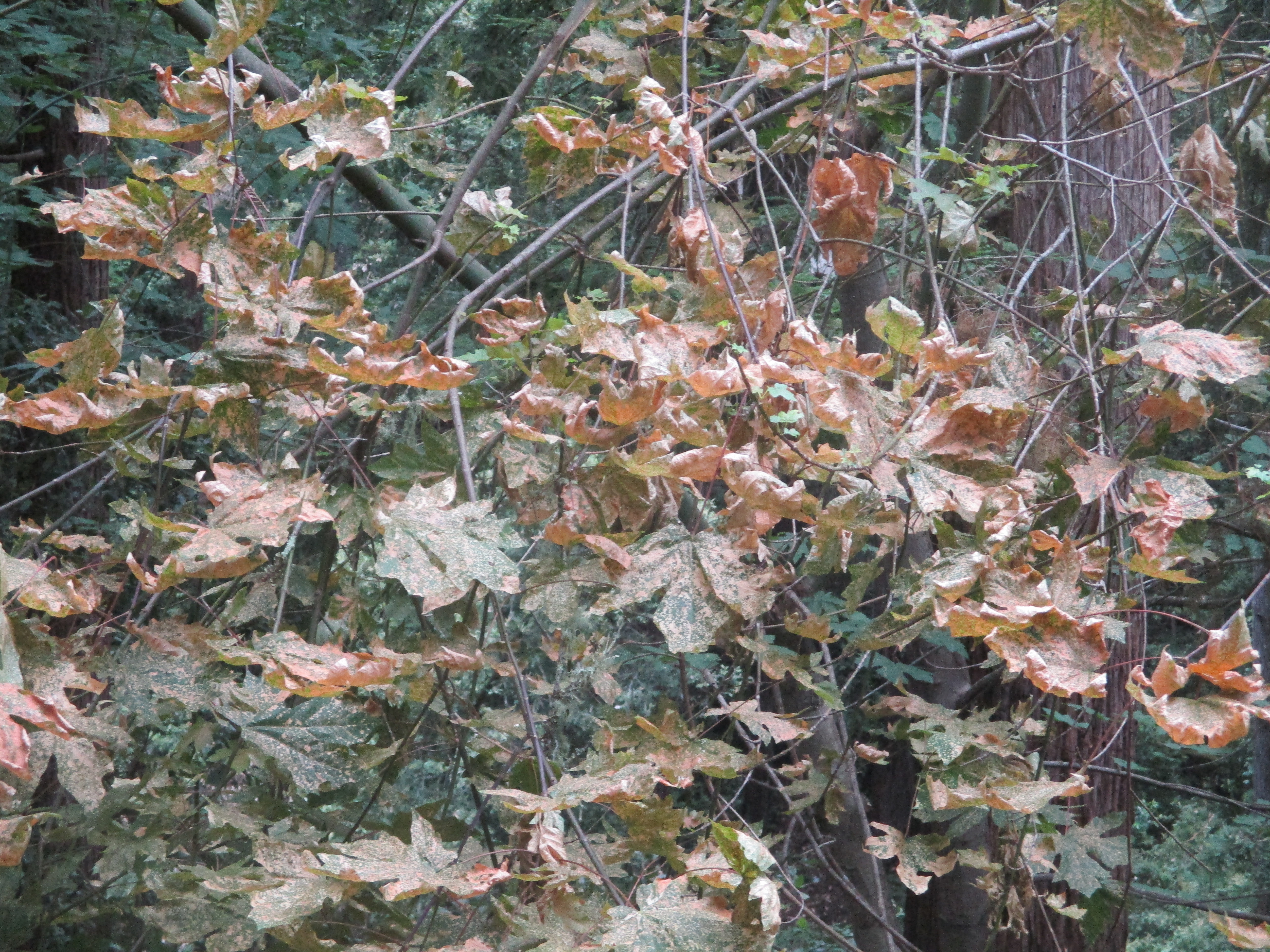
The picture above is an example of scorch on a significant scale. The bigleaf maple was formerly shaded by a big Douglas fir that fell last May, leaving the maple both severely disfigured and very exposed. Such exposure would not have been a problem it the foliage had always been so exposed. The problem was that it developed in shade, so could not adapt to the new exposure.
The exposed foliage survived for a while, but eventually succumbed to warmth…
Well, not only is this recycled article four days late, but even if it were on time, the lily of the Nile are blooming quite late this year because of the cool spring and summer weather.
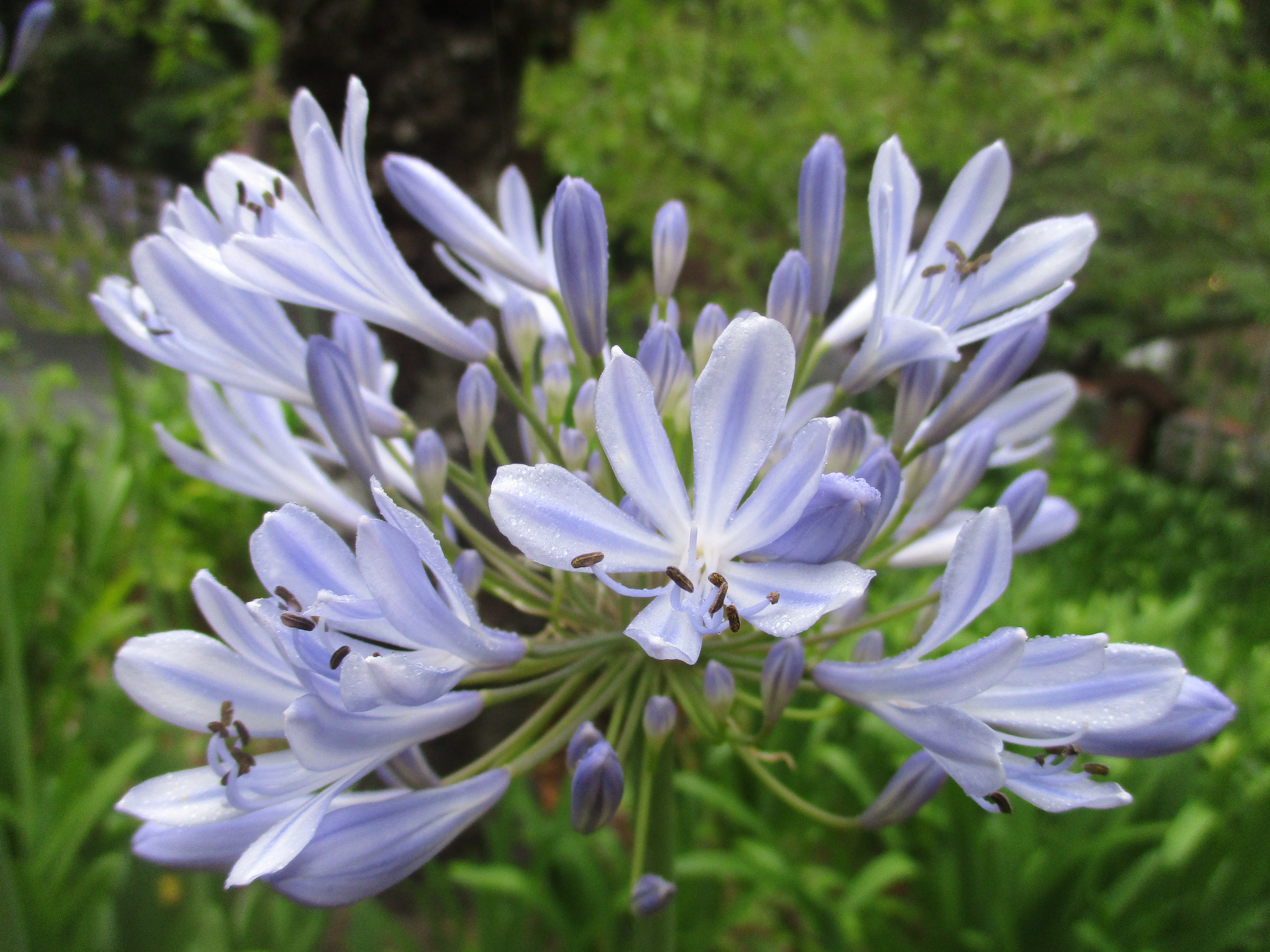
Lily of the Nile are floral Fourth of July fireworks.
Fireworks, Fourth of July parades, and the associated crowds are of course canceled for this year.
Lily of the Nile does not mind. It blooms in time for the Fourth of July regardless of what the rest of us are doing, or not doing. That is one of the two reasons why some of us know it as the ‘Fourth of July flower’. The other reason is that the nearly spherical floral trusses resemble exploding skyrocket fireworks. They are mostly blue, with some white. All that is missing is red.
The bloom in this picture is not exactly exemplary. It would have been larger, rounder, and likely more advanced in bloom if it had developed in a sunnier location. There are enough of them that we do not notice that most are somewhat diminutive. In autumn, many of the overgrown…
Since the camera died, all my pictures are taken by telephone and then sent to my email. The primary problem with this procedure is that the telephone signal here is unreliable. I actually had six timely pictures to post today, but could not get them here. Instead and again, these six are merely five random pictures that I had no other use for, as well as an illustration that I copied from a magazine. Incidentally, the illustration from a magazine is not of particularly good quality. Actually, most of what is shared on Six on Saturday is of superior quality, and more interesting.
1. My Los Angeles homeless camp made the New York Times! This is it in an illustration for an article about hedges. It is why I have never stayed at the famously eccentric Hotel del Flores, which incidentally, has less Flores. It is in the back yard of Brent’s Jungalow.
2. ‘Tropicanna Black’ Canna was ‘borrowed’ from my Los Angeles homeless camp during a previous trip late last summer. It now lives happily with five other fancy cultivars here.
3. Morea iridioides, African iris is nothing special. This and three others were split from an overgrown specimen that I planted at my mother’s garden in the early 1990s though.
4. This is where they live now. They will not look so silly as the Dodonaea viscosa grows. I should pluck bits from the biggest specimens to add to the small specimen this winter.
5. Acer platanoides, Norway maple resembles ‘Schwedleri’ Norway maple that I grew up with. I can not remember the name of this modern cultivar. I prefer the original though.
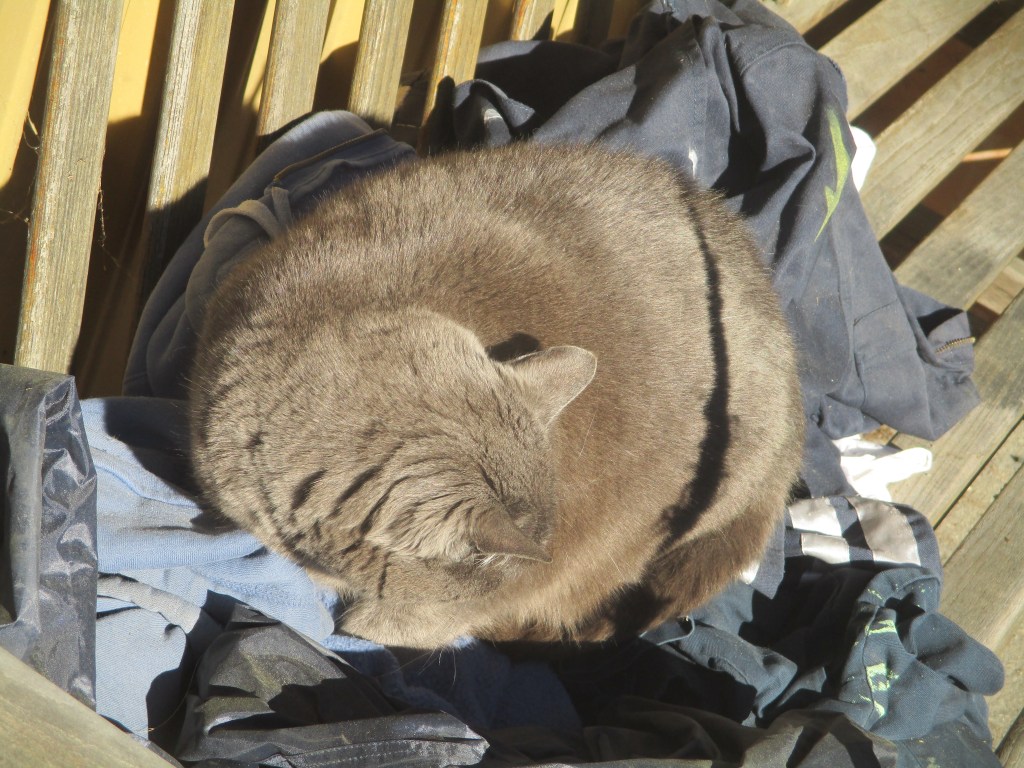
6. Rhody approves of these unplanned Six on Saturday, although this sixth older picture may have been featured earlier. He and I both know how popular any of his pictures are.

 Although I can not be certain, I believe that this is prickly lettuce.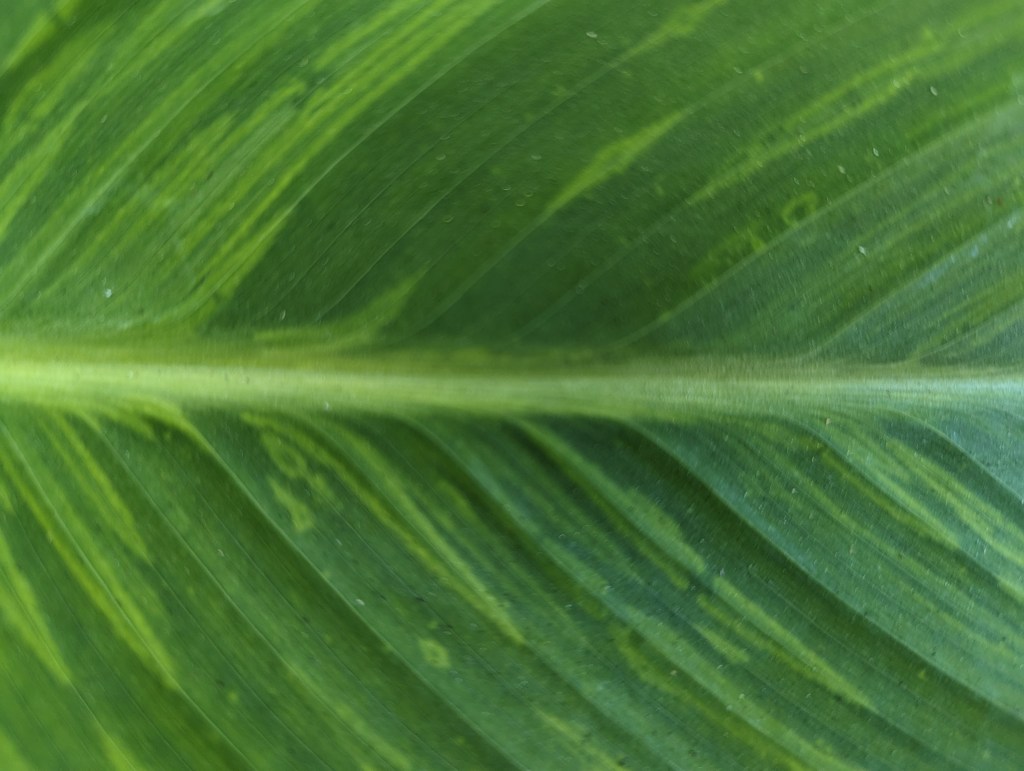


 This must be the better half.
 Out with the old, . . .
  Lily of the Nile are floral Fourth of July fireworks.


 Tony Tomeo