Horticulturists are by nature, nonconforming. I happen to find it difficult to conform to what makes us nonconforming. Trends are fleeting. Old technology that has worked for decades or centuries is still best. Although I am not totally against chemicals, I find that almost all are unnecessary for responsible home gardening. Pruning is underappreciated, and fixes many problems.
We installed canna for next summer into five pretty glazed pots with slim rims. I am not so keen on the pots, but they are pretty, and I do not expect canna to come out in one piece.
If I put a spider plant in the pot on the right, I may never get it out.
Clay pots have been around for a very long time. It is impossible to know for how long exactly. It is logical to say that they have been around long enough to evolve into the perfect shape for their function. Although the dimensions and proportions are variable, the basic design characteristics of the simplest and best engineered clay pots can not be improved on.
Clay pots are circular from above and below for a few reasons. Such a shape is easily formed on a potters’ wheel. It is more structurally sound than a form with flat sides and more corners. The space within is evenly distributed around the vertical center, without more remote corners. Although roots will circle within, there are not so many corners for them to congregate in.
Almost all California lilac that inhabit refined landscapes are cultivars of native species. Ceanothus thyrsiflorus is one of such native species that grows wild near here. It is a bit less adaptable to home gardens than cultivars are. However, it can be splendid within unrefined and wildland landscapes. New plants need irrigation only until they establish their root systems. Wild plants need none.
Wild California lilac can get taller and wider than fifteen feet. That is larger than cultivars, but with more open branch structure. Their evergreen foliage is somewhat glossy. Individual leaves are only about an inch and a half long, with prominent veins. Fluffy floral trusses that bloom in spring are about two or three inches long. Tiny individual flowers are sky blue or pale blue.
Like many chaparral species, California lilac does not respond favorably to pruning. It performs best where it can grow without disruption. Wild specimens perform well for only about ten years. They might then die suddenly. Some may survive for nearly fifteen years. They grow faster with occasional irrigation, but do not survive as long.
California native plants seem like they should be very appropriate for home gardens. In the wild, they require neither irrigation nor maintenance. They are quite satisfied with local climate and soil. Of course, gardening with natives is not so simple. Home gardens are very different from wild ecosystems.
Furthermore, wild ecosystems here are very different from wild ecosystems elsewhere. California is a very big place, with many different ecosystems. Some alpine species from the Sierra Nevada would be unhappy on the coast. Some coastal species from Del Norte County would be unhappy in the Mojave Desert. California native plants should be regionally appropriate.
Therefore, chaparral species are generally most appropriate for local chaparral climates. Many riparian species perform satisfactorily here as well, but expect more irrigation. However, appropriateness to a climate is not the same as appropriateness to a garden. Actually, many chaparral species are unappealing within home gardens. Some are difficult to domesticate.
A few species of California lilac are native here. Any of them are pleased to inhabit local home gardens. However, some grow quite large, and then die after only ten years or so. They may not last even that long with typical irrigation. Few respond favorably to pruning. They prefer to grow wild. Such big, awkward and temporary plants are undesirable within many compact and refined home gardens.
Combustibility might also be a concern for chaparral plants. Some chaparral ecosystems rely on fire for periodic renovation. In the wild, some such ecosystems may burn as frequently as every few decades. After burning, fuel begins to accumulate for the next fire. Even if not copious enough to be hazardous, such accumulation can be unkempt.
Only a few specialty nurseries provide wild California native plants. Most nurseries provide cultivars of such plants that are more adaptable to home gardens. ‘Carmel Creeper’ is a densely sprawling California lilac that gets only a few feet tall. It is commonly available. The original species can get more than fifteen feet tall, with open branch structure.
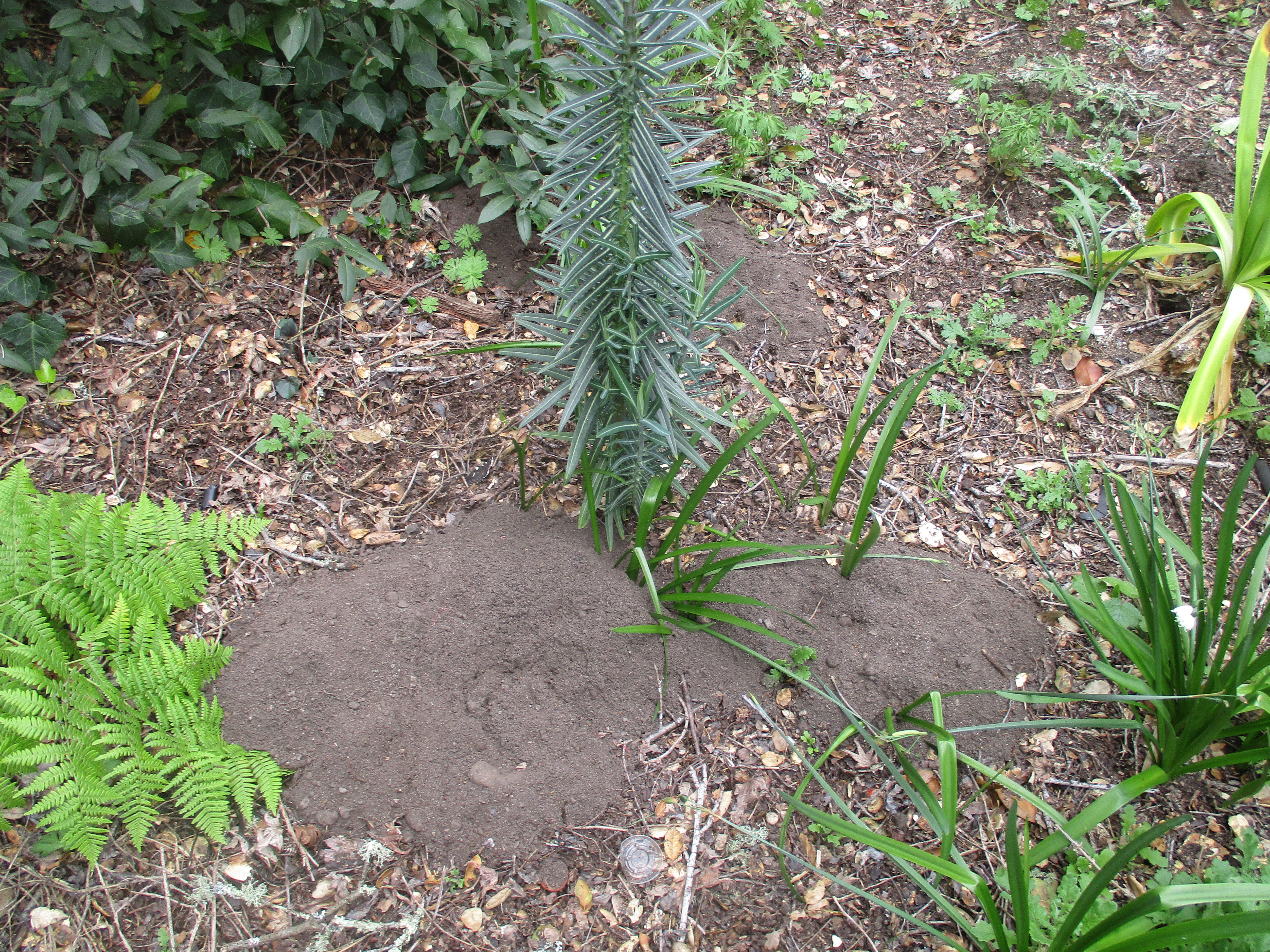
Honey badger don’t care. Neither does the gopher who did this.
Deer do not eat all plants. There are a few that are toxic to them. There are more that deer simply dislike. With a minimal bit of research, it is not difficult to find a few lists of plant species that deer are supposed to avoid. The problem with such lists though, is that deer do not read them. Only toxic plants are reliably safe from deer.
It would not be so bad if only deer were a bit more cooperative. They would be welcome in gardens if they ate only weeds that no one wants anyway. We all know that they can eat weeds, they just choose not to do so while they are in our gardens.
For that matter, gophers would not be such a problem if they ate only weeds, and aerated only soil that needs…
Shasta Lake is a large reservoir on the Sacramento River. It contains water for flood control and to generate electricity. Some of the water within is used for agricultural irrigation and, to a relatively minor degree, to supply regional municipal water.
It is a very common misconception that the volume of water within Shasta Lake is necessarily relative to ‘drought’ conditions. Low water level is supposedly indicative of a ‘drought’. High water level is supposedly indicative of ‘normal’ weather conditions, including adequate precipitation. This same misconception seems to apply to all reservoirs in California.
Well, after the rainiest winter since 1982 and 1983, Shasta Lake is still not full. The level fluctuates, so might have been full earlier, or might be full later, but regardless, is not presently full. Water must be released prior to expected rainy weather, which can still occur during spring, in order to accommodate more water to control flooding. Less water may be released as drier weather is expected. Shasta Lake could therefore be fuller or completely full for summer, when almost no rain is expected. The presently observed water level does not indicate deficiency of water any more than a potentially higher water level during summer indicates surplus.
Most of California has a chaparral climate. Some of California has a desert climate. Such climates are naturally dry through summer. It is quite normal. It does not constitute a drought. A drought is an unusually dry weather pattern. It is not so normal.
Contrary to popular belief, California is NOT in perpetual drought. Although droughts occasionally happen, they are not annual events. Dry weather that occurs annually every summer is normal climate. If there is a deficiency of water here, it is because there are nearly forty million people relying on a limited supply of water.
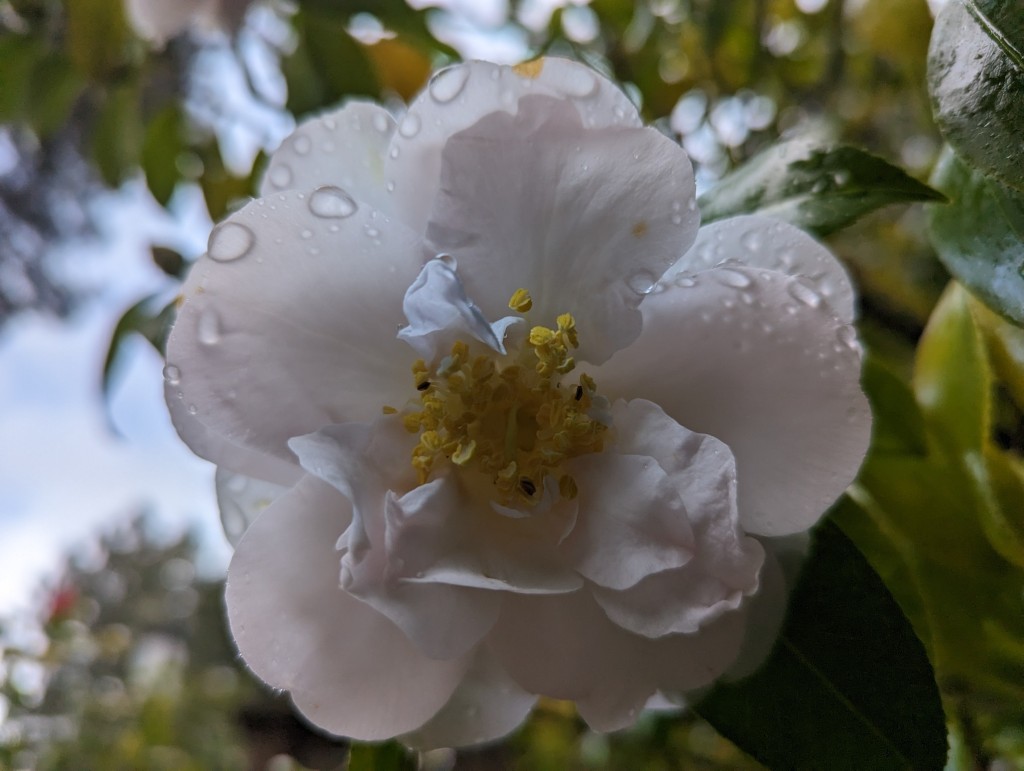
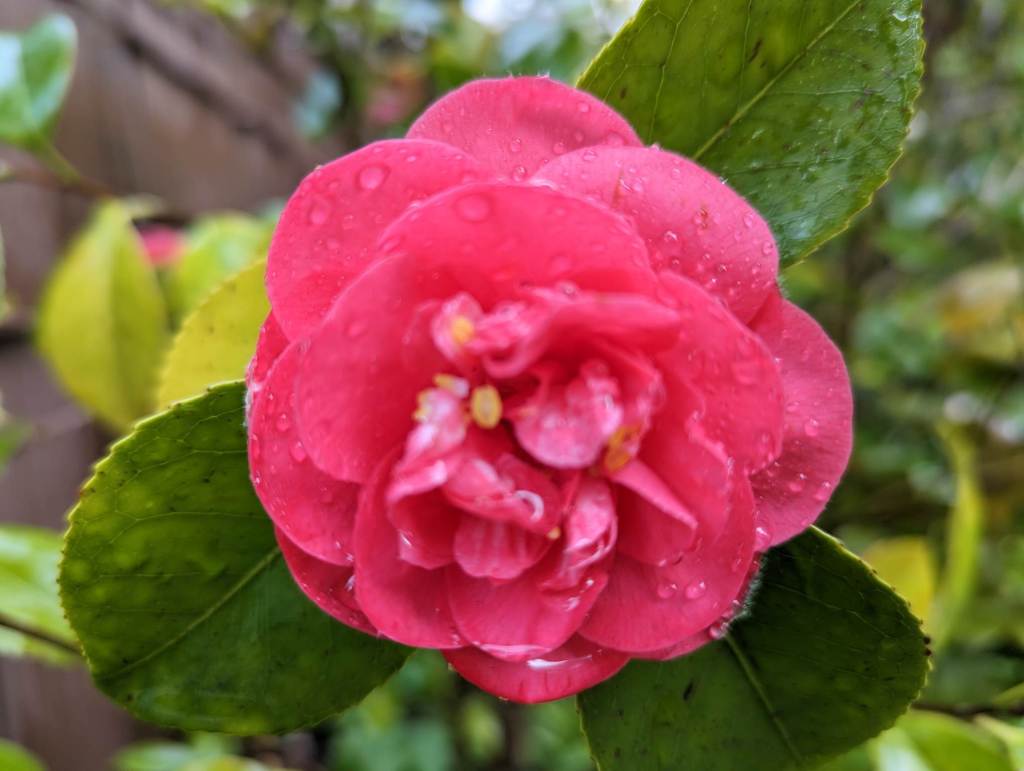
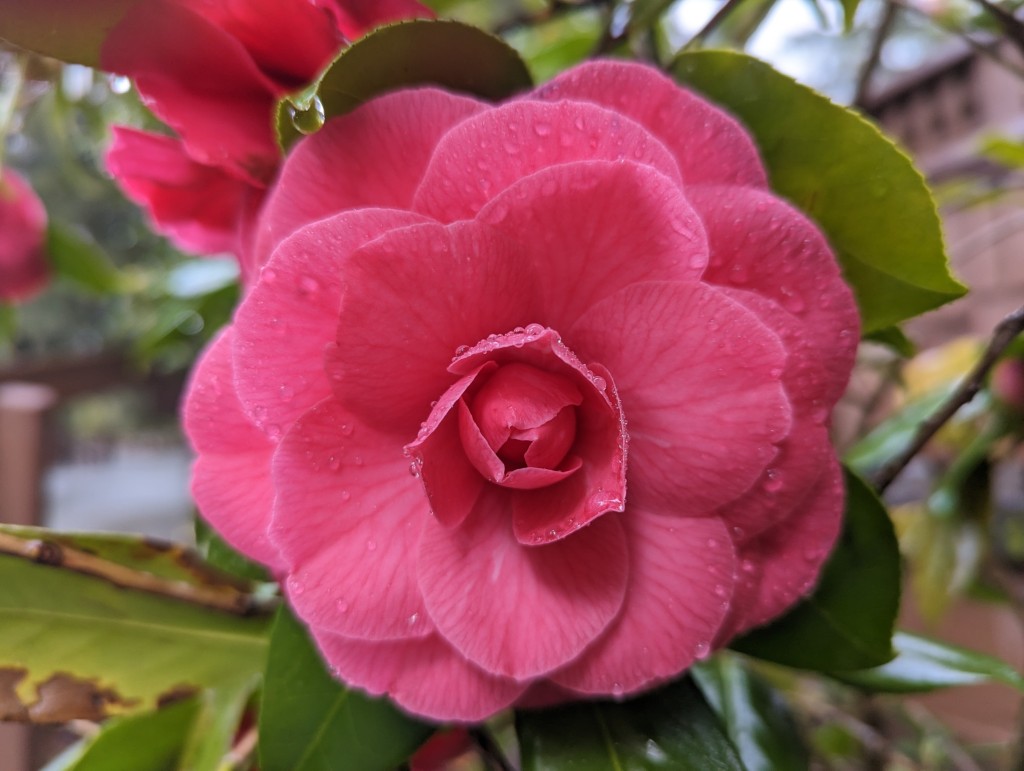
All but the first of these six are Camellia japonica. They bloomed late this year, likely as a result of the exceptionally wintry winter. Also, these pictures are more than two weeks old. They likely finished blooming by now. I do not know because I am not there. Rhody, Carson and I are still on vacation in the Pacific Northwest. As these Six on Saturday post at midnight, we will begin our trip home. Pictures of our vacation would be appropriate, but are not processed yet. Besides, I do not take many pictures. Also, although these few pictures are now outdated, I did not want to waste them. These five camellias and single flowering cherry demonstrated commendable diligence by blooming after such a wintry winter.
1. Double white flowering cherry is obviously not a Camellia japonica, but happens to be my favorite of our several flowering cherries here. The tree is in rough condition though.
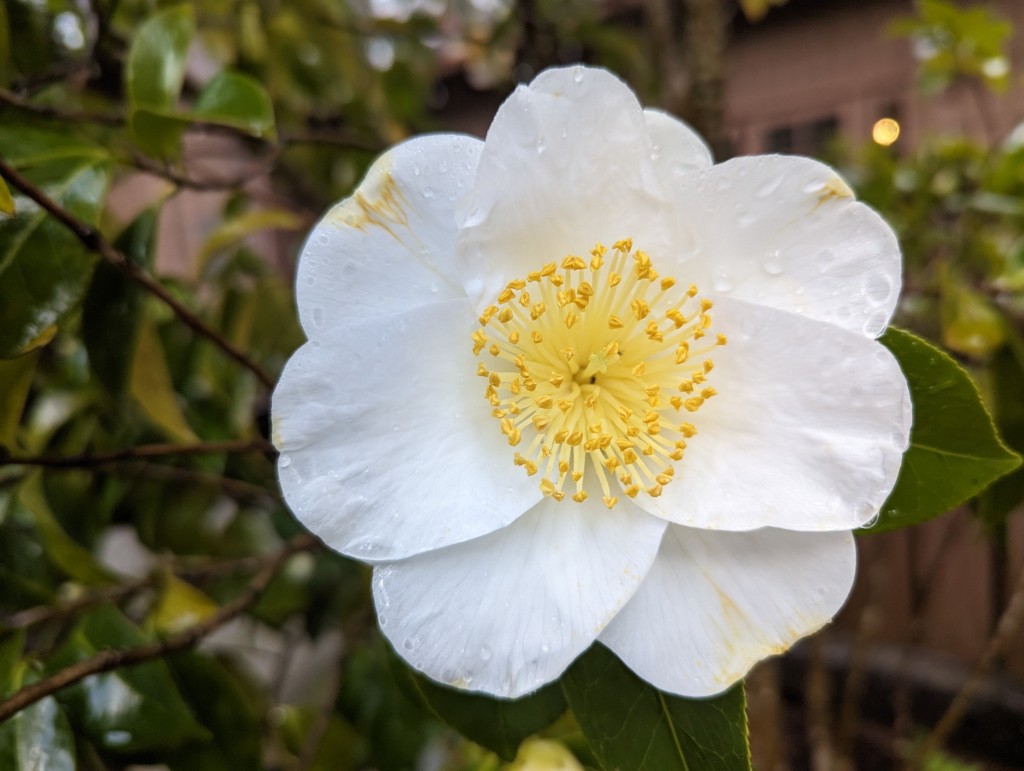
2. Frilly white camellia with a relatively modest staminate center may be the prettiest of the white camellias here, but does not look so pretty in this shaded picture after the rain.
3. Pinkish watermelon red camellia blooms with variable floral form. Some flowers seem to be of peony form. Some seem to be of anemone form. I have no idea what form this is.
4. Very pallid pink camellia seems to be almost white. Whiter white or pinker pink could be prettier, but its pastel color seems to be very appropriate to its distinctive floral form.
5. Pinkish watermelon red camellia resembles the color of #3 now, but normally blooms deeper red. Perhaps the unusually harsh weather last winter somehow altered the color.
6. Single white camellia with a prominently staminate center looks like a sunny-side-up egg. Camellia blight around the edges proliferated during the exceptionally rainy winter.
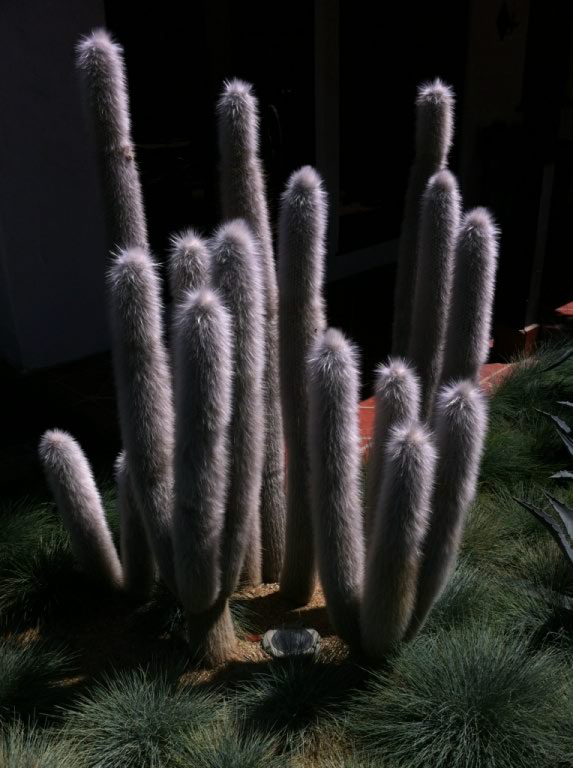
Old man cactus has developed an interesting means with which to shade itself.
The long, white hair of old man cactus, Cephalocereus senilis, that protects it from sun scald in harsh climates is what make it so striking in home gardens. However, the sharp spines concealed by the hair make it more appealing from a safe distance, like in the background behind lower perennials. The white, yellow or red flowers are rarely seen, since they only bloom on old stems that are at least a dozen years old. Such old stems are often cut down to the ground before they bloom because they get too tall and awkward, or because they eventually lose some of their hair as they get too old. There should be plenty of hairier, younger stems emerging from the basal clump to replace the older stems anyway. Individual stems rarely develop branches. Although old man cactus can get quite tall, it is typically kept less than fifteen feet tall.
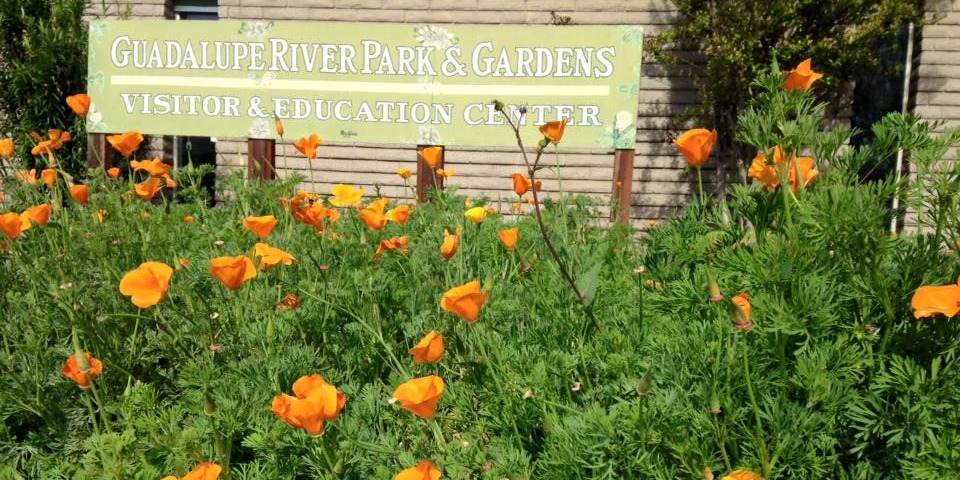
Spring in Guadalupe Gardens, a celebration of healthy living, gardening and the environment, will be here in little more than two weeks, on April 28! The 5 kilometer Fun Run that begins at 9:00 a.m., an hour before anything else, makes its way through the park and back to the main event, where there will be various health professionals to share information about healthy living, and for health screenings. Other exhibits will feature information about the environment and green technology, including presentations about solar energy and worm composting. Recyclable electronic waste can be dropped off free of charge. There will be all sorts of lectures, workshops, activities for children and even dancing and live bluegrass music.
But honestly, the main reason that most of us who read this column attend Spring in Guadalupe Gardens is all the gardening goodies! There will be an abundance of all kinds of plants from all kinds of specialty nurseries. Spring in Guadalupe Gardens has always been a great source of rare and unusual plants, as well as some of the more familiar plants, at reasonable prices.
Not only will there be plenty of plants to buy, but experts and some of the nurserymen who grew many of the plants will be available for advice on selection and cultivation. Representatives from the American Fuchsia Society, the John. E. Stowell Dahlia Society and the South Bay Heritage Rose Group will be there selling their plants, and sharing their expertise and information about membership. It is not too late in the season to select warm season vegetable plants, including heirloom varieties, from the extensive assortment that will be available.
Besides the shopping, Guadalupe River Park Conservancy and Greenwaste will be giving away one free bag of compost to each household. The San Jose Heritage Rose Garden, which is the most extensive public collection of old-world roses in the Western Hemisphere, will be in full bloom and open for tours.
Spring in Guadalupe Gardens will be from 10:00 a.m. to 3:30 p.m., in the Guadalupe River Park and Gardens between Taylor Street and Coleman Avenue in San Jose. There is no charge for admission or parking. More information can be found online at www.grpg.org or by telephoning 298 7657. Registration for the Fun Run, which begins an hour earlier at 9:00 a.m., can be arranged at www.grpg.org/FunRun.shtml.
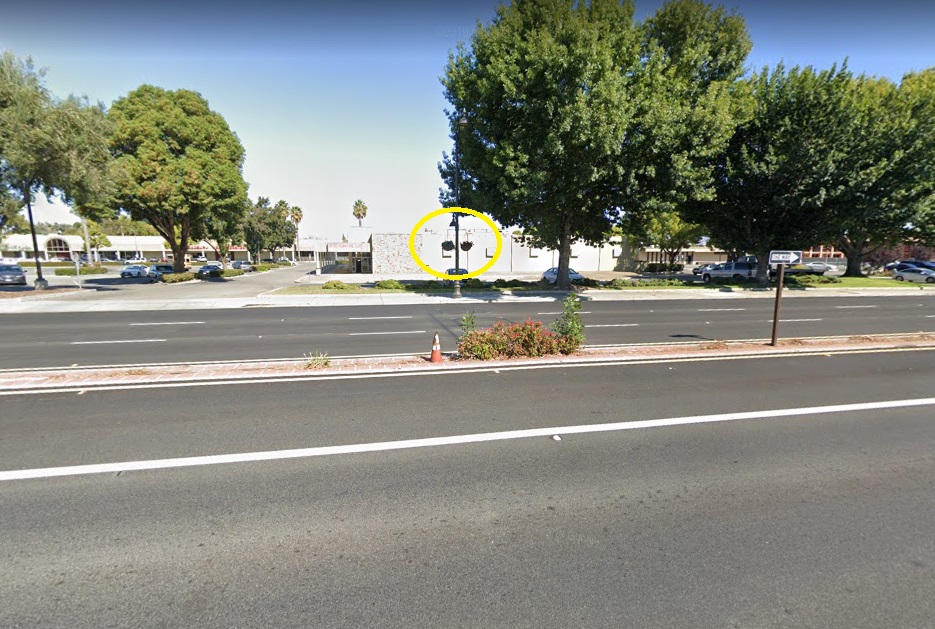
Would these hanging potted plants even be noticeable if they were not circled?
Container gardening is overrated. Perhaps not so much now as it had been while it was more of a fad a decade or so ago, but it is still overrated nonetheless. Most plants are happier in the ground than they are in confinement. They want to disperse their roots freely to where the goodies are, and not contend with the unnatural temperature fluctuations of contained medium.
There are only a few exceptions for which containment of potted plants is an advantage. Houseplants are the most obvious exceptions. Also, plants that are sensitive to frost can be relocated to sheltered situations for winter if contained. Potted orchids and other flashy bloomers can be prominently displayed while blooming, and then returned to utilitarian locations as they finish.
The justification for the hanging potted plants in the picture above escapes…
Valley oak and coast live oak are the two most magnificent oaks of California. Valley oak likely receives more notoriety. It stands taller, and defoliates to expose its sculptural form through winter. Coast live oak, Quercus agrifolia, is almost as grand within its evergreen foliage. It can grow as tall and broad as seventy-five feet, with trunks wider than ten feet.
Coast live oak is notably variable in the wild. Exposed and solitary trees can grow bigger and older than grove trees. They can live for many centuries, and hang their canopies to the ground. Grove trees may not live half as long, and tend to shed shaded lower growth. Solitary trees are likely to survive fire. Grove trees within forests are less likely to survive.
Coast live oak is more appealing in the wild than within home gardens. Regularly messy debris is mildly herbicidal to some delicate plants below. It also stains hardscapes. Trees that matured without irrigation are very susceptible to rot with new irrigation. Landscapes around such trees must therefore demand very little. Roots are very sensitive to damage.

 If I put a spider plant in the pot on the right, I may never get it out.

 Honey badger don’t care. Neither does the gopher who did this.


 Would these hanging potted plants even be noticeable if they were not circled?
 Tony Tomeo