Horticulturists are by nature, nonconforming. I happen to find it difficult to conform to what makes us nonconforming. Trends are fleeting. Old technology that has worked for decades or centuries is still best. Although I am not totally against chemicals, I find that almost all are unnecessary for responsible home gardening. Pruning is underappreciated, and fixes many problems.
Delightfully fragrant star jasmine can be either a ground cover or a climbing vine.
The strong fragrance of the inch-wide, star shaped flowers of star jasmine, Trachelospermum jasminoides, gets attention from quite a distance. Whether they bloom lightly in partial shade, or profusely enough to obscure nearly half of the foliage below, their crisp white shows up nicely against the rich waxy green of the simple two or three inch long, and inch wide leaves. Star jasmine is among the more complaisant of vines, so only climbs or creeps along the ground to about ten feet; perhaps twice as much when very mature.
Silver wattle has a weird but effective means with which to clear space for its seedlings.
Why do forests seem to be so peaceful? Perhaps it is because most of what goes on there happens in slow motion . . . very slow motion. It is difficult to see how violent and competitive the various plants are to each other as they grow. Ironically, by bringing the serenity of a forest into our own gardens, we also bring in a certain degree of the natural violence that we are not so aware of.
Vines are some of the nastiest of plants in the forest. Only a few, like bougainvillea, manage to climb to considerable heights by simply leaning harmlessly onto taller trees for support. However, vines like the various ivies and creeping fig, grip tightly to the trunks of the trees that support them. Once such a vine reaches the top of a tree, it develops its own supportive trunk while simultaneously strangling and shading out the tree that supported it.
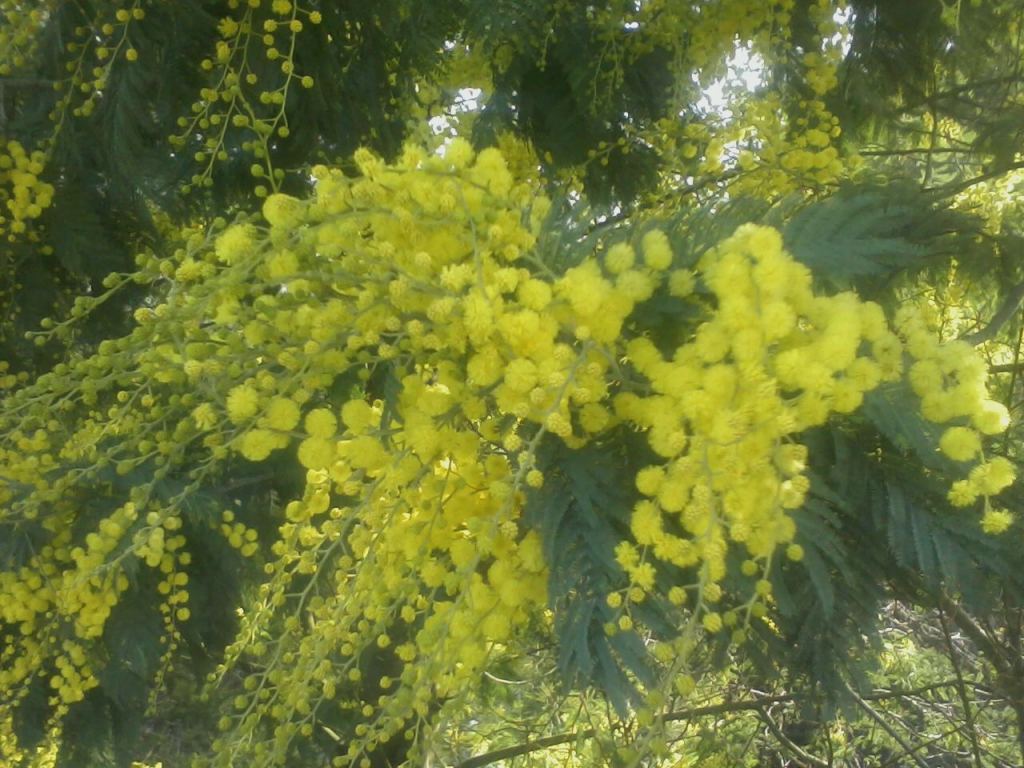
Some acacias and some willows have figured out how to take out some of their competition simply by clobbering them. For example, Acacia dealbata grows fast and big, but is innately unstable and does not live very long. Old trees invariably fall onto other trees, which clears patches of forest for their own seedlings.
All sorts of cypress, pine and walnut, as well as many eucalypti control their competition by overwhelming seedlings of other plants with foliar debris that leaches herbicidal chemicals into the surrounding soil. Their own seedlings do not seem to mind much, so are able to germinate and grow where space allows.
Monterey cypress, Monterey pine, California fan palm and Mexican fan palm use an even nastier technique, by incinerating their competition during forest fires. They retain as much of their own foliar debris as possible, so that during a forest fire, they burn hot enough to kill other plants and their seeds. Their own seeds though, survive the fire in protective fruiting structures. Monterey pine cones merely get cooked in a fire, and then open to disperse their seed as they begin to cool after a fire.
Like it or not, most gardens include at least some plants that are not as peaceful as they seem to be. Some have the potential to be downright violent. That is why is is important to know how the various plants behave and what they are capable of.
For examples, although bougainvillea can be trained up into arbors and trellises, creeping fig should not be allowed to climb into trees or any structures that might get damaged by its griping and strangling habits. Beards of dead fronds should be pruned from fan palms that are close enough to structures to be hazardous if they burn. Knowing our plants and maintaining them accordingly will promote the sort of harmony that we all want in the garden.
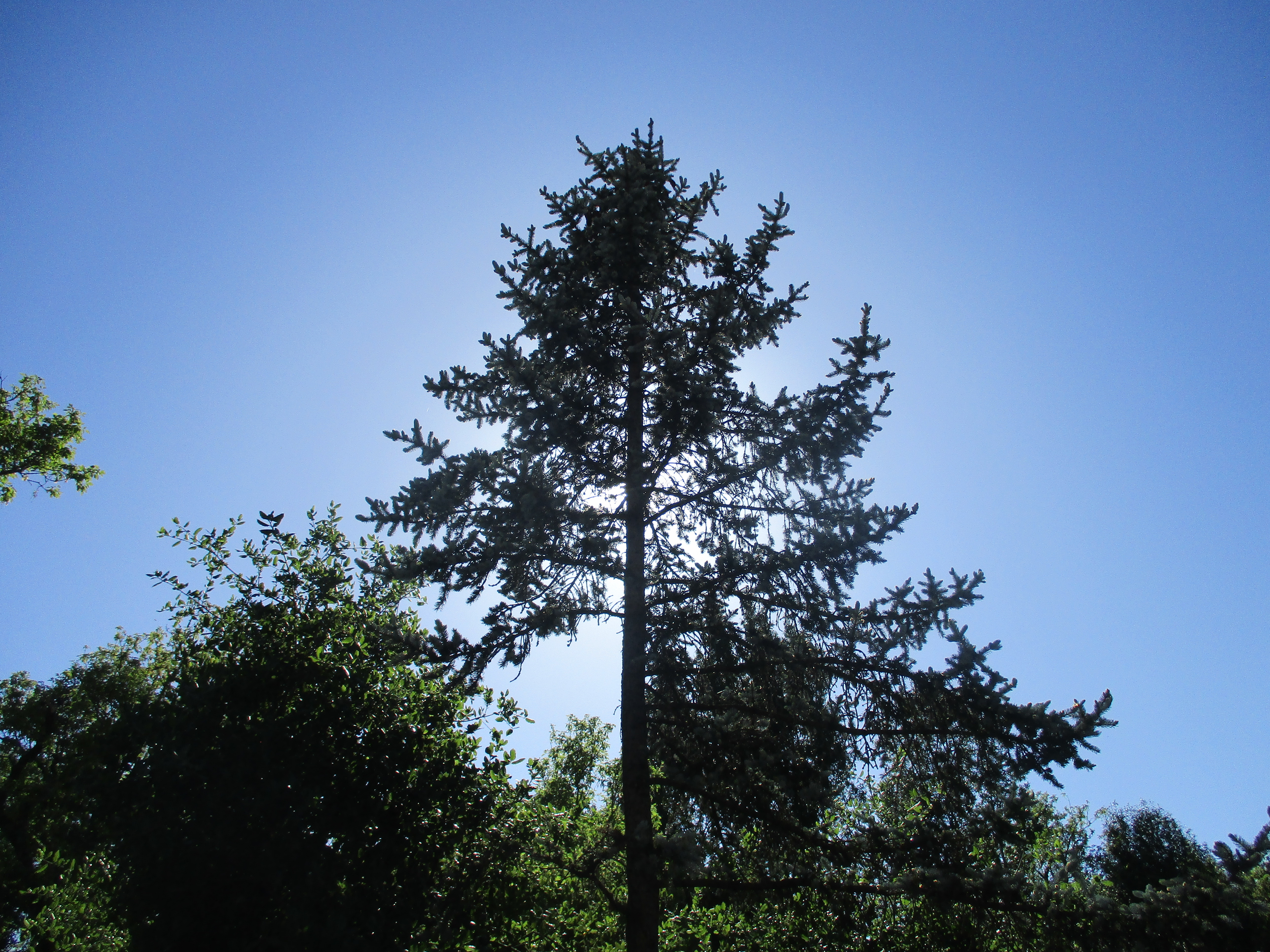
Even Charlie Brown would reject this little blue spruce.
No one wants to cut down this little blue spruce. What is worse is that no one wants anyone else to cut it down either. We all know it is ugly. We all know that it can not be salvaged. We all know that it really should relinquish its space to the healthy and well structured coast live oak next to it, in the lower left of the picture. Yet, it remains.
It was planted amongst a herd of gold junipers in about 1980 or 1981, shortly after the construction of the adjacent buildings. An abandoned irrigation system indicates that it was likely irrigated for some time afterward, although it is impossible to know for how long. Otherwise, it and the junipers were completely ignored for the last four decades.
When the vegetable garden was installed nearby, brambles, weeds and trash…
Its abundance of small but very sharp spines are both a blessing and a curse. Barberry, Berberis thunbergii, can work like vegetative barbed wire. An intruder might get through its thicket growth of limber stems once. Its unavoidable thorny nastiness will dissuade a second attempt. Unfortunately though, the same thorny nastiness is unpleasant to prune.
Ironically, most barberry is aesthetic rather than utilitarian. Popular modern cultivars are bright yellow or dark purplish red. Variegation is still rare. Most cultivars are less than six feet tall. Some are very dense and less than two feet tall. Old fashioned green barberry that gets ten feet tall is now uncommon. Autumn foliar color is exquisitely red or orange.
Barberry works splendidly as a low shorn hedge, although it defoliates through winter. Its naturally billowy, flaring or upright form is even more splendid unshorn. Congested older specimens regenerate vigorously after winter coppicing. Small ovate leaves constitute a refined foliar texture. Tiny bright red berries are rarely observable before birds find them.
There are rules to hedging. Many hedges violate some of such rules. Formal hedges are the most egregious offenders. Their uniformity, symmetry and form require compliance to relatively strict standards. Relatively relaxed standards of informal hedges or screen are standards nonetheless. Almost every hedge eventually needs maintenance of some sort.
The primary difference between formal and informal hedges is uniformity. A formal hedge involves only a single variety of a species. Spaces between individuals of such a hedge are all the same. An informal hedge can involve more than one species. Spacing may be variable, even if for a single variety. Informal pruning is less strict than formal shearing.
Both types of hedges are generally utilitarian, as well as aesthetically appealing. Many provide privacy. Many obscure undesirable scenery. Some divide gardens into distinct spaces. Size and shape is very relevant to how effectively a hedge serves its purpose. Unfortunately, most hedges are significantly larger than necessary. Many are obtrusive.
This happens because their depth, from front to back, is easy to ignore. A healthy facade of dense foliage conceals wasted space within. It can slowly expand outwardly as each subsequent shearing procedure allows. Expansion is faster above than below, which is why so many hedges are wider on top. Distended tops shade and inhibit lower growth.
Obtrusive hedges are difficult to restore. Most require removal of their appealingly dense foliar facades. Such a procedure exposes unappealingly bare stems within. This should be temporary for most hedges. They efficiently refoliate to develop new facades with less depth. Such renovation is impractical for junipers, which can not refoliate so efficiently.
Renovation of obtrusive hedges is unpleasant and temporarily unsightly. However, it can recover formerly useless space. A hedge that was six feet wide can be as effective if only a foot wide. There is no need for it to extend over usable spaces, such as walkways and patios. Other vegetation will likely appreciate better exposure to sunlight. Mild weather delayed but did not eliminate the need for seasonal maintenance of hedges.
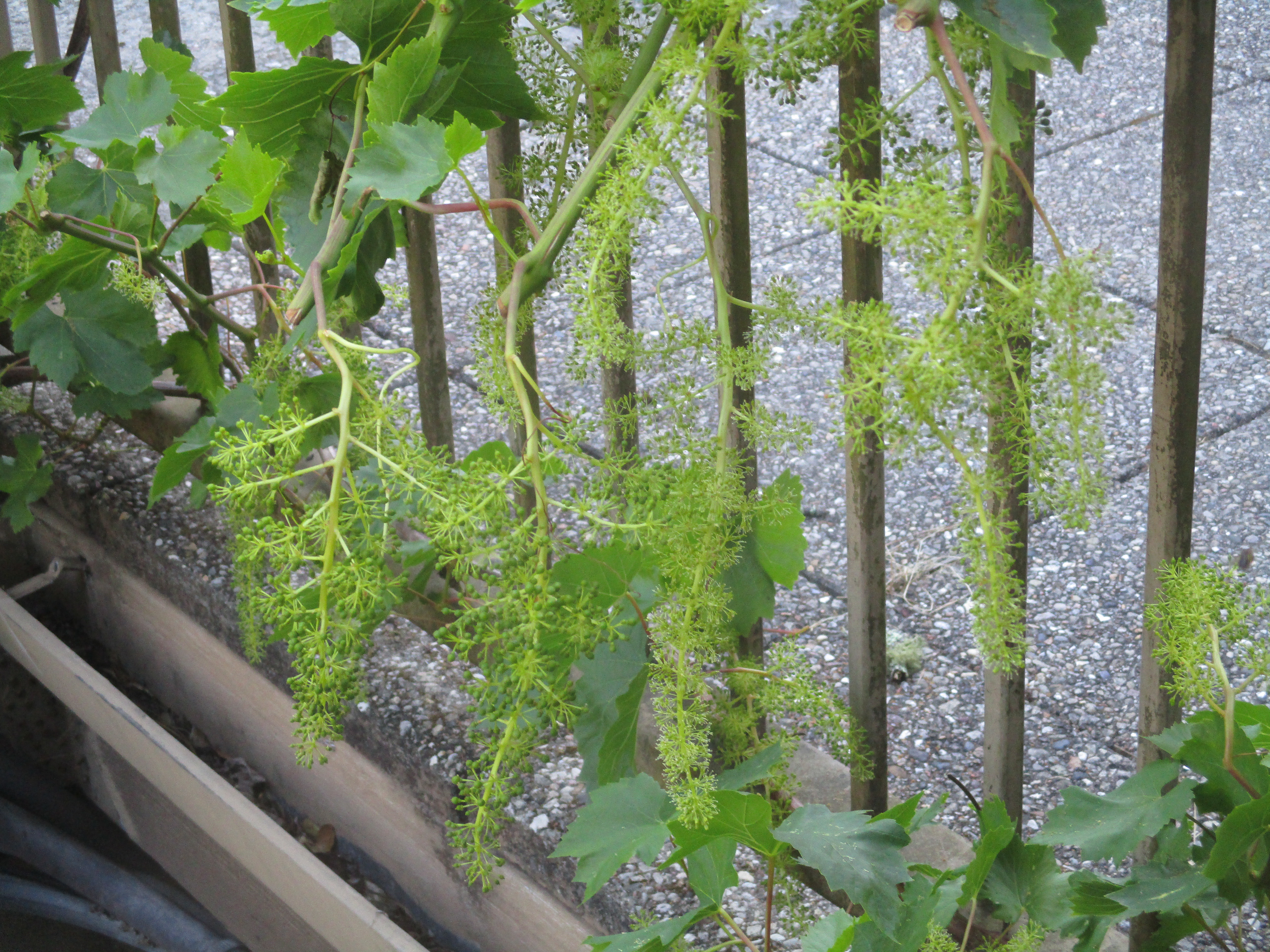
The last of the layered copies of this grape vine that I found while pruning it found homes prior to last winter. However, I found several more layered copies of an unidentified and likely feral grapevine across the creek last winter. It never ends.
My colleague down south and I have completely different gardening style. He is a renowned landscape designer, so his home garden is as elaborate as the landscapes he designs for his clients. I am primarily a farmer of horticultural commodities, so my home garden is very strictly utilitarian, with few items that are grown just because they are pretty.
My colleague’s garden is outfitted with a very well built pergola over the patio at the rear of the home. Six common Chinese wisteria were installed to climb the six supporting post and sprawl above. Their cascading spring bloom is both spectacular and alluringly fragrant.
Of course, when I saw that pergola while the wisteria were still young, I thought that it would be ideal for Dago wisteria, which most of us know simply as grapes. They climb like Chinese wisteria. They bloom…
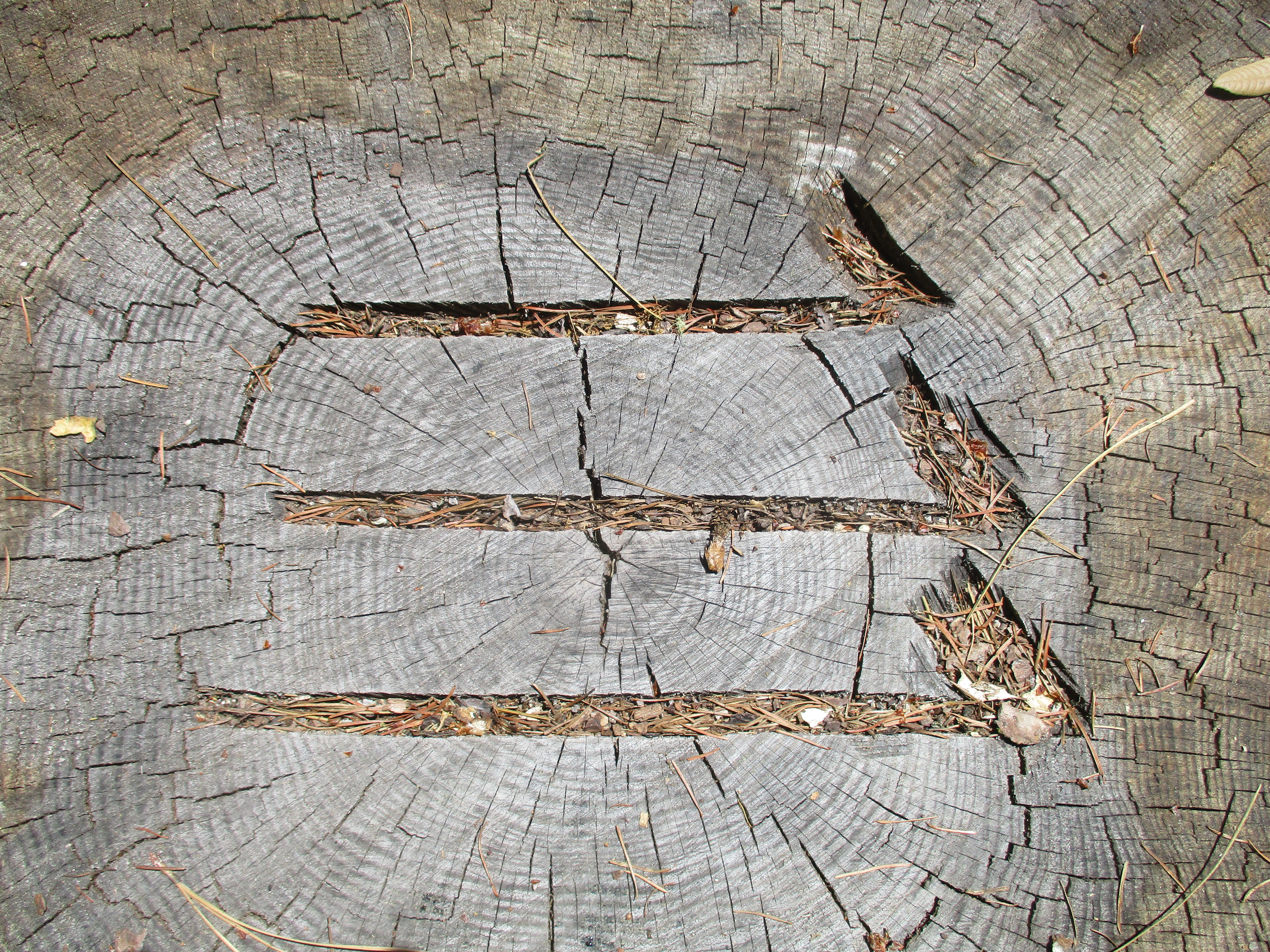
What does this mean? Is it ‘111’ deprived of the lower serifs? Is it ‘777’ with abbreviated arms? . . . ‘TTT’ lacking right arms? . . . ‘LLL’ with abbreviated legs? Is it pointing toward something important? Is a hieroglyph from an ancient language . . . or a language that has yet to be invented?! Is it like a miniature crop circle pattern cut into wood by Sasquatch or extraterrestrials?!
The arborist who left it here after cutting down the deceased ponderosa pine that formerly stood where this large stump remains might be amused to read that I contemplated it so intently. Actually, I did not really contemplate it so much. I only wrote about it as if I did because it is amusing to do so. I have no idea what this hieroglyph represents…
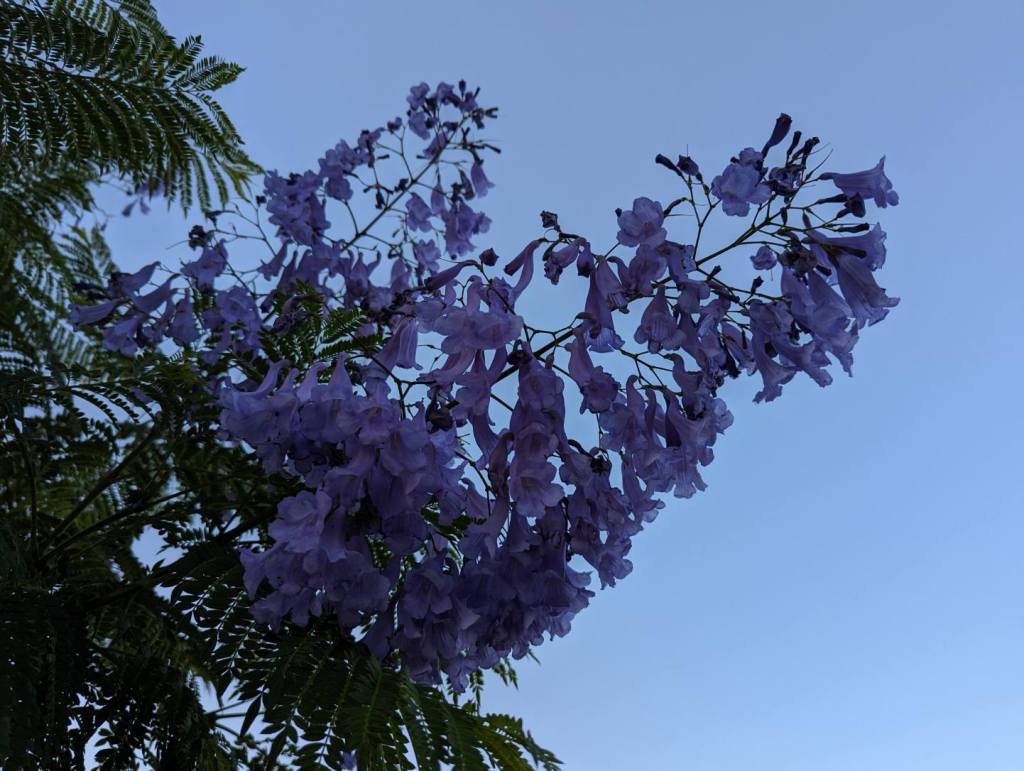
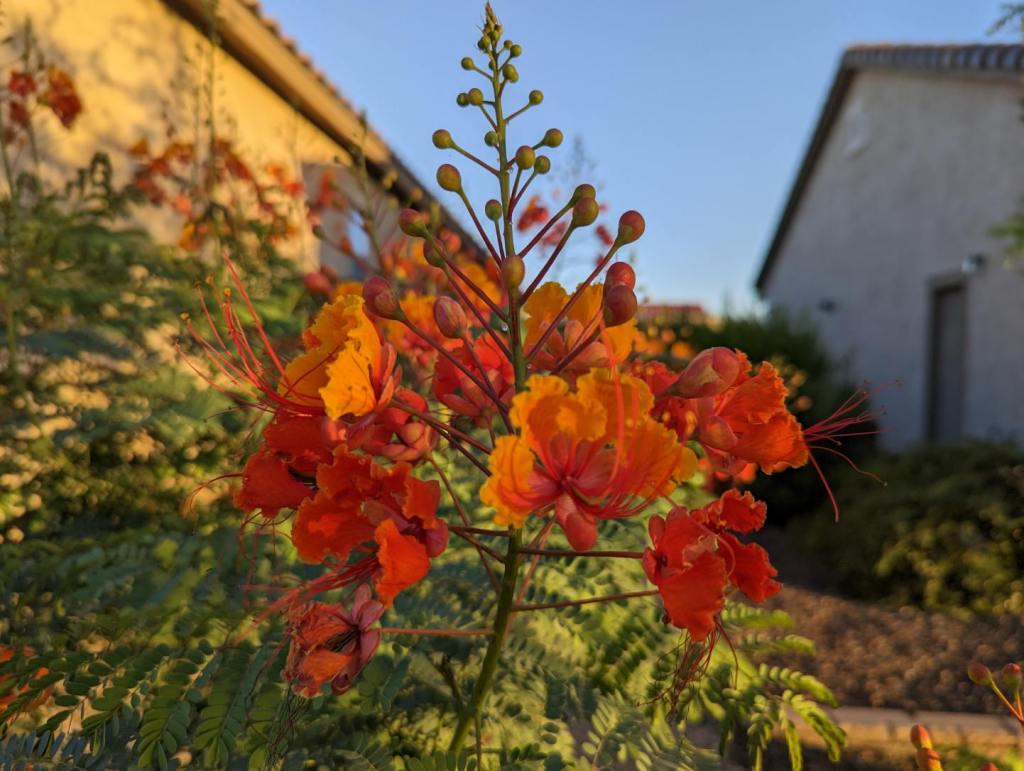
Aesculus is not native to Arizona. Buckeye is merely where I vacationed after leaving the Los Angeles region. It is northwest of Phoenix, which is also a genus that is not native to Arizona. It was a hundred degrees daily while I was there, but oddly, never to a hundred and one. My Six are from residential gardens. #2 is of the Plantaginaceae family. #1 and #6 are of the Fabaceae family. The three others are of the Bignoniaceae family. Fabaceae and Bignoniaceae seem to be popular there. #1, #4 and #5 are native species. Carnegiea gigantea, saguaro, which is the State Flower of Arizona, grows wild there. I should have taken pictures of it. The base of a minor specimen is visible to the far right of picture #1.
1. Prosopis glandulosa, honey mesquite was in need of clearance pruning. I brought the bigger stems from the pruning debris back for a colleague who will use it to smoke meat.
2. Russelia equisetiformis, firecracker plant, as the specific epithet describes, resembles equisetum, but with these red and narrowly tubular flowers that exclude interested bees.
3. Jacaranda mimosifolia, jacaranda is one of a few familiar species that I encountered. I am impressed that it is popular and seems to perform well within such an arid climate.
4. Chilopsis linearis, desert willow got my attention because of this floral color that is so unusual for trees. I had previously only encountered it while it was defoliated for winter.
5. Tecoma stans, esperanza, as well as poinciana #6 below, should bloom like this in my garden. Crazy Green Thumbs sent me seed for both last year. Both were terrible failures.
6. Caesalpinia pulcherrima, poinciana, as well as esperanza #5 above, remind me that I should have been more diligent and protective with the seed from Crazy Green Thumbs.
Sweet flag is a riparian perennial that performs well in saturated soil.
After many centuries of being grown for use in herbal medicine, sweet flag, Acorus gramineus, is still a popular evergreen perennial; but is now appreciated more for its low mounds of grassy foliage. ‘Ogon’, one of the most popular cultivars, has light yellow variegated foliage that contrasts well with deep green foliage, or brightens partially shaded spots in the garden. Individual clumps grow quickly to about eight inches tall and broad, and then spread slowly by producing more shoots. New plants are easily propagated by division. Sweet flag likes plenty of water, and does well in partially submerged pots in koi ponds, or poorly drained spots.
Wild flowers are generally worse for allergies than more colorful flowers within home gardens.
Have you ever wondered why it is sometimes difficult to know which flowers cause the worst allergies at any particular time? It is for the same reason that it can be difficult to find the flowers that produce the most fragrance. They simply do not need flashy colors to attract pollinators. Fragrant flowers instead use fragrance to attract pollinators. Flowers that are the worst for allergies simply put less effort into attracting pollinators, since they prefer to get their pollen delivered by wind. Yes, wind; it is one hundred percent natural and absolutely free.
Pollen than is designed to be dispersed by wind seems to perform just as well without it, by floating through the air, which is like ‘diet wind’. Unlike the pollen of big colorful flowers that is heavy and sticky in order to adhere to pollinators, pollen that is designed to be dispersed by wind (or diet wind) is extremely finely textured and abundant. Since it is not so directly and efficiently delivered between flowers, it gets everywhere and into everything, with the hopes that some of it, if even just a few particles, will reach the flowers that it wants to pollinate.
Pollen that primarily relies on wind for dispersion is like all those millions of bulk mailing fliers that get mailed out to everyone so that one or two or perhaps a few might reach someone who might actually be interested in getting one. Pollen from big flashy flowers are more like fancy Christmas cards that we send directly to friends, family and neighbors, but would be too expensive to send to millions of uninterested people. The problem is that like so much junk mail that clogs mailboxes, wind dispersed pollen is too abundant, which makes it a serious problem for those who are allergic to it. There is no escape when it fills the air.
The many wind pollinated plants that bloom in secret are the worst for pollen production. Unremarkable flowers of pines, cypress and cedars are among the worst. Acacias and eucalyptus are nearly as bad; but at least some have colorful bloom. Although hedged privets are not often able to bloom (because their flower structures get shorn off), privets that are allowed to grow into trees produce wicked pollen, even at a young age. Wild grasses may not seem like they would be much of a threat in urban landscapes, but their pollen travels for many miles to find victims.
Unfortunately, there is no way to control all the plants that produce objectionable pollen. We can only contend with those in our own gardens and be aware of what else is out there in the neighborhood.


 Even Charlie Brown would reject this little blue spruce.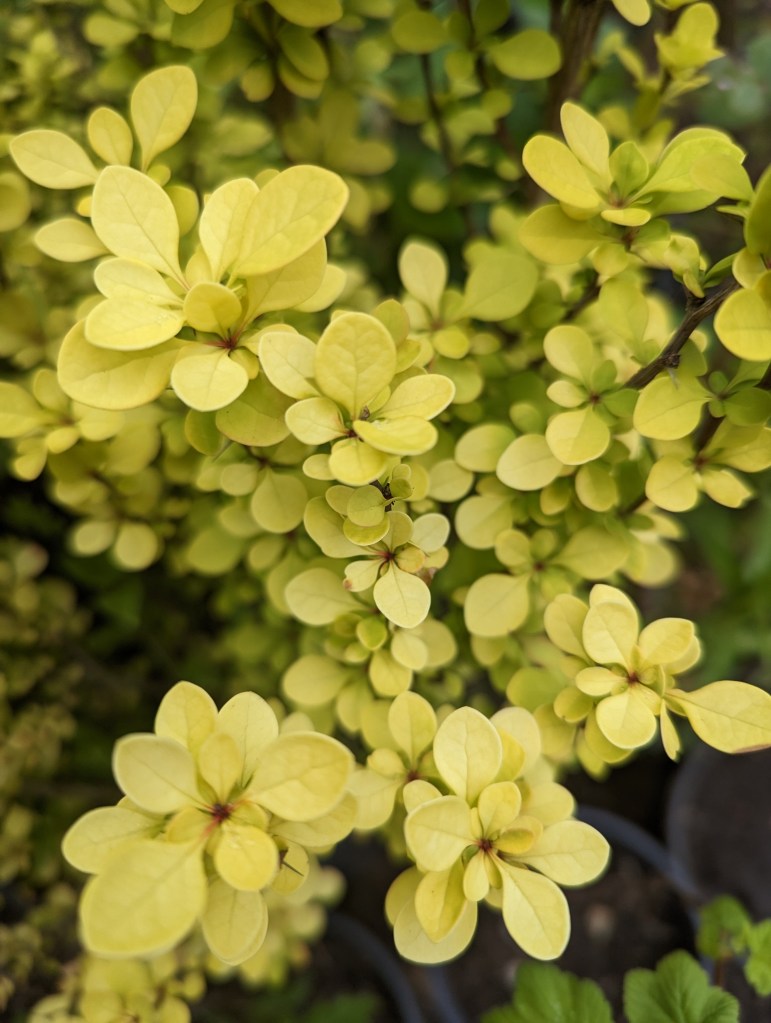

 All this bloom will eventually be fruit.
  “111”? . . . “777”? . . . “TTT”? . . . “LLL”?