Aw NUTS!

It takes quite a bit of effort to collect just a few of the native hazelnuts, and even more effort to separate them from their hard shells. A few can go a long way though. Once dried and perhaps roasted, they can be ground with finely ground coffee. One nut sufficiently flavors a pot of espresso.

tonytomeo's avatarTony Tomeo

P90602Not just any nuts, but precisely the sort that I recently discussed with a colleague, as I explained how they do not grow here. The nuts that is. The big thicket forming shrubs that are supposed to produce them not only grow here, but are a relatively common native. I just rarely see even a single nut on them. I sort of wondered how they mange to procreate with such rare seeds that invariably get taken by unconcerned rodents or birds.
They are the beaked hazelnut, Corylus cornuta. You can see why they are known as such. The elongated nut husks look like Big Bird. The very rare nuts within are quite small with good rich flavor, like hazelnut concentrate, and develop only on the biggest and most distressed old hazelnut shrubs.
However, the young and healthy hazelnut shrub that produced the nut in this picture actually produced quite a…

View original post 184 more words

Rose Lily

Three years later, this lily continues to bloom, and more abundantly.

tonytomeo's avatarTony Tomeo

P90601KWhat a delightful surprise! It happens sometimes here in the rose garden. It may not look like much, as a short stemmed single lily floret that is mostly overwhelmed by the English lavender that I held back with my boot for this picture. It should be three feet tall or so, with several florets. The surprise is that no one planted it. Well, at least no one planted it recently. This rose garden has more history than is obvious from what blooms here now.
Old pictures show that it was formerly an extravagant perennial bed, with an abundance of canna, dahlia, penstemon, pelargonium, Shasta daisy, Japanese anemone, various iris, and of course, various lilies. Lower annuals were cycled through the seasons at the front edge. Only a few roses bloomed against the low wall at the rear. Soil was likely regularly amended with compost and fertilizer. Someone put significant effort…

View original post 150 more words

Six on Saturday: Four Feral Iris?

The iris that live in my garden will likely always live in my garden. Each one has history. I got my first Iris pallida from my great grandmother’s garden at about the time I was in kindergarten. Less than twenty others have been added since then, because I am so very selective. I must be. Otherwise, my garden would fill with iris which I would be obligated to perpetuate. These four iris pictured here are at work, although #4 originated from my garden, where the two other white iris that are not pictured here live. All finished bloom a while ago, so these are old pictures.

1. Dicentra formosa, which I believe is Pacific bleeding heart, blooms at about the same time as the bearded iris. Some of the colonies are quite broad under the redwood forests.

2. Cestrum fasciculatum Newellii ‘Ruby Clusters’ could do without either its first variety name or its subsequent cultivar name. I did not select it, but am getting to appreciate it.

3. Yellow iris appeared next to a debris dump many years ago. It could have grown from a scrap, or could be feral. It seems wimpy. It got canned, but should have been relocated.

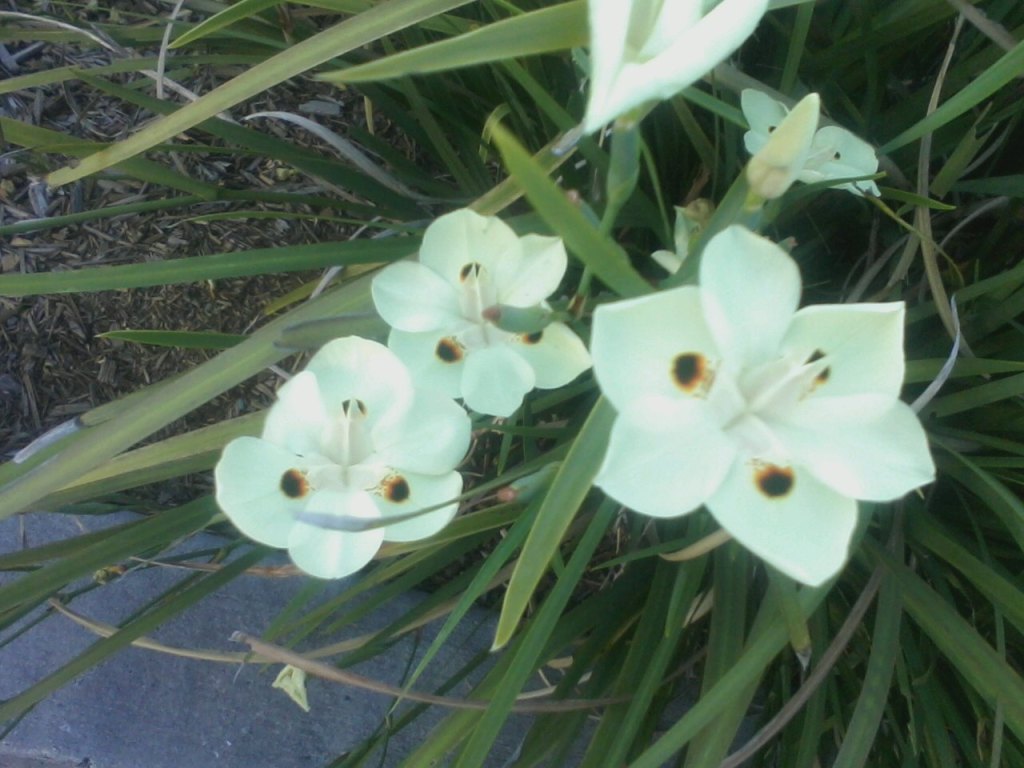
4. White iris seems prettier at night. During the day, it seems to be slightly grayish, with oddly pale yellow beards. I believe that it is feral. Two other cultivars are perfectly white.

5. Blue iris, with both dark and light blue, could actually be a cultivar. It is impossible to be certain. The flowers are simple and not ruffled. The stems are tall, but a bit too lanky.

6. White and blue iris, of these four, is the most likely to be a cultivar. Lanky stems could be a result of neglect. I hastily interred the rhizomes last autumn just to keep them alive.

This is the link for Six on Saturday, for anyone else who would like to participate: https://thepropagatorblog.wordpress.com/2017/09/18/six-on-saturday-a-participant-guide/

Pittosporum eugenioides

Pittosporum eugenioides leaves have distinctively wavy margins.

Large shorn hedges or informal screens are the more popular functions of Pittosporum eugenioides. It works like a modern and more relaxed option to privet. What few garden enthusiasts know is that it can alternatively be allowed grow into a small tree, either as a standard (on a single trunk) or with multiple trunks. It grows rather efficiently to more than twenty feet tall and about half as broad while young, and as it matures, can eventually get about thirty feet tall and broad.

The glossy leaves have appealingly wavy margins and distinctively pale midribs. The slightly fragrant flowers are only pale yellow, and are not abundant among young trees. Big old trees often bloom enough in autumn to be pleasantly fragrant. Stems and foliage are lemony fragrant when pruned or shorn. However, the common name of ‘lemonwood’ (or tarata) is not so common locally for Pittosporum eugenioides.

Can’t See The Forest For The Trees

Even small trees can become obtrusive.

Foliage is often employed to obscure views. Evergreen shrubbery or trees can provide privacy in the garden or for windows. It can just as easily hide unappealing buildings in the distance, or driveways where cars get parked. Unfortunately, too much foliage often obscures desirable views or interferes with lighting.

There are all sorts of reasons to control greenery that might otherwise get overgrown. Overgrown shrubbery and trees not only hides the architectural appeal of a home, but can also be a security risk by concealing windows and doors that burglars might break into, and by obscuring security lighting and street lights. Too much shade prevents lower plants from getting the sunlight they need.

The best way to limit overgrowth is by selecting plants that stay proportionate to their intended functions. For example, shrubbery below windows should naturally stay lower than the lower windowsills. Shade trees for areas where views should stay open should have high branch structure and relatively bare trunks. Well, most of know that this does not always happen.

The options are limited for greenery that wants to get larger than it should. Obviously, it can be pruned regularly; but this may be more work than it is worth, and can cause disfigurement Some plants can be pruned less frequently if pruned more severely, but will be bare and potentially unsightly for quite a bit of time. Overgrown plants can alternatively be removed and replaced with plants that are more proportionate to intended functions.

An option that is not often considered is an ‘updo’. Trees and large shrubbery that are obtrusive to views or lighting can be pruned up and over what they are being obtrusive to. For example, lower growth of large pittosporums that is covering low windows can be pruned away to expose bare inner trunks supporting higher growth. The lower trunks can be appealingly sculptural without being too concealing. This works nicely for large shrubbery like viburnum, bottlebrush, oleander, photinia and pineapple guava.

Street trees that interfere with street lights (or marquis on storefronts) may need to be updo pruned a few times for adequate clearance, but these procedures are much less work, are less disfiguring to the affected trees, and produce more appealing results than keeping trees down.

Horridculture – Unpruned Fruit Trees

The majority of fruit trees require intensive and specialized maintenance.

tonytomeo's avatarTony Tomeo

P90529They do not come with instructions for their maintenance. Deciduous fruit trees, particularly the stone fruit trees (such as cherry, plum, prune, apricot nectarine and peach) and pomme fruit trees (such as apple and pear), can be procured as easily as nasturtium seed or petunias. Whether bare-root in winter or canned (potted), they very often get planted into gardens where they are expected to produce their fruit as easily as daisies bloom.
Instructions for planting that come with bare root stock are useful for getting those particular trees started, but mention nothing about how even brand new trees need to be pruned after installation, and will need specialized pruning annually every winter thereafter. The same applies to rose, raspberry, blackberry (all varieties), grape, and to a lesser extent, fig, pomegranate, persimmon and several other fruit producing trees, vines and shrubs.
The problem with the stone fruit and pomme fruit trees…

View original post 149 more words

Red Willow

Red willow is a riparian native.

Of the few native species that share the same designation of ‘red willow’, Salix lasiandra, is likely the most common locally. However, it has a few other common names, including shining willow and Pacific willow. For those acquainted with it, recognition is easier than nomenclature. It is not a problem though, since red willow is rarely an intentional choice.

Red willows, including less common species, grow wild in local riparian situations. They sometimes sneak into home gardens, particularly if irrigation is generous. Their rampant growth is susceptible to spontaneous limb failure. Pruning can compensate for structural deficiency of young trees. However, trunks typically succumb to decay within thirty years.

Mature trees are mostly less than thirty feet tall, typically with low branches, and possibly with a few elegant trunks. The gray or light brown bark is finely furrowed. The deciduous foliage has a slight sheen, and then turns brownish yellow prior to autumn defoliation. Its narrow leaves are about three inches long. Twigs are yellowish or green rather than red, as it implies.

Nature Is Not Naturally Accommodating

Many trees naturally exhibit irregular form.

Gardening is quite unnatural. It involves unnatural cultivation of mostly unnaturally exotic (nonnative) species of plants. Irrigation delivers more water than seasonal rain provides. Fertilizers contribute more nutrients than endemic soils provide. Pesticides, if necessary, inhibit proliferation of pathogens. Nature simply could not accommodate such demands.

Not only is gardening unnatural, but it also interferes with established ecosystems. Many aggressively invasive plants were formerly desirable exotic plants that naturalized. Many pathogens arrived with exotic plants. Several naturalized plants have potential to distract native pollinators from native plants that rely on their pollination. It is an ecological mess.

Nonetheless, it works. Gardening within the constraints of nature would be unproductive. Most residents of California inhabit chaparral or desert climates that originally sustained limited vegetation. Such limited vegetation sustained a very limited indigenous populace within relatively vast areas. Modern residential parcels would be completely inadequate.

That is the justification for gardening, whether for sustenance, or merely to beautify home environments. Unnatural breeding continues to improve performance of many useful and appealing plants. Unnatural horticultural techniques generate more desirable vegetation within confinement of urban gardens than would naturally inhabit a few acres in the wild.

Nature remains relevant though. All plants originated within nature somewhere. Besides their basic requirements, exotic plants prefer environmental conditions that are similar to those of their natural origin. Some tropical plants crave more warmth and humidity. Some plants prefer more winter chill. Most popular exotic plants rely on supplemental irrigation.

Physical characteristics of many plants necessitate special accommodations also. Roots of plants that naturally compete in dense jungles are likely to damage pavement. Without adequate pruning, native plants that naturally exploit burn cycles can become perilously combustible. Many vines naturally try to overwhelm nearby vegetation and infrastructure.

Campground II

I sometimes inspect weirdly fallen trees for clients, but did not expect to observe such a weird subject right here.

tonytomeo's avatarTony Tomeo

P90626This is a formerly unplanned sequel to the article ‘Campground‘ from last Sunday. That article described my concern for any of the homeless who might camp on the banks of an adjacent creek, below innately unstable and structurally deficient riparian trees. Just a few minutes after the article posted at midnight, the biggest and most deteriorated box elder tree in the area of concern coincidentally fell! No one was there at the time to be hurt.
The tree that fell was located just a few yards to the right of those in the picture of the previous article. It happened to be the only tree that was inside the fence. Therefore, as it fell inward, it did not damage the fence. The trailer that it landed on is for heavy tractors, so was undamaged. Only the top few timbers of a pile of lumber that it landed on…

View original post 152 more words

Garter Snake

Ah, the weird surprises of gardening.

tonytomeo's avatarTony Tomeo

P90525KThis little critter surprised me at work last week. Even though I knew it to be harmless, my instinctual response was to get away from it fast. I have encountered enough rattlesnakes to know better than to take the time to identify a snake before getting some distance from it. Even after identifying a snake as a harmless garter snake, I still prefer to avoid it as it leaves. This one was in no hurry, so got picked up with a rake and set safely aside.
Between high school and college, I took a summer job for a (primarily) retail nursery in Miramar on the coast of San Mateo County. At this job, I sometime went with the maintenance crew to work in a few home gardens. At one such job, just overlooking the beach in Montara, I needed to mow an overgrown lawn. Rather than mow back and forth…

View original post 160 more words