Red Passion Flower Vine

Red is simpler but more colorful.

The mostly white and blue common passion flower likely remains the most popular. After all, it is the weirdest. Elaborate and disproportionate floral parts imply that it is of another planet. Red passion flower, Passiflora racemosa, although less peculiar, is perhaps a bit more colorful. Its brick red flowers bloom randomly for as long as weather remains warm. 

Flowers are about three or four inches wide. They develop in open racemes that seem to spread out somewhat evenly over the exterior of their foliage. Bloom is not profuse, but is somewhat continuous until autumn. Newer flowers replace older flowers within the same racemes. Leaves are as wide as their flowers, with three blunt lobes and axillary tendrils. 

The lushly evergreen foliage can get shabby through winter, or completely ruined by just mild frost. It regenerates vigorously though. Aggressive pruning as winter finishes delays bloom, but promotes vigorous growth. Vines can potentially reach more than twenty feet. Fruit is rare without manual pollination. Fruit flavor can be bland without tropical warmth.

Vines Are Aggressive Social Climbers

English ivy can cling to anything.

Regardless of how appealing many of them are in home gardens and landscapes, vines are flagrantly exploitative. They rely on shrubbery, trees or anything they can climb on for support. As they reach the tops of their supports, they extend their foliar canopies above. Vines have no reservations about overwhelming and maybe killing their own supporters. 

Vines climb with clinging roots, twining stems, tendrils, twining leaves, or even thorns or spines. Some vines are annuals or perennials. The most aggressive or destructive sorts are woody plants. Some creep along the ground while young, and then climb when they find support. Some mature to support their own weight as they lose their original support. 

English ivy and Algerian ivy, in their juvenile forms, can be practical ground cover plants. However, when they encounter shrubbery, trees or buildings, they become clinging vines that can overwhelm their supports, and ruin infrastructure. As they mature, clinging vines evolve into shrubbier and obtrusively bulky adult growth that blooms and produces seed. 

Boston ivy, which incidentally is not actually ivy, is more practical as a clinging vine than the other ivies. It does not grow as ground cover anyway. Nor does it develop bulky adult growth. However, it also has limitations. Because it attaches to its supports with clinging tendrils, it is only practical for surfaces that it can not wreck, such as reinforced concrete.

Bougainvillea is a delightful and shrubby vine. It neither clings to surfaces nor grips onto support by twining. It simply generates long and vigorous canes that eventually lie down onto its surroundings. Long thorns help to anchor these canes in place. Canes should be satisfied with trellises, but sometimes mingle with shrubbery or trees, or spill over fences. 

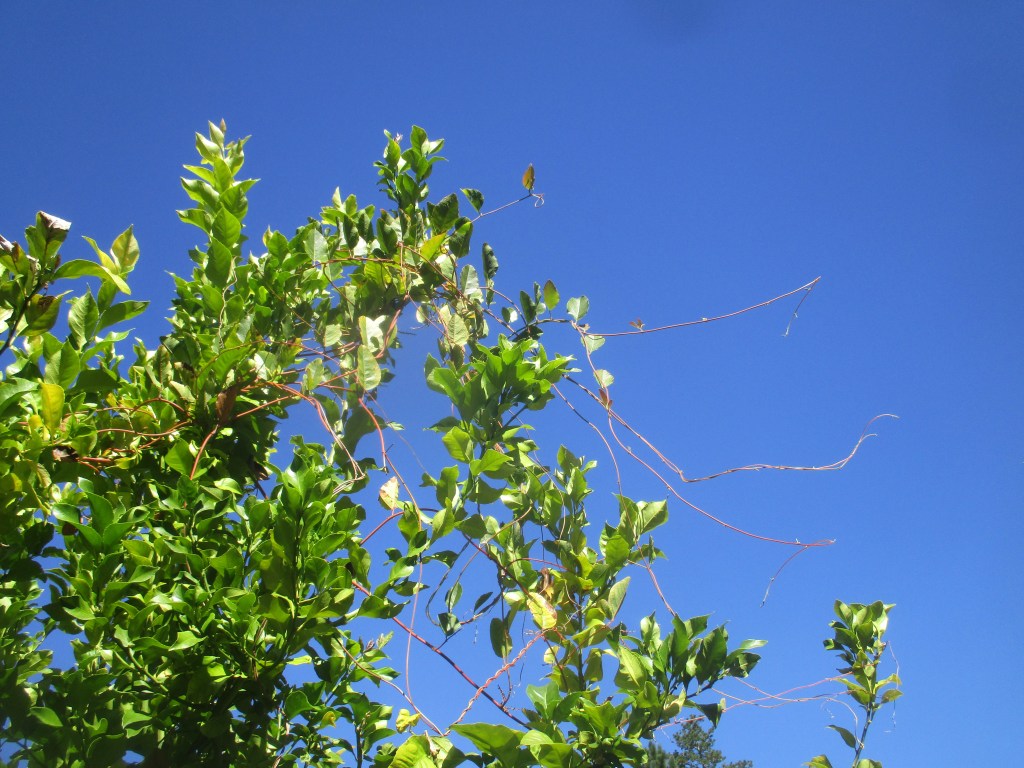
Carolina jessamine, lilac vine and mandevilla climb with twining stems, but are relatively docile. Star jasmine, which performs well both as a ground cover plant and as a climbing vine, can crush flimsy lattice with its twining vines. Wisteria might crush substantial trellis beams. Passion flower climbs with wiry tendrils, but can be overwhelmingly voluminous. 

The Other Rhodies

While in the Pacific Northwest, I noticed that these are proportionately less popular than they are here. There are a only few more of them, while there are MANY more of the more common evergreen rhododendrons.

tonytomeo's avatarTony Tomeo

P90504KThere are countless species and cultivars of rhododendrons. Some have been in cultivation for centuries. Their big bold blooms are spectacular against a backdrop of their dark evergreen foliage. They prefer shelters spots, and some are happy to bloom in places that are too cool and too shaded for other flowers to bloom so well. They are so impressive that no one notices that they lack fragrance.

There is certainly a lot of variety among rhododendrons. Some are low mounding shrubs, while other can grow as small trees with open branch structure. Flowers can be white, pink, red, purple, blue or maybe even yellow or orange. Most flowers have some sort of pattern within the main color, but some are solid colors. Nonetheless, regardless of all the variety, we think that we can recognize a rhododendron when we see one.

Then there is Rhododendron occidentale, the Western azalea. The…

View original post 151 more words

Utilitarian Landscape

Is this a bit ‘too’ utilitarian, or just amusingly tacky?

tonytomeo's avatarTony Tomeo

P90505I am no designer. I am merely a horticulturist. I grow things, and I know how things should be grown in landscape situations.

My colleague Brent Green is a landscape designer, as well as a horticulturist. He knows how things should be grown in landscape situations too, but more importantly, he knows how to assemble the landscapes that they grow in. He creates the sort of landscapes that most people think that all horticulturists strive for. (A few pictures of his home garden can be found in a former article, as well as another similar article that it links to: https://tonytomeo.com/2019/04/06/six-on-saturday-brents-garden/ .)

Brent and I have two completely different sets of standards for landscape design, to say the least. His ideal landscapes are very lush and inviting, with abundant color and fragrance. Mine are very simple and structured, with abundant fruits and vegetables. He strives to bring the ambiance of…

View original post 150 more words

Six on Saturday: Best For Last

Seed are germinating; and cuttings are rooting. I try to finish my propagation before the end of winter. Some seed appreciate the last bit of chill to maintain their schedule. Some cuttings prefer to start their rooting process while still dormant, so that they are ready to grow by spring. The last and most important of these six pictures is irrelevant to cuttings and seed though. Only the names of those involved are relevant to horticulture; and half of that relevance is merely, although amusingly, coincidental. It will be interesting to see how many can answer the question presented with the last picture. It was difficult to get a reasonably clear picture, and after all the effort, the clarity may not help much.

1. Esperanza seed from Crazy Green Thumbs is finally germinating! Poinciana seed that came with them are still inactive. My rush to sow them prior to spring seems unfounded.

2. Poinciana seed of another kind and from another source is germinating though. Brent thought that I got royal poinciana seed. Rather than disappoint, I procured a few online.

3. Canna seed germination is a surprise. These seed were discarded runts from pods that were still green when deadheaded. I saw them growing from the trash and canned them.

4. Red passion flower vine was a runt also. None of a few other cuttings that got plugged properly took root. This one was too dinky, so was left in its jar of water, where it rooted.

5. Angel’s trumpet cuttings are growing like the red passion flower cuttings should have. They were scraps from pruned out frost damage. Many appeared dead prior to plugging.

6. Lily and Rhody are nearly indistinguishable as they frolic. Their genders are opposite, and their faces are distinct, but they scamper too fast to discern. Can you identify them?

This is the link for Six on Saturday, for anyone else who would like to participate: https://thepropagatorblog.wordpress.com/2017/09/18/six-on-saturday-a-participant-guide/
Gazania

Gazania is colorful until cool autumn weather.

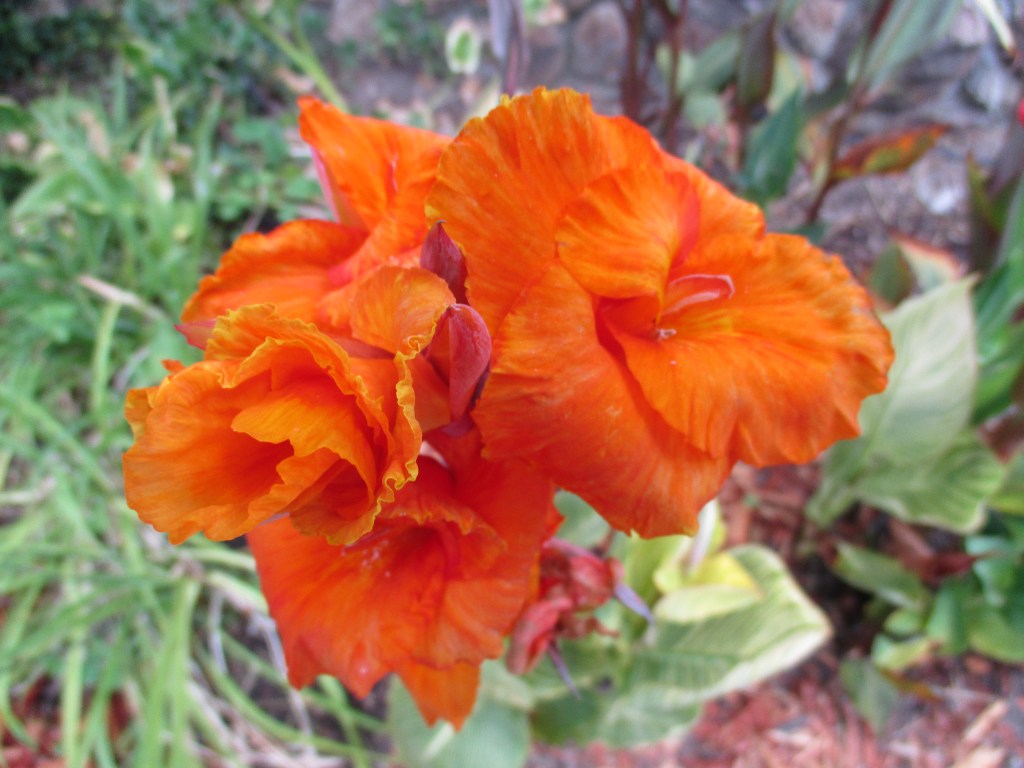
The most familiar of the gazanias are the ‘trailing’ types commonly appreciated as ground cover. They are rather shallow, but dense enough to prevent most weeds from getting through. Their yellow or orange composite (daisy like) flowers bloom initially in spring, and then continue to bloom sporadically as long as the weather stays warm into autumn. Some trailing gazanias have interesting silvery foliage.

‘Clumping’ gazanias do not spread efficiently or thoroughly enough to be practical as ground cover over large areas, but bloom a bit more profusely with bigger flowers in shades of yellowish white, light yellow, bright yellow, orange, brownish orange and brownish red. The foliage gets a bit deeper to form irregular but dense low mounds. Clumping gazanias can be lined up as an informal border around blooming annuals or perennials, or incorporated individually into mixed urns or vertical gardens.

Gazanias are not too discriminating about soil quality or frequency of irrigation. They only need good sun exposure. Trailing gazanias are rather easy to propagate by cuttings made from scraps from pruning around the edges. Clumping gazanias do not get pruned as much, but are easy to propagate by division from dense clumps.

Gardening Up A Wall

These succulent tapestries exemplify artistic vertical gardening.

Like so many fads often do, the vertical gardening fad has become trendier than it really should be. It certainly has practical applications, and is very appealing in the right situations. However, in the wrong situations, it can be more problematic than it is worth.

Vertical gardens can shade and insulate exposed walls, but really do little more than strategically placed shade trees, large shrubbery or even trellised vines can do in that regard. The disadvantage of vertical gardening is that it can hold moisture against the affected walls, and can promote rot if the planters are not installed properly. Planters over windows or decks drip just like any other planters do, staining or dirtying whatever is below. Only free standing vertical gardens (that are not attached to a wall) or those on concrete walls that are not susceptible to rot will not cause such problems.

Water borne pathogens (diseases that disperse in water) can proliferate more in vertical gardens because they get carried with the natural flow of water from top to bottom. Wherever any such disease gets established on a vertical garden, it will likely get carried to everything below. In the ground, such diseases spread slower since they only travel as far as water flows or gets splashed.

The obvious advantage to vertical gardening is that it makes it possible to grow many more plants in very limited space, which is excellent if there is no open ground for vegetable gardening. It can also be a great way to display plants like orchids and certain bromeliads that are more appealing if they hang from above. Staghorn ferns cling to walls naturally.

Another advantage is that vertical gardening can be so aesthetically appealing and unique. Vertical gardens of small, densely foliated succulents hung like tapestries to adorn exterior walls are so much more interesting than simple vines or shrubbery used to obscure such walls. Northern exposures that are too dark for most plants can be adorned with ferns.

Horridculture – Bad Seed

This is one of my more docile rants, although I still see no need for ‘improvement’ with such an excellent flower.

tonytomeo's avatarTony Tomeo

P80317+California poppies are like no other wildflower. They are so perfectly bright orange, and look almost synthetically uniform in profusion, as if painted onto coastal plains and hillsides. They may be a bit more yellowish in some regions, or a bit deeper orange in others, but they are always bright and strikingly uniform.
Genetic variation is naturally very rare. I can remember hiking with my Pa up to the (lesser known) Portola Monument in the hills behind Montara, and finding a few pale white poppies, and even fewer pale purple poppies. It was like finding four leaf clovers! Genetic variants among California poppies are not quite as rare as four leaf clovers are, but finding a few of both white and purple was really strange. I never found a pink one though.
Nowadays, poppies can bloom in all sorts of shades and hues or orange, yellow, red, pink and soft…

View original post 199 more words

Argyle Apple

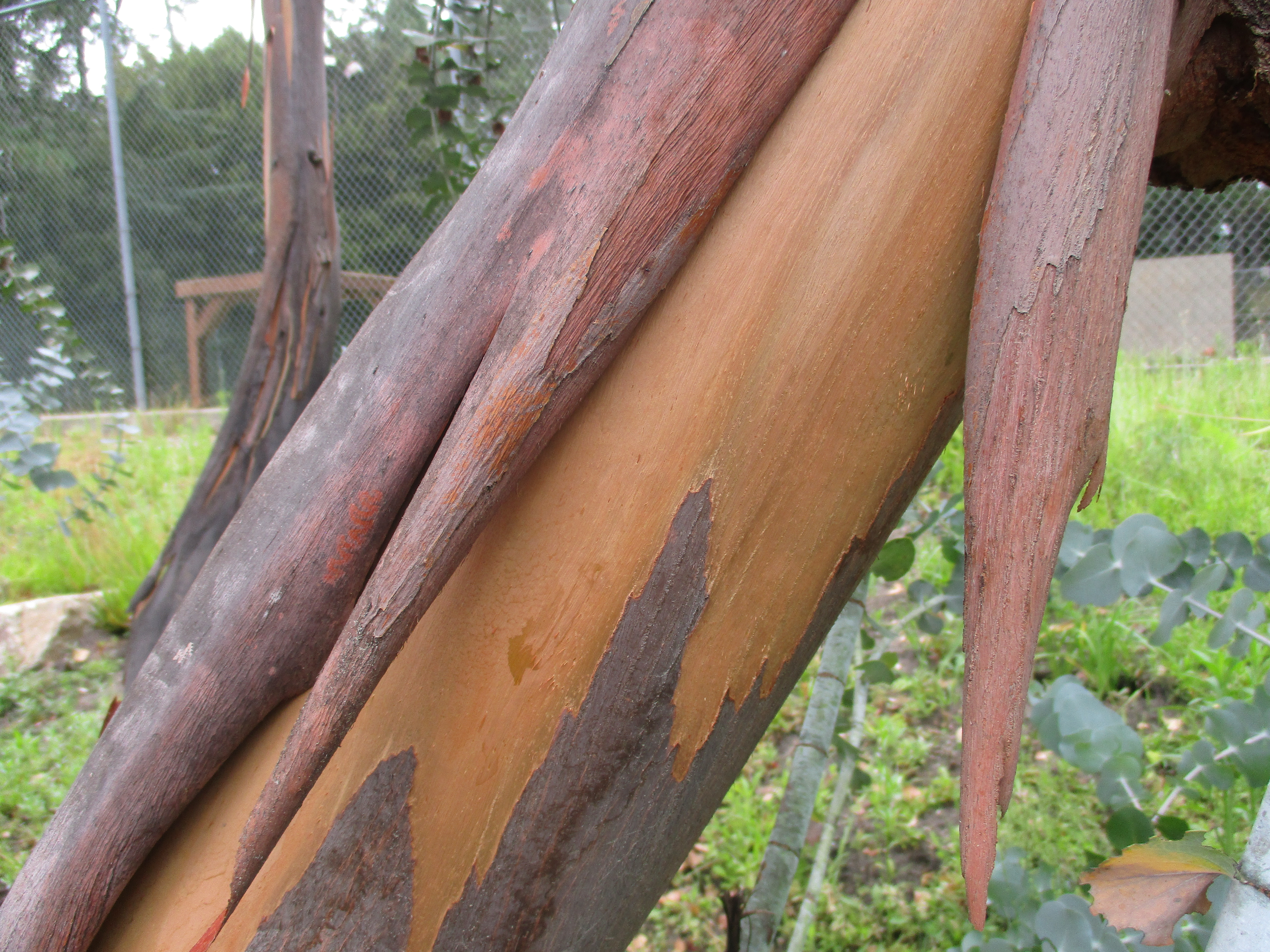
Silvery foliage with fibrous brown bark.

Such silvery foliage provides a bold display on such a substantial tree. Most comparably silvery foliage is of smaller perennials or shrubbery, such as agaves or artemisias. Agyle apple, Eucalyptus cinerea, grows intimidatingly fast to nearly thirty feet tall and almost as wide. Although shorter than most other eucalypti, it can get a hundred feet tall in the wild. 

Paired juvenile leaves of young trees are circular and sessile (clinging directly to stems, without petioles). Unpaired adult leaves are lanceolate and as silvery as juvenile leaves. Coppicing or pollarding force juvenile growth and temporarily eliminate adult growth, but also ruin structural integrity. Trees subsequently rely on repetition of the same technique. 

Trunks and limbs can be disproportionately bulky, and create an illusion of a bigger tree. Irregular branch structure can be sculptural. Fibrous brown bark is handsomely furrowed. Juvenile foliage is a popular accessory to cut flowers. Adult foliage is likewise delightful. Incidentally, the Latin name of this species often transposes for Eucalyptus pulverulenta.

Sudden Limb Failure Jeopardizes Safety

Entire trees can also fall unexpectedly.

Windy weather sometimes breaks limbs from trees, or blows entire trees over. Evergreen trees are innately more susceptible to such damage than deciduous trees are. Wind can blow more easily through deciduous trees while they are bare through winter, when most wind occurs. However, deciduous trees are now more susceptible to sudden limb failure. 

Sudden limb failure, or spontaneous limb failure, is a result of gravity rather than of wind. It is actually more likely without wind, during mild or warm weather, particularly with high humidity. It consequently has potential to be more hazardous than limbs that blow down. More people go outside among trees during mild weather, and fewer expect falling limbs. 

Sudden limb failure occurs if limbs become unable to support their own increasing foliar weight. Warmth accelerates vascular activity, which sustains foliar growth. High humidity and a lack of wind inhibit evapotranspiration (evaporation from foliage), which otherwise helps to alleviate excessive weight. Developing fruit can also cause sudden limb failure.

In the wild, willows, poplars, sycamores, and perhaps a few other riparian trees regularly and naturally exhibit partial sudden limb failure. Limbs that fracture and sag onto soil, but remain partially attached to their original tree, can generate roots and grow as new trees. Although their strategy is practical for them, it is unacceptable within refined landscapes. 

Several native and exotic trees of chaparral climate are quite susceptible to sudden limb failure within or adjacent to irrigated landscapes. Since they are not accustomed to such abundant moisture, they overindulge. Mature wild trees are more likely to exhibit sudden limb failure after an unusually rainy and warm winter, or if rain continued late into spring.

All native oaks, particularly valley oak and coast live oak, are susceptible to sudden limb failure. So are Monterey pine and Monterey cypress. Carob, sweetgum, various elm and various eucalypti are exotic species that are notorious for such behavior. Evergreens are more unpredictable, since their new growth is less obvious among their lingering foliage.