Horticulturists are by nature, nonconforming. I happen to find it difficult to conform to what makes us nonconforming. Trends are fleeting. Old technology that has worked for decades or centuries is still best. Although I am not totally against chemicals, I find that almost all are unnecessary for responsible home gardening. Pruning is underappreciated, and fixes many problems.
This grand sycamore has likely been here since the third day of Genesis. A few of the top branches got broken off when Noah’s Ark floated over. When I was a little kid, it was on the edge of a vacant field where road debris was dumped, and older kids rode their dirt bikes. Now it is on the western edge of the parking lot of Felton Covered Bridge Park. I write about it sometimes.
‘California Sycamore‘, ‘Hanging Gardens Of Babylon‘, ‘Nature Is Messy‘ and ‘Tufts‘ are some of the articles that feature this exquisite specimen. The last three of these examples describe some of the difficulties of old age for sycamores. Something that I may not have mentioned in these article though, is that such mature sycamores eventually develop root suckers.
I use the term ‘suckers’ loosely. For those of us…
This is the first ‘Six on Saturday’ post that I ever reblogged. I only do so because the post that I should reblog was somehow already reblogged. I do not know how, why or when. Anyway, this ‘Six on Saturday’ post is timely because the cannas are blooming now. Since posting these pictures three years ago, I identified #3 as Canna musifolia, and #5 as ‘Pretoria’. #6 is still ‘Wyoming’. I have no idea what #4 is.
There are only four pictures of cannas here. I could have gotten two more for an even six, but would have needed to get them elsewhere. These six pictures were obtained within one of the landscapes at work. Except for pruning a grapevine and flowering cherry trees, I do not work in this garden, so can not take credit for these cannas. I will take credit for the pictures though.
However, I probably should have taken pictures that show the foliage in conjunction with the bloom. Without the foliage there is not much to distinguish the big orange flowers of the last two pictures from each other.
1. Kangaroo paw, Anigozanthus, is one of my lesser favorite perennials, but happens to be one of the more practical for the chaparral climate. Besides, this one happens to be rather pretty. I do not know what cultivar, or even what species…
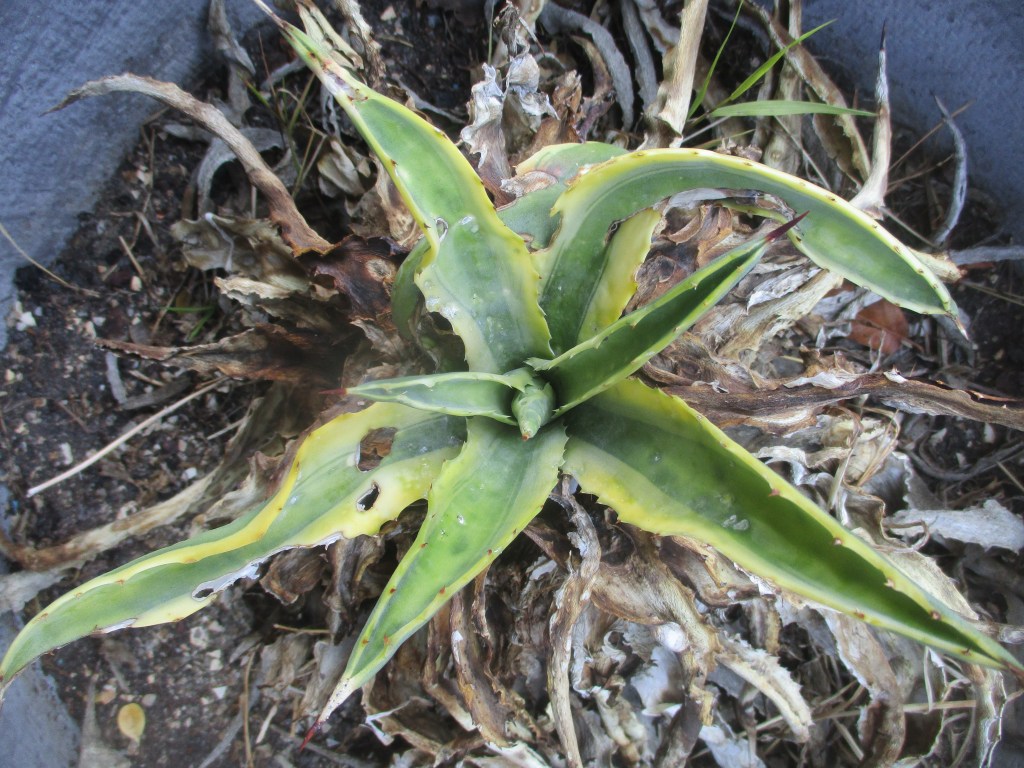
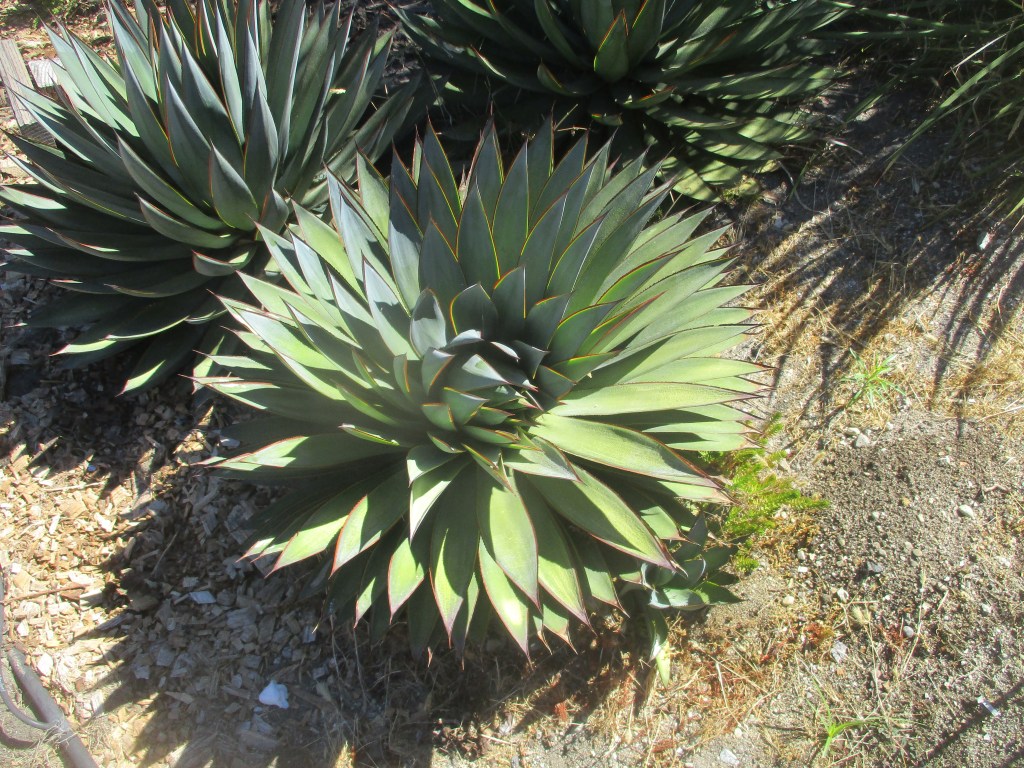
Several species of Agave inhabit the landscapes here. Only a few are identified. Some of those that are unidentified could likely be identified if their identities were important to us. For some, identification would be as simple as researching our records. I know what Agave attenuata is only because there is nothing else like it. #3 is likely a variegated and dwarf cultivar of Agave americana. #6 is the surprise of these Six. It is a familiar species that was formerly identified as another genus. Although its relation to the Family should be obvious in regard to physiology, it is not visually similar to others of the Agave genus. I still know it by its older and perhaps less accurate designation. It works for me.
1. Pups of an unidentified agave that was removed last year are a concern because others just like this continue to develop where the agave was relocated from a few years earlier!
2. The parent agave got removed and dumped next to a greenwaste pile after gophers ate its base, but somehow survived. It fell over only recently. Maybe other gophers found it.
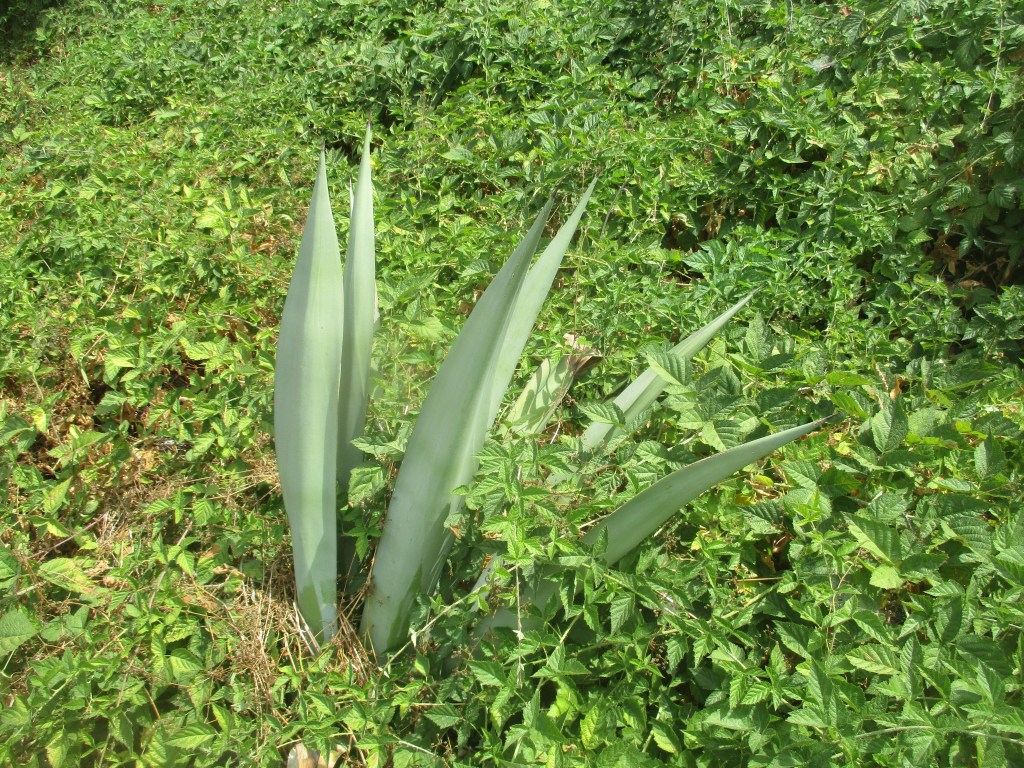
3. Gophers also ate the base of this other unidentified agave, which, like the other agave, seems to have survived somehow. Fortunately, it did not leave undesirable pups behind.
4. Agave attenuata arrived as a big cutting with a long stem, and by odd circumstances. The severed stem generated a big secondary rosette, which is now generating four pups.
5. The pup to the lower right of this unidentified agave indicates that its primary rosette may be about bolt and bloom. Although most agaves are monocarpic, their pups survive.
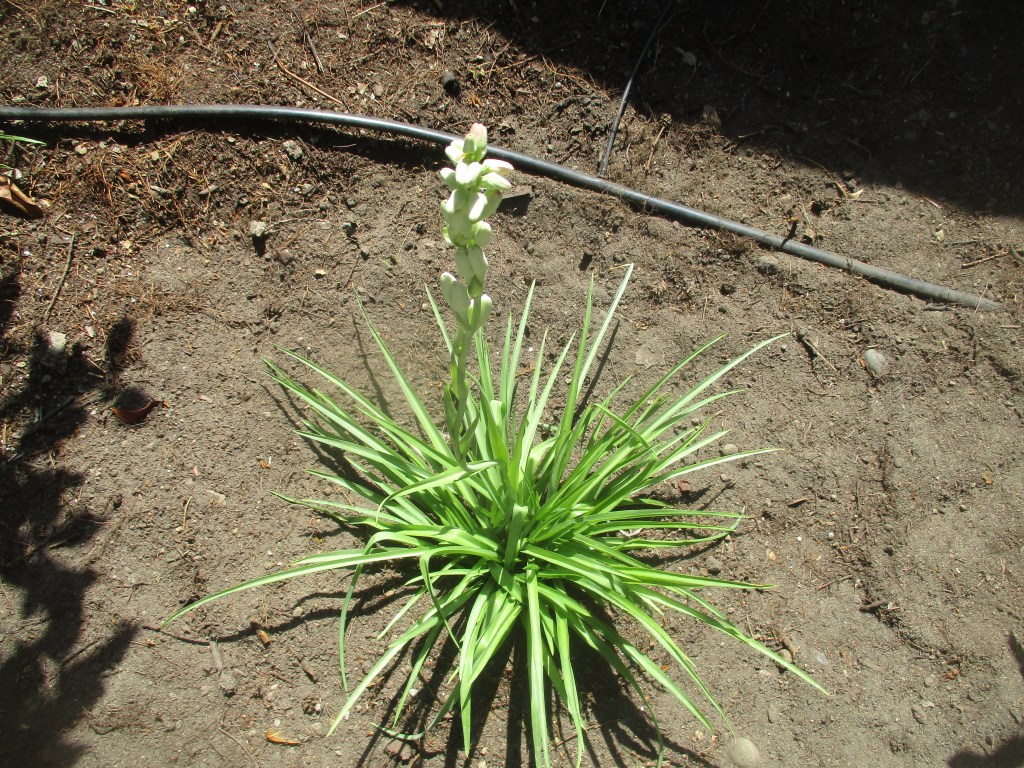
6. Surprise! Fresh from 1985, tuberose, which was formerly Polianthes tuberosa, is now Agave amica. We just installed three, with two more still canned. I hope for many pups.
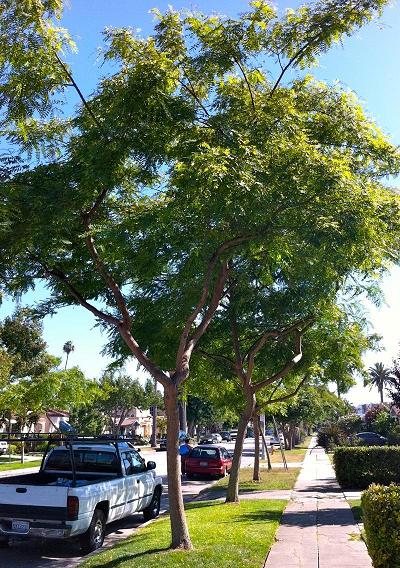
It may not get too tall, but with appropriate pruning, the tipu tree, Tipuana tipu, spreads a broad canopy high enough to be a good street tree. A mature tree is not much more than thirty feet tall and at least as broad. Roots are not too aggressive. A slight bit of mess is rarely but actually more likely to be a problem. The pale yellowish flowers that fall early in summer are followed by a few seeds. Not too long after the seeds stop falling, the deciduous foliage starts to fall. The soft green leaves are pinnately compound, with eleven to seventeen leaflets that are about an inch and a half long. Tipu tree is still uncommon, but really should be more popular than it is.
No matter how unique the individual gardens are, conforming street trees really unify a neighborhood. Streets of tract homes are typically planted with a common street tree that is complimentary to the architectural styles of the homes, and is complaisant to the difficulties of life at the curb. Neighborhoods of mixed architectural styles sometimes have difficulty finding a tree that suits every home, so often select two or more options. Older neighborhoods are not quite as selective about conforming street trees because so many various trees get mixed in over the years.
Before selecting a street tree, it is best to inquire with the particular municipality about designated street trees. Home owners associations generally install their own trees where needed, with little or no regard for the preferences of individual residents. Some urban neighborhoods (that are not home owner associations) are nearly as selective, requiring individual home owners to maintain a specific street tree or trees. Others do not require street trees, but limit selection for those who desire them. Selection is very often limited to only a single species.
There are of course many rural and unincorporated neighborhoods without limitations for street trees, and neighborhoods where limitations simply are not enforced. However, selection should still be limited to trees that are appropriate for curbside planting. Such trees should have high branch structure so that they can be pruned for clearance above the largest of trucks that can use the roadway. They should be reasonably clean, and not produce anything that could be messy on cars parked below. Roots should be complaisant with concrete curbs and sidewalks, particularly where space is limited. Foliage and bark must be resilient to harsh exposure and enhanced glare (from surrounding pavement).
London plane (sycamore) and crape myrtle trees are the two most common street trees planted by landscapers, and are the most commonly pre-designated street trees, but are actually not the best of choices. London plane is popular among landscapers because it can survive the neglect that landscapers are notorious for, but has aggressive roots that eventually damage concrete, especially since landscapers waste so much water and keep the soil saturated. Crape myrtle is remarkably colorful both in bloom and with fall color, and has remarkably complaisant roots, but does not get tall enough for adequate clearance, and often gets infested with insects that drop sticky honeydew on parked cars.
We arborists happen to like trees. That is why we are arborists. Most of us also understand that trees are not appropriate for every situation, or where they are not appreciated. There is no point in planting a tree where it will just get cut down by someone else who does not like it. We want trees to be happy. We also want those who live with them to be happy with their trees.
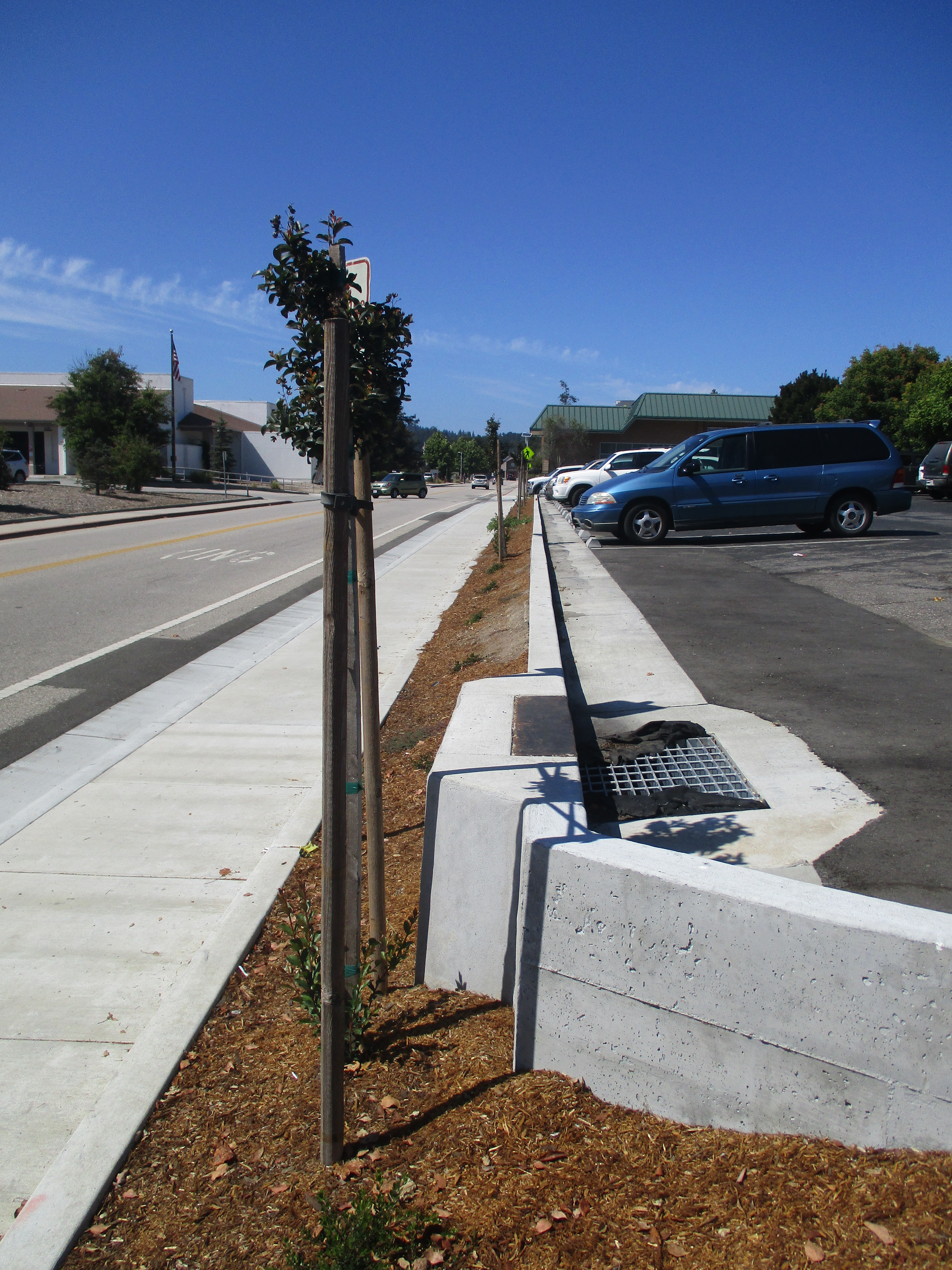
Trees are ‘generally’ desirable over parking lots and roadways. They provide shade that cools the pavement during hot summer weather. Arborists naturally prefer trees that get big enough to make substantial shadows. It is also important for such trees to get high enough to be pruned for minimal clearance above the biggest vehicles to use the roadways or paring lots. They should also be pruned above streetlamps and signs. Clearance of signs is a serious problem…
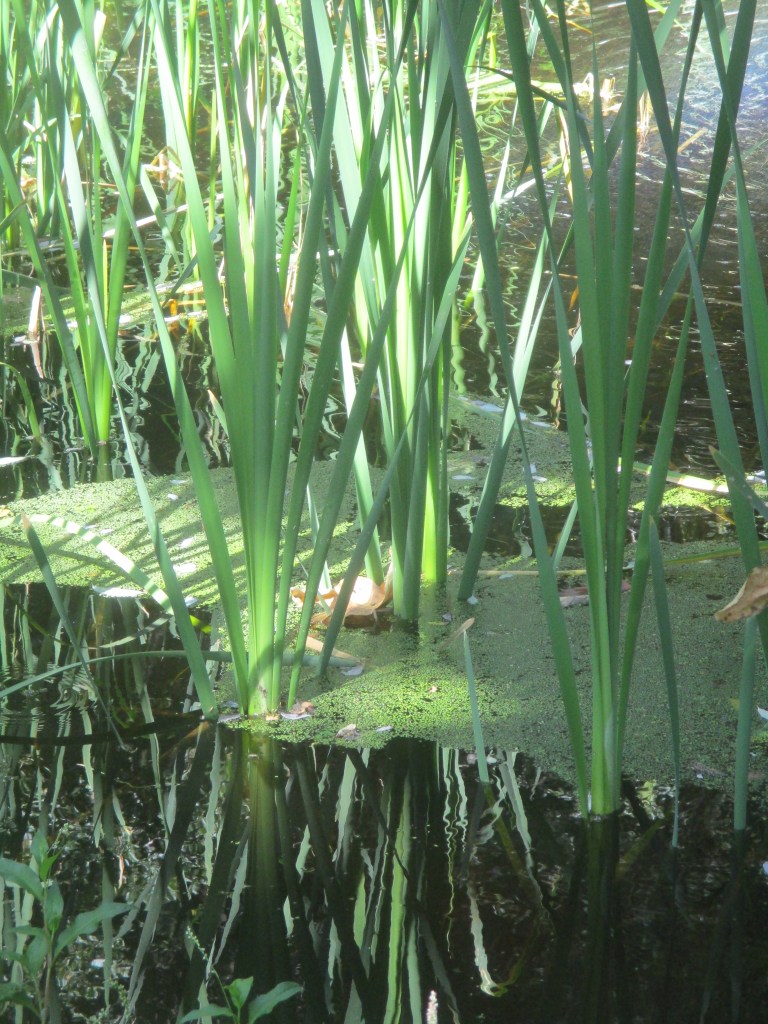
Ducks somehow find water. They eventually visit most home garden ponds that they can fit into. Duckweed, Lemna minor, is likely to come with them. It adheres to waterfowl and other wildlife for that purpose. It proliferates very efficiently, and almost typically becomes a nuisance. Eventually, proliferation in a healthy pond should stabilize to a tolerable rate.
Individual duckweed plants are tiny. Their oval leaves are typically less than a quarter of an inch long. Each floating leaf extends its single root less than three quarters of an inch into the water below. Plants produce no more than four rooted leaves before dividing into a few smaller plants to repeat the process. Bloom and subsequent seed are uncommon.
As a floating aquatic plant, prolific duckweed might obscure koi and submergent aquatic plants within garden ponds. However, it also helps stabilize healthy aquatic ecosystems. In fact, it is useful for bioremediation of agricultural and industrial applications. It absorbs detrimental substances from water, while producing fodder and biomass for composting.
Home gardens and landscapes should be compatible with their respective climates. For local chaparral climates, plants that do not need much watering through the long and dry summers are appropriate. Aquatic plants are the extreme opposite. They require regular replenishment of the ponds that they inhabit. Arid warmth increases their need for water.
Aquatic plant can not be ‘drought tolerant’. Several, such as duckweed, water lettuce and water hyacinth, float over the surface of water. Water lily and lotus inhabit the mud below the water, and extend their foliage to float over the surface of the water. Waterweeds stay completely submerged, with or without roots. Aquatic plants need water for their survival.
Marginally aquatic plants are somewhat less dependent on water. Cattail and yellow flag iris inhabit shallow ponds and saturated soil, but can survive if their situations drain for a while. If they stay too dry for too long, they can initiate dormancy, and then recover when saturation resumes. Canna inhabits either shores of shallow ponds, or evenly moist soil.
Regardless, all aquatic plants require maintenance that is completely different from what terrestrial plants require. Even those that need only minimal maintenance will eventually necessitate muddy and messy interaction. Much of such interaction is under water that is difficult to see through while murky. Aquatic plants are innately heavy and totally sloppy.
Moreover, some common aquatic plants grow like weeds. Water hyacinth and giant reed are two of the most invasive exotic species in California. So, not only are they sloppy, but they are also voluminous! Because they are very invasive, they should not inhabit ponds that they could escape. Besides, giant reed is too overwhelming for most home gardens.
Few home gardens include natural ponds or water sources to contain as ponds. Garden ponds are therefore mostly contained within some sort of sealed infrastructure, and need replenishment to compensate for evaporation. Fountains aerate the water for a healthier ecosystem, but also increase evaporation. Some tall aquatic plants also consume water, as the foliage that extends above water transpires.
Without prior notice, I was informed on Friday morning of a workday on Saturday morning at Felton Presbyterian Church. That was yesterday. Since there was no time to get other chores done in advance, I was an hour late. Considering that we only work for four hours between eight and noon, one hour is rather significant. I felt compelled to attend regardless. A few friends who are parishioners of Felton Presbyterian Church appreciate it. The difficulty of not attending is that there are several other volunteers who do attend, and they all have very different ideas, or no idea at all, about how to accomplish what needs to be done in the landscape. It is amazing how much damage can be done with a few light duty power tools and too much undirected ambition. Even when I am there, it is difficult to convince the others that I know more…
The weather in the parts of California that most of us are familiar with is generally rather mild. Some of the hottest temperatures every recorded were in the Mojave Desert, but not many of us even know how to get there. Some of the heaviest snowfall ever recorded was near Tahoe, but many of us think of that as almost Nevada. San Jose, Los Angeles and the most populous regions enjoy mostly comfortable weather throughout they year. ‘Drought’ is often an inaccurate description of the naturally prolonged dry chaparral and desert weather, as if it is abnormal. There would be no chaparral or desert if it rained here as much as it does in other climates. What is considered to be normal rainfall in some regions would be disastrous to regions that do not normally get so much precipitation. Drought does happen here sometimes, but it is not as common…

 This grand sycamore has likely been here since the third day of Genesis. A few of the top branches got broken off when Noah’s Ark floated over. When I was a little kid, it was on the edge of a vacant field where road debris was dumped, and older kids rode their dirt bikes. Now it is on the western edge of the parking lot of Felton Covered Bridge Park. I write about it sometimes.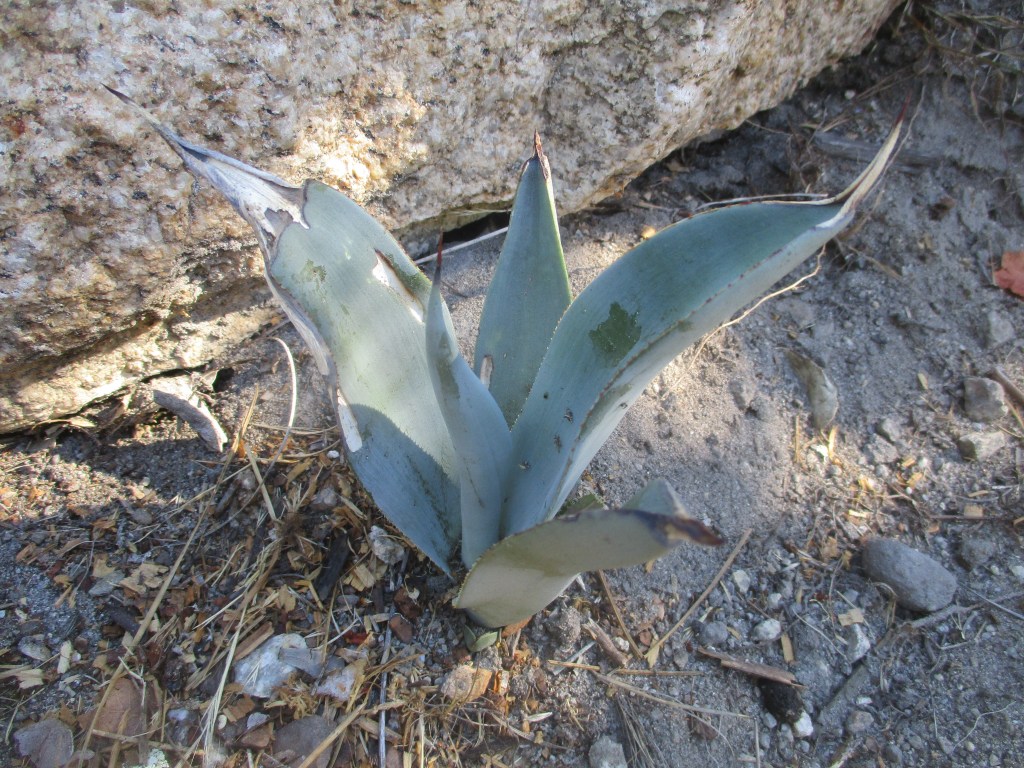


 We arborists happen to like trees. That is why we are arborists. Most of us also understand that trees are not appropriate for every situation, or where they are not appreciated. There is no point in planting a tree where it will just get cut down by someone else who does not like it. We want trees to be happy. We also want those who live with them to be happy with their trees.
 Without prior notice, I was informed on Friday morning of a workday on Saturday morning at Felton Presbyterian Church. That was yesterday. Since there was no time to get other chores done in advance, I was an hour late. Considering that we only work for four hours between eight and noon, one hour is rather significant. I felt compelled to attend regardless. A few friends who are parishioners of Felton Presbyterian Church appreciate it.