I believe that the Statute of Limitations applies here.
via Felony Garden
I believe that the Statute of Limitations applies here.
via Felony Garden
It just occurred to me that I have not visited this coffee shoppe in more than a year!
These six are not from my garden or landscapes, since I am away from home for now.
Before the evacuations, and before I was even aware of the local wildfires, I came to the Santa Clara Valley for unrelated obligations. Evacuations started in a neighboring town the following Wednesday morning. By Thursday morning, my region was evacuating. I have been here for several days and may be here longer than I need to be if I am unable to return home afterward.
1. Plumbago auriculata – looked pretty when I planted it here, and before I knew how rampant it can get. It really wants more space. The blue is almost too bland. The foliage is rather pale.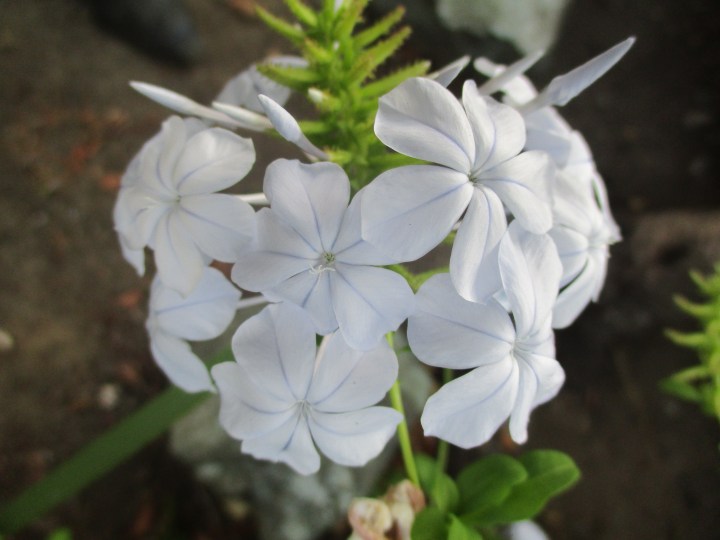
2. Pelargonium peltatum – is the only one of these six that I did not plant here. I have no idea where it came from. I know this species is nothing special, but this color is too pretty to ignore.
3. Chamaecyparis lawsoniana ‘nidiformis’ – is rare here, perhaps because it dislikes a chaparral climate. This specimen is not much bigger than it was when I installed it three decades ago.
4. Juniperus chinensis ‘Shimpaku’ – sound as if it is related to Pikachu. Bonsai artists appreciate it more than I do. It is sculptural like a diminutive Hollywood juniper, but grows very slowly.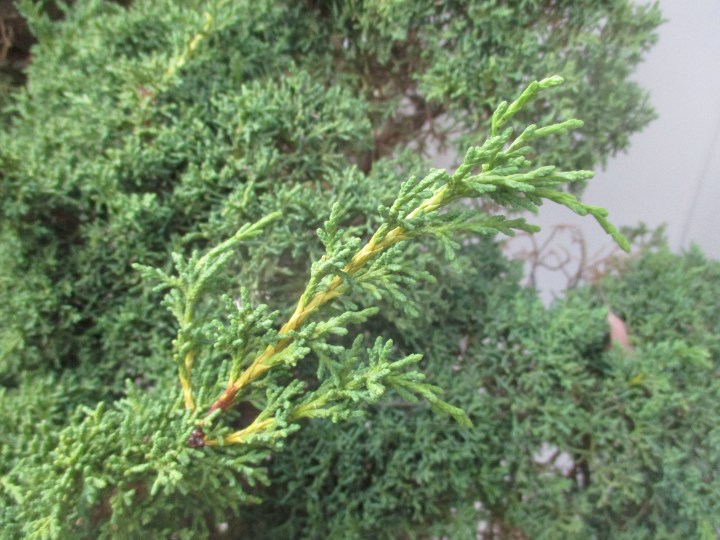
5. Juniperus chinensis ‘Hetzii (Glauca)’ – is known by a few species or hybrid species names, including X media, X pfitzeriana and virginiana, rather than chinensis, most without ‘Glauca’.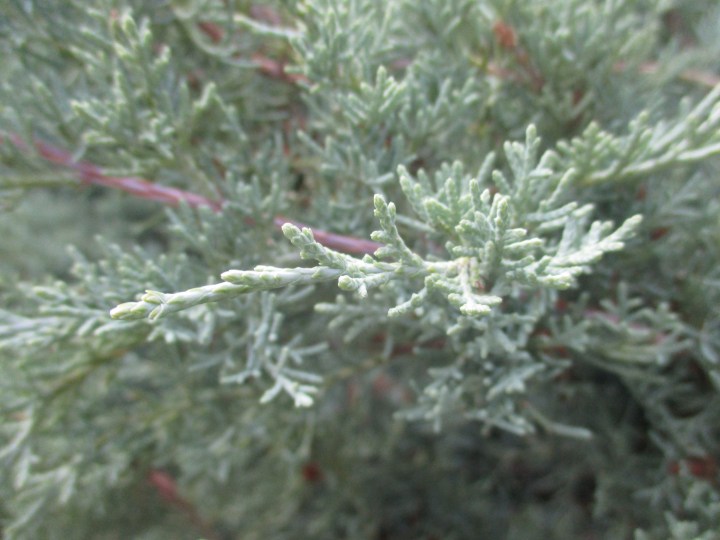
6. Acer saccharinum – is not one of the favorite maples within its native range; but it happens to be one of my favorites. I grew this one out front by layering a stem from its parent out back.
This is the link for Six on Saturday, for anyone else who would like to participate:
https://thepropagatorblog.wordpress.com/2017/09/18/six-on-saturday-a-participant-guide/

Many of us who already grow sea lavender, Limonium perezii, might wonder why it is a topic for August. In the mildest spots, it gets more credit for blooming in winter while most other plants are dormant. Yet, it is actually classified as a summer blooming perennial because it blooms more reliably though summer in most places.
Bluish purple blooms stand more than two feet tall, just above coarse mounds of evergreen basal foliage that gets more than two feet wide. Each billowed bloom contains many tiny flowers. Larger blooms are too heavy to stand upright, so they lay down on the foliage. The weirdly wavy leaves are on such long petioles (leaf stalks) that they may lay down too.
Established plants do not need much attention or water. Faded bloom should be pruned away. It is not practical to remove all of the faded foliage. Every few years or so, old plants can be reinvigorated by getting divided. Newly divided rhizomes will need to be watered regularly until they disperse their roots. Sea foam statice likes full sun exposure.
Lightning is very rare here. For half of the year between spring and autumn, rain is also very rare. Summers are long and dry. Weirdly though, if a storm passed through between spring and autumn, it usually involves lightning, and is usually within only a few days of the Feast of the Assumption, on August 15. This time, it arrived just about an hour after midnight on August 16.
It was warm that night, so the windows were open at home. There was a gust of wind in the cottonwoods that sounded like the Santa Ana Winds of the Los Angeles region, and the electricity went out, likely because the same gust knocked a tree onto cables elsewhere. The lighting might have started earlier, but became visible without electrical lights outside. I heard no thunder.
Lightning worries us while the weather is so warm and dry. It came without rain. Previously, humidity had been minimal. There was a faint aroma of smoke in the morning, but nothing was mentioned about fires during the day. That was Sunday. Monday was warmer and less humid, and smelled notably smokier as I left for the Santa Clara Valley, where I have been since then.
Fires that were started by the lightning in Bonny Doon was finally mentioned in the news on Tuesday, but did not seem to be a major concern. By the next morning, Boulder Creek was being evacuated! Brookdale and Ben Lomond were evacuated later on Wednesday. By this morning, Felton and everyone at work were being evacuated! Scott’s Valley and environs could be next!
It all happened so fast and I am miles away. Even if I were not miles away, I would need to go miles away with everyone else who was evacuated. I was told that ash and burned leaves were falling from the sky around my home this morning. I have never seen so much smoke over the Santa Cruz Mountains, or filling the sky of the Santa Clara Valley. I hope to never see it again.
This reblogged post is from my other blog at ‘Felton League’.

It would seem obvious that there would be more flowers to cut to bring into the home during summer than there would be in winter. A quick tour through the garden might prove otherwise. Much of the color in the garden this late in summer is provided by flowers that fade quickly, or small flowers of shrubby plants that lack good stems for cutting.
Lilies, gladiolus and most of the lily of the Nile that bloomed earlier in summer are finished. Bearded iris (reblooming types) that will soon be blooming again, as well as cannas, wilt too much to last long as cut flowers. Dahlias happen to be at their prime, and are excellent cut flowers if their water gets changed regularly. Otherwise, they rot and smell badly.
Realistically, anything that blooms is fair game. Of course, this does not mean that everything tried will work. It does means that some flowers that are not often thought of as good cut flowers might be worth considering as such. Not all of us are equipped with roses, zinnias, dahlias, sunflowers, delphiniums, blanket flowers or the many other favorite summer bloomers.
All sorts of sages, which are also known by their Latin name of ‘salvia’, are delightful cut flowers. However, some types are not very showy. Others wilt right after getting cut. Mexican blue sage may or may not wilt, but is colorful enough to be appealing even if it can not stand up like it should. Sometimes it is best to try something new to see if it works.
Sea foam statice and annual statice are nice cut flowers both fresh and dried. Fresh flowers are probably more colorful, but of course, do not last as long as dried flowers. Annual statice is lightweight enough to stand upright as it dries in a vase. Sea foam statice has bulkier flowers that should probably be hung up-side-down to dry straight.
Oleander certainly is reliably colorful, but is not worth cutting. It wilts almost immediately, and drips toxic sap. However, the stigmatized and common lemon bottlebrush is a surprisingly tasteful cut flower with rustically aromatic foliage. Speaking of foliage, some types of eucalyptus, particularly the red flowering gum (Eucalyptus ficifolia), have handsome flowers as well.
This recycled article fits into the ‘Horridculture’ category only because some might find it to be VERY objectionable. It is still one of my favorites.
via White Supremacy
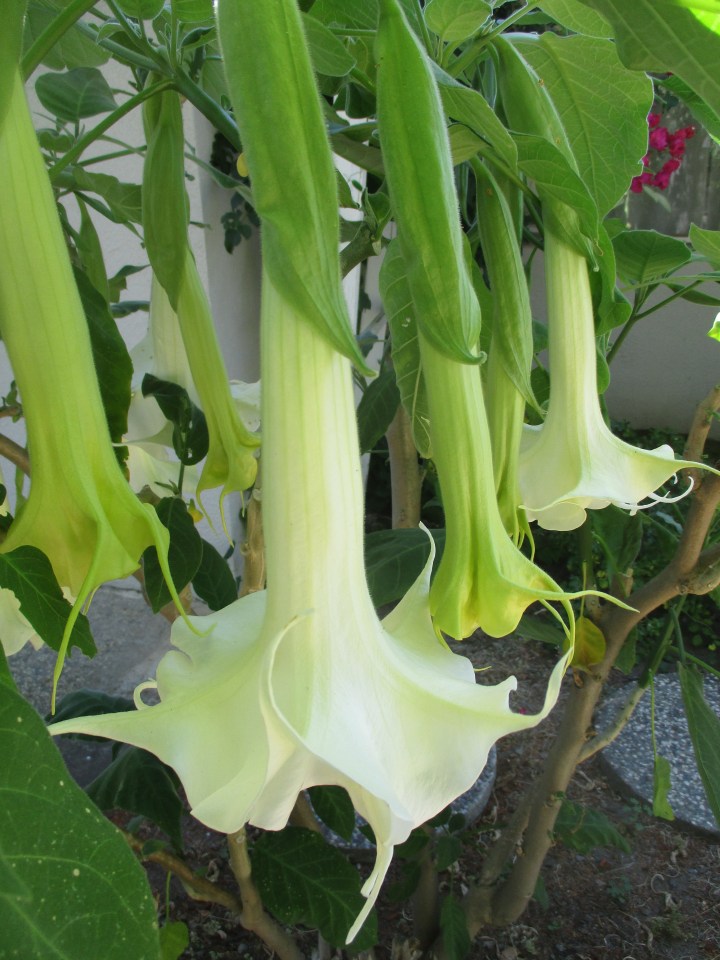
Human intervention has sustained the seven species of angel’s trumpet, Brugmansia, since their prehistoric extinction from the wild. They were likely endemic to tropical regions from Venezuela to Chile, and southeastern Brazil. Their extinction was likely a consequence of the natural extinction of animals that dispersed their seed. Most garden varieties are hybrids of the various species.
Angel’s trumpet is either a big shrub or small tree, with rather herbaceous stems. The more popular cultivars can get more than eight feet tall. Cultivars that might get twice as tall are rare. The soft leaves get about six inches long and half as wide. Leaves might get almost twice as long on vigorous growth. Some cultivars have slightly tomentous (fuzzy) foliage. A few have variegated foliage.
Although generally sporadic, and pastel hues of pink, orange, yellow or white, bloom is impressive. The pendulous trumpet shaped flowers are commonly longer than six inches, and half as wide. Double flowers are frilly. Several cultivars are delightfully fragrant, particularly in the evening. All plant parts are very toxic. Plants damaged by frost in winter are likely to regenerate from their roots.
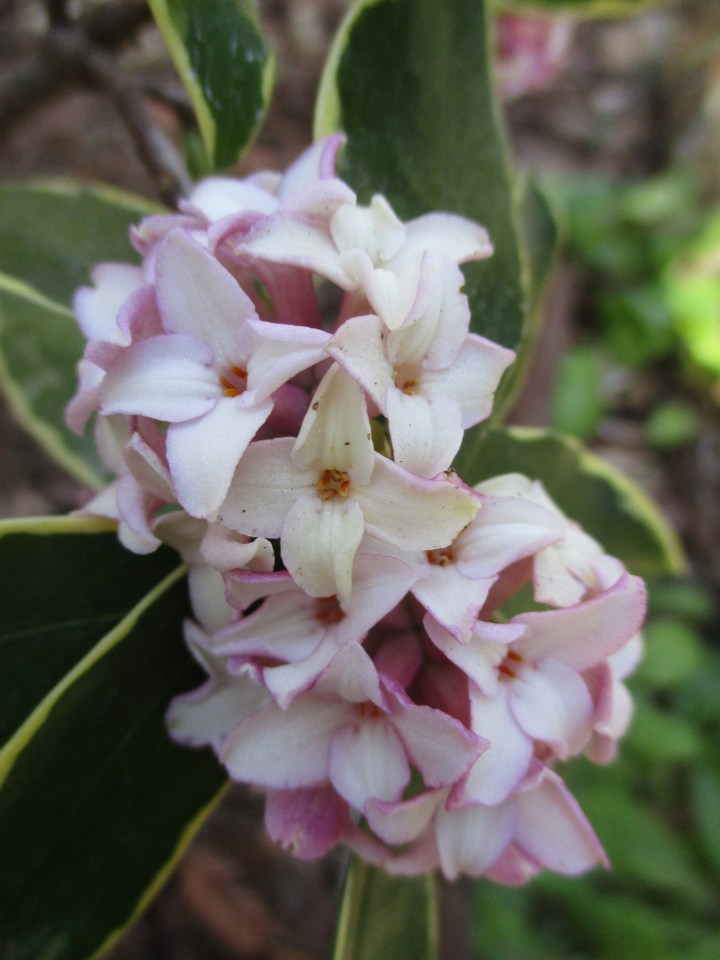
Many who enjoy gardening appreciate fragrant flowers. Many grow particular flowers specifically for their fragrance. Yet, not many consider why so many flowers are fragrant. Plants can not enjoy their own alluring floral fragrances any more than they can enjoy their own delightful floral colors and forms. They do not expect people to enjoy their bloom either. Human appreciation is incidental.
Floral fragrance is merely intended to attract pollinators. Flowers are inanimate, so rely on either wind or animate pollinators to exchange their pollen among other flowers. Animate pollinators are mostly insects, but may be birds, bats or other animals. Flowers do what they must to attract their preferred pollinators. Many use color and floral form. Many use fragrance. Some use both tactics.
Flowers that use both color and fragrance to attract pollinators are mostly endemic to densely forested ecosystems. There is more competition for pollinators within such ecosystems than there is within ecosystems of sparser vegetation. Otherwise, fragrant flowers are generally not as colorful as those that are not as fragrant. Likewise, the most colorful flowers are generally not so fragrant.
Angel’s trumpet is striking in bloom because the flowers are so large. Wisteria and lilac that bloomed last spring were spectacular because they were so profuse. The pastel hues of their blooms are no problem that their fragrance does not compensate for. Pink jasmine and mock orange are about as fragrant, even if their color range is more limited. Star jasmine is not always so profuse.
Pittosporum tobira and Pittosporum undulatum are even less visually impressive in bloom, but can be surprisingly fragrant. The tiny but richly fragrant flowers of sweet osmanthus, sweet box and night blooming jasmine are so obscure that other bloom is often credited with their fragrance. As the name implies, night blooming jasmine is powerfully fragrant after sunset during warm weather.
Freesia, hyacinth, narcissus, lily and some bearded iris are both colorful and very fragrant.
This is something that I hope my high school physics professor does not remember.

