As much as I dislike fads, I think this is one fad that could have lasted longer that it did three years ago.
via ROCKS!
As much as I dislike fads, I think this is one fad that could have lasted longer that it did three years ago.
via ROCKS!
August 15 is the Feast of the Assumption, which celebrates when the Blessed Virgin Mary, at the end of her life, was assumed into Heaven, body and soul. In some cultures, it is known more simply as the Assumption, so is not considered a Feast Day. That would be fine with me. The vegetable garden is rather pathetic for the middle of August. There are plenty of cucumber, and more summer squash than we know what to do with, but the rest of the produce is slim pickings.
1. Squash – of this sort will not be ready until after the first frost next winter. Nonetheless, it seems to be maturing slowly. It should probably be substantially larger for this late in summer.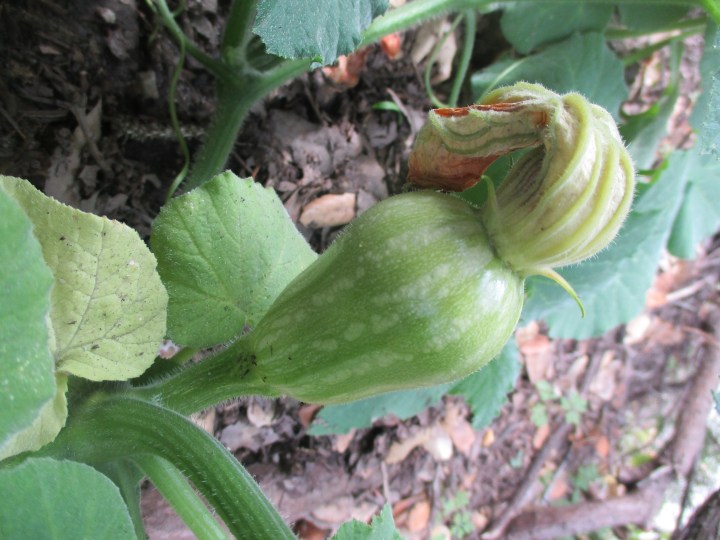
2. Kale – could be either late or early. It is a spring or autumn vegetable here. Seed was sown late, but should have been later to be ready for autumn. It should survive, and start over later.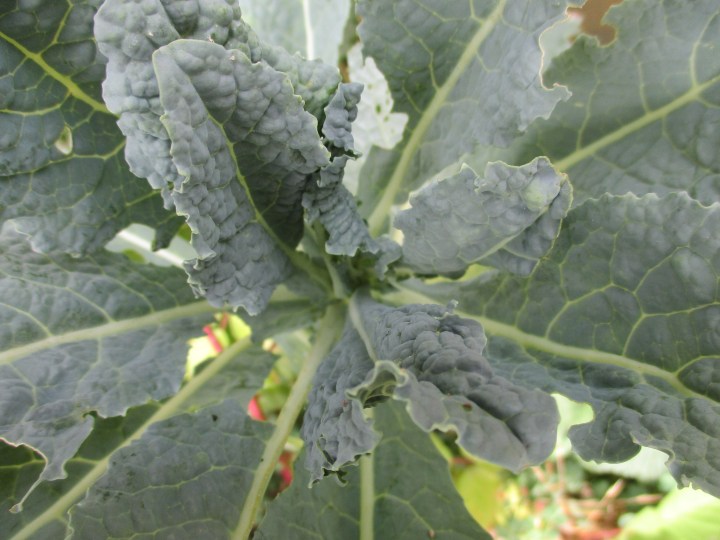
3. Tomato – are better than they look here. The cherry tomatoes do not ripen in clusters though. I just pluck the ripe fruits off individually. None of the bigger tomatoes have ripened yet.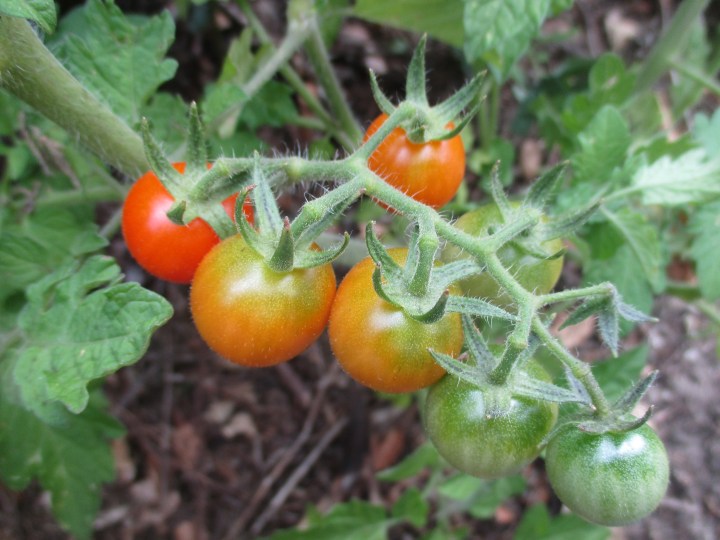
4. Bean – vines have grown like weeds, but are just beginning to produce. I have never grown this variety before. The variety that I had always grown starts producing earlier, while young.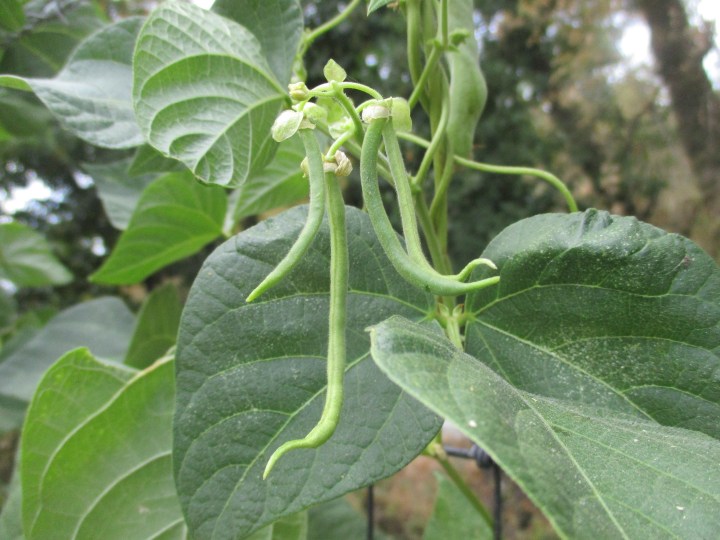
5. Cucumber – production has been adequate. However, because I have not been watering regularly enough, the cucumber are rather bitter. I like how the vines climb up over the junipers.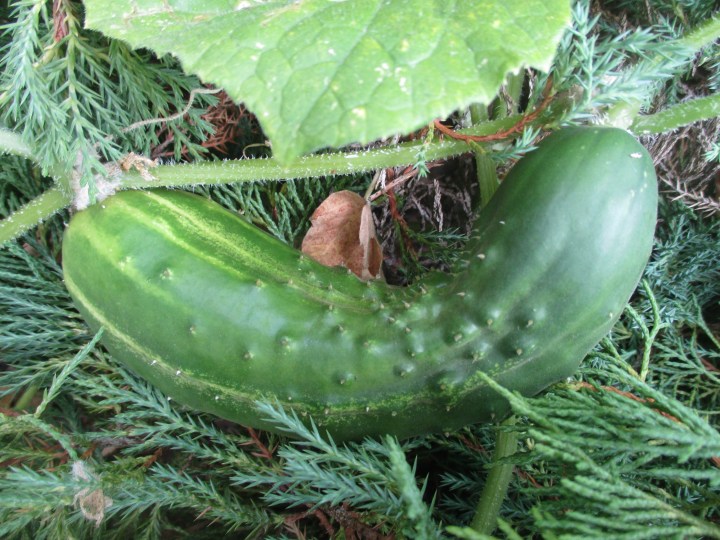
6. Squash – has been too productive! These are the summer squash, mostly zucchini, for the neighbors. However, there is nothing ‘ini’ about those that could not get harvested early enough.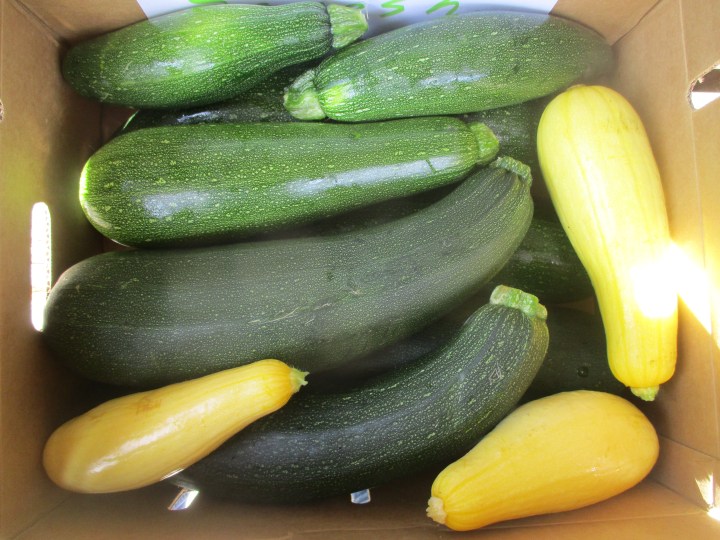
This is the link for Six on Saturday, for anyone else who would like to participate:
https://thepropagatorblog.wordpress.com/2017/09/18/six-on-saturday-a-participant-guide/

There are not many flowers as blue as those of plumbago, Ceratostigma plumbaginoides. Individual flowers are not much more than half an inch long, but can be quite abundant until autumn. Each of the many terminal flower clusters is on a rather reliable schedule, so that new flowers begin to open as older flowers begin to fade.
Thin stems stand only about half a foot to a foot above underground rhizomes. Individual plants get about 3-feet wide, but realistically, will slowly spread farther if conditions are right. They do not spread fast enough to be invasive, but can get into some unexpected spots if not controlled. The simple leaves are about two inches long.
The main problem with plumbago is that it is deciduous, so it dies back to the ground in autumn. The weather is too mild here to produce the good fall color seen where autumns are cooler. Plumbago is a popular bulb cover because new growth, although slow to develop, emerges just in time to obscure fading foliage of early spring bulbs like daffodil and tulip.
Plumbago also works well with stone, since the stone is still appealing without the foliage through winter. The wiry stems weave nicely through otherwise bare cobbles, or spill slightly over low stone walls. Even though shade inhibits bloom, plumbago makes a nice informal ground cover under open shrubbery.
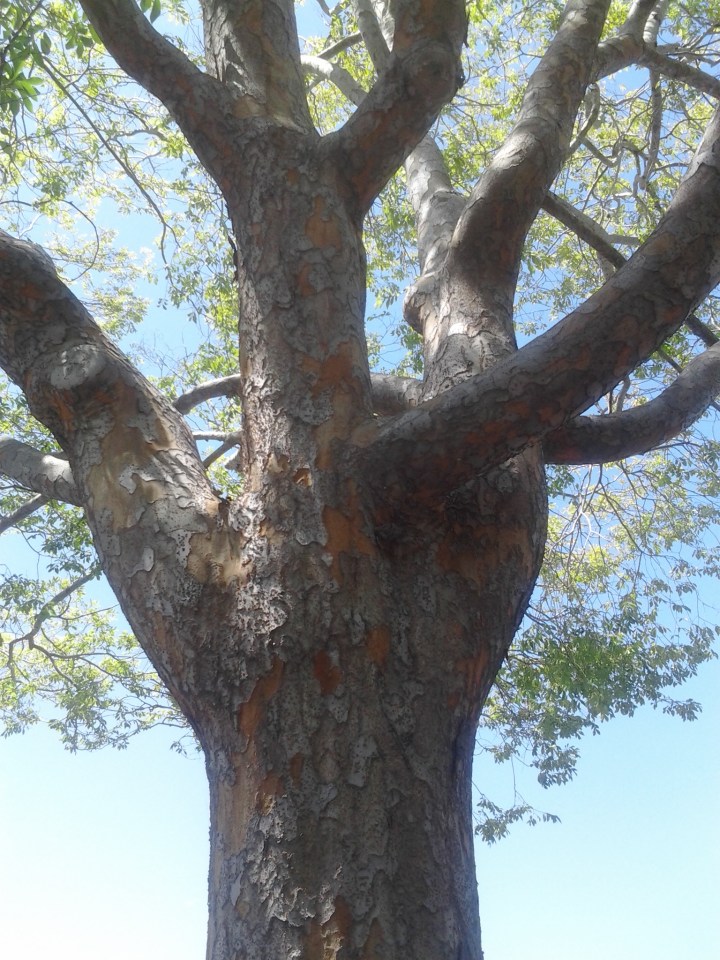
All the optimistic predictions of a rainy winter do not help with the drought yet. Nice warm weather only makes the garden even drier. Many of us have let our lawns dry out, maybe with plans to replace them later. Some have decided to replace lawn with artificial turf, hardscape or other landscape features.
The problem with this is that trees and other large plants that have dispersed their roots under the lawns are thirsty for the volumes of water that they had gotten while the lawns were well watered. They can survive longer than lawn does without watering, and will adapt to less water when they do get it, but they can not do without water completely.
It seems silly to water artificial turf or new decking, but it is sometimes necessary, especially for thirsty trees like willow, ash, elm and redwood. This is why some artificial lawns are outfitted with the original irrigation systems of the lawns that they replaced.
Drought tolerant trees, like certain oaks and most eucalypti, are more adaptable. Of course, those that were originally watered generously are greedier. Those that got only minimal watering may not notice if they get none at all. Regardless of their requirements, they all can be watered less frequently than lawns were, but should be watered generously when they do get watered.
Generous, but infrequent watering soaks into the ground better to satisfy deep roots. It is actually what most trees prefer. Lawn needs frequent watering only because the roots are so shallow. Generous, but infrequent watering uses less water not only because less evaporates from the surface of the soil, but also because less water gets used.
For example, watering weekly for 20 minutes is a generous volume of water, but is still less than watering for 15 minutes three times each week. It is only 20 minutes of watering compared to forty five minutes of watering.
This reblogged article has potential to conform to the ‘Horridculture’ meme for Wednesday, even if it does not sound like it.
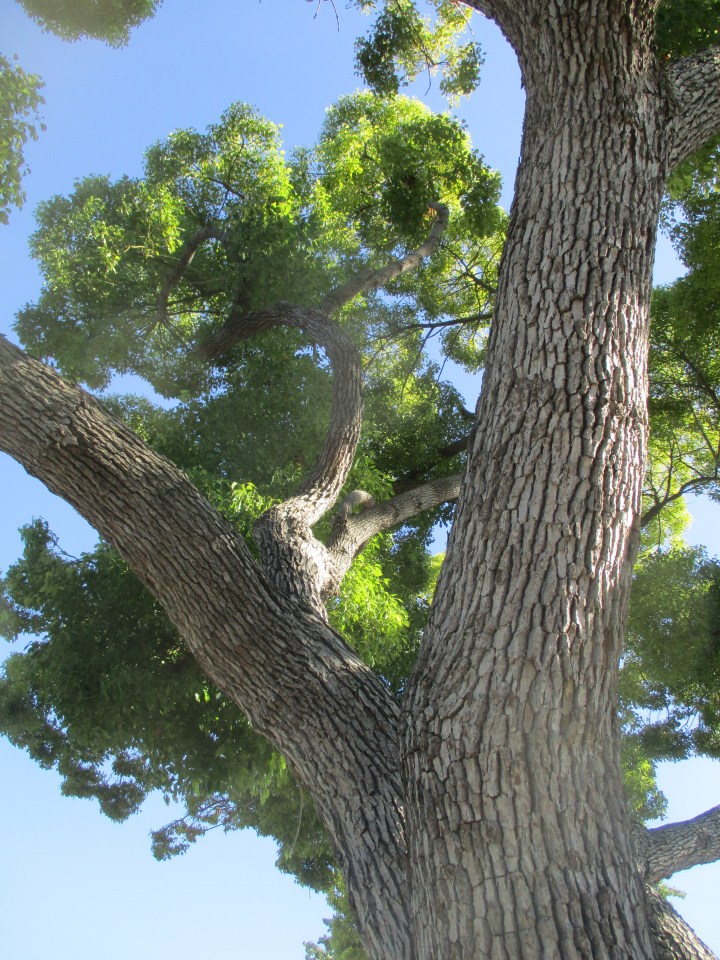
The best camphor trees, Cinnamomum camphora, are in parks and other spacious landscapes. Such trees have sufficient room for their broad canopies. Although they do not grow rapidly, they eventually get quite large, and perhaps too massive for confined urban gardens. Some of the older local trees are nearly fifty feet tall, and nearly as broad. They have potential to get much bigger.
Camphor trees excel as shade trees. Their light green or perhaps yellowish evergreen foliage is quite dense. Shade of groups of trees or large trees with low canopies inhibits the growth of lawn grass. Also, roots are likely to eventually elevate lawn or other features that are close to the trunks. Foliar canopies are billowy, but can be lopsided, especially in windy or partly shaded situations.
Trunks and main limbs of camphor trees are rather stout, and can be rather sculptural. Trees should be pruned for clearance while young. Otherwise, obtrusively low limbs can become prominent components of the canopies. The tan bark is distinctively checkered. It darkens handsomely with rain. All parts of camphor tree are quite aromatic. Frass from spring bloom can be slightly messy.

Modern urban home gardens are shadier and more confined than older suburban home gardens originally were. Modern homes are both taller and closer together on smaller parcels. Fences are also taller to compensate for the minimal proximity of adjacent homes. Less sunlight reaches the ground. There is not as much space available for shade trees. Nor is there as much use for them.
Huddled modern homes are simply not as exposed to sunlight as older suburban homes were. Sunlight is more of an asset than a liability. Walls, ceilings and windows are so thoroughly insulated that shade is less important. Solar arrays up on roofs must remain exposed to sunlight. Smaller and denser trees are more important for obscuring views of adjacent homes, rather than for shade.
Shade trees are still useful for rural and suburban homes. Shade helps to keep older and less energy efficient homes cooler through warmer summer weather. If strategically situated to the south, west or southwest, they shade homes during the warmest time of day. Well proportioned trees do not darken too much of their gardens. Deciduous trees allow warming sunlight in through winter.
The popularity of modern urban homes is directly proportionate to the popularity of small evergreen trees. Such trees fit into smaller garden spaces, and permanently obscure unwanted scenery. Big deciduous shade trees that are practical for larger garden spaces become obtrusive in confined spaces. Defoliation in winter reveals unwanted views, and deprives the landscape of privacy.
Some of the more practical of small evergreen trees are actually large shrubbery. English laurel, Carolina cherry, photinia, hopseed bush and various pittosporums can get high enough to obscure neighboring windows. All are conducive to pruning if they get too tall. If staked on single straight trunks, or pruned to expose a few sculptural trunks, they do not occupy much space at ground level.
Tristania laurina, and some melaleucas are naturally small to midsized evergreen shade trees. Some species of Podocarpus can be pruned as midsized trees.
This too is reblogged from more than three years ago.
After three years, this remains a mystery. No one is complaining.
As I said last week, the Santa Clara Valley is the best place in the entire Universe for horticulture. That is where these pictures came from. Although I planted only the Ilex aquifolium of the second picture, I collected all six of these plants from various sources over the years. They have been quite happy here. I will now be taking more copies or originals of all but Ilex aquifolium.
1. Juniperus virginiana – is my favorite this week. I know it is uninteresting to those who are familiar with it, but it happens to be one of only a few that I brought from Newalla in Oklahoma.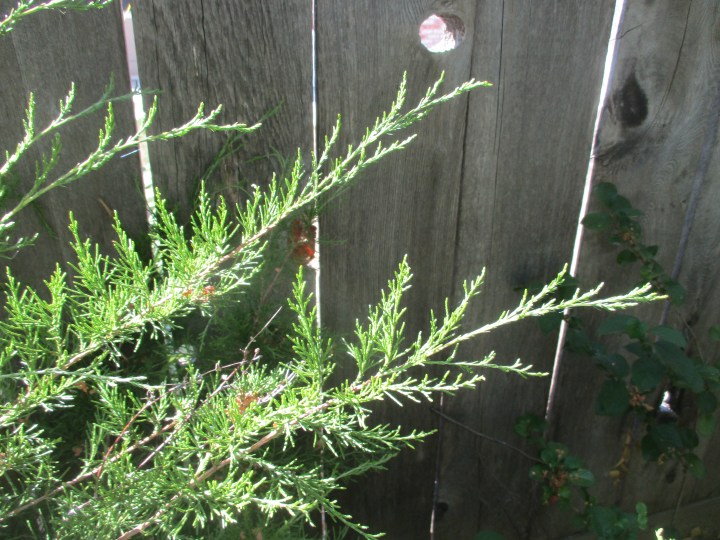
2. Ilex aquifolium – is the only one this week that I actually purchased from a nursery, while in school in San Luis Obispo in the late 1980s. It is uncommon (and unpopular) here. I still dig it.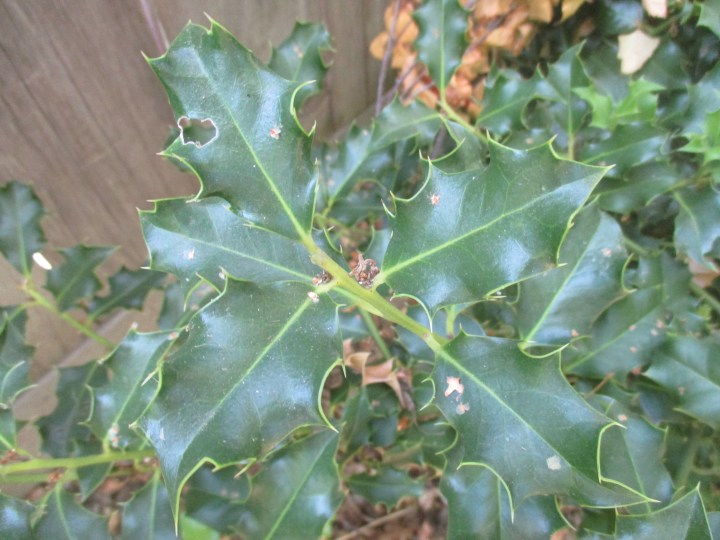
3. Viola odorata – came from Santa Clara while I was in high school. (I thought) I wanted it because it blooms white. It is not very pretty, but I can not get rid of it. Violets should be ‘violet’.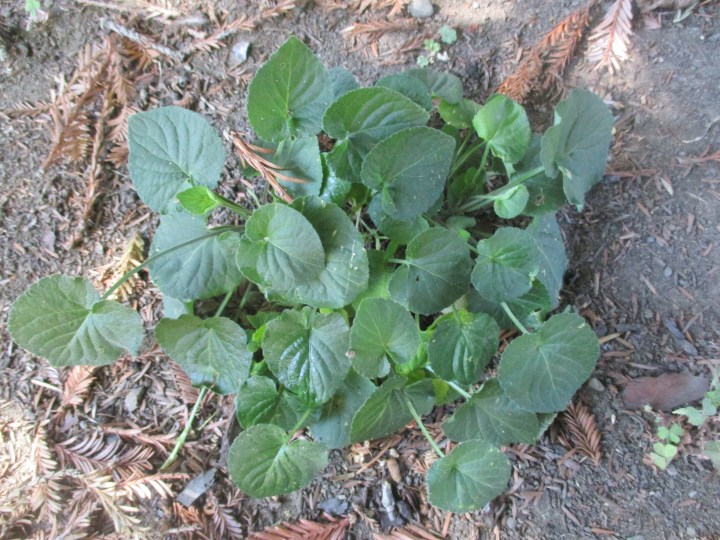
4. Pelargonium hortorum – is not the original that I found in a compost pile in Montara in about 1980, but is very likely the same ‘unimproved’ species or whatever it is. I found it downtown.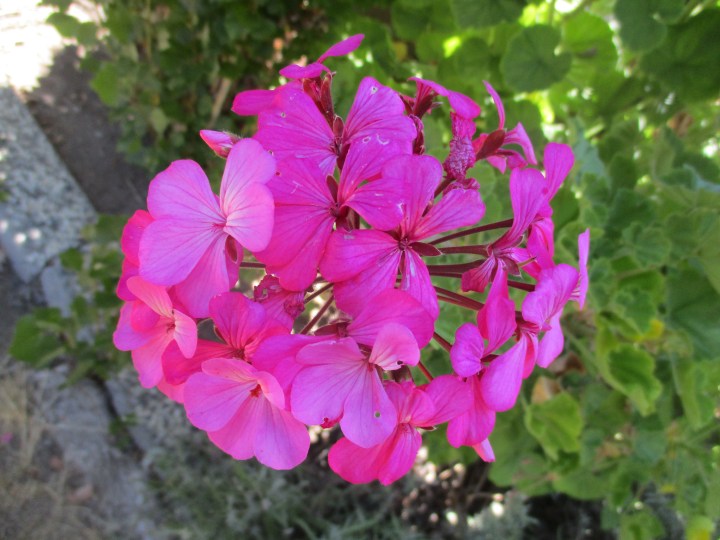
5. Agapanthus orientalis – from Watsonville in 1992, is one of my two favorite agapanthus; because it is white, but is otherwise identical to my original blue agapanthus from the late 1970s.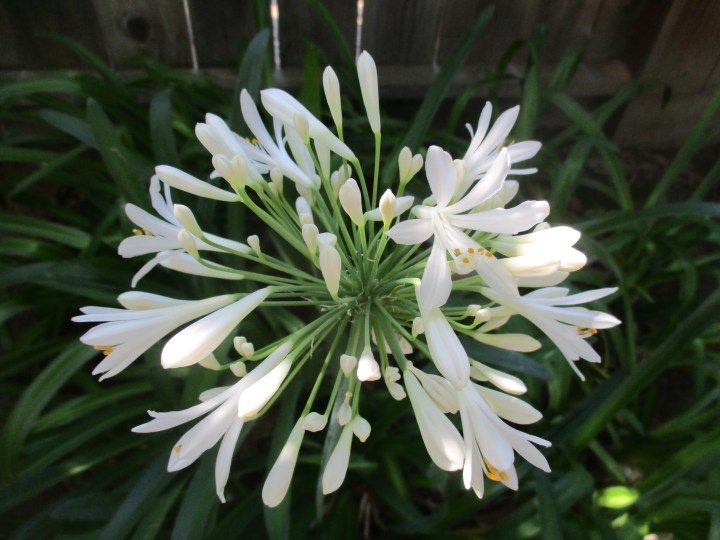
6. Amaryllis belladonna – came from Hoot Owl Creek in Oklahoma. It lived in the same garden with my Iris pallida! I know it is no more interesting that these others here, but it has history!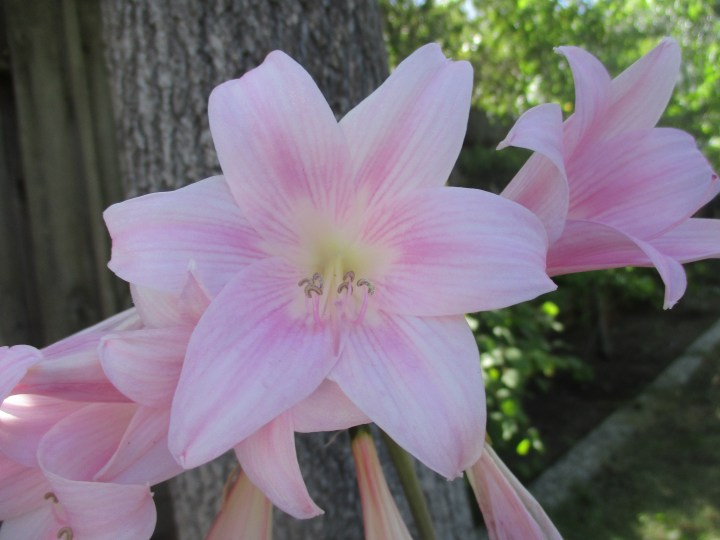
This is the link for Six on Saturday, for anyone else who would like to participate:
https://thepropagatorblog.wordpress.com/2017/09/18/six-on-saturday-a-participant-guide/

