Horticulturists are by nature, nonconforming. I happen to find it difficult to conform to what makes us nonconforming. Trends are fleeting. Old technology that has worked for decades or centuries is still best. Although I am not totally against chemicals, I find that almost all are unnecessary for responsible home gardening. Pruning is underappreciated, and fixes many problems.
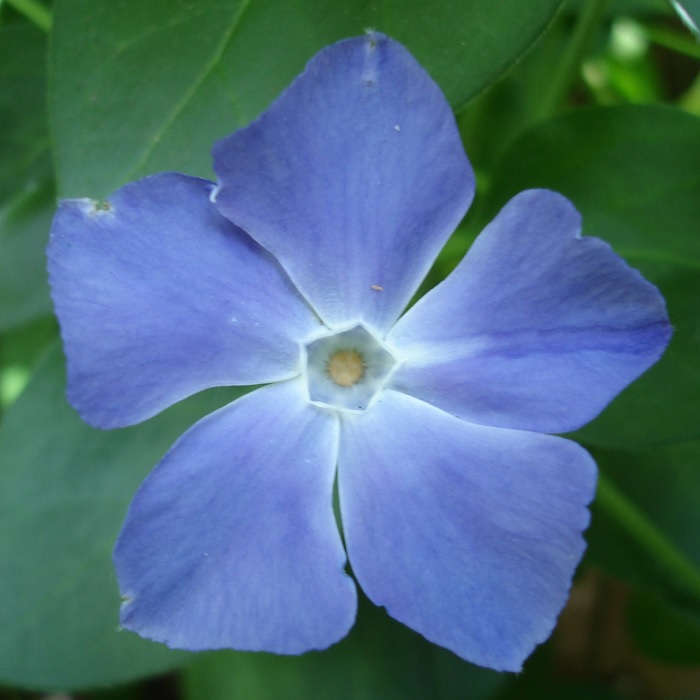
Bloom is sporadic, but the delightful purplish blue color is worth it.
If the Latin name of dwarf periwinkle is Vinca minor, it is logical that large periwinkle should be Vinca major. Large periwinkle is more commonly known simply as periwinkle or common periwinkle, although it is not as common as dwarf periwinkle is, at least in landscapes. In some regions, it has naturalized as an invasive weed.
Some might accurately say that periwinkle is shabbier than the relatively neat and dense dwarf periwinkle. Others might say that it is just rustic or informal. The wiry stems stand less than a foot tall before they bend over from their own weight. Fallen stems can root where they touch the ground, and grow into new plants over winter.
The evergreen foliage is rich green, and a bit darker than the top of a billiard table. The simple paired leaves are about an inch and a half to two inches long. The slightly purplish blue flowers are about an inch and a half wide, with five petals each. Bloom is sporadic, but almost continuous, except for a lapse through winter.
As the simple name implies, ‘groundcover’ covers the ground. Groundcover plants stay lower than shrubbery, and function something like mulch. They insulate shallow roots of other plants, inhibit weeds, and some groundcovers inhibit erosion. Besides all their utilitarian functions, they provide appealing foliage, and some bloom nicely.
Lawn is probably the most common groundcover, and is also the most useful; but that is an entirely different and involved topic! Other groundcover plants are spreading perennials, plants with sprawling stems, or vines grown without support. Most are evergreen, since defoliated plants do not cover much of anything too well.
Gazanias and iceplants are popular perennial groundcovers. Their old stems tend to die out and decompose as efficiently as new stems pile up over them, which is why they do not get too deep. Gazanias can eventually get bald spots that need to be patched with new plants, or ‘plugged.’
(The debris from pruning the edges of easily rooted perennial groundcovers can be processed into cuttings known as ‘plugs’, which can go directly into bald spots. Plugs can be taken from dense spots if no edging is necessary. They should be watered regularly, or plugged in autumn to take advantage of rain while roots develop.)
Groundcover forms of ceanothus (wild lilac), juniper and contoneaster are really shrubs that extend their stems more horizontally than vertically. Honeysuckle and both Algerian and English ivies are vines that spread over the ground until they find something to climb. Their stems root into the ground wherever they need to.
Since most groundcover plants are naturally understory plants that grow below larger plants, many tolerate considerable shade. Periwinkle and the ivies are remarkably happy in partial shade. However, vines, particularly the ivies, will climb walls and trees for more sunlight if they get the chance.
Many of the perennial groundcovers and some of the vines are neater if mown or cut low annually. Periwinkle does not need to be mown, but can get rather unkempt before new growth overwhelms the old through winter. Mowing eliminates the old stems, and makes the new growth fluffier. Dwarf periwinkle stays too low to mow.
This would have been an ideal time for a seasonal update on the little Memorial Tree in Felton Covered Bridge Park. Until recently, it had been healthier and growing more vigorously than it had since it was installed a few years ago. It had survived major accidental damage, and was just beginning to thrive. Sadly […]
Victorian landscapes made good use of cherry laurel, Prunus laurocerasus. It works well as a large formal hedge. For more relaxed modern landscapes, it makes delightful informal screen. The main reason that it is now less popular than other hedging shrubbery is that it gets rather broad if not shorn back regularly. If allowed to grow as a low rounded tree, it can get twenty-five feet high!
Regularly shearing is not necessarily frequent. It should be efficient though. Confinement for such broad shrubbery is important. If shorn back farther than where the outer surface is desired late in winter, fresh new foliage can fluff out nicely within allowable space through spring. Subsequent aggressive shearing to maintain confinement may only be necessary once or twice during summer.
The big leaves are about three inches long, and luxuriantly glossy. If hedges get shorn less aggressively, but more frequently than two or three times annually, such big leaves can be rather shabby much of the time. If shorn less frequently, small trusses of creamy white flowers may get a chance to bloom. Cultivars are more compact than the species. One cultivar is variegated with pale gold.
Those who enjoy gardening where winter weather is harsh likely know what sun scald is. It happens late in winter, if exposed bark warms enough to prematurely resume vascular activity during the day. Vascularly active tissue then succumbs to hard frost at night. Wintry sunlight is not sufficiently intense to scald bark; but the damage suggests otherwise. Glare from snow enhances exposure.
Of course, without hard frost or snow, this sort of sun scald is not a concern here. However, there is another sort of sun scald that happens during the warmth of summer. It truly is scald, caused by exposure to sunlight that is sufficiently intense to literally cook vascular tissue just below thin bark. Although induced by opposite extremes of seasonal weather, the damage is remarkably similar.
Since even deciduous trees are foliated during summer, most bark is safe from summertime sun scald. Bark becomes more exposed and susceptible if deprived of some of what shades it. That can easily happen if aggressive pruning diminishes the foliar canopy above. Removal of a nearby tree also eliminates significant shade. Painting an adjacent wall a light color can enhance glare.
White paint applied to the trunks of susceptible orchard trees reflects most of the damaging sunlight, but is too unsightly for landscape trees. Stubble of small twiggy stems can shade the trunks of some young trees until their canopies are broad enough to provide shade. Sun scald typically develops on southwestern and upper exposures that are more exposed to the most intense sunlight.
Maple, oak, ash, birch, flowering cherry, flowering crabapple, English walnut and almost all deciduous fruit trees are innately susceptible to sun scald. The interior stems of privet, holly and English laurel are more resilient to sun scald if exposed by major pruning during late winter rather than during summer. Although, with only a few exceptions, any thin bark can be susceptible to sun scald.
Foliage of many plants can be damaged by enhanced exposure too, but that is known as ‘scorch’, and is another topic.
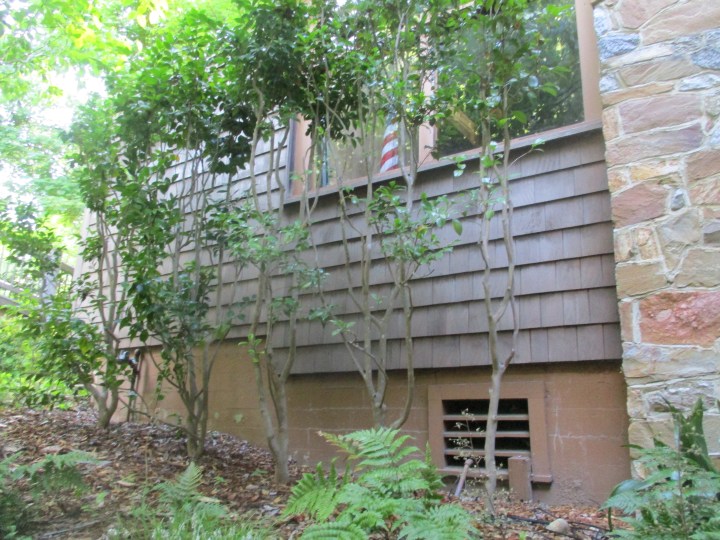
Before: Camellias left the foundation exposed a long time ago, but instead obscured the view from the windows above.
‘Foundation planting’, which most of us think of as vegetation intended to merely obscure a foundation behind lower and prettier plants, has a simple utilitarian origin. Before homes were so commonly outfitted with rain gutters like they are now, densely shrubby foundation plantings diffused water that fell from eaves, and limited splattering of mud onto foundations and walls.
Nowadays, foundation planting only needs to look good, and maybe obscure crawlspace vents or exposed undersides of decks. They might be allowed to get as high as window sills, or higher.
These camellias got more than a bit too high. They had not obscured the cinder block foundation in a very long time, and did not contribute much to the shingled wall above. What was worse was that all of their best foliage and bloom obscured the view from the window above, and obstructed sunlight to the interior. They were impressive specimens, but were not doing their job.
We tried to prune their canopies lower and thinner, in order to promote more lower growth that we could prune down to later. They responded by merely replacing what was pruned away, exactly where it was pruned away from. We considered relocating the camellias to where such big and lanky camellia trees would be desirable, but they are too old and firmly rooted in place.
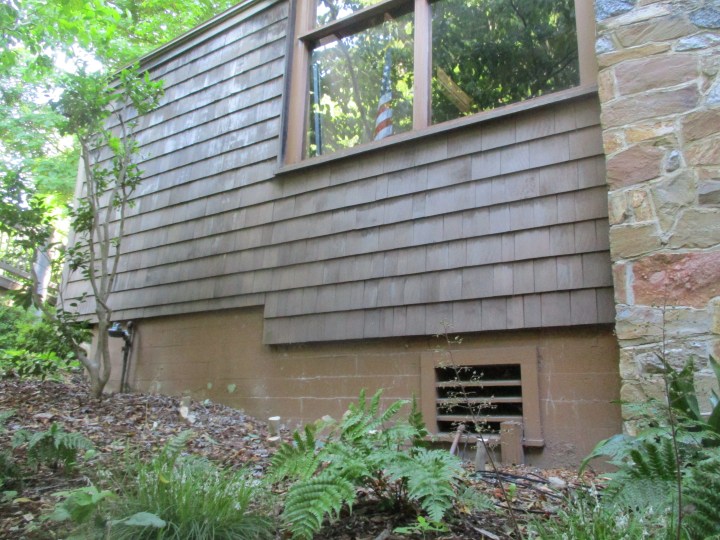
After: Camellias can either start over or die.
The only option was to coppice them. It was quick and easy. We cut them to the ground with the expectation that they will either regenerate from their stumps or die. If they die, we will not miss them. (Okay, I might.) The new growth will obscure the foundation well, and after a few years, should resume blooming. They will be patchy if some but not all do survive, but we tried.
The remaining sculptural specimen obscures no windows.
Stumps are a few inches high. Any new growth should hopefully develop on top, just above grade.
‘Small and white, clean and bright’? They only got as far as ‘small’ and ‘clean’, but did not get to ‘white’ and ‘bright’.
“Edelweiss, edelweiss, every morning you greet me. Small and white, clean and bright, you look happy to meet me. Blossom of snow, may you bloom and grow, bloom and grow forever. Edelweiss, edelweiss, bless my homeland forever.”
Why are there no corny songs like this about California poppy?
Although I never met edelweiss before, I always thought that it must be quite excellent. Those who are familiar with it where it grows wild in European mountains seem to believe so. It does not look like much in pictures, so must be much more impressive if experienced directly.
A colleague here who met it directly in Austria decided to grow some, and easily procured seed online. The seed was chilled in a freezer to simulate winter in the Alps, and sown just prior to the last of the rain as winter ended. They germinated, and the seedlings started to grow, but then mildewed. The potting soil that they were in was likely too rich and too damp.
After all, edelweiss naturally lives in limestone scree, where the climate is harsh. Such environments are less than hospitable to fungal pathogens that cause mildew. Rich and well watered medium that would be considered to be a good situation for so many other seedlings may not be what edelweiss seedlings are comfortable with.
There are already plans to try edelweiss again next year. Seed might get sown in sandier medium, and a bit later in the year, so that they are not so regularly dampened by rain. If they survive beyond their seedling stage, they will likely become more resilient as they get established in an appropriate landscape. There are a few situations here where sandy soil drains well.
Perhaps I will eventually experience edelweiss, and see what all the fuss is about.
This is not a good week for my Six on Saturday. The first three are of pansies; and the last two are of gladiolus. That is not much variety. Posting six pictures of different cultivars of roses or rhododendrons is somehow different and more interesting.
I did not get out enough to get many good pictures this week. I work inside for part of the week, and needed to stay in for Thursday as well. I got outside only on Wednesday and Friday.
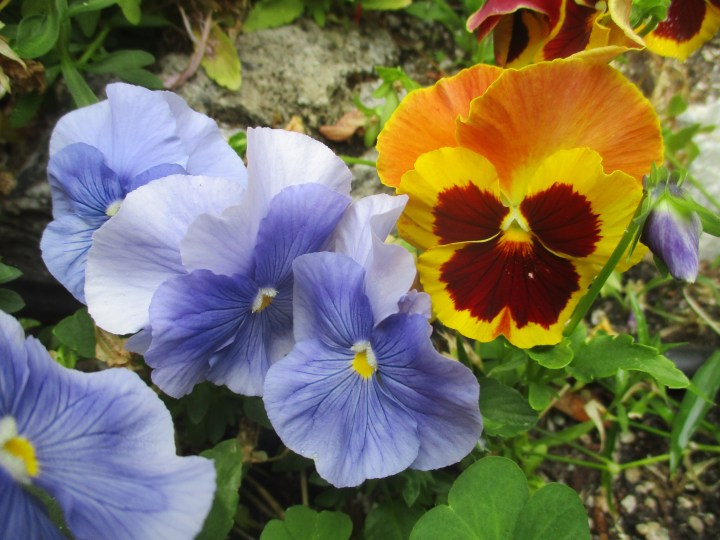
1. Pansies are slowly succumbing to the warmth of spring and early summer. They can continue to perform as long as they like, we will not be replacing them with any warm season annuals.
2. Pansies are even prettier up close. Foliage was unusually sparse among this group, even prior to spring. Pansies had never stayed so late before. I would not have guessed that they could.
3. Pansy is one of the favorite flowers of my colleague down south. Although he does not use many at work, or even in his home garden, he always grows one pot full of them through winter.
4. Alstroemeria, which are also known as Peruvian lilies, do very well here. I do not remember if this is pink or ‘peachy’. I believe it is ‘peachy’. There are also yellow alstroemeria here.
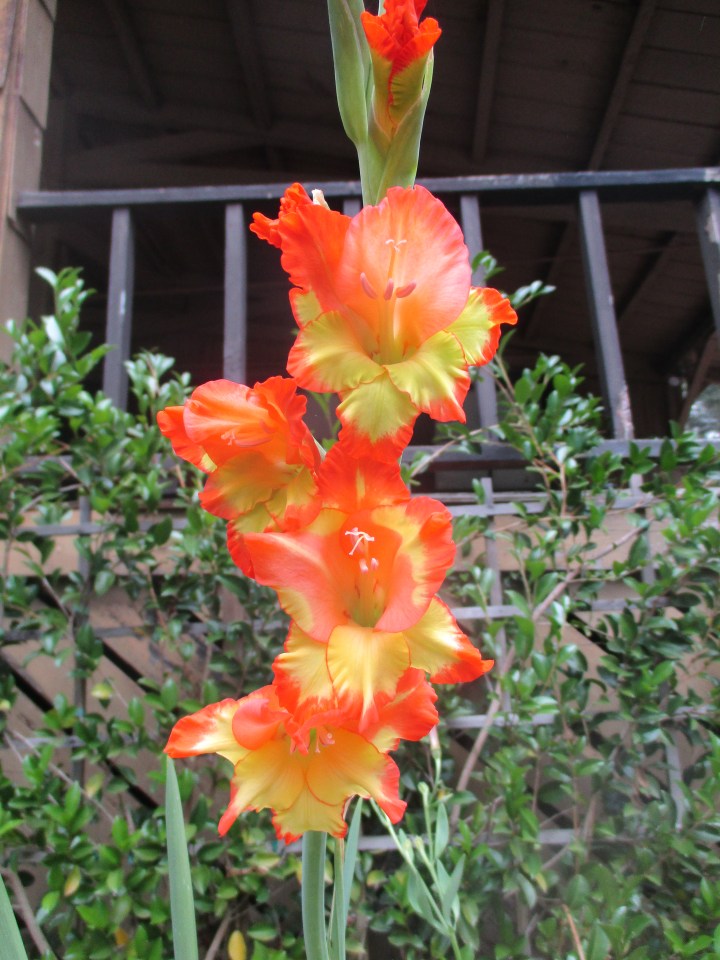
5. Gladiola is one of my favorite summer bulbs, but I have not planted any in many years. They are not reliably perennial here. However, this orange gladiola has bloomed for several years.
6. Gladiola, now that I think about it, is actually my favorite summer bulb, rather than just one of my favorites. This purple gladiola has bloomed as long as the other, only in a different area.
This is the link for Six on Saturday, for anyone else who would like to participate:
Garden varieties are less likely to naturalize than the straight species is.
Many plants are so easy to grow that they become invasive weeds. Butterfly bush, Buddleja davidii, has done exactly that in some regions, and is only controlled here by the arid climate. Yet, once established, it does not need much water at all, and can survive on rainfall in some spots. They only want good sun exposure.
Mature plants can get more than 15-feet tall and half as broad, with long arching limbs. Most garden varieties stay smaller, and some do not get much more than six feet tall. The evergreen foliage is sage green, grayish green or chartreuse. The paired leaves are about the size and shape of willow or eucalyptus leaves.
Conical trusses of densely packed tiny flowers that bloom in mid-summer can be various shades of blue, purple, red and pink, as well as dusty white. Some new varieties bloom soft orange or yellowish orange. The more compact and colorful modern varieties are not as fragrant as old classics are.
New plants are less reliant on irrigation if installed at the beginning of the rainy season.
Autumn is the time for planting. Cooling weather slows plants down so that they do not mind disruption so much. Increasing rain (hopefully) keeps the soil evenly moist while roots slowly disperse. The combination of cooling weather, increasing rain and shorter days keeps plants well hydrated so they can slowly ease into spring.
Why is this important now? Well, it probably is not important. It merely demonstrates why this is not the best time for planting. Only a few warm season annuals and vegetables get planted this time of year. Seeds for certain autumn vegetables get sown now. Otherwise, more substantial plants should wait until autumn if possible.
Mid summer in some ways is the opposite of autumn. While the weather is warm, plants are too active to be bothered. Even minor disruption can be stressful. Soil moisture provided by irrigation is often too irregular and unreliable for dispersion of many new roots. There is less time to recover from stress during shorter nights.
Smaller plants and seeds survive summer planting better than larger plants do. Seeds need to disperse all new roots anyway, so they will adapt to what they get. They certainly need regular watering, but are quite talented at putting their roots wherever the moisture goes. With a bit more time, smaller plants will do the same.
Larger plants have more difficulty with the planting process because they need to disperse so many more roots to get established. When they get planted, all their roots are initially confined to the volume of media (potting soil) that they were grown in. They are susceptible to whatever happens within that limited volume.
For example, a small plant in a four inch wide pot is initially confined to less than sixty-four cubic inches of soil. It can double its soil volume to one hundred forty-four cubic inches by merely dispersing roots less than one inch laterally. A tree in a 24-inch wide box needs to disperse roots ten inches laterally to do the same!
It would seem that drought tolerant plants would be less susceptible to the stress of planting in summer.
However, they are more sensitive because they are so reliant on extensive root dispersion. Until they disperse their roots, they actually need to be watered as frequently as other plants do.