Horticulturists are by nature, nonconforming. I happen to find it difficult to conform to what makes us nonconforming. Trends are fleeting. Old technology that has worked for decades or centuries is still best. Although I am not totally against chemicals, I find that almost all are unnecessary for responsible home gardening. Pruning is underappreciated, and fixes many problems.
Not to be confused with closely related catnip, catmint is a resilient perennial for sunny and warm spots. Nepeta faassenii had always been the more familiar catmint. Modern varieties include a few other specie and hybrids. The various catmints work like the various lavenders or trailing rosemary, without getting so shrubby.
Unless they lean on something or climb through shrubbery, stems do not often get any higher than a foot as they spread to two or three feet wide. A few stems around the edges can grow roots through winter, to spread more the following year. New plants are easy to propagate by division of some of the rooted stems before spring.
The diagonal flower spikes that bloom most profusely as weather warms in spring are the color of faded blue denim. Some catmints bloom white or pink. The finely textured foliage is grayish green, although some varieties of catmint have chartreuse or greener foliage. Spent bloom can get shorn off to keep new foliage neat.
It is amazing that so many orchards are so productive in California, and that so many similar orchards had formerly been productive in the urban areas in which so many of us now live. Nowadays, it takes so much work to care for just a few fruit trees in home gardens. Horticulture is not what it used to be.
Diseases and pests get transmitted all over the world at a rate unlike at any other time in history. It is just too easy to buy and sell infected plants online, and get them delivered without adequate inspection. Many varieties of plants that are so easily imported may not perform as reliably as the more traditional varieties.
Modern landscaping does not make fruit production any easier. Most deciduous fruit trees do not get pruned adequately or properly. Many get too much water. Almost all must live in crowded landscape conditions where diseases and pest proliferate. Sanitation (removal of infected plant parts) is rarely as efficient as it should be.
Then there is all this crazy weather! First, the winter does not get as cool as it should. Then, it does not get warm enough in spring. It is all so difficult to keep track of. Many plants do not know how to respond. Those that stay dormant through cool weather got an early start. Those that like warmth in spring started late.
The unfortunate deciduous fruit trees that need both a good chill through winter and nice warm spring weather are really confused. Early blooms were ruined by brief late frosts or brief rain showers. Some delayed blooms were not synchronized with pollinators. Some of the minimal fruit is developing slowly.
Even the fruitless or ‘flowering’ relatives of the deciduous fruit trees are annoyed by the weather. Many flowering cherry trees that should have bloomed profusely prior to foliation delayed bloom until lower foliage started to appear. However, both bloom and foliation are so slow and sporadic that upper stems stayed bare quite late.
Flowering crabapple trees, which generally bloom after flowering cherries, actually bloomed more reliably, and were not delayed as much. Hopefully, fruiting apple and pear trees, although late, will be more productive than so many of the cherry, apricot, plum, peach and nectarine trees will be this year.
Rhody was not impressed, and he is an expert on fragrance.
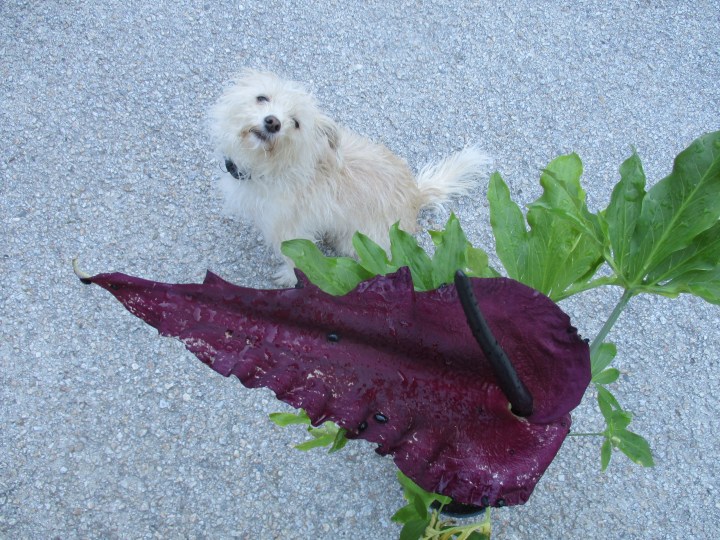
Dracunculus vulgaris – dragon lily. It was featured in the gardening column for next week, both as an illustration for the main topic, and as the ‘highlight’ species. It is as unappealing as the name and the pictures suggest, but it sure is interesting. It has several more equally unappealing common names. We know it as ‘death arum’ because that is the first name we came up with.
Besides, it smells like death. Yes, it stinks. It does so to attract flies for pollination. Actually, it attracts quite a few annoying insects. I can not explain why, but insects who congregate around stinky flowers are as unappealing as the fragrance that draws them. They are certainly very different from the appealing bees and butterflies who pollinate flowers with appealing fragrance.
The first of these death arums mysteriously appeared in the garden of a colleague several years ago, and promptly multiplied by both seed and disbursement of tubers. There are now a few expansive colonies that continue to expand. Cutting down the foliage does not slow them down much. The fragrance, which is not too bad individually, is getting to be bothersome collectively.
My colleague brought me one of the tubers to confirm the identity. I got a picture of it since it was here, but then did not know what to do with it. I did not want to toss it aside into the forest like I do with so much other greenwaste. It could have grown into a problem. I did not want to discard it either, since it was viable and healthy. So, I canned it and put it aside in the nursery.
This is the result. It is not as stinky as I expected it to be. I still do not know what to do with it.
These unidentified beetles that I had never noticed here before arrived promptly for the stinky bloom.
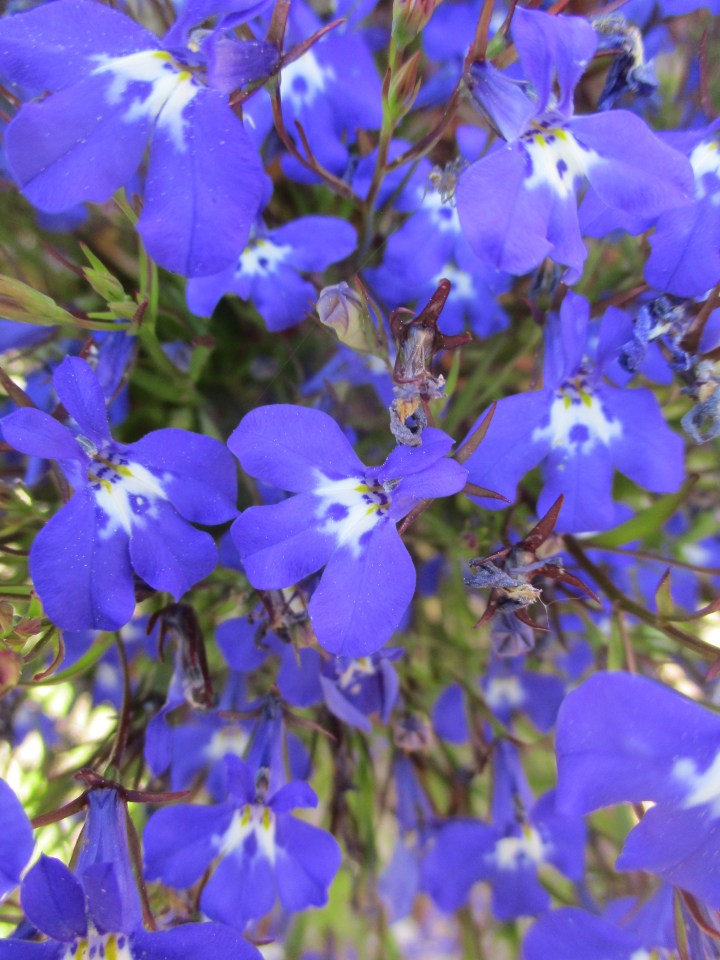
No other bedding plants exhibit such rich blue as trailing lobelia, Lobelia erinus. Cultivars with white, purplish pink, purple or sky blue bloom are still not quite as popular as the favorite cobalt blue bloom. Individual flowers are tiny but very profuse and uniform. Some have white centers. The narrow leaves are tiny as well, and finely textured. Some cultivars have dark purplish bronzed foliage.
Individual plants are only about three to six inches high and wide. Cultivars that are more rounded and densely foliated are excellent for edging. They are very popularly planted in single rows, and alternating with alyssum. Trailing types exhibit wispier growth that stays a bit lower and spreads a bit wider. They do not trail far, but cascades nicely from urns and hanging pots of mixed annuals.
Although grown as a warm season annual, trailing lobelia can survive as a short term perennial where winters are mild. Fresh new growth develops out of the centers of overwintered plants about now. If pressed gently into the soil just before they are replaced by new growth, scraggly outer stems can develop roots. They just might grow into new plants before the originals eventually die off.
Bedding plants that go into the garden in spring are generally warm season or summer annuals. They should perform through summer until the weather gets too cool for them the following autumn. Bedding plants that go into the garden in autumn are generally cool season or winter annuals. They should perform through winter until the weather gets too warm for them late the following spring.
That sounds simple enough. Each type of bedding plant performs best within a specified season. Since they are annuals, they complete their life cycles within a single season within a single year. Of course, it is not so simple here where seasons are as unique as they are. Winter is mild. Summer is arid. Some bedding plants that are annuals in harsher climates may survive as perennials.
For example, busy Lizzie and wax begonia are warm season annuals in most climates. They succumb to frost as weather cools in autumn. Locally, they can survive through winter if sheltered from mild frost. Any that survived through last winter can regenerate now. As bedding plants, they will not be as uniform as they were last year. However, their variability would be fine for mixed bedding.
If sheltered and warm enough, wax begonias may actually continue to perform right through winter. If they dislike the aridity of summer, they can even perform slightly better through winter than they do through summer. Their best performance is often about now and again in autumn, between the two extremes of summer and winter. They challenge their designation as a warm season annual.
Even some of the bedding plants that really are annuals may not behave as such. Alyssum and nasturtium can disperse seed to replace themselves before they finish. They are not true to type, so their progeny eventually revert. Nonetheless, simple yellow and orange nasturtium and white alyssum are splendid for many relaxed gardens. Nasturtium might perform better in summer or winter.
Bedding plants usually know more about what they should be doing than those who are managing and manipulating them.
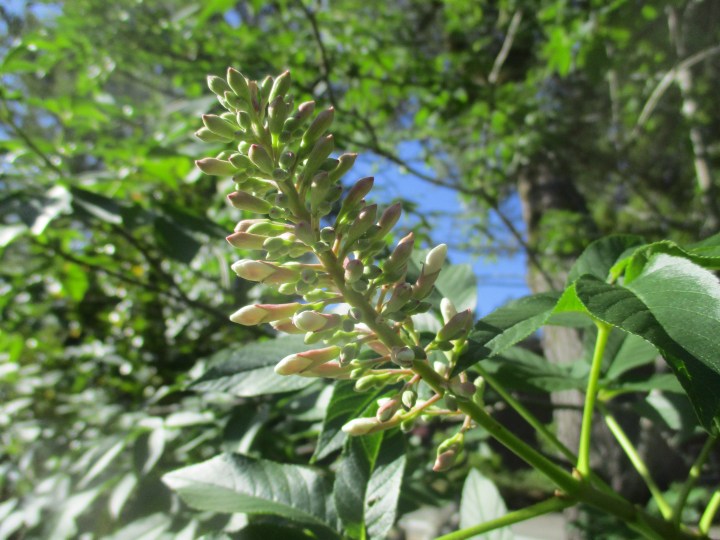
Buckeye starts to bloom like lilac, or upside down wisteria.
Ohio is the Buckeye State. The Ohio buckeye that is native there must be very special. Perhaps all other trees that are native to Ohio are just not very uninteresting. Whatever the situation, I sort of believe that the Ohio buckeye is more appealing in some regards than the California buckeye that is native here. However, the California buckeye might be more weirdly interesting.
The main reason that California buckeye is not popularly used in landscapes is that it is ‘twice deciduous’. That means exactly what it sounds like. Just like other deciduous trees, it defoliates in response to cooling autumn weather, and refoliates in response to warming spring weather. Unlike other deciduous trees, it repeats the process through the warmest weather of summer.
When summer weather gets too warm and arid, the foliage of California buckeye shrivels and sort of defoliates. Without rain to dislodge the shedding foliage, it can linger and look shabby for quite a while and maybe until it is replaced by secondary foliage that develops as the weather mellows. The secondary foliage does not last long before it is time to defoliate again for autumn!
California buckeye is not often planted into landscapes because it really does look like the living dead through summer. It provides no shade when shade is most desirable. Those that I work with are only here in the landscapes because they grew from self sown seed that sneaked in on its own. Some will be subordinated to more desirable adjacent trees, although there is no rush.
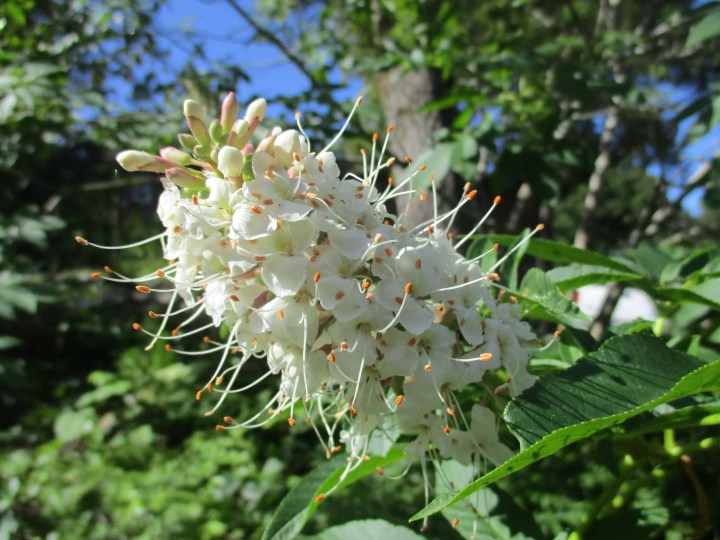
I happen to like California buckeye. Except for the rarely seen red horsechestnut, it is the only species of buckeye that I am familiar with. Bloom is neither colorful nor reliably profuse, but is delightfully fragrant in close proximity. Not many natives are fragrant.
The fragrance is sort of buttery and faintly sugary.
This is not another of my many racial slurs for the renowned Southern Californian landscape designer, Brent Green. Believe or not, I endure many more of such slurs from him; so will not even bother putting something else out there that compels his retaliation. This is about Japanese laurel, Aucuba japonica, which is incidentally rather yellowish with rich golden variegation.
Japanese laurel, which is known as gold dust plant locally, is happy in partial shade, and will tolerate rather significant shade. That is a distinct advantage in landscapes that are dominated by so many big redwoods. Even without significant bloom, the bright yellowish foliage is an asset in visually dark parts of the landscapes. There probably should be more of it here than there is.
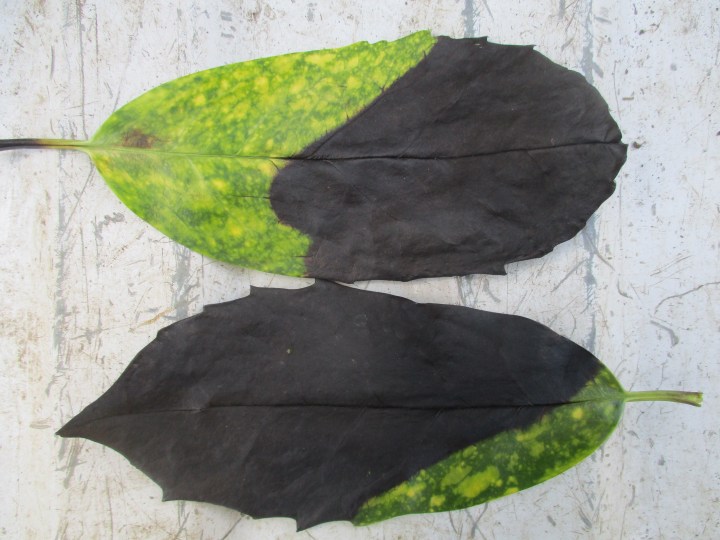
It is not one of my favorites though. It does not cooperate with pruning, and often produces overly vigorous growth that flops over in response to aggressive pruning. It shelters proliferation of snails in warmer climates. What I dislike most about it is the prominent blackening of some of the foliage that is too exposed to direct sunlight. It is so unsightly in front of the cheery gold.
After pruning a few overly vigorous stems that became floppy, I noticed how quickly the lush and fresh new foliage blackens from exposure. The pictures above and below were taken about two hours after the stems were pruned. The stems grew in a notably shaded situation, and were then left out on a hot black bed liner without shade, which of course accelerated the process.
I should have gotten a picture of the foliage as I found it, with all exposed surfaces blackened, as if spray painted where they were on the black vinyl. The portions of the leaves that remain green were shaded under other foliage.
Shaded parts are still fresh and gold dusted green. Exposed parts are roasted to a crisp.
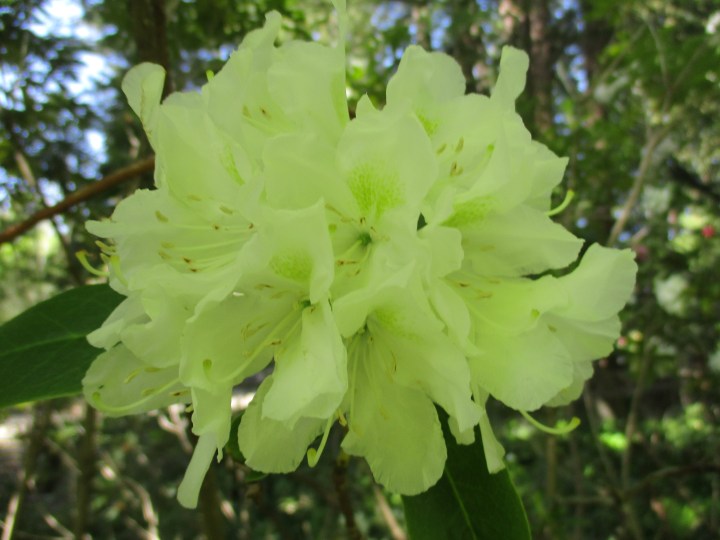
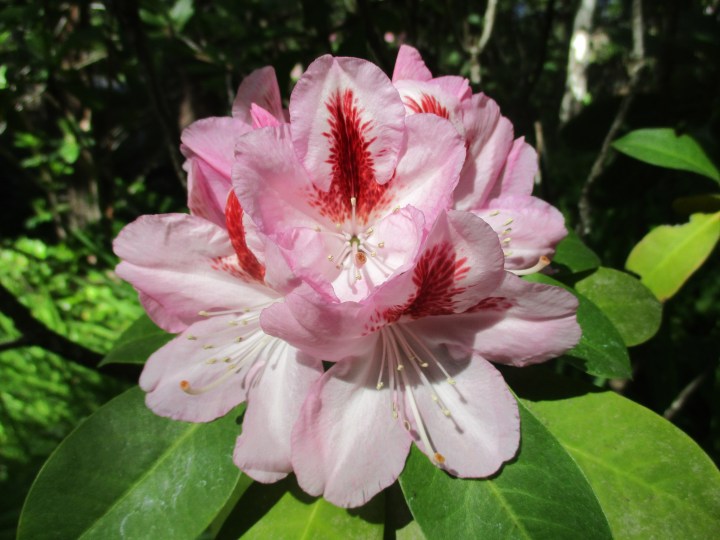
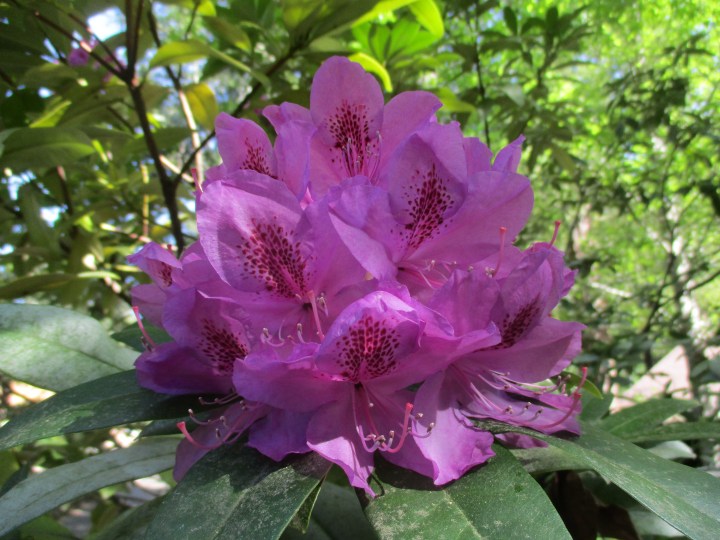
As mentioned last week, the first five of these pictures are now two weeks old. They are too pretty to discard for lack of punctuality. However, it was necessary to delete one so that the most important, although less horticultural, sixth picture could be included. Not much of the bloom remains now.
1. Color seems odd for this one. It did not seem so greenish to me when I got the picture. In fact, it seemed more pale, and almost white. I know the camera sees it more accurately than I do.
2. #1 from last week, which may have been ‘Mrs. G. W. Leak’, looks like this. I did not notice earlier. I would have otherwise deleted this instead of what I deleted to leave room for #6 below.
3. If #4 from last week did not look like ‘Anah Kruschke’, it is because this one is. I knew I got a picture of it, but somehow switched the two. This is the only one that I can identify this week.
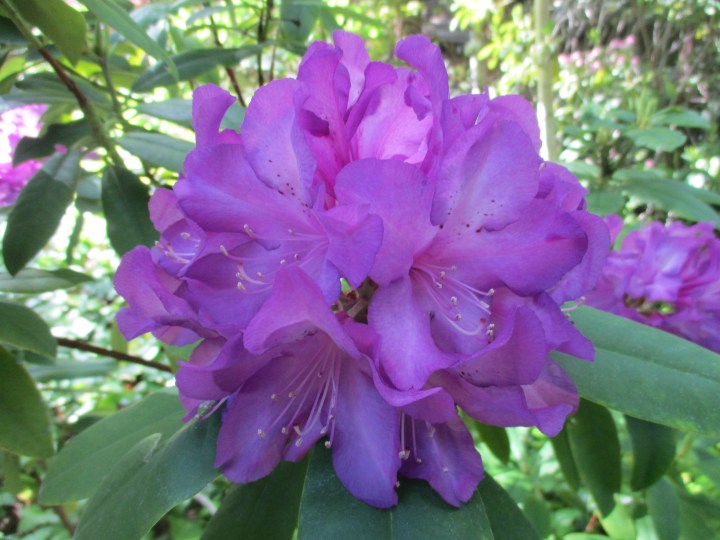
4. Color is something that I am not proficient with. I do happen to prefer this color to other purple rhododendrons. I do not know if it is purple or lavender, or if lavender is just pastel purple.
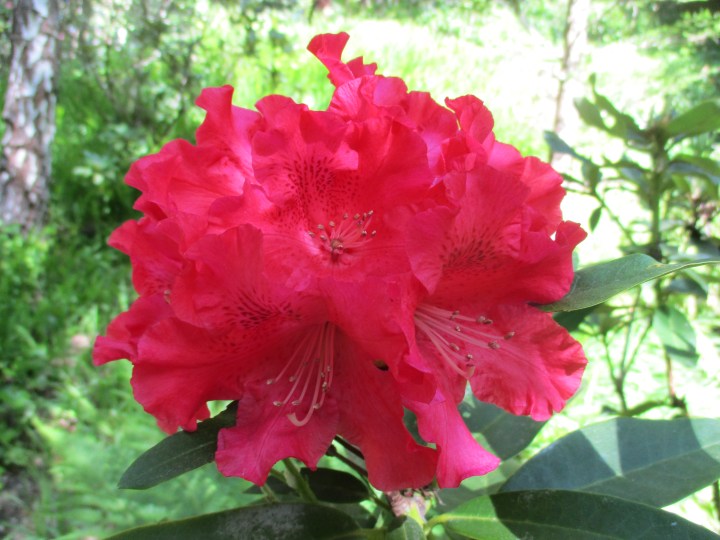
5. Of all the rhododendrons here, only a few are as richly red as this one. Of those few, this one is the second largest specimen, and most prolific in bloom. It is usually one of the last to bloom.
6. Rhody! It is not much, but it proves that I at least tried to get a picture of what we all came here for. I deleted a good picture of another rhododendron to do it! Rhody would not cooperate.
This is the link for Six on Saturday, for anyone else who would like to participate:
There are several oaks, especially natives, that do not need much more water than they get from rain. Pin oak, Quercus palustris, is not one of them. It is naturally endemic to areas that are damp or swampy for part of the year. It is more tolerant than others are to lawn irrigation, but is also more sensitive to drought.
Compared to other oaks, pin oak grows fast while young. It can get two stories tall in about ten years. Then, it takes more than twice as long to double in size. Old trees do not get much more than fifty feet tall, with trunks nearly three feet wide.
The deciduous foliage turns as brown as a grocery bag in autumn, and may linger late into winter, or until it gets replaced by new foliage in spring. The distinctively deeply lobed leaves are about two to five inches long, and about two thirds as wide. Each leaf has five or seven lobes. Each lobe has five to seven teeth.
There really is no such thing as a perfect tree. Some are not quite as messy as others. Some have better structural integrity than others. Some have gentle roots; and some stay proportionate to tight spots. However, without exception, all trees grow, drop leaves, and disperse roots.
This is an important consideration when selecting any tree, and especially when selecting a street tree for the narrow space between the curb and the sidewalk (which is commonly known as a park strip). Even where there is no sidewalk, or where the sidewalk is at the curb, most of the obstacles are the same.
Street trees should have reasonably complaisant roots that should not be likely to damage curbs, sidewalks or roadways, at least for several years. They should naturally develop reasonably high branches. They will need to be pruned higher than trucks that may park at the curb. Street trees must also tolerate harsh exposure.
Wider park strips can of course accommodate larger trees. Those that are only two feet wide or narrower are probably not wide enough for any tree larger than photinia, purple-leaf plum or English hawthorn, which are difficult to prune for clearance over roadways and sidewalks.
Messy leaves, flowers or fruit that might not be a problem within the garden might be more of a problem at the curb. It is not so easy to rake such debris if cars park over it. Trees that are commonly infested with scale or aphid are likely to drop sticky honeydew (scale and aphid poop) onto parked cars.
Unfortunately, those who get street trees do not always get to select them. Many municipalities assign specific trees to specific streets. Some streets have a few trees to choose from. Others have only one option. Home Owners’ Associations (HOAs) decide if and where new trees get planted.
Crape myrtle is probably the most common choice for a new street tree because the roots do not get big enough to damage pavement. However, the canopies are not very big either. They stay too low to be pruned above trucks. Crape myrtle is susceptible to scale infestation that can get bad enough to make sidewalks sticky.
For many years, London plane (sycamore) had been another popular street tree. Unfortunately, the voracious roots can damage pavement within only a few years. The messy foliage discolors and starts to fall before autumn.