Rodents Will Never Give Up

00401thumb
Warming weather brings out the gophers.

None of the most problematic rodents here hibernate completely. Only ground squirrels hibernate, but they are rare, and tend to avoid home gardens and refined landscapes. Some other rodents are less active through the cooler parts of winter, but never completely stop eating, chewing and digging up what they want from our gardens. Many will become more active with warming weather.

Gophers are the most destructive rodents right now. They might still be excavating the mud of last winter from their tunnels. They will find plenty to eat as warming weather stimulates root growth of their favorite plants. Young gophers are growing up and leaving home, to excavate more tunnels and consume more vegetation elsewhere. They are more numerous now than they will be all year.

Squirrels are not so industrious. For now, they are destructive only if they dig out recently planted seedlings and bedding plants, or eat flowers and freshly emerging foliage. They should otherwise be temporarily satisfied with acorns that they hid late last year. They will become more of a problem as they eat ripening fruit, nuts and maybe vegetables later in summer. Some might chew bark.

Rats are sneakier than squirrels. They are not as destructive to ripening nuts and stone fruits, but do eat some of what falls to the ground. Although not a problem for the garden, well fed rats infest adjacent homes, where they cause serious damage. At this time of year, rats sometimes ruin citrus fruit. They eat the pulp out from the rinds of oranges and tangerines, and the rind off of lemons.

Rodents are nearly impossible to exclude completely and safely from gardens. Poisons are too dangerous to be practical around the home, particularly if there are dogs or cats anywhere nearby. Traps are safer and effective, but require diligence. Also, some traps are difficult to set. Each type of rodent exhibits distinct characteristics. That which controls one type is ineffective for another.

Sanitation and vegetation management deters some rodents by depriving them of sustenance and nesting sites.

March 22, 2020 – Memorial Tree Update

As I promised earlier, this is the update from Felton League.

tonytomeo's avatarFelton League

Before

If it continues with the healthy growth it exhibited after a seemingly slow start last year, the still small Memorial Tree of Felton Covered Bridge Park should be happy now, in its fifth season. It was pruned, groomed and relieved of weeds last Friday. Its first dose of fertilizer will be applied today, before fresh new foliage starts to develop. New binding should remain until autumn.

The last update for the Memorial Tree was on August 10. An update regarding its horticultural concerns posted earlier this morning on my other blog, where this post will be reblogged to. This little tree has certainly been through some difficult times. It is gratifying to see that it is recovering and doing well. As it grows, it becomes more resilient and less susceptible to damage.

The Memorial Tree is actually the fourth tree to be planted on its spot since Felton Covered…

View original post 152 more words

Memorial Tree Update – March 22, 2020

P00322-1
Memorial Tree – Before

Updates get complicated as they link back to previous updates to previous updates to previous updates and so on. Linking and reblogging from another blog adds more complication. The last update for the Memorial Tree was reblogged from Felton League on August 10. It and previous updates should link back to preceding updates chronologically. At least it sounds simple.

Another brief update that will reblog here from Felton League at noon will describe more of the social significance of the Memorial Tree rather than horticultural concerns. It really is special.

This little Memorial Tree has certainly been through some difficult times. Despite reassurances that it would not happen again, and that the tree would be outfitted with an ‘approved’ trunk guard, the trunk base has been gouged by weed whackers on more occasions than I can remember. That is an unfortunate consequence of efficient but unaware community service workers.

Such major damage severely inhibited growth. As it begins its fifth year, the Memorial Tree is barely six feet tall. By now, it should be developing branch structure above minimal clearance. Fortunately, it was quite healthy last year. If it continues to grow similarly this year, it will grow above six feet, where it can later develop scaffold limbs. I intend to apply fertilizer regularly.

Stubble had been left on the trunk to enhance caliper growth. That which was developing into significant branches was removed to concentrate resources into vertical trunk growth. Stubble that remains is minimal, but should be substantial enough by winter to get mostly pruned away again. It will more likely be unnecessary, and pruned away completely from the main trunk.

Binding is unfortunately still necessary. The species innately develops irregular form. Binding straightens the otherwise curved trunk. Once the trunk lignifies in the desired position, binding and the associated stake will not be necessary. The larger lodgepole stake holds the binding stake vertical, but is more important for protection from those who bump into the still small tree.

Weeds were removed from around the base of the Memorial Tree, so that there would be no need for a dreaded weed whacker to get close to it. Former damage is compartmentalizing well.

P00322-2
Memorial Tree – After

Poppy And Periwinkle

P00321-1
Even though I know they are slightly purplish, periwinkle look blue to me.

Clearing space for a new small vegetable garden is more work than it will be worth. It took more than a day to remove the thicket of bramble from a triangular area that is only about forty feet from front to back, and not much more than twenty feet wide. After so many years of getting trash dumped on top of them, the brambles were unusually prolific with gnarly root burls.

There is still significant work to do. I still need to condition the soil and groom the adjacent junipers before sowing seed for the warm season vegetables for this summer. Now that I can see that the junipers that were formerly concealed by brambles are worthy of salvage and grooming, I will need to clear a bit more garden space across the road, and cut back a few trees above.

When finished and producing, the garden will not produce enough. The four hundred or so square feet in the main part of the garden should supply enough for two people; but realistically, it would more likely produce enough for me alone, with a bit extra to can for when it is not producing much. There are about a dozen on our crew. They all have families. I need a quarter acre!

The math of it all is frustrating. So is all the work to get it started. It all seems so futile. I know we will appreciate the little bit that we get. I will still get plenty from the weeds that grow wild around the baseball field, so will not take much from the garden.

P00321-2
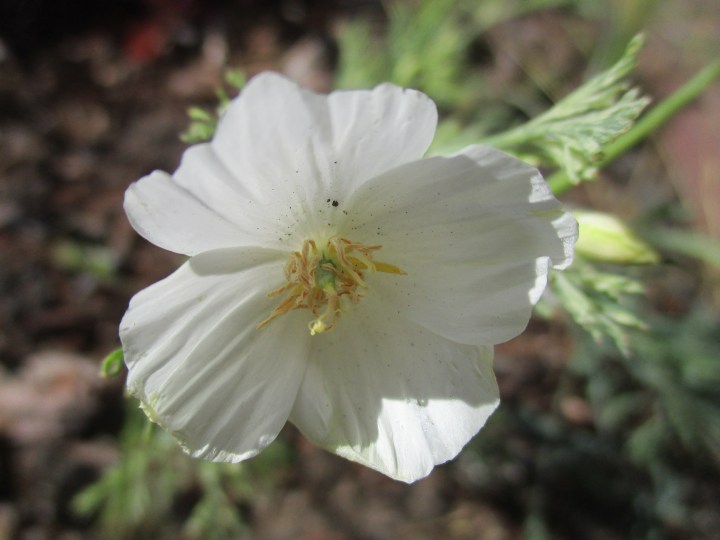
As simple as they are, poppies are still my favorite native wildflower.

For now, I try to visualize what the small vegetable garden will look like in production this summer, even if all that I see blooming are the poppies and periwinkle on the outskirts.

P00321-3
My illustrations are more technical than artistic. It looks like someone else took this one. Ignore the pickup in the background.

Six on Saturday: New Vegetable Garden


There is more time for a late start on a new vegetable garden now. I had planed to take this and next week off from most of my work, to tend to other neglected obligations. However, under the circumstances, I am still unable to tend to many of those obligations! Well, the crew wants a new vegetable garden.

1. Before, the area was overwhelmed with a dense thicket of Himalayan blackberry brambles, that had grown up into the joists of the deck above, and over the adjacent junipers to the right.P00321-1

2. After, it is not much better. This initial phase took me half a day!! I intended to remove most or all of the junipers, but as they become exposed, it is evident that they are worth salvaging.P00321-2

3. I already know I will be sowing seed for the warm season vegetables a bit late; but this wild cucumber feels compelled to remind me. It is already past the top of this seven foot high fence.P00321-3

4. This is just some of the debris that I removed. For comparison, the animal to the lower left is a buffalo. Okay, it is really just Rhody. The dumpster is as high as the cargo container though.P00321-4

5. Okay, so that was a bit of an exaggeration. The pile really is this big, but only the small portion outlined in yellow to the upper right is from the new garden, and is only about two feet high.P00321-5

6. While up on the bridge over the debris pile, I got this picture of most of the work trucks that are not at work where they belong. Everyone else writes about it; but I have not mentioned it.P00321-6

This is the link for Six on Saturday, for anyone else who would like to participate:

https://thepropagatorblog.wordpress.com/2017/09/18/six-on-saturday-a-participant-guide/

‘Eureka’ Lemon

50318

‘Lisbon’ lemon actually came first. It is still grown in orchards for lemon juice and other lemon products. The glossy evergreen foliage is a nice bright green. The late winter bloom is nicely fragrant. Mature trees can be kept about twelve feet tall, or allowed to get much taller. Besides the nasty thorns, the only other problem is that all the fruit ripens within a limited season.

‘Eureka’ lemon, Citrus limon ‘Eureka’, is a mutation of ‘Lisbon’ that is more casual about its schedule. It produces a good quantity of fruit in season through the end of winter, and also produces lesser quantities throughout the year. Because it is so productive, the lesser quantities should be more than sufficient whenever lemons are needed.

The ‘Variegated Pink’ lemon is a mutation of ‘Eureka’, so is a mutation of a mutation. The foliage is nicely variegated with white. The green fruit is striped with yellow until it ripens to yellow. The pulp and juice are pink of course. Like many variegated plants, the ‘Variegated Pink’ lemon stays much smaller than ‘Eureka’ lemon, and is more sensitive to frost.

No One Likes A Sucker

50318thumb
Citrus have been bred for centuries.

Citrus trees that are grown from seed take a few years to mature enough to produce fruit. As they mature, the juvenile stems are outfitted with thorns that are even nastier than thorns on adult growth! Because most citrus has been extensively bred, seed grown trees are very likely to exhibit genetic variations. This is why citrus trees are cloned from stems of stock trees.

Cloned trees are genetically identical to their parents, so will always produce the same fruit. They are cloned from adult growth, so do not need time to mature from juvenile seedlings. They can therefore bloom and produce fruit as soon as their roots are ready. Also, their thorns are less dangerous.

Cloning citrus is not as simple as rooting them from cuttings though. With few exceptions, citrus trees are grafted onto genetically different rootstock. Most citrus trees in home gardens are grafted onto dwarfing rootstock that limits the size of the trees when mature. Orchard trees are grafted onto rootstock that allows them to get significantly larger.

The graft union, where the upper part of a grafted tree is attached to the rootstock, is typically visible just above the ground. The base of the trunk below the graft union is typically a bit more stout than the relatively lean section of trunk above the graft. Trunks of old trees are often more furrowed below the graft union than above it.

Sometimes, the rootstock tries to do more than provide roots. It can produce stems from below the graft union, known as ‘suckers’ that can potentially compete with the grafted portion of the tree above. Unfortunately, understock grows more aggressively than most types of citrus, so can overwhelm and shade out the desirable parts of an otherwise healthy citrus tree.

The most common understock for citrus produces suckers that are outfitted with unusually big and wicked thorns that are not to be messed with! If fruit develops, it seems to be humongous and disfigured lemons that lack flavor. Before they overtake good citrus trees, suckers should be pruned neatly away as they develop, without leaving any stubble to regenerate more sucker.

Horridculture – Red Hot Chili Peppers

00325thumb
Sweet bell peppers are actually more of a challenge to grow.

This illustration is relevant neither to the topic, nor to that really creepy rock band of the same name. Even though the band has been popular since I was in high school, all that I know about them is that I am none too keen on their music. Embarrassingly, I do not know much more about the topic, and it has been a hot topic much longer than I have been growing my vegetables.

Vegetables make no music of course. I just mean that I am no more familiar with contemporary cultivars of hot pepper than I am with music that I do not appreciate. I happen to appreciate some types of peppers, and some of them happen to be hot peppers. However, I have not bothered to get acquainted with those that are so ridiculously hot that I do not want to grow them.

Why should I? What are they good for? Why waste my time, limited garden space and other resources on something that no one wants to eat or add to any recipe? They are not particularly productive. If they were, they would only make more of something that is just as useless as the few that each plant produces. I can not even justify putting effort into finding a picture of one.

Those who indulge in this fad brag about it profusely. They post pictures of their few tiny hot peppers online, with sensational claims that there is nothing hotter. Some post selfies with their free hand dangling one of their weird peppers over their extended Gene Simmons tongue. Some even post videos of their drunken friends tasting their peppers, as if it can not be done sober.

I suppose that, regardless of how pointless it seems to me, it is one way to enjoy gardening.

Onion

00325
Onions are weirdly bulbous foliar vegetables.

Although it is the most cultivated species of its genus, no one knows the origins of domestic onion, Allium cepa. Leek, shallot, garlic, chive, and a few other species are also popular vegetables. Most common bulbing onions produce familiar distended bulbs that are ready for harvest after defoliating and initiating dormancy in autumn. Green onions are leaves and attached juvenile bulbs.

Onions are probably easiest to grow locally from small juvenile onions known as ‘sets’, that grew from seed during the previous summer. Alternatively, seed sown during summer grows into small plants that go dormant to overwinter, and then resume growth the following spring. Mature onions should go completely dormant in autumn before storage, but are usable directly from the garden.

Yellow or brown onions are the most popular for cooking. Red or purple onions are milder and more colorful for fresh use, and are also popular for stir fry. White onions, whether fresh or cooked, are even milder, and are the traditional onions for salsa. All onions produce distinctively bluish foliage that stands about a foot high. The hollow leaves flop over and shrivel for dormancy in autumn.

Crop Rotation For Home Gardens

00325thumb
Pepper plants should get relocated annually.

Vegetable gardening is not permanent landscaping. With few exceptions, vegetable plants are annuals, like bedding plants. They do their respective jobs within only a few months. When finished, they relinquish their space to different vegetable plants of a different season. More of the same will be in season again in a few months. Crop rotation is something to consider when that happens.

Crop rotation is standard procedure for field crops involving several acres of the same variety of vegetable. Some crops grow on the same land for a few years. Some change annually. With few exceptions of big perennial vegetable plants, none stay in the same location for too long. Some fields go fallow for a season without production. Most simply produce a different type of vegetable.

Vegetables that grow for too long in the same soil eventually deplete some of the nutrients that they use most. Different types of vegetables deplete different types of nutrients. Crop rotation allows soil that was depleted by one type of vegetable to be used by another type that does not mind the depletion. While slowly depleted of a new set of nutrients, soil recovers from previous depletion.

For example, a sunny side of a fence is an ideal spot to grow pole beans. It is tempting to grow them there annually. However, they do not perform as well for a second season, and are likely to be scant for a third year. However, tomatoes appreciate what beans do to the soil, and do not miss what they took from it. After tomatoes take what they want for a season, beans are ready to return.

Crop rotation also helps to disrupt the proliferation of host-specific pathogens that overwinter in the soil and decomposing plant parts.

Generally, new vegetable plants should not be of the same family as vegetable plants that they replace in a particular location. Beans, squash, okra or corn should be happy where tomatoes grew last year. Peppers and eggplants are of the same plant family as tomatoes, so are likely to crave what the tomatoes already depleted. They are also susceptible to some of the same pathogens.