Autumn is mild here. There has been no rain yet. None is in the forecast. Nights are only beginning to get cool. A thermometer outside claims that it has been cool enough for frost, although none has yet been observed. As pleasant as such mild weather is, it can be boring in the garden. The few deciduous trees that develop good color are only beginning to do so, and in no rush. Some chores that rely on chill or rain get delayed.
1. 32 degrees! Does this qualify as frost? This is the same thermometer that said it was 96 degrees last week. I do not believe everything it says, although cold is not as easy to fake as heat.
2. Krispy Kritter had a bad day. It is not from frost though. This formerly exemplary Heavenly bamboo succumbed to warmth and aridity, . . . . and unintended disconnection of irrigation.
3. California buckeye defoliated through the warmth of summer, and should foliate for early winter, only to defoliate as winter gets cooler. I knock these big seeds out because they look silly.
4. African iris, Morea bicolor, got split early where it crowded a walkway. We did not want to plug it until the rain starts, so soaked it in a bucket of water, where the roots started growing!
5. Mrs. Pollock zonal geranium, Pelargonium hortorum ‘Mrs. Pollock’, likewise needed to be pruned back prematurely. I was able to process cuttings from the scraps, and plug them directly.
6. Such intricate variegation is genetically unstable. Mrs. Pollock zonal geranium often gets less variegated mutant growth that must be plucked. Well, . . . . I sort of plugged some as cuttings.
This is the link for Six on Saturday, for anyone else who would like to participate:
https://thepropagatorblog.wordpress.com/2017/09/18/six-on-saturday-a-participant-guide/
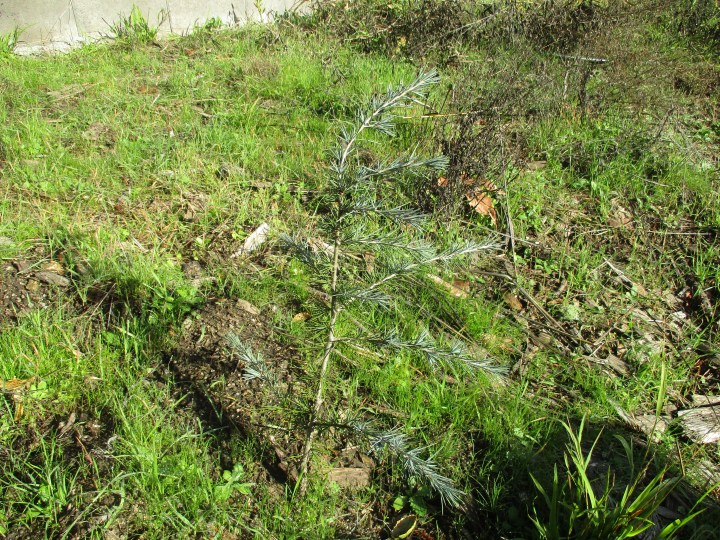
As the colorful deciduous trees go bare, the evergreen trees get more attention. A weeping white spruce, Picea glauca ‘Pendula’, really stands out. It grows slowly to only about fifteen feet tall and maybe five feet wide, so does not need as much space as a typical spruce tree. What makes it so distinctive is the weirdly pendulous stems that hang limply from a strictly vertical trunk. It is hard to believe that it is only a different variety of the same species as the dwarf Alberta spruce, which is very short, dense and symmetrically conical, with stout little stems. The foliage of weeping white spruce is lighter green than that of most other spruces, but is not as blue as that of blue spruce. The short and stiff needles are rather prickly to handle.
Hooey! It’s a bunch of hooey! Sweet pea seed that gets sown this time of year for next spring does NOT need to be soaked before sowing. In fact, unless there is some strange species of plant that has become that dependent on human intervention, NO seed need to be soaked prior to sowing. Not only is the technique completely unnecessary, but it is completely unnatural as well.
Of all the Official State Trees, the coastal redwood, Sequoia sempervirens, of California is the grandest. Seriously, it is the tallest tree in the World, so it really ‘is’ the grandest! The tallest is 380 feet tall! Although the related giant redwood of the Sierra Nevada develops bigger trunks, the bulkiest coastal redwoods are thirty feet wide at the base! The oldest are more than 2,000 years old!
The electricity is still on here at 8:20 p.m.. I just turned the lights off to get the cool picture above. The
Arborists see trees very differently from how most of us see them. They know their trees very intimately, and by botanical name. Arborists know how big particular trees get, both tall and wide, and if they are likely to develop structural deficiency or aggressive roots. They can tell us which are deciduous, which are evergreen, and which are messy with foliage, bloom or fruit.


Mild autumns and arid summers keep chrysanthemums on a different schedule here than in most other regions. They can get planted in spring to grow through summer and bloom through autumn; but because they can take a bit of work, they are more often planted while blooming in autumn. Although commonly grown as autumn annuals, they are perennials that can regenerate next spring, grow through summer, and bloom even better the following autumn.