Red Trumpet Vine

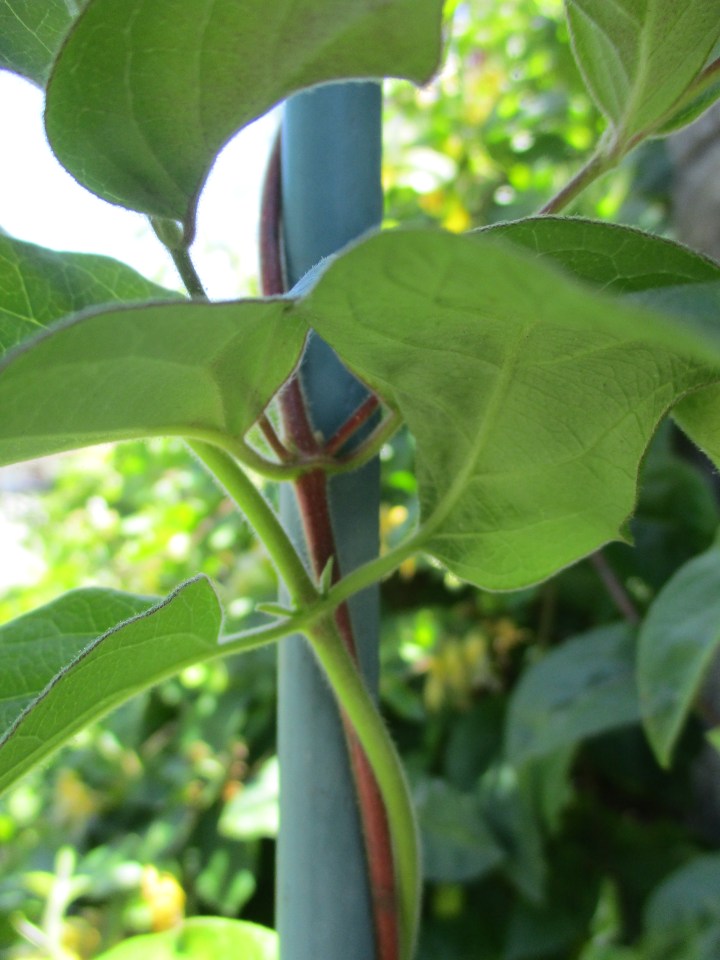
60420Red trumpet vine, Distictis buccinatoria, is more green than red. The tubular orangish red flowers with yellow throats are pretty while weather is warm, but not too abundant. Slightly distressed plants tend to bloom more abundantly. Each evergreen compound leaf is a pair of leaflets with a sneaky central tendril that will grab onto anything while holdfast discs get a more permanent grip.

Vines tolerate significant shade, but will find their way to sunnier situations where they grow more aggressively. They can easily reach the roof of a two story house, and grow out of reach in trees. Their holdfast discs will damage paint, and even shingles! Overgrown plants can be cut to the ground and allowed to regenerate.

Red trumpet vine wants to be watered somewhat regularly while young. Mature plants can disperse their roots well enough to find water if they do not get it directly.

Vines Are Naturally Social Climbers

70906thumbIf more of us knew how vines compete in the wild, fewer of us would grow them in our home gardens. Understory plants that are satisfied with the sunlight that reaches them through a higher forest canopy are the most passive. Taller trees compete for sunnier exposure above. Vines are the most aggressive as they climb and overwhelm trees to get the best exposure on top of everything.

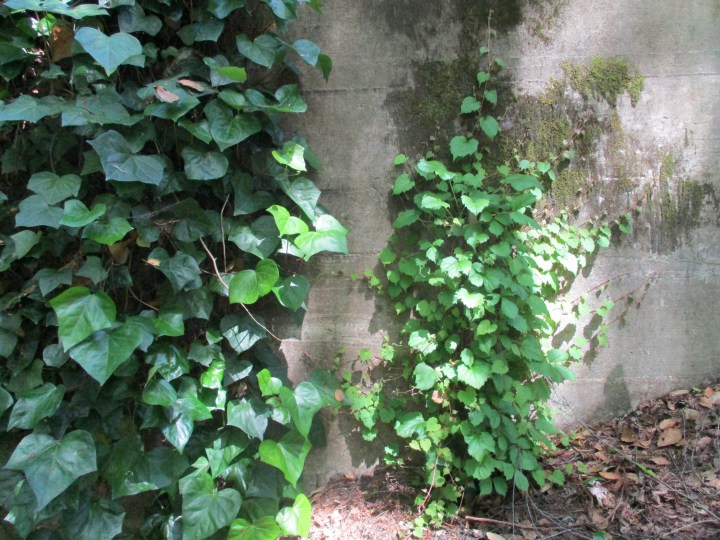
English and Algerian ivies happens to be among the more efficient of aggressive vines. While young, juvenile growth creeps along the ground searching for victims. Once it encounters something to climb, the stems develop aerial roots so that they can climb vertically. Once the climbing stems reach the top of the support, they develop shrubby adult growth that blooms and produces seed.

In home gardens, ivy is a popular and practical groundcover. However, if allowed to climb as a vine, it can root into walls and ruin paint. Even if the vines are removed, the unsightly aerial roots remain. The shrubby adult growth can overwhelm and even shade out and kill the trees or shrubbery that originally supported it. If it climbs onto a roof, it can accumulate debris and promote rot.

Creeping fig is even nastier. Its network of clinging vines grafts together as it grows, and then strangles the supportive trees as they continue to grow within the constrictive network of grafted stems. Yet, it and Boston ivy work nicely and harmlessly on concrete freeway sound-walls where their aggressive behavior is a major advantage, and their clinging aerial roots are not a problem.

Wisteria and red trumpet vine are considerably better behaved, but even they will crush lattice and anything else they wrap around. If they get into trees, they quickly grow out of reach. They may seem to be more appealing than the trees that they climb are, but can strangle and kill substantial limbs. Even without aerial roots, red trumpet vine clings with holdfast discs that damage paint.

Even though many vines are practical for home gardens, their personalities need to be considered. Star jasmine and honeysuckle can either grow as groundcover or as climbing vines. They can get big, but are not often destructive. Potato vine works nicely on fences, but gets aggressive in trees. Carolina jessamine, lilac vine and mandevilla are some of the more complaisant of vines.

Horridculture – Pale Clivia Syndrome

P90417Back in the good old days, Kaffir lily, Clivia miniata, which is probably most popularly known simply as ‘clivia’, bloomed with big round trusses of exclusively bright reddish orange flowers. It was such an excellent color that no one thought to change it. Flowers of feral plants that sometimes grew from seed were potentially more orange and less red, but were flashy nonetheless. There was no need, and minimal potential, for ‘improvement’.

Then the allure of the ‘rare’ happened. Yellow Kaffir lilies had previously been so rare that very few had seen them. Once the rest of us became aware of their existence, many of us wanted them, only because they were so rare. However, after seeing them, some of us came to the conclusion that they were rare because no one wanted them when the species was first introduced, and cultivars with the best color were selected and perpetuated.

Regardless, yellow Kaffir lily suddenly became a fad. Traditional bright reddish orange Kaffir lilies became passe. All the while, those subscribing to the fad seriously believed that yellow was better and more desirable than reddish orange simply because it was so very rare. All the while, yellow became increasingly popular, increasingly available . . . and no longer rare. All the while, reddish orange became unpopular, uncommon . . . and rare.

So now what? Why is yellow more popular than reddish orange now? Yellow is insipid and pale. Reddish orange is vibrant and bright. Furthermore, yellow is so dreadfully common. Reddish orange is quite rare. According to the previous justification for the popularity of insipid pale yellow Kaffir lily, bright reddish orange Kaffir lily should be popular now, not because they are so much more colorful and appealing, but because they are RARE!P90406++++

These are in Brent’s garden.

Snowball Bush

90424Long before hydrangea blooms with its distinctively round floral trusses of abundant small flowers, the snowball bush, Viburunum opulus ‘Roseum’, shares its own unique version of similar bloom. Although the cultivar name suggests that the bloom would be pink or red, it is exclusively white. Hydrangea will bloom later, mostly in pink or red, with some in blue or lavender, and a few in white.

The snowball blooms of snowball bush are about thee inches wide, so are smaller than those of hydrangea, and do not last quite as long. They bloom early in spring, without subsequent bloom. The two or three inch long deciduous leaves might turn surprisingly vivid orange and red before defoliating in autumn. Mature specimens easily get taller than ten feet, and might reach fifteen feet.

Snowball bush eventually develops a relaxed and unrefined style that fits nicely into woodsy landscapes. Autumn foliar color is better with full sun exposure, but a bit of partial shades promotes a slightly more open branch structure that displays the spring bloom better. Pruning should be done after bloom. Snowball bush prefers somewhat regular watering and rich soil, but is not too finicky.

Gophers Go For Spring Vegetation

90424thumbHibernation is a luxury enjoyed by different animals in different climates, where much colder weather inhibits activity through winter. Gophers take no such extended time off here. They merely work less diligently through the cooler and rainier times, and maybe get out of the way if the soil they live in gets too saturated. Their minimal damage had probably been easier to miss or ignore.

Now it is spring! The weather is warming. The soil is draining. All the roots and vegetation that gophers eat are growing. The gophers that were here and somewhat active all through winter are really making a scene now, as they clean mud from their homes and excavate new tunnels. Babies are growing up fast and leaving home, and excavating new homes of their own. What a mess!

Many of the primitive techniques that were used in the past to mitigate gopher problems are ineffective, impractical or even dangerous. Pouring gasoline into tunnels and waiting a few minutes to ignite the fumes can start fires anywhere such tunnels resurface, and possibly out of view! Bare razors dropped into tunnels are potentially dangerous to anyone who happens to dig them up later.

Traps take some work and experience to set properly, but are still the best way to deal with gophers. They do not involve poison that can be dug up and eaten by someone else, or eaten by a gopher who staggers from underground to get eaten by someone else. As long as dogs are not allowed to dig them up, traps are likely only be dangerous to gophers and those setting the traps.

Conventional traps are set in pairs, in each of both directions of a lateral tunnel that is found by excavating back from the tunnel under an active gopher volcano (pile of displaced soil). Once set, the tunnels must be back filled to eliminate air circulation into the tunnel, which would warn a target gopher of intrusion. A bit of weedy vegetation added before back fill might help attract a gopher.

Setting gopher traps is easier to read about than to do safely. It is best to learn how to do it from someone who is proficient at it..

See Anemone

P90414This really is something that I did not expect to see. It may not look like much. It is just a raspy anemone with bites taken out of it, blooming later than it should. What is so impressive about it is that it was not planted here last year. It was planted during the previous year, then bloomed on time last year, and then died back like anemones normally do. I did not plant it, of course. It is in a planter where volunteers contribute whatever they like.
In case you are wondering why I am writing about it as if I did not expect it to bloom again, I didn’t. For whatever reason, anemones typically bloom well only once here, in their first season after they get planted. They may produce foliage for the following season, or maybe even several seasons, but very rarely bloom again. It annoys me that they are even sold locally. Nurseries should know better than to sell bulbs that do not perform well here.
I have always believed that anemones, like a few other types of bulbs, do not get enough chill in winter to bloom again. This is a rather mild climate. There are certain cultivars of apple that do well where winters are cooler that would be dissatisfied with the minimal chill they would get here. (Incidentally, this last winter was not unusually cold.)
There is also the possibility that anemones can not maintain their foliage long enough through the arid spring and summer weather to sufficiently regenerate their resources to bloom again. The foliage begins to appear in conjunction with bloom, then grows more as bloom finishes, but then dies back as the weather gets warm in spring and summer. The weather is not hot here, but it is rather arid.

Knucklehead

P90413KThis is the beginning of one of several new knuckles on a pollarded crape myrtle tree that was pollareded for the first time just this past winter. It was quite a mess of thicket growth that was too congested to bloom well. It is also located in a confined situation where it could not just be groomed, pruned up for clearance, and then just left to develop a larger canopy higher up. Pollarding will both contain it, as well as invigorate healthier growth.
New shoot growth now emerging from the ends of limbs that were pruned back last winter will elongate and eventually bloom through spring and summer. Next winter, after all the colorful autumn foliage has defoliated, the tree will get pruned back to these same knuckles to repeat the process. Stems will get cut back as neatly as possible, leaving no stubs, but such pruning causes knuckles to become slightly more distended as the develop.
Minor shoot growth that develops elsewhere on the mature stems below the developing knuckles should be removed as it appears. It is easy to knock off now, before it gets big enough to need to be pruned off. Knocking it off or ‘peeling’ it off, as drastic as it sounds, is actually better than pruning it off. It removes more of the callus growth that is likely to develop more stem growth later. New growth should be concentrated into the knuckles.
Pollarded crape myrtles bloom later than those that are not pollarded, but they bloom more profusely. They are also more resistant to mildew, and develop better foliar color in autumn.
The picture below shows the same crape myrtle that I got the picture of the single knuckle above from, shortly after it was pollarded. This picture was used another article at:
https://tonytomeo.com/2019/03/16/six-on-saturday-picture-dump/P90316++++

Six on Saturday: Spring Flowering Trees – With Problems


You probably do not notice the problems while distracted by the profuse bloom. That is just swell. It is gratifying that the trees that I work with are appealing to those who see them. Since I work with them, I notice their problems. I would have posted just close up pictures of the flowering cherries and flowering crabapples, but because they are blooming at different times this year, I got only these three.

1. The shade of the big redwood trees is a bit too dark for this flowering cherry tree. It is always this sparse. What is worse is that the upper layer of bloom is suspended on a single horizontal limb that extends from the right, out the backside, back in toward the center and off to the left as it is seen here in the picture. What looks like supporting limbs is actually trunks of birch trees in the background. I would prefer to cut the awkward limb off, but you can see how flat topped the remaining portion of the tree would be without it.P90413

2. This is the main reason the tree remains. These double white flowers are the whitest of the trees here.P90413+

3. My absence at a previous work day at the Presbyterian Church was the problem with this ‘Prairie Fire’ flowering crabapple. I had worked with this tree for a few years to thin out the thicket growth, and repair structural damage. Then, because I was not there, someone else pruned it indiscriminately with hedge shears and loppers! What a mess! It is best that you can not see the damage within the canopy. I don’t know why this was done. The tree only needed minor trimming for clearance above parked cars. After bloom, I will start the process of structural repair all over again.P90413++

4. These rosy pink flowers make it all worth it though.P90413+++

5. This flowering cherry actually looks better than I expected it to this year. I pruned out so much necrosis last years that I figured that the tree was deteriorating. I expected a bit more new necrosis to develop this years. As you can see, that did not happen so much. I am not disappointed. Actually, I am impressed that there is no necrosis worth noticing. The worst problem with the tree right now is that it is disfigured by the unexplained necrosis. Well, that will not prevent us from appreciating the bloom.P90413++++

6. This is the bloom close up. It is very similar to the other two old cherry trees that I will be cutting down this year. I wrote an article, and perhaps others, about them earlier. https://tonytomeo.com/2019/03/31/the-end-of-the-cherry-blossom-festival/P90413+++++

This is the link for Six on Saturday, for anyone else who would like to participate:

https://thepropagatorblog.wordpress.com/2017/09/18/six-on-saturday-a-participant-guide/
Iceplant

60413Bright pink bloom that can be profuse enough to obscure the succulent foliage below is nothing new for iceplant. Some bloom bright purplish pink. Others are reddish pink. A few are softer pink or white. What is unexpected is iceplant that blooms bright yellow, orange or gold, like Lampranthus aureus does. (Freeway or beach iceplant that blooms soft yellow or pink is not a true iceplant.)

Lampranthus arueus neither spreads as far nor cascades quite as well as other types of iceplant, but if planted a bit closer together, it can cover quite a bit of ground. It gets about a foot deep, or a bit deeper if crowded by other plants. It is very easy to grow from cuttings stuck wherever new plants are wanted. The inch and a half wide flowers are slightly wider than those of other iceplant.

All iceplant are quite undemanding. Although they bloom better and stay greener with occasional watering, they do not need much water. They should only be fertilized if they get wimpy. After the spectacular primary bloom phase early in spring, too much fertilizer might inhibit sporadic bloom later in summer. Unfortunately, the healthiest iceplant may not bloom again after spring bloom.

Plant Problems Are Sometimes Exaggerated

04It is not easy for wild trees to adapt to a refined landscape. After a lifetime of adapting to their native environment and dispersing their roots to where the moisture is through the dry summers, they must adapt to all sorts of modifications such as excavation, irrigation and soil amendment. Newly installed plants grow into a new landscape while some mature trees succumb to disease and rot.

Oak root rot is such a common disease in California that there are only a few places where it is not found in the soil. It is not often a problem to new plants, but often becomes a problem to mature trees that suddenly get more water than they are naturally adapted to, particularly if roots have been violated, and the soil has been amended to retain more moisture. Change is not always good.

However, many of the same trees that are so susceptible to oak root rot if the environment around them changes can be remarkable adaptable as young trees. California sycamore happens to be a riparian tree that naturally grows near water. Although old trees may not adapt well to change, young trees planted in new landscapes will adapt to the water that is available as they mature.

California sycamore trees that are adapted to landscape or lawn irrigation are not likely to be bothered by oak root rot until they get old. Realistically though, any old sycamore is susceptible to oak root rot. The only difference is that those that get more water mature faster, so get old sooner. A California sycamore tree planted into a home garden may live only one century instead of two.

Verticillium wilt is another disease that can be found in most places throughout California. It is notorious for severely disfiguring and killing ash trees and many other plants. However, it needs moist soil in which to proliferate. Because lawns are irrigated so frequently and often excessively, ash trees in lawns are innately susceptible to verticillium wilt. In situations that are not irrigated so frequently, newly planted ash trees can mature into healthy shade trees.