 This is why I do not bother growing greens in the garden just yet. Wild radish grows here wild; and there is way too much of it. Most but not all of it gets mown in meadows or cut down with weed whackers on the edges of roadways. There is no need to cut down that which is out of the way. Besides, we could not cut it all even if we wanted to. There is wild turnip and mustard too. All are prolifically naturalized and invasive exotic species.
These radishes do not make the distended roots that garden varieties of radishes are grown for. Nor to the wild turnips make distended turnip roots. They, as well as the mustard, do make good greens though. They may not be quite as good as fancier garden varieties, but I can’t beat the price, or get any other type of vegetable for such minimal effort. I only need to go grab what I want when I want it. There really is no cultivation involved.
Even though their seed is not sown in phases to extend their season, they remain productive for a long time, and only stop producing if they get too dry in summer. If I were to grow a garden variety of turnip green, I would sow a few phases a few weeks apart so that, as an earlier phase finishes, a later phase begins producing. Unlike other types of greens that must be gathered prior to bloom, wild greens can be taken from blooming plants.
Wild greens can be canned like collards, but are better if simply frozen. Unbloomed floral trusses are like tiny bits of broccoli. If gathered while still young and tender, thicker stems can be chopped and cooked like broccoli stalks, and can even be pickled.
Like Peas In A Pod
 Generally, that is how they are. Almost all perennial pea flowers bloom with the same bright purplish pink color of the bloom in the picture below. That is, of course, before their pods develop, but you get the point. We sort of know what to expect from them.
As I mentioned in the ‘Six on Saturday‘ post last week, from which the picture below originated, variants like the pink bloom in the picture above are sometimes observed. The rare clear white flowers are my favorites. There might be fluffier double flowers too; although, in my opinion, the single flowers are prettier and look more like pea flowers should look.
I also mentioned last week that, although perennial pea has a sneaky way of growing where it is not wanted, it typically does not grow reliably from seed sown intentionally where it might actually be desirable. I have tried. The seed just did not cooperate. I managed to get a few to grow, but only because I put out a few hundred to compensate for the expected minimal rate of germination.
Because I like the white so much, I took seed from a vine that had bloomed with single white flowers. I figured that they would be more likely to produce a few white blooming progeny. I would have been satisfied if only a single vine in a group of several bloomed white, but got only a few vines that all bloomed with the typical bright purplish pink. They were pretty nonetheless, but were ironically removed when the site was redeveloped.
I also collected seed from vines that bloomed with the common single bright purplish pink flowers, just in case the viability rate of their seed might somehow be better. They were sown into a different situation, so even if I happened to know how many of the seed that were sown germinated and grew, it would not be an accurate comparison. Regardless, I was no more impressed with the result. Perennial pea is best appreciated as weed.
Six on Saturday: Serious Weeds
The humongous perennial pea that I showed off last week was relatively innocuous. These six are some of the more prolific weeds. Actually, except for the first two, these are some of the most aggressive and problematic weeds in this region. All are exotic, which means that they are not native. Some were imported intentionally. Some were more likely stowaways. All except for #2 were found right outside here. #2 was found closer to town.
1. Vetch was most likely imported intentionally as a cover crop, forage crop or both. Because I do not know which vetch this is, I do not know why it is here. This is neither of the two species of vetch that are native here. It is a polite and pretty weed that never seems to become much of problem. Consequently, not much is known about it, or how it affects the ecosystem. Most of us just let it do what it wants to because it improves the soil.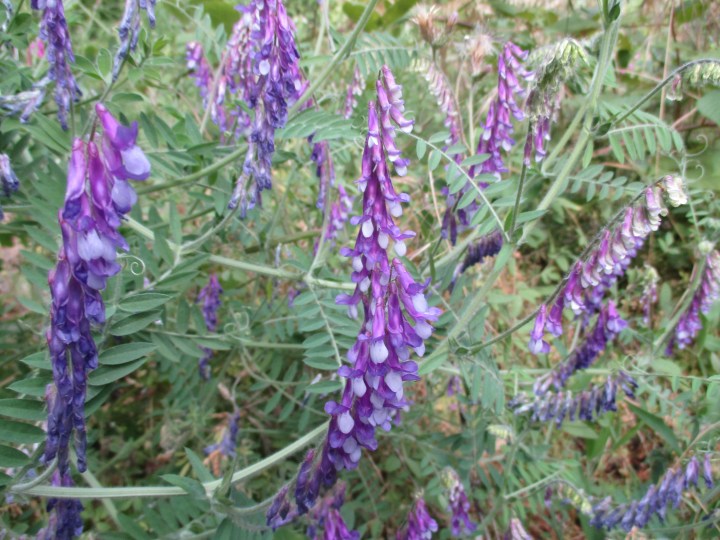
2. Queen Anne’s lace might have been imported intentionally because the young roots, young leaves and flowers are edible. It is, after all, a wild version of carrot. However, the small roots mature quickly and become too tough to eat, and often develop bad flavor. Furthermore, it is avoided because it it too easily confused with the extremely toxic poison hemlock! It can be a companion plant for attracting pollinators, but is mostly ignored.
3. Saint John’s wort was imported intentionally as a ground cover for landscapes, and escaped into the wild where it competes aggressively with native plants. It is toxic to grazing animals, so must be removed from where it appears in pastureland. Unfortunately, its wiry but tough stolons are extremely difficult to eradicate. This species is unavailable here, not just because it is invasive, but because it is so susceptible to rust. It never looks good.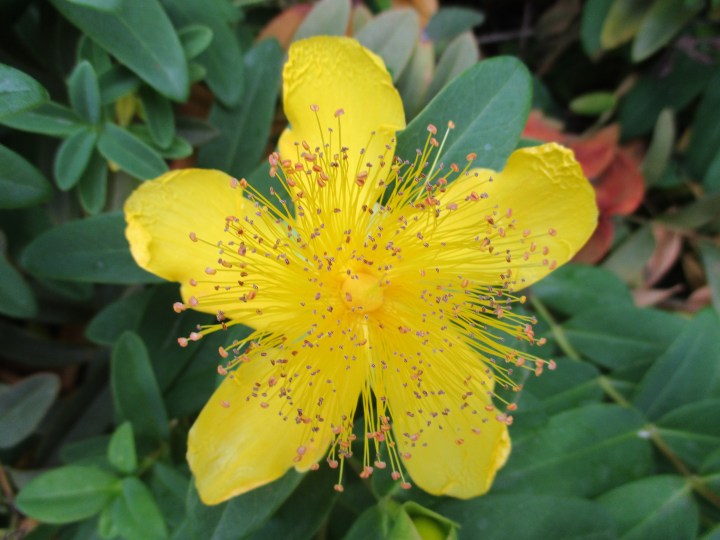
4. Broom is one of the nastiest. Some believe it to be Scottish broom (which we call ‘Scotch broom’). Some believe it to be Spanish. Actually, it is most likely French. It doesn’t matter. It is terribly prolific and aggressive, with seed that remain viable and continue to germinate for many years after parent plants get removed. It was imported intentionally just because it is so pretty in bloom. So many of the worst weeds arrived here like that.
5. Himalayan blackberry, like Queen Anne’s lace, might have been imported intentionally because it produces something edible. It happens to makes decent blackberries. However, it is neither as reliable nor as productive as garden variety blackberries. Berries might be sparse and of inferior quality, and are very difficult to pick because the canes are so very wickedly thorny! Canes are extremely vigorous and aggressive, and difficult to kill!
6. Thistle was likely a stowaway. There is no realistic reason to have imported it. Nothing eats it. It is too wickedly spiny to handle. It does not work as a cover crop, although it does try to cover as much area as it can get its prolific seed into. There are other thistles that are more invasive, but none that are as mean as this one is with those formidable spines! I do not know for certain what species this is, but it is not one of the native thistles.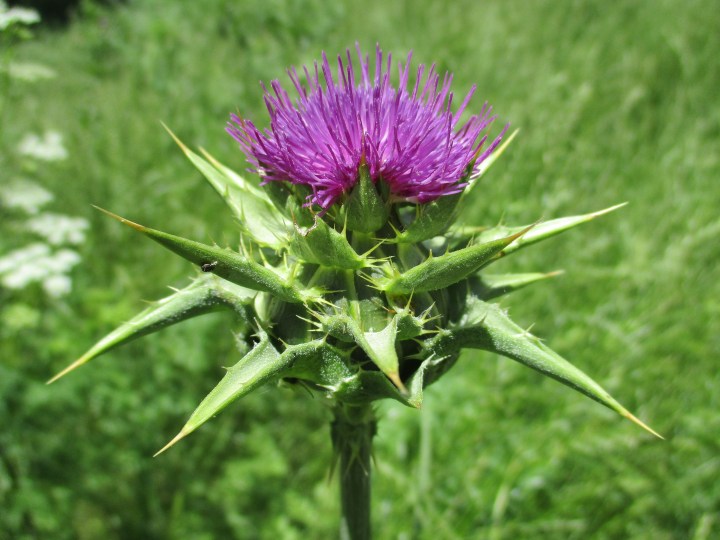
This is the link for Six on Saturday, for anyone else who would like to participate:
https://thepropagatorblog.wordpress.com/2017/09/18/six-on-saturday-a-participant-guide/
Flowering Maple
 It is impossible to say who the parents were. So many specie were hybridized to develop the many cultivars of flowering maple that the Latin name of the collective group is simply Abutilon X hybridum, which means exactly what it looks like. They are hybrids of various and rarely documented species of Abutilon. The ‘X’ dispels any doubt. ‘Chinese lantern’ is another common name.
Flowers can be yellow, orange, red, pink or pale yellowish white. They look like small hibiscus flowers that do not open all the way, and some only open half way. Many hang vertically. Some hang at about forty-five degrees. Bloom is sporadic all year, and more abundant while weather is warm. The rather sparse evergreen foliage looks somewhat like maple foliage, with variable lobes.
The largest flowering maples do not get much taller than the eaves. Short types stay shorter than two feet. Stems can be awkwardly angular, even if pruned back to promote fluffier growth. Roots can be unstable, necessitating staking or pruning to lighten the load. Flowering maple prefers partial shade, and can tolerate significant shade, but can also do well in full sun if watered regularly.
Rain On The Shade Parade
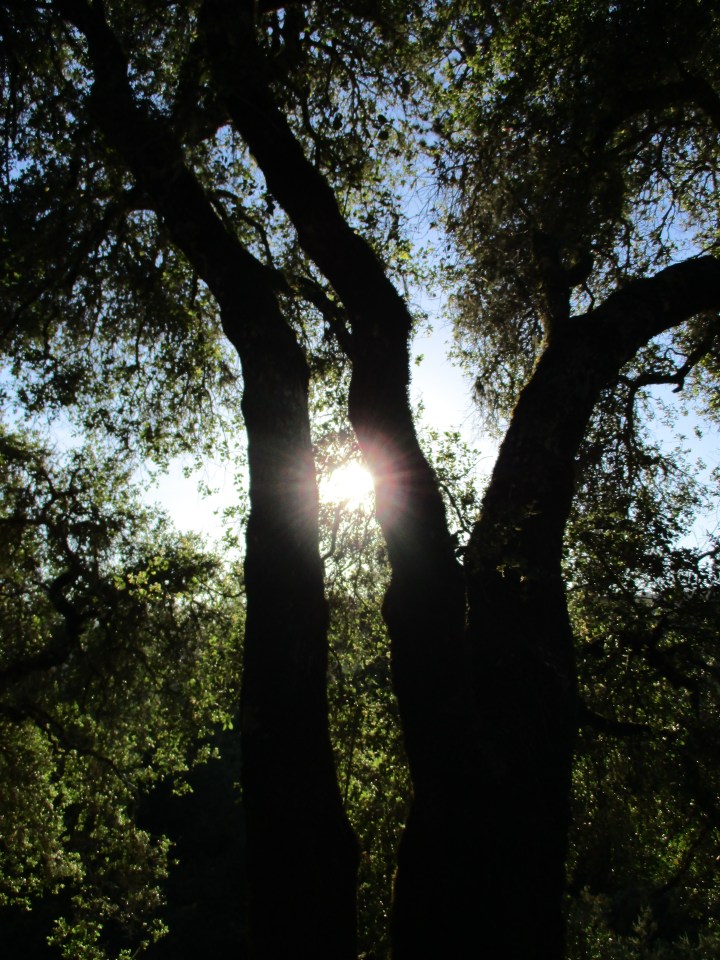 Modern urban lifestyles are becoming less conducive to gardening all the time. Bigger and taller homes cast larger shadows over smaller garden spaces. The taller fences between these homes do not help. The densely evergreen trees employed to obscure the views of other larger and taller homes also obscure sunlight. Not much sunlight reaches the ground where shorter plants need it.
While all this is going on, we are supposed to be gardening with more sustainable plants that demand less water. Smaller, shadier and more sheltered gardens should naturally use less water than larger and more exposed gardens need. Yet, the plants that do not mind the shade naturally want more water than plants that want more sunlight. There are not many that are drought tolerant.
Drought tolerant plants are naturally endemic to dry climates. Many are from chaparral regions. Some are from deserts. In such ecosystems where water is too scarce to sustain much foliage, there is not much competition for sunlight. Shade tolerant plants are just the opposite. They are from forested ecosystems with taller and shadier trees. Such ecosystems are sustained by rainfall.
There are quite a few plants that do not mind a bit of shade. Heavenly bamboo, flowering maple, hydrangea, camellia, azalea, rhododendron, holly, daphne and andromeda (Pieris spp.) are some of the more familiar shade tolerant shrubbery; but alas, none are drought tolerant. Nor are the various ferns. Even small shade tolerant trees like dogwood want to be watered regularly.
Most of the plants that tolerate shade but are not too terribly thirsty are groundcover plants or perennials. They are not exactly drought tolerant, but can survive with minimal watering because they do not dry out so much in the shade. Once established in a cool shady environment, plumbago, lily turf, periwinkle Saint John’s wort and coral bells (Heuchera spp.) only need to be watered occasionally through summery weather, although they are thirstier in sunny spots. Both English and Algerian ivy need nothing in the shade.
Horridculture – Security Clearance
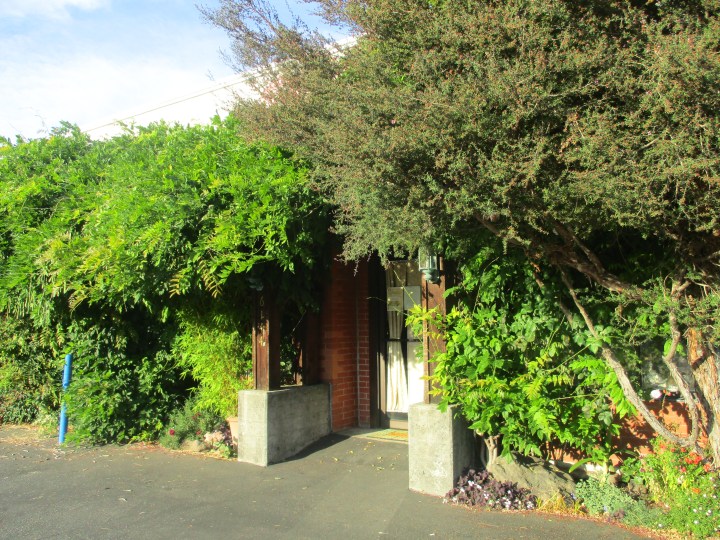 A well designed landscape should be an asset, not a liability. It should beautify and enhance the function of outdoor space, while harmonizing with associated indoor spaces. In order to continually do so, even a very well designed landscape requires maintenance so that it does not become so overgrown that it becomes unsightly and obstructive.
Some landscapes require less maintenance than others. There happens to be very few that can be allowed to grow wild, but only because their components are allowed the space they need to do what they do naturally. It is not fair to incorporate plants merely because they are appealing, and then expect them to conform to unnatural constraints without some degree of intervention.
As an arborist, I often see trees that must be pruned for clearance from roofs, gutters, walls, windows, lighting, utility cables and roadways. It is normal for trees and large shrubbery to encroach into such features. Furthermore, it should not be much of a problem if such trees and shrubbery are maintained properly.
The landscape in the picture above contains several desirable plants that could, with a bit of effort, be maintained within the very limited space; New Zealand tea tree, Chinese wisteria, golden bamboo, Heavenly bamboo (Nandina), star jasmine, Spanish lavender, fleabane, oxalis and a small juniper. Some of these might not have been identified correctly, and there may be more in there, but it is impossible to distinguish from this picture.
The golden bamboo and Chinese wisteria are probably a bit excessive. However, there is a nice arbor above that would be ideal for the Chinese wisteria if someone would be willing to put the effort into pruning and containing it. It takes serious commitment to contain golden bamboo, but it is possible, and might perhaps be justifiable to retain a more tolerable quantity of its handsome form outside the window that it is in front of.
One of the most obvious problems with this landscape is that it is so crowded that the various components are barely indistinguishable from each other, and lack the space to perform as they would like to. This is about clearance though. As you can see, the collective plant material has been pruned only to maintain clearance from around the lower part of the doorway, and from the pavement of the parking lot. So much more is needed.
Anyone getting out of or into a car parked next to this landscape must duck under the New Zealand tea tree or Chinese wisteria. The upper part of the doorway is not much better. Vertical clearance needs to be restored and maintained. The New Zealand tea tree seems to have some serious potential anyway, and would likely be very appealing if pruned to expose the main trunk and limbs.
Furthermore, there are windows behind all that mess! Unless someone really wants privacy and dislikes curtains, those windows should be exposed to allow sunlight in. All this obscuring vegetation darkens and cools the interior, which increases reliance on electrical lighting and some sort of heating. Besides, it just looks trashy.
Not only does the vegetation inhibit sunlight coming into the building, but it also inhibits light coming out from the building. The lighting that is barely visible at the top of the pillars flanking the doorway is there to illuminate the parking lot at night. Another doorway outside the left margin of this picture, is for ATM machines, so is outfitted with security lighting, which is almost inoperative because of the lack of pruning for adequate clearance.
Ivy Geranium
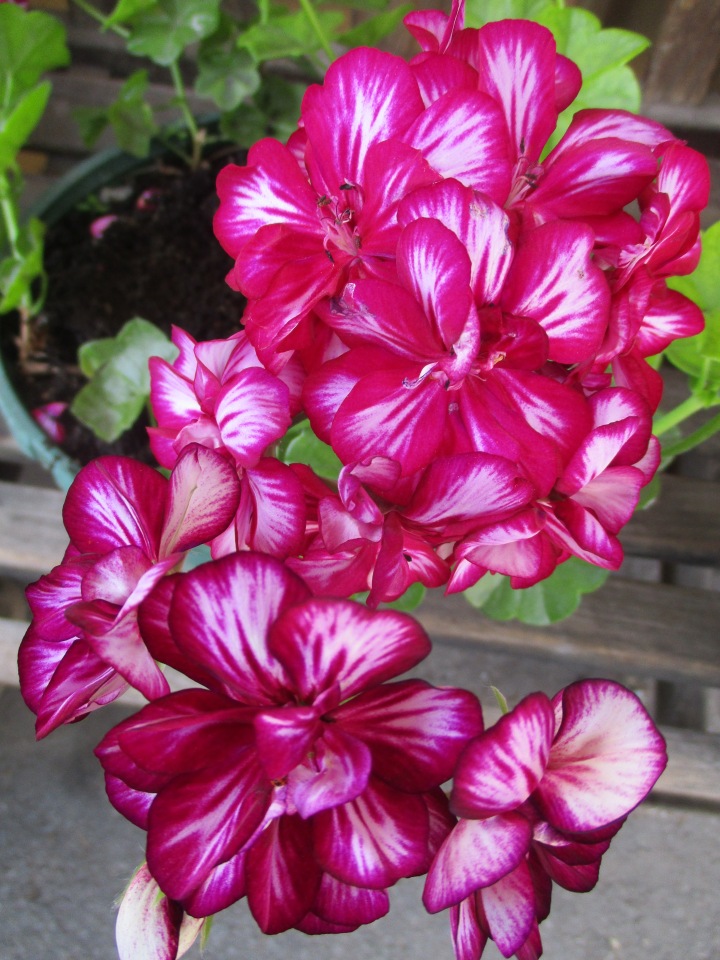 This is one of the more traditional perennials for old fashioned window boxes, not only because it cascades downward to avoid obstructing associated windows, but also because, back before window screens were commonly available, the aromatic foliage was purported to repel mosquitoes. Ivy geranium, Pelargonium peltatum, is splendid for hanging pots and retaining walls as well.
The best bloom is usually later in summer or in early autumn, but sporadic bloom can continue almost throughout the year. The flowers are very similar to those of more common zonal geranium, but perhaps more abundant. The slightly more extensive color range goes beyond hues of white, pink, red and peach, to include rich burgundy, pinkish lavender and candy striped red with white.
The rounded and lobed light green leaves are rather succulent, so are easily damaged. Some cultivars have slight foliar halos (semicircular zones of darker color around the centers of the leaves) almost like those of zonal geraniums, but not quite as prominent. The thin and nearly succulent stems are easy to root as cuttings. Although fragile, they can sprawl or cascade as much as six feet.
Summer Turns Up The Heat
 Does the heat seem to have come on suddenly this year? There was all that rain through winter, then a quick but delightful spring, and now it is suddenly over a hundred degrees in some places! What happened?! There is certainly nothing abnormal about such warmth in the middle of June. It just comes as a surprise when it arrives so suddenly after such pleasantly mild spring weather.
At least warm weather here is not as dreadful as it is in other climates. It cools down a bit overnight. Humidity is typically (although not always) low. There is typically at least a bit of breeze by late afternoon, just after the worst of the warmth. We need not contend with the sort of dankly humid heat, that lasts all day and into the night without even a slight breeze, that so much of America gets.
Of course, that is no consolation now. By our standards, it is hot. Gardening is no fun, and some of it gets neglected. We become more aware of where shade trees should have been planted. We might also notice wilted or pallid plants that are not getting enough water. Pruning that was delayed while new spring growth matured may need to be delayed a bit longer, until the weather cools.
Unfortunately, the minimal humidity and occasional breezes that make the weather more comfortable for us make it more uncomfortable for the plants in the garden. Plants can realistically tolerate more heat than we can, but prefer it to be in conjunction with humidity. Otherwise, they can lose too much moisture to evapotransipiration (evaporation from foliar surfaces), and wilt or desiccate.
Automated irrigation obviously needs to be adjusted accordingly. Potted plants need more of an increase than those in the ground. Those that are overgrown, in hanging pots, or exposed to the typical evening breezes will be the most consumptive. It is not always easy to know how much they need, but one can be certain that if they are wilting, they need more than they have been getting.
Pots exposed to sunlight can get uncomfortably warm. If cascading or bushy growth does not shade the south sides, smaller potted plants can.
Crop Circles
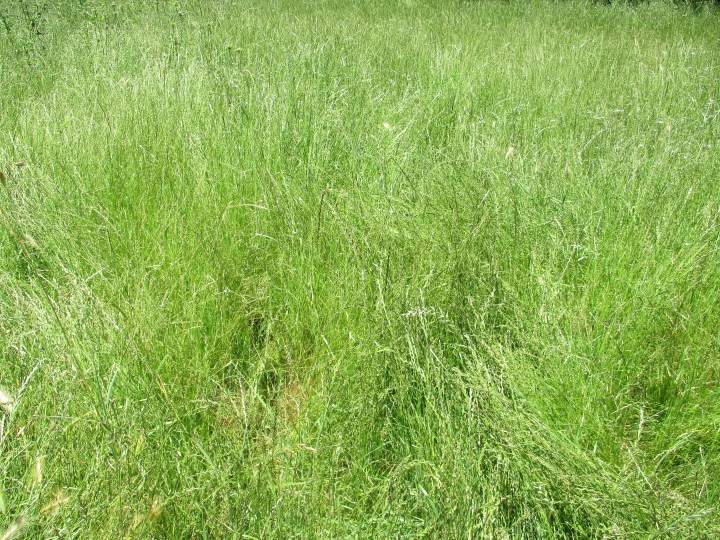 These are perfect conditions for crop circles. Even without any convenient grain crops, there is plenty of tall grass in unmanaged and ungrazed fields. All this grass needs is to be crafted into crop circles.
The first crop circles that I ever witnessed were made by cows. I was not much more than six, and my younger brother who found them was not much more than five. No one bothered to explain to us that cows were related to cattle who grazed nearby. Consequently, we had no concept of what cows were.
Earlier in the day, we had discovered what was described to us as a ‘cow pie’. Naturally, we were skeptical. It looked just like what cattle leave behind, which was not good. I was not about to try it, so got my younger brother to taste it. Apparently, it tasted about as bad as it looked. It seemed quite suspicious that a cow would made such an unappealing pie, and then just leave it out on the ground like that.
When we found the first of a few crop circles, our older sister and her friend told us that it and those we found afterward were made by the same cow or cows who made the unappetizing pie. Apparently, cows like to lay down in long grass. Although we did not know what a cow looked like, we ascertained from the sizes and shapes of the crop circles that the cows who made them were quite large and somewhat circular.
Furthermore, since we did not see any trails leading to or from the crop circles, we deduced that the the cows who made them flew in from above. We were very intelligent kids.
Of course, since then, I found that baby deer make small crop circles; but because they have such long and lanky legs, they do not leave such obvious trails leading to and from such crop circles either. There is no need to fly in from above.
Rhody made a very small crop circle, and because he is so lean, did not leave much of a trail coming or going. He is not tall enough to step over the grass, but is narrow enough to get through it without disturbing it much.
Pink Trumpet Tree

This is why I do not often use pictures that my colleague, Brent Green, sends to me. He frequently tells me what I should feature in my gardening column, and sends me what he considers to be good pictures for such topics. This picture would have been good for writing about the sky over Los Angeles, or the neighbors’ driveway, since those are two of the most prominent features here. Where did all the smog go?
Chimneys in Los Angeles seem silly to me. Even if the weather got cool enough for a fire in a fireplace, there is no firewood to burn. The chimney to the far right certainly seems to be original to the house, but how did it survive all the earthquakes since the house was built, probably in the 1940s or 1950s? There have been a few moderate earthquakes since then.
Those signs that warn potential criminals of non-existent home security systems are even sillier, and just cluttering otherwise nice landscapes. There is nothing official looking about them. There are bins of them for sale in the local big box stores. Shouldn’t we all assume that since the home on the left is in Los Angeles, that it is outfitted with home security system that is more impressive than that silly, irrelevant and unwelcoming sign?
I would guess that what Brent really wanted to send a picture of was the big pink trumpet tree, Tabebuia heterophylla. After all, it does happen to be sort of in the middle of the picture. It really was spectacular while blooming late last winter. However, even if Brent had sent a good picture of it, I would not have featured it. Most of those who read my gardening column are not within regions where pink trumpet tree blooms like this.

