It sounds more compelling that way, like the old song by Art of Noise in 1984. It was . . . unique for the time. I suppose it still it. Brent introduced me to that Beat Box when we lived in the dorms at Cal Poly in 1986. Otherwise, to me, the name would have suggested a shallow wooden box for storing root vegetables in a cellar, or a crisper drawer of a refrigerator – a box for beets.
Well, I am just beeting around the bush to avoid sharing the unsightly pictures of my beat-up and neglected planter box downtown, which, incidentally, features neither beets, nor bushes.
The last update was only six weeks ago. https://tonytomeo.com/2018/08/18/six-on-saturday-out-with-the-old/ There has not been much improvement. I manage to remove the litter that accumulates. The condition of most of the plants is unfortunately natural for this time of year. It will not last long. For now, it is what I have to share.
The main problem now is that the common houseleeks, which are the most prominent perennials, naturally looks very tired. I would have no problem with it in my own garden. I know that they look great for most of the year. They look like they do now only in late summer. They recover immediately as soon as the rain starts in autumn. I do not know what is so great about rain, or what rain does that the irrigation does not do. I think that it coincides with cool humidity. Warm aridity is probably what causes the houseleeks to fold up and shed much of their foliage the way they do.
1. Common houseleek was grown from two tiny cuttings that I acquired from the garden of a friend’s deceased mother as we were emptying her home in Monterey. They arrived with a bronze common houseleek, another unidentified houseleek, an unidentified aloe, and, of all things, a bearded iris. They grew like weeds, and are now the most prominent features in the planter box. They would not have been my first choice, but once they started to grow, everyone liked them. I sometimes consider cutting them back so that they regenerate as lower foliar plants; but most people like their height and sculptural stems. I will instead groom out some of the superfluous grown to display their stems better. Once the rain starts, and they regenerate new foliage, they will look exquisite! For now, they look like . . . this.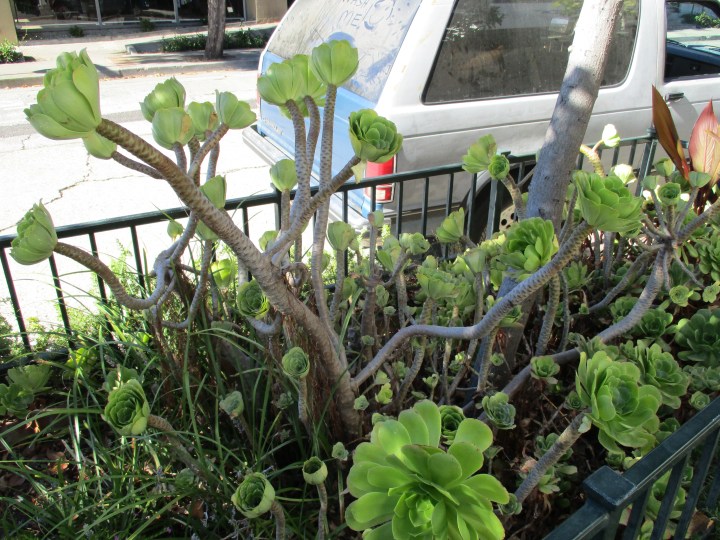
2. Bronze common houseleek was planted between the two common houseleeks, and at the same time, but never gets going well. As soon as it tries to grow, someone takes the top off of it. It would be an excellent contrast if it gets the chance. It really looks bad right now, but like the others, it will fluff out with the rain. The third smaller houseleek is right below it.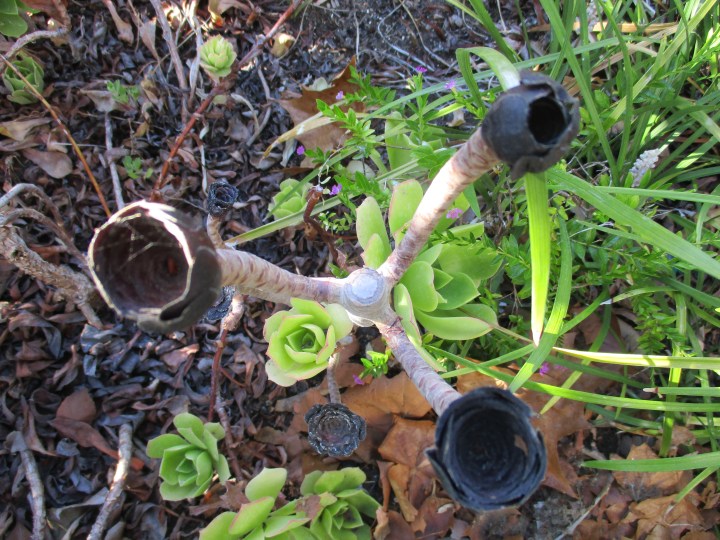
3. One never knows what might be found in a roadside planter box or landscape. Besides the concrete slurry (that was dumped by a tile-setter working in the adjacent building) and big puddles of vomit (such as those commonly found outside of downtown bars), I have found discarded bicycle parts (that were replaced by the adjacent bicycle store), baggies of dog poop, loaded diapers, small bags of trash, and a variety of dishes, glasses and flatware from neighboring restaurants. This disfigured fender is certainly not the strangest item to appear in my planter box, but is one of the largest.
4. Two nice urns outside of the adjacent bicycle shop always look so much better than my planter box. They are filled with nice potting soil, and get watered more generously. The big houseleek in the closer of the two urns was removed from my planter box when it got too crowded. I would have planted a matching pair, but the farther of the two urns had been temporarily removed to make room for a sign. Now that it has returned, it is outfitted with a big aloe from the planter box. The aloe was cut back when the tile on the corner of the planter box where the aloe is located was repaired. I was not there when it happened, but I am very pleased that someone in the bicycle store salvaged the severed bits of aloe. I would have been annoyed if they had been wasted. They are quite large now. It would be excellent if they bloom soon. Most aloes bloom in summer, but this species has tried to bloom at really odd times . . . except in summer! The floral stalks in the planter box have always gotten broken off before they bloom, so I do not even know what the flowers look like. If they never get the chance to bloom, the foliage still looks great.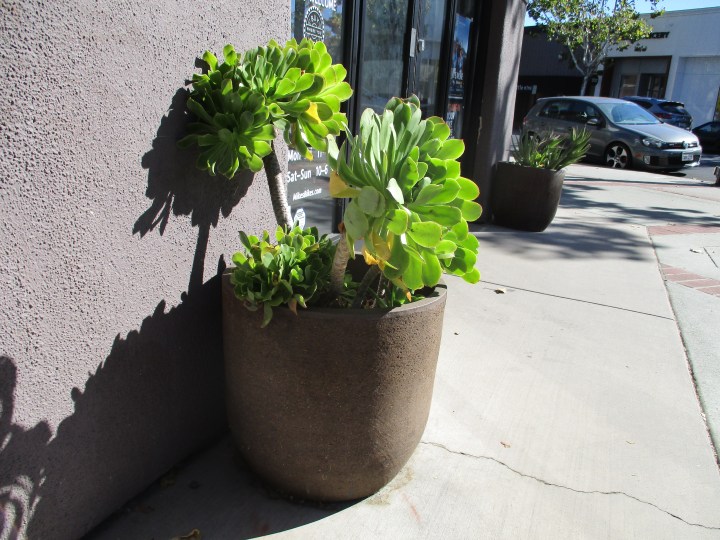
5. The adjacent tree well really did not look this bad after I pulled up some of the debris that collected in it a month or so ago. It now looks as nasty as it did during my previous update. I know the bit of housleek looks really nasty, but it stays because I expect it to recover once the rain resumes. Nasturtiums grow here too. I will sow seed for ‘Jewels Mix’ nasturtiums in the planter box only because nasturtiums do not regenerate there as reliably.
6. This second tree well that is just west of that in the #5 picture above had a nice magnolia tree in it a month ago. Only this pile of chipped stump remains. The sidewalk, curb and road pavement will be replaced soon. Street trees will be added later. The magnolias were so pretty, but were too impractical and messy. I am impressed that they did not do more damage than they did during the half century that they were there.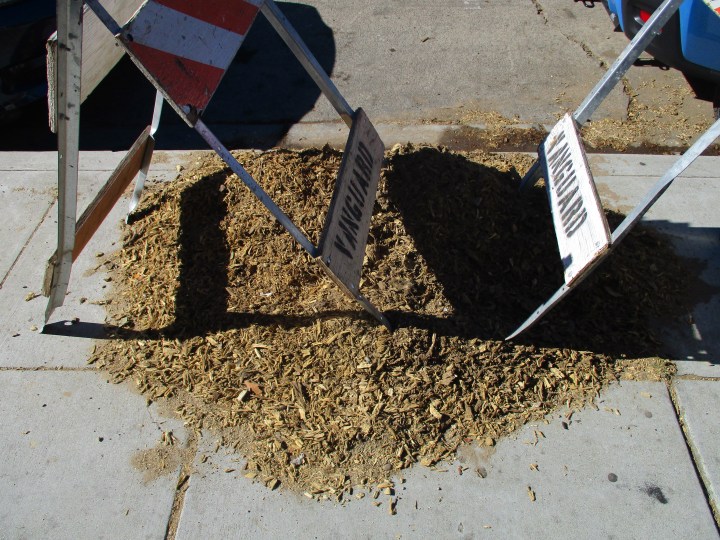
This is the link for Six on Saturday, for anyone else who would like to participate:
https://thepropagatorblog.wordpress.com/2017/09/18/six-on-saturday-a-participant-guide/
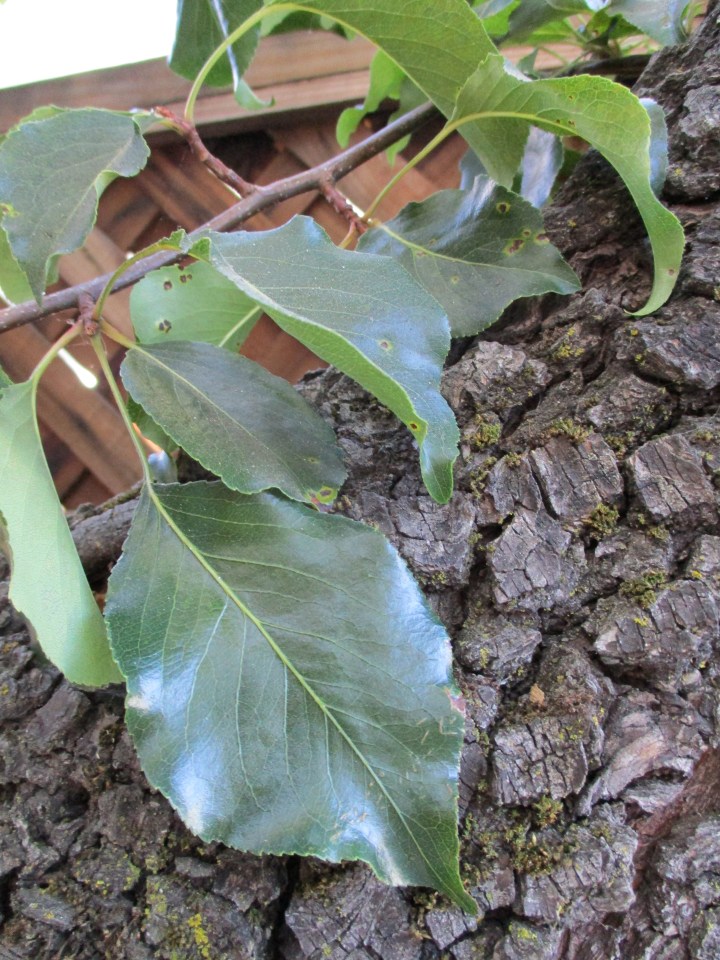 If it were not so seriously susceptible to fireblight, the evergreen pear, Pyrus kawakamii, would be a practical evergreen shade tree for small garden spaces. Mature trees do not often get much taller or wider than twenty five feet. Aggressively pruned trees that do not bloom much are less susceptible to fireblight. Regularly groomed trees can live with fireblight for many years or decades.
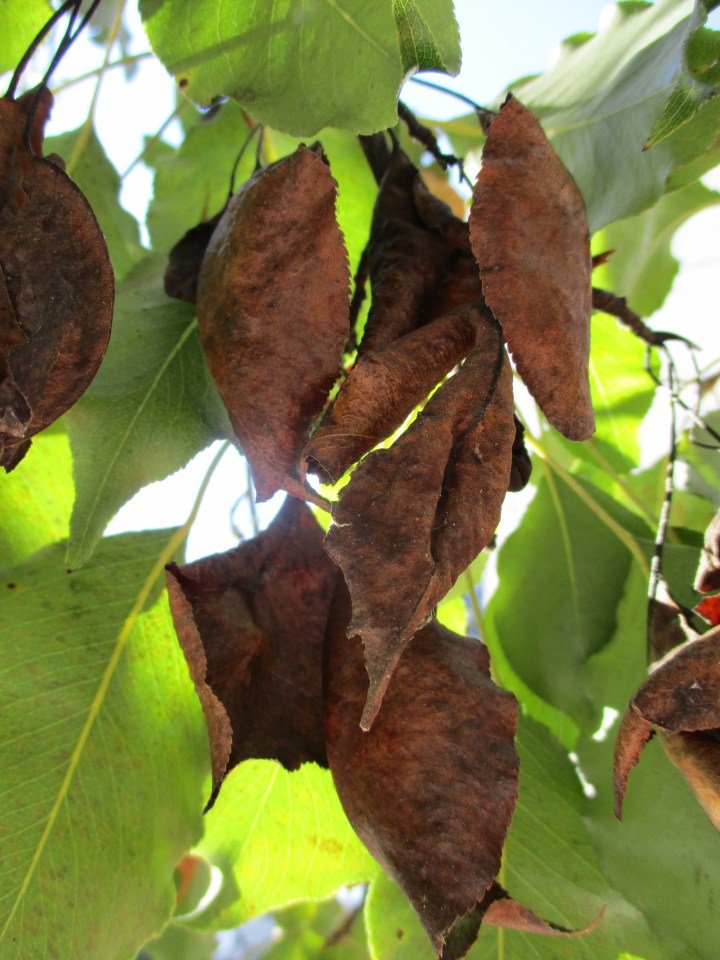 Bunches of blackened leaves hanging from blackened stems in otherwise healthy pear trees really are as serious as they look. They probably appeared as new growth was developing in spring, and are still as dead now as they were then. As surrounding foliage colors and falls, the blackened foliage will remain until it gets knocked out by rain and wind in winter, or until it gets pruned out.
 There were barely enough blue elderberries left this late in the season for the blue elderberry jelly that should have won the blue ribbon at the Harvest Festival. It’s a long story.
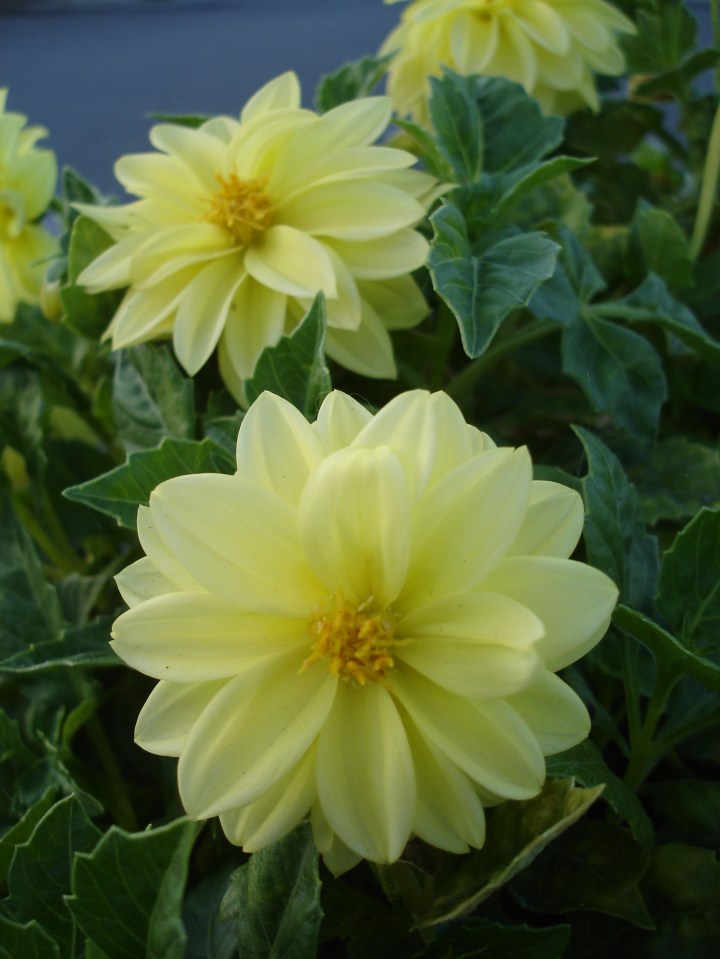 They are really just smaller versions of the larger perennial dahlias that are grown for their big bold flowers and flashy colors. Technically, annual dahlias produce smaller versions of the same perennial roots that can survive through winter to regenerate the following spring. Yet to most of us, it is easier to purchase new plants in spring than to grow new plants from stored roots.
 Like it or not, the warm season annuals that were so flashy all through spring and summer will eventually need to be replaced with cool season annuals to provide color through winter. It is always unpleasant to pull up the annuals of a previous season while they are still blooming, even if they are already getting scruffy and discolored. It is actually easier if they got roasted by recent warmth.
 It wasn’t even two days. The article about the ‘Illegal Planting’ of the Memorial Tree in Felton Covered Bridge Park posted at noon on Saturday, and then on Sunday night or early Monday morning, the Memorial Tree was vandalized. Fortunately, it is nothing serious. A small bag of trash was impaled onto the binding stake that is there to keep the trunk straight, which pushed the top of the small tree aside. It needed to be bound to a new stake anyway.
 The most popular hardwood in California is essentially unavailable in nurseries. California black oak, Quercus kelloggii, provides between a quarter and a third of the hardwood timber harvested in California. One would not know it by its sporadic appearance within mixed forests of the Coastal Ranges. It is much more common in the Sierra Nevada, which might be why no one grows it.
 Autumn is slow in getting here. Yes, as of last Sunday, it is now autumn. The date is determined by the equinox, so is the same for everyone in the Northern Hemisphere, and is the same for the arrival of spring in the Southern Hemisphere. It just takes a bit longer for autumn weather to develop in the mild climate here. Nights are cooler. Shorter days are not as warm as they had been.
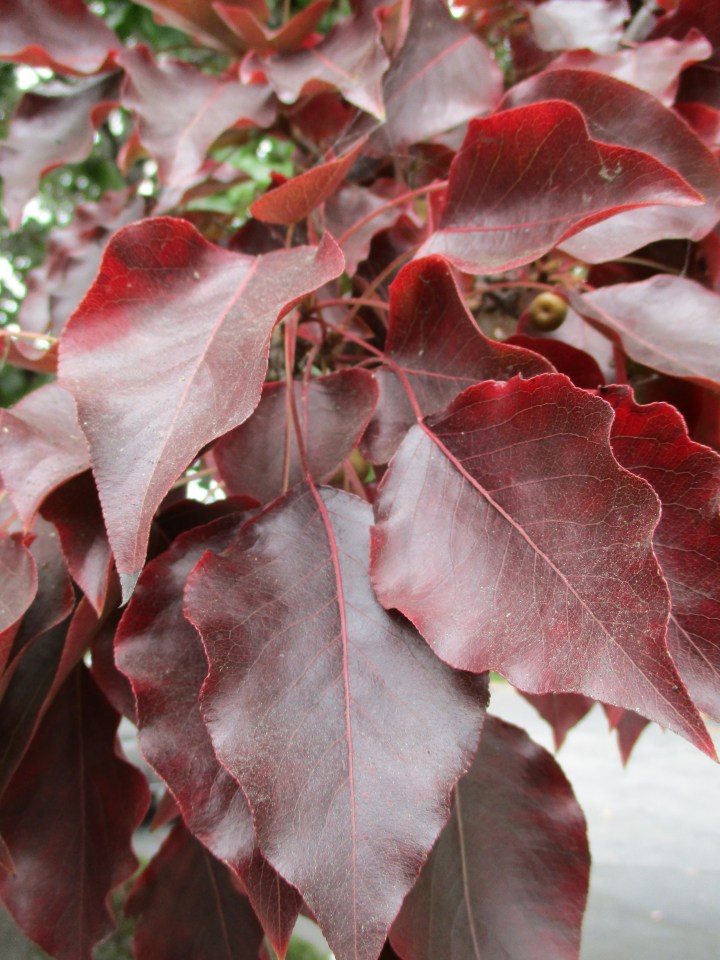 Now that they have been so popular for so long, the deficiencies of flowering pear, Pyrus calleryana, (which is also known as Callery pear), are becoming increasingly evident. The dense branch structure and compact form that are so appealing while trees are young compromise structural integrity as trees mature. Symmetrical trees can be severely disfigured if limbs get broken by wind.
