 Not just any poppies; California poppies, the state flower of California.
So why the picture of an old cinder block wall on the edge of an unkempt and weathered parking lot behind the old County Bank Building? Well, right there in the middle of the picture, where the lowest course of block meets the edge of the pavement are a few weeds, and some of these weeds are poppies showing how resilient they can be.
California poppies are opportunistic. They grow fast and bloom when they can. For most, that means that they bloom as the weather starts to warm up at the end of winter. For others in irrigated gardens, they can bloom in phases through summer. Some do their thing quickly as soon as they get a bit of moisture from the first autumn rains or even dew. They know what time of year it is, and that the weather will not likely get hot enough to cook them; so they bloom and throw their seed for another generation in a few more months, or maybe many months from now. They adapt. That is how they live on the edges of forests of the Santa Cruz Mountain, to interior valley chaparral, to the Mojave Desert. They are a remarkable specie.
Remember the poppies in the Wizard of Oz? There are several theories about what those poppies represent, and why the put Dorothy, the Cowardly Lion and Toto to sleep without affecting Scarecrow and TinMan. Duh, Scarecrow and TinMan do not breath. They can not inhale the narcotic produced by the poppies. Even if they did, they lack the physiology to be susceptible to opiates.
There is a significance to poppies blooming today, the same day I wrote about the gingko, on December 13; but this ain’t Oz.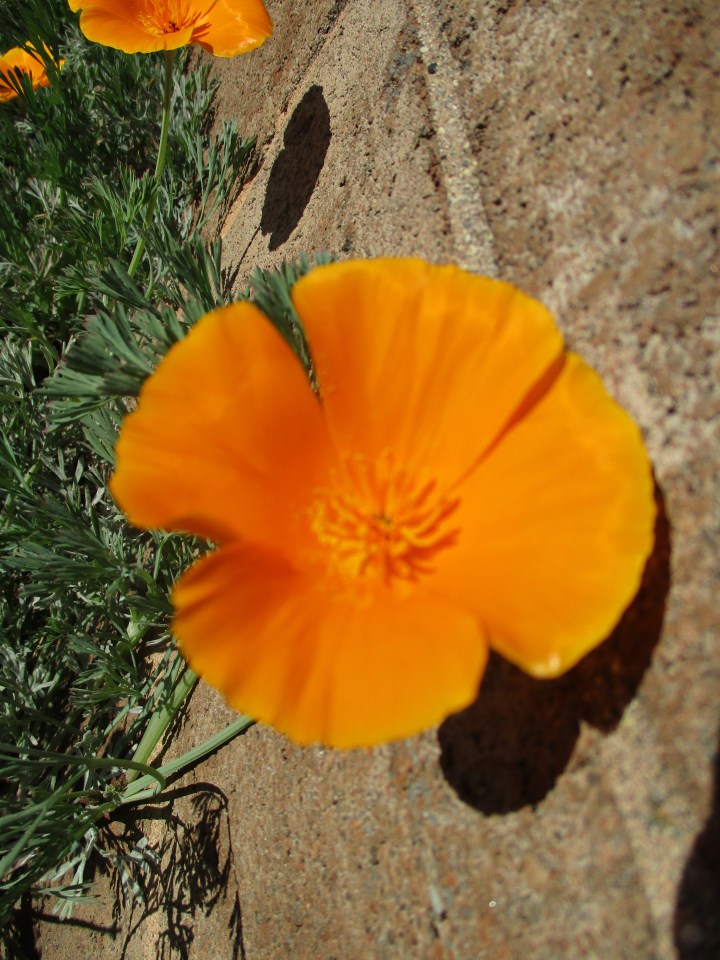
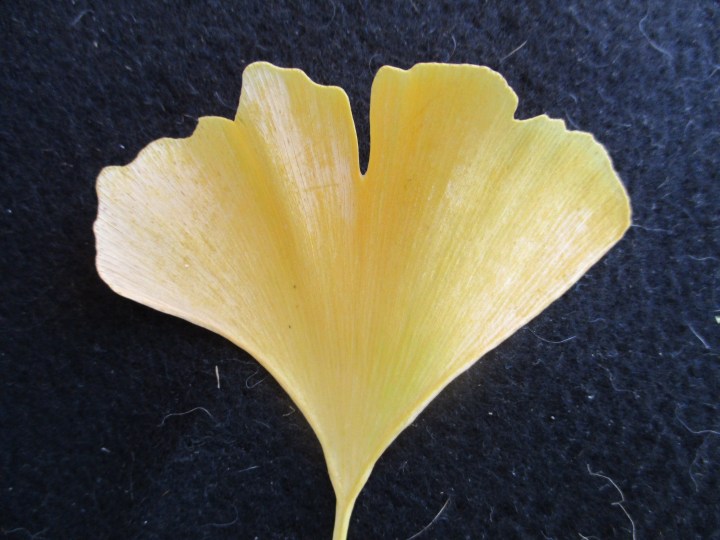 This single yellow ginkgo leaf says a lot. It was found among the abundant cottonwood leaves on the broad walkway in Felton Covered Bridge Park (
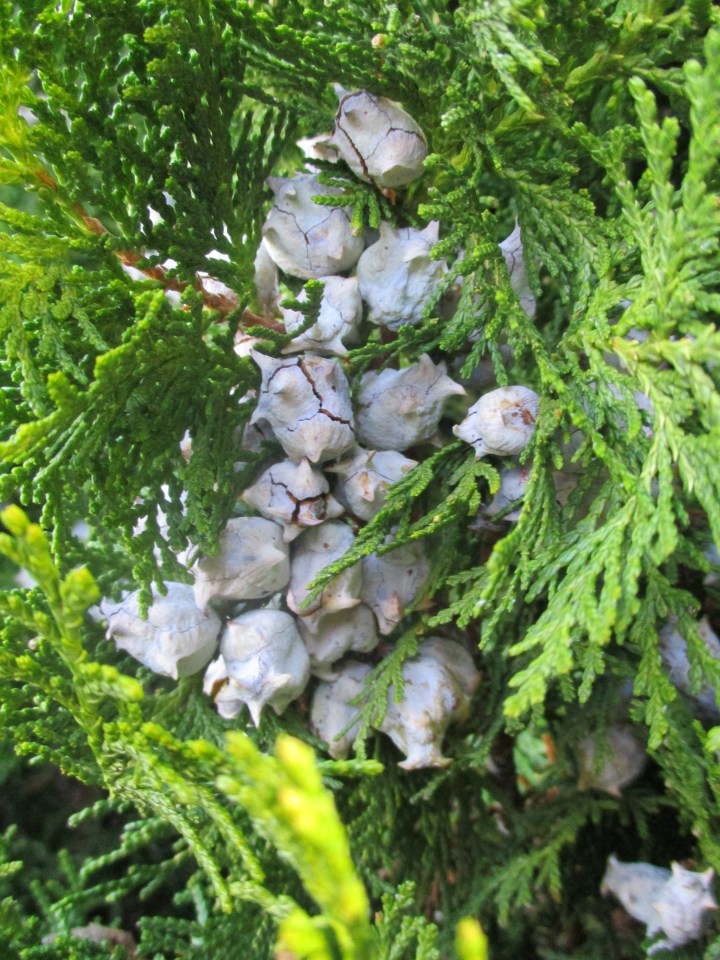 These pale blue . . . whatever they are, were just too cool to pass up without a picture. Technically, they are the ‘cones’ of dwarf golden arborvitae, Platycladus orientalis (formerly Thuja orientalis) ‘Aurea Nana’. They do not look much like cones. They are only about three quarters of an inch long, and are rarely as profuse as they are here. They are less appealing as they dry and turn brown.
 There should be no guilt associated with a cut Christmas tree. They were stigmatized many years ago, when some people believed that they were harvested from forests, and more of them likely were back then. However, most of us now know that, except for a few that actually are harvested from the wild, Christmas trees are grown on farms like most other cut foliage or horticultural crops.
 Horticulturists have a way of making all those long Latin names sound easy to pronounce. Lyanothamnus floribundus ‘Asplenifolius’ – Syzigium paniculatum – Metasequoia glyptostroboides. I do not know why proper pronunciation of their names is so important. They have no ears. They can not hear if we simply call them ‘Earl’. Even if they could hear, they would not respond.
 Isn’t this a delightful meadow? It is located right across from the historic Felton Covered Bridge
  Apparently, someone thought that there might possibly be the remote chance of the potential for homeless people to maybe engage in activities that could perhaps be determined to be bad, right behind the Community Garden. If you look closely, you might be able to see them back there. Maybe not. (More accurate information can be found at the Facebook page of Felton League at
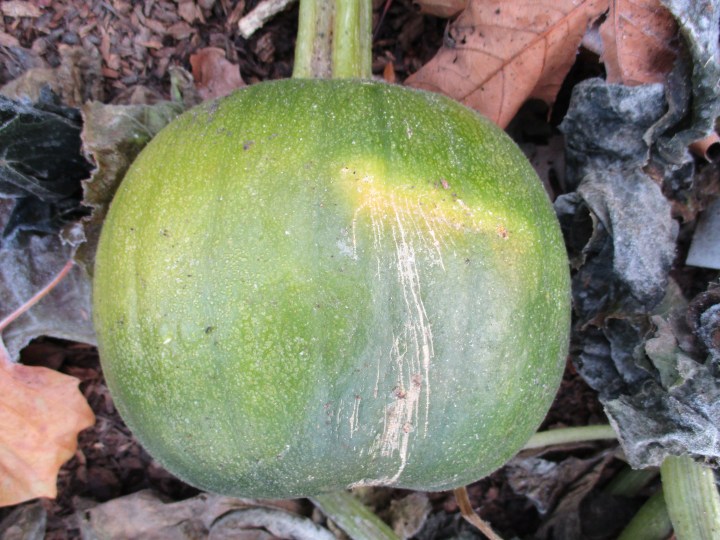
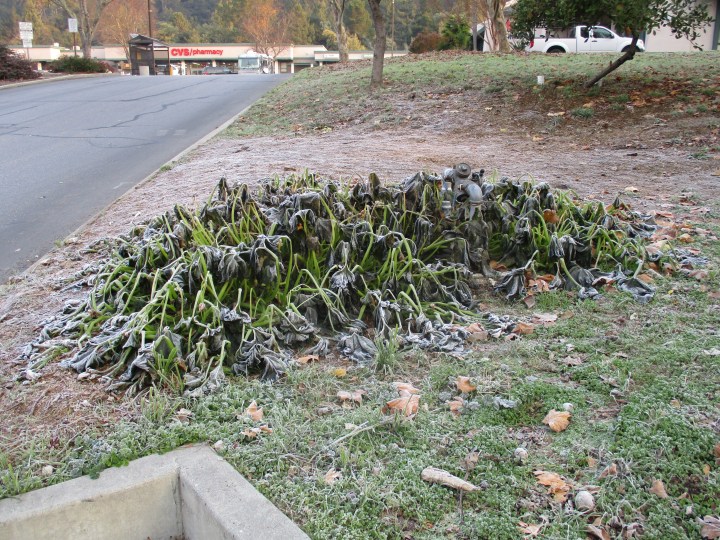 Yes, we get it too. It took a while, but we finally got it just like most of everyone else in North America and the Northern part of the Norther Hemisphere. It is not much to brag about, but it is enough to melt the big feral pumpkin vine that I wrote about earlier (
 It is about time that someone reintroduced this technique! Blue Princess holly is now available together in the same pot as its male pollinator, Blue Prince holly (Ilex x meserveae ‘Blue Princess’ and ‘Blue Prince’). With careful pruning to prevent one from crowding out the other, both can coexist and provide profuse, bright red berries every winter, indefinitely. As the plants grow, their main trunks will eventually graft together.
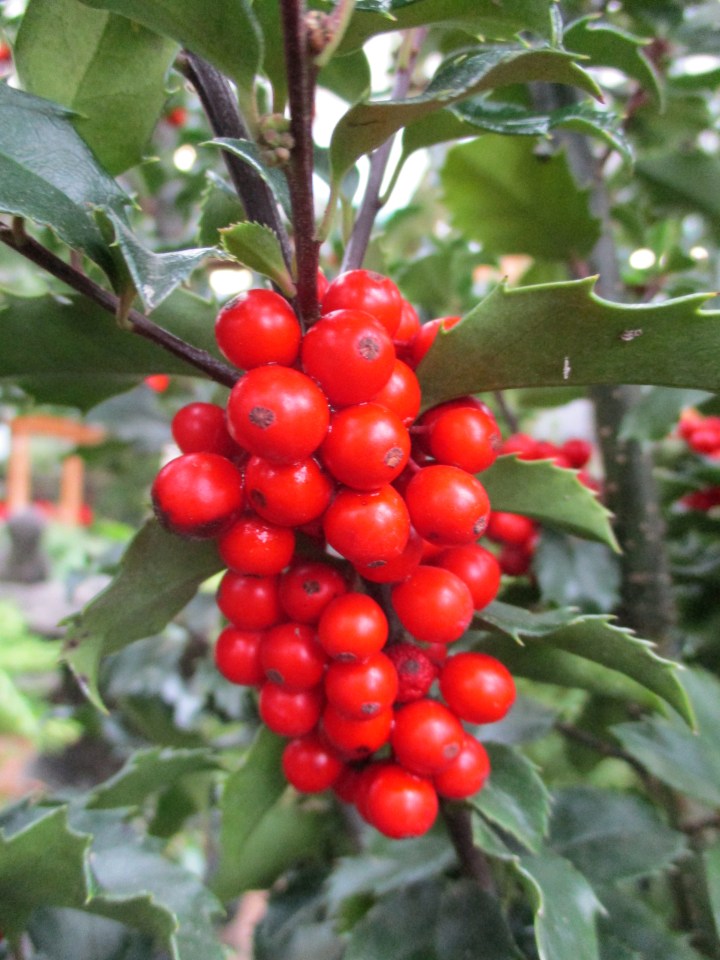 There are some things about plants that we might be better off not knowing about. For instance, their idea of sex is even weirder than that of humans! Generally, flowers of ‘monoecious’ plants have male parts and female parts that do what they must to produce seed, which is often contained in some sort of fruit structure. Some plants can pollinate themselves. Ick! Others require separate but compatible pollinators.
 “It’s not nice to fool Mother Nature.” That old margarine commercial was lame back in the 1970s, but the quote is so true. Inadvertent interference with the natural process of wildfires has unfortunately increased the combustibility of the flora of forests and wildlands throughout California. No one really meant to interfere with the process. It is just what happens when we need to protect our homes and properties from fire.
