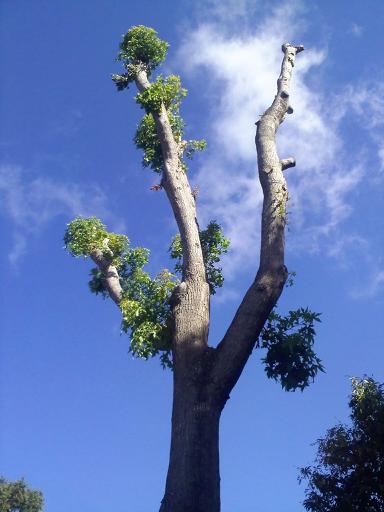
I use the term loosely. Okay, so maybe I use it mockingly in this context. This sort of thing really should have no connection to the works of Calder, Rodin or Brancusi. It might be worthy of a few fancy adjectives, such as ‘severe’, ‘unusual’, ‘dramatic’ and ‘bold’. Horticulturally though, we might be thinking more like ‘disgraceful’, ‘abhorrent’, ‘ridiculous’ or ‘just plain sad’.
There is nothing wrong with pollarding, that severe sort of pruning that almost all other arborists will tell you is wrong. It involves pruning trees back to the same distended terminal knuckles every winter. Only a few trees are adaptable to the technique, and technically, sweetgum happens to be one of those few trees.
The stipulation is that once pollarded, they MUST be cut back to the same knuckles EVERY winter. A small stub or maybe two can be left on knuckles to allow them to elongate a bit annually, but that is about all. Pollarding is severely disfiguring, and ruins structurally integrity for all growth after the first growing season. Without this annual and aggressive maintenance, pollarded trees are very likely to drop limbs and possibly disintegrate faster than they can recover.
Sweetgums are not often pollarded because they are usually grown for their autumn color. Secondary growth that develops in response to pollarding is too vigorous to color well. The foliage stays green well into winter, and then falls without much color at all. Pollarding sort of defeats the purpose of growing a sweetgum.
The real problem with this particular tree is that it was not pollarded correctly. For one, it was probably cut like this because someone thought that it was too big. It should have been cut much lower if someone was going to put the work into pollarding it at all. Now, the secondary growth that must be pruned away will be very high, and take much more work to prune away. It will also be more exposed to wind. Limbs that break away will fall from higher up, so will fall farther away, and with more inertia.
Secondly, the pruning technique really was ‘abhorrent’. Small stubs are acceptable on established knuckles in order to direct growth. Long stubs that are expected to develop into knuckles are also acceptable. The weird stubs on the trunks of this tree are both too short and too stout. Because they are too short, they will be too shaded to develop into knuckles. They are too stout to compartmentalize or ‘heal’ (if they do not form knuckles) so are likely to decay, and spread decay into the trunks.
Thirdly, this tree was pollarded in summer, which is why the secondary growth is so stunted and underdeveloped now that the tree should be going dormant for autumn. The stunting should not be much of problem, since new growth should develop in spring. The problem is that the lightly colored bark likely scaled when it suddenly became exposed to sunlight by the removal of all of the foliage in the middle of summer. The scalded areas will eventually decay and become open wounds, which will spread decay into the main trunks and limbs. Even if secondary growth is healthy, and the tree gets pollarded correctly every winter, the limbs will eventually become unable to support the weight of healthy foliage.
This is one of the many reasons it is so important to procure the services of a qualifies arborist. Someone payed a significant amount of money to get this valuable tree ruined, and will eventually need to pay more money to have it removed. It would have been much less expensive to pay a bit more to get the tree pruned properly, or to have it removed completely.
 The Latin name is easy to confuse with the sacred flowers of an aquatic perennial from tropical regions of Asia, or a funny looking British sport coupe. Lotus berthelotii is a diminutive terrestrial perennial known as parrot’s beak. It gets only about a foot high, and spreads to only two or three feet wide. It cascades nicely from hanging pots, and is actually rarely planted out in the garden.
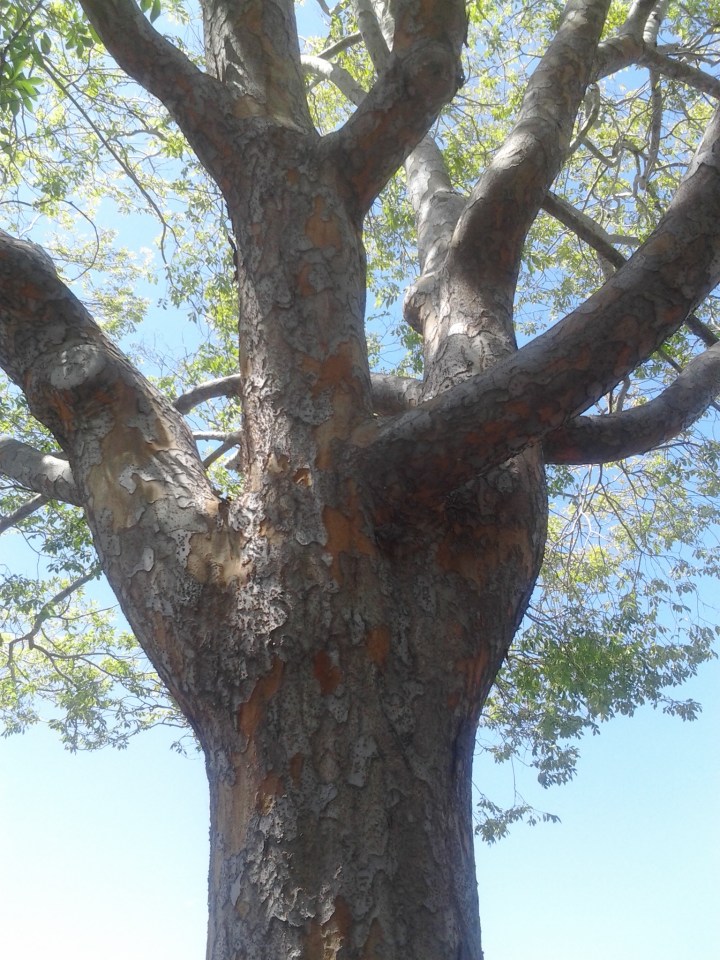 Now that winter is only two weeks away, and many deciduous plants are defoliating and dormant, it may seem as if there will be less work to do in the garden. After all, not much is growing. The funny thing is that this is the best time to sneak up on some of them, and prune them while they are sleeping. Depending on what is in the garden, winter can be just as busy as any other season.
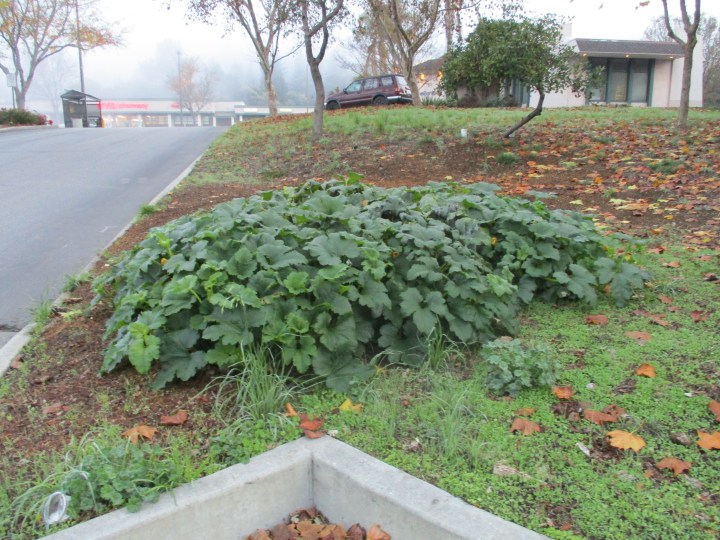 Just a few feet downhill from where the old valley oak had lived for centuries (
 Now that I have been watching a few other blogs for three months, I notice that some people write some very interesting or at least entertaining articles about topic that are not directly related to the main topic of their respective blogs. Most are just like old fashioned slide shows (remember those?) with cool pictures from around the neighborhood, travels, home projects, or whatever might be interesting. I have not done this yet; but I happen to have a bit of free time at the moment, so thought that I would post these three pictures of the historic Felton Covered Bridge. Although I am technically from Los Gatos, my home is in the Santa Cruz Mountains between Los Gatos and Felton. I also have history in Felton, since my grandparents and my Pa used to live here.
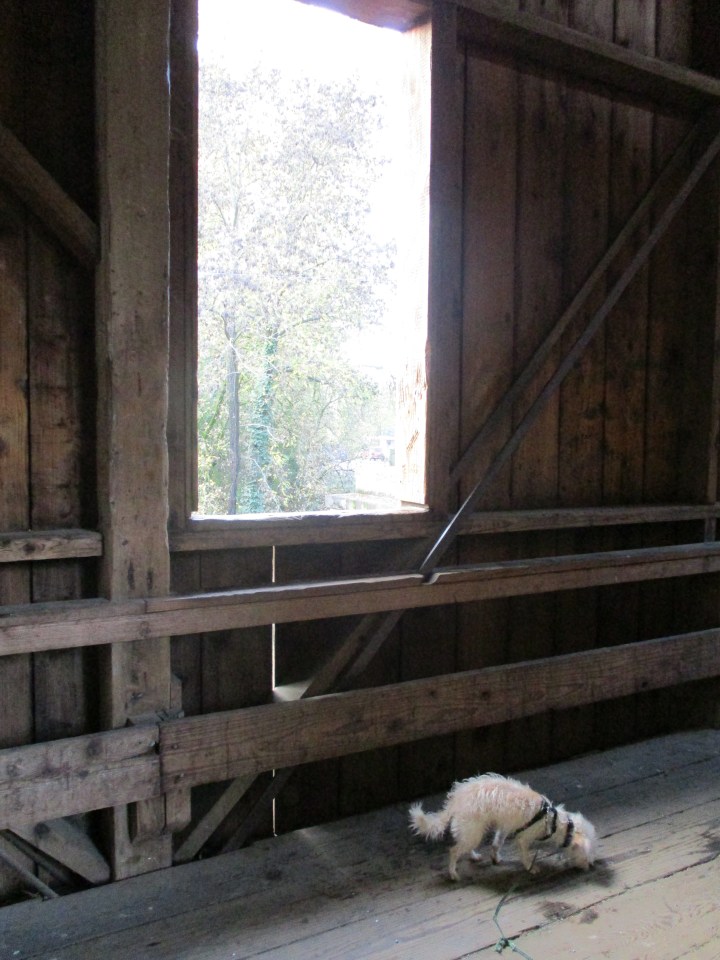 This is the southwestern of the four sidelight windows on the Felton Covered Bridge. If crossing from the end in the upper picture, it would be on the left side toward the far end. It is the best window in the house. Rhody to the lower right might be mistaken for a rodent (
  This is the view from that same window. That wet thing below is the San Lorenzo River. The black spots in that wet thing below are ducks. Once the rain starts, the San Lorenzo River really looks more like river than a creek. This last spring, in the San Lorenzo River right below the Bridge, we scattered the ashes of a good friend, Steven Ralls, with whom I went to Oklahoma (to the right in the illustration –
  After reading so much about the exquisite foliar color that most everyone else in the Northern Hemisphere gets this time of year, I must admit, I can get rather envious of those who experience four seasons instead of just two. The abundance of spring in the Southern Hemisphere does not help. Why have I not found a garden blog from Ecuador or Indonesia so that I have something to point and laugh at? It just isn’t fair.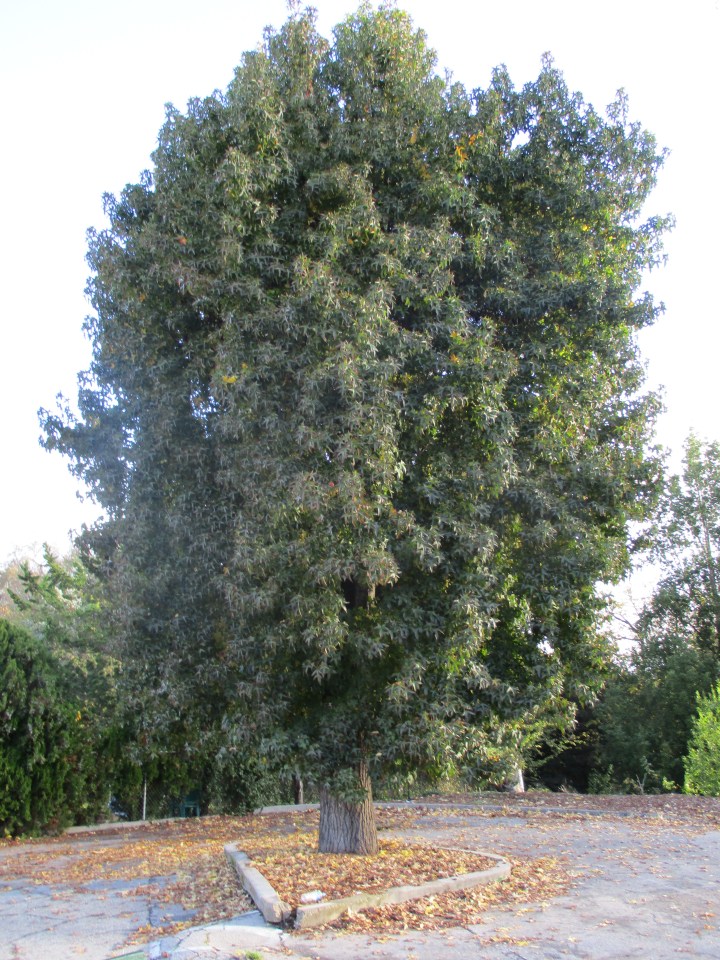
 Here on the West Coast of California, most of us know goldenrod only as a color of crayon. In most other parts of America though, it is a common wildflower that is colorful enough to be popular in home gardens. Yet, with more than a hundred specie, it is hard to say exactly which goldenrod, (Solidago spp.) the crayon color corresponds to. All are some shade of gold or yellow, but some are a bit more orange than others.
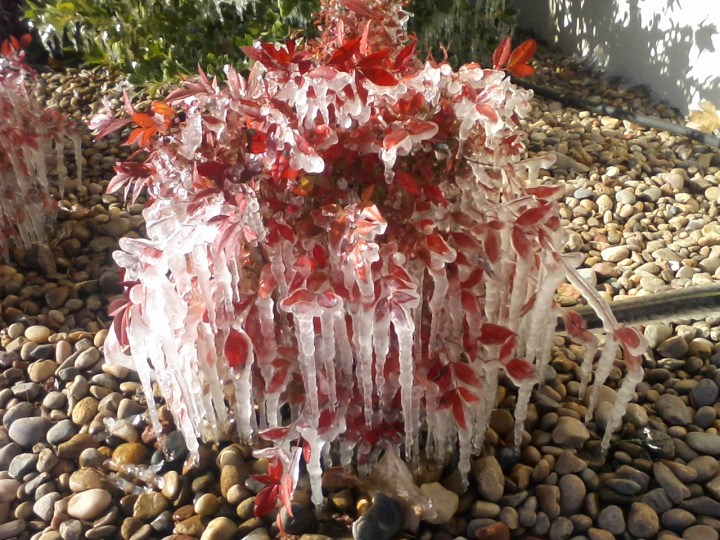 One of the most important differences between plants and animals is that animals are ‘animated’, and plants are not. Aquatic plants might float about, and might even drift into more favorable situations. Vines and plants with creeping rhizomes can likewise relocate. Otherwise, most plants are confined to the same locations where they grew naturally, or where they were planted. They need to get it right from the beginning.
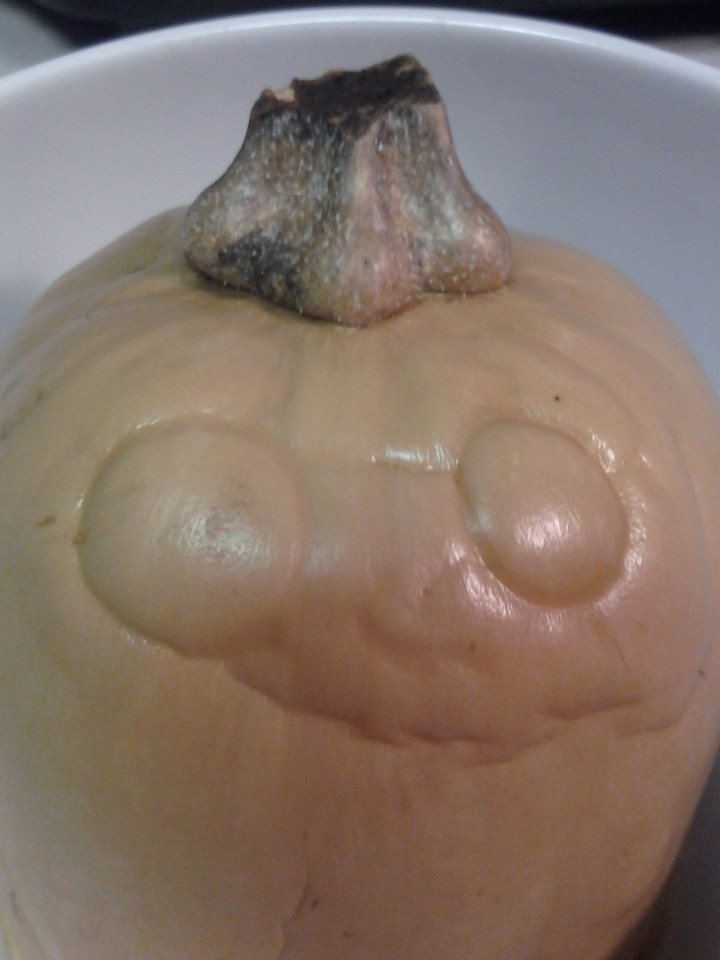 There are not many things that will grow in my zone that I will not at least try to grow if I have the space and resources to do so. I really like to grow fruits and vegetables, particularly those that I am familiar with from when I was young. They are just as productive now as they were then. The only problem is that I do not know how to cook. I can freeze, can or pickle large quantities of produce, but cooking is something that I leave to experts.
 Is it coincidence that the Latin name of black-eyed Susan is Rudbeckia, or was Becky rude enough to give Susan her black eye? The dark center is something that all varieties have in common, and what distinguishes them from most of the related blanket flower varieties. The daisy flowers of black-eyed Susan are traditionally yellow. Modern varieties can be orange, reddish or bronzed.
