Pot Marigold

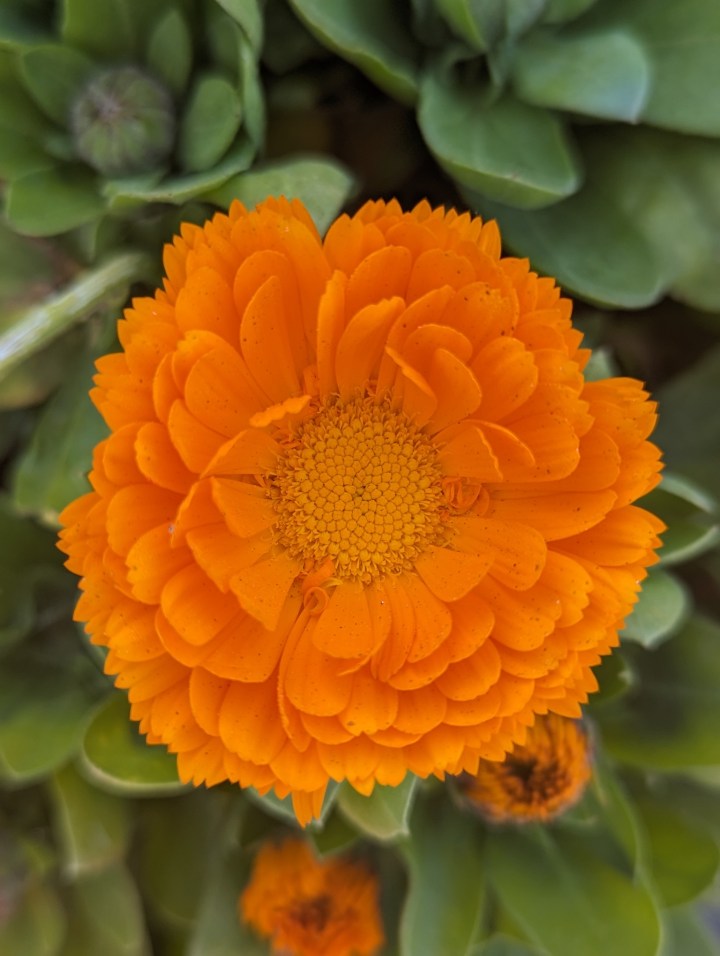
Pot marigold blooms with marigold colors.

French marigold is one of the most popular annuals of autumn. Pot marigold, Calendula officinalis, provides similar color with daisy like flowers. Most are bright orange or yellow. They lack only the warm burnished red of French marigold. They compensate with more variety of their pastel ranges. Their single or double blooms are two to three inches wide.

Within cooler climates, pot marigold blooms between spring and late autumn frost. Here, it blooms better through mild winters, with only minor pauses for any mild frost. It is more likely to dislike summer warmth. Like many seasonal annuals, it can technically grow as a short term perennial. However, also like others, it performs best for a particular season.

During their season, taller varieties may grow a bit higher than two feet. Most are shorter. Their oblong and slightly fuzzy leaves are mostly between two to five inches long. Some develop wavy margins. Mildew is sometimes a problem. Deadheading promotes bloom. However, a few deteriorating flowers can remain to provide seed for another generation. Subsequent generations eventually revert to simple and single yellow or orange bloom.

Cool Season Bedding Plants Begin

Marigold becomes more popular for autumn.

There is no rush yet. Some cool season bedding plants can go into their gardens as late as autumn. Ornamental kale and cyclamen can be as late as winter if necessary. Locally, autumn and winter can be a bit later than elsewhere. Also, different cool season bedding plants rely on different schedules. Ornamental kale and cyclamen actually prefer to wait.

Cool season bedding plants are the same as winter bedding plants. They also qualify as cool season annuals and winter annuals. However, most have potential to be perennial, and some can perform after winter. Some are warm season bedding plants within cooler climates. Locally warm summers and mild winters limit their performance very differently.

All bedding plants provide a profusion of temporary floral color for their assigned season. Cool season bedding plants replace deteriorating warm season bedding plants. Within a few months, warm season bedding plants will become seasonal again. Most that can be perennials are disposable for simplicity. Replacement is generally simpler than salvage.

Installation of bedding plants is often contingent on performance of their predecessors. If petunias of last summer still bloom nicely, pansies for autumn may need to wait. Pansies might need to be early though, if petunias are already shabby. Most cool season bedding plants are fortunately adaptable in that regard. Merely a few must wait for cooler weather.

Scheduling for seeding of cool season bedding plants is not as adaptable. Seed can not germinate and grow faster if late. Actually, seedlings grow slower as weather gets cooler. Seedlings for some species should be growing already. Others should start about now or rather soon. Some should start in cell packs or flats. Several others prefer direct sowing.

Pansy and viola are probably the most familiar and reliable cool season bedding plants. Marigold and perhaps snapdragon are popular now, but may not perform through winter. They become seasonal again as winter ends. Sweet William and a few sorts of primrose are potentially perennial. Any that survive through summer could resume blooming soon.

Seven Weeks

July 12 & August 30

What a difference seven weeks can make! Updates regarding the Memorial Tree in Felton Covered Bridge Park are typically posted annually about the twelfth of July. Growth is obvious after a year. I did not expect it to be so obvious after less than two months between the twelfth of July and the thirtieth of August. I suppose that I should not be surprised. Even after most growth occurs through spring, some growth continues through late summer, and perhaps as late as the beginning of autumn, immediately prior to the slow initiation of dormancy for winter. Specimens of this species, valley oak, Quercus lobata, are innately vigorous and grow faster and more vertically while young. Growth decelerates and redirects itself laterally as trees mature and age. Otherwise, if they continued to grow as vigorously as they do while young, they would collapse from their own weight before they get to be as old as elderly trees get. Some live for more than six centuries, so their technique is obviously effective. Four nearby California black oaks, Quercus kelloggii, are not likely to get to be five centuries old, and are more likely to live for only one or two centuries. Unfortunately, two of them are not in comparably exemplary condition. One must be pruned for removal of major necrosis, and direction of new growth. Another requires major structure pruning. All four should be pruned for clearance above the surrounding parking lot. Perhaps I should be more concerned with these four California black oaks now that the Memorial Tree will need nothing for quite a while. Perhaps I should investigate the condition of the Monterey cypress Memorial Trees within the nearby Memorial Grove, which are growing well enough that surrounding box elders should be pruned away to relinquish more space for them.

August 30 zoomed out

See Anemone

Anemone hupehensis

Japanese anemone, Anemone hupehensis, which is now Eriocapitella hupehensis, is one of several species that I had been wanting to grow for a very long time. Like peony, goldenrod, Joe Pye weed, Indian paintbrush, beautyberry and fancy hybrids of clematis, they are prominent features of fancier gardens in other regions. Some of such species do not perform well here. Others are merely unpopular, but might perform well here if they get the chance. I see them all only in pictures, so can not distinguish what their respective situations are. The only anemones that I had ever encountered while young were sea anemones on nearby beaches. In college, I met poppy anemones, which we know merely as anemone, but found that they are not as reliably perennial as they are purported to be. Japanese anemone had been elusive, until I met a very established and perhaps invasive colony of it in an old landscape near Oakland less than fifteen years ago. I figured that if it can be as happy as it was in a relatively coastal climate, it could be happier here with a bit more chill during winter. Until then, I assumed that minimal chill was a limiting factor to their performance here. ‘Honorine Jobert’ seemed to be the epitome of single white Japanese anemone, but I had not seen any white cultivars, even those with double flowers, that were not alluring. Then, I discovered an unidentified cultivar of Japanese anemone on the edge of a rose garden here. It survives as a remnant of a preceding perennial garden, but does not perform well now that redwood roots have become so aggressive. Furthermore, its floral color is unimpressive. It is not white, but is not quite pink either. Heck, it is not even white blushed with pink. I do not know how to describe it. Initially, it seemed to be only slightly pinkish pale gray. Ick! This year, it seems to be slightly more pinkish than it had been, which makes it slightly less disappointing. However, now that I know it is here, I will not try any other Japanese anemone until I at least try to grow this one well. I am confident that if I relocate bits of it to a garden where it does not need to compete with other vegetation, it will bloom with a more appealing shade of pink. I will not mind that it is not white if it does that much. Then, if it can perform well, I will know that I can grow a white cultivar of anemone also. There is no rush though. Although white happens to be my favorite color, and Japanese anemone happens to excel at white, pink can be appealing also. This is my very first Japanese anemone, and regardless of how unimpressive it is now, I am pleased with it.

Six on Saturday: Too Much or Not Enough

Propagation without adequate propagation infrastructure can be disappointing. It might alternatively be a bit too rewarding. I prefer to propagate excessively, to compensate for expected losses. Consequently, I generate surplus much more often than I encounter any disappointment. One of the disappointments this week is actually the result of a surplus that occurred too late within the growing season of that particular species. I managed to find three other disappointments for half of these Six, but they are relatively minor, and should eventually be resolved prior to autumn. Even then, because these three particular species are vulnerable to chill while young, I intend to shelter them through winter. The surplus can eventually be shared with neighbors. It all works out.

1. Passiflora racemosa, red passion flower vine pruning debris was processed into a flat of thirty-six cuttings. I suspected that only a few would survive, but I was wrong. Oh my!

2. Citrus paradisi ‘Marsh’ grapefruit cuttings were initially about as numerous, but very few survived. They defoliated, and are still vulnerably dinky. They are ungrafted anyway.

3. Mentha spicata, mint is still going. There was already too much months ago, but I still plug its trimmings as cuttings. I should stop now. I should have stopped before I started.

4. Vanilla planifolia, vanilla is still doing nothing. Only this one of five cuttings survives. Its single exposed bud has been inactive for months. Perhaps a lower bud is doing more.

5. Borago officinalis, borage grew unexpectedly from expired seed that got tossed. These thirty-six, which are now in a filled flat, are too many at the end of their growing season.

6. Musa acuminata ‘Popo’Ulu’ banana is the eighteenth of twenty cultivars here, but this is its first new leaf since its arrival. It must grow more prior to autumn to survive winter.

This is the link for Six on Saturday, for anyone else who would like to participate: https://thepropagatorblog.wordpress.com/2017/09/18/six-on-saturday-a-participant-guide/

Japanese Aralia

Japanese aralia is both prehistoric and futuristic.

The popularity of Japanese aralia, Fatsia japonica, has spanned more than just a few decades. The big, glossy leaves of this lush foliar plant adorned the home of the Flintstones in Bedrock many thousands of years ago, as well as the office of Mr. Spacely of Spacely Sprockets, where George Jetson works, some time in the future! It is just as happy in most types of soil as it was in the front yard at the Flintstone Residence, and is just as happy in large containers as in Mr. Spacely’s office. As long as it is protected from harsh exposure or reflected glare (like it might get from large lightly colored walls or tinted windows), Japanese aralia does well in full sun, or can be just as happy in the shade of larger trees. 

Although it does not grow too rapidly, Japanese aralia eventually gets nearly eight feet high and wide, and commands a bold presence. Their deeply and symmetrically lobed leaves can get as broad as a foot and a half, on long petioles (stalks). The foliage of ‘Vairegata’ emerges with a yellow border that turns pale white. ‘Moseri’ stays quite compact.

Plants grown for their foliage can be maintained by cutting oldest stems to the ground as they deteriorate, so that newer stems can replace them. Excessive basal watersprouts can be cut or ‘peeled’ off if they get too crowded. Alternatively, lower growth can be pruned away as it develops to elevate the canopy and expose interior stems. However, individual stems do not last indefinitely, and will eventually need to be replaced by any convenient watersprout. The most deteriorated plants can be rejuvenated by getting cut to the ground just before spring.

Botanical Names ‘Should’ Be Universal.

Is it naked lady, amaryllis lily, belladonna lily, Jersey lily, resurrection lily, August lily or March lily?

No horticulturist has yet identified the flowers that Mickey Mouse picked from the porch at the home of Minnie Mouse to give here when she came to the door. Most of us agree that they are a black and white variety of ‘posy’, since they look so similar to those that Popeye picks in the same manner for Olive Oyle, before being smacked aside by Bluto, who then takes the flowers and presents them to Miss Oyle as ‘posies’. However, real posies look nothing like the daisy like flowers of cartoon courtship. Perhaps these flowers will remain as unidentified as the variety of the yellow tulips that the Pink Panther replaces with an also unidentified pink variety of tulips.

Misidentification of plants is probably more common now than ever. Plants are becoming available from other regions, where they may be known by common names that are very different from familiar or local common names. Even Latin or ‘botanical’ names, which should be universal, are not always perfectly reliable, since they are so often based on variable common names. The problem with misidentification is that we sometimes get plants that are very different from what we were expecting.

When purchasing plants or seeds online, it is always best to confirm that the Latin names are what they should be, since they are still more reliable than common names. Misidentification is more likely if the Latin name does not correspond to any of the known common names of the particular plant.

For example, seed that is described as that of ‘swamp maple, Acer saccharinum’ most likely really is Acer saccharinum, even though it is more commonly known locally as ‘silver maple’. The common names, both ‘swamp’ and ‘silver’ maple are regional, but are both correct. However, seed of ‘Norway maple, Acer macrophyllum’ should not be trusted, since the common name does not correspond to any of the several common names associated with the Latin name. It may actually be one or the other, but there is no way of knowing which.

It should not be assumed that plants that are known primarily by their Latin name can not be misidentified; since it actually sometimes happens. Yucca aloifolia that has naturalized on the Gulf Coast of Texas is known to many as Yucca gloriosa!

Horridculture – Hackers (again)

Is it really too much work to not leave such stubs while destroying a hedge?!

It has been quite a while since I posted anything that qualifies for the theme of ‘Horridculture’. Such topics are not only unpleasant, but have become redundant and passe. They are annoyingly frequent reminders of how several of the horticultural industries attract too many of those who either lack practical experience or simply do not care about their work. I can not even remember how many times I wrote about hackers, which is why I did not assign a number to this title. I can see that I addressed this issue as recently as February. Nonetheless, because this particular incident involves a Prunus laurocerasus, cherry laurel hedge that we have been renovating for a few years, it is difficult to ignore. The formerly severely overgrown hedge had been responding somewhat slowly but otherwise adequately to its renovation, all behind a reasonably presentable facade. Actually, until recently, the facade had become tidier and denser than it had ever been before. Then, a tree service was hired to clear some adjacent unmanaged vegetation. The objective was to remove vegetation from an area that is to be paved for dumpsters. There was no concern for the quality of the work, since remnants of such vegetation can be managed or removed later. The problem is that those who performed the task also removed a significant portion of the facade of the hedge beyond the area from which unmanaged vegetation needed to be removed. What is worse is that it was done so horridly. I do not remember seeing any proper cuts. All involved stems were stubbed and gashed. I can only guess that whoever did this expected the hedge to be removed later. I can not be certain of that, since complete removal within one process would have been less work than such thorough disfigurement. I mean that someone put a great deal of effort into disfiguring the hedge this severely. Fortunately, the hedge will eventually recover. I removed the stubs and neatened what remains, and will try not to look at it for the next several months. The tree service that did this actually removes unwanted trees for us efficiently and safely. Their arborists are quite experienced and qualified for what they do. I just do not want them to do anything else.

Someone put a great deal of effort into this degree of damage.

Bedding Dahlia

Bedding dahlias can perform as perennials.

Dahlias are as variable as related chrysanthemums. Rare tree dahlias can grow ten feet tall from the ground annually. Most popular dahlias grow less than half as high with more lavish bloom. Bedding dahlias are less than a foot and a half tall with smaller but profuse flowers. They are popular as warm season annuals, but can be perennial like the others.

Bedding dahlias are neither as ornate nor as diverse as those that are better cut flowers. They compensate with foliar density and floral profusion. Their flowers are less than five inches wide, and could be about half as wide. Their floral color range is limited to yellow, orange, red, pink and white. Floral variegation can add another color of the same range.

Bloom continues through summer and autumn, until frost. Deadheading promotes better bloom. Dormant tubers may remain in their gardens through winters here. They could rot, though, while their soil remains cool and damp. If dug and stored for winter, they prefer to return to their gardens prior to spring warmth. Dormant tubers propagate well by division.

Summer Warmth Continues Into Autumn

Dog days of summer are over.

The locally mild climate might be rather boring. Winter weather is not very cold. Summer weather is only sometimes very hot. Then, warmth does not often last for very long. Such climate might seem to be deficient in seasons. Summer seems to be the primary season, with just a few cool weeks of winter. Spring and autumn seem to be only brief transitions.

According to the position of Sirius, the Dog Star, the dog days of summer are done. They are the hottest days of the year for several climates of the Northern Hemisphere. The last was the eleventh of August. The final day of summer is the twenty-second of September. Such dates are less relevant here than elsewhere, though. Warm weather may continue.

Indian summer is more typical here than not. In some other climates, it is unusually warm and dry weather that continues into autumn. In this particular climate, it is not so unusual. Another difference is that it does not occur after earlier frost, as it might elsewhere. Some climates here lack frost anyway. Locally, warm weather is more lingering than fluctuating.

Some vegetation knows how to exploit such weather. Indeterminate tomato varieties can continue to be productive until a first frost. If they started soon after a last frost, they could get sloppy with rampant growth. That should not be a problem if production is the priority. With phasing as late as August, determinate tomato varieties can also produce until frost.

Most popular canna cultivars are hybrids of tropical and montane species. Because they are tropical, they are not accustomed to distinctly cool winter seasons. Because they are montane, they survive mild frost. Therefore, they grow until frost, and then resume growth as soon as they can afterward. Dahlia is similar, but maintains dormancy through winter.

Photoperiod also influences growth. Days gradually shorten through summer regardless of the duration of warmth. Some species are more responsive to this than others. Later in summer, crape myrtle can slowly begin to develop autumn foliar color. It does not require much chill to become strikingly colorful for autumn. It can do so while cannas still bloom and tomato plants still produce fruit.