Horridculture – Pilferage

Cuttings could have been taken more neatly than this.

Aeonium arboreum, tree houseleek and a few other succulents within my tiny downtown garden are very important to me. They are from the former garden of a friend who passed away years ago. They have performed very well for this particular application since their arrival. They are resilient and undemanding, and provide delightful foliar color and form. The darkest bronze cultivar of tree houseleek that I ever grew arrived with them, but over a few months, was stolen until none of it remained. As the first few cuttings grew enough to become prominent, they were either taken completely, or deprived of their upper foliar rosettes. Any remaining rooted but bare stems eventually succumbed as any subsequent foliar rosettes that they generated were also taken. The surviving succulents remain only because they are both less popular, and too numerous for complete depletion. Actually, I would not mind if those who find these succulents to be appealing sometimes take a few pieces. I merely find their lack of tact to be annoying. I expect them to know better than to take the last of something. Also, I expect that they should have enough sense to take bits from where they would not be missed, and to do so neatly, without leaving broken stubs. Quite a few stems are sometimes overgrown or extending awkwardly outside the planter box, so should be removed anyway. Many stems that are overwhelmed by upper growth could be removed without compromising collective visual appeal. That might actually be a common occurrence that I am not aware of because it is done properly. Stems of these succulents can be easily broken neatly at their unions, without leaving stubs, so pruning shears are not even necessary. Fortunately, these damaged tree houseleeks will recover like they and other succulents always do.

Coastal Redwood

Coastal redwoods need room to grow.

Not every garden can accommodate coastal redwood, Sequoia sempervirens. Wild trees can grow hundreds of feet tall, with trunks as wide as thirty feet! None are so big in home gardens, but only because they are still young. They can live for more than two thousand years. By that time, those in urban landscapes are very likely to become major concerns.

Realistically though, urban trees are generally more compact than wild trees. There is no need for extreme height without competition from other similarly tall trees. Besides, lower trees are less vulnerable to wind. Warm and dry wind can desiccate foliage. Strong wind can dislodge branches. Limbs that fall from very high canopies are extremely hazardous.

Almost all modern coastal redwoods from nurseries are of the cultivar ‘Soquel’. They are strictly conical and symmetrical in form, with uniform foliation. ‘Aptos Blue’ exhibits more relaxed form and very slightly bluish foliage. ‘Santa Cruz’ should be more available than it is since it is more resilient to arid warmth. Old seed grow trees are genetically variable. For old formal gardens, they are less formal than younger trees.

Shedding Foliage Often Precedes Defoliation

Shedding foliage will eventually get messy.

Indian summer is more typical here than not. As usual, the weather cooled somewhat as summer finished, and then warmed again. It is now autumn by date, but still seems to be summer by weather. This might confuse some vegetation, although some is familiar with this pattern. Some vegetation reacts by shedding foliage prematurely, prior to dormancy.

Prematurely shedding foliage is not the same as defoliation of deciduous species. Many of the species that exhibit such response to the weather are evergreen. More importantly, both evergreen and deciduous species do it prior to autumn dormancy. Also, they do not defoliate completely. There will be enough deciduous foliage for autumn foliar color later.

In the wild, prematurely shedding foliage is common among native California sycamore. It is a natural response to minor desiccation from any combination of aridity and warmth. It is as random as weather. Anthracnose is a foliar disease that might cause more severe defoliation earlier. Either type of shedding may be visually unappealing, but is harmless.

Actually, premature shedding foliage is common among many regionally native species. It helps them survive within chaparral climates. Although not a problem in the wild, it can be messy in or adjacent to refined landscapes. Both coastal redwood and coast live oak are notoriously messy. Yet, both species are evergreen and endemic to coastal climates.

Some exotic species from various climates can exhibit prematurely shedding foliage too. Species from other chaparral or desert climates are naturally proficient with the process. Species from less arid climates learn fast. It can be stressful for some of them. Daylength assures them that shedding is now safe. However, warmth that necessitates it might not.

Various species react variously to the various causes of premature shedding. That is too many variables. Simply, shedding is different every year because the weather is different every year. Eastern redbud and birchs that are exceptionally messy now may not be next year. Japanese maples happen to be shedding a bit less this year than they typically do.

The Hedge on the Ledge – Update

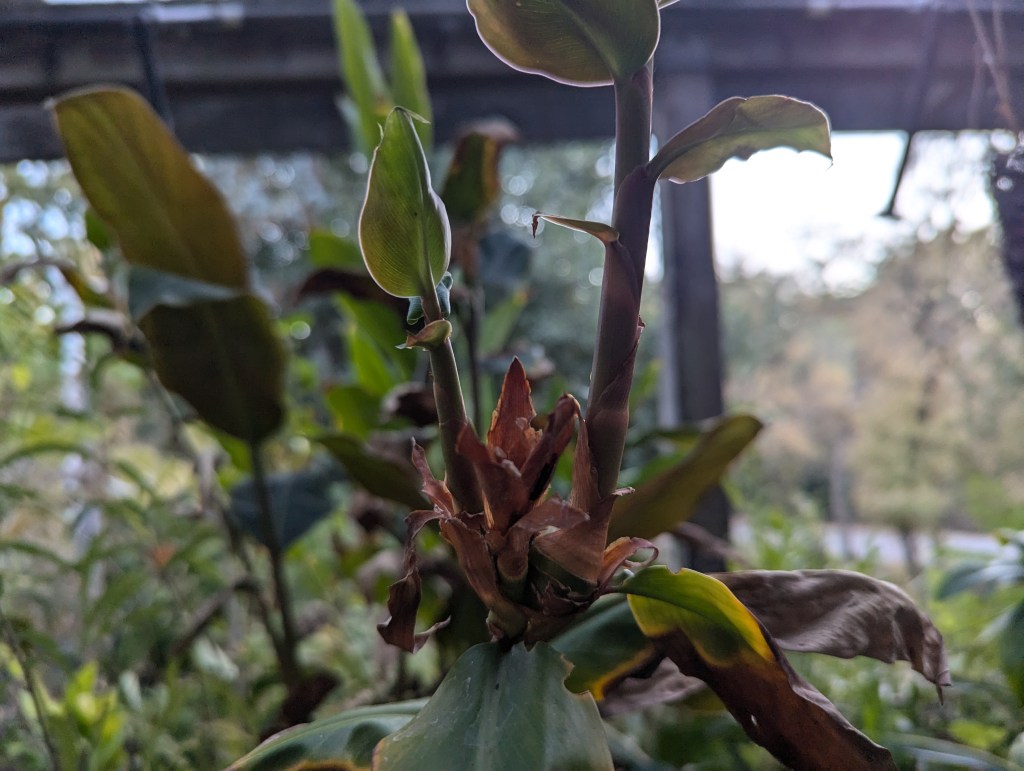
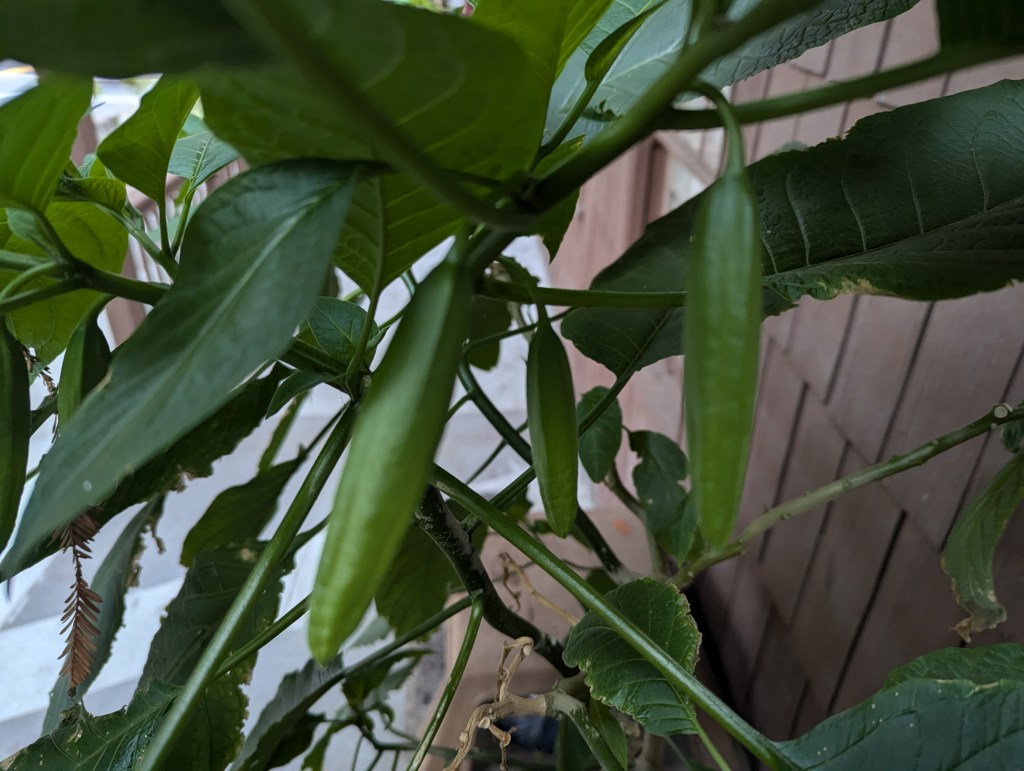
The Hedge on the Ledge continues to develop. Nothing has been added or subtracted from it since its previous update late last July. The vegetation has only grown and been moved about a bit. Perhaps that is an understatement. It has grown more substantially than it should have been allowed to within a situation that it should not actually be in. The only other change is that the pair of parakeet flower pups and the pair of banana pups switched places. It is so overgrown that it obstructs sunlight that would otherwise brighten the associated window. That was not so bad during warm weather of summer. It might not be so desirable as weather cools for autumn. Besides, all of this overgrown vegetation should relinquish its space to smaller vegetation that can benefit from the sheltered position and associated but presently unused heating mat through winter. After all, shelter from minor frost and access to electricity for a heating mat were the original justifications for the installation of this silly shelf below only the half of its window that opens. If I had known that it would still be here, I might have constructed it as a window box instead of an exposed shelf, so that the black vinyl cans and their faded old labels would not be so prominently visible. Eight #1 cans fit neatly onto the shelf, with three 4″ pots nestled into the spaces between them. An elastic strap holds them firmly in place so that they do not get blown off. The vegetation includes:

4 – #1 Solandra maxima ‘Variegata’ cup of gold vine – back row closest to window

2 – #1 Musa acuminata ‘Golden Rhino Horn’ banana – left and right corners of front row

2 – #1 Heliconia psittacorum (unidentified) parakeet flower – middle of front row

2 – 4″ Cucurma longa (unidentified) turmeric – left and right between rows

1 – 4″ Agapanthus africanus ‘Peter Pan’ lily of the Nile – middle between rows

Seventh on Saturday . . . and Eighth and Ninth – Omissions

Six on Saturday is, as should be obvious, limited to six. Therefore, I omitted a few of the pictures of colorful berries that I took last week. The first of these three of the omissions is likely the most important, but was omitted because its berries are not quite as colorful as they will be as they ripen a bit later. The other two were omitted because they actually justify omission. I mean that they are nothing to brag about. However, I did not want to delete their pictures that they were polite enough to pose for without sharing them here.

7. Callicarpa americana, American beautyberry was one of several gifts from Woodland Gnome of Our Forest Garden. I had never encountered it prior to its arrival, but wanted to grow it for years! These berries will soon ripen to a slightly purplish but bright bubble gum pink. Although I am typically not so keen on such bright color, I find their oddness to be very appealing. There is a white cultivar, and I do typically prefer white, but I want to grow the typical sort that grows wild within its natural range, rather than any cultivar.

8. Viburnum tinus, laurustinus fails to impress me. I realize that it is popular elsewhere, and that I should learn to appreciate it, but nonetheless, its allure somehow escapes me.

9. Cotoneaster pannosus, silver cotoneaster, to me, is even more unimpressive, perhaps because it is a weed locally. Berries are not colorful for long before turkeys destroy them. What is worse is that turkeys do not seem to eat the berries. They just shake them off the stems, and just leave them to decay on the ground. Berries that manage to ripen are not as vibrant red as firethorn berries, but are a somewhat grungy brownish or orangish red.

This is the link for the original Six on Saturday, for anyone who would like to participate: https://thepropagatorblog.wordpress.com/2017/09/18/six-on-saturday-a-participant-guide/

Six on Saturday: Berries

Brightly colored berries are ripening for both migrating and overwintering birds who are enjoying the abundance.

1. Rosa californica, California wild rose produces nice small hips, but then defends them within a thicket of very thorny canes. Birds have no problem flying in from above to take all they want. I get only what is left when it is time to cut the thicket down during winter.

2. Sambucus cerulea, blue elderberry is one of only two of these six that is designated as a berry by its common name, but is the only one of these six that is not a berry. Its fruits are drupes. Its jelly wins ribbons every time I bring it to compete at the Harvest Festival.

3. Cornus florida, flowering dogwood should stay almost fruitless. Yet, it produces more berries than the red flowering currant produces. It and the red cestrum are the only two of these six that are not native here. Rhody says it is dogwood because the ‘bark’ is ‘ruff’.

4. Ribes sanguineum, red flowering currant should produce more berries than flowering dogwood, but this is about as abundant as it gets. The berries do not even look appealing enough to collect. Their flavor is no more impressive than their oddly grayish blue color.

5. Cestrum fasciculatum ‘Newellii’ red cestrum berries are toxic, like those of snowberry and flowering dogwood. However, they are not toxic to birds who sometimes eat them as soon as they become colorful enough to be pretty. Birds can be pretty in the garden also.

6. Symphoricarpos albus, snowberry is a rather skimpy species. Its thin and wiry stems form low and sparsely foliated thickets. It only stays because it produces these unusually white berries. It might be prettier and more prolific if coppiced during winter dormancy.

This is the link for Six on Saturday, for anyone else who would like to participate: https://thepropagatorblog.wordpress.com/2017/09/18/six-on-saturday-a-participant-guide/

Ghost Ivy

Adult ghost ivy growth is shrubby rather than vining. Also, it blooms and produces seed.

Ghost ivy is actually just a fancy name for variegated Algerian ivy, Hedera canarienses ‘Variegata’. Their glossy six inch wide leaves with three or five ‘corners’, are irregularly blotched with dark green, very pale green and white. Like all ivies, ghost ivy can grow as a ground cover, climb like a vine, and eventually develops self supporting branches that bloom and set seed. It may be somewhat less aggressive than unvariegated Algerian ivy, but can still overwhelm perennials, small shrubs, and even small trees.  

Ivy can be allowed to climb tree trunks only if it is not allowed to wrap around and graft onto itself. Otherwise, tree trunks will become constricted as they grow and expand within their ivy wrappers. Because they climb by aerial roots, the various ivies should not be allowed to climb painted or wooden surfaces that can be damaged or succumb to rot. However, some people like the look of ivy cascading down from hefty arbors and porches enough to not mind replacing rotten parts occasionally.  

Contrary to the deep green of Algerian ivy, which adds a cooling effect to sunny landscapes, ghost ivy lightens up dark areas. Ghost ivy is only rarely available in ground cover ‘mud’ flats, or in #1 (1 gallon) cans. Larger plants are not practical, since they take too much time to recover from transplant. New plants are very easy to propagate from cuttings made from pruning debris. Cuttings from shrubby adult growth become shrubby plants.

California Native Plants

(Some of the information within this article is very outdated because the article was recycled from several years ago.

Valley oak, as well as coast live oak, were the two most common native non-riparian tree species of the Santa Clara Valley.

Bringing nature to the garden is generally very unnatural. Before urban development of the Santa Clara Valley, there were a few valley and coast live oaks spread out sporadically over open chaparral, with a few sycamores, maples and other riparian specie only in the creeks and Guadalupe River that run through it. There are vastly more trees and plant life here now than there ever have been, and specie from every region of the world. Since exotic (non native) plants are from other climates and soils, they require unnatural accommodations, such as watering and fertilizers, to keep them happy.

The most natural gardening is done with native plants, which are naturally adapted to local climates and soils. Natives are not as demanding of amendments, fertilizers or pesticides as some exotic plants are, since they know how to get they want with the local resources available. Because most are satisfied with natural rainfall, they do just fine with minimal watering (once established).

All sorts of native plants will be available at the Native Plant Sale at Hidden Villa Ranch in Los Altos Hills in only ten days on October 16, from 10:00 a.m. to 3:00 p.m.. Deergrass, monkey flower, redbud, blue-eyed grass, buckwheat, sedums and native lilies and orchids will all be there and accurately labeled. Volunteers from the California Native Plant Society will be available to talk about alternatives to law, including native perennials, shrubs, wildflowers and grasses. Books about native plants, as well as posters and note cards featuring native plants will also be available.

From 1:00 to 2:00 p.m., Stephanie Curtis of Curtis Horticulture will give a free hour lecture about tips for planting success and maintenance for natives. Admission is limited to 25 people though, first come first served. 

Hidden Villa Ranch is located at 26870 Moody Road in Los Alton Hills, two miles west of the Moody Road and El Monte Road interchange at Highway 280. Plant selection is best early in the day. All sales must be by cash or check, since credit cards are not accepted. It helps to bring boxes to carry purchased items. More information can be found at www.cnps-scv.org or cnps_scv@yahoo.com or by telephoning 650 – 260 3450. Incidentally, autumn is a good time for planting, since the warmest part of summer is over, and the rain will arrive soon to settle soil around the roots of newly planted plants.  

Horridculture – Keep Out!

Gilroy City Council does not endorse this landscape.

Corner lots can be challenging. Even if paths do not get worn diagonally through front lawns, vegetation between curbs and sidewalks is likely to get trampled. The pavement in the foreground of this picture connects the sidewalk to crosswalks for the two associated streets. (I realize that this is not a very good picture, and the blotched out poster for a candidate for Gilroy City Council could not be erased completely, but I took it from a car while stopped at a stop sign.) Vegetation for this particular application must be durable, and perhaps deterrent to trampling. This particular vegetation certainly conforms in that regard. However, there is no polite way of saying how extremely dysfunctional this landscape is. Firstly, from the get go, it is very dangerous to anyone who might simply trip and fall as people sometimes do. Secondly, this landscape will become more dangerous as it matures. Although most of the already crowded agaves seem to be a somewhat compact cultivar that should not reach very far over the sidewalk, the specimen at the center of the bottom of the picture seems to be a variegated common century plant, which has potential to reach halfway across the sidewalk. Thirdly, the entire hot mess will be hideous as it soon needs to be pruned for clearance. The sago palm will soon reach the sidewalk like the common century plant. Pruning will destroy their foliar form. The Mexican fan palm should eventually grow upward and out of the way, but will eventually prevent the streetlamp from illuminating a portion of the sidewalk close to the corner, where illumination is relatively important. Fourthly, this collective herd of wickedly hateful vegetation will soon be too congested to remove litter or weeds from; and curbside landscapes such as this innately collect litter.

‘Karpooravalli’ Banana

‘Karpooravalli’ is a relatively undemanding cultivar.

‘Cavendish’ and its variants have always been the most familiar types of banana locally. They are the most popular that are available from produce markets. From nurseries, they remain the most commonly available cultivars. A few other options are only beginning to become available. A few of these could be more reliably productive within local climates.

‘Karpooravalli’ has been available here for quite a while, but remains uncommon. Those who are familiar with it often describe it as wanting ‘only sunshine and water.’ It tolerates soil of inferior quality better than other cultivars, and craves less fertilizer. Within rich soil, it may crave none. It should likely stay away from fences that its pups could sneak under.

‘Karpooravalli’ is supposedly the sweetest of the Indian bananas. Although its fruit is a bit shorter than more familiar bananas, it is often a bit plumper. Ripe fruit is yellow with pale green blush, and delightfully aromatic. Foliage is more resilient to wind than that of most other cultivars. It can stand more than fifteen feet tall on its very vigorous pseudostems.