Deadheading Redirects Resources For Growth

Deteriorating flowers lose their appeal fast.

Early spring bulbs that went into their gardens last autumn are now blooming. Some are already done. Some summer bulbs should begin to bloom as the last spring bulbs finish. A few of them might bloom as late as autumn. Ultimately, like the earliest of spring bulbs, all eventually finish. As they do, their deteriorating flowers will necessitate deadheading.

Deadheading is simply the removal of deteriorating blooms. For many species, it diverts resources from fruiting into other growth. Many species can utilize diverted resources for subsequent bloom. Many become more intent on blooming again after deprivation of any prior fruiting. Spring bulbs instead utilize all their diverted resources for new bulb growth.

For spring bulbs, it is the most practical response to deadheading. Most bloom only once annually. Therefore, they can not divert resources directly to subsequent bloom. Instead, they prioritize vegetative growth of bulbs to grow and bloom for the next spring. They are patient. Reproduction remains their priority. They merely regroup before another attempt.

Because of extensive breeding, many spring bulbs can not produce viable seed anyway. Of course, this does not prevent them from trying. Even seeding or fruiting structures that contain no viable seed can be unappealing. For them, deadheading is merely aesthetic. Some complicated hybrids that might produce viable seed are unlikely to be true to type.

Elimination of viable seed that is not true to type is as practical as it is aesthetic. Without deadheading, such seed can grow into feral progeny. Such ferals may be more similar to remote ancestors than to their direct parents. They can be aesthetically inferior, but more prolific. Eventually, less desirable feral bulbs may displace their more desirable parents.

Because they are small but abundant, some freesia avoid deadheading. Resultant ferals are more fragrant but less colorful with pale white bloom. They are more prolific, so might eventually displace their parents. Common grape hyacinth and snowflake are too florific to deadhead, but are true to type. Actually, they can become invasive in some situations. Montbretia are very likely to be invasive.

R & R

Rhody in Skooter’s Garden

Rhody is very proficient with Rest & Relaxation. He has been doing quite a bit of it since we left on vacation at midnight last Monday morning. He rode about eight hundred seventy miles mostly on the rear deck so that others on the road with us could observe him doing so. Since arrival in Western Washington, he has been snuggling with others whom he encounters while also engaging in similar activities. This illustrations demonstrates how expertly he engaged in rest & relaxation in Skooter’s Garden.

Although not as proficient as Rhody is, I also have been engaging in a significant rest & relaxation. This is why I have not written as much as I typically write about horticultural topics during the past several days. Although I am aware that I must compose my gardening column by Wednesday, I have deferred most other writing. If it seems otherwise, it is only because my gardening column posts in two sections on both Mondays and Tuesdays, and old articles are recycled for both Thursdays and Fridays. My negligence is more apparent only on Wednesdays and weekends. I should return from vacation on Thursday or Friday, so might resume more typical blogging before too many notice.

Six on Saturday: Vacation

Rhody, Carson and I are finally on vacation in Western Washington. As usual, departure was delayed. Now that we are here, and not at work, I have not been taking pictures like I should have been. Consequently, I am deficient of pictures for Six on Saturday. Four of these six, or two thirds, are not even relevant to horticulture.

1. Sasquatch, who is also known as Bigfoot, is a celebrity of the Pacific Northwest; and is a species that is commonly considered an individual. This was in Canyonville in Oregon.

2. Portland in Oregon is the City Of Roses. This is its South Waterfront district, south of Downtown. Incidentally, most roses prefer the climates of San Jose to those of Portland.

3. Rhody enjoys rest stops. They allow him to renew his ownership of Oregon. This is the Toutle River Rest Area, on northbound Highway 5, north of Castle Rock in Washington.

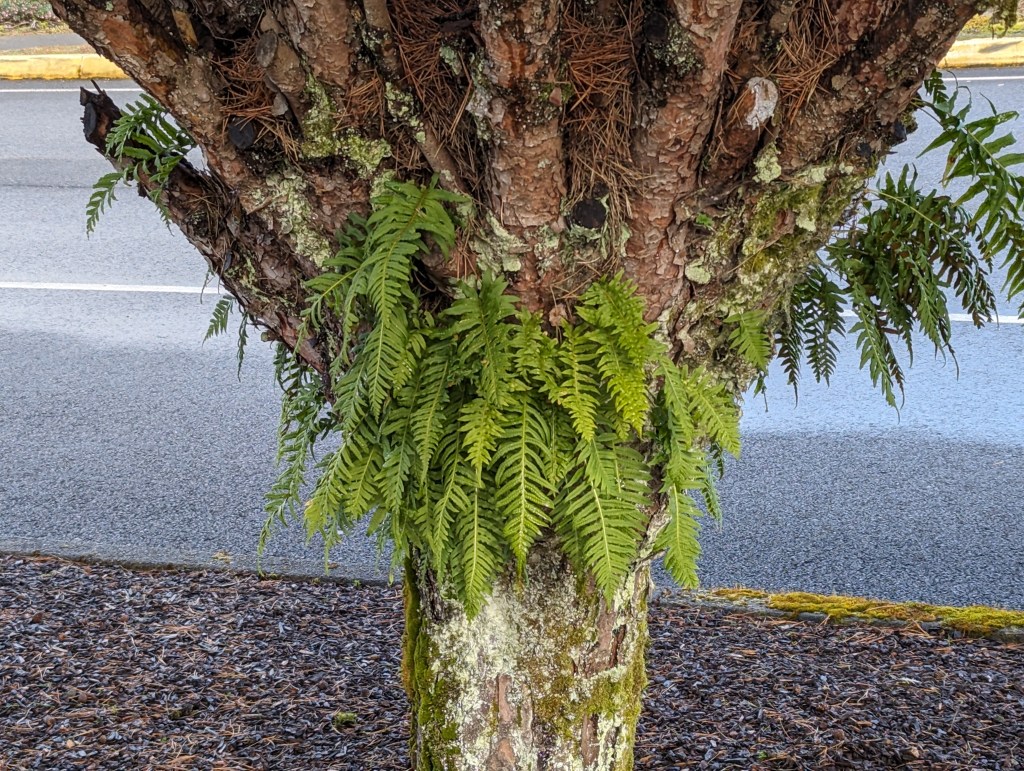
4. Ferns are common within the coastal climates of the Pacific Northwest. I do not know what this fern is. The pine may be a Japanese red pine. It is in Raymond in Washington.

5. ‘Black Gamecock’ Louisiana iris is to the left within the big box to the right. It was the priority, to replace what the gophers ate last year. There is more now than then! The rest of this vegetation is a dozen or so additional perennials from Tangly Cottage Gardening! I will get individual pictures of some of them as I process them when I get back to work. The unidentified variegated foliage to the far right seems to be variegated Japanese iris.

6. Skooter approves of my exploitation of his garden. He must know that I intend to take better care of his Louisiana iris than I did last year. He was on a sunny porch at the time.

This is the link for Six on Saturday, for anyone else who would like to participate: https://thepropagatorblog.wordpress.com/2017/09/18/six-on-saturday-a-participant-guide/

Blue Eyed Grass

It is more like an iris (of the floral sort, not the ocular sort) than a grass.

Contrary to its common name, blue eyed grass, Sisyrinchium bellum, is not a grass at all, but is like a diminutive iris. The modern cultivars that are more commonly found in nurseries are somewhat more colorful than the wild plants that are native to coastal areas between about Santa Barbara and Portland. Yet, even these are rather subdued, with small half inch wide blue or light purple flowers delicately suspended above bluish grassy foliage that may be as low as only a few inches, and is rarely higher than a foot. They bloom best in sunny but not too hot areas. Once established, blue eyed grass is not too demanding, but naturalizes and slowly spreads more reliably if watered occasionally through summer. However, they can rot if watered too generously or too frequently.  

The San Francisco Flower and Garden Show (2010)

(This article is from 2010, so contains irrelevantly outdated information, but the link to the website below is accurate.)

The big Pacific maples outside my window never seem to get enough rest through the brief winters. Not too long ago, their leaves turned yellow and fell during autumn. Their branches were bare for only a short time through the middle of winter. Now their buds are popping open to remind me that it is now early spring. Gardening can no longer be put off because the weather is too cool and rainy to go outside, or for that matter, because it is too cool for the various plants to be actively growing and in need of much attention. Gardening now becomes a rush just to keep up with all that is going on, and to not miss out on the many excellent gardening events this time of year.  

The San Francisco Flower and Garden Show, the grandest of these events, has already begun and will continue though March 28 at the San Mateo Event Center. More than 70 seminars feature topics such as sustainability in the garden, edible gardening, new plants, garden design, container gardens and water conservation. Guests can also learn how to create bonsai, build trellises, grow orchids, prune properly and how to determine what plants are best for each garden. Sproutopia has fun and educational activities and entertainment for young children.

There are also many displays exhibiting everything from garden sculpture to victory gardens. The pocket parks and container garden display shows the potential of gardening with limited space, or with little time to devote to gardening. The Bonsai Society of San Francisco is exhibiting impressively mature bonsai specimens, and demonstrating bonsai techniques. Flower Lane exhibits floral design by California Garden Clubs. Hot Plant Picks displays some of the most recently introduced or developed plants. Some are still too new to be available in nurseries yet.  

Gardens for the Future, the twenty display gardens that are the most prominent component of the San Francisco Flower and Garden Show, illustrate themes ranging from simple and refined to opulent and lush. ‘Velvet Daggers3’ may be my favorite because it “suggests that we seek out new applications of simple technology” and “demonstrates the beautiful qualities of xeric plants” (yuccas perhaps!?). ‘Pulling Up Daisies’ defies conventional thirsty lawns and consumptive landscaping, suggesting evolution of environmental compatible landscaping with natives. “The use of native plants makes ‘Native Garden 3.0’ a model of sustainability.” These are merely three of my favorite gardens. There are seventeen others that are worthy of more theatrical descriptions! 

The San Francisco Flower and Garden Show will be open from 10:00 a.m. to 8:00 p.m., except on Sunday, March 28, when it will close two hours earlier at 6:00 p.m.. It is at The San Mateo Event Center, which is located at 2495 South Delaware Street in San Mateo. Admission is $20 for all five days, or $4 for youths sixteen years old and younger. Children four years old and younger are free. Student admission is $15 with valid student identification. After 3:00 p.m., or 2:00 p.m. on the last day, half day admission is $12. More information can be found at www.sfgardenshow.com

Winter Flowering Cherry

Such bloom seems a bit early.

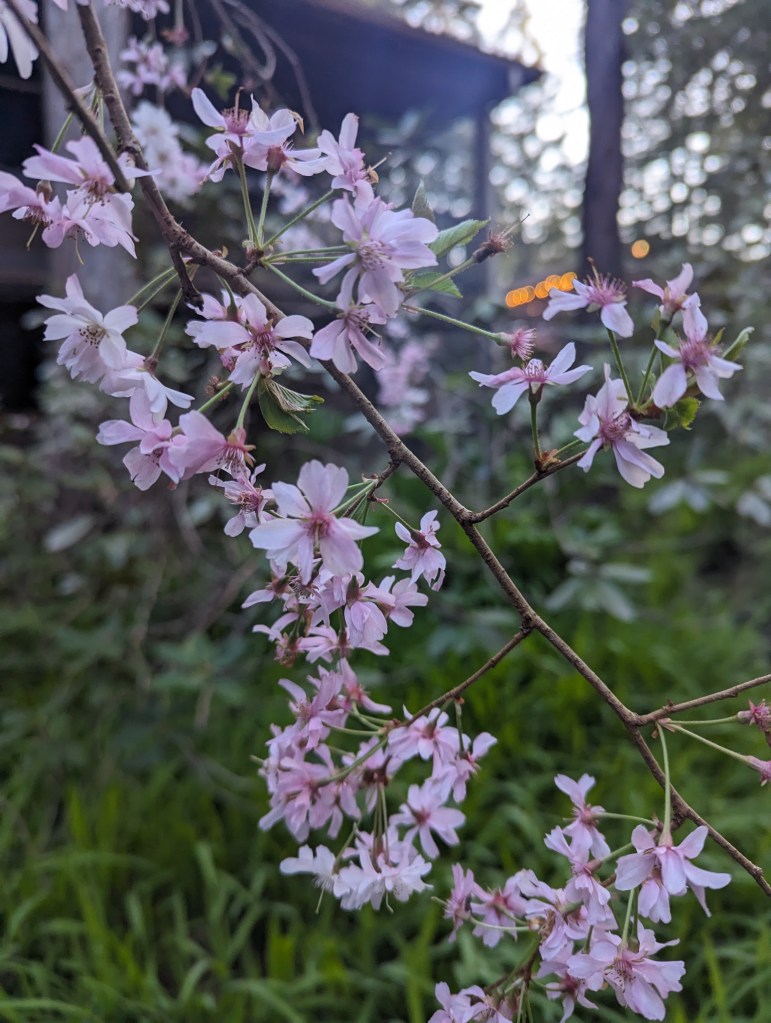
Its name describes it simply. Winter flowering cherry, Prunus X subhirtella, is a flowering cherry that blooms for winter. It is more popular where winters are cool enough to inhibit other bloom. It is less common here only because of other options for wintry floral color. Besides, slightly more floriferous flowering cherries bloom almost immediately afterward.

WIntertime bloom is actually a bit more reliable here than where it is more popular. Frost is too mild locally to damage it much, and mostly occurs earlier. Rain is mostly too light and too brief to dislodge much of the bloom. Bloom is a bit less profuse than that of other cherries because it is a bit more continuous. Therefore, it recovers from minor damage.

The relatively common sort of this uncommon flowering cherry blooms for late winter. Its bloom is slightly lavenderish pink. Some rare cultivars can bloom as early as autumn or as late as spring. A few are pendulous. Floral color ranges from white to pink. Floral form is mostly single but can be double. Deciduous foliage turns yellow or orange for autumn.

Force To Be Reckoned With

Flowering quince is conducive to forcing.

Winter flowering cherry, flowering quince, witch hazel and forsythia are finishing bloom. Later types of flowering cherry and flowering quince bloom immediately afterward. Lilac, redbud and weigela bloom only slightly later. Flowering crabapple extends the season of such flashy early bloom. It is relatively easy to force any of these for even earlier bloom.

Forcing is more popular where cool weather inhibits bloom through winter. It accelerates bloom simply by exposing it to home interior warmth. Bulbs that remain dormant in cold gardens bloom sooner in warm homes. Winter is the most popular time for forcing bulbs. It is now time to force formerly dormant deciduous stems to bloom a bit earlier for spring.

It is less wasteful to force deciduous stems to bloom than to force bulbs to bloom. Bulbs rarely survive because they exhaust their resources without replenishment. Those that do survive and have potential to bloom again may take a year to recover. Bulbs are not cheap. Deciduous stems are free, and are as disposable as other popular cut flowers.

The most popular stems to force are the fruitless counterparts of fruit trees. This includes flowering cherry, flowering crabapple and flowering quince. Flowering quince is actually not closely related to fruiting quince though. It also includes flowering apricot, flowering plum, flowering peach and flowering pear. Flowering pear is likely to smell badly though.

Stems from deciduous trees that actually produce fruit are just as easy to force. They are only less popular because they are not bred to be as pretty. Also, removal of their stems compromises fruit production. Those who plan to force such stems can leave a few extra during dormant pruning. Collection of stems should not damage or disfigure the source.

Stems are ready to force when their floral buds are just about to pop. Ideally, some buds should be slightly exposing their floral color within. A few flowers could be blooming. At that stage, bloom accelerates significantly in response to home interior warmth. Aridity can desiccate larger blooms. Otherwise, wisteria, dogwood, deciduous magnolias and perhaps azaleas are conducive to forcing.

Dual Citizenship

As brightly colorful as Persian buttercup is, I still prefer white.

French peony Persian buttercup was added to one of our landscapes last year. They are not two different perennials, such as French peony and Persian buttercup. They are a group of cultivars of one species, Ranunculus asiaticus ‘French Peony’. Ranunculus asiaticus is the species of Persian buttercup. ‘French Peony’ is its cultivar.

So, is it French or Persian? Well, yes.

Ranunculus asiaticus, Persian buttercup is native to Southwestern Asia, Southeastern Europe, Northeastern Africa and elsewhere within the Mediterranean Region. This range could potentially include the Southern Coast of France within the Mediterranean Region, but much more likely includes Persia within Southwestern Asia. My guess would be that Persian buttercup is as Persian as its name says it is.

‘French Peony’ is a group of cultivars that could have been developed anywhere and given an appealing name that promotes its marketability, but was most likely developed in France, where most breeding of this particular species was done. My guess would be that ‘French Peony’ is as French as its name says it is.

Of course, French peony Persian buttercup could have been developed anywhere, even Persia, and merely given its appealing French name without actually being French. Alternatively, it could have been developed completely in France, from Ranunculus asiaticus from the Southern Coast of France, without actually being Persian. For that matter, it could have been developed in Greece from Greek stock.

To me, French peony Persian buttercup seems to be chicly cosmopolitan. I remember it as popular for urban window boxes within the greatest cities of the World, such as San Jose, Oakland and San Francisco. If I had not seen that it is also popular in Reno and Portland, I would consider it to be as Californian as so many other exotic species and varieties that are popular here.

These would be nice for Ronald McDonald’s garden.