Annuals Change With The Seasons

Several perennials are useful as annuals.

Winter continues. It will not end until March 19. Wintry weather is unconcerned with such dates though. It could end at any time, or continue a bit later. Vegetation is more aware of this than we are. It wants to be ready regardless. Cool season annuals linger as long as they can. As they no longer can, warm season annuals should be ready to replace them.

Warm season annuals, or summer annuals, include both bedding plants and vegetables. They perform seasonally as cool season annuals do, but through warm seasons instead. They perform for only one annual cycle, although several have potential to be perennial. Removal of perennials is necessary only because subsequent annuals need the space.

All sorts of annuals are available in cell packs from nurseries. They become available as they become seasonable. Those that bloom for late winter and early spring are available now. More of those that bloom best during warm weather should become available soon. It is still a bit too cool and early for most of them. It is not too early for their seed, however.

Although plugging cell pack seedlings into a garden is easier, some prefer to sow seed. Those who do so should begin about now so that the new seedlings are ready by spring. Many seedlings require the warmth and shelter of a greenhouse to grow. As they mature, and the weather warms, they relocate into their garden. Other seed prefer direct sowing.

Many more varieties of annuals are available as seed than as seedlings from nurseries. Even if only a few varieties of seed are in nurseries, countless more are available online. Also, some flowers from previous seasons provide viable seed for subsequent seasons. There are a few reasons to justify the extra effort of growing annual seedlings from seed.

Sunflower and nasturtium are among the warm season annuals that prefer direct sowing. Their roots dislike confinement within cell packs. They recover slowly from transplanting. Cosmos and alyssum do not mind transplanting, but also grow easily from direct sowing. Seed for many varieties can start now because the weather will be warmer as they grow. Petunia, impatien, zinnia and lobelia are easier from cell packs later.

Hard Hat

This is a harsh reminder.

This is why arborists wear hard hats. It is more than eight feet tall. I do not know how much of it extends into the wet sand. Nor do I know how much it weighs. It might have fallen from about twenty-five feet up. I do not know how far the pole saw that it was plucked down with was extended. Even with a hard hat, this would have been potentially very dangerous. I am glad that it is now on the ground, or will be when it falls over.

Nature is naturally hazardous. We try to make some of it safer. We can not eliminate all hazards though. Some, like this one before it fell, are not obviously hazardous. Some are not visible from the ground. As frequently as some hazards are eliminated, others are developing. Trees are always growing and shedding limbs that get shaded out. Old trees are always dying and deteriorating. It never ends.

The alder that dropped this necrotic limb took quite a beating when the creek flooded last winter. Water was higher than this broken limb now stands. Massive trunks of trees that fell upstream floated through here, battering any tree trunks that they encountered, including the trunk of the tree that dropped this limb, which is now at the edge of the water at its current depth. Such pummelling should have dislodged such decayed limbs. Perhaps this limb was not so decayed last winter, and therefore more firmly attached.

The intention of the minor tree work that was done in this area was merely to neaten the scenery a bit. Hazards such as this were not a consideration, since the trees appeared to be reasonably safe, and because they are located on the bank of a creek where no one else goes.

Mycology

I have no idea what fungi this is.

Mycology was a topic that we horticulture students did not study much in school. We learned about some of the more important fungal diseases of vegetation, but that was about all. We could not take the time to study it any more extensively than mycologists could take the time to study horticulture or even botany.

Yet, horticulturists are often expected to know more about mycology than we should be expected to know. Perhaps it is because fungal organisms seem to grow sort of like botanical organisms grow. In ancient history, mycology actually was more closely related to botany, but needed to become a separate discipline as more was learned about each of the two. Perhaps that was at a time when entomology still included arachnids, myriapods and crustaceans. Heck, there was a time when earth, air, water and fire were considered to be the only four primary elements.

I have no idea what this mushroom is. It got my attention because it is so weird. It is such a weird mix of pastel purple, gray and white, with such a distinctly flat top. It was solitary. Not only did I see no others like it, but I noticed no other terrestrial mushrooms of any sort nearby. It appeared amongst blackberry bramble and naturalized English ivy, on the bank of a creek, under bay trees, with bigleaf maples, white alders, red alders and a deceased Douglas fir nearby. The area was quite damp from all the rainy weather this winter. Large and likely old rusty ruddy brown basidiocarps extend from the rotting bases of some of the bay trees. Smaller and likely younger brown and white basidiocarps extend from the rotting trunk of the deceased Douglas fir. All of this is irrelevant, since I still have no idea what this is.

Six on Saturday: Strange Times

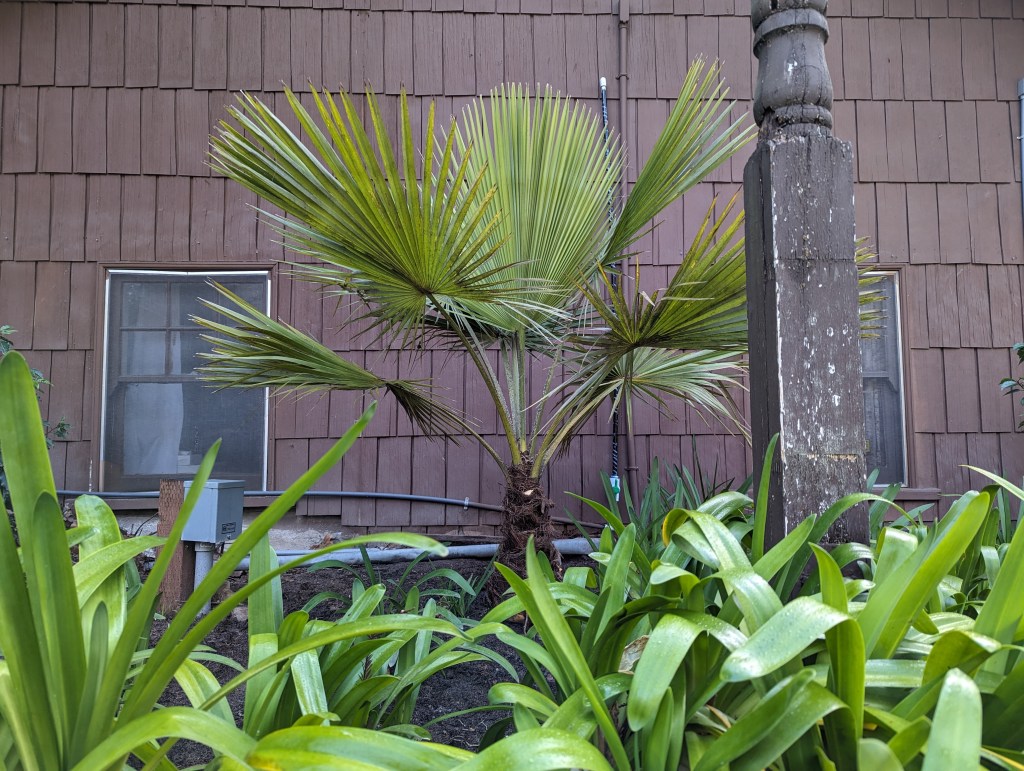
Some flowers are blooming strangely this year. Well actually, one bloomed strangely last year, and is now blooming normally. Flowers that prefer more winter chill than they can experience here are blooming quite nicely this year, even after less frost than last winter. I can neither make sense of it all, nor complain about it. I mean, it may be strange, but it is strange in a good way. We added a windmill palm that I mentioned two weeks ago to a landscape. I like palms, especially this palm, but I am not sure that I like them here with the redwoods. Palms are strange with redwoods.

1. Trachycarpus fortunei, windmill palm is strange because it is one of only three palms here. Palms and redwoods should not mix. It remains canned, so will be removed as the unseen angel’s trumpet behind it grows. I featured it two weeks ago, before it came here.

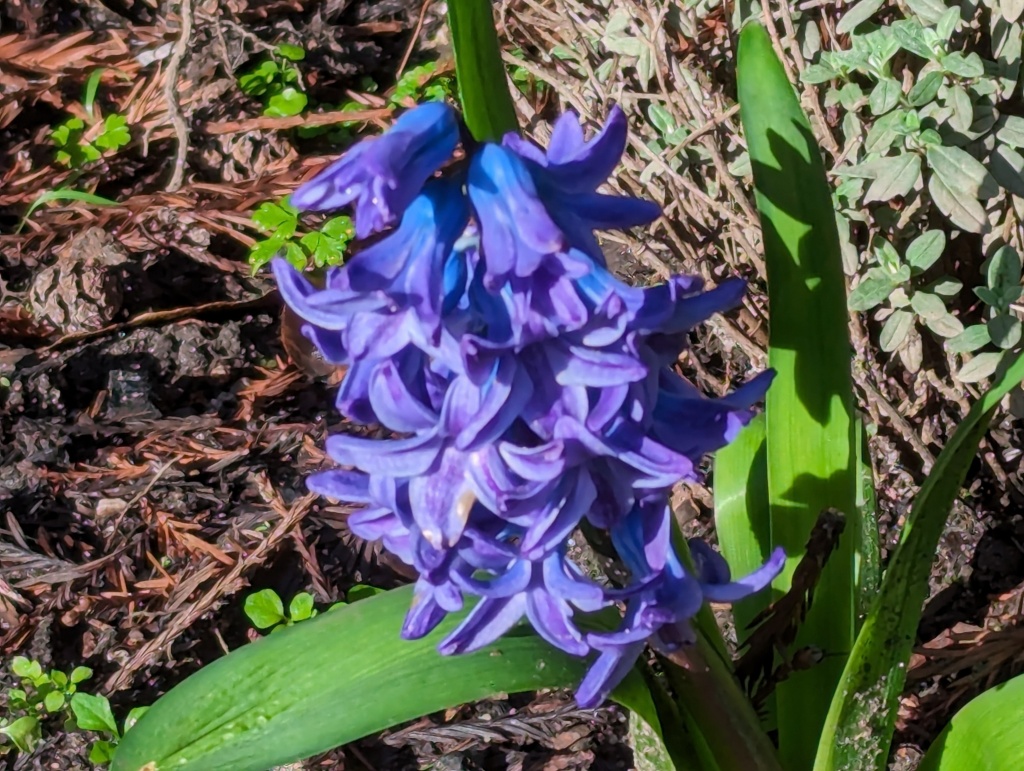
2. Hyacinthus orientalis, hyacinth is not so strange either, but it performs strangely well and reliably with only minor chill. Several have been blooming like this for several years.

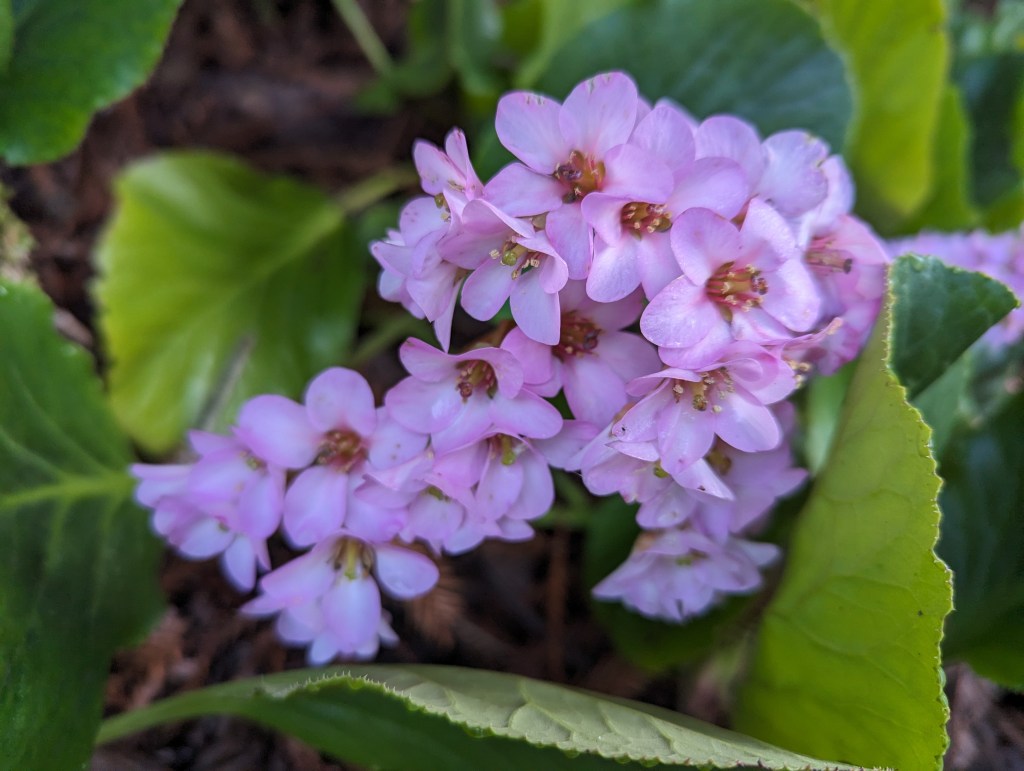
3. Bergenia crassifolia, pig squeak is blooming strangely late with a strangely light pink floral color. Otherwise, it blooms a bit better now that a sycamore that shaded it is gone.

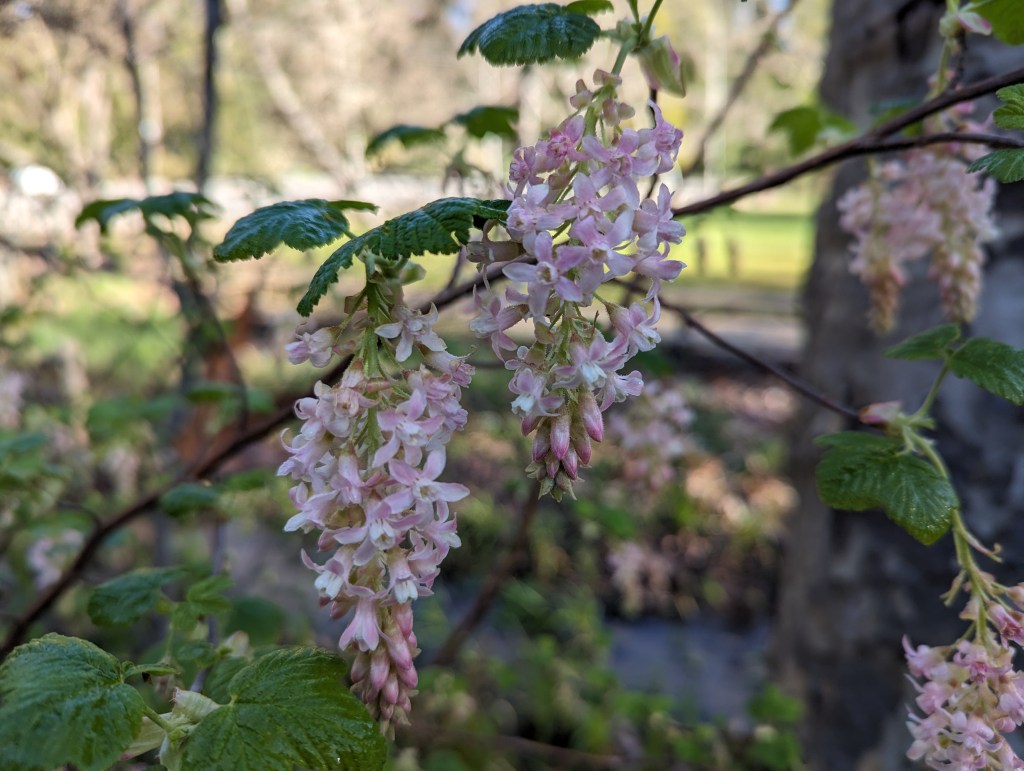
4. Ribes sanguineum, red currant is blooming with a strangely light pink floral color too. It is not much more than white, but is not white. All are this same strangely pallid color.

5. Brugmansia X cubensis ‘Charles Grimaldi’ angel’s trumpet did just the opposite. After blooming strangely pallid peachy orange since spring, it now blooms yellow as it should.

6. Helleborus orientalis, Lenten rose is blooming strangely well this year. Typically, only a few bloom like this. Now, many are. This is one of a uniform colony that is likely feral.

This is the link for Six on Saturday, for anyone else who would like to participate: https://thepropagatorblog.wordpress.com/2017/09/18/six-on-saturday-a-participant-guide/

Horridculture – Hackers

How could anyone believe that this was appropriate?!

Of the many different types of horticultural professionals, the two most professional and educated are nurserymen and arborists. The two least professional and downright idiotic are maintenance gardeners and arborists. That means that some of the most professional and some of the least professional of horticultural professionals are arborists.

I have been very fortunate to have worded for some of the most professional, most educated and best arborists. However, much of my work as a consulting horticulturist and arborists involved damage that was caused by some of the least professional, least educated and worst of so-called arborists. They ruin the trees that their clients pay them to maintain or repair. It is infuriating.

Someone put a great deal of effort into destroying this formerly healthy tree.

This tree was formerly a nearly exemplary specimen of big cone pine, Pinus coulteri. It was impressively healthy and exhibited no indication of instability. Its only obvious problem was that it developed so many trunks that it would eventually develop structural deficiency. That will not likely be a problem now, since it will not likely survive long enough for such deficiency to develop. Even if it remains healthy enough to grow significantly, it will become too structurally deficient as a result of this recent damage to survive for long.

I can not imagine how anyone, arborist or not, could believe that this was a proper pruning technique. Nor can I imagine how anyone could have put so much effort into so blatantly destroying this formerly healthy tree. Seriously, this involved a lot of work! Every trunk, every major limb, and many minor limbs were cut. Some cuts were made at lateral branches, but many were not. It is not possible for the tree to compartmentalize all of the resulting pruning wounds, which will remain exposed to the weather until the tree succumbs to the resulting decay.

Recovery from such severe damage is impossible.

Arizona Cypress

Established Arizona cypress needs no irrigation.

Although not native, Arizona cypress, Hesperocyparis arizonica, behaves as if it is. It is native to deserts and chaparrals of Mexico, New Mexico and, of course, Arizona. Hence, new specimens only require irrigation until they disperse their roots. Afterwards, they are satisfied with seasonal rainfall. They are more resistant to pathogens than other cypress.

Most modern Arizona cypress cultivars are bluish gray with densely conical form. A few are yellowish, pendulous or columnar. ‘Blue Ice’ is a strikingly silvery bluish gray cultivar of smooth Arizona cypress. Most old Arizona cypress trees exhibit significant variation because they grew from seed. Some develop irregular form or more greenish drab color.

In the wild, Arizona cypress can grow taller than sixty feet. Locally, few get forty feet tall, particularly since modern trees are compact cultivars. Most stay less than twenty feet tall, and some stay about half as wide as they are tall. They work well as informal evergreen hedges. Smooth Arizona cypress exfoliates rough outer bark to expose smooth red inner bark. It is Hesperocyparis arizonica variety glabra.

Arboriculture Is Horticulture Of Trees

Many trees grow out of reach.

Recently wintry weather is a reminder that large trees require maintenance. Otherwise, some are likely to eventually drop limbs or blow over. Even some of the most stable and structurally sound trees benefit from maintenance. Otherwise, they can become shabby, overgrown or obtrusive. Such maintenance is what constitutes the basis of arboriculture.

Arboriculture is, most simply, the specialized horticulture of trees. Of course, it is not as simple as its definition. It is as complex as the diversity of the countless species of trees that it involves. In some gardens, particularly within rural regions, it may involve forestry. For small trees, such as citrus or Japanese maples, it may be comparable to gardening.

Garden enthusiasts are likely to maintain small trees within their gardens. Those who do not enjoy gardening may rely on maintenance gardeners to do so. Unfortunately though, very few maintenance gardeners are qualified for arboriculture. Many commonly damage or ruin trees by attempting to maintain them improperly. Arboriculture is very specialized!

Arborists are specialized horticulturists of trees who perform arboriculture. Most prefer to work with large trees that are beyond reach of garden enthusiasts. Many also work with small trees for those who do not enjoy gardening. Information about arborists is available at isa-arbor.com. This is the website of the International Society of Arboriculture, or ISA.

Garden enthusiasts who maintain their small trees may not be able to do so forever. Only a few of the smallest sorts of trees will never grow beyond their reach. Most trees that are manageable while young eventually mature. Taller types of palms grow too tall to groom within only a few years. It becomes more practical and much safer to rely on arborists.

Trees are the most substantial and permanent of vegetation within home gardens. They are not as temporary or disposable as annual bedding and vegetable plants. Some can survive for centuries. Within most municipalities nowadays, mature trees are protected by ordinance. Trees are commitments, which are certainly worthy of proper arboriculture.

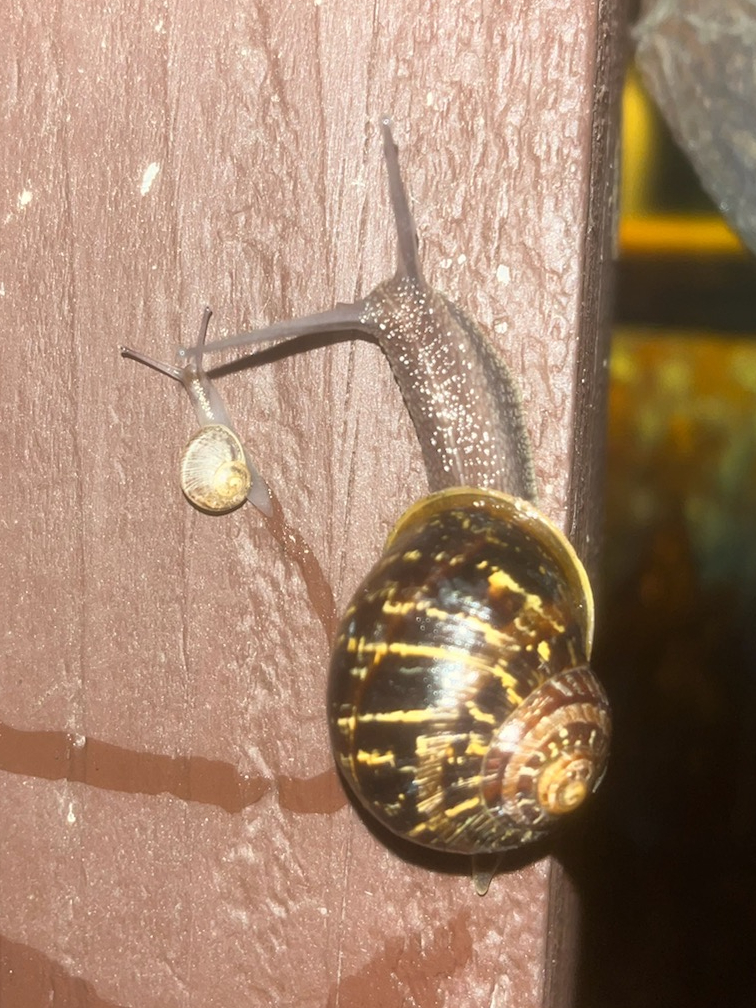
Escargots

French hors d’oeuvres are somehow among the most bothersome of garden pests within California. They are voracious. They are very prolific. They are sneaky. They are more resilient to attempts to limit their damage than they had been in the past. Furthermore, attempts to limit their damage are less effective than they had been in the past.

Molluscicides, which are the pesticides that are formulated to be toxic to molluscs such as snails, are not nearly as toxic as they had formerly been. Years ago, they were so toxic that they had potential to be dangerous to cats, dogs, wildlife or children. They are safer for everyone now, including the molluscs that they should be toxic for. Some snails succumb after consuming such molluscicides, but some survive.

The progeny of snails who survive consumption of molluscicide are genetically more likely to also survive consumption of the same molluscicide than snails who did not survive to proliferate. Those who do not inherit such genetic resilience do not survive to proliferate. Consequently, each subsequent generation is more resistant to the particular molluscicide than its preceding generation. Although a different molluscicide would be more effective temporarily, a few snails survive it also, to proliferate and repeat the process. It is how they ‘develop resistance’.

Besides, many garden enthusiasts are hesitant to apply molluscicides because of how toxic such pesticides had been in the past, and how, regardless of how much safer they now are, they must still be toxic to some degree in order to be effective.

Lushly landscaped and generously irrigated home gardens are ideal habitats for snails. Vegetation within such landscapes is damp and sheltered, and provides an abundance of sustenance. Skunks, foxes, ducks and other wildlife that eat snails generally avoid or lack access to many urban home gardens. Opossums and raccoons are either uncommon, or more interested in eating fruits, vegetables, trash or dog and cat food.