Alocasia or Colocasia? II

Alocasia or Colocasia or both?

While it seems that anything can be found online, it is baffling to see what can not be found online. Horticultural concerns seem to be particularly lacking. Perhaps those who enjoy horticulture innately dislike the internet. Perhaps they are merely too busy in their gardens to bother getting online too much.

‘Pele’s Smoke’ has been one of the more popular cultivars of sugarcane for home gardens for quite a while, but I can not determine how wide its canes are. Eucalyptus pulverulenta and Eucalyptus cinerea seem to have traded their names since the 1980s, but now, no one seems to know which is which, or if either ever was the other. No one can explain how seed from sterile banana cultivars are available online. Anyone can say anything. There is no accountability.

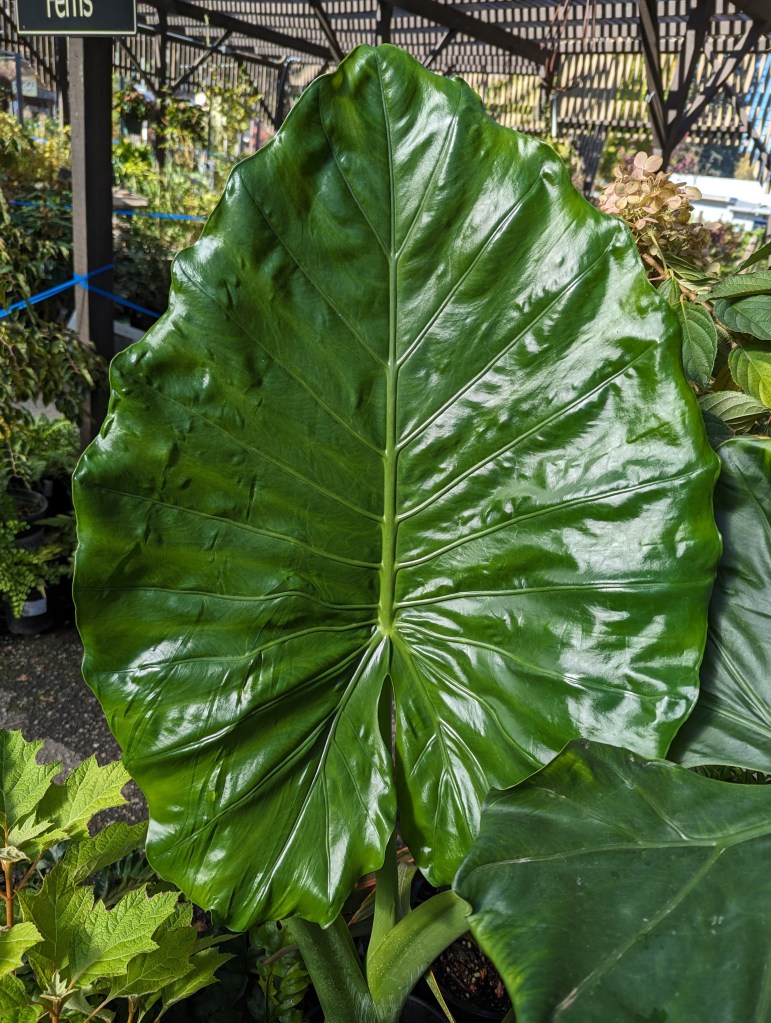
Alocasia and Colocasia are as baffling now as they were when I mentioned the difficulty with choosing between the two about a month ago. I am still inclined to procure Colocasia gigantea for a riparian landscape at work. However, I am now inclined to also procure Alocasia macrorrhiza. Both are quite appealing. I think that I would like to grow both within the same landscape so that I can compare them later. It would be easier than trying to compare vague information about them that I can find online. Realistically, since I would grow them from corms, both are quite inexpensive. If necessary, I can later relocate whichever is less appealing than the other.

This would not be my first occasion of not relying on the internet. I am working with ‘Pele’s Smoke’ sugarcane presently, and will be pleased with it regardless of how it behaves. I grow both Eucalyptus pulverulenta and Eucalyptus cinerea; although by mistake, since I procured one because I thought it was the same as the other. All of the cultivars of banana that I grow were procured as pups or plugs, since I do not trust seed. Ultimately, I will be pleased with both Alocasia and Colocasia.
Six on Saturday: Self-Replication

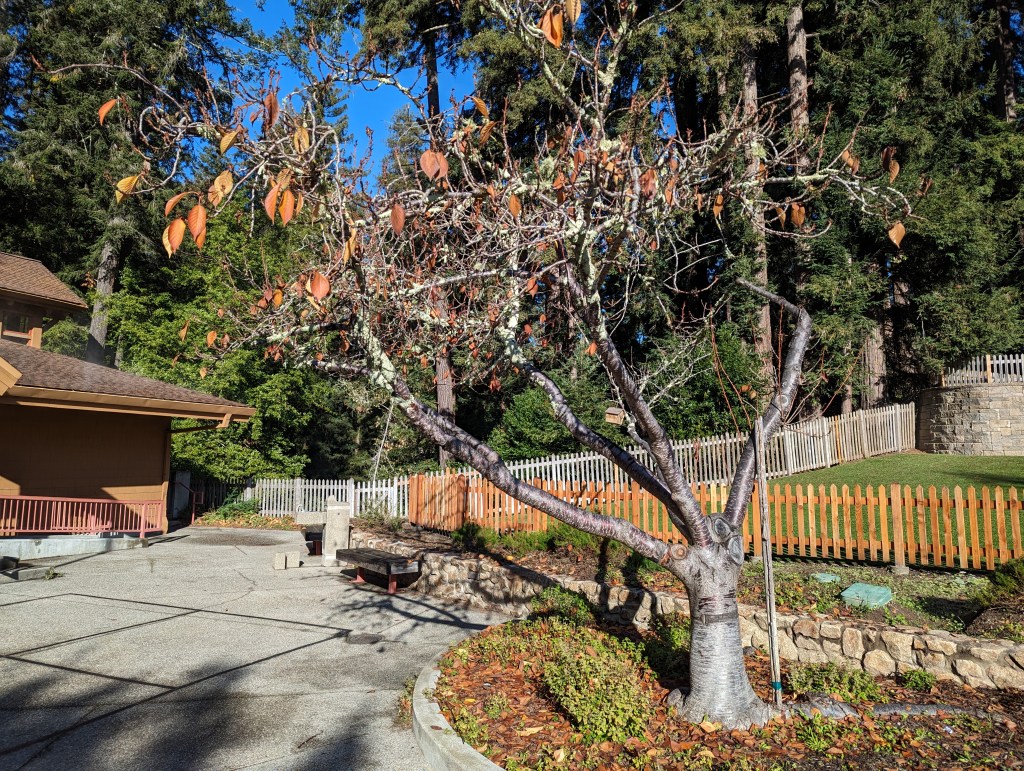
Kwanzan flowering cherry is spectacular as it blooms for early spring. Only one inhabits our landscapes, and of course, it is dormant and defoliated until next spring. I took these six pictures of it anyway, to demonstrate that it is deteriorating fast, but could be able to replace itself before it succumbs to decay completely. Unfortunately though, it will likely be removed before it is able to do so, so that we can install a purple leaf plum within this particular situation instead. I only assist with this self-replication process because of the very unlikely possibility that replacement with another different tree may never actually happen. It has been delayed for years.

1. This flowering cherry tree has been deteriorating for the past several years. Several big limbs have died, leaving its canopy disfigured and lopsided. Its right half is nearly gone.

2. Only shiners remain where some of the major limbs that died were removed from the trunk. If this tree were to survive any longer, these shiners would decay before they heal.

3. Incidentally, this tree is not grafted. Suckers from the roots are indistinguishable from growth of the canopy. Bark of exposed roots is indistinguishable from bark of the trunk.

4. Therefore, this sucker is genetically identical to the original tree. The roots have been generating suckers for several years. All but this one were removed. Instead, it is bound.

5. The binding stake is nailed to one of the major limbs of the original canopy, as well as to a big root below. Damage to the limb is unimportant. It will be removed soon anyway.

6. The bound sucker is now more than six feet tall. It could develop branches to begin to grow as a new tree next year. It could stay as a replacement after removal of the original.

This is the link for Six on Saturday, for anyone else who would like to participate: https://thepropagatorblog.wordpress.com/2017/09/18/six-on-saturday-a-participant-guide/

Horridculture – Cyclamen (deferred from Wednesday)

Cyclamen are too expensive to be as disposable as they are.

Cyclamen persicum is a popular cool season annual. It is known simply as cyclamen here because it is the only common cyclamen that is available. It might be known as florists’ cyclamen where other species are available. Red and white are the most popular colors because cyclamen are associated with Christmas. Cyclamen can alternatively bloom with various tints and shades of pink, salmon pink and purplish pink. Some bloom with two-toned color or picotee margins. Cyclamen really is a delightful perennial.

Yes, perennial. Like many garden annuals, cyclamen is actually a perennial. It can survive in the garden for many years. It merely goes dormant through warm summer weather, and then resumes growth as weather cools during autumn.

Not only is it a perennial, but it is an expensive perennial. It is too expensive to be so disposable. So-called ‘landscapers’ do not mind. Disposable annuals are lucrative for them. Besides, even where cyclamen can perform as a perennial, it is not colorful throughout the year, and even in season, it is not as colorful as it is for its first season away from the nursery that it originally grew in.

Other species of Cyclamen that are available within other regions are becoming available here as well. Their bloom is sparser, with only light pink or blushed white flowers. They are grown as perennial wildflowers that bloom for autumn or winter, when not much else blooms. Although not as garish as common florists’ cyclamen, they are appreciated for their perennial performance.

The few florists’ cyclamen that we install at work bloom somewhat reliably only until spring. Because they were grown within ideal greenhouse conditions, they do not adapt immediately to landscape conditions. By spring, many are already beginning to rot. Those that survive their summer dormancy may become perennial.

Coffee

It looks more like a houseplant than the source of coffee.

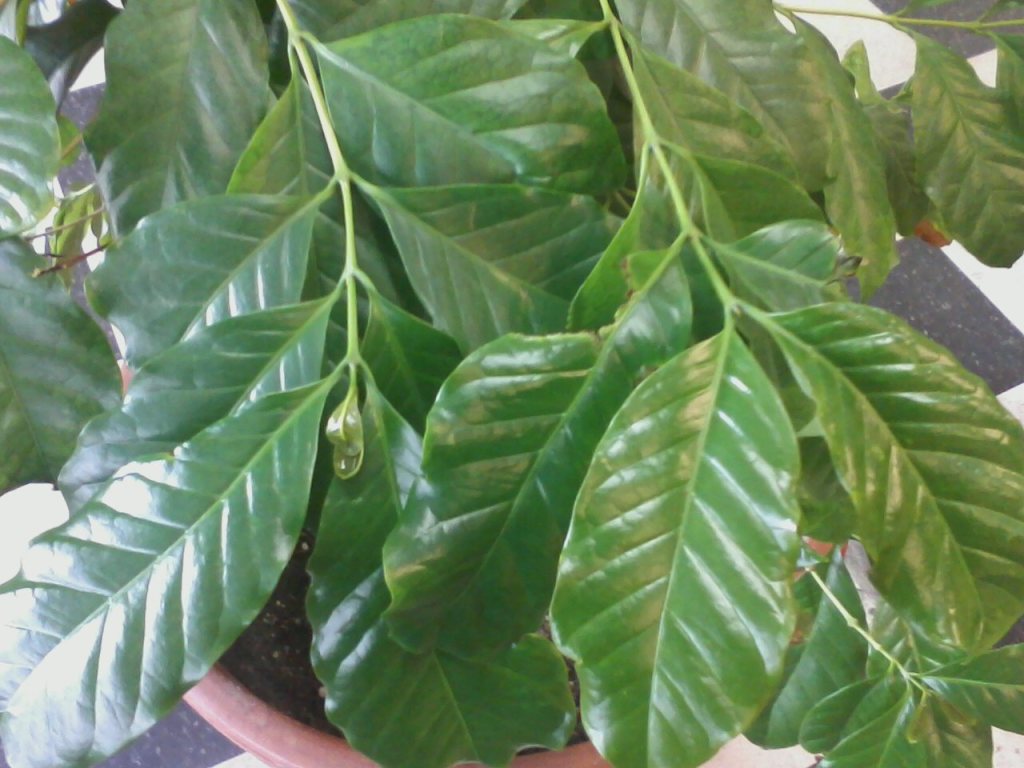
The White Raven Coffee Shop, the best little pourhouse in Felton, has an interesting but old fashioned houseplant on the counter. This group of four small but rapidly growing coffee trees, Coffea arabica, was a gift from a loyal customer.

Mature plants can get to thirty feet tall in the wild. Fortunately, coffee trees are easy to prune to fit interior spaces. Pruning for confinement is actually better than relocating big plants outside, since they do not like cold weather and are sensitive to frost.

Like various species of Ficus, coffee is appreciated more for lush foliage that happens to grow on a tree that can be trained by pruning to stay out of the way, overhead or in other unused spaces or corners. The simple remarkably glossy leaves are about two and half inches long or a bit longer. The very fragrant small white flowers are almost never seen among well groomed houseplants, and only rarely and sporadically bloom among less frequently pruned larger trees in greenhouses and conservatories.

The half inch wide coffee fruit, which is known as a ‘cherry’, is even more rare than flowers among houseplants because of the scarcity of both pollinators and pollen (from so few flowers). Those fortunate enough to get flowers sometimes pollinate them with tiny paintbrushes or clean make-up brushes to compensate for a lack of insects about the house. The resulting bright red or somewhat purplish cherries barely taste like cherries and only make two coffee ‘beans’ each; not enough to bother roasting and grinding for coffee, but great for bragging rights.

Christmas Trees Grow On Farms (2011)

Christmas trees grow on farms rather than forests, but some farms are in forests.

(This is an old article from 2011, so much of the information within is no longer relevant.)

Douglas, grand, white and Noble firs, as well as sierra redwoods, Monterey pines and at least fourteen other varieties of Christmas trees can be found and cut at Santa’s Tree Farm and Village near Half Moon Bay. Certainly, no one needs that many Christmas trees; and most select only one. Yet it is good to know that somewhere within such a vast selection, there is the perfect Christmas tree. Santa’s Tree Farm and Village also provides wreathes, garlands, tree stands, flocking, fire retardant and delivery.

On weekends, Sleighbells Gift Shop is open from 9:00 a.m. to 4:00 p.m.; and through December 18, Santa Visits between 9:30 a.m. and 4:30 pm.. For $2, children from two to ninety-two and older can ride the train from 9:30 a.m. to 4:00 p.m., as weather allows. Younger children ride for free. Santa’s Tree Farm is open between 8:00 a.m. and 5:00 p.m. on weekends (except for closing at 1:00 p.m. on Christmas Eve), and from 9:00 a.m. to 5:00 p.m. on weekdays.

Except for trees on the Diamond lot and pre-cut trees, prices range from $46 to $69. VISA and Mastercard and leashed dogs are welcome. Santa’s Tree Farm and Village is at 78 Pilarcitos Creek Road at Highway 92, six and a half miles from Highway 280 on the way to Half Moon Bay. Coupons, showtimes (yes, ‘showtimes’) and more information can be found at the website http://www.santastreefarm.com, or by telephoning 650 – 726 2246.

Atlantic cedar, Austrian pine, Arizona cypress, Leyland cypress Scott’s pine, sugar pine, white fir, as well as many other varieties of Christmas trees can also be obtained from Crest Ranch Christmas Tree Farm, located in the Santa Cruz Mountains west of the San Lorenzo Valley. Douglas firs, pines, cedars and cypress are $37 up to five feet tall, and $7.40 for each additional foot. White and Greek fir varieties are $42 up to five feet tall, and $8.40 for each additional foot. All sales are cash or check. An ATM is available.

The beautifully scenic picnic area is a good excuse to bring lunch, or at least get something at the snack bar. Leashed dogs are welcome. More information can be found at the website http://www.crestranch.com or by telephoning 831 – 426 1522. Crest Ranch Christmas Tree Farm is open from 8:00 a.m. to 5:00 p.m. until December 20, and is located at 12200 Empire Grade outside of Felton.

Silverleaf Cotoneaster

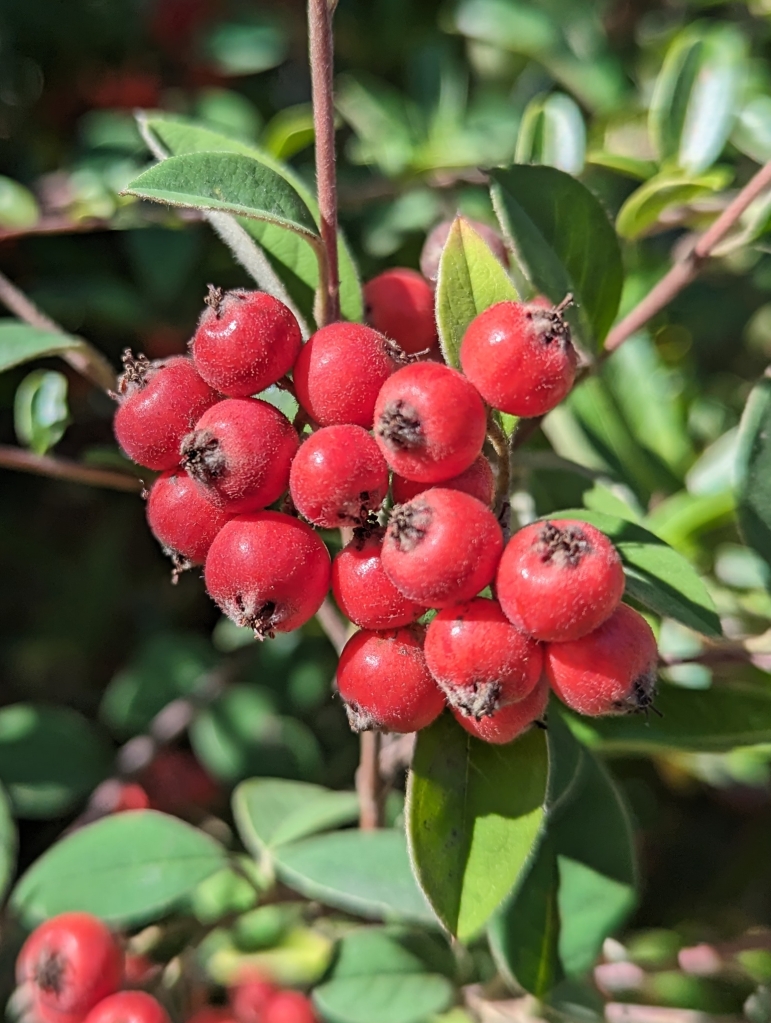
Silverleaf cotoneaster berries are subtly colorful.

Its prevalence within a few wild ecosystems suggests that it is native. In actuality, it likely naturalized here only after the Gold Rush. Silverleaf cotoneaster, Cotoneaster pannosus, is native to southern central China. It likely came here with the influx of Chinese laborers after 1848. It was a common component of the original landscapes of Golden Gate Park.

Nowadays though, silverleaf cotoneaster is rare within refined gardens. Modern cultivars and other species are more adaptable. Silverleaf cotoneaster naturally develops broadly outwardly flaring form. Pruning that damages its natural form causes awkwardly angular form. Ironically, undesirable feral specimens often develop the best form without pruning.

Silverleaf cotoneaster can get more than ten feet tall, and nearly twice as wide. Removal of old trunks to their bases promotes more vigorous new growth. Alternatively, removal of low growth promotes taller tree form on arching trunks. The small camo green leaves are unremarkable. The copious red berries that ripen for autumn are very appealing to birds.

Berries Get Colorful For Winter

Firethorn berries are very reliably abundant.

Some vegetation excels at exploitation of wildlife. All sorts of flowers use color and floral form to attract pollinators. Many flowers rely on fragrance or flavorful nectar for this same purpose. Many flowers employ a combination of such techniques. After pollination, many species produce fruit to draw wildlife to disperse their seed. This includes winter berries.

Just as flowers appeal to particular pollinators, fruits appeal to particular consumers. Big fruits appeal to animals who eat them, perhaps sloppily, but drop the seed within. Acorns and nuts appeal to squirrels who bury more than they can retrieve. Winter berries appeal to birds who do not digest the seed within. The birds deposit the seed wherever they go.

It is a mutually beneficial arrangement. Birds, whether migratory or overwintering, eat as many berries as they want. Vegetation that provides winter berries benefits from efficient dispersal of its seed. Naturally, such fruits ripen as birds are fattening up for winter. They are brightly colorful to attract hungry birds. They are small enough for birds to eat whole.

This is convenient for home gardening. It provides some color after defoliation of autumn foliar color, and prior to spring bloom. It is actually more appealing where cooler weather accelerates defoliation. Also, such color contrasts more prominently against snow within a stark landscape. Within any climate though, such berries last only until birds find them.

For some, birds and squirrels who come for winter berries are welcome. Some prefer the color of winter berries. Ultimately though, the wildlife determines how long winter berries linger. Anyone can cultivate vegetation that produces winter berries. Very few can protect such fruit from wildlife that craves it. Berries rarely last long enough to rot through winter.

Firethorn produces the most colorful winter berries. Various cotoneasters are similar, but with somewhat subdued rusty red color. Toyon develops larger but looser clusters of fruit. English hawthorn fruit resembles that of cotoneaster, but on bare stems. Hollies produce only a few berries. They are dioecious, so need male pollinators which are rarely nearby.

The Hedge on the Ledge

Perhaps no one will notice.

I can explain. Firstly, I should mention that this is an industrial building at work, not a home garden; so no one else cares what it looks like. Secondly, although this building is outfitted with an abundance of external electrical lighting, it lacks external electrical outlets. Thirdly, I brought a ‘Double Mahoi’ banana tree back from the Los Angeles region less than a month ago, so divided its pups at the most inconvenient time, as autumn weather was getting cooler. Fourthly, I should stop numbering all these individual statements, and get on with a simple explanation of this visually unappealing contraption.

The banana tree went to its permanent home already, where it can hibernate through winter. However, its pups languished and immediately began to deteriorate here. Because they will not grow much until warmer weather after winter, their rudimentary corms can rot faster than they can recover from their division. Therefore, I purchased an electrical heating mat to warm their media from below, and accelerate root and corm growth. It was not a pleasant purchase, since I object to reliance on such technology, but that is another topic for later.

I did not want to extend an extension cord too extensively from a window to the nursery benches on the deck to the lower right in the illustration above. I thought that this shelf would be less obtrusive. Perhaps I should have thought a bit more about it. I successfully extended and obscured an extension cord for the fountain on the mountain, but again, that is another topic for later.

Now that it is installed directly outside the window, without the need for an extension cord, the shelf fits the heating pad reasonably well, and suspends eight #1 cans with three 4″ pots nestled in between.

By the time this explanation posts at midnight next Sunday morning, the largest of the four ‘Double Mahoi’ banana pups, which incidentally is already in the process of generating another rudimentary pup, might be exhibiting a slight bit of accelerated growth. The two smallest of these four pups were cut back to their corms, and the third will likely get cut back also, so will take a bit longer to exhibit growth. All four are arranged in the front row at the bottom of the illustration below.

The three 4″ pots that are nestled in between the #1 cans contain tissue cultured plugs of ‘Gran(d) Nain’, ‘Cavendish’ and ‘Orinoco’ banana. With all seven pups and plugs of banana neatly arranged on the heating mat, remaining space accommodated a few cuttings that should also benefit from the warmth of the heating mat.

The four #1 cans in the rear row at the top of the illustration below contain cuttings of passion flower vine and cup of gold vine. The passion flower vine to the right of center is unidentified, but ‘Constance Elliot’ is to the left of center, with a single cutting of ‘Frederick’. Almost predictably again, that is another topic for later. Nine cuttings of unvariegated cup of gold vine to the far right are shabby because they were superficially damaged by minor frost earlier. Six cuttings of variegated cup of gold vine are to the far left.

Although shabby, they do not look so silly from inside.

Too Late To Divide Cymbidiums

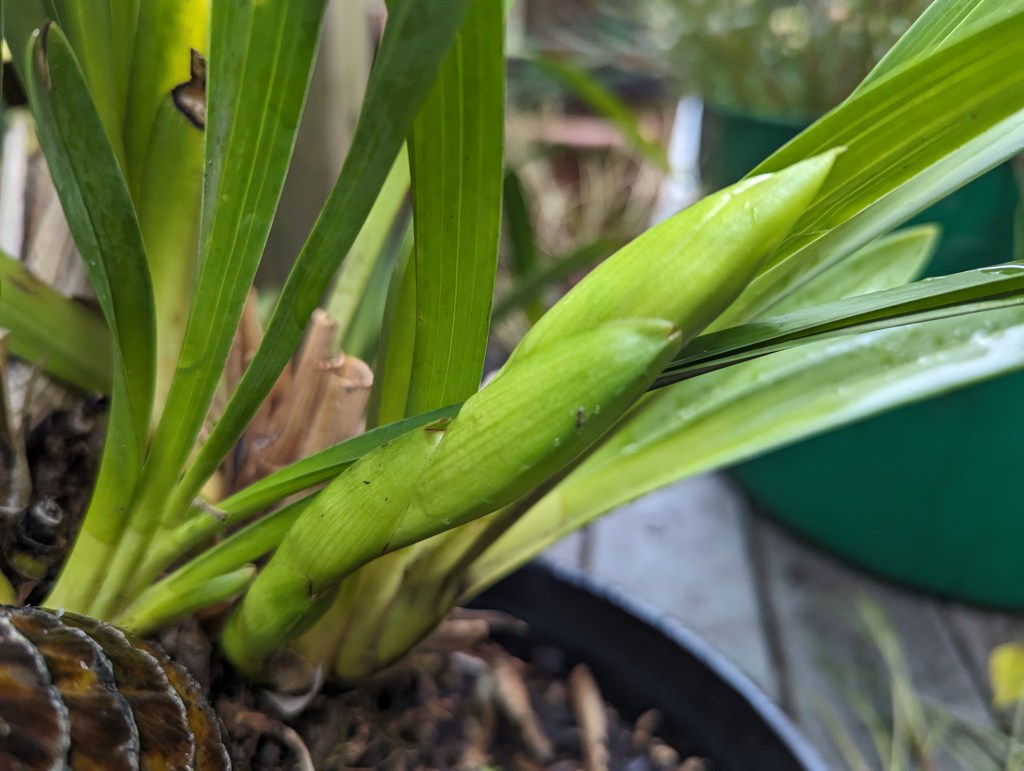
New floral shoots appeared almost immediately after the former bloom finished.

Cymbidium orchids perform quite well here, and seem to be happier with a bit of neglect. Actually, those with a tolerable bit of foliar blemishing or discoloration bloom better than those with exemplarily healthy and vigorous foliage. Those that get everything that they supposedly want, such as coarse chunks of fir bark to disperse their roots into, and regular application of fertilizer, are likely to produce an abundance of healthy foliage with only moderate bloom.

Only two cymbidiums inhabit my garden. I gave all others away many years ago. I acquired one of these two from a neighbor in the early 1990s, and have divided many copies of it since then. It remains potted within a bunch of leafy debris that I raked from my driveway under a massive valley oak many years ago. I suspect that the debris has decomposed to soggy muck at the bottom of the pot, although it remains friable on top, where I only rarely add a bit more leafy debris. I am not so keen on its simple pink bloom, but I continue to grow it because it has been with me for so long.

The other cymbidium was a gift from a colleague here. It originally grew ‘properly’ in a pot of coarse fir bark, but was removed from its pot many years ago, and left to die on top of a pot of potting soil that something else had already died in. It grew unattended there for a few years before coming here. It has bloomed splendidly and annually since its arrival. I want to divide it, but have not managed to do so between bloom phases. Its bloom continues for so long, that by the time it finishes, the next bloom phase is beginning. Fortunately, it is not too overgrown yet.

Six on Saturday: Springtime

Flowers bloom throughout the year here. I featured bloom this week to avoid the topic of minor frost damage that I should have protected vulnerable foliage from. Frost is minor here, and does not occur every year, but it occurred here prior to some other regions this year. However, this bloom can imply that it is springtime.

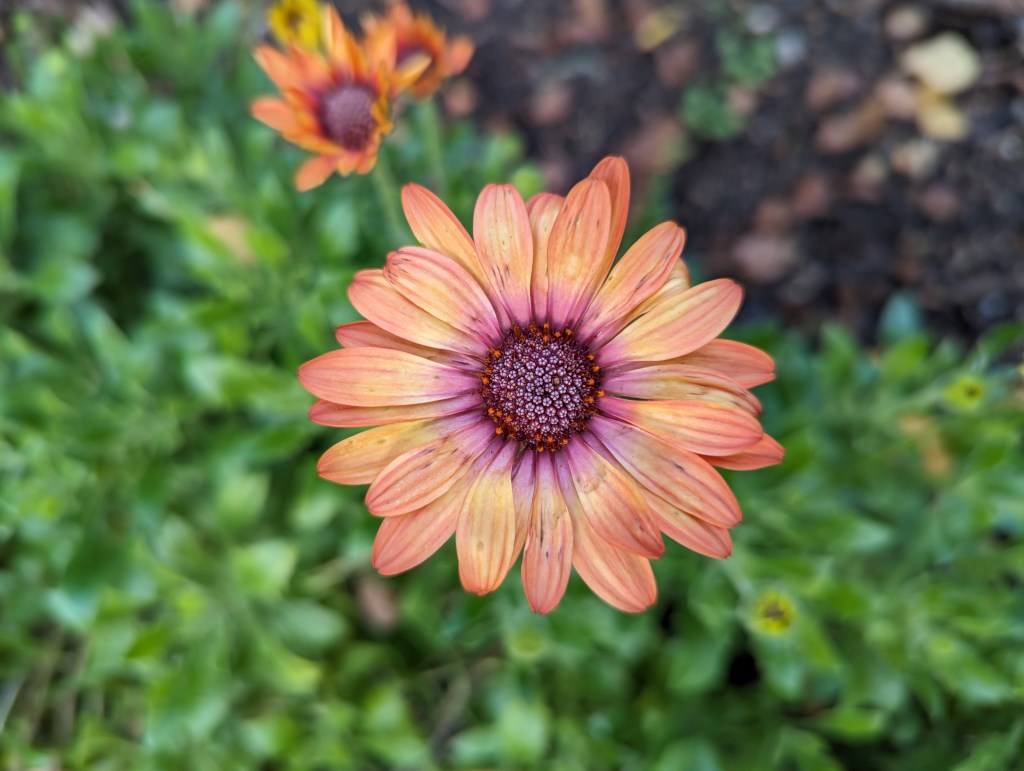
1. Osteospermum X hybrida, African daisy should bloom most for spring, but can bloom randomly whenever it chooses, and often blooms most profusely for summer or autumn.

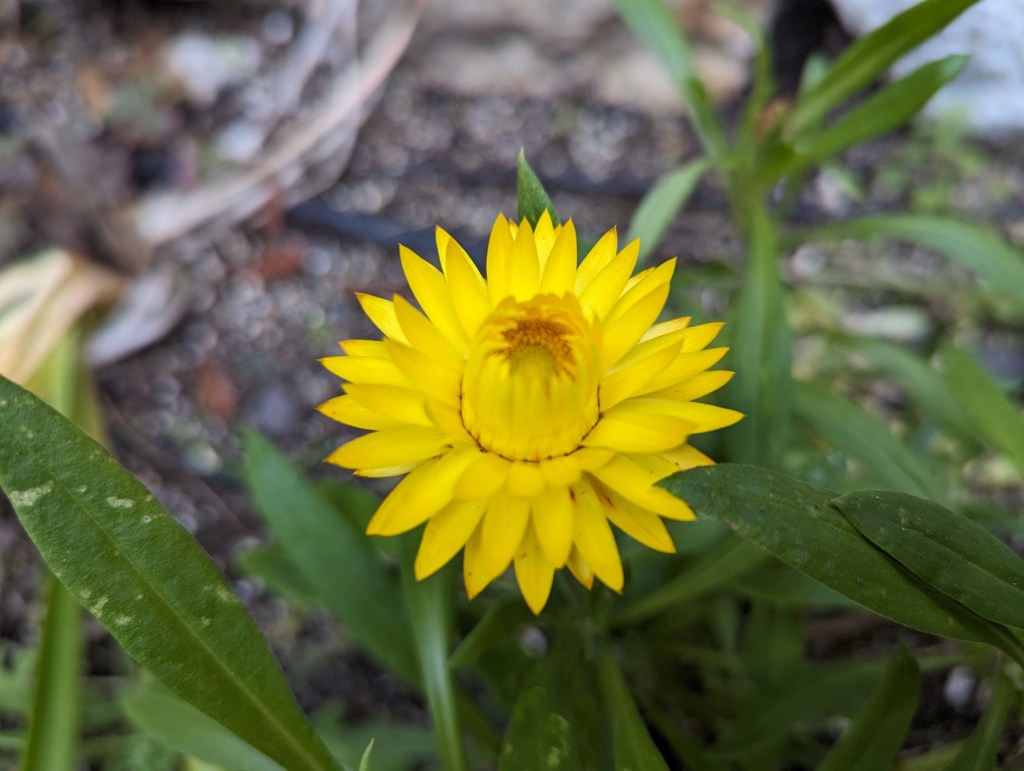
2. Helichrysum bracteatum, strawflower is my favorite of these six because I remember it as the main cut flower crop to the east of my Pa’s home in Montara through the 1980s.

3. Salvia chiapensis, Chiapas sage is a species that I had never met before last year. They grew well through last summer, and even better with more bloom through this summer.

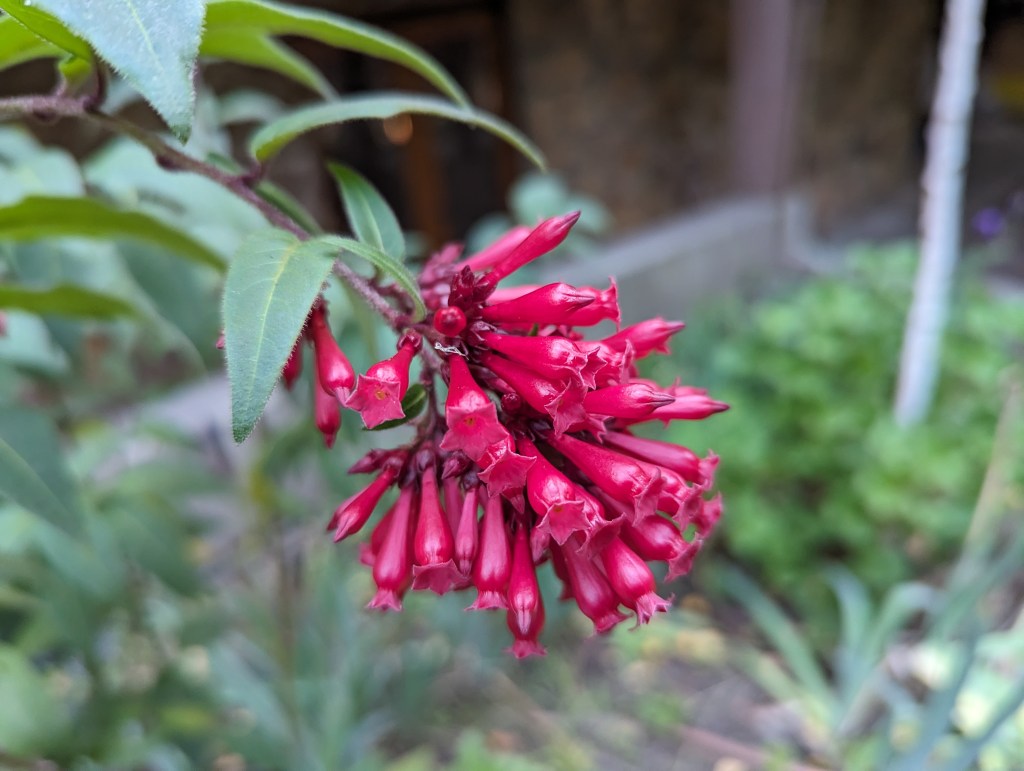
4. Cestrum fasciculatum ‘Newellii’, bastard jasmine has an interesting name. Of course, it is not really jasmine. It recovered slowly from gopher damage, but blooms nicely now.

5. Rosa, carpet rose is my least favorite of these six because it is so cheap and common. I prefer old fashioned and respectable hybrid tea roses that are such excellent cut flowers.

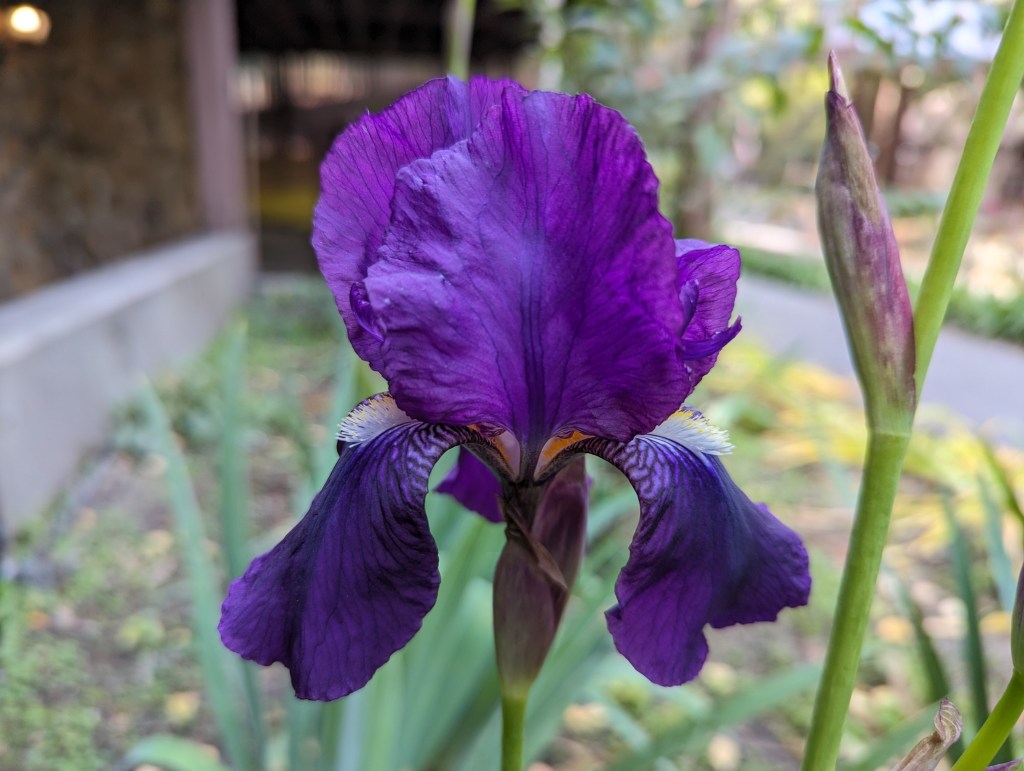
6. Iris X germanica, bearded iris should bloom for spring. Reblooming types also bloom for autumn. I have no idea what this is, but I sort of doubt that it is a reblooming variety. Earlier, it did not bloom much, so now seems to be blooming late for the first phase this year, rather than blooming again for a second phase within the same year. Furthermore, its simple bloom and slim floral stalks suggest that it is not extensively bred. It might be a simple species that is confused about the seasons here, because this climate is so mild.

This is the link for Six on Saturday, for anyone else who would like to participate: https://thepropagatorblog.wordpress.com/2017/09/18/six-on-saturday-a-participant-guide/