Unhappy Fishtail Palm

Now that the foliar color has improved, the foliar density is deteriorating.

Fishtail palm is never completely happy here. It is not much happier in Southern California. Even the happiest are discolored to a minor degree. Many are more significantly discolored. Some are so very discolored that they are visually unappealing.

No one seems to know why. I suspect that they would prefer more humidity. Perhaps they prefer more humid warmth. They may dislike the pH of the soil.

Furthermore, fishtail palms are monocarpic. Each trunk dies after bloom. Clumping sorts develop new trunks prior to the demise of a blooming trunk. Those that do not develop replacement trunks die completely.

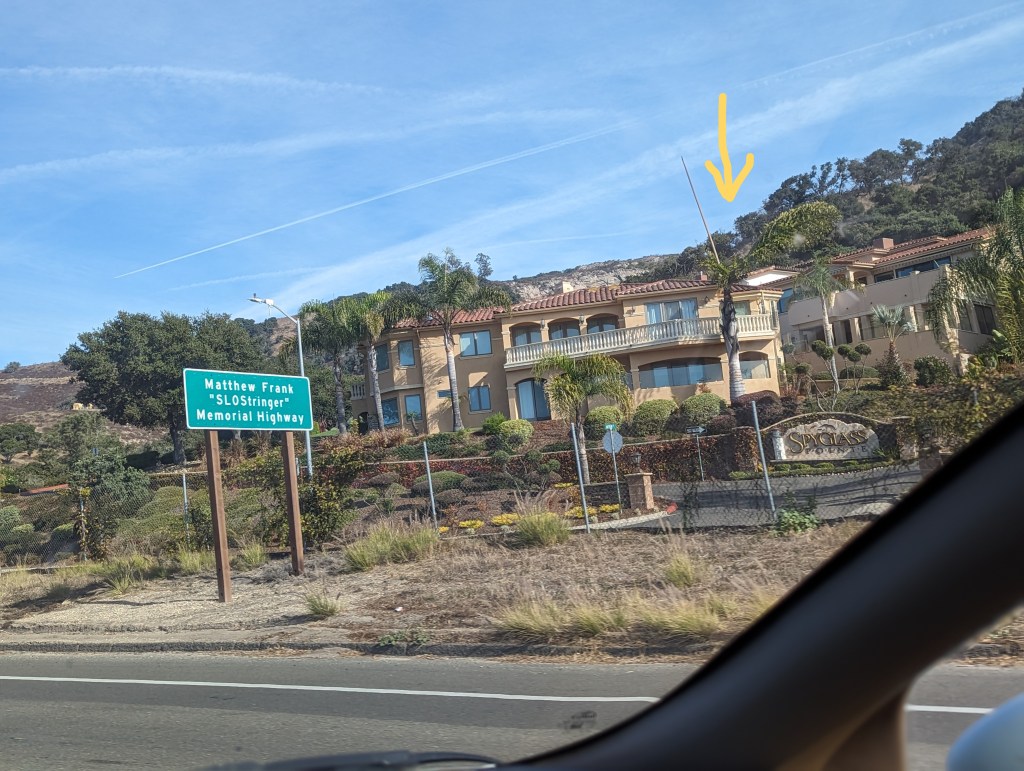
The illustration above is obviously not of exemplary quality. I took it from the car while driving. This was on northbound Highway 101, at the northern extremity of Pismo Beach. The palm to the upper left of the sign for Spyglass Pointe, with the yellow arrow pointing at it from above, is a fishtail palm. Until recently, it had been famously chlorotic.

Colleagues who drove through Pismo Beach typically asked me about this palm after seeing how chlorotic it typically had been. This it he least chlorotic that I have ever seen it. However, it may be naturally deteriorating after its primary bloom. Although I have not observed any bloom, I can see that new leaves are not developing on the same rate that They had in the past. This picture shows it with only a single open leaf, with another foliar spike extending from the terminal bud.

This particular fishtail palm is not very old. I can remember when the associated residential buildings were constructed less than two decades ago. landscapes and associated trees were added shortly afterward. Since then, the fishtail palm had been unhappy. This likely why fishtail palm is not more commonly available here than it is.
Mousers

Kitties are very proficient with mind control techniques.

Rodents have become a problem at home without Darla the mouser kitty. I do not know if Darla actually caught many rodents, or merely deterred them from inhabiting her territory. It is irrelevant. The absence of rodents was more important. Now that she has gone to live a domestic lifestyle in Santa Clara, rodents of various types are damaging some of the vegetation within the nursery, particularly young perennials.

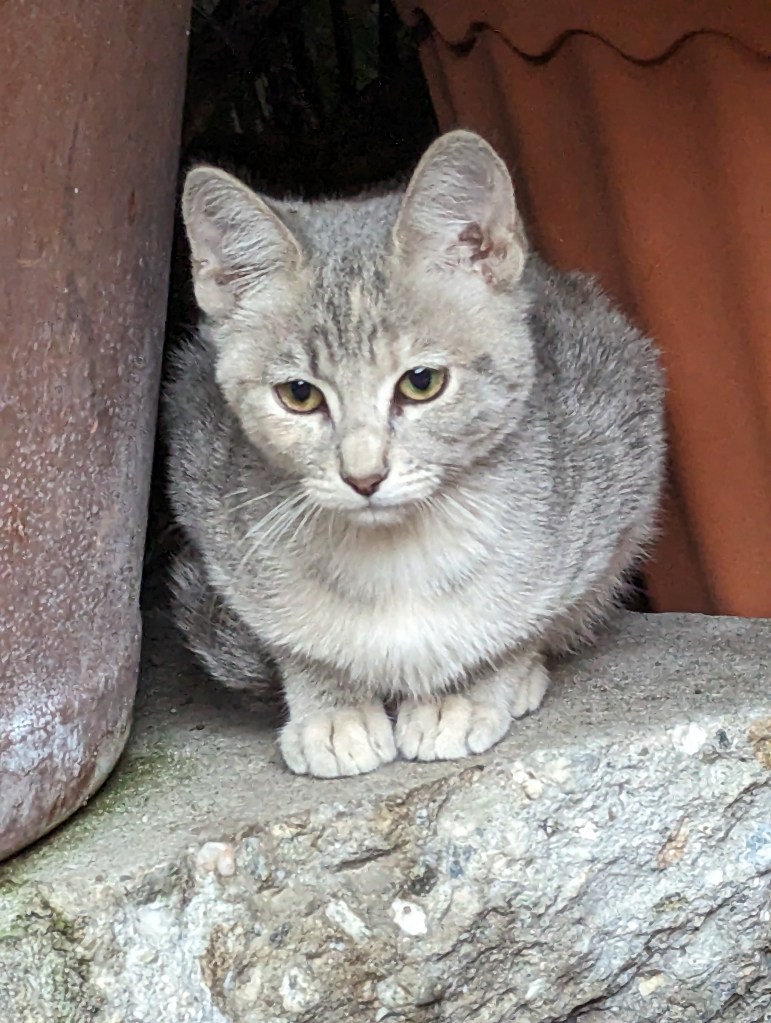
A pair of feral kitties are supposed to be relocating to our facility. They do not need to stay within the main building, although they will have adjacent shelter. I do not care how they intend to eliminate rodents and prevent them from returning. I only care that they do so. If they are half as effective as Darla was, I will be pleased.

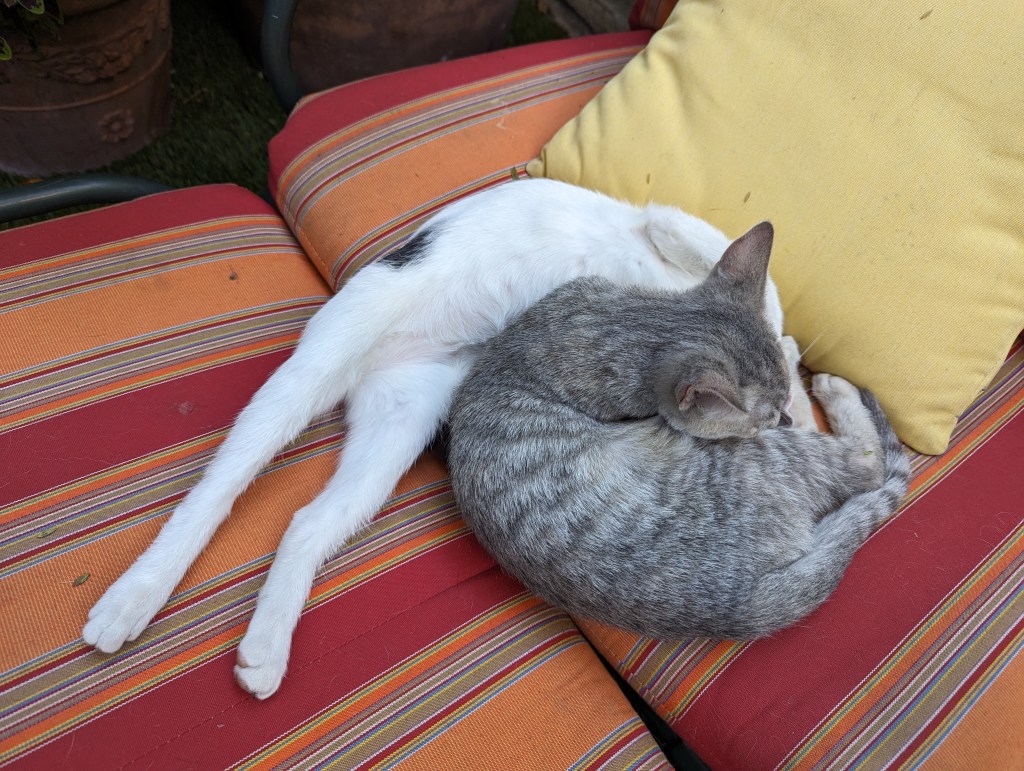
Brent, my colleague down south, recently procured three little kittens, supposedly to work as mousers like Darla did. They seem to be too friendly and playful though. I can not imagine them catching rodents. They certainly do not seem like the sort of kitties who rodents would fear. They are too playful and too nice.

If rodents avoid situations that are occupied by kitties, then any kitty could be effective. If rodents must be exterminated, then more diligent mousers would be necessary. I have no idea how instinctive mousing is for kitties. I suspect that it is different for each kitty, which is why some are better mousers than others.

At least these three little kittens are delightful. I mean, who would not appreciate such cute kitties in the garden? I regularly remind them that I am none too keen on kitties, but like all other kitties whom I have ever met, they do not care. They know how to get me to do whatever they demand.

Regardless of how weird kitties can be, they always seem to be dangerously cute.

Six on Saturday: Los Angeles to Los Gatos

Six on Saturday is hasty for me this Saturday. The last few days have been rather hectic. It is now about midnight on Friday. I am presently in Los Angeles, and will be returning to Los Gatos in a few hours. It is a long story. I did not get many pictures.

1. Washingtonia robusta, Mexican fan palm is the most familiar palm of the Los Angeles skyline. This one is very unique though. It grew under the onramp from the northbound Harbor Freeway to the westbound Santa Monica Freeway, on top of an embankment on northbound Toberman Street. It grew vertically until it encountered the underside of the onramp. It then crept along the underside of a merge lane toward the south. It resumed vertical growth after reaching the edge, and escaping from below. Countless commuters who drive past it, and perhaps also over it, are unaware of its extraordinary contortions.

2. Coleus scutellarioides, coleus is still performing nicely within Brent’s garden. Autumn is a bit later and significantly milder within Los Angeles than within Los Gatos or Felton.

3. Coleus scutellarioides, coleus is familiar among my generation because it was popular as a houseplant through the 1970s. It is likely more popular in home gardens nowadays.

4. Nephrolepis exaltata ‘Variegata’, variegated Boston fern or tiger fern is one of several species that I will bring back from Los Angeles because I can not procure it in Los Gatos.

5. Three little kittens are new residents of Brent’s garden. I doubt that they are related to those that Los Gatos is named after. They will eventually help with rodent management.

6. Rhody is normally terrified of kittens. He does not seem to be aware that they are just small cats. Now that we are about to leave, he is much more tolerant of their playfulness.

This is the link for Six on Saturday, for anyone else who would like to participate: https://thepropagatorblog.wordpress.com/2017/09/18/six-on-saturday-a-participant-guide/

Queen Anne’s Lace

Goodness! Apologies for this dreadful picture!

There are actually a few different flowers known as Queen Anne’s lace. The most common species, Daucus carota, that has naturalized and even become somewhat of a weed in some areas, has two and a half inch broad, flat-topped trusses of delicately minute but abundant flowers, with a single red flower at the center of each truss. Apparently, Queen Anne pricked a finger with a needle while making the lace, leaving a drop of blood. Modern varieties have broader and fluffier trusses, often lacking central red flowers. They are a popular ingredient or fill for mixed bouquets with more colorful flowers.

The biennial foliage of Queen Anne’s lace grows to about three feet tall in the first year, with weedy but intricately lacy leaves. It blooms in summer of the second year. It is very similar to poison hemlock, which is poisonous enough to kill Nero, so should not be allowed to grow in vegetable gardens or where toxicity might be a problem; just in case.

Beyond Fresh Cut Flowers

Palm fronds are striking cut foliage.

Most flowers bloom in spring. Many bloom a bit later and though summer. Not nearly so many start to bloom in autumn or though winter. This time of year, there is more to clean up from fading blooms than there are fresh blooms to cut and bring in.

Much of the color in the garden through autumn is provided by colorful foliage or foliage that gets colorful as the weather gets cooler. Later in winter, some plants have colorful bark and stems that gets revealed by winter defoliation. Coral bark Japanese maple, red twig dogwood and some arctic willows have remarkably colorful twigs.

Blooms of a few plants are sometimes cut and recycled after they fade because their dried flowers, flower stems or seed pods are appealing. Hydrangeas are not so attractive as they deteriorate out in the garden, but can be cut and hung upside down to dry to substitute for fresh flowers later. If done quickly, many types hold their color somewhat. Those that do not hold their fresh color may turn an appealing shade of brown.

Queen Anne’s lace can likewise be a nice dried flower, but is not so easy to hide in the garden while it dries. If cut and hung to dry, individual stems should be hung separately, since they bend and are difficult to separate if hung in clusters. Their flat-topped flower trusses curve inward as they dry, so they look nothing like they do fresh.

The rigid flower stems of New Zealand flax are rather sculptural protruding from their softer foliage. These same stems can be cut, plucked of seed pods, and like dried hydrangeas, used as cut flowers when there is not much else to get out of the garden. Ironically, New Zealand flax flowers sometimes get cut before they bloom, since not everyone appreciates their contrast against their own softly textured foliage.

Years ago, New Zealand flax flower stems were actually dried and spray painted! For those daring to try this technique, it also works well with lily -of-the-Nile flowers stems and trusses (plucked of their seed pods), Heavenly bamboo flower stems, and even dried pampas grass blooms. However, pampas grass blooms are deprived of their fluffiness and most appealing quality by spray paint. Bird-of-Paradise leaves twist interestingly as they dry, to provide texture with or without paint.

Fronds (leaves) of some fan palms can provide bold cut foliage. Mediterranean fan palm is difficult to handle because of the nasty teeth on the stalks, but has nice rounded leave that fan out nicely behind other flowers. They can be cut into smaller fans, or even other not so rounded shapes. Windmill palm is much easier to handle, but is a bit larger, so is more likely to need to be trimmed to shape. All are easy to cut with common scissors, and can be dried and spray painted.

There is probably more in the garden to substitute for cut flowers than would be guessed. Useful plant parts can be found in the least expected of places.

Horridculture – White California Poppy

White California poppies are naturally very rare.

California poppy is the official State Flower of California. Most Californians are familiar with it. We certainly know what color it should be. With few exceptions, it is bright and clear orange. Some, particularly within desert climates, are golden or more yellowish. White and pastel purple California poppies are rare aberrations. When I was a kid, finding one or the other was comparable to finding a four leaf clover for kids in Ireland. They were even a bit better though, since plants that bloomed with variant color bloomed with more than a single flower.

When I was about a freshman in high school, I found both a white and a purple California poppy just a few feet apart from each other. They happened to be at the Portola Monument in Montara, near where the Portola Expedition discovered San Francisco Bay. It was too early for seed, and I did not return for seed later. Besides, most of such seed produces plants that bloom with typical orange floral color. Nonetheless, at the time, I was very pleased to have found two very rare aberrations.

In more recent years, varieties of California poppy were developed. Some bloom with white or purple bloom. Others bloom with pink, red or yellow flowers. Some have double flowers. They are readily available from mail order catalogues and nurseries, as well as online. White or pastel purple California poppies are no longer rare or special. This sort of takes the fun out of finding one.

I suspect that the white California poppy in this less than exemplary picture is natural. Poppy seed was not likely sown here intentionally. Nonetheless, I do not know. Now that it is no longer special, its source is not so important. Realistically, their typical bright orange floral color is the best anyway.

Box Elder

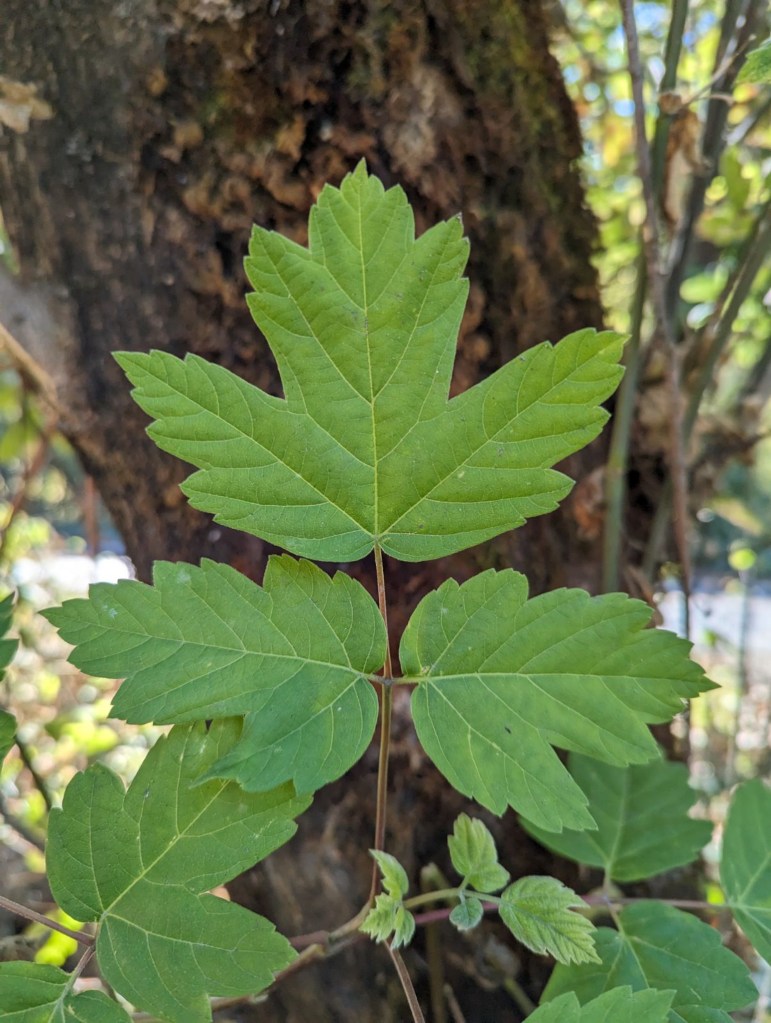
Box elder leaves are pinnately compound.

Leaves of three, leave it be, unless one can see that it is a box elder tree, Acer negundo. This is the most common of the North American maples. It is native to all American states except for only Alaska and Hawaii. Yet, it is also unique as the only maple with pinnately compound leaves. Typical leaves have three leaflets, but might have as many as seven. A few rare maples have palmately compound leaves.

Although common in the wild, box elder is rare within refined landscapes. It grows fast to about forty feet tall, but does not live for much more than fifty years. It typically develops a few plump trunks with casually irregular form. Unfortunately though, such form becomes structurally deficient with age. Autumn foliar color is unremarkable yellow or brown here.

However, a few garden cultivars display distinctly colorful foliage for spring. ‘Flamingo’ is the most popular cultivar. Pink variegation of new spring growth fades to white. ‘Auratum’ displays bright yellow new growth. ‘Violaceum’ displays smoky blushed new foliage with purplish red floral tassels. After pollarding, such cultivars are more compact and colorful, but lack floral tassels.

Defoliation Is A Messy Process

Defoliating deciduous foliage must go somewhere.

Autumn foliar color eventually gets messy. Actually, any deciduous foliage can become messy during its autumn defoliation. Color is not a prerequisite. Some deciduous foliage remains green through the process. Furthermore, some evergreen foliage contributes to the mess. A few evergreen species shed a bit more as the weather becomes more wintry.

Contrary to popular belief, deciduous vegetation is neater than evergreen vegetation. It only seems to be messier because it defoliates completely at once. Also, such complete defoliation exposes bare stems. Evergreen vegetation sheds slower throughout the year. As it replaces old foliage with new, it sheds more in seasonal phases, but incompletely.

Deciduous leaves also seem to be messier because they are generally bigger. They do not disintegrate into landscapes as efficiently as tiny evergreen leaves do. They require raking from lawns, as well as groundcover that can absorb smaller leaves. So, they fall most abundantly, and dissipate least efficiently. That is why defoliation is so very messy.

Defoliation of deciduous foliage occurs at both the best and worst time of year. It allows more warming sunlight into homes and gardens while the weather is cooling. It leaves deciduous trees more resilient to eventual windy wintry weather. However, it gets messy while the weather begins to get less conducive to gardening. Summer is about finished.

It truly is ironic. Rain and wind will eventually dislodge the last deciduous foliage during winter. Rain is also why this same foliar debris must not clog eavestroughs and gutters. Yet, it is why removal of such debris can be such an unpleasant chore. Removal of foliar debris from hardscapes is also important. It stains and gets slippery if dampened by rain.

While defoliation decreases shade above, it can increase shade below. Accumulation of foliar debris can detrimentally overwhelm turf and groundcover. Some large leaves can do the same on top of dense shrubbery. Fungal pathogens proliferate within the dark and stagnant dampness below such debris. Shade from such debris inhibits photosynthesis.

‘Borrowing’

This particular situation is both too compact and too shady for these items.

Yellow and purple ‘Karma’ iris did not work out so well. To be brief, Brent and I ‘borrowed’ rhizomes of pink bearded iris after their bloom, and prior to their removal and disposal, but they bloomed yellow and purple for the following spring. Apparently, we ‘borrowed’ the wrong rhizomes, and were victims of ‘karma’ that was appropriate for the manner in which we ‘borrowed’ them.

Of course, that experience has never dissuaded me from ‘borrowing’ what I want to grow in my own garden. I am a horticulturist. I can grow just about anything that will grow here from seed, cutting or other sources of propagation material. Some is from situations from which it must be removed anyway. Some is from greenwaste piles. Some is from seed or cuttings that I find while out and about. I purchase almost nothing from nurseries.

Much of what we grow for the landscapes at work is recycled from other landscapes at work. This particular portion of a landscape is in front of a residential staff cabin. The Australian tree fern and elephant ears were installed here by a former resident who no longer resides here. Unfortunately, this situation is both too confined and too shady for them. Not only do the leaves extend over the adjacent walkway and steps, but, in response to the shade, they also grow larger and therefore more obtrusive than they otherwise would be. Because it would be impractical for them to remain within this landscape, I am not at all hesitant about recycling them into other landscapes. I am merely waiting for cooler and rainier winter weather, when they will be more conducive to relocation. The elephant ears should be dormant. I know which landscape the fern will relocate to. The elephant ears may remain canned for propagation.

Monocarpic?

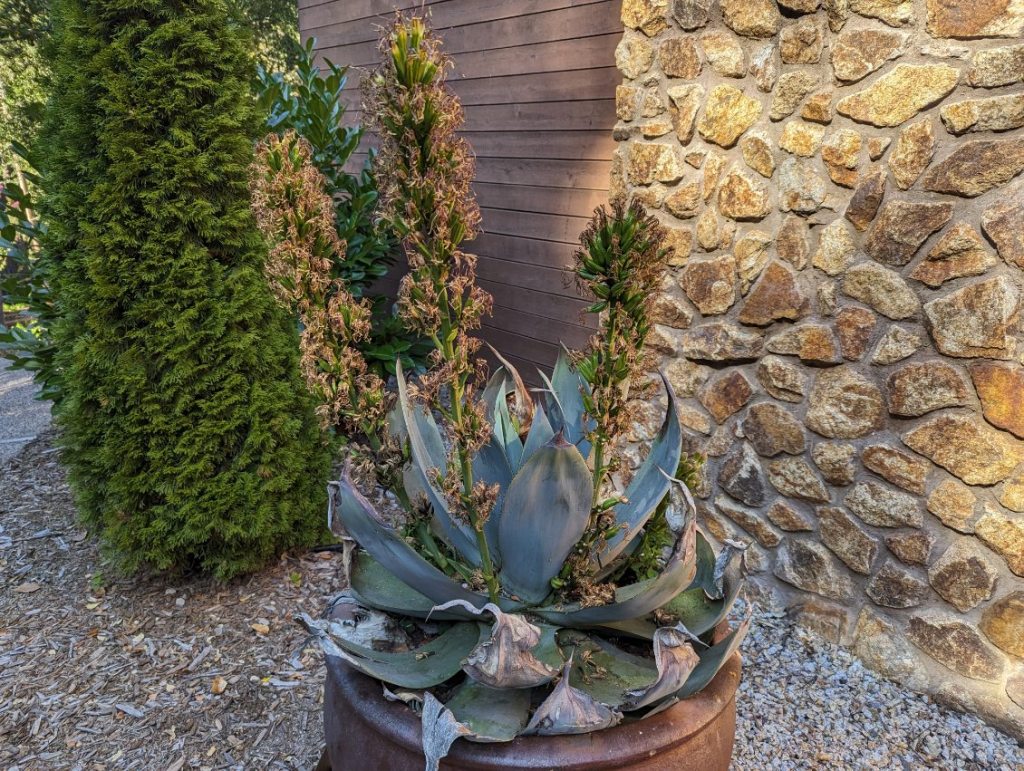
Agaves refuse to die.

Monocarpic species bloom only once. They die afterward. Many annuals are monocarpic by default. After bloom and production of seed, they have served their purpose of perpetuating the next generation. Some may bloom more than once within their respective season, but realistically, do not expect to live for long after doing so.

Agaves are monocarpic. Unlike annuals, some grow for many years before maturing enough to bloom. In fact, the century plant is known as such because, in the wild, it supposedly takes a century to mature enough to bloom and finally die. Of course, they do not take nearly so long to bloom within cultivation.

That could be either an advantage or a disadvantage. Their bloom is awesome, but their death is ugly. Removal of their deteriorating but wickedly thorny foliage is a horrid chore. The sap from their foliage causes a rash that can be comparable to the allergic reaction from poison oak. What is worse is that they are not really monocarpic!

Again, that can be either an advantage or a disadvantage. They provide more than enough pups to replace their deteriorating carcass. However, these prolific pups must be divided from each other and the deteriorating carcass of their parent. They are too numerous to accommodate within the same garden or share with neighbors who likely do not want them. Furthermore, they continue to generate pups long after the parent and first litter of pups is gone. Without intervention, they seem to never die completely. Even with diligent intervention, they can linger for many years.

This particular agave should have remained vegetative for many years, but bloomed after only two or three years. The first litter of pups bloomed immediately afterward, as this picture demonstrates. Ultimately, we would like only a single pup to replace the parent.