Dried Flowers Were Formerly Fresh

Some faded bloom retains striking form.

All sorts of flowers bloom through autumn as well as winter. Honeysuckle still exudes its richly sweet summery fragrance. Honestly though, most flowers bloom for spring or early summer. They finished a while ago, and are now going to seed. Even flowers that bloom repeatedly do so less now. This is when floral design can get creative with dried flowers.

Straw flower, statice and globe amaranth are among the most familiar of all dried flowers. While still fresh, they already seem to be dry. They do not seem to change much as they dry. They neither fade nor wilt very much. Only their stems sag. If they hang upside down as they dry, their stems remain straight as they stiffen. Their foliage is likely unimportant.

Rose and hydrangea are among less conventional dried flowers that actually look dried. They fade and shrivel, but somehow develop a distinct visual appeal. Amaranth, celosia, lavender and globe thistle fade and wilt only somewhat. Because amaranth stems curve downward anyway, they need not hang to dry. Lavender stems can dry before collection.

Pampas grass and cattails are big and bold dried flowers that were popular in the 1970s. Hairspray should contain dislodged fuzz that otherwise escapes pampas grass bloom. It can also prevent cattail bloom from bursting to disperse its fuzz. Cattails typically grow in marshes, where they are difficult to reach. Pampas grass foliage inflicts nasty paper cuts.

Some dried flowers are better dried than fresh. Some are mere by products of bloom that deteriorated earlier. Dried floral trusses of lily of the Nile, without their seed capsules, are quite striking. So are dried floral spikes of New Zealand flax and some yuccas. They are merely deadheading debris otherwise. Even dried queen Anne’s lace is worth recycling.

Dried flowers do not necessarily need to be of floral origin. Dried bird of Paradise leaves develop weirdly twisty form. Colorful deciduous leaves can be as colorful in the home as in the garden. So can firethorn and cotoneaster berries. Twigs of ‘Sango Kaku’ Japanese maple and red twig dogwood provide color with form. These are only obvious examples. There are many more to experiment with.
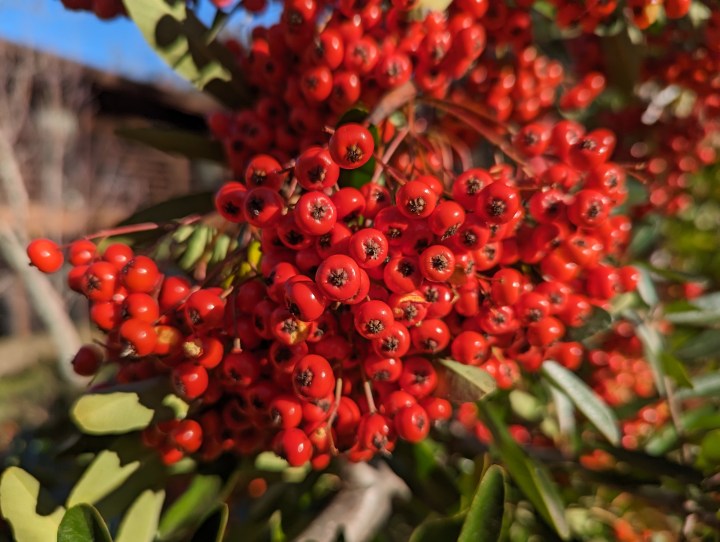
Birds Enjoy Colorful Fruits and Berries.

Brightly colored berries are an incentive for birds to disperse the seed within.

Colorful fruit and berries that ripen in autumn and winter bring more than their own color to the garden. They also attract all sorts of birds. Some birds want to fatten up on the earlier and typically more abundant and colorful fruit before migrating south for the winter. Other birds that stay through winter eat fruit and berries that develop over a longer season, after the migratory birds are gone.

The most abundant and brightly colored red fruit of pyracantha (or firethorn) appeals to the early migratory birds that want to fatten up fast and get south. Cotoneaster, toyon and English hawthorn are not quite as flashy, but appeal to the same crowd of migratory birds. These sorts of plants get their colorful fruit early on in the season, but are then stripped of it rather efficiently.

The fruit of pyracantha, cotoneaster and toyon is not often very messy since almost all of it gets consumed; but the birds that eat it can be remarkably messy before they fly south. Coincidentally, these three plants are often grown as informal hedges and screens around the perimeters of large parking lots, so the mess is a traditional nuisance for many parked cars this time of year.

Chokeberry and elderberry ripen early enough for the migratory birds, but do not get devoured so efficiently because they are not so brightly colored. Migratory birds seem to prefer bright red or orange berries, so are likely to leave black chokeberries and blue elderberries for overwintering birds, which stay through winter. Strawberry tree, although not very productive, appeals to both crowds, and anyone else who might be interested in their fruit, by producing bright red berries throughout the year.

Persimmon, holly, loquat, some mahonia and some crabapple are even a bit more selective, by ripening their fruit later in autumn and winter after the migratory birds are gone. Pomegranate fruit splits open in the middle of winter, exposing a buffet of juicy red berries with meaty seeds for anyone who hasn’t gone south for the winter. Many pittosporums do the same, but without the colorful advertisement. Of course, most of us want to get our persimmons, loquats and pomegranates before the birds do!

Citrus such as lemons, oranges, grapefruits and mandarins that ripen later in winter do not attract birds, so we only need to share these fruits with our friends and neighbors. Citrus are colorful enough on their own anyway.

Falling Leaves Are Getting Messy

Deciduous foliage gets messy through autumn.

The primary problem with autumn foliar color is that it eventually becomes quite a mess. Premature shedding started the process even before much of the foliar color developed. Evergreen foliage can contribute to the mess, but most debris now is deciduous. Autumn is, obviously, its season for defoliation. Falling leaves merely do what is natural for them.

Falling leaves fall at different rates. Just as some fall prematurely, some might linger into winter. Also, some that usually linger into winter may fall earlier or later for some winters. Unusually cool, windy or rainy weather accelerates defoliation. However, defoliation can be slower with milder weather. Prolonged foliar color is pretty, but prolonged mess is not.

Besides falling at different rates, falling leaves are quite diverse. Big leaves of sycamore and fruitless mulberry are easy to rake away. Small and abundant leaves of Chinese elm require a bit more effort. They tend to sift between rake tines. Sycamore leaves disperse tomentum that is irritating and perhaps dangerous to inhale. Oak leaves stain pavement.

In a few relevant regards, falling leaves are quite convenient. Their absence allows more warming sunshine through as the weather cools. Not very long ago, they provided shade during summer warmth. Defoliation also allows wintery wind to blow more safely through deciduous trees. Otherwise, such trees would be more susceptible to damage from wind.

Falling leaves are also quite inconvenient. They clog eavestroughs and gutters precisely when they should not. As rainy weather begins for winter, it dislodges even more foliage. Also, it dampens foliar detritus so that it stains concrete and decking more than while dry. Raking detritus is most important while it is most unpleasant because of wintery weather.

Some coarse groundcover, such as Algerian ivy, can absorb smaller falling leaves. Most groundcover or turf is not so accommodating, though. Bigger leaves can overwhelm and shade them, as well as low or dense shrubbery. Slugs and, where they do not hibernate, snails can proliferate within this damp shade. So can fungal pathogens that tolerate chill.

Automated Irrigation Should Adjust To The Weather.

Some irrigation becomes temporarily obsolete through the rainy season.

Now that it has started to rain, what should be done with automatic watering systems? In almost all situations, automatic irrigation systems should be adjusted to accommodate for moisture provided by rain. If rain is sufficient to provide enough or too much water, irrigation can be discontinued until needed again when the rain stops a few months from now.

If the first few storms are discontinuous enough with warm and dry weather mixed in between, lawns and plants that want more substantial watering may need to be watered a few times until the rain becomes more reliable. However, because of cooler temperatures and shorter days, plants do not use nearly as much water as they did during the summer anyway, so do not need to be watered nearly as much as they were only a month or so ago.

Deciduous plants that are losing their leaves need the least moisture, since they can not lose any moisture through evapotranspiration (evaporation from foliar surfaces). The very few plants that bloom or even start to grow during winter use a little bit more water than those that really are dormant, but are still likely get all they need from rain even without getting watered.

Flowering annuals, particularly left over warm season annuals that continue blooming late, may get moldy with too much rain. Their flowers and some of their foliage can turn to mush until there is a break in the rain. Removal of damaged flowers and leaves slows the spread of the mold but does not cure it. Good air circulation among well spaced plants and in exposed areas helps inhibit mold. Regardless, moisture from abundant rain can eventually cause mold to be a problem.

In fact, the only plants that are not likely to get all the water that they need from rain are those that are in pots and planters under eaves or in the home as houseplants. Nonetheless, sheltered plants that are outside should still get much less water now than they do during the long and warm days of summer. These plants are either dormant or at least more sedate because of the shorter cooler days through winter. Houseplants may likewise use less water because the home environment is also cooler.

However, if the heating system of the home decreases humidity, some large houseplants may actually want a bit more water through winter! Humidity fluctuates most in older deficiently insulated homes that are heated by wood stoves or fireplaces; since these homes get humid without a fire burning, but then get much drier with a fire. 

Firewood Still Warms Some Homes

Firewood is a byproduct of arboriculture.

Firewood was much more popular only a few decades ago. It was readily available from displaced orchards and nearby forests. Fireplaces and even a few woodstoves were not yet so uncommon. People were more motivated to cut and split firewood. More than now purchased it already cut and split. For heating, gas and electricity were more expensive.

Firewood is not so readily available nowadays. Forests are not so nearby. Orchards that were subject to displacement in the past are now completely gone. Most firewood that is available for purchase is a byproduct of arboriculture. Yet, it may not be much less costly than gas or electricity for warmth. Gas or electricity are more convenient and less messy.

Fireplaces and woodstoves are not so common nowadays either. Modern building codes prohibit them from new construction. Repair is rarely justifiable for any that incur damage from earthquakes. Because most are very rarely if ever in use, their removal is generally more practical. The many more households that are here now utilize much less firewood.

However, firewood is not obsolete. It is a renewable resource that very literally grows on trees. Some households consume only very minor volumes from their home landscapes. Some households purchase more significant volumes of it from tree service businesses. In some communities, it is available from woodcutters who harvest it from private forests.

Regardless of its source, firewood for this autumn and winter must be seasoned by now. In other words, after cutting and splitting, it needed time to dry thoroughly. Otherwise, it is difficult to ignite, produces excessive smoke, and burns inefficiently. Palm, cordyline and yucca trunks are not suitable for firewood. They burn fast, but do not produce much heat.

Average home gardens do not produce much firewood. However, removal of a single big tree can instantly provide an abundance. Tree services prefer to leave such wood where it falls. They usually cut it to fit fireplaces but do not split it. Those with an abundance are often happy to share, especially if they use none. It occupies space, and eventually rots.

Cool Season Floral Color

Calendula dislikes summer warmth and may not last completely through winter, but should last as long as marigold.

What was probably the last of the warm weather for the year really got the zinnias going again; but only for their leaves to become dusted with powdery mildew in the subsequent long cool nights. No matter how good the zinnia flowers still look, it is time for cool season annuals.

In mixed plantings, cool season annuals can be ‘plugged’ (as seedlings or small plants) or sown (as seed) among the warm season annuals so that they are ready to perform as the warm season annuals succumb to cooler weather. Of course in more uniform beds, warm season annuals will eventually need to be removed to make space for their cool season replacements.

Pansies and related violas are likely the two most popular cool season annuals. They fill in nicely as bedding plants or are nice components to mixed plantings. They perform best early in the season while the weather is still a bit warm, but should last until the weather gets too warm the following spring.

Primroses and Iceland poppies can take a bit more effort since they need ‘deadheading’ (removal of deteriorating flowers) to continue blooming. Primrose can also be hazardous to anyone who happens to be allergic to them, causing skin irritation comparable to that of poison oak! Some primroses are very brightly colored, while others are more subdued and elegant shades of pink and white. Iceland poppies are mostly pale shades of orange, yellow, pink and white on wiry stems.

Chrysanthemums, which are actually perennials, are the most variable of the cool season annuals, with a wild range of colors and flower forms. The varieties most popularly grown as annuals stay low and compact. Taller types make good cut flowers, but are not so practical for bedding. The related African daisies, which are incidentally similar to the ground cover of the same name, lack the variety of flower color and form, but are easier to grow; particularly as a perennial long after other cool season annuals are gone.

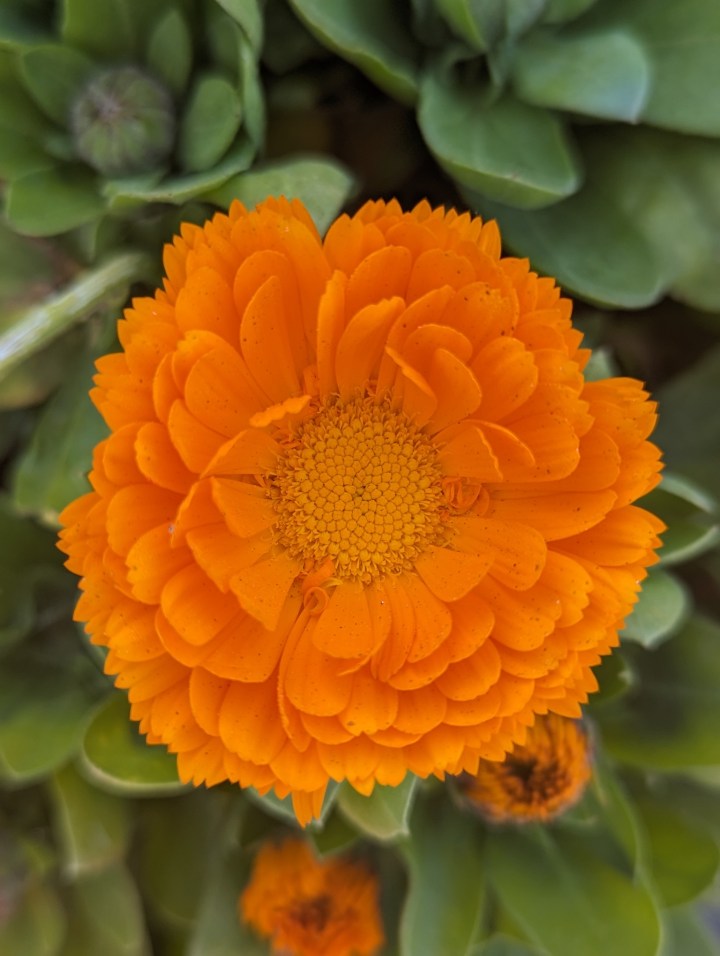
Calendulas are another simpler chrysanthemum relative that are more proportionate to typical annuals, since they get only a few inched deep. They would probably be more popular than they are if they provided more colors than their marigold like orange and yellow. Unlike chrysanthemums and African daisies, calendulas really are annuals, so do not last long into warm weather.

Red, white, pink and rosy pink flowers among rich green foliage can be provided by sweet William (dianthus). They not only tolerate a bit more shade than some other cool season annuals, but are also likely to survive sporadically as perennials where protected from warm exposure through spring and summer.

Stock is the best cool season annual for fragrance. It smells like carnations, but much stronger. Short varieties are good bedding annuals, and even better for mixed plantings. Taller varieties are great cut flowers.

Fall Foliage Is Gaining Color

Minor chill can initiate major color.

Fall foliage is underappreciated here. It is not naturally prominent enough to suggest that it should be otherwise. Most native vegetation is evergreen. Most that is deciduous turns simple hues of yellow, without much orange or red. Some just gets shabby and brown as it defoliates with minor chill. Native vegetation does not represent total potential, though.

Contrary to common beliefs, local weather is not too mild for fall foliage to develop color. Only a few locally rare deciduous species need cooler weather for such color. Only a few deciduous species prematurely shed too much to develop their color for fall. Colorful fall foliage really could be more prominent within gardens than it is. It merely is not a priority.

Many home gardens here are within suburban or urban situations. Evergreen vegetation is therefore useful for privacy or to obscure undesirable views. Winter weather is not cold enough for evergreen shade to make it significantly colder. Some believe that deciduous vegetation is messier than evergreen vegetation. Some find it less appealing while bare.

Actually, evergreen foliage is generally more persistently messy than deciduous foliage. Although it sheds less abundantly, it does so more continuously through longer seasons. Some never stops shedding. Ultimately, the quantity of its detritus is at least comparable to that of deciduous foliage. Deciduous foliage sheds more profusely, but does so briefly.

Efficient shedding could be an incentive for deciduous vegetation. Sunnier conditions for winter could be another, whether or not it adds a bit of warmth. The color of fall foliage is obviously worthy of consideration also. Some types are more colorful than others. Some are more reliable than others. Ultimately, there is quite a bit of fall foliage to choose from.

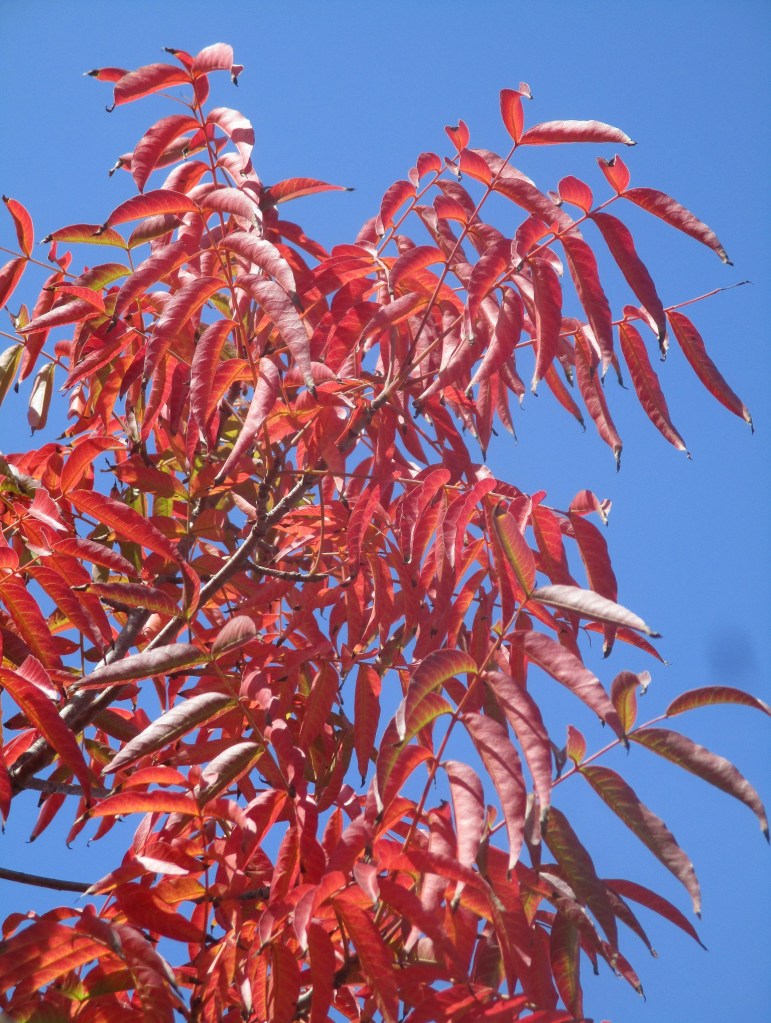
Sweetgum, pistache and flowering pear develop the most exquisitely colorful fall foliage. Their color ranges from bright yellow, through orange, to deep red. Sweetgum is messier than the others, but only because it retains its fall foliage longer. Crape myrtle is smaller, but comparably colorful. Ginkgo is quite reliable for exceptionally brilliant yellow foliage, early in fall.

Tree Work Will Be Less Stressful During Dormancy.

Only arborists can work on the big trees.

The taller trees are typically the first to admit that summer is finished and that it is now autumn. Perhaps because they are higher up and into the changing weather more than smaller plants that are sheltered and closer to the ground. Some trees are changing color nicely. Others are thinking about it. Evergreens are, . . . well, evergreen; so they may not seem to change so much. Nonetheless, autumn is here, and most plants will consequently be going dormant for the winter, or at least slowing down a bit.

For many trees and other plants that need to be pruned, the next few months will be the best time for it. Because they are more or less dormant, they are not very aware of whatever procedures they are subjected to. When they wake up in spring, they simply adapt to the earlier pruning and start growing as if not much happened to them. Dormancy is like a natural anesthesia for trees and plants.

Conversely, the end of winter and beginning of spring is the worst time to prune many trees and plants because they are just emerging from dormancy, so are wide awake! If necessary, minor pruning done properly is generally tolerable, but should realistically be done either before or after that time. Maples, birches, mulberries and figs express their disapproval of late pruning by bleeding profusely, and sometimes for a long time.

Deciduous trees are most dormant by winter when their leaves have fallen off. Pruning them a bit earlier would probably be harmless, but deprives them of their colorful foliage. Maples, gingkoes, poplars and mulberries typically defoliate earliest. Oaks, elms and sweetgums (liquidambars) take their time, holding onto their leaves until they get knocked out by wind and rain. Oaks and elms are not very colorful anyway. Sweetgums though can look too good to get pruned late into winter!  

Arborists are physicians of trees, so can prescribe recommended pruning and maintenance procedures. Many trees, like Chinese elms, fruitless mulberries and willows, need more attention than others. Austrian black pines and Eastern redbuds are not so needy. Blue spruces that are allowed to remain branched to the ground and have enough space around them may never need a visit by an arborist.

Regardless of how much attention any particular tree needs, when it develops a problem that is out of reach, it should be assessed by an arborist, and hopefully pruned accordingly. Because trees are the most substantial features of the landscape, and can develop worse problems if not maintained properly, it is imperative to procure the services of qualified arborists; and not trust such important tasks to a gardener or anyone who can find a chain saw and pick up. Fortunately, certified arborists can be found at the website of the International Society of Arboriculture (ISA), at www.isaarbor.com.

Spring Bulbs Benefit From Vernalization

Spring bulbs vernalize with winter chill.

Spring bulbs obviously bloom for spring. Less obviously, they vernalize with winter chill. They are seasonable about now because this is when they should get into their gardens. Many prefer to be interred into their shallow graves by Halloween. Many can wait as late as New Year’s Day. If too much later, some may not experience enough chill to vernalize.

Planting spring bulbs can be ungratifying because there is nothing to see afterward. After all, they are dormant at the time. They lack foliage or any other parts to extend above the surface of the soil. They seem to remain inactive until they bloom as winter succumbs to spring. However, between now and then, they will secretly reset before resuming growth.

Vernalization is how many spring bulbs finish their previous season and begin their next. They know that it is winter after they experience a particular duration of a particular chill. By then, they should have finished all growth of the previous season. Afterwards, all new growth and bloom is for the next season. It is how they know to bloom on time for spring.

Dutch iris, freesia, ranunculus, anemone and common narcissus do not need much chill. Tulip, hyacinth, crocus and a few narcissus and daffodil do. Some bulbs that benefit from it get a prechill treatment before coming to nurseries. Prechilled tulip and hyacinth bulbs are sadly unlikely to bloom after their first year. They prefer more chill than they get here.

Otherwise, many spring bulbs are supposedly reliably perennial. Naturally, actual results may vary. Anemone can survive for many years, but might bloom only rarely. Ranunculus may be less perennial, but may also bloom better while it survives. Dutch iris and crocus are unpredictable. Freesia and simple varieties of narcissus are more reliably perennial.

Technically, some spring bulbs are not bulbs. Ranunculus and freesia, for example, grow from corms. Nonetheless, almost all spring bulbs bloom only once annually. Succession planting can prolong bloom. It provides subsequent phases to begin bloom as preceding phases finish. However, phases of reliably perennial bulbs synchronize after first bloom. Summer bulbs and bulb-like plants are seasonable later.

Vines Are Aggressive

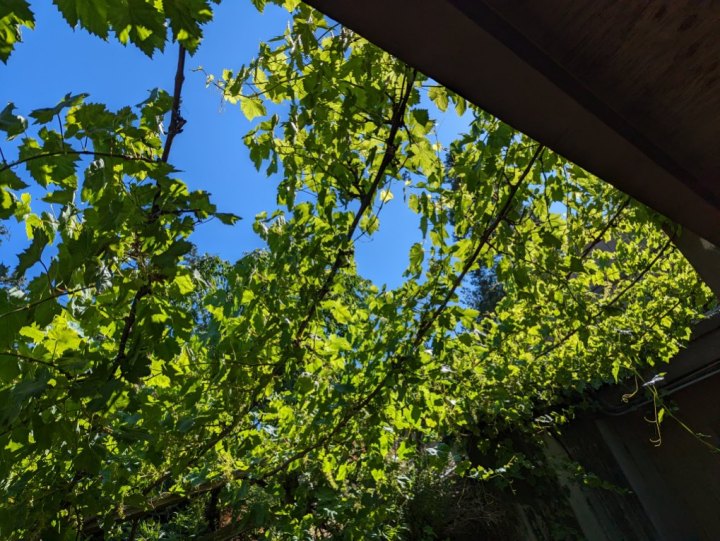
Grapevines need to be tamed.

So many of the vines that we enjoy in our gardens might not be so appealing if we knew how they behave in the wild. Many of their characteristics that are often practical in garden situations are detrimental to neighboring plants in natural settings. If they can get away with it, vines can be just as brutal in our own gardens.

Creeping fig is perhaps the most brutally aggressive of vines. Like many other vines, it exploits trees for support. While it reaches the top of the trees, it wraps the tree trunks with a grafted network of stems that expands as it grows, literally strangling the trees that gave it support. By the time the supporting tree trunks decay, the creeping fig has developed its own self supporting trunk. Algerian and English ivies can do the same.

Fortunately, these vines rarely get such opportunities in garden situations. Nonetheless, they need to be kept out of trees that might otherwise get overwhelmed. Since they attach to the surfaces that they climb by aerial roots, they should not be allowed to climb onto painted surfaces, stucco, or anything else that they can damage.

Boston ivy supports itself by holdfast disks, which it leaves on everything that it gets a hold of. If the vines get removed to paint a wall, the disks remain. Like creeping fig and the ivies, Boston ivy, should therefore only be allowed to climb surfaces that are not likely to be damaged by its climbing techniques. Creeping fig and Boston ivy both happen to be quite practical for freeway infrastructure and sound-walls, but are difficult to accommodate in tame urban landscapes.       

Wisteria is another very aggressive vine that can overwhelm small trees and shrubbery, but lacks aerial roots. It instead climbs by twining stems, which are safer for painted surfaces, but can constrict and crush light trellises, wooden shingles, lattice or anything else that that wrap around. It is certainly worth growing, but needs adequate support.

Bougainvillea and climbing roses do not climb on their own, but instead produce ‘scrambling’ canes that shoot upward and then lean onto their surroundings for support. If grown as vines, they need to be fastened to their support. If not pruned back occasionally, they can get quite overgrown and shrubby. Most varieties that are popular now fortunately stay small and manageable.

Honeysuckle, potato vine, blue dawn flower, evergreen clematis, star jasmine and the various trumpet vines are more manageable, but are still moderately aggressive. Carolina Jessamine, lilac vine, mandevilla, and passion vine are among the more docile of vines, only outdone by the annual vines like annual morning glory and climbing nasturtium.