Autumn Tasks

Gardening tasks may be a bit less demanding now, but are no less important.

With cooler and rainy weather, and shorter days, gardening is not what it was a few months ago. It is more comfortable to stay inside when the weather is not so pleasant. Besides, gardening when the garden is too wet gets muddy, and can damage lawns and bedding areas. Even while the weather is pleasant, there is not enough daylight left to get much done at the end of the day.

The good news is that gardening is not as demanding in autumn and winter as during spring and summer. Plants are either dormant or are growing only minimally. Pruning and hedging is therefore not so necessary. Lawns likewise do not need to be mown as often. Without much blooming, there is less need for deadheading. With rain bringing more moisture than the garden needs, and cooler temperatures inhibiting evaporation to take moisture away, watering is rarely a concern.

The bad news is that there are a few things than should be done in autumn and winter that should not be delayed to spring. For example, early spring blooming bulbs should be planted as they become available in nurseries so that they can get a good chill through winter and disperse their roots as soon as possible. Also, evergreen trees that may be a bit awkward on their trunks should be staked before winter winds. (Deciduous trees do not get blown around much without their foliage.) 

Eventually, or sooner, the weather will get cold enough to necessitate protection from frost. Marginal plants are probably safe under eaves or taller evergreen trees. Sensitive plants that are not in pots that can be moved to shelter should be tented when threatened by frost. Tenting can be as simple as tarps suspended above the foliage by stakes, and only needs to shelter plants from exposure.

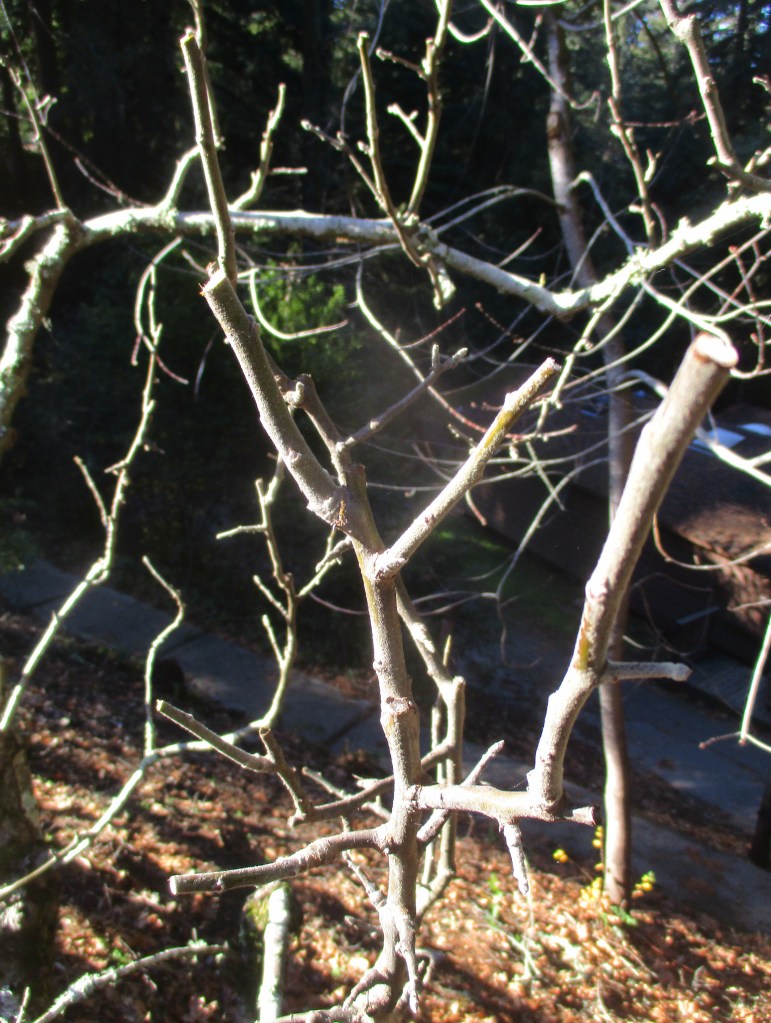
As deciduous fruit trees lose their foliage, they will be ready for winter pruning. This is very important for apricot, peach, cherry, nectarine, plum, prune, apple, pear and related trees, since they should not be pruned once they start to bloom in spring. Maples and birches should also be pruned while completely dormant in winter, since they bleed so profusely if pruned in spring or summer.

Weed seedlings may start to appear with winter rain. They do not grow as rapidly now as weeds do in spring, but have a sneaky way of growing in more places because of the uniform availability of water in places that would be dry without rain. Fortunately, they are easy to pull while the soil is damp. Seedlings of any desirable plants should be identified first so that they can be distinguished from weed seedlings and not pulled.

Falling leaves should be raked from lawns and ground cover, not because they are unappealing in the garden, but because they block out sunlight and promote rot. Raking should not be done immediately after rain though, since lawn and ground cover are so easily damaged while soil is wet and muddy.

Precipitation Should Continue Through Winter

Red sky at morning, meteorological warning.

Deciduous foliage gets colorful with autumn chill. Then, it gets messy. Then, with a bit of precipitation, it gets even messier! It seems like a waste as it all succumbs to rain and, in other climates, snow. It is sensible, though. Deciduous vegetation will be less vulnerable to stormy weather without it. Weather will be getting increasingly stormy through autumn.

This is how the Mediterranean climate here operates. The dry season that begins during spring continues until autumn. The relatively shorter rainy season centers around winter. Therefore, most precipitation occurs during winter. Spring and autumn are brief transition seasons that tend to favor the dry season. Almost no precipitation occurs during summer.

Spring and autumn transitions between rainy and dry seasons are innately variable. The rainy season tends to finish early during spring, but may not. It sometimes pauses before resuming. It may do so more than once. Conversely, the rainy season tends to begin late during autumn, but may begin earlier. Occasionally, precipitation begins disturbingly late.

Generally, the first significant storm with significant precipitation begins the rainy season. This may be difficult to believe with typically significant time between the first few storms. Yet, with cooler weather, elevated humidity, and shorter daylength, moisture lasts longer. Precipitation, even if merely drizzling fog, will likely dampen gardens before they get dry.

Irrigation obviously does not need to be as generous as it was during summer. Until next spring, some vegetation will require none at all. Not only will weather provide and retain more moisture, but vegetation uses much less. Refraining from manual irrigation is easy. Adjustment of automated irrigation systems actually requires more effort and awareness.

As deciduous species defoliate for winter, some other species might get more vivacious. Cacti, agave, and some yuccas that lack irrigation become more turgid with precipitation. Remaining palo verde foliage is likely to become greener and fresher prior to defoliation. Most xeric species utilize moisture from precipitation as it becomes available seasonally.

Alternatives For Fresh Flowers

Form develops as color fades.

There are so many choices for flowers to grow for cutting between spring and the end of summer. For autumn and winter though, the choices are somewhat limited. Of the few things that bloom this time of year, there are fewer that are good cut flowers, and even fewer that bloom continually or profusely enough to provide an abundance of flowers until other flowers start to become available again in spring. Besides, who wants to go out to the garden in wintry weather to get flowers to bring into the home?

Many plants have other parts that are showy enough to substitute for cut flowers in the home. Cut foliage, stems, seedpods and even bark can be useful. Some flowers can be dehydrated to last all year, but look nothing like they do while fresh; and the process is somewhat involved. The most convincing alternative to fresh flowers is probably dried flowers.

Not many flowers dry well. Almost all simply turn brown and deteriorate. Only a few remain intact and also keep some of their color. Roses and hydrangeas are commonly dried, although their colors fade and they become shriveled. Yarrow and baby’s breath likewise change their appearance as they dry, but not quite as much. It is not so obvious as their tiny flowers shrivel.

The best dried flowers look somewhat fresh when they are actually dried. Strawflower, statice, globe thistle and globe amaranth are four of the best examples. These flowers are actually rather ‘crispy’ while they are still fresh, and only become crispier as they dry. If left in the garden, the flowers deteriorate only because of exposure to weather, and eventually rot in winter rain.

Simply as fresh cut flowers, strawflower, statice, globe thistle and globe amaranth flowers last longer than just about any other flower. They can even be separated from mixed bouquets and dried as the other flowers deteriorate and get discarded. They only need the lower portions of their stems that were originally soaking in water to be cut off if significantly deteriorated.  

However, most dried flowers probably look best if dried immediately after getting cut, since their foliage yellows more as it dries slowly. Lightweight flowers, like baby’s breath and statice (except bulky perennial statice) can be arranged fresh but without water, and simply allowed to dry as they are arranged. The only potential problem with this technique is that flowers may be difficult to separate and recycle later.

Flowers are more often laid out to dry individually and then arranged afterward. Globe thistle and globe amaranth are rather pliable and can wilt while drying, which can change the shape and consistency of a formerly fresh floral arrangement. Once dried though, their stems remain firm, and they can then be arranged more permanently. Most flowers are adequately dry in about a week indoors (or outdoors in warm dry weather).  

Because strawflowers are rather bulky on soft stems that may wilt, they dry with straighter stems if hung upside down while drying. The biggest flowers should be hung singly. Smaller flowers can be hung in small bunches. This works for heavy flowers like roses, and wide flowers like yarrow as well.

Wintry Berries Are Already Colorful

Most wintry berries are bright red.

Seed of most vegetation here finishes developing by late autumn to be ready for winter. It wants to germinate while soil is damp, and before it gets dry after spring. Some needs to vernalize with a bit of chill to be ready to germinate prior to spring. Some offers incentive to birds or other wildlife to disperse it. It develops within colorful fruits and wintry berries.

Both migrating and overwintering birds enjoy wintry berries while other food gets scarce. Squirrels and other wildlife are likely to indulge as well. Seed within such fruit is resilient to digestion. In fact, many of such seed germinate better after digestion softens their hard exteriors. For them, digestion by their vectors is comparable to vernalization by weather.

This is why wintry berries are so colorful. They want to be visually appealing to birds and other vectors who disperse their seed. Their vectors need no more persuasion than that. They instinctively recognize a free meal when they see it. While they eat well, vegetation which feeds them benefits from dispersion of its seed. It is a mutually beneficial situation.

Birds and wildlife are not exclusive beneficiaries of ripe wintry berries. Many people who enjoy gardening appreciate their vibrant color. Such color is particularly appealing where floral color is deficient during winter. Many who enjoy gardening instead prefer any birds who eat such berries. Unfortunately, wintry berries will not last long after birds find them.

Wintry berries are already developing color, a month or so before the beginning of winter. Some may become more prominent as autumn foliar color eventually diminishes. Almost all wintry berries are bright red, but some are rusty red, orange or even golden. Greenish pittosporum berries are not so prominent. Elderberries are uncommon in home gardens.

Firethorn is the most prominent of wintry berries here. Various cotoneasters are likely the second most prominent, with rustier red color. Toyon berries are more colorful than those of cotoneaster, but are less common. English hawthorn can retain its berries longer than its deciduous foliage, but is rare. Because they lack pollination, most hollies are fruitless.

Autumn Foliar Color Within Mild Climates.

Pistache does not need much chill to develop exquisite foliar color.

Cooler climates may not have so much annual flower color to choose from at the end of summer, but have more autumn color from trees and a few shrubs and vines. The weather is of course different every year, so autumn color is never predictable. Just as some of the typically colorful trees may not be so spectacular every year, some of the more mundane trees may be surprisingly colorful if the weather is just so.

In milder climates, sweetgum (Liquidambar), flowering pear and Chinese pistache are generally the most reliable for the most color as the weather gets cooler. All three exhibit a good range of color, from clear yellow, through orange and bright red. Sometimes, particular colors are more prominent, or even exclusive. For example, Chinese pistache can be completely orange without yellow or red. Some cultivars of sweetgum specialize in particular color ranges. For example, ‘Burgundy’ turns dark red or purplish red without much yellow or orange.

In cooler climates, maples color well. Sugar maple is perhaps the most colorful, comparable even to sweetgum. Unfortunately, it does not hold onto its foliage as tightly, and soon looses it to slight wind or rain. Red maple colors just as reliably, but is more red and brown with less yellow and orange. Norway maple typically turns yellow or somewhat orange. Silver maple turns only dingy yellow, but gets big enough to make quite a show.

The best bright yellow is probably provided by maidenhair (Ginkgo biloba) tree. Birch, honey locust, tulip tree, fruitless mulberry, some willows and poplars can be comparable if the weather turns cool suddenly. Redbud, dogwood, hawthorn and flowering cherry are more subdued shades of yellow, but are grown more for their spring flowers anyway. Persimmon probably provides the best brightest orange foliage, followed by abundant and comparably bright orange fruit!

Some ash, some oaks, Chinese tallow tree, parrotia and dawn redwood all provide their own flavors of autumn color. Dawn redwood and pin oak actually turn simple brown, which some people think makes the trees look dead! Raywood ash turns a nice burgundy red or purplish. However, the old fashioned Modesto ash (which is a type of Arizona ash) turns as bright yellow as fruitless mulberry does. Not all crape myrtles have good fall color, but some are as colorful as sweetgum is. Various hazels, spiraeas and viburnums are colorful shrubbery in autumn. Wisteria vines, which are known more for their colorful spring flowers, turn yellow.

Dried Flowers Were Formerly Fresh

Some faded bloom retains striking form.

All sorts of flowers bloom through autumn as well as winter. Honeysuckle still exudes its richly sweet summery fragrance. Honestly though, most flowers bloom for spring or early summer. They finished a while ago, and are now going to seed. Even flowers that bloom repeatedly do so less now. This is when floral design can get creative with dried flowers.

Straw flower, statice and globe amaranth are among the most familiar of all dried flowers. While still fresh, they already seem to be dry. They do not seem to change much as they dry. They neither fade nor wilt very much. Only their stems sag. If they hang upside down as they dry, their stems remain straight as they stiffen. Their foliage is likely unimportant.

Rose and hydrangea are among less conventional dried flowers that actually look dried. They fade and shrivel, but somehow develop a distinct visual appeal. Amaranth, celosia, lavender and globe thistle fade and wilt only somewhat. Because amaranth stems curve downward anyway, they need not hang to dry. Lavender stems can dry before collection.

Pampas grass and cattails are big and bold dried flowers that were popular in the 1970s. Hairspray should contain dislodged fuzz that otherwise escapes pampas grass bloom. It can also prevent cattail bloom from bursting to disperse its fuzz. Cattails typically grow in marshes, where they are difficult to reach. Pampas grass foliage inflicts nasty paper cuts.

Some dried flowers are better dried than fresh. Some are mere by products of bloom that deteriorated earlier. Dried floral trusses of lily of the Nile, without their seed capsules, are quite striking. So are dried floral spikes of New Zealand flax and some yuccas. They are merely deadheading debris otherwise. Even dried queen Anne’s lace is worth recycling.

Dried flowers do not necessarily need to be of floral origin. Dried bird of Paradise leaves develop weirdly twisty form. Colorful deciduous leaves can be as colorful in the home as in the garden. So can firethorn and cotoneaster berries. Twigs of ‘Sango Kaku’ Japanese maple and red twig dogwood provide color with form. These are only obvious examples. There are many more to experiment with.

Birds Enjoy Colorful Fruits and Berries.

Brightly colored berries are an incentive for birds to disperse the seed within.

Colorful fruit and berries that ripen in autumn and winter bring more than their own color to the garden. They also attract all sorts of birds. Some birds want to fatten up on the earlier and typically more abundant and colorful fruit before migrating south for the winter. Other birds that stay through winter eat fruit and berries that develop over a longer season, after the migratory birds are gone.

The most abundant and brightly colored red fruit of pyracantha (or firethorn) appeals to the early migratory birds that want to fatten up fast and get south. Cotoneaster, toyon and English hawthorn are not quite as flashy, but appeal to the same crowd of migratory birds. These sorts of plants get their colorful fruit early on in the season, but are then stripped of it rather efficiently.

The fruit of pyracantha, cotoneaster and toyon is not often very messy since almost all of it gets consumed; but the birds that eat it can be remarkably messy before they fly south. Coincidentally, these three plants are often grown as informal hedges and screens around the perimeters of large parking lots, so the mess is a traditional nuisance for many parked cars this time of year.

Chokeberry and elderberry ripen early enough for the migratory birds, but do not get devoured so efficiently because they are not so brightly colored. Migratory birds seem to prefer bright red or orange berries, so are likely to leave black chokeberries and blue elderberries for overwintering birds, which stay through winter. Strawberry tree, although not very productive, appeals to both crowds, and anyone else who might be interested in their fruit, by producing bright red berries throughout the year.

Persimmon, holly, loquat, some mahonia and some crabapple are even a bit more selective, by ripening their fruit later in autumn and winter after the migratory birds are gone. Pomegranate fruit splits open in the middle of winter, exposing a buffet of juicy red berries with meaty seeds for anyone who hasn’t gone south for the winter. Many pittosporums do the same, but without the colorful advertisement. Of course, most of us want to get our persimmons, loquats and pomegranates before the birds do!

Citrus such as lemons, oranges, grapefruits and mandarins that ripen later in winter do not attract birds, so we only need to share these fruits with our friends and neighbors. Citrus are colorful enough on their own anyway.

Falling Leaves Are Getting Messy

Deciduous foliage gets messy through autumn.

The primary problem with autumn foliar color is that it eventually becomes quite a mess. Premature shedding started the process even before much of the foliar color developed. Evergreen foliage can contribute to the mess, but most debris now is deciduous. Autumn is, obviously, its season for defoliation. Falling leaves merely do what is natural for them.

Falling leaves fall at different rates. Just as some fall prematurely, some might linger into winter. Also, some that usually linger into winter may fall earlier or later for some winters. Unusually cool, windy or rainy weather accelerates defoliation. However, defoliation can be slower with milder weather. Prolonged foliar color is pretty, but prolonged mess is not.

Besides falling at different rates, falling leaves are quite diverse. Big leaves of sycamore and fruitless mulberry are easy to rake away. Small and abundant leaves of Chinese elm require a bit more effort. They tend to sift between rake tines. Sycamore leaves disperse tomentum that is irritating and perhaps dangerous to inhale. Oak leaves stain pavement.

In a few relevant regards, falling leaves are quite convenient. Their absence allows more warming sunshine through as the weather cools. Not very long ago, they provided shade during summer warmth. Defoliation also allows wintery wind to blow more safely through deciduous trees. Otherwise, such trees would be more susceptible to damage from wind.

Falling leaves are also quite inconvenient. They clog eavestroughs and gutters precisely when they should not. As rainy weather begins for winter, it dislodges even more foliage. Also, it dampens foliar detritus so that it stains concrete and decking more than while dry. Raking detritus is most important while it is most unpleasant because of wintery weather.

Some coarse groundcover, such as Algerian ivy, can absorb smaller falling leaves. Most groundcover or turf is not so accommodating, though. Bigger leaves can overwhelm and shade them, as well as low or dense shrubbery. Slugs and, where they do not hibernate, snails can proliferate within this damp shade. So can fungal pathogens that tolerate chill.

Automated Irrigation Should Adjust To The Weather.

Some irrigation becomes temporarily obsolete through the rainy season.

Now that it has started to rain, what should be done with automatic watering systems? In almost all situations, automatic irrigation systems should be adjusted to accommodate for moisture provided by rain. If rain is sufficient to provide enough or too much water, irrigation can be discontinued until needed again when the rain stops a few months from now.

If the first few storms are discontinuous enough with warm and dry weather mixed in between, lawns and plants that want more substantial watering may need to be watered a few times until the rain becomes more reliable. However, because of cooler temperatures and shorter days, plants do not use nearly as much water as they did during the summer anyway, so do not need to be watered nearly as much as they were only a month or so ago.

Deciduous plants that are losing their leaves need the least moisture, since they can not lose any moisture through evapotranspiration (evaporation from foliar surfaces). The very few plants that bloom or even start to grow during winter use a little bit more water than those that really are dormant, but are still likely get all they need from rain even without getting watered.

Flowering annuals, particularly left over warm season annuals that continue blooming late, may get moldy with too much rain. Their flowers and some of their foliage can turn to mush until there is a break in the rain. Removal of damaged flowers and leaves slows the spread of the mold but does not cure it. Good air circulation among well spaced plants and in exposed areas helps inhibit mold. Regardless, moisture from abundant rain can eventually cause mold to be a problem.

In fact, the only plants that are not likely to get all the water that they need from rain are those that are in pots and planters under eaves or in the home as houseplants. Nonetheless, sheltered plants that are outside should still get much less water now than they do during the long and warm days of summer. These plants are either dormant or at least more sedate because of the shorter cooler days through winter. Houseplants may likewise use less water because the home environment is also cooler.

However, if the heating system of the home decreases humidity, some large houseplants may actually want a bit more water through winter! Humidity fluctuates most in older deficiently insulated homes that are heated by wood stoves or fireplaces; since these homes get humid without a fire burning, but then get much drier with a fire. 

Firewood Still Warms Some Homes

Firewood is a byproduct of arboriculture.

Firewood was much more popular only a few decades ago. It was readily available from displaced orchards and nearby forests. Fireplaces and even a few woodstoves were not yet so uncommon. People were more motivated to cut and split firewood. More than now purchased it already cut and split. For heating, gas and electricity were more expensive.

Firewood is not so readily available nowadays. Forests are not so nearby. Orchards that were subject to displacement in the past are now completely gone. Most firewood that is available for purchase is a byproduct of arboriculture. Yet, it may not be much less costly than gas or electricity for warmth. Gas or electricity are more convenient and less messy.

Fireplaces and woodstoves are not so common nowadays either. Modern building codes prohibit them from new construction. Repair is rarely justifiable for any that incur damage from earthquakes. Because most are very rarely if ever in use, their removal is generally more practical. The many more households that are here now utilize much less firewood.

However, firewood is not obsolete. It is a renewable resource that very literally grows on trees. Some households consume only very minor volumes from their home landscapes. Some households purchase more significant volumes of it from tree service businesses. In some communities, it is available from woodcutters who harvest it from private forests.

Regardless of its source, firewood for this autumn and winter must be seasoned by now. In other words, after cutting and splitting, it needed time to dry thoroughly. Otherwise, it is difficult to ignite, produces excessive smoke, and burns inefficiently. Palm, cordyline and yucca trunks are not suitable for firewood. They burn fast, but do not produce much heat.

Average home gardens do not produce much firewood. However, removal of a single big tree can instantly provide an abundance. Tree services prefer to leave such wood where it falls. They usually cut it to fit fireplaces but do not split it. Those with an abundance are often happy to share, especially if they use none. It occupies space, and eventually rots.