Shedding Foliage Often Precedes Defoliation

Shedding foliage will eventually get messy.

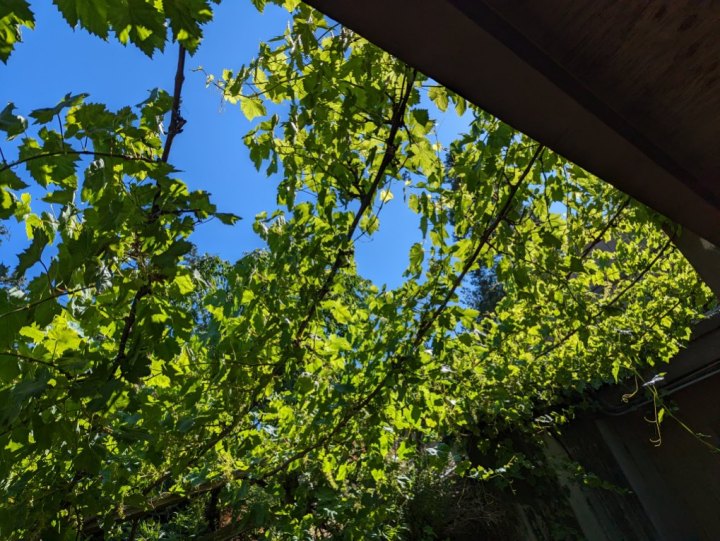
Indian summer is more typical here than not. As usual, the weather cooled somewhat as summer finished, and then warmed again. It is now autumn by date, but still seems to be summer by weather. This might confuse some vegetation, although some is familiar with this pattern. Some vegetation reacts by shedding foliage prematurely, prior to dormancy.

Prematurely shedding foliage is not the same as defoliation of deciduous species. Many of the species that exhibit such response to the weather are evergreen. More importantly, both evergreen and deciduous species do it prior to autumn dormancy. Also, they do not defoliate completely. There will be enough deciduous foliage for autumn foliar color later.

In the wild, prematurely shedding foliage is common among native California sycamore. It is a natural response to minor desiccation from any combination of aridity and warmth. It is as random as weather. Anthracnose is a foliar disease that might cause more severe defoliation earlier. Either type of shedding may be visually unappealing, but is harmless.

Actually, premature shedding foliage is common among many regionally native species. It helps them survive within chaparral climates. Although not a problem in the wild, it can be messy in or adjacent to refined landscapes. Both coastal redwood and coast live oak are notoriously messy. Yet, both species are evergreen and endemic to coastal climates.

Some exotic species from various climates can exhibit prematurely shedding foliage too. Species from other chaparral or desert climates are naturally proficient with the process. Species from less arid climates learn fast. It can be stressful for some of them. Daylength assures them that shedding is now safe. However, warmth that necessitates it might not.

Various species react variously to the various causes of premature shedding. That is too many variables. Simply, shedding is different every year because the weather is different every year. Eastern redbud and birchs that are exceptionally messy now may not be next year. Japanese maples happen to be shedding a bit less this year than they typically do.

California Native Plants

(Some of the information within this article is very outdated because the article was recycled from several years ago.

Valley oak, as well as coast live oak, were the two most common native non-riparian tree species of the Santa Clara Valley.

Bringing nature to the garden is generally very unnatural. Before urban development of the Santa Clara Valley, there were a few valley and coast live oaks spread out sporadically over open chaparral, with a few sycamores, maples and other riparian specie only in the creeks and Guadalupe River that run through it. There are vastly more trees and plant life here now than there ever have been, and specie from every region of the world. Since exotic (non native) plants are from other climates and soils, they require unnatural accommodations, such as watering and fertilizers, to keep them happy.

The most natural gardening is done with native plants, which are naturally adapted to local climates and soils. Natives are not as demanding of amendments, fertilizers or pesticides as some exotic plants are, since they know how to get they want with the local resources available. Because most are satisfied with natural rainfall, they do just fine with minimal watering (once established).

All sorts of native plants will be available at the Native Plant Sale at Hidden Villa Ranch in Los Altos Hills in only ten days on October 16, from 10:00 a.m. to 3:00 p.m.. Deergrass, monkey flower, redbud, blue-eyed grass, buckwheat, sedums and native lilies and orchids will all be there and accurately labeled. Volunteers from the California Native Plant Society will be available to talk about alternatives to law, including native perennials, shrubs, wildflowers and grasses. Books about native plants, as well as posters and note cards featuring native plants will also be available.

From 1:00 to 2:00 p.m., Stephanie Curtis of Curtis Horticulture will give a free hour lecture about tips for planting success and maintenance for natives. Admission is limited to 25 people though, first come first served. 

Hidden Villa Ranch is located at 26870 Moody Road in Los Alton Hills, two miles west of the Moody Road and El Monte Road interchange at Highway 280. Plant selection is best early in the day. All sales must be by cash or check, since credit cards are not accepted. It helps to bring boxes to carry purchased items. More information can be found at www.cnps-scv.org or cnps_scv@yahoo.com or by telephoning 650 – 260 3450. Incidentally, autumn is a good time for planting, since the warmest part of summer is over, and the rain will arrive soon to settle soil around the roots of newly planted plants.  

Banana Trees Actually Produce Bananas

Banana trees provide boldly lush foliage.

Banana trees, much like palms, arboriform yuccas and cordylines, are herbaceous trees. They develop no secondary xylem, or wood. What seems to be trunks are pseudostems, which are just leaves in very tight bundles. These pseudostems grow from subterranean corms, which can grow rather big. Each pseudostem is monocarpic, so dies after bloom.

Although they are very easy to grow, banana trees are not very popular. They can be too easy to grow, and become overwhelming. In some climates, frost can ruin their foliage for part of the year. In some exposures, their foliage can get shabby from wind. Some expect generous and frequent applications of fertilizer. All want generous and frequent irrigation.

These characteristics are contrary to growing banana trees merely for appealing foliage. Realistically, that is what most are for. Those of the Ensente genus are fortunately easier to maintain, but fruitless. Their lushly huge leaves are spectacular, relatively durable and generate much less debris. However, after a few years, they die without generating pups.

Banana trees of the Musa genus generate fruit, although some are primarily ornamental. A few produce delightfully colorful fruit that is too small, seedy or starchy to be palatable. Musa are more pervasive although less popular than Ensente. While Ensente come and go, Musa are reliably perennial. Several produce enough pups to potentially be invasive.

Musa, unlike Ensente, therefore develops colonies of a few to many pseudostem trunks. A few new trunks can replace each old trunk faster than they can deteriorate after bloom. Removal of deteriorating old trunks promotes growth and fruiting of new trunks. So does culling of congested new trunks. They propagate very easily by division with intact roots.

Because banana trees are tropical, they are unfamiliar with the seasons here. They grow fast with warmth but very slowly without it. They bloom randomly though. Flowers that try to bloom during autumn may stagnate long enough to rot through winter. Late fruit can do the same. Fruit that begins to develop early is much more likely to finish prior to autumn. Some cultivars develop faster.

The Stakes Are High.

Binding nursery stakes should be replaced with less restrictive staking and straps.

            After all the unnatural things that plants must endure to get into gardens and landscapes, it is amazing that they are as happy as they are to perform. Most come from very different climates, only to be grown in artificial nursery conditions while confined to containers, then get shipped to other different climates where they get planted in foreign soil, and are expected to adapt. Nonetheless, they still provide flowers, fruit, vegetables, shade and all that we expect from them!

             Trees must suffer even more. Their lower growth that should enhance trunk growth gets pruned away prematurely. Trunk growth is further inhibited by staking, which is ironically necessary for straight and vertical trunks. Fortunately, most trees recover from these procedures.

            Weaning trees off their original stakes can take a bit of work though. Because of their lanky trunks and disproportionately bulky canopies, most new trees need help to stand up against the wind. Except for palms and a few stout trees that are allowed to keep their lower growth, such as redwoods and some pines, almost all trees need to be staked when planted. However, their trunks should not be bound so tightly that they rely on their stakes for support.

            Stakes that are proportionate to new trees should be installed as the trees get planted. They should ideally be a few inches away from the trees and stand as high as necessary to provide adequate support. A small tree (such as #5 or 5 gallon) may need only a single stake. A larger tree (such as #15 or 15 gallon or larger) typically needs two stakes on opposite sides. The original ‘nursery stakes’ that are bound to the trunks should then be removed as trees then get tied to their new stakes. Trees will need to be supported during this process.

            Trees like red maple or flowering pear that have stronger trunks that do not bend much may only need to be tied at the top, just above their lowest limbs. Most trees have more flexible trunks though, so also need to be tied lower down, generally about halfway between the ground and the top tie. Very flexible trees, like many eucalypti, may need to be tied in even more places. Since there are rarely branches on the trunks to keep the lower ties from sliding downward, the ties may need to be nailed to the stakes.

            Ties should wrap around the trunks and cross over before wrapping around the stakes; in a ‘figure 8’ pattern. This limits abrasion from the stake against the trunks. Ties made from recycled tires with bailing wire at the ends are ideal and easiest. For larger lodgepole stakes, recycled tire ties without wire can be nailed directly to the stakes. Ties should only support trees as they blow away from their stakes or bow from their own weight, but should not bind them firmly to the stakes. This way, trees need to become able to support their own weight.

            As trees mature and no longer need support, stakes and ties should be removed. Stakes and ties that get left too long can actually interfere with trunk development, and cause significant damage and abrasion as trunks expand.

Palm Trees Deserve Special Accommodation

Palm trees are bold landscape features.

Palm trees qualify as trees only because of their size and form. The most familiar sorts here develop trunks, and many grow quite tall. The smallest houseplant palms can grow as tall as dwarf citrus trees. Mexican fan palm can grow nearly a hundred feet tall. Palms are monocots, though, so are not actually woody. Technically, they are herbaceous trees.

Palm trees share this distinction with several other herbaceous trees. Banana tree trunks are just tightly rolled leaves. Tree ferns elevate their growth on roots that grow downward through rotting stem growth. Neither banana trees nor tree ferns can generate branches. Sago palms, cabbage trees and arboriform yuccas develop branches, but without wood.

Some palm trees develop a few trunks, but almost none develop branches above grade. Date palms can, but rarely branch. Doum palms typically branch, but are extremely rare. Any other branching palm trees are either aberrative or not really palm trees. Palm trunks do not grow wider as they grow taller. Adventitious roots can become buttressed, though.

All palm trees are evergreen, with either pinnate or palmate foliage. Feather palms have pinnate foliage. Each leaf consists of a central rachis that supports many narrow leaflets. Fan palms have palmate foliage. Each leaf radiates from the terminus of its stout petiole. Both basal leaflets of feather palms and petioles of fan palms are typically horridly spiny.

Since palm trees can not branch, they are not conducive to pruning to direct their growth. Their big but solitary terminal buds grow only upward and maybe away from shade. Any that reach high voltage cables can not go around, so necessitate removal. Clearance for overhanging obstacles is a major consideration for situating new palms. Some grow fast.

While unconducive to directional pruning, most palm trees benefit from grooming. Only a few shed their old foliage naturally. Most get shabby by retaining it. Many, particularly fan palms, eventually become combustible or infested with rodents. However, some may be visually appealing with neat beards of old foliage. Only arborists can groom large palms.

Unconventional Dried Flowers

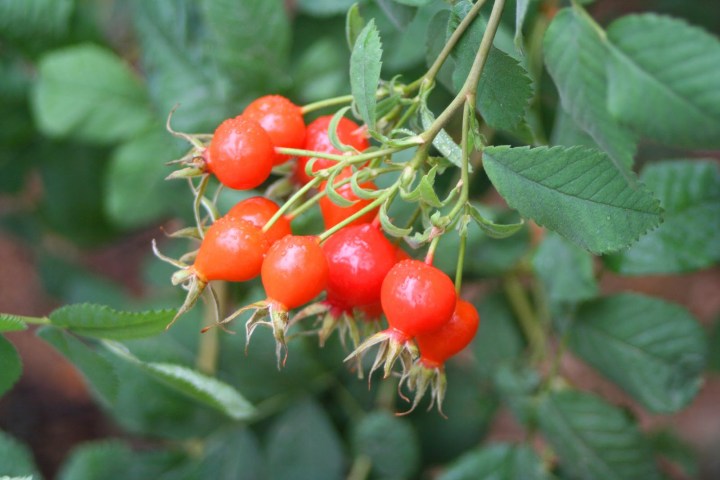
Rose hips are pretty fresh, and can alternatively be dried.

The problem with an abundance of bloom by lily-of-the-Nile over the summer is that all the spent blooms need to be plucked about now. Fortunately though, not all of the spent blooms need to go to compost or greenwaste. The stalks and floral trusses (the clusters of short flower stems on top of the stalks) can actually become interesting ‘dried flowers’, even though the real flowers are long gone.

Many years ago, my neighbor took many of the lily-of-the-Nile stalks that I plucked from my front yard, plucked off the seed capsules, and hung the empty stalks upside down until they dried and turned tan. Being the artistic sort, she added them to other dried flowers and foliage, and arranged them in a large vase (which I think is pronounced as ‘vahz’). Over the years, we found that we can actually let them dry in the garden if we first remove the seed capsules which would otherwise weigh them down and bend the stalks.

Since my artistic neighbor liked these lily-of-the-Nile flower stalks so much, I brought her other dried flower stalks to see how or if they could also be useful. We found that flower stalks from New Zealand flax were just as interesting and even more striking; and some types make rather tall stalks. The large seed capsules from Eucalyptus ficifolia function like modern substitutes for small pine cones. 

There are many other plant parts that can be dried and used with dried flowers as well. Cut bird-of-Paradise leaves become sculpturally twisted as they dry. Petioles (leaf stalks) of windmill palm become simple but striking straight black sticks. While still green, the palm leaves can be cut with scissors into interesting shapes less than six inches wide (larger cutouts disfigure). Some native iris produce large seed capsules that split open as they dry, to reveal bright orange or red seeds within. Money plant is actually grown for its dried seedpods instead of for flowers of foliage.

Even bare stems can be added to dried flower arrangements. Both manzanita and madrone have gnarly stems that turn black or dark brown once cut. Fig has contrastingly thick and curving white or gray stems. Bamboo can be cut into sections of any desired length and stripped of foliage. Heavenly bamboo (Nandina spp.) has shorter canes with a corky texture. Realistically, there are no rules for what works well with dried flowers. Anything that looks good is worth trying once.

Straw flowers, statice (Including sea lavender), lavender, globe thistle and yarrow are some of the more traditional dried flowers. Cat-tails and pampas grass flowers can work as well in large arrangements as they did decades ago, but should be sprayed with hair spray to keep them from shedding. (Cat-tails can actually be very messy if they happen to explode.)

Although spray paint is much too synthetic for those of us who prefer dried flowers to look natural, it also works well to keep pampas grass flowers and cat-tails from shedding while adding serious color. Some people enjoy the potential for unnatural colors enough to spray paint other dried flowers and plant parts that do not need to be sprayed with a fixative.

Gathering Seed To Grow Later

Variegation is generally nontransferable by seed.

Deadheading, or the removal of deteriorating bloom, is contrary to the purpose of bloom. It conserves resources for subsequent bloom or vegetative growth. It neatens associated vegetation. Deadheading is certainly justifiable. However, it eliminates most seed before it can develop. Seed is the priority of bloom. Gathering seed can be a good compromise.

Techniques for gathering seed are as variable as bloom and subsequent seed. For some popular annuals and perennials, it is as simple as deadheading. Their seed develops as fast as their bloom deteriorates. Seed is easy to shake from dried stems of rose campion, campanula and columbine. Cut stalks of lily of the Nile must dry for their seed to mature.

Gathering seed from vegetable fruits can be a bit more complicated. Some are mature as soon as their containing fruits ripen. For example, seed from ripe chile peppers are ready for drying and storing immediately. However, zucchini must mature too much to be edible for its seed to finish developing. Furthermore, squash seed is likely to not be true to type.

This is often a consequence of cross pollination from other varieties of the same species. Progeny of very different parents inherit genetic qualities of both parents. Similarly, many extensively bred varieties exhibit reversion. Their progeny can be more similar to distant ancestors than direct parents. Reversion may be progressive through a few generations.

Reversion is less likely among hybrids only because most hybrids are sterile. Gathering seed from them is generally either futile or impossible. Some hybrid canna develop seed capsules that contain no viable seed. Seedlessness is an advantage of seedless hybrid watermelon. Viable seed of the few hybrids that could produce it is wildly unpredictable.

Most mutations, such as variegation or dwarfism, are not inheritable. Seed of variegated Kaffir lily therefore grows into unvariegated specimens. Some seedlings mature through a juvenile phase prior to bloom. This is why avocado seedlings grow so lean without fruit in their first few years. Ultimately, gathering seed is most practical for simple wildflowers, annuals, perennials and some vegetables.

Colorful Autumn Fruit Is For The Birds

Firethorn is typically the most colorful of autumn berries.

It is hard to ignore the slight bronzing of flowering pear trees in the neighborhood. The recent warm weather after such a mild summer may detrimentally accelerate the development of autumn foliar color, as well as the ripening of some of the colorful fruit that adorns gardens through autumn and winter. Sadly, there have been reports of scorched persimmons as well.

Despite their deviation from a more typical schedule, many of the plants that provide the most colorful fruit start to do so about now, just as birds want to fatten up for winter. My favorites of these provide fruit that I like to get before the birds do. I have already harvested gooseberries, currants and grapes, and am in the process of getting to the elderberries and black chokeberries. Pomegranates will ripen later in autumn. Citrus and persimmon will be ready later in winter, followed by loquat. Natal plum produces randomly all year.

Even fruit that I do not want looks good and keeps the birds happy though. Firethorn is probably the showiest and most popular of these, since it produces such abundant bright red berries that linger into winter. Some have orange or even yellowish berries. Cotoneaster and toyon are similar, but not so flashy. English hawthorn makes similar berries, but grows into a larger tree. Fruiting crabapples were harvested in early summer; but the ornamental, albeit sparse fruit of the flowering crabapples will linger after the leaves fall. Plants that provide abundant fruit that is popular with birds may not be so desirable near where cars are parked outside though, since well fed birds can be rather messy.

I am particularly fond of persimmon, pomegranate, English hawthorn and crabapple trees for other reasons as well. Persimmon trees will provide some of the best orange and red autumn foliar color. By the time it falls, there is plenty of comparably bright orange fruit to replace it! Pomegranate blooms with few but bright reddish orange flowers in summer. English hawthorn and crabapple trees are among the most abundant of spring blooming trees. Some of the flowering crabapple trees bloom with unique shades of bright pink and nearly red. 

Heavenly bamboo, Oregon grape (Mahonia) and California pepper tree are not often grown for their colorful fruit, but sometimes like to show it off. Oregon grape is striking because the fruit is so dark purplish black. California pepper tree makes pendulous trusses of small pink berries. Snowberry is an uncommon native that makes few but striking white berries. 

Succession Planting Prolongs Vegetable Harvest

Frisee is for autumn and spring.

Winter vegetables might inspire both enthusiasm and trepidation as their season begins. Sowing their seed and plugging their seedlings into a fresh garden is delightful. Concern for their performance while summery warmth continues is not. It may take a while, but the weather will eventually cool. Later phases of succession planting will enjoy it even more.

Succession planting, which is the same as phasing, looks simpler than it is. Most simply, it is cultivation of small groups of any vegetable throughout its season. First groups might seem premature, but then seem less so as their season evolves. Subsequent groups are likely to seem more appropriate to their season. They can be one to several weeks later.

Planning is important for efficient use of space. The first groups of winter vegetables can use space as summer vegetables relinquish it. Later groups can use space as these first groups of winter vegetables relinquish it. However, with good crop rotation, any one type should not grow twice on the same sites. They prefer former sites of different vegetables.

So, succession planting is more complicated than growing one big group for the season. It is practical, though, for extending the harvests of individual varieties. The first groups of each variety are ready for harvest first. Each subsequent group should become ready as the preceding group finishes. The last group should finish at about the end of its season.

Different types of vegetables obviously respond differently to succession planting. Those that grow in autumn and spring but not winter need no other succession planting. Radish grows so fast that several phases can fit into one season. Cabbage can linger for so long that only two or three phases might be sufficient. Besides, they develop at different rates.

Succession planting is also effective for several spring bulbs that will soon be available. Although less obviously, and later next spring, prolonged planting should prolong bloom. However, reliably perennial bulbs synchronize for subsequent spring bloom. Succession planting is less effective for summer bulbs later. It only delays prolonged bloom for some that bloom for a recurrent bloom cycle.

Gardening With Succulents

(This article is recycled from many years ago, so contains very outdated information.)

Many succulents are remarkably easy to propagate from cuttings.

Succulent plants that were so trendy during the 1970’s seem to be gaining popularity again. This is actually one of the few trends that I like to see, since succulents are such useful and practical plants in modern urban gardens. Although some cacti, agave and larger succulents become quite imposing, most other succulents are quite compact and proportionate to small garden spaces. Some can by happy in the partial shade of atriums and under eaves. Succulents generally do not need much attention, are remarkably easy to grow, and are even easier to propagate. Most do not need much water. 

‘Gardening with Succulents’, with master gardener Laura Balaoro and the Guadalupe River Park Conservancy, is a great program for experiencing the potential for succulents in containers and the garden. There will be several samples of container gardens to demonstrate some of the many possibilities for succulents, as well as their variety of textures and colors. Common pathogens, propagation methods, succulent that grow through winter, and succulents that are adaptable to partial shade will all be discussed. After a planting demonstration, there will be free cuttings for those who can not wait to add new succulents to their gardens.

‘Gardening with Succulents’ is only in a few days, from 10:00 a.m. to noon on September 11, so it is important to register right away by telephoning 298 7657 or online at www.grpg.org. If this program gets full to capacity first, there are many other interesting classes and programs described at the website for later. Admission is $15, or $10 for members of Friends of Guadalupe River Park and Gardens. ‘Gardening with Succulents’ will be at the Guadalupe River Park and Gardens Visitor and Education Center, which is located at 438 Coleman Avenue in San Jose.

Nearby in the San Jose Heritage Rose Garden, the last of the Rose Deadheading Blitzes will be from 5:00 to 7:30 p.m. on September 14, in order to remove spent blooms and promote more blooms before autumn. Volunteers should bring pruning shears and gloves, and wear closed-toe shoes; and of course, stay for ice cream afterward. (Loaner shears are available if necessary.) The San Jose Heritage Rose Garden is located on Taylor Street at Spring Street, just east of Coleman Avenue. Visit www.grpg.org or telephone 298 7657 for more information or to register.