Colorful Autumn Fruit Is For The Birds

Firethorn is typically the most colorful of autumn berries.

It is hard to ignore the slight bronzing of flowering pear trees in the neighborhood. The recent warm weather after such a mild summer may detrimentally accelerate the development of autumn foliar color, as well as the ripening of some of the colorful fruit that adorns gardens through autumn and winter. Sadly, there have been reports of scorched persimmons as well.

Despite their deviation from a more typical schedule, many of the plants that provide the most colorful fruit start to do so about now, just as birds want to fatten up for winter. My favorites of these provide fruit that I like to get before the birds do. I have already harvested gooseberries, currants and grapes, and am in the process of getting to the elderberries and black chokeberries. Pomegranates will ripen later in autumn. Citrus and persimmon will be ready later in winter, followed by loquat. Natal plum produces randomly all year.

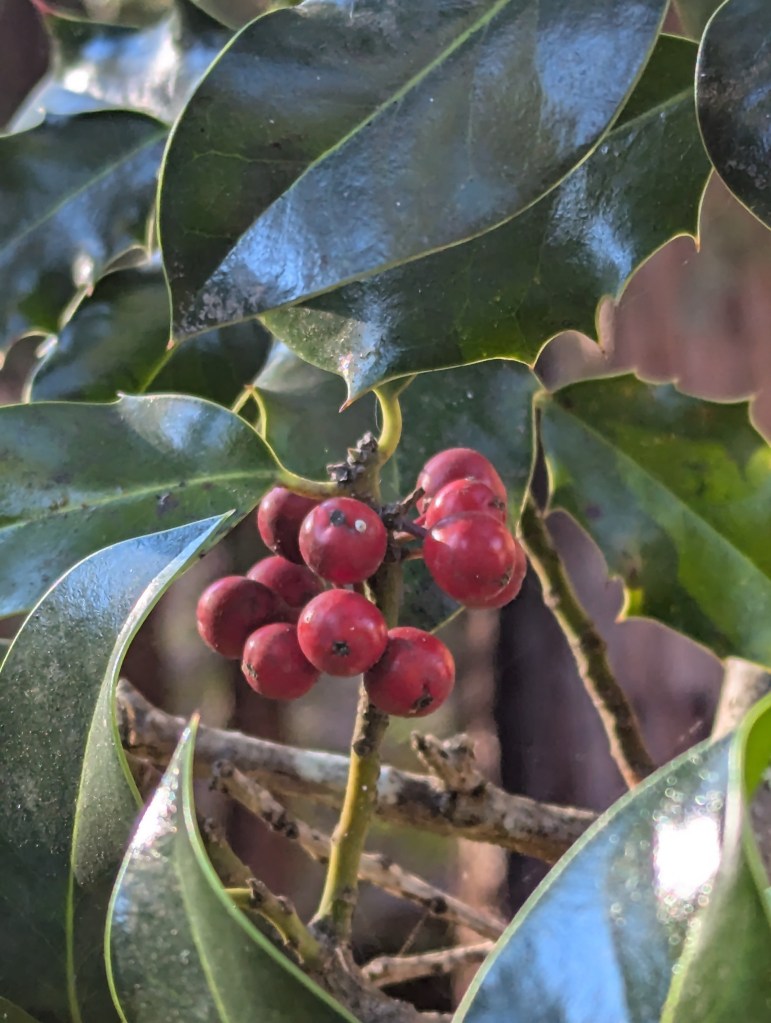
Even fruit that I do not want looks good and keeps the birds happy though. Firethorn is probably the showiest and most popular of these, since it produces such abundant bright red berries that linger into winter. Some have orange or even yellowish berries. Cotoneaster and toyon are similar, but not so flashy. English hawthorn makes similar berries, but grows into a larger tree. Fruiting crabapples were harvested in early summer; but the ornamental, albeit sparse fruit of the flowering crabapples will linger after the leaves fall. Plants that provide abundant fruit that is popular with birds may not be so desirable near where cars are parked outside though, since well fed birds can be rather messy.

I am particularly fond of persimmon, pomegranate, English hawthorn and crabapple trees for other reasons as well. Persimmon trees will provide some of the best orange and red autumn foliar color. By the time it falls, there is plenty of comparably bright orange fruit to replace it! Pomegranate blooms with few but bright reddish orange flowers in summer. English hawthorn and crabapple trees are among the most abundant of spring blooming trees. Some of the flowering crabapple trees bloom with unique shades of bright pink and nearly red. 

Heavenly bamboo, Oregon grape (Mahonia) and California pepper tree are not often grown for their colorful fruit, but sometimes like to show it off. Oregon grape is striking because the fruit is so dark purplish black. California pepper tree makes pendulous trusses of small pink berries. Snowberry is an uncommon native that makes few but striking white berries. 

Succession Planting Prolongs Vegetable Harvest

Frisee is for autumn and spring.

Winter vegetables might inspire both enthusiasm and trepidation as their season begins. Sowing their seed and plugging their seedlings into a fresh garden is delightful. Concern for their performance while summery warmth continues is not. It may take a while, but the weather will eventually cool. Later phases of succession planting will enjoy it even more.

Succession planting, which is the same as phasing, looks simpler than it is. Most simply, it is cultivation of small groups of any vegetable throughout its season. First groups might seem premature, but then seem less so as their season evolves. Subsequent groups are likely to seem more appropriate to their season. They can be one to several weeks later.

Planning is important for efficient use of space. The first groups of winter vegetables can use space as summer vegetables relinquish it. Later groups can use space as these first groups of winter vegetables relinquish it. However, with good crop rotation, any one type should not grow twice on the same sites. They prefer former sites of different vegetables.

So, succession planting is more complicated than growing one big group for the season. It is practical, though, for extending the harvests of individual varieties. The first groups of each variety are ready for harvest first. Each subsequent group should become ready as the preceding group finishes. The last group should finish at about the end of its season.

Different types of vegetables obviously respond differently to succession planting. Those that grow in autumn and spring but not winter need no other succession planting. Radish grows so fast that several phases can fit into one season. Cabbage can linger for so long that only two or three phases might be sufficient. Besides, they develop at different rates.

Succession planting is also effective for several spring bulbs that will soon be available. Although less obviously, and later next spring, prolonged planting should prolong bloom. However, reliably perennial bulbs synchronize for subsequent spring bloom. Succession planting is less effective for summer bulbs later. It only delays prolonged bloom for some that bloom for a recurrent bloom cycle.

Gardening With Succulents

(This article is recycled from many years ago, so contains very outdated information.)

Many succulents are remarkably easy to propagate from cuttings.

Succulent plants that were so trendy during the 1970’s seem to be gaining popularity again. This is actually one of the few trends that I like to see, since succulents are such useful and practical plants in modern urban gardens. Although some cacti, agave and larger succulents become quite imposing, most other succulents are quite compact and proportionate to small garden spaces. Some can by happy in the partial shade of atriums and under eaves. Succulents generally do not need much attention, are remarkably easy to grow, and are even easier to propagate. Most do not need much water. 

‘Gardening with Succulents’, with master gardener Laura Balaoro and the Guadalupe River Park Conservancy, is a great program for experiencing the potential for succulents in containers and the garden. There will be several samples of container gardens to demonstrate some of the many possibilities for succulents, as well as their variety of textures and colors. Common pathogens, propagation methods, succulent that grow through winter, and succulents that are adaptable to partial shade will all be discussed. After a planting demonstration, there will be free cuttings for those who can not wait to add new succulents to their gardens.

‘Gardening with Succulents’ is only in a few days, from 10:00 a.m. to noon on September 11, so it is important to register right away by telephoning 298 7657 or online at www.grpg.org. If this program gets full to capacity first, there are many other interesting classes and programs described at the website for later. Admission is $15, or $10 for members of Friends of Guadalupe River Park and Gardens. ‘Gardening with Succulents’ will be at the Guadalupe River Park and Gardens Visitor and Education Center, which is located at 438 Coleman Avenue in San Jose.

Nearby in the San Jose Heritage Rose Garden, the last of the Rose Deadheading Blitzes will be from 5:00 to 7:30 p.m. on September 14, in order to remove spent blooms and promote more blooms before autumn. Volunteers should bring pruning shears and gloves, and wear closed-toe shoes; and of course, stay for ice cream afterward. (Loaner shears are available if necessary.) The San Jose Heritage Rose Garden is located on Taylor Street at Spring Street, just east of Coleman Avenue. Visit www.grpg.org or telephone 298 7657 for more information or to register.

Winter Vegetables Are Starting Now

Several cool season vegetables are roots.

Winter bedding plants are a reminder. They become in season at about the same time as winter vegetables. Therefore, as pansies replace petunias, turnips may begin to replace okra. As for bedding plants, it is a slow process that can continue until frost. Some winter vegetables start earlier than others. Some summer vegetables produce later than others.

For example, young okra plants that started late can continue to be productive until frost. There is no need to replace them until then. Instead, older okra plants that started earlier also finish and vacate their space earlier. Early phases of turnip seed can use this space as it becomes vacant. Then, later phases of turnip seed can replace later phases of okra.

Winter vegetables, or cool season vegetables, do grow slower than summer vegetables. In that regard, spring and summer warmth is an advantage. Consequently, recovery from delays is not as easy for them. More winter vegetables than summer vegetables are true vegetables. In other words, they are not fruit that contain seed. Many are distended roots.

This is why most winter vegetables should grow directly from seed. Root vegetables are susceptible to disfigurement from transplanting. Also, most usually grow in quantities that are impractical for transplanting. Most winter vegetables that are practical for transplants grow big above ground. This includes small groups of broccoli, cauliflower and cabbage.

Because broccoli, cauliflower and cabbage are so big, only a few of each are necessary. One or two cell packs of seedlings may be sufficient. They may not cost much more than packets of seed. Also, they are immediately ready for transplant. Seed must start growing earlier, in cells, flats or in their gardens. However, more varieties are available from seed.

Beet, carrot, radish, turnip and parsnip are roots that must grow from seed. Baby lettuces grow from seed because they are so numerous. Hedding lettuces can grow from seed or seedlings. So can peas and cucumbers, but they are more likely to grow best from seed. Successive sowing or planting prolongs production time of almost all winter vegetables. Subsequent phases begin production as their preceding phases finish.

Late Summer Heat Confuses Some Vegetation

(This article is recycled from several years ago, so some of its information is irrelevant to current conditions. Also, it posted more than half a day late.)

Weather should but does not always get cooler at this time of year.

After the coolest July in a century, and one of the mildest summers in memory, the recent warm weather at the end of August seemed unseasonable, even though it is actually not unusual for this time of year. Predictions of an Indian summer for this year were made shortly after predictions for this past El Nino winter materialized. The ash blasted into the atmosphere by a volcano in Iceland may have changed all that. No one really knows. The weather continues to change like the weather.

For right now though, the damage caused by the sudden warmth is becoming evident. Fortunately, most of the damage is harmless and should be gone by winter. Some is a bit unsightly. The desiccation of small or potted plants may unfortunately be as serious as it looks. The most severely damaged plants may not recover.

The yellowing inner foliage that eventually turns reddish brown in redwood trees is actually a normal response to foliar desiccation that results from warm or dry weather. As long as the outer foliage remains healthy, this discoloration is harmless. Inner foliage that is more expendable is merely being shed to conserve moisture for the more important outer foliage. This shedding foliage will deteriorate and get cleaned out by wind and rain in autumn.

This older foliage typically sheds naturally throughout summer. However, because the summer was so mild, much of the foliage that should have been shed was not shed. As the weather only recently but suddenly became warm, all the foliage that should have been shed earlier became discolored and began to shed at the same time, which is why it is now so much more noticeable.

A few other trees are also shedding some of their foliage. Trees in areas that are not landscaped or watered may drop dried leaves in even slight breezes. Leaves of deciduous trees that would be colorful and pliable if they fell on schedule in autumn are instead crispy and brown. Maple, oak, ash, sycamore (including plane), willow, poplar, eucalyptus and madrone are among the most affected. Fortunately, this is a harmless response to the warm weather after such a mild summer.

Some Japanese maples are damaged more significantly, but should recover. Because they are naturally understory trees (which prefer to grow in the partial shade and ambient humidity of larger trees), they are not well adapted to warm and dry weather, particularly if it becomes warm as suddenly as it recently did. Some got roasted so quickly that the foliage stays attached to the stems as it shrivels and dries. Foliage that is still partially viable (and hopefully functional) should fall in autumn and winter. Foliage that is necrotic (dead) may linger until it is forced to fall by new foliage that emerges next spring.

Potted plants that were desiccated by the heat may not be so fortunate. Even though they can be unsightly, roasted plants that may be rooted into the ground through their drainage holes should not be moved right away, since the roots that are in the ground are the least damaged and the best hope for recovery. Similarly, roasted plants that hang over the edges of their pots should not be pruned back too severely until later, since exposing the pots to more sunlight will cause more heat to be absorbed if the weather gets warm again.

Cool Season Bedding Plants Begin

Marigold becomes more popular for autumn.

There is no rush yet. Some cool season bedding plants can go into their gardens as late as autumn. Ornamental kale and cyclamen can be as late as winter if necessary. Locally, autumn and winter can be a bit later than elsewhere. Also, different cool season bedding plants rely on different schedules. Ornamental kale and cyclamen actually prefer to wait.

Cool season bedding plants are the same as winter bedding plants. They also qualify as cool season annuals and winter annuals. However, most have potential to be perennial, and some can perform after winter. Some are warm season bedding plants within cooler climates. Locally warm summers and mild winters limit their performance very differently.

All bedding plants provide a profusion of temporary floral color for their assigned season. Cool season bedding plants replace deteriorating warm season bedding plants. Within a few months, warm season bedding plants will become seasonal again. Most that can be perennials are disposable for simplicity. Replacement is generally simpler than salvage.

Installation of bedding plants is often contingent on performance of their predecessors. If petunias of last summer still bloom nicely, pansies for autumn may need to wait. Pansies might need to be early though, if petunias are already shabby. Most cool season bedding plants are fortunately adaptable in that regard. Merely a few must wait for cooler weather.

Scheduling for seeding of cool season bedding plants is not as adaptable. Seed can not germinate and grow faster if late. Actually, seedlings grow slower as weather gets cooler. Seedlings for some species should be growing already. Others should start about now or rather soon. Some should start in cell packs or flats. Several others prefer direct sowing.

Pansy and viola are probably the most familiar and reliable cool season bedding plants. Marigold and perhaps snapdragon are popular now, but may not perform through winter. They become seasonal again as winter ends. Sweet William and a few sorts of primrose are potentially perennial. Any that survive through summer could resume blooming soon.

Botanical Names ‘Should’ Be Universal.

Is it naked lady, amaryllis lily, belladonna lily, Jersey lily, resurrection lily, August lily or March lily?

No horticulturist has yet identified the flowers that Mickey Mouse picked from the porch at the home of Minnie Mouse to give here when she came to the door. Most of us agree that they are a black and white variety of ‘posy’, since they look so similar to those that Popeye picks in the same manner for Olive Oyle, before being smacked aside by Bluto, who then takes the flowers and presents them to Miss Oyle as ‘posies’. However, real posies look nothing like the daisy like flowers of cartoon courtship. Perhaps these flowers will remain as unidentified as the variety of the yellow tulips that the Pink Panther replaces with an also unidentified pink variety of tulips.

Misidentification of plants is probably more common now than ever. Plants are becoming available from other regions, where they may be known by common names that are very different from familiar or local common names. Even Latin or ‘botanical’ names, which should be universal, are not always perfectly reliable, since they are so often based on variable common names. The problem with misidentification is that we sometimes get plants that are very different from what we were expecting.

When purchasing plants or seeds online, it is always best to confirm that the Latin names are what they should be, since they are still more reliable than common names. Misidentification is more likely if the Latin name does not correspond to any of the known common names of the particular plant.

For example, seed that is described as that of ‘swamp maple, Acer saccharinum’ most likely really is Acer saccharinum, even though it is more commonly known locally as ‘silver maple’. The common names, both ‘swamp’ and ‘silver’ maple are regional, but are both correct. However, seed of ‘Norway maple, Acer macrophyllum’ should not be trusted, since the common name does not correspond to any of the several common names associated with the Latin name. It may actually be one or the other, but there is no way of knowing which.

It should not be assumed that plants that are known primarily by their Latin name can not be misidentified; since it actually sometimes happens. Yucca aloifolia that has naturalized on the Gulf Coast of Texas is known to many as Yucca gloriosa!

Summer Warmth Continues Into Autumn

Dog days of summer are over.

The locally mild climate might be rather boring. Winter weather is not very cold. Summer weather is only sometimes very hot. Then, warmth does not often last for very long. Such climate might seem to be deficient in seasons. Summer seems to be the primary season, with just a few cool weeks of winter. Spring and autumn seem to be only brief transitions.

According to the position of Sirius, the Dog Star, the dog days of summer are done. They are the hottest days of the year for several climates of the Northern Hemisphere. The last was the eleventh of August. The final day of summer is the twenty-second of September. Such dates are less relevant here than elsewhere, though. Warm weather may continue.

Indian summer is more typical here than not. In some other climates, it is unusually warm and dry weather that continues into autumn. In this particular climate, it is not so unusual. Another difference is that it does not occur after earlier frost, as it might elsewhere. Some climates here lack frost anyway. Locally, warm weather is more lingering than fluctuating.

Some vegetation knows how to exploit such weather. Indeterminate tomato varieties can continue to be productive until a first frost. If they started soon after a last frost, they could get sloppy with rampant growth. That should not be a problem if production is the priority. With phasing as late as August, determinate tomato varieties can also produce until frost.

Most popular canna cultivars are hybrids of tropical and montane species. Because they are tropical, they are not accustomed to distinctly cool winter seasons. Because they are montane, they survive mild frost. Therefore, they grow until frost, and then resume growth as soon as they can afterward. Dahlia is similar, but maintains dormancy through winter.

Photoperiod also influences growth. Days gradually shorten through summer regardless of the duration of warmth. Some species are more responsive to this than others. Later in summer, crape myrtle can slowly begin to develop autumn foliar color. It does not require much chill to become strikingly colorful for autumn. It can do so while cannas still bloom and tomato plants still produce fruit.

Sustainability Sometimes Needs Help

Some perennials naturally last longer than others.

            As much as I like to remind everyone of how easy it is to perpetuate many of their perennials for ever, and to share with their friends, neighbors, children, grandchildren, great grandchildren and so on, there are just some perennials that are not meant to last. I do not mean that they can not last; only that they are not as easy to sustain as others are. For most of these not so easy to sustain perennials, the original plants actually die completely, so will only be sustainable if replacement copies are propagated by cuttings or layers before the demise.

             Many of the very easy to grow daisies and daisy relatives are actually not as self sustaining as they should be. Clumping gazanias can actually rot out in the middle after a few years. Before this happens, it is rather easy to propagate replacement plants from division of mature clumps, or to take small cuttings, even though clumping gazanias do not often need to be pruned. Alternatively, side shoots can be layered (pressed into the soil to form roots) right next to parent clumps. Only a few replacements are necessary, but without them, clumping gazanias eventually die out.  

            Even trailing gazanias can eventually die out. Because they sometimes need to be pruned around the edges, there is a regular supply of material to make cuttings to patch bald spots. To get bigger cuttings, I actually like to delay edging until the plants look shabbier than they should around the edges; but my neighbors do not mind. (At least they do not tell me if they mind.)

            Shrubby marguerite daisies (not blue marguerites) and euryops likewise need to be replaced every few years. If there is enough space, outer stems that lay on the ground can be layered. It is best to bury each layered stem in a small hole, and then hold it down with a stone or brick. The layered plants may not be so symmetrical when the parent plants die out, but should fill out nicely. The fourteen euryops in the long park-strip in front of my home did not have enough space for layering, so died a slow, miserable and unsightly death until I finally removed them. If I had planned better, I would have taken cuttings to replace them.

            It is a surprise when pink breath of Heaven (Coleonema or Diosma pulchrum) or coyote brush dies suddenly, because they are really woody shrubs. (Although coyote brush is actually of the family Compositae like gazanias and daisies, etc.) Various ceanothus live longer, but not much longer. These woody shrubs are not so easy to layer, and quite difficult to root from cuttings, so often get replaced with new plants from the nursery, or different plants.  

Staking Helps Keep Trees Straight

Binding can interfere with trunk development.

Planting trees often involves staking. Until they disperse new roots, many new trees rely on stakes for stabilization. Their stability is limited by the initial confinement of their roots. Nursery stakes and their associated binding provide different support. They merely direct straight trunk growth. In a home garden, nursery stakes subordinate to landscape stakes.

This process is different for different trees. Small palm trees need no staking at all, either in nurseries or home gardens. Spruce trees are too stout to need support after they grow beyond their nursery stakes. Camphor trees may need both types of stakes concurrently. Landscape stakes maintain their stability as nursery stakes maintain their trunk integrity.

Typically though, landscape stakes completely replace nursery stakes of most trees. For adequate stability, they must extend into undisturbed soil below excavated soil. For most trees with bare trunks, such staking should reach lower limbs. Some trees need only one stake. Some, particularly those with large canopies, may need a pair of opposing stakes.

Straps that attach trees to their landscape stakes need proper installation also. They are more durable than nursery binding, but must not be too restrictive. They should only hold trees upright without interfering with their natural development. Straps should be as high as practical on their respective stakes. Additional ties may be needed to prevent bowing.

Some old fashioned straps are strips of old tires with bailing wire at each end. Others are simple bailing wire through bits of old hose. Modern straps are more refined and diverse to facilitate staking for diverse subjects. They should cross over between the stakes and the trees they support to limit abrasion. Short nails may attach them firmly to their stakes.

Staking should be as unobtrusive as possible. Trunks that can move somewhat freely in mild wind are studier than those that can not. Binding for trees that initially require it with staking should be as loose as practical. Incremental loosening might be safer for weakly limber trunks. Without loosening, tight binding might harmfully constrict trunk expansion.