Florist Quality And Landscape Quality

Chrysanthemums are available out of season.

Roses from a home garden are not quite the same as roses from a florist or market. They mostly bloom on stems that are relatively thinner and shorter. Floral and foliar blemishes are more likely. As they unfurl, they can get a bit wider and disperse more fragrance. One of the more obvious differences is their seasonality. They are unavailable through winter.

Florist roses are likewise different from garden roses. They are not as limited by season, so are available at any time of year. Their elegantly straighter stems are relatively longer and a bit heftier. Blemishes are rare. Buds are generally plumper and likely to last longer, but may not unfurl completely. They are typically relatively narrow and a bit less fragrant.

Environmental factors cause most of the differences. Home garden roses develop with a relatively natural exposure to weather. Florist roses develop within synthetic greenhouse environments without natural weather. However, genetics cause some of the differences. Florist roses are not the same cultivars that are available from nurseries for landscaping.

The same applies to several florist quality potted plants. They also grow within unnatural environments. They also are cultivars that perform well for their specific purpose. Some cultivars are impractical for landscapes. Some take quite a while to adapt to landscapes. Many that are seasonally popular for particular Holidays may not last for long afterward.

Most azaleas and hydrangeas are landscape cultivars. Some are florist cultivars though. Landscape cultivars that grew outside in nurseries adapt efficiently to landscapes. Florist cultivars that grew in greenhouses take more time or may not adapt. Those that do might bloom with lavishly large florist type flowers. Such bloom may not be resilient to weather.

Several cultivars of florist carnations and chrysanthemums are also landscape cultivars. Florist lilies are the same that are seasonally available as dormant bulbs from nurseries. Adaptation to a garden can be stressful, especially for those that bloomed out of season. However, once they adapt, they might perform for several years as short term perennials.

Sunscald

Even cacti are susceptible to scald if their exposure changes.

Agave americana is a tough perennial that is naturally endemic to harsh desert climates. It not only survives, but is happy in awful heat and dry air without shade. However, a specimen that lived in my garden for about two years succumbed to sunburn and moderate heat in less than a day.

The problem was that it had been growing in a rather shady spot since it arrived. There was enough ambient sunlight to sustain it, but no direct exposure to sunlight. The typically stout steely blue leaves were consequently elegantly elongated and slightly twisted, but well adapted to their particular environment. This would not have been a problem, except that I dragged the plant out to relocate it.

In only a few hours, the leaves were roasted by exposure to sunlight. They melted and laid limp like steamed asparagus. Only the unfurled leaves in the middle remained turgid. By the next morning, the scorched leaf surfaces were already turning ashy white. Now, the desiccating foliage lays flat with slightly curled blackening edges, around the surviving meristem (terminal bud in the middle), like an angry starfish road kill taking its last gasp.

The good news is that the new foliage that eventually develops from within the presently unfurled middle leaves should adapt to the environment where the plant gets relocated to, even if the first leaves to open are not quite adapted. The bad news is that the damaged foliage cannot be salvaged, and will need to be cut before planting. I will put the plant deeper in the ground than the level it had been growing at so that the leaf stubs will be buried.

Just as people can get sunburned, plants that are sheltered can succumb to sunscald when they suddenly become too exposed. It does not always result from the particular plant getting moved, but sometimes happens when nearby plants or features change. For example, foliage of Japanese maples that have grown as understory plants to larger shade trees is susceptible to foliar sunscald if the larger trees get removed or pruned significantly. Replacing old large picture windows with more reflective windows to keep the interior cooler may reflect enough glare to the exterior to temporarily scald sensitive ferns. Aggressively pruning English walnut, avocado or silver maple trees in summer may expose sensitive bark of main limbs enough to cause bark scald.

Damage to foliage may linger as long as the foliage does, but is typically as temporary as the foliage is. Deciduous plants will drop the damaged foliage in autumn, and replace it with more adapted foliage in spring. Bark scald though can be a serious problem, since the bark is not so easily replaced in a year. One of my great grandfather’s old English walnut trees got sunscald on some main limbs when the tree was pruned for clearance from a room addition in about 1950, and remained damaged when the tree was removed about half a century later. The scalded bark decayed decades ago, exposing inner wood to decay.

Aridity Is Opposite Of Humidity

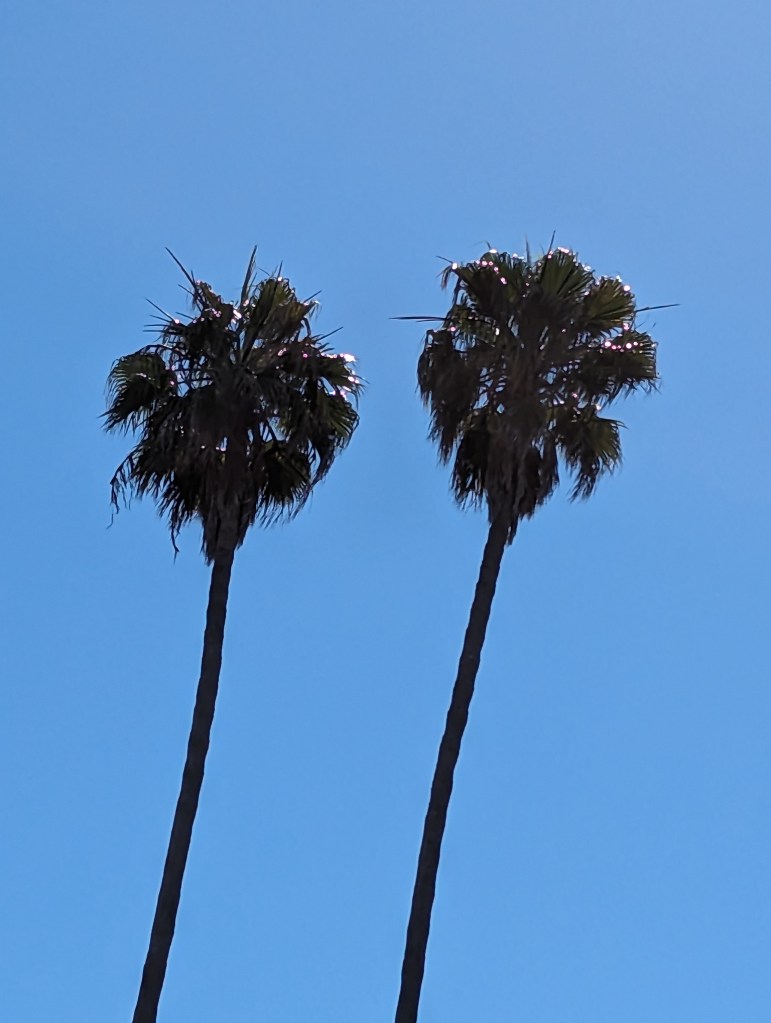
The sky is bluer with aridity.

Aridity is a measure of humidity. Humidity is a measure of aridity. Although opposite, they are similar. Humidity is the quantity of water vapor that is suspended within the air. Aridity is a deficiency of humidity. They are components of weather that are more likely felt than seen. Although, aridity clarifies the air, which typically causes the sky to seem more blue.

Of all components of weather, only atmospheric pressure is less tangible than aridity. It is measurable with instrumentation, but perceptible to very few. Except for its clarification of the sky, aridity is just as invisible. It is more perceptible, though. Just as humidity inhibits dissipation of heat, aridity promotes it. Therefore, arid heat feels cooler than humid heat.

That is why the West Coast is famous for its delightfully arid weather with sunsets. Even when the weather here is warmer than elsewhere, it may be more comfortable. Although undesirable, smog and smoke from forest fires provide color for clear sunsets. Temperate arid weather is more conducive to gardening. However, some vegetation might disagree.

Fragrant flowers can not disperse their fragrance quite as effectively during arid weather. Nor can aromatic foliage disperse its aroma quite as effectively. A few varieties of colorful foliage and flowers may fade a bit faster with minimal humidity. After all, most vegetation within home gardens is originally from more humid climates. It naturally enjoys humidity.

More importantly, most vegetation needs more water through arid weather. It loses much more moisture from its foliar surfaces at such times. Any breeze, which people might like, exacerbates loss of moisture. Obviously, warmth does also. Automatic irrigation requires appropriate adjustment as weather changes. Manual irrigation may become demanding.

Irrigation is less demanding for species that actually prefer local Mediterranean climates. Many of such species are native. Most are native to other regions with similar climates. A few are native to climates that are more arid, but tolerate a bit of extra moisture. Weather and climate do not adapt to a garden. It is best to cooperate with climate than not.

Succulents

Succulents are remarkably diverse.

Among the many garden chores that I neglected so far this summer is the ‘processing’ of many of the bits and pieces of unusual succulent plants that I acquired from earlier volunteer work days at the Arizona Garden at Stanford. Volunteers are always welcome to take any of the debris that we generate. After everyone present took what they could, I could not bear to waste what was left; so I took more than I should. Cacti, agaves and yuccas cannot be recycled as green waste, so would otherwise have been disposed of.

I really wanted large canes of a particular unusual yucca, so processed them as large cuttings first. I only needed to cut away all but the foliage on top, stick them in the ground and keep them watered until roots grow. This particular desert yucca does not grow roots as efficiently as tropical yuccas do, though.

Meanwhile, many pieces of cacti, ice plant, and succulents that I can not even tell you the names of remain out in a pile in the driveway. However, as I was looking them over today, I noticed that they are not only alive, but actually seem to doing quite well. Some are even blooming!  

This is just too weird. There is no soil. There is no watering. Even if there were, there are no roots to exploit the resources that are necessary to keep plants alive. These bits and pieces of various succulents get only sunlight and warmth during the day. Apparently, this is all they need for now.

They know that it will eventually rain. When it does, they will develop new roots into the soil wherever they are. Since I do not intend to let them do this in my driveway, I will eventually get them into the garden, and water them in to hasten the rooting process. I will groom them and strip lower foliage from agaves and aloes, so that they look better than the debris that they are. They should actually grow slightly and look pretty good by autumn.   

There are so many different kinds of ‘succulent plants’ or ‘succulents’, that the definition is not always so clear. All cacti are succulents that are equipped with spines. Many relatives of poinsettia (euphorbs) have fleshy green stems just like cacti, so are also succulents. Some of these even look like cacti, with comparable spines. Aloes and agaves are succulents as well, with large fleshy leaves, some with very sharp leaf tips and teeth on their leaf margins. The list goes on, including sedums, sempervivums, echiverias, aeoniums, crassulas, lithops, ice plants and more.

Simply speaking, succulents store water in distended ‘succulent’ leaves, stems or even roots, in order to survive long dry seasons. Most happen to be remarkably easy to propagate from cuttings. Some can even be grown from relatively large cuttings. In the desert where water is a very limited commodity, many succulents defend themselves with spines or teeth.

Yuccas, which are related to aloes and agaves, are considered (by ‘some’) to be succulents as well, even though they lack fleshy leaves or stems. Some yuccas that form trunks and branches, particularly those that are from tropical or forest environments, and especially the common Yucca elephantipes, are just as easy to propagate from cuttings as other succulents are.

Pollinators Are As Busy As Bees

Flower breeding is not for pollinators.

Flowers bloom for pollination. It is that simple. Most rely on wind to disperse their pollen. They are more abundant than colorful or fragrant. More prominently colorful and fragrant flowers rely on pollinators. Their color and fragrance attract preferred pollinators, such as insects, birds or bats. Such flowers sustain their pollinators with nectar or surplus pollen.

More than pollinators appreciate their diligence. Almost everyone who enjoys gardening enjoys floral color and fragrance. Cultivation of naturally appealing bloom began several thousand years ago. Selection and breeding most likely began relatively soon afterward. Ultimately, during relatively modern history, hybridization began getting too complicated.

Pollinators were not a priority during such processes. Because most ornamental flowers produce no usable fruit, pollinators are unimportant. Because of extensive hybridization, many ornamental flowers are sterile anyway. Floral color, fragrance and various tangible attributes are more important. Modern bloom appeals more to people than to pollinators.

A few modern flowers now confound their original pollinators. Some types of insects can die of exhaustion while trying to ascertain them. These insects may recognize floral color or fragrance but not strange floral structure. A few modern flowers are too frilly for access. Some attract pollinators without providing enough nectar or extra pollen to sustain them.

Several exotic flowers with less or no breeding distract pollinators with their abundance. Lemon bottlebrush blooms very abundantly and is still common within some landscapes. Blue gum eucalyptus is naturalized in parts of California. Both attract monarch butterflies that native species rely on. Native ceanothus must instead rely more on other pollinators.

Furthermore, a few pollinators actually disrupt native ecosystems. Honey bees, although very important to local agriculture, are not native. They arrived in San Jose in 1853, from where they dispersed throughout the West. It is now impossible to assess their influence. Even seemingly beneficial influence is unnatural and therefore ecologically detrimental.

Village Harvest redirects surplus from home gardens to those who can use it.

Surplus need not go to waste.

(This article is several years old, so some of the information within is likely outdated.)

Those who witnessed the event know that it actually happened. During citrus season a few years ago, a crew of volunteers descended upon, or should I say, ascended ladders into the legendary and monstrously large King Grapefruit Tree in a gallant but hopeless attempt to harvest the fruit. Our caravan of an assortment of smaller pickups and my full sized Ford that we drove out to confront this aberration of nature where it resided was completely full by the time we had harvested only about a third of the fruit. We left happy with our plunder, but unexpectedly defeated by the abundance left behind. I have seen many fruit trees throughout my career, but have never seen so much fruit in a single tree! 

It may have watched us leave exasperated with our mud-flaps dragging, but the King Grapefruit Tree was not solely victorious. We Village Harvest volunteers and the many beneficiaries of Village Harvest enjoyed its fruit for weeks! Village Harvest arranges for community fruit harvesting events to collect fruit that might otherwise go to waste so that it can instead be distributed to people in the community who can use it. The fruit of the King Grapefruit Tree was donated, and more was harvested later, so that it would not become an unwanted mess for the residents of the nearby home.

This is just one of many examples of how Village Harvest community fruit harvesting events benefit everyone involved. Those who donate their surplus fruit get it harvested and taken away before it becomes messy. Village Harvest volunteers get to take a bag or so of the fruit that gets harvested during the event. The clientele of the local food agencies that distribute the produce get fresh home grown fruit from the Santa Clara Valley; which is, as we all know, the best in the world.

Although citrus season is still several months away, five community fruit harvesting events are scheduled to collect summer fruit through July. On July 18 and again on August 1, two Mountain View community harvesting events will be from 9:00 a.m. to 12:30 p.m.. Two Central San Jose community harvesting events will be from 8:30 a.m. to 12:30 p.m. on both July 20 and July 27. The Sunnyvale community harvesting event will be from 8:00 a.m. to noon on July 26. Locations to meet for each event can be determined when making reservations.

Information about volunteering for any of these and other events, or how to arrange for donation of fruit, can be found at the website, www.villageharvest.org, or by telephoning 888 – 378 4841. Because admission is limited, it is advisable to make reservations for any event early, either online or by telephone. (It may be too late for the July 18 event.) Parking is also limited, so participants should carpool if possible. Pickups and station wagons to help transport fruit are very helpful. So is a grocery bag to share in the harvest afterward. Covered shoes (not sandals) are important. Layered clothing is more comfortable for cool mornings that get warmer closer to noon.  

Weed Abatement Beyond Refined Gardens

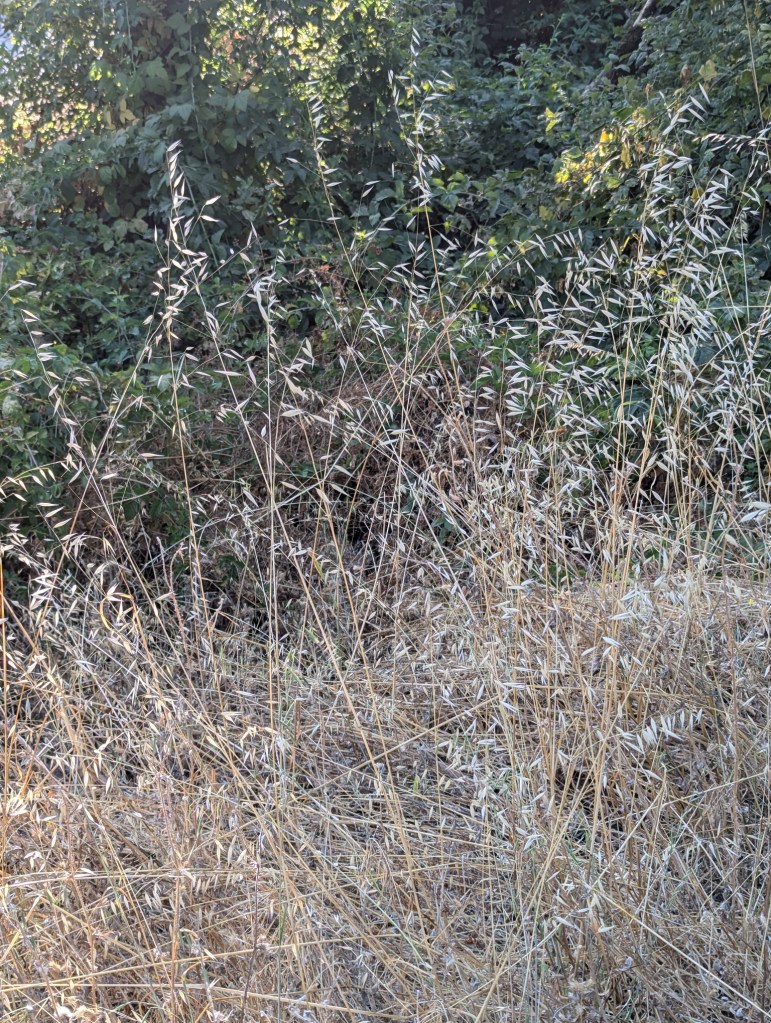
Dry weeds can be very combustible.

Gardening involves weeds. Gardening outside of refined gardens involves more weeds. A few of such weeds are native species which grow where they are undesirable. Most of the most aggressive are naturalized exotic species. Collectively, they are an unpleasant consequence of unmanageable external biodiversity. They necessitate weed abatement.

Weed abatement is a standard procedure within refined gardens. Most know it simply as weeding. Ideally, it is harmless to desirable vegetation. It may be a relatively simple task where desirable vegetation excludes weeds. Also, weeds are less abundant where they lack sources of seed to regenerate. Timely weeding should eliminate much of their seed.

Unfortunately, no garden is isolated from external influences. Weed seed sneaks in from uncultivated spaces, adjacent gardens or beyond. Suburban and rural gardens might be close to wildlands or forests. Many of such weed seed sources are beyond the control of their victims. Some are merely easy to ignore because they are out of view or not in use.

For some unused or unseen areas, weed whacking can be more practical than weeding. It entails cutting undesirable vegetation almost to grade with a motorized weed whacker. Manual weed whackers, although rare, are not extinct. Weed whackers are not selective. They can sever desirable annuals or perennials that mingle with undesirable vegetation.

The primary advantage of weed whacking is that it is fast and efficient. With good timing, it eliminates bloom or developing seed prior to dispersion of seed. Diminishment of seed inhibits subsequent proliferation, and is much safer for pets. Foxtail seed are notoriously hazardous. Besides, overgrown weed vegetation becomes a fire hazard as it desiccates.

Viable basal stems and roots that remain after weed whacking are not much of an asset. Many types of perennial and biennial weeds regenerate from such growth. However, to a very minor degree, such vegetation may contribute to healthy biodiversity. It may sustain some beneficial insects and soil microorganisms. Also, it can inhibit surface soil erosion.

Seemingly Complicated Latin Names Simplify Nomenclature.

Tecoma stans has only one Latin name, but a few common names; esperanza, yellow bells, yellow elder, yellow bignonia and trumpet bush.

If I remember correctly, it was Wednesday evenings when my three college roommates and I would gather in the parlor of our apartment on Boysen Street in San Luis Obispo to watch Star Trek: the Next Generation. One of my roommates, who has since returned to Cal Poly as a professor of rangeland resource management, traditionally made cornbread for the occasion . . .  with butter and honey . . . mmm. So, for half an hour each week, we learned more about the remotely futuristic cultures of planets many light years away than about our studies.

Thanks to a contraption referred to only on rare occasion as the ‘universal translator’, nearly everyone in this quadrant of the galaxy will be able to understand each other within the next four centuries. No matter what language is spoken, it will all be perceived as the same universal language. Unfortunately, the ‘universal translator’ has not yet been invented. The many languages used on this single planet will consequently continue to interfere with accurate communication.

This is why horticulturists, biologists, and many other professionals who may interact with colleagues who speak other languages or even slightly different regional dialects use Latin to identify, among other things, biological organisms. Latin names may be cumbersome to pronounce and daunting to spell, but are universal to those of us who use them. This is important because the ‘common names’ are so regionally variable. 

For example, some of the European maples that we know as maples here are known as sycamores in England, but are known everywhere by their Latin name of Acer. (Latin is traditionally italicized.) Similarly, North American sycamores that are known as maples, planes or plane trees in various regions are all likewise known everywhere by their Latin name of Platanus. With few exceptions, the universality of Latin names facilitates accurate identification.

Latin names are therefore very helpful when researching plants. A tree known simply as a ‘cedar’ might be a calocedrus, arborvitae, juniper, cypress, chamaecyparis or a true cedar just to name a few. Knowing that this particular tree is more specifically a ‘red cedar’ perhaps limits the possibilities to arborvitae or juniper. (Differentiation between ‘Eastern’ and ‘Western’ red cedars is often neglected in the East and West where the respective cedar is predominant.) Identifying the tree as a Juniperus virginiana will help us find the most accurate information about it, even though it is not really a cedar at all, but a juniper.   

Insect Pathogens Prefer Less Biodiversity

Wildflowers and even weeds promote biodiversity.

Weeds grow, bloom, disperse seed and die a natural death without much trouble. This is especially frustrating while insect pathogens destroy desirable vegetation. Weeds seem to be more resilient to insect infestation and damage. Many actually are. They use nature to their advantage. Cultivation of desirable vegetation interferes with natural biodiversity.

Those who enjoy gardening do not want to consider it to be unnatural. Nonetheless, it is. It involves many exotic species that are not natural components of regional ecosystems. Breeding to improve their performance unnaturally compromises their vigor. They rely on unnatural irrigation and perhaps fertilization. They sustain many exotic insect pathogens.

Most species within home gardens could not survive for long without cultivation. Several that can unfortunately become invasively naturalized. In the process, most that benefited from breeding revert to a feral status. Some eventually enjoy more biodiversity in the wild than in cultivation. They rely on naturally beneficial insects to mitigate insect pathogens.

Insect pathogens are quite often more problematic than weeds. However, generally, they are less problematic than they were years ago. This is partly a result of improvements of modern horticulture. Strangely though, it is also partly a result of sloppier gardening. Old fashioned monoculture for big areas is passe. Biodiversity became an incidental benefit.

More species of vegetation sustain more insect species. This might not have qualified as an advantage years ago. Now, garden enthusiasts are more aware that some insects are predatory of others. Predators may not eliminate all insect pathogens, but they often limit infestations. With adequate limitation, damage is likely to be tolerable or inconspicuous.

This is one of two primary reasons that insecticides are less common now. Besides their potentially hazardous toxicity, they are simply less necessary. When they are necessary, modern insecticides target more specific insects. They can kill pathogens without hurting beneficial insects. Vegetation that too frequently needs insecticides becomes unpopular.

Container Gardening

These containers are almost completely obscured by their contents.

Container gardening is one of those trends that I could do without in my own garden. Even though I know that it is actually very practical for several reasons, I prefer to grow as much as I can directly in the ground because I do not want to take care of contained plants. However, even with only minimal potted plants around my garden, the steep embankment above my driveway has reminded me of one of the many reasons why people like to grow plants in large or hanging pots, elevated planters or window boxes. There are just so many plants that look so good cascading out of containers.

The lily-of-the-Nile that I planted on top of part of the embankment to hold the soil together actually look really cool leaning over the top edge, and would look just as good in large planters. The smaller ‘Peter Pan’ lily-of-the-Nile is more proportionate to smaller urns. Since these do not hang over the edges too far, they look even better mixed with more pendulous plants like trailing rosemary, verbena, ivy geranium and dwarf periwinkle. Upright plants like fuchsia and smaller types of New Zealand flax in the middle of mixed plants add good contrasting form. Dracaenas (Cordyline spp.) were traditional vertical accent plants of Victorian gardening.

Low planters and pots, as well as many hanging pots, are very often best outfitted with traditional cascading annuals like lobelia, sweet alyssum, petunia, portulaca and my favorite, nasturtium. Even if annuals that do not cascade are the central features of mixed planters, cascading plants around the edges really maximize the show by spreading even more flower color over the exteriors of the containers. Colorful perennials like fibrous begonias, busy Lizzie, campanula, fleabane, scaevola and dusty miller may not cascade as well as the annuals, but add width, and probably cascade adequately for ‘artfully’ designed pots that are too appealing to obscure completely.

In sheltered lanais and porches, spider plant, burro tail and wandering Jew are classic solitary perennials for hanging pots. What orchid cactus lacks in form and foliage, it makes up for with bold flowers.

The largest pots and planters can benefit from simple ground covers like shore juniper and English ivy, perhaps dressed up with flowering annuals. Gazanias can provide their own flowers, so can instead be dressed up with the colorful and textural foliage of blue fescue or another grassy perennial. Asparagus densilforus has such bold texture and form alone that it does not necessarily need the color of annuals.