Electrical Cables Necessitate Arboricultural Atrocities

Trees can not mix with electricity.

Electrical cables are hazardous! There is no need to elaborate. That is why high voltage electrical cables are either subterranean or aerial. Subterranean electrical cables remain safely out of reach underground. Aerial electrical cables remain safely out of reach about thirty feet above ground. However, electricity is always dangerous regardless of location.

Excavation can inadvertently expose subterranean electrical cables. Pruning large trees can similarly involve minimal proximity to aerial electrical cables. Home gardening rarely involves such deep excavation. However, it commonly involves arboriculture, or pruning, of big trees. When it does, the most eager of garden enthusiasts must know their limits.

Clearance pruning eliminates obstructive vegetation. Ideally, it prevents it from becoming obstructive before it does so. It is useful for roadways, walkways and chimneys, and also protects roofs from damage. Yet, it sometimes necessitates the service of professionals. For example, pruning trees over major roadways is likely too hazardous for anyone else.

Pruning trees over high voltage electrical cables is even more hazardous. However, it is also necessary. That is why electrical service providers employ professionals to perform such tasks. Unfortunately, proper arboricultural technique is not a priority. Reliability and safety of electrical service are. It is efficient, but can severely damage any involved trees.

What is worse is that such damage is also dangerously close to utility cables. Corrective procedures also require the services of specialized arborists. Utility service providers do not assume any associated expenses. Removal might be more practical than salvage for the most severely mutilated trees. Salvage of decapitated palm tree trunks is impossible.

Selection of appropriate trees can limit such problems in the future. With few exceptions, palms are inappropriate within aerial utility easements. Almost all grow only upward with solitary terminal buds. Conversely, some large shrubbery is conducive to pruning to stay lower than cables. So are a few compact trees. Several stay lower than cables naturally.

Many Pruning Techniques

Proper pruning enhances performance rather than compromise it.

If gardeners can reach it, they will most likely shear it. They do not mind if it was intended to be a shade tree, a flowering shrub or even a sculptural succulent. Few will take the time to prune and groom properly. Ironically, formal hedges that actually need to be shorn are rarely shorn properly! 

Most of us fortunately are not gardeners, but merely enjoy our gardens. We know the importance of proper pruning, and that various plants need different pruning techniques. The main difficulty is determining which techniques are best for each type of plant in our gardens.

Shearing is primarily for hedges; which by the way, should be slightly narrower up high, and slightly wider down low in order to optimize sun exposure to all parts. Generally, plants that are grown for their flowers, fruit or natural form should not be shorn regularly.

Fruit trees and modern roses need the most specialized pruning while dormant in winter, so are not recommended for ‘low maintenance’ gardening. Their specialized pruning thins out superfluous growth, concentrating resources for fruit and flower production. Pruning also removes suckers (from below graft unions) and the ‘four Ds’; which are Diseased, Damaged, Dying and Dead stems. 

Most trees eventually need some sort of pruning to direct their growth. Limbs that are too low need to be pruned away to maintain adequate clearance from roadways, sidewalks, chimneys, roofs and anything else that they should keep their distance from. Lighting, road signs and views from cars coming out of driveways should not be obstructed. As larger trees mature, they eventually need the attention of professional arborists to maintain their health, stability and structural integrity.

Small trees like Japanese maple, Hollywood juniper and pineapple guava look much better with selective pruning and thinning to expose their natural forms. If they become obtrusive, such trees are very often pruned back for confinement. They should instead be pruned to direct their growth up and out of the way, so that lower obtrusive stems get removed, and upper growth can develop naturally.

Nandina, abelia, various bamboos, old fashioned lilac and other plants that produce new stems from the ground benefit from another type of thinning known as ‘alternating canes’. This involves cutting older canes to the ground as they begin to deteriorate or become overgrown. Alternating canes without any other pruning allows nandina to keep its distinctive foliar texture, and abelia to develop its distinctive arching branch structure.  

Layering Can Copy Favored Flora

Ivy can grow roots almost anywhere.

Seed is the most familiar method of propagation. However, some popular plants produce no viable seed. Some produce seed that is genetically very different from its parents. For many plant varieties, only vegetative propagation reliably produces similar copies. Such copies can grow from division, cuttings or layering. They are genetically identical clones.

Layering is uncommon for nurseries because it is generally insufficiently productive. It is unpopular for home gardening because it seems complicated. It is actually more reliable for many species than cuttings are. Also, layering is quite practical if merely a few copies are sufficient for home gardening. Realistically, it is not as complicated as it seems to be.

Layering is simply the development of roots where stems lay on the soil. All sorts of flora does it naturally without intervention. For example, ivy vines notoriously develop roots as they extend over the ground. Tips of raspberry canes develop roots where they leap over to reach the ground. These rooted tips grow replacement canes that repeat this process.

With a bit of intervention, several species that do not commonly layer can do so also. For some, it can be as simple as pressing a lower stem into moist soil. Application of rooting hormone to exposed cambium accelerates layering for most. Gouging into the underside of the buried portion of stem exposes its cambium. Tip growth must remain above grade.

For most species, the buried portions of layering stems should be a few inches in length. Extra stem length is no problem. Actually, if stems are long enough, they can be situated into their permanent locations. Stems can layer right below grade, but they prefer to be a few inches deeper. While their roots develop, they require irrigation for evenly moist soil.

The few inches of foliated tip growth above grade sustains actively layering stems. Also, remaining intact cambium provides sustenance from the original plant. Only a few stems can layer simultaneously, but that is enough for most gardens. Hydrangeas, azaleas and camellias layer quite easily. Pines, oaks and eucalyptus do not. Layers should develop quite a few roots before separation.

In The Zone

Climate is regional.

We all know how excellent the local climate is for gardening. As we travel around the area though, we also realize that there is more than one climate. Locally, there are at least three of the standardized ‘Sunset’ garden zones, with several more within only a few miles. There are countless microclimates too.

Elevation, terrain, latitude and the proximity of the ocean or large bodies of water all influence the climate. Even though the Santa Cruz Mountains are not very high, they sometimes get snow on top because higher elevations are a bit cooler. When the Summit and Santa Clara Valley floor are cold in winter, the slopes in between are not quite as cold because cold air drains away downhill. The areas closest to the San Francisco Bay stay much cooler through summer because of the insulating quality of the water. 

More localized variables like forests, lakes, direction of slopes and infrastructure affect microclimates. Older neighborhoods with mature trees are shadier and cooler than newer neighborhoods with smaller trees. The west facing slopes to the east get warmer than the east facing slopes to the west. In Downtown San Jose, tall buildings create cool and shady microclimates to the north; and some reflect enough solar radiation to significantly warm areas to the south and west.

It is important to know what climate zone any particular garden is in to be able to select appropriate plants. Besides that, it is important to know the microclimates within the garden to know where each plant will be happiest. Tropical plants that would be happy in Los Angeles might succumb to even mild local frosts. However, plants that might succumb to frost if too exposed may be safe in sheltered microclimates.

Generally, Campbell, most of San Jose, southern Sunnyvale, northeastern Cupertino, northeastern Los Gatos and Union City are all within Sunset Zone 15. Most of Saratoga, southwestern Los Gatos, southwestern Cupertino and Mission San Jose are in Zone 16. Santa Clara, Alviso, Milpitas, northern Sunnyvale and western Fremont are in Zone 17.

None of these zones are too severe. Because of the marine influence of the San Francisco Bay, Zone 17 can actually be relatively boring and not so great for plants that want winter chill or summer warmth. Zone 16 is very similar to Zone 15, but comprises hillside thermal belts where cold air drains away in winter, and also gets a bit warmer in summer. Above and below Zone 16, Zone 15 gets cool enough for plants that want winter chill, but may not get warm enough in summer for plants that crave heat. The Sunset Western Garden Book not only describes the climate zones in detail, but also specifies what zones every plant is adaptable to.

Feral Vegetation Inherits Natural Advantages

Feral alyssum is limited to white.

Most vegetation within home gardens is better than it was naturally in the wild. For many, systematic selection isolated the best from average populations. Selective breeding and hybridization improved many others. Some are too genetically compromised by breeding to produce viable seed. Feral progeny of those that are not demonstrate the divergences.

Such feral progeny are generally not true to type. They are, to varying degrees, more like their ancestors than their direct parents. Some can revert directly to a natural state in the first generation. Some do so slower through a few generations. Feral progeny of hybrids are still hybrids but may be more primitive. Many hybrids produce no viable seed though.

‘Jewel Mix’ nasturtium, for example, blooms with many shades of yellow, orange and red. Several are pastels. Some are dark enough to be almost brown. A few are bicolors. Their progeny though, blooms with less light, dark and red colors. Bloom becomes exclusively bright yellow and orange as feral plants replace originals. It reverts to more natural color.

That is because nature is efficient. By human standards, innately unnatural breeding and selection improve plant life. They produce better fruits, vegetables, flowers and anything that grows on plants. However, they interfere with natural function such as reproduction. Seedless limes, which are preferable within home gardens, would go extinct in the wild.

Plants that revert to more natural feral states are merely trying to survive. Sterile pampas grass is only sterile because it is exclusively female. Naturalized Andean pampas grass can pollinate it from a distance, though. Their hybrid but nonsterile feral progeny may be as invasive as their Andean parent. They are detrimental to their ecosystem, but survive.

Not all feral flora grows from seed. Seedless and thornless honeylocust are grafted onto wild honeylocust understock. Seedy and thorny suckers can grow from such understock below its grafts. They commonly develop after removal of original grafted trees. By some standards, they become aggressively invasive. By other standards, they are sustainable.

Herbs Are Not Confined To Herb Gardens.

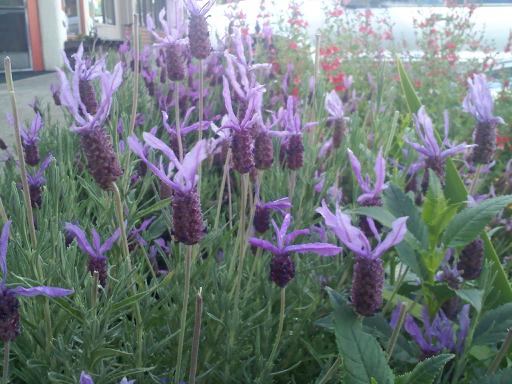
Spanish lavender is as herbal as English lavender.

While waiting for my white mocha at the White Raven coffee shop, I noticed white sage smudge sticks (incense) for sale. I also noticed that white sage is a component of at least one of the many herbal teas available. Although white is my favorite color, I am doubtful that it would be one of my favorite flavors. White sage seems to me to be much too pungent. I suppose that I should at least try it to satisfy my curiosity. Otherwise, the many other herbal teas included more docile but equally compelling herbs like sunflower petals, cactus flowers, chamomile, lavender, mint, catnip and various geraniums.

My mocha was ready too quickly, before I could investigate all of the herbal teas. Since I needed to get out of the way at the counter, I went to peruse the incense, where I again noticed some familiar herbs, like various sages, lavender, rosemary and bay laurel. A few plants that I do not commonly think of as herbs are common components of incense as well, such as juniper, cedar and pine. This was all too baffling; so I took my mocha to a table out front by a roadside garden, where I noticed some of the exact same herbs that I came outside to get away from!

All these fancy herbs and incenses and girly boutique beverages are simply not my cup of tea. Although at the White Raven, I know better than to be surprised by what might be in an excellent tea. Regardless, the garden out front is still more my style, and reminds me of how so many utilitarian herbs can also be very appealing ornamentals.

Rosemary, lavender and several of the sages are actually quite common in ordinary landscapes, whether or not anyone even notices that they have herbal merit. Some types of creeping thyme are sometimes used as ground cover in small areas, particularly around pavers or stepping stones where they release their fragrance if lightly trampled. Santolina and various yarrows and scented geraniums are less ordinary, but are similarly grown more often for their aesthetic value than as herbs. In my own garden, I really do not know what yarrow is good for. I like to add geranium leaves to sun tea, even if it makes it a girly boutique beverage.

Some herbs are almost too happy in my garden. The feverfew, chamomile and nasturtiums (my favorites!) that grew from seed from Renee’s Garden two years ago have spread outside of their area. I actually gave my mints away before they could escape. The catnip is confined to a hanging pot by the neighbor’s cat who gets sufficiently overindulgent to eradicate any self sown seedlings below. I never would have guessed that an inebriated cat could be so useful! Calendula, chive and oregano have all been grown from seed and become happily naturalized. 

Botanical Names Should Simplify Horticulture

Buick is a distinct automotive genus.

Botanical names of the vegetation that home gardening involves may seem complicated. Some are difficult to pronounce or spell. A few seem to be as lengthy as sentences. They seem to be a foreign language because most are Latin. Some are Greek. However, they are more valid than common names. What is common here might be uncommon abroad.

For example, Acer pseudoplatanus is a type of maple here in North America. However, it is a type of sycamore in England. Its common name is regionally inconsistent, so can be confusing. Its botanical name, though, is the same everywhere. Incidentally, Acer is Latin for “maple”. Pseudoplatanus is Latin for “false sycamore”. Technically, it truly is a maple.

Technically though, only a few cedars are truly cedars. Both deodar and blue Atlas cedar are species of Cedrus, which is Latin for “cedar”. However, incense cedar is a species of Calocedrus, which is a separate genus. Western and northern red cedars are species of Thuja, which is arborvitae. Again, botanical names are more valid than common names.

Nomenclature is a standardized application of names. Simple botanical nomenclature is binomial, which indicates that it involves two names. The first is the “general” or “genus” name, which is capitalized. The second is the “specific” or “species” name, which is not capitalized. Both are italicized. Species is singular and plural. Genera is plural of genus.

Botanical names are actually very similar to automotive names. Only italicization and the lack of capitalization of the species are different. Buick, Chrysler and Mercury are all like genera. Electra, Imperial and Grand Marquis are all like species. Sequoia sempervirens uses the same binomial format as Buick Electra. Botanical names really are that simple.

Many automotive species include variants, such as Limited, Custom and LSE. These are like varieties or cultivars of plant species. Such variants are evident by single quotes, but lack italicization. For example, ‘Soquel’ is the cultivar of Sequoia sempervirens ‘Soquel’. (‘Cultivars’ are ‘cult’ivated ‘var’ieties that are true to type only by vegetative propagation. Varieties can be naturally true to type by seed.)

Volunteering at the San Jose Heritage Rose Garden

The San Jose Heritage Rose Garden is the most complete collection of ancestral roses in the World!

(This article is recycled from several years ago, so information about events is now outdated.)

            No matter how careful I am to avoid spending any money at Spring in Guadalupe Gardens, I have never escaped without purchasing something, or a few or even several somethings that I did not need but really wanted for my garden. My plunder was relatively meager this year, but did include three climbing roses from Liggett’s Rose Nursery.

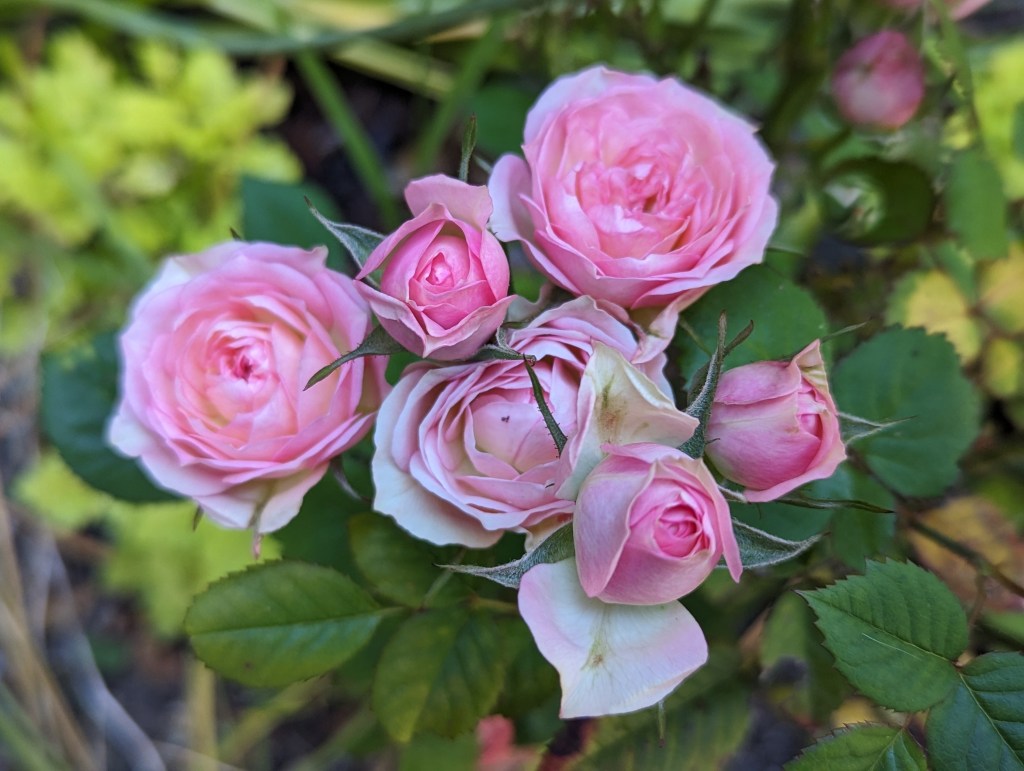
            One is a ‘Renae’ rose that blooms all summer with remarkably fragrant pale pink blooms. Its fragrance is so obnoxiously strong though; that I gave the plant to my neighbor, and told him that it ‘smells good’. It really does smell good, albeit from a distance, such as in my garden.

            The other two roses are ‘Lamarque’, with abundant fluffy white blossoms all summer. The robust fragrance is fortunately more tolerable. I really like the monstrous canes that are already reaching out to cover a bare embankment.

            The two ‘Lamarque’ roses are manageable so far. I really do not know how manageable they will be next year though. It would be nice if they could go wild, and only get pruned as they encroach into trees and the driveway. However, roses perform best if properly maintained. I will want to be able to prune off deteriorating flowers to promote subsequent bloom. This process of ‘dead heading’ will not be so easy if I can not reach all the canes.

            The Heritage Rose Garden has a similar challenge. Although most of the plants are within reach of anyone wanting to prune them, there are simply too many plants for a herd of goats to remove all the spent blooms from. Since goats are not such a feasible option in a rose garden, volunteers are invited to attend a Rose Deadheading Blitz from 5:00 to 7:30 p.m. every second Tuesday of each month, beginning June 8 and continuing until September 7.  

            No experience is needed, either for deadheading the roses or for swilling the ice cream served afterward. Volunteers should bring shears and gloves, and wear closed-toe shoes. Shears are available from the staff if necessary. 

            The Heritage Rose Garden is located on Taylor Street at Spring Street, just east of Coleman Avenue in San Jose. Volunteers can get more information or sign up by contacting Volunteer Coordinator, Lucy Perez by telephone at 298 7657 or by email at lperez@grpg.org

            My bounty from Spring in Guadalupe Gardens of past years includes many succulents, particularly a few specie of Crassula that were frozen by frost early last winter. Their recovery has been delayed by the lingering cool and rainy weather through spring. Now that I am removing the last of the sludge that remains from the previously frozen leaves and stems, I am finding where snails have been hiding and breeding. Even though the sludge is harmless, the snails within are not. I probably should have cleaned it out earlier.

            Foliage of fruit trees, roses or other plants that has been infected with peach leaf curl, powdery mildew or any other disease should likewise be removed and disposed of. Either next spring or later this year, secondary infection is much more likely without sanitation.

Clearance Pruning Directs Obtrusive Vegetation

Traffic signs must always remain visible.

Pruning techniques are very diverse to serve various purposes. Dormant pruning during winter concentrates resources for spring or summer growth. Hedging or shearing merely contains growth. Thinning or grooming removes superfluous growth to enhance sunlight diffusion. Clearance pruning directs new growth that might otherwise become obtrusive.

There are too many distinct pruning techniques to mention. Some, such as shearing and thinning, are mutually exclusive. Shearing actually initiates the sort of congested growth that thinning eliminates. Techniques such as dormant pruning and clearance pruning are mutually compatible. After all, almost all pruning is less stressful with winter dormancy.

Clearance pruning merely becomes a concern now as spring growth becomes obtrusive. Much of the worst require professional assistance. Only arboricultural professionals can safely prune trees away from high voltage cables. Such cables are extremely hazardous! Utility services generally try to arrange such procedures before major problems develop.

However, arboricultural professionals are necessary for other clearance pruning as well. Many trees are simply too large or hazardous for anyone but professionals. Some extend over roadways that need clearance for the largest of trucks. Some extend over chimneys that could ignite vegetation that gets too close. Many simply extend beyond a safe reach.

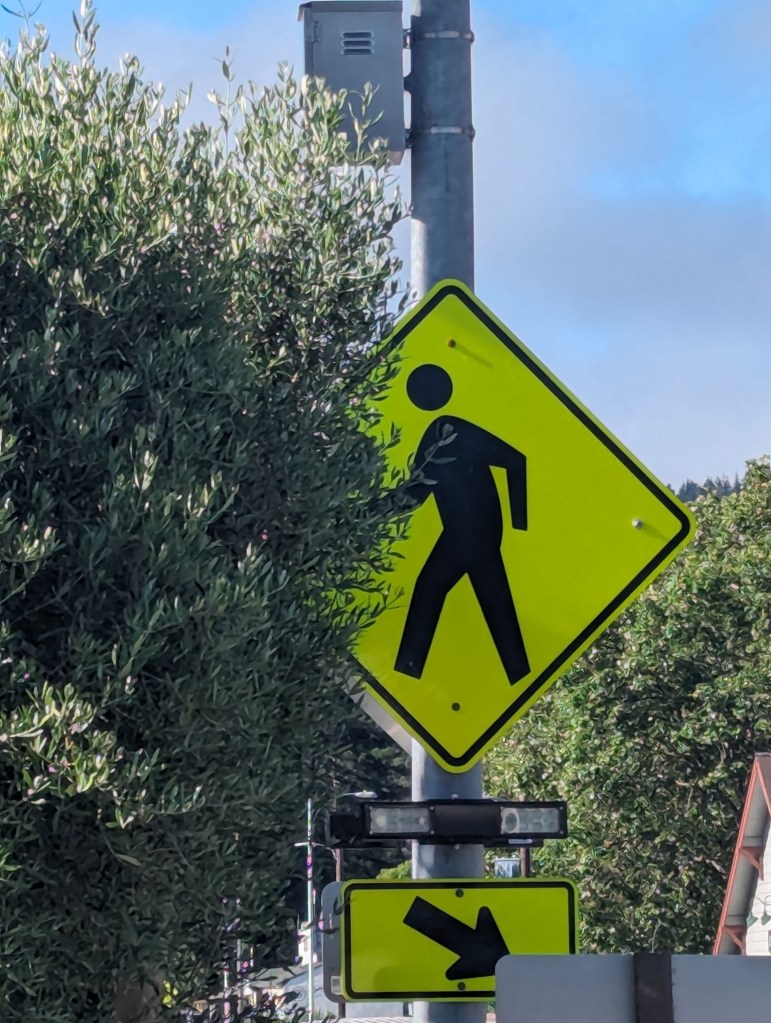
Street trees seem to require the most clearance pruning. They must be a specified height over any roadway, as well as over any sidewalk. Also, they must not obstruct street signs or views for cars backing out of driveways. Ideally, their interference with light from street lamps should be minimal. Vegetation that is closer to buildings presents other concerns.

Besides chimneys and exhaust vents, roofs also need clearance. Stems and foliage are abrasive as they move in any wind. They collect debris that causes rot and clogs gutters. Furthermore, walkways and navigable areas are more efficient with adequate clearance. Clearance pruning should direct growth away from any obstruction, rather than contain it.

Every Species Of Vine Is Distinct

Bougainvillea does not cling to its support. It merely leans on it, or must be tied.

Harvesting grapes from a pear tree last summer reminded me why it is so important to control the grape vines this year. Without proper confinement to the fence below, the grape vines had climbed into and overwhelmed the pear tree above. My neighbor who witnessed the consequences of my lack of diligence in the garden, and helped me with the harvest, mentioned that the ‘grape tree’ was more productive than the vines had been when properly maintained during the previous year. I was embarrassed about my transgression nonetheless.

My colleague in Southern California has no problem grooming the many different kinds of vines that adorn arbors, trellises, walls, fences and railings in his garden. I certainly could not let him find out that I was vanquished by my single grapevine, which he refers to as ‘Dago wisteria’. I probably remind him of how important it is to control his vines more often than I am offended by racial slurs.

The trick is to select vines that are appropriate to each particular application. Vines for small, light trellises must be relatively complaisant, like lilac vine, pink jasmine, Carolina jessamine or clematis. Aggressive vines like wisteria, grape (the ‘other’ wisteria) and the larger trumpet vines need hefty trellises or arbors. Brambles and scrambling plants like bougainvillea and climbing roses do not actively climb, so need to be tied or ‘tucked’ into their supports.

Some of the seemingly innocent vines can actually become somewhat aggressive. Mandevillea, potato vine and star jasmine have wiry stems that seem harmless enough, but can eventually tear apart lattice or light trellises. Perennial morning glory and passion vine are potentially invasive. Trailing nasturtiums and annual morning glory really are as innocent as they look, so are nice small annual vines where space is limited. I prefer pole beans though.

Vines like Boston ivy, Virginia creeper and creeping fig that attach to their supports with roots or discs (modified tendrils) are too destructive for most applications in home gardens. They are fine on unpainted reinforced concrete buildings and concrete walls, such as the retaining walls and sound walls of freeways, but will ruin paint, siding, stucco and shingles. Unlike the other vines, these lack colorful bloom. Boston ivy and Virginia creeper produce remarkable fall color though, but then defoliate revealing bare stems through winter.

Algerian and the various English ivies are good ground cover plants that will become climbing foliar (without showy blooms) vines if they reach support. Unfortunately, they root into their support like creeping fig does, so have limited practicality. Honeysuckle is an aggressive vine that can also double as a ground cover.