Sustainable Vegetable Gardening

It will be time to add warm season vegetables to the garden soon.

This article is recycled from several years ago, so the information about the class is no longer relevant.

            Just as we are getting accustomed to winter, it is already time to begin to get ready for spring. The first of the six sessions of the Sustainable Vegetable Gardening class with Master Gardener Ann Northrup at Guadalupe River Park and Gardens will be from 7:00 to 9:00 p.m. on February 10. Subsequent sessions continue weekly at the same time until the sixth session on March 17, in time for warm season vegetables to replace cool season vegetables.  

            Topics include: soil preparation, amendments and fertilizers; irrigation methods and systems; working with both seeds and seedlings; cultural requirements of specific warm and cool season crops and varieties that do well locally; and how to identify and manage common pests, weeds and diseases of vegetable crops in the Santa Clara Valley. Sustainable Vegetable Gardening emphasizes sustainable gardening techniques, such as mulching, efficient watering techniques, composting, integrated pest management and organic fertilizers and soil amendments. Participants will learn how to manage a successful and environmentally responsible food garden that will produce vegetables and herbs throughout the year.  

            Sustainable Vegetable Gardening will be at the Guadalupe River Park and Gardens Visitor and Education Center at 438 Coleman Avenue in San Jose. Admission is $72. Pre-registration is required and can be arranged by telephoning 298 7657. More information about this and other classes can be found at www.grpg.org.  

            Another reminder of the distant but eventual spring is that seed catalogues start to arrive. Some arrive by email as links to online catalogues. It seems that the best still arrive by mail though. I have yet to receive two of my favorite catalogues from Baker Creek Heirloom Seed and Park Seed. Baker Creek not only has some of the oldest heirloom seeds, including Early American seeds, but also some of the weirdest vegetable, herb and flower seeds from all over the world. Park Seed supplies the more contemporary traditional seeds that I grew up with, as well as all sorts of bulbs and plants.

            It may be too late by the time their catalogues arrive, because the Renee’s Garden Seed Catalogue is already here! The online catalogue can be found at www.reneesgarden.com. Even though I typically do not like mixed seeds, I do like Renee’s Garden color coded mixes with the different types within the mixes dyed different colors. I simply separate the different seeds as I plant them. It is like getting two or three packets of seed in one.

            I think I like Renee’s flowers as much as the vegetables. There is an entire page of sweet peas to choose from! I also like the selection of sunflowers, nasturtiums and morning glories. This last year, the delicate blue stars in the centers of the big white flowers of ‘Glacier Star’ morning glory were my favorite.

Citrus Fruit Ripens Through Winter

Unharvested lemons stay fresh for months.

Winter is bare root season, which is the best time for installation of deciduous fruit trees. It is also the best time for dormant pruning of deciduous fruit trees. Evergreen fruit trees do not get much attention. Installation and any pruning of evergreen fruit trees happens after winter. However, regardless of perceived neglect, winter is actually citrus season.

Technically, citrus are always in season here. That is because most citrus fruits last so long on their trees after ripening. Also, some types produce a few fruits sporadically after their primary season. The latest ‘Lisbon’ lemons can still be good as the earliest of the following season ripen. ‘Eureka’ lemons ripen in minor phases after their primary phase.

Therefore, winter is citrus season merely because it is when most citrus fruit ripens. The schedule is ideal. It begins as pear and apple season finishes. It finishes as cherry and apricot season begins. Pears and apples, and especially cherries and apricots, are less predictable than citrus. Fortunately, citrus can begin a bit early or finish late if necessary.

All citrus are species or hybrids of the same genus of Citrus. Kumquats also classify as Fortunella though. The primary components of the flavors of their fruits are sweet, sour and bitter. The most familiar oranges are sweet oranges, but sour and bitter oranges also exist. Most lemons and limes are sour, but there are also sweet lemons and sweet limes.

Oranges, which are generally sweet oranges, are the most popular citrus. Navel oranges are traditional eating oranges. ‘Valencia’ is a traditional juicing orange. Blood oranges are a bit more tart, with blushed or red flesh and juice. ‘Seville’ sour orange is useful for marmalade. Rare bitter oranges provide flavoring for teas, and fragrance for perfumery.

Lemons are the second most popular citrus. Mandarin oranges, or mandarines, should probably be more popular. They are the more perishable of citrus though, because their rinds are relatively loose. Tangerines are merely mandarines of the Americas. ‘Rangpur’ lime is a sour mandarine. Real limes are very diverse, but mostly ripen greenish yellow. Grapefruits combine sweet, sour and bitter.

A Good Arborist Can Be Difficult To Find.

Some of the most avid garden enthusiasts need help with big trees.

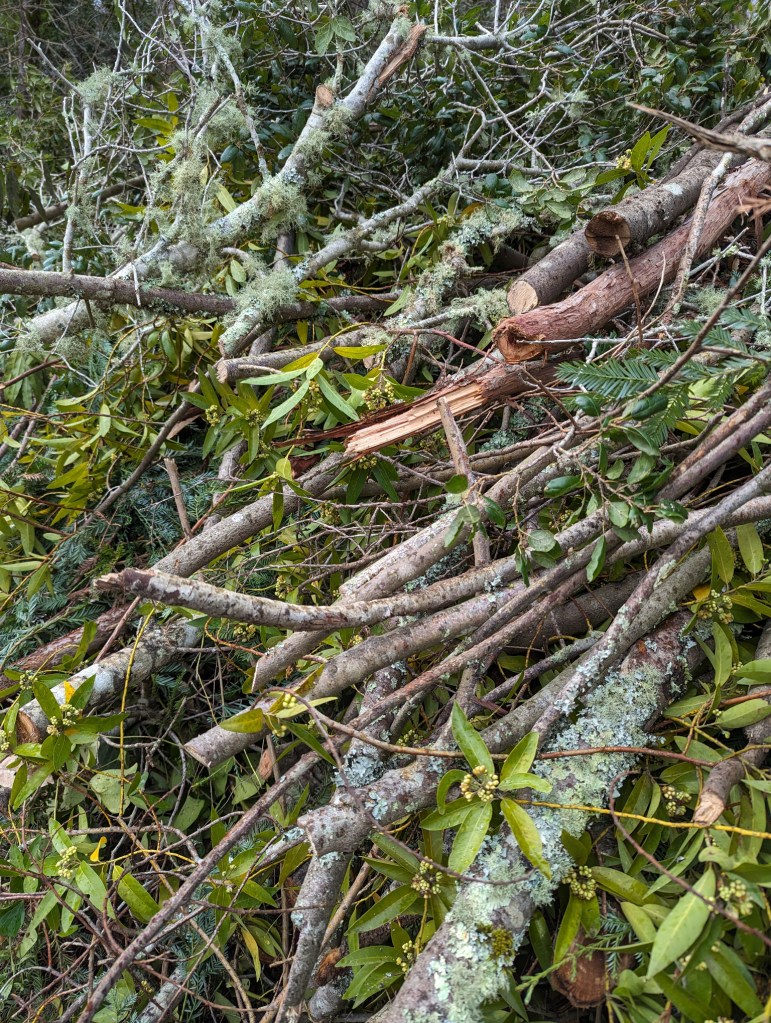
            It was probably best that I was not here when it happened. Although, coming home to it was horrible nonetheless. This is the second major tragedy in my garden in only a few months. Last autumn, just before it could defoliate to be less susceptible to the wind, the most magnificent black oak in my garden was blown down. Now I find that the weather has again flaunted its ominous power by claiming the innocent life of the most glorious Douglas fir, and desecrating the shattered remains in the cold mud.

            How can this be?! I am an arborist! I am supposed to protect trees from such demise! Sadly, the truth is that the fir has been deteriorating for a long time before we became acquainted. There was nothing that I could have done for it. If the tree had been located where it could have been hazardous to anyone in the area, it would have needed to be removed.

            Hazardous trees innately become much more hazardous in stormy weather. Rain loosens their anchorage by softening the soil. Wind can either destabilize trees, or break their limbs away. Ideally, it is best to give trees the attention they need before the weather gets unpleasant. Realistically though, we do not often think about it while the weather is not so threatening.

            Now that the weather is reminding us of how important it is to take care of our trees, we should be certain to do so properly. Large trees may require procedures that we are unable to perform. When it becomes necessary to procure the services of tree maintenance professionals, it is imperative to find qualified arborists. (Arborists are horticulturists of trees.)

            Unfortunately, the arboricultural (tree maintenance) industries are infested with unqualified ‘hackers’ who can inflict serious damage. Real arborists are about as specialized as physicians are. Getting anyone else to assess trees is about a sensible as getting a cardiologist to do brain surgery. 

            Arborists inspect trees to identify hazards such as instability and structural deficiency, and then prescribe corrective procedures. Not everyone involved with the crew that performs any necessary procedures is a ‘certified’ arborist. The crew should though be directed by what an arborist prescribes. Sometimes, trees are found to be too hazardous to be salvaged, and will need to be removed.

            The website of the International Society of Arboriculture (ISA) at www.isaarbor.com is an excellent resource for finding local certified arborists. This site also features articles that explain in more detail than I did why it is so important to ‘hire an arborist’, as well as many other relevant topics. Perhaps just as importantly, it demonstrates how serious arborists are about arboriculture.

Pollard And Coppice During Winter

Proper pollarding and coppicing are rare.

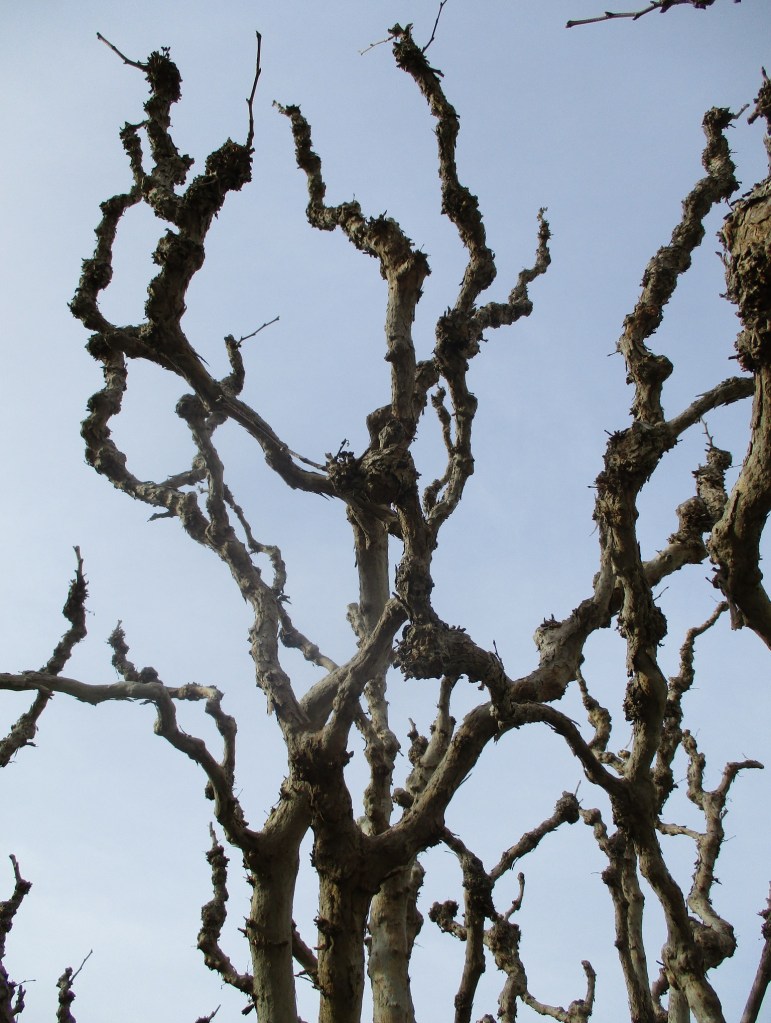
This is extreme dormant pruning. Pollard and coppice pruning involve complete removal of all new growth. They typically involve growth from a previous season annually. A two year cycle involves growth from two previous seasons, and so on. This repetitive pruning to the same origins stimulates distended callus growth there. It is as brutal as it sounds.

This is why pollard and coppice pruning are vilified in America. The techniques evolved through centuries of horticulture and several cultures. Both are still practical for various reasons everywhere else. However, American arboriculture classifies them as topping or disfigurement. Consequently, very few arborists here know how or want to do it properly.

Like other dormant pruning, pollard and coppice pruning must happen during winter. It is too severe for active vegetation. Also, pollard pruning exposes bark of trunks and limbs. Such bark would scald during sunnier summer weather. Growth from distended callus growth, or knuckles, shades lower stems by summer. It is very vigorous through spring.

That is what pollard and coppice pruning is still useful for within other cultures. Vigorous foliage is useful for fodder for livestock, including silkworms. Vigorous stems are useful for kindling and basketry. Some species bloom more vigorously on vigorous new growth. Others can not bloom to produce unwanted pollen or messy fruit within the same year.

Colorful or variegated foliage is more colorful in response to pollard or coppice pruning. Some eucalypti generate juvenile foliage for floral design. Such foliage is more aromatic than adult foliage. Improved foliar vigor enhances resistance to some diseases, such as mildew and rust. Coppicing can renovate some types of overgrown or shabby shrubbery.

The difference between pollard and coppice pruning is that pollard pruning retains limbs. Coppice pruning retains only a stump near grade. It is less reliant on repetition, and may never need it again. Pollard pruning compromises structural integrity, which necessitates repetition. Otherwise, pruning to restore structure will eventually become necessary. Not many species are receptive to such extreme pruning techniques.

Learn How To Prune Dormant Deciduous Fruit Trees Properly

(This article is recycled from 2010, so includes outdated information. It is deferred from yesterday because Wi-Fi was not operational.)

Deciduous fruit trees require very specialized pruning.

            So many of the kids I grew up with now have an apricot tree in their own back yard, even though not many of us actually like the fruit. We all remember the remnant orchards, mostly apricots, which were scattered about the Santa Clara Valley when we were young. We also remember how we consumed vast volumes of apricots in every form imaginable; including fresh, dried, canned and stewed, and in jams, jellies, compotes, syrups and pies. I could go on, but it would ruin my appetite.

            Deciduous fruit and nut trees are certainly not ‘low maintenance’. Most need to be pruned annually, while dormant in winter. If not pruned correctly, they become overburdened with their own fruit. Also, the process of selecting from the many different cultivars of the many different types of fruit is quite a chore. There are many more cultivars to choose from for home gardens than for orchards, particularly with the many modern cultivars introduced during the past few decades.

            Because those who maintained the orchards are now as nearly extinct from the Valley as the orchards are, we need to know how to care for our own trees. This is why Friends of Guadalupe River Park and Gardens has scheduled the Dormant Fruit Tree Pruning Class with Sean McGrail in only a few days, on January 23, from 9:30 to 11:30 a.m.. Tools, techniques and basic pruning concepts will be explained and demonstrated among the many fruit trees, including apricots, cherries, prunes, apples and others, of the Historic Orchard of Guadalupe Gardens. Participants will then get to participate in pruning some of these trees. The Historic Orchard is located just south of Taylor Street in San Jose, adjacent to the Guadalupe River Park Trails. Admission is $15. 

            A week later, on January 30 from 9:00 a.m. to noon, the Best of the Best class, also with Sean McGrail, as well as Nancy Garrison and the California Rare Fruit Growers, will discuss many of the best fruit cultivars for the Santa Clara Valley. Afterward, planting, site selection, drainage and pruning of new trees will be demonstrated in the Historic Orchard. Admission is $30. Required registration can be arranged by telephoning 298 7657. Information about both classes can be found online at www.grpg.org.     

Dormant Pruning Exploits Winter Dormancy

Fruit trees become congested without pruning.

Bare root season begins as the year ends for a simple reason. That is when deciduous plants are dormant. They are unaware of the otherwise distressful process of relocation. This is also why winter is the season for dormant pruning. Such pruning would be very distressful at any other time of year. While dormant, deciduous plants are unaware of it.

Dormant pruning of fruit trees is also important for a simple reason. Extensive breeding has increased reliance on horticultural intervention. In other words, deciduous fruit trees now generate more fruit than they can support. Their fruit is both unnaturally abundant and unnaturally large. It is both too heavy and too consumptive for its unpruned stems.

Dormant pruning enhances the quality of fruit by concentrating resources. Although less copious, fruit is bigger and better. Also, dormant pruning enhances structural integrity of supportive stems. Although more vigorous, vegetative growth is more compact. Stouter stems endure less leverage from fruit weight. As a bonus, more fruit is easier to reach.

Almost all deciduous fruit trees require very specialized dormant pruning. This includes some nut trees, as well as grapevines, kiwi vines, cane berries and roses. However, it does not include evergreen fruit trees, like citrus and avocados. They do not need such aggressive pruning. Besides, pruning stimulates new growth that is vulnerable to frost.

Unfortunately, dormant pruning is too specialized to describe in a few paragraphs. For most deciduous fruit trees, it is quite aggressive. Peach and nectarine trees may benefit from removal of half of their stem growth! Apricot and plum trees need a bit less pruning. Cherry and almond trees may need only minor pruning. Yet, all six are stone fruit trees.

Apple, pear and quince are all pomme fruits. Their trees require similar dormant pruning. Their many varieties require various degrees of such pruning though. Fig, mulberry and persimmon trees all require particular types of dormant pruning as well. Deciduous fruit trees are certainly not low maintenance. This should be considered before planting any.

Bare Root Stock

Bare root stock is none too pretty in the beginning.

Now that Christmas trees have been moved out of the nurseries, it is time for bare root plants to move in! As the term implies, bare root plants have ‘bare roots’, lacking typical media (such as potting soil) which is typically contained in cans or pots. All sorts of deciduous fruit trees, roses, grapes and berries can be purchased bare root, either bagged with moist wood shavings, or out of the ‘sand boxes’ that they are heeled into in the nurseries. Even more are available from mail order catalogues. (Just check climate zone ratings for mail order stock.)

I purchased all of my deciduous fruit trees bare root mainly to save money. Bare root stock typically costs about half of what canned stock (grown in a nursery can or pot) does. Also, because bare root stock does not take up as much space as canned stock does, more varieties can be brought in and made available during bare root season.

Bare root stock gets established into the garden more efficiently than canned stock does. It gets dug, transported and planted while dormant; and can disperse roots into relatively uniform soil immediately after dormancy. However, stock that gets canned wakes up in spring in uncomfortably warm and confining nursery cans. After adapting to nursery conditions, it must then adapt to new garden environments, and disperse roots into soil that is very different from what it already rooted into.

Bare root stock should be planted as soon as possible after it leaves the nursery so that roots do not get too dry. If they can not get planted immediately, plants that were pulled from sand boxes in nurseries should get their roots heeled into (covered with) damp soil. Bagged stock in original packaging is safe for a few days in the shade.

Roots should be soaked a few hours before planting. I prefer to instead keep roots well watered for a day after planting. Broken or damaged roots should be pruned away before planting. Damaged and superfluous stems should be pruned away after planting.

Planting holes for bare root stock can be wide enough to loosen surrounding soil, but should be no deeper than necessary. Plants are likely to settle too deeply if the soil below is too loose. All roots should be buried while graft unions (the odd ‘kinks’ low on the trunks of grafted trees) remain exposed. Soil can be mounded firmly into a ‘volcano’ in the middle of each hole to spread roots over. Backfill soil can be amended lightly; not so much that it is too different from surrounding soil.

A basin should be formed around each new bare root plant so that roots can be soaked and settled in by filling the basins with water twice. Bare root plants are initially dormant and lack foliage, so do not need water again until they develop foliage, and the soil gets dry in spring. Besides, rain and cool weather will keep the soil wet through winter.

Living Christmas Trees Eventually Mature

Living Christmas trees are real trees.

Christmas trees are extreme cut foliage. They stand alone, rather than as accessories to cut flowers. Most are a few feet tall, and some are much grander. Ultimately though, they are as disposable as cut flowers. Because they are so expensive, their disposal seems to be wasteful. Realistically though, they are more practical than living Christmas trees.

Now that living Christmas trees remain after Christmas, they require attention. They are otherwise as disposable as cut trees are. Large specimens are too expensive to discard. They might also be difficult to maintain. Because almost all were field grown, they are in very dense and heavy soil. Such soil can retain either insufficient or excessive moisture.

Many initially healthy living Christmas trees can deteriorate through summer. Some get too shabby to function as a Christmas tree before their second Christmas. They adapt to local climates slowly after leaving the climates in which they grew. Some do not survive. They are happier in the ground than in a tub, but as such, can not come in for Christmas.

Living Christmas trees are less expensive than cut trees only after a few years of service. Several of the more compact types can actually survive containment for several years. A few can survive in tubs indefinitely with occasional pruning. Otherwise, most eventually need to graduate from containment to a garden. This is not as simple as it seems to be.

Visual appeal and price limit selection of living Christmas trees. Physical characteristics of such trees should be more of a consideration. Some are more tolerant of confinement within large pots than others are. Some will eventually be quite adaptable to landscapes. The unfortunate reality is that many become very large trees that need substantial space.

Small pre-decorated trees in mylar wrap are the most common of living Christmas trees. Unfortunately, most are either Italian stone pine or Canary Island pine. Both grow too big for compact gardens. Planting living Christmas trees in the wild is not a practical option. Without irrigation, formerly confined trees can not survive long enough to disperse roots. If they could, they can damage local ecology.

Modern Roses Require Dormant Pruning

Aggressive dormant pruning promotes spring and summer bloom.

(This recycled article posted in 2012, so some information within is now outdated.)

Just about anyone can plant roses in the garden, and care for them for at least the first year. Pruning them properly while they are dormant in winter in order to get them to perform satisfactorily every subsequent year is what most of us who grow roses have difficulty with. Like deciduous fruit trees, roses should not be planted and expected to perform with minimal attention. They certainly should not be pruned with hedge shears!

The once modern, but increasingly old-fashioned, hybrid T roses have traditionally been the most common victims of inadequate pruning, since they need such aggressive pruning every winter to prevent overgrowth that interferes with healthy cane growth and bloom. More modern cultivars (cultivated varieties) designed to resemble older roses, as well as reintroduced old fashioned roses are generally not so demanding, but likewise perform best with proper dormant pruning. There are slightly, and not so slightly, different ways to prune the different types of roses. Even the ‘low maintenance’ carpet roses should be pruned to some degree.

Fortunately for those of us who are just learning about roses, the first of several free rose pruning lessons in the San Jose Heritage Rose Garden began this morning, January 4. These hands-on lessons continue at 9:00 a.m. every Wednesday and Saturday until late February. Participants meet in the center of the Garden. The minimum age to attend is sixteen; but minors without parental supervision require a signed minor release form that can be obtained from the Guadalupe River Park Conservancy.

Participants should bring bypass shears, leather gloves, closed-toe shoes and preferably a water bottle. Those who lack shears or gloves can borrow what they need at the Garden. The Heritage Rose Garden is located on West Taylor Street near Walnut Street in San Jose. Parking can be found on Seymour, Taylor or Walnut Streets. More information can be obtained by email to Emily of the Guadalupe River Park Conservancy at emily@grpg.org  or by telephoning 298 7657.

The Heritage Rose Garden is the most complete collection of old world roses, the ancestors of modern roses, in the world! Although it lacks modern cultivars, it exhibits a remarkably extensive variety of roses, with all sorts of growth habits. There really is no other garden where one can prune roses with the same basic techniques in so many different ways.

Incidentally, modern hybrid T roses derive their designation from the ‘T budding’ technique employed to attach the scion (upper blooming portion) to the understock (roots), not because the rose hips (fruiting structures) are used to make tea. However, all sorts of roses, including floribundas, polyanthas, grandifloras and all sorts of climbing roses, are budded by the same means; and many hybrid T roses are actually grown on their own roots and not budded onto understock at all. The designation of hybrid T seems somewhat out dated, but is still effective.

Bareroot Season Begins With January

Bare roots are dormant for winter.

Christmas trees and associated items are no imposition for nurseries. They are seasonal while not much else is appealing to a retail market. They occupy retail area that summer and autumn commodities relinquished earlier. Then, they relinquish their same space as bareroot stock becomes seasonable. The chronology is very coincidentally very efficient.

Bareroot season is not actually contingent on the end of Christmas tree season. It begins with winter dormancy of bareroot stock. This dormancy merely and fortuitously coincides with Christmas. It is as effective as anesthesia for surgery. Basically, dormant stock goes to sleep on a farm, and awakens in a new home garden. Timing of the process is critical.

Bareroot stock initially grows in the ground rather than within nursery cans. Separation of its roots from the soil they grew is harmless during dormancy. Both roots and stems need simultaneous pruning. Then, stock is ready for transport without soil. Some gets packing of moist sawdust in plastic bags. Most awaits resale from bins of moist sand at nurseries.

Bareroot stock has several advantages to more familiar canned nursery stock. It is much less expensive. It is also much less cumbersome. So, not only are more items affordable, but also, more fit into a car at the nursery. Their relatively small roots systems are easy to install. More importantly, without binding, their new roots disperse much more efficiently.

Deciduous fruit trees are the most popular bareroot stock. This includes stone fruits such as apricot, cherry, plum, prune, peach and nectarine. Also, it includes pomme fruits such as apple, pear and quince. Roses and cane berries are likely the second most popular of bareroot stock. Persimmon, pomegranate, fig, mulberry, and nut trees are also available.

Some of the more unusual bareroot stock is available only from online catalogues. More variety seems to become available locally though. Elderberry has only been available in California for the past several years. Currant and gooseberry are variably available here. Artichoke, asparagus, rhubarb and strawberry are perennials that are available bareroot. Cultivars of blueberry and grapevines are available.