Spring Bulbs Begin In Autumn

Daffodil bloom is not in season, but their dormant bulbs will be soon.

Even before winter begins, it is time to plan for it to end. Bulbs (including corms, tubers, rhizomes and tuberous roots) of many of the earliest spring flowers that bloom while the weather is still cool late in winter should begin to get planted about now. They are still dormant and not all that impressive yet, but have already stored everything they need to be ready to bloom as soon as they think it is time. Since the weather will be getting cooler through autumn before it gets warmer at the end of winter, even the earliest blooming of spring bulbs will stay dormant for a while, and have quite a bit of time to slowly disperse roots before their foliage eventually peeks through the soil.

Bulbs planted later will likely bloom later, which is actually an advantage for ‘phasing’ bulbs. Like vegetables, bulbs can be planted in phases every two or three weeks, depending on the duration of the bloom cycle of the particular bulbs involved. As one group finishes blooming, the next group starts blooming. Bulbs become available when it is time for them to be planted, and generally remain available long enough for a few phases to get added later when convenient, although there is always the threat of particular varieties getting sold out later in the season.

Phasing is only effective in the first season, since bulbs get established after their first bloom cycle, and will subsequently be on the same schedule as all their friends of the same variety. Bearded iris, calla, anemone and rananculus are not conducive to phasing, but instead bloom at a particular time, regardless of when they were planted.

Narcissus, daffodil, grape hyacinth, bearded iris and classic white callas are the most reliable of spring bulbs, and the most likely to naturalize, although bearded iris and callas will probably bloom quite late in their first year. Crocus, freesia and harlequin flower are almost as easy to grow. Anemone, rananculus, hyacinth, lily, tulip and the small colorful callas are tempting, but are not as reliable after their first year because the seasons are so mild here.

Juniper Cultivars Deserve More Consideration

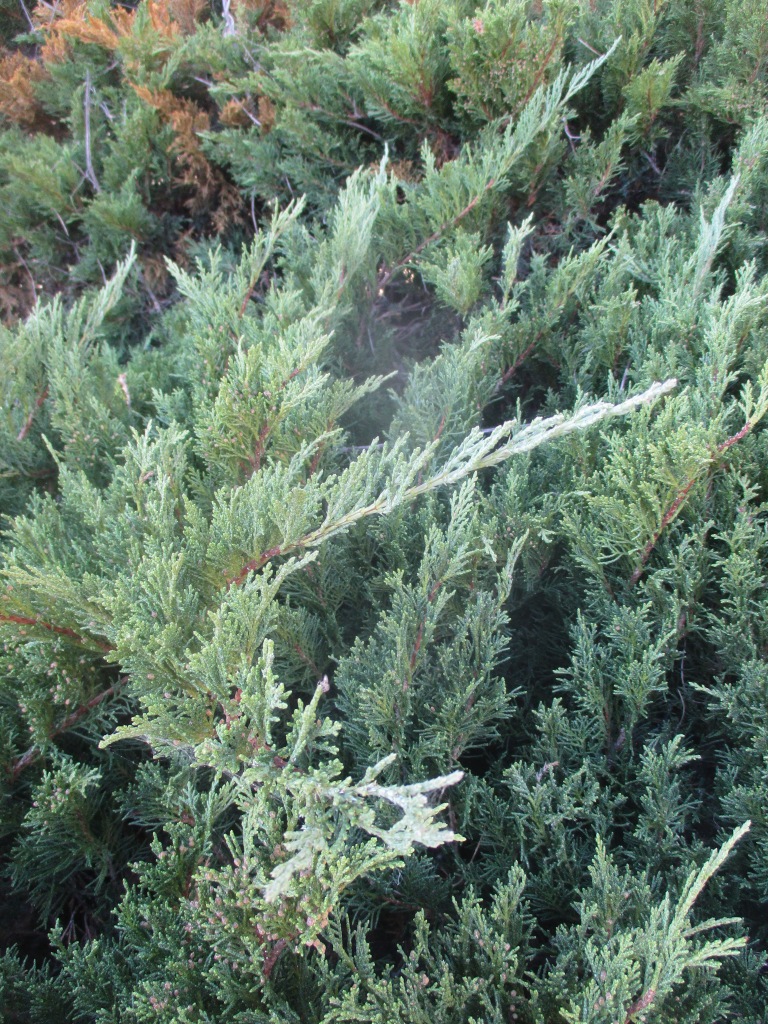
Evergreen juniper foliage has distinctive texture.

Fads come and go. Many can be good, even if only briefly. A few might be bad enough to later stigmatize the object of the fad. For example, the formerly esteemed crape myrtle is now familiar as a mundanely common tree. Flashy bloom and complaisance contributed to its excessive popularity. Most sorts of juniper are similarly victims of their previous fad.

A few cultivars of juniper suddenly became overly popular during suburbanization of the 1950s. They were remarkably reliable and resilient. Most were shrubbery or low hedges. A few were groundcover. Hollywood juniper grew as a compact sculptural tree. However, most junipers grew too big. They became difficult to maintain, or impossible to renovate.

As many outgrew suburban gardens, few junipers outgrew their reputation. Even modern cultivars that were unavailable during the fad of the 1950s are perhaps less popular than they should be. Realistically, many old and new cultivars of juniper are quite practical for refined home gardens. They merely need to be appropriate to their particular application.

Many cultivars of several species of Juniperus are commonly available. Straight species are very rare from nurseries, although a few are native nearby. All junipers are evergreen with tiny awl or scale leaves. Foliar color ranges from forest green to silvery gray. Bloom is unremarkable. Some junipers produce pretty and aromatic blue, gray or black berries.

Junipers generally do not respond favorably to pruning that damages their natural forms. Those that grow as groundcovers, with stems that sprawl over the surface of the soil, are not offended by pruning to contain their edges. However, most groundcover junipers are actually just low shrubbery. Pruning might leave holes within their dense foliar canopies.

Junipers that grow as small trees do not mind removal of lower limbs at their main trunks, but object to partial pruning or ‘stubbing’ of such limbs. Regardless of their natural forms, all junipers should be proportionate to their particular applications. With sufficient space, they can mature and develop their naturally distinguished forms with minimal altercation. Maintenance could really be quite minimal.

Autumn Foliar Color Begins In October

After blooming so colorfully for summer, crape myrtle foliage turns bright orange and red for autumn.

Why do so many from other regions comment on the mild climates of the west coast of California as if pleasant weather is a deficiency? If horrid summer heat and frigid winter cold were worth bragging about, not so many people would have been so eager to migrate here.

Contrary to popular belief, the four seasons, although considerably milder than in other regions, are enough to keep our gardens productive, dynamic and even colorful in all seasons. All sorts of deciduous plants and fruit trees get just enough chill in winter to bloom reliably in spring. The warming weather between winter and summer that gets most plants to bloom is what spring is all about. Summer is then warm enough for fruit and vegetables to develop. Then there is autumn, when so many deciduous plants turn flashy colors before winter dormancy.

Although the mild weather limits the choices, there are still a few plants to provide autumn foliar color. Actually, autumn is not so colorful locally primarily because the potential for color is not exploited like it is elsewhere. There are just so many other plants that do not turn color in autumn to choose from. Really, Vermont would be less colorful if palm trees grew there!

Sweetgum, Chinese pistache, flowering pear and maidenhair tree are the most reliable trees for autumn color. Maidenhair tree turns remarkably bright yellow. The others get the whole range from yellow to orange to red. Sweetgum also gets burgundy, and has the added advantage of holding foliage until it gets knocked off by wind or rain. Where the big, bright orange (and yummy) fruit that hangs through winter is desirable, Japanese persimmon is as colorful as Chinese pistache. (Persimmons are horribly messy if not harvested.) Various poplars, tulip tree and black walnut can almost get as bright yellow as maidenhair tree.

Crape myrtle and redbud are shrubby plants that provide good autumn color. Redbud turns clear yellow. Crape myrtle though, can also get bright orange and brownish red. Several of the Japanese maples, although not always as reliable, can actually get even more colorful if the weather is right. Boston ivy (which is actually related to grape) is the most colorful of climbing vines, but because it attaches directly to whatever it climbs, it is best on concrete walls that it will not damage.

Common Names Are Potentially Uncommon

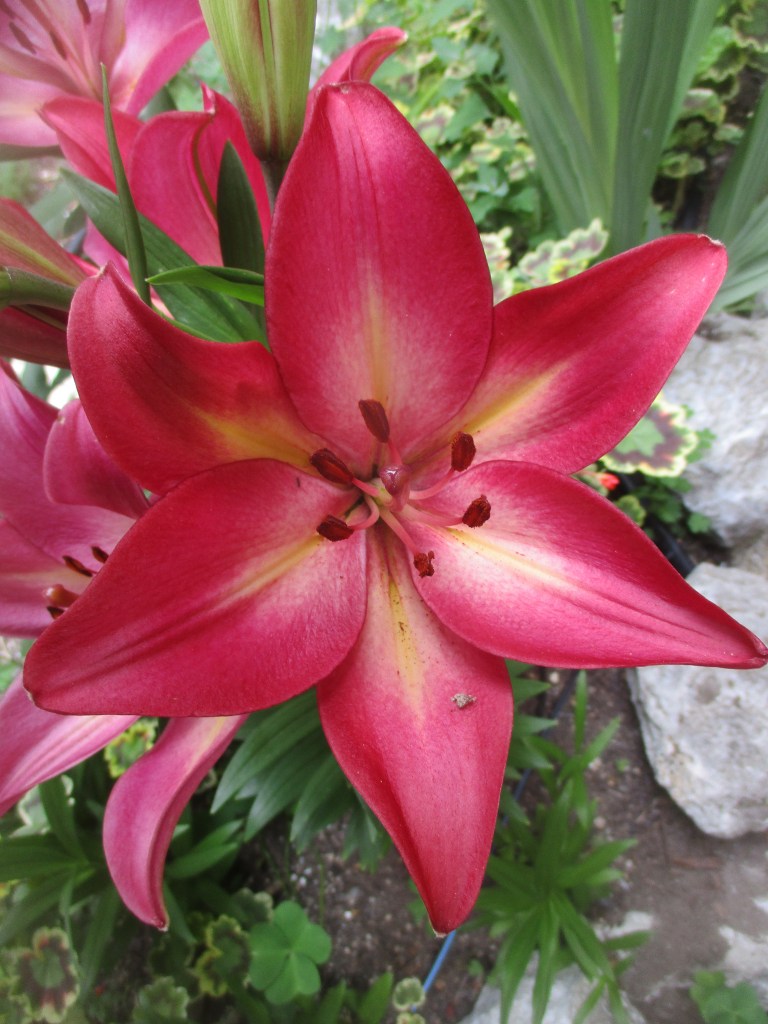
Lily is neither calla nor canna.

Nomenclature is simply a structured technique of naming. Botanic nomenclature assigns universally precise general or genus names with specific or species names to all plants. Such botanical names are also scientific and Latin names, but not common names. They are binomial with their uncapitalized species names after their capitalized genus names.

Latin, scientific or botanical names are the same for everyone everywhere, regardless of regional language. They simplify documentation and distribution of botanical information for plants that have different regional common names. Even if all other information needs translation, botanical names do not. They are really more common than common names.

Realistically, common names are no more common than common sense. Many regional names are common only within isolated or contained regions, such as individual islands of Polynesia. Aloalo of Hawaii are simply familiar hibiscus here. Lily of the Nile seems to be the only common name for Agapanthus, but is more familiar as thanh anh in Vietnam.

Acer platanoides is Latin for ‘maple which resembles a sycamore’. Acer pseudoplatanus is Latin for ‘maple which is a false sycamore’. Both are maples here, but also sycamores in England. Conversely, Platanus X acerifolia, which translates to ‘sycamore with maple foliage’ is a sycamore here, but a plane in England. Common names might be confusing.

This is why botanical names are so important. Arborists and horticulturists both here and in England recognize them regardless of possible inconsistencies with common names. Of course, common names are useful regionally. They may be easier to remember, more appealing or merely amusing. Pigsqueak and sticky monkey flower are difficult to forget.

Nonetheless, it might be helpful to be aware that some common names are inaccurate. A rose by any other name would smell as sweet, unless of course, it is a Confederate rose, Lenten rose, rose of Sharon or rock rose. None of such roses are actually roses. Neither calla lily nor canna lily is a real lily. Neither dracaena palm nor sago palm is a real palm.

Cool Season Vegetables Eventually Replace Warm Season Vegetables

Peppers do not grow in cooling autumn weather.

Just as warm season annual flowers that bloomed through spring and summer get removed to relinquish their space to cool season annuals, summer vegetable plants need to vacate the garden for cool season vegetables. Fortunately, removing vegetable plants is not as unpleasant as removing the pretty flowers might have been, because most have finished producing whatever it is that they were grown to produce.

Besides, cool season vegetables are even cooler than warm season vegetables, since some have distinctive foliage that is appealing beyond the vegetable garden, in borders, pots and mixed plantings, out in the landscape. Swiss chard is a striking foliar plant, whether it gets eaten or not. The outer leaves can get eaten without compromising the appeal of the inner leaves that continue to grow and fluff outward to replace them. Arugula, kale, mache, loose lettuce (non heading) and collard, mustard and turnip greens do the same.

This ability to function in more places in the landscape is a definite advantage since cool season vegetables are not quite as productive as warm season vegetables are. They would certainly like to be as productive, but grow slower through cool weather.

Most cool season vegetables should be sown into the garden as seed. Root vegetables, like beet, carrot and radish, might be available as seedlings in cell packs, but do not recover very well from transplanting. Besides, seedlings of such plants in cell packs are either too abundant and crowded, or to sparse to produce much. Leek, loose leaf lettuce and most of the greens likewise grow best if sown as seed in rows instead of planted in tight clumps as they are grown in cell packs.

Only greens that are grown as individual big plants, like chard, kale and collard green, can be as productive from cell pack seedlings as from seed. However, each cell pack produces only six plants, maybe with some extras. A package of seed costs about the same, but contains more seed than most gardens can accommodate.

Actually, the only cool season vegetables that might be more practical to grow from cell pack seedlings than from seed are broccoli, cauliflower, cabbage and Brussels sprout. These vegetables grow as even larger plants, so minimal quantities, like one or two or perhaps three cell packs, are sufficient.

Like so many of the warm season vegetables, many cool season vegetables should be planted in phases every two to four weeks to prolong harvest. By the time the first phase finishes, the next phase will be ready. The frequency of phases depends on the growth rate and duration of production of the particular plants. For example, chard has a long duration of production, so does not need many phases.

Cool Season Annuals Eventually Replace Warm Season Annuals

Petunia must eventually be replaced, even if the tips of deteriorating stems continue to bloom.

Here in the mild climates on the west coast of California, the difficulty of getting new cool season annuals into the garden to bloom through autumn and winter is not selecting, procuring and installing the new annuals. It is the removal of the warm season annuals while they are still blooming and looking so good! Knowing that planting new annuals sooner than later will get them an earlier start is not always much consolation.

Pansy, viola, primrose, snapdragon and alyssum are probably the most familiar and favorite of cool season annuals, and are often allowed to bloom late into spring when they probably should be replaced by warm season annuals. Alyssum easily naturalizes, and can actually bloom all year in coastal or cool areas. Snapdragon are probably the most difficult of these favorites to grow, since they so often get infested with rust, a common fungal disease that proliferates where winters are mild.

Cornflower (bachelor’s button), stock, Iceland poppy, sweet William and calendula are probably a bit less popular only because they are not so conducive to mass planting as bedding plants. Cornflower and stock get taller than they should for beds, although they look great behind beds; and stock is excellently fragrant. Iceland poppy, sweet William and calendula do not often grow uniformly enough for large beds; and calendula does not offer much variety of color beyond shades of yellow and orange. Yet, all are great in mixed plantings.

Ornamental cabbage and kale are grown for their colorful foliage instead of flowers. Cabbage may be a bit more colorful; but kale can provide more variety of foliar texture. Because they form such bold rosettes of foliage that do not blend into each other like other bedding plants do, they are more often grown as narrow borders or in small mixed plantings instead of in broad uniform beds.

The ornamental potential of both Swiss chard and parsley should not be denied. Swiss chard has distinctively ruffled and glossy foliage that can be dark green or deep burgundy. Their prominent midribs and veins can be even more colorful with shades of greenish white, yellow, orange, red or pale purple. Parsley is rich green, with full, intricately textured foliage that happens to look quite sharp with white alyssum. The main problem with these two cool season vegetables is that their appearance can be compromised if they get eaten.

Autumn Annuals Transition From Summer

Warm colors bloom as weather cools.

Cool season vegetables will replace warm season vegetables during autumn. Also, cool season annuals will replace warm season annuals. Neither simple task is easy for warm season plants that continue to perform too well to remove. Conversely, some finish early. Autumn annuals may compensate until cool season annuals become more seasonable.

Summers here are long, dry and somewhat warm. Even petunias and other annuals that enjoy warmth and tolerate aridity may not want to perform for so long. Without occasional grooming, they can get shabby by late summer. The recent unusually warm weather only accelerated the process for this year. Summer weather might continue into early autumn.

Consequently, it may still be a bit too early for some favorite cool season annuals that do not appreciate arid warmth. Pansies can get scrawny and lay low in response to warmth. Ornamental cabbage and kale is likely to bolt (general floral stalks) after exposure to too much warmth. Such annuals perform better or for a longer season after summer warmth.

This is why autumn annuals are so popular. They replace tired warm season annuals by the end of summer, and bloom until the weather is cool enough for cool season annuals. Autumn annuals generally bloom for shorter seasons than warm or cool season annuals, but most last until frost or significant rain. After bloom, a few are actually perennial plants.

Chrysanthemums and marigolds may be the most familiar of autumn annuals. Marigolds are actually warm season annuals that can perform just as well during spring or summer. Late installation allows late performance, which can continue until frost or sustained rain. Chrysanthemums are actually perennials, so can grow and bloom again for next autumn.

Celosia and alyssum, like marigold, are warm season annuals that perform late after late installation. Sweet William is a cool season annual that, after early installation, begins to perform earlier. Several types of aster naturally bloom late in summer or early in autumn. Even if nasturtium already succumbed to warmth, fresh seedlings may perform until frost. Old plants, prior to deterioration, could have provided seed, albeit feral, for their own replacement.

Succulents Are A Diverse Group

If Agave are succulents, are closely related Yucca also succulents?

There really is no way to neatly classify succulents. Many are spiny cacti with fleshy stems without recognizable foliage. Others are euphorbs (related to poinsettias) that may resemble cacti, or may instead have fragile leaves on fleshy stems. Aloes and agaves have bold rosettes of fleshy leaves that obscure their wide basal stems.

The most familiar succulents are small docile perennials, like the many varieties of jade plants and iceplants. Some are flowering perennials like begonias. A few are even grown as annuals, like busy Lizzie (impatiens).

So what do succulents have in common? Well, that is a good question that is open to interpretation. Most would agree that succulents have some sort of fleshy succulent parts for storing water through dry weather. These succulent parts are most often leaves or stems. Yet, yuccas, dracaenas and ponytail palm that are no more succulent than palms, are considered by many to be succulents like related aloes and agaves.

Many succulents are remarkably easy to propagate vegetatively (without seed). Most aloes, some agaves and many yuccas produce pups, which are basal shoots that can be separated as new plants. Agaves that do not produce pups while young will likely produce many pups after they bloom and begin to deteriorate. (Individual rosettes die after blooming.)

Despite the nasty spines that make them difficult to handle, cactus that produce multiple trunks can likewise be divided. Cactus can alternatively be propagated as large cuttings; but because they are so fleshy, should be left out for their cut ends to dry and ‘cauterize’ somewhat before rooting. Many euphorbs behave much like cacti, but are even more hazardous to handle because of their very caustic sap.

The majority of small succulents, like the many jade plants and iceplants, are notoriously easy to propagate by cuttings.

Cole Vegetables Are Cool Vegetables

Mustard greens are cultivated and naturalized.

September began with the warmest weather of the year. Such weather is not uncommon for late summer here. It can happen as late as early autumn. Still, it can be disconcerting while weather should be cooling. Cool season vegetable plants that are technically now seasonable dislike such warmth. Cole vegetables are particularly responsive to weather.

Cole vegetables are within the Cruciferae family, which is alternatively the Brassicaceae family. They therefore also classify as crucifers or brassicas. They include various forms of broccoli, cauliflower, cabbage, collard, kale, kohlrabi, mustard, turnip, radish, arugula, rutabaga and Brussels sprouts. As variable as they are, several are of the same species.

Broccoli and cauliflower are floral vegetables, since their primary edible parts are bloom. Brussels sprouts, cabbage, collard, kale, arugula, mustard greens and turnip greens are foliar. Turnip, radish and rutabaga are roots. Kohlrabi is a distended stem. Mustard seed, which is a seasoning instead of a vegetable, is the only common fruiting cole vegetable.

Therefore, unlike most warm season vegetables, cole vegetables should not fruit or go to seed. Broccoli and cauliflower only begin to bloom, but do not finish prior to harvest. This is why most cole vegetables are cool season vegetables here. Warmth stimulates bolting and bloom, which ruins flavor and palatability. Cool weather prolongs vegetative growth.

Contrary to the implications of recent weather, cool season vegetables, including several cole vegetables, are seasonable. This is the time to sow seed for turnip, radish, rutabaga and other cool season root vegetables directly into the garden. Transplant of seedlings is disfiguring to roots. Weather should be cooler by the time new seedlings start to develop.

Arugula, turnip greens, mustard greens, collard, kale and kohlrabi likewise develop most efficiently from seed. However, transplanted seedlings can be adequately productive too. Because only a few broccoli, cauliflower, cabbage and Brussels sprouts plants are likely sufficient, cell pack seedlings are likely more practical than seed. Since they are already growing, they can get planted a bit later.

Conformity Is No Simple Task

Patching bald spots within Iris moss with Scottish moss might look . . . odd.

A combination of modern horticultural apathy and too many choices was probably the demise of conformity in home gardens. Formal hedges or even informal screens of several of the same plants are nearly obsolete. Ironically, long and low barrier hedges and so called ‘orchards’ of identical trees planted in regimented rows or grid patterns have become common in large landscapes in public spaces.

Those of us who still crave formal hedges, paired trees or any such symmetry in our home gardens must be more careful with the selection of the plants that need to conform than would have been necessary decades ago when there was less variety to complicate things. It is just too easy to get different varieties of the same plant. Only plants with matching cultivar (cultivated variety) names will necessarily match. (Yet, on rare occasion, even these are inaccurate.) For example, ‘Emerald’ arborvitaes will match other ‘Emerald’ arborvitaes, but will not match ‘Green splendor’ arborvitae, no matter how they resemble each other in the nursery.

Plants that are identified by their characteristics instead of by cultivar name are riskier. Blue lily-of-the-Nile could be any one of many different cultivars with blue flowers. It is therefore best to obtain all lily-of-the-Nile for any matching group from the same group in the same nursery at the same time. What will be available next week may actually be a different variety with a different shade of blue and different foliar characteristics. Nurseries bring stock in from so many different growers.

Adding new plants to replace those that have died within established hedges or streets flanked with the same trees can be particularly difficult, especially if the old varieties are no longer available. The old fashioned yellowish Japanese boxwood that was so common for small hedges in the 1950’s has not been common in nurseries for several decades. Replacement plants are darker green. Some are even compact cultivars or different specie like English boxwood. When lined up and shorn together, they make ‘calico’ hedges.