Evergreen Foliage Has Distinct Advantages

Evergreen foliage is shady all year.

Gardening was easier before suburban lifestyles became so passe. Now, larger modern urban homes occupy smaller urban parcels. Modern fences are taller to enhance privacy for such densely situated homes. Garden space is both minimal and shaded by so much infrastructure. Ironically, shady evergreen foliage is now more practical for such gardens.

Deciduous trees are still practical for single story suburban homes on suburban parcels. They provide cooling shade for summer, and allow warming sunshine through for winter. Smaller evergreen trees and shrubs closer to fences obscure unwanted scenery beyond, without shading homes during winter. Such strategy is facilitated by sufficiency of space.

It is not so practical for confined and modern urban gardens though. Space is insufficient for big deciduous shade trees. Smaller trees can not get tall enough to shade roofs of tall modern homes. Insulation of modern homes is fortunately so efficient that summer shade and winter sunshine are not as advantageous as they still are for older suburban homes.

Therefore, most trees in modern home gardens primarily obscure unwanted scenery and provide privacy, rather than merely provide shade. Not only should they be proportionate to their gardens, but such trees should also retain evergreen foliage as low as the tops of associated fences. Some of the more practical options are actually evergreen shrubbery.

Large evergreen trees, such as Southern magnolia, California pepper, camphor, various palms and some eucalypti, are too big for some confined modern home gardens. English laurel, New Zealand tea tree, hopseed bush, various arborvitae, and particularly various pittosporum function as small evergreen trees that are proportionate to confined gardens.

As practical as evergreen foliage is for modern urban home gardens, it requires as much maintenance as other forms of vegetation. Contrary to common belief, evergreen foliage sheds. It is just sneaky about doing so slowly throughout the year. Additional foliage also innately adds shade to already shady situations, which can complicate other gardening. To become compact evergreen trees, shrubbery requires directional pruning.
A Few Favorite Cut Flowers

Try unconventional cut flowers if you can.

Flowers add such variety of color and fragrance to the garden that it is no wonder that they are so popularly cut and brought from the garden into the home. Even though larger quantities of flowers can be purchased from markets or florists without depleting those blooming in the garden, growing our own can be so much more rewarding. We may not be able to grow all the varieties of flowers that commercial growers can grow in greenhouses or other climates, but we can grow many other varieties of flowers that commercial flower growers do not provide.

Many flowers can be grown specifically for cutting, like vegetables are grown to be harvested. Some, like cosmos and daisies, can be grown in such abundance in mass plantings that it is easy to cut a few without anyone missing them. Other flowers, like roses and New Zealand tea tree, are merely by-products of plants that also function as shrubs, vines, trees and even ground covers.

Peruvian lilies are some of the best cut flowers, not only because they last so long after getting cut, but also because they bloom so much through such a long season that there are usually enough flowers for the garden as well as the home. The taller and unfortunately rare types grown by commercial flower growers are better for cutting than the more common ‘garden varieties’ are.

Callas are likewise among the better prolific cut flowers, but only bloom white. The colored types are neither as prolific nor as reliable. Believe it or not, lily-of-the-Nile makes good cut flowers when they bloom white or blue in the middle of summer. They are just awkward because their blooms are so round.

Gladioli are good either as cut flowers or for color in the garden, but unless they are planted in large quantities, they are not prolific enough for both. Like vegetables, they can be planted in phases (in season) to prolong the bloom season. Unfortunately, they need to be planted annually because they do not often naturalize. Those that do naturalize will synchronize their bloom season after the first season.

Several types of iris bloom more generously, and some are happy to naturalize, but only a few types are good cut flowers like Dutch iris are. Some bearded iris wilt within hours of getting cut.

Vines Are Aggressive Social Climbers

English ivy can cling to anything.

Regardless of how appealing many of them are in home gardens and landscapes, vines are flagrantly exploitative. They rely on shrubbery, trees or anything they can climb on for support. As they reach the tops of their supports, they extend their foliar canopies above. Vines have no reservations about overwhelming and maybe killing their own supporters. 

Vines climb with clinging roots, twining stems, tendrils, twining leaves, or even thorns or spines. Some vines are annuals or perennials. The most aggressive or destructive sorts are woody plants. Some creep along the ground while young, and then climb when they find support. Some mature to support their own weight as they lose their original support. 

English ivy and Algerian ivy, in their juvenile forms, can be practical ground cover plants. However, when they encounter shrubbery, trees or buildings, they become clinging vines that can overwhelm their supports, and ruin infrastructure. As they mature, clinging vines evolve into shrubbier and obtrusively bulky adult growth that blooms and produces seed. 

Boston ivy, which incidentally is not actually ivy, is more practical as a clinging vine than the other ivies. It does not grow as ground cover anyway. Nor does it develop bulky adult growth. However, it also has limitations. Because it attaches to its supports with clinging tendrils, it is only practical for surfaces that it can not wreck, such as reinforced concrete.

Bougainvillea is a delightful and shrubby vine. It neither clings to surfaces nor grips onto support by twining. It simply generates long and vigorous canes that eventually lie down onto its surroundings. Long thorns help to anchor these canes in place. Canes should be satisfied with trellises, but sometimes mingle with shrubbery or trees, or spill over fences. 

Carolina jessamine, lilac vine and mandevilla climb with twining stems, but are relatively docile. Star jasmine, which performs well both as a ground cover plant and as a climbing vine, can crush flimsy lattice with its twining vines. Wisteria might crush substantial trellis beams. Passion flower climbs with wiry tendrils, but can be overwhelmingly voluminous. 

Gardening Up A Wall

These succulent tapestries exemplify artistic vertical gardening.

Like so many fads often do, the vertical gardening fad has become trendier than it really should be. It certainly has practical applications, and is very appealing in the right situations. However, in the wrong situations, it can be more problematic than it is worth.

Vertical gardens can shade and insulate exposed walls, but really do little more than strategically placed shade trees, large shrubbery or even trellised vines can do in that regard. The disadvantage of vertical gardening is that it can hold moisture against the affected walls, and can promote rot if the planters are not installed properly. Planters over windows or decks drip just like any other planters do, staining or dirtying whatever is below. Only free standing vertical gardens (that are not attached to a wall) or those on concrete walls that are not susceptible to rot will not cause such problems.

Water borne pathogens (diseases that disperse in water) can proliferate more in vertical gardens because they get carried with the natural flow of water from top to bottom. Wherever any such disease gets established on a vertical garden, it will likely get carried to everything below. In the ground, such diseases spread slower since they only travel as far as water flows or gets splashed.

The obvious advantage to vertical gardening is that it makes it possible to grow many more plants in very limited space, which is excellent if there is no open ground for vegetable gardening. It can also be a great way to display plants like orchids and certain bromeliads that are more appealing if they hang from above. Staghorn ferns cling to walls naturally.

Another advantage is that vertical gardening can be so aesthetically appealing and unique. Vertical gardens of small, densely foliated succulents hung like tapestries to adorn exterior walls are so much more interesting than simple vines or shrubbery used to obscure such walls. Northern exposures that are too dark for most plants can be adorned with ferns.

Sudden Limb Failure Jeopardizes Safety

Entire trees can also fall unexpectedly.

Windy weather sometimes breaks limbs from trees, or blows entire trees over. Evergreen trees are innately more susceptible to such damage than deciduous trees are. Wind can blow more easily through deciduous trees while they are bare through winter, when most wind occurs. However, deciduous trees are now more susceptible to sudden limb failure. 

Sudden limb failure, or spontaneous limb failure, is a result of gravity rather than of wind. It is actually more likely without wind, during mild or warm weather, particularly with high humidity. It consequently has potential to be more hazardous than limbs that blow down. More people go outside among trees during mild weather, and fewer expect falling limbs. 

Sudden limb failure occurs if limbs become unable to support their own increasing foliar weight. Warmth accelerates vascular activity, which sustains foliar growth. High humidity and a lack of wind inhibit evapotranspiration (evaporation from foliage), which otherwise helps to alleviate excessive weight. Developing fruit can also cause sudden limb failure.

In the wild, willows, poplars, sycamores, and perhaps a few other riparian trees regularly and naturally exhibit partial sudden limb failure. Limbs that fracture and sag onto soil, but remain partially attached to their original tree, can generate roots and grow as new trees. Although their strategy is practical for them, it is unacceptable within refined landscapes. 

Several native and exotic trees of chaparral climate are quite susceptible to sudden limb failure within or adjacent to irrigated landscapes. Since they are not accustomed to such abundant moisture, they overindulge. Mature wild trees are more likely to exhibit sudden limb failure after an unusually rainy and warm winter, or if rain continued late into spring.

All native oaks, particularly valley oak and coast live oak, are susceptible to sudden limb failure. So are Monterey pine and Monterey cypress. Carob, sweetgum, various elm and various eucalypti are exotic species that are notorious for such behavior. Evergreens are more unpredictable, since their new growth is less obvious among their lingering foliage. 

Time For Warm Season Annuals

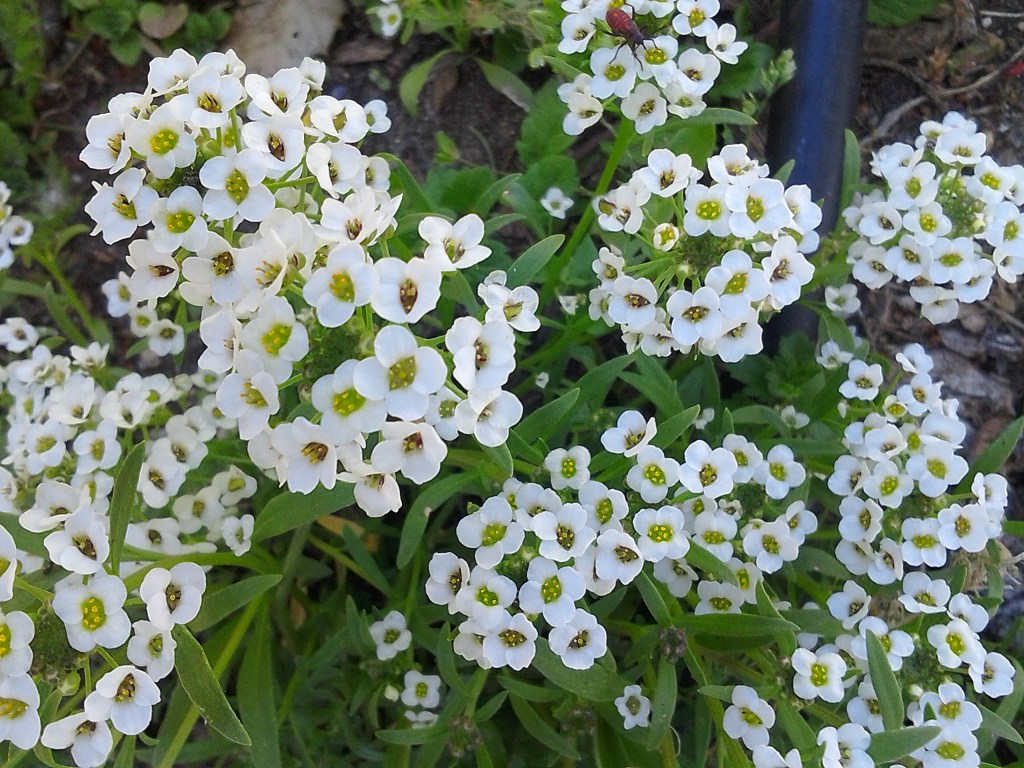
Sweet alyssum is one of those warm season annuals that is too easy to grow to be taken too seriously.

Nasturtium and sweet alyssum seem to be more than warm season annuals. Like many other warm season annuals, they get established best if added to the garden just after winter, and then grow and bloom mostly during warm spring and summer weather. Then, if allowed to stay in the garden as cooler weather inhibits bloom somewhat , they survive through autumn and winter. By the time the original plants die out, new seedling emerge to replace them.

A potential ‘slight’ problem with allowing these annuals to naturalize (perpetuate naturally by sowing their own seed) is that fancier varieties eventually revert to a more genetically stable state. Sweet alyssum that can be various shades of pink or purple as well as white eventually blooms almost exclusively white after a few generations. Nasturtium that might start out with all sorts of shades of yellow, orange, red or brownish red eventually blooms with only basic bright yellow, bright orange and perhaps rarely, cherry red.

The reason that this is only a potential problem is that most of us are totally pleased with white sweet alyssum, and yellow and orange nasturtium! Another slightly more realistic potential problem with naturalization of sweet alyssum or nasturtium is that it leaves us no excuse to try different varieties. Anyone who doubts this should take a quick look through the online catalog of Renee’s Garden!

Nasturtium is easier to grow from seed than from small plants in cell pack, since small plants take time to recover from transplant. Besides only two or perhaps three of the multitude of varieties available as seed can be found in cell packs. Sweet alyssum can either be grown from cell pack or from seed, but like nasturtium, more varieties are available as seed. Although they grow throughout the year, both are still considered to be warm season annuals.

Busy Lizzy (impatiens), petunia, marigold, lobelia, cosmos and zinnia are some of the other popular warm season bedding annuals this time of year. Statice, cockscomb, verbena, moss rose and pincushion flower are also in season. Statice, tall varieties of cosmos and some varieties of zinnias make good cut flowers. Verbena, moss rose and pincushion flower are more often grown in mixed planting rather than as homogenous bedding. Although many more varieties are available as seed, cell packs of any of these warm season annuals provide more immediate results, especially this late in the season.

Palms Are Very Distinctive Among Trees

Palms provide distinctively lush foliar texture.

Palms seem to exemplify the culture of California. However, only the California fan palm, which is also the desert fan palm, is native. All others are exotic. With its dwarf palmetto, Oklahoma has as many native palms as California. Furthermore, the California fan palm is only endemic within remote riparian ecosystems of the Colorado and Mojave Deserts.

Common date palms were likely the first of the many exotic palms in California. Spanish Missionaries imported them for date production during the Eighteenth Century. Although initially utilitarian rather than decorative, recycled trees from displaced orchards became popular for larger landscapes. Potentially messy fruit is minimal without male pollinators. 

Long before urbanization displaced date orchards, many other palms came to California merely because of their visual appeal. Some are large enough to be shade trees. Others can provide shade in groups. Many develop elegant trunks or sculptural form. Some stay relatively low or shrubby. All innately provide famously and luxuriantly evergreen foliage.  

Palms are most certainly appealing within appropriate situations. They are very different from other trees though. Like arborescent yuccas and cordylines, palms are ‘herbaceous trees’. Unlike yuccas and cordylines, and with very few exceptions, palms do not branch. Nor do their trunks continue to expand in width as they continue to grow in height above.  

Palms consequently spend their first few years widening their bases at ground level. Big palms, such as Canary Island date palm, likely require many years. Once their bases are adequate, developing palms ‘launch’ into vertical growth. Although palms do not branch, a few, such as Mediterranean fan palm, develop multiple trunks from their primary bases. 

Once palms launch, they grow only upward. They lean only to avoid shade, or if pushed by wind. It is impossible to direct their bulky but singular terminal buds around obstacles, such as utility cables. It is also impossible to contain their shade as they get high enough to shade adjacent areas instead. Many palms are spiny, so are difficult to prune properly, even while young and within reach.

The Stakes Could Be High

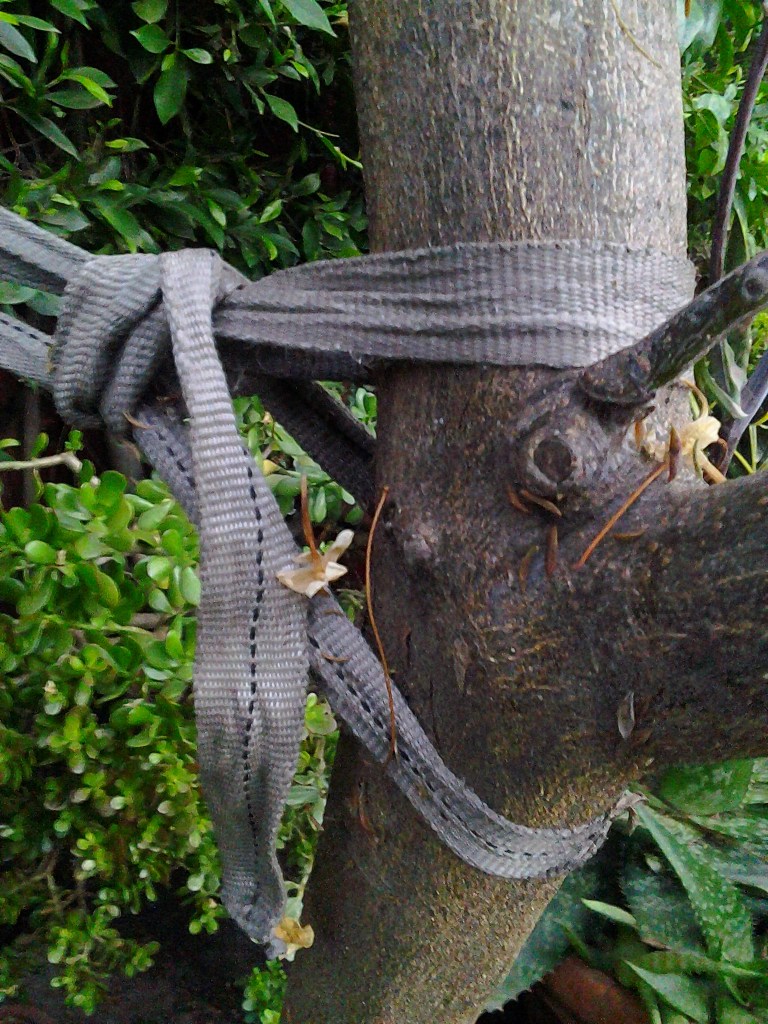
Some unfortunate trees become so reliant on staking and straps that they are never able to support their own weight.

The irony of landscaping and gardening to bring nature closer to the home is that it is so very unnatural. Plant specie are imported from all over the world, grown in synthetic environments, and then expected to perform in unfamiliar climates and soils far from home. Most plants have been bred for optimal retail appeal at the expense of their natural adaptations.

Trees grown in nurseries need to be staked tightly to develop the sort of straight trunks that branch at just the right height to be marketable. In the landscape, trees need to be staked because they have become so dependent on the stakes that they grew up with. Eventually though, trees need to learn how to carry their own weight.

When new trees get planted and staked loosely with heftier stakes that stand up to wind, old tightly bound nursery stakes should be removed since the tight binding interferes with trunk development. By the time trees gets planted, the nursery stakes are probably nearly rotten through at the ground anyway. The new heftier stakes should not hold trees tightly in place, but simply be there to keep them from getting blown over.

Straps should likewise not be tightly bound, but instead allow for a bit of motion with the breeze. Straps should cross over in a ‘figure eight’ pattern between trees and their stakes, so that trunks do not rub so abrasively against the stakes. Most trees need only two straps each, or two pairs of straps if two stakes are used, with support up high, and lower support to prevent outward bowing. If there are no branches to hold straps in place, straps must be nailed or otherwise attached to the stakes.

Some sturdy trees, like well developed redwood trees and small magnolias, may not need stakes. Palms and yucca certainly do not. However, limber trees like the various eucalyptus may need more support than just two straps. The problem is that many trees become dependent on their stakes and will not develop strong trunks if they do not need to.

It is better to prune maturing staked trees to limit weight and wind resistance (that might cause them to blow over) than to provide more support with heftier stakes. If a maturing young tree is relying on stakes and straps for support, it needs to be pruned. A young unstaked tree that begins to lean from the weight of its canopy should likewise be pruned until it regains its posture without getting staked and bound. Trees should never be tied to other trees, buildings or anything else that can be damaged by the tension.

Cultivars Are Merely Cultivated Varieties

Cultivars are distinct within their species.

Nomenclature is simply the technique of naming. Botanically and horticulturally, it is also a precise method of classification. Large classifications divide into smaller and exclusive classifications, which likewise divide. Botanical families divide into many genera, which likewise divide into many species. Some species divide further into varieties or cultivars. 

For example, Schwedler maple is within the Sapindaceae family. This family divides into many genera including the maple genus of Acer. (Genera is plural of genus.) This genus divides into varied species, including the Norway maple species of platanoides. Norway maple divides into more cultivars, including ‘Schwedlerii’, which is the Schwedler maple. 

Therefore, the botanical name of the Schwedler maple is Acer platanoides ‘Schwedlerii’. Family names are omissible. Genus names justify capitalization. Species names do not. Both genus and species names appear in italics. (Incidentally, genera are more ‘genera’l than ‘speci’fic species.) Single quotation marks contain names of varieties and cultivars.

Varieties are, as their designation implies, variants of a species. Some are dwarf, like the dwarf pampas grass. Some bloom with atypical color, like the maroon Texas bluebonnet. Their variations are natural and at least somewhat inheritable. Cultivars are varieties that can not perpetuate naturally, so are reliant on cultivation. They are ‘cultiva’ted ‘var’ieties.

Some cultivars developed from breeding. Others are naturally occurring mutants that are desirable enough to perpetuate. Because their unique characteristics are not inheritable, perpetuation is artificial. Seed of cultivars that originated as mutants lacks any desirable mutation. Seed of extensively bred cultivars is genetically unstable, or may not be viable. 

Most cultivars therefore rely on cloning for perpetuation. Propagation by cutting, grafting, division, layering and tissue culture, generates genetically identical copies of an original. Although it is illegal to propagate patented cultivars for profit, most common cultivars are too old for patents. Many perennial cultivars, such as iris and canna, proliferate naturally. 

Give Plants What They Want

Flowering crabapples are generally reliable for profuse bloom, but some varieties might perform and grow better where winters are cooler.

Dogwoods are certainly pretty as they bloom this time of year. They are rare, but seen often enough in nurseries to make one wonder why they are even more scarce in local gardens. Those that got sold in previous years should now be prominent features around town. The problem is that because they are not happy in local climates, dogwoods become dogwon’ts. They won’t bloom. They won’t provide good fall color. Many won’t even grow. Dogwoods prefer more humidity, so in local gardens, want to be sheltered from full sun exposure and drying wind by larger trees or buildings.

Nurseries generally stock plants that are appropriate for local climates. A few nurseries also have a few plants that would rather be somewhere else, but can be grown with certain accommodations. Reputable retail nurseries are generally careful to divulge which plants need more attention, and what their requirements are. However, many of the big garden centers in home improvement stores are more interested in selling what they can rather than selling what is actually appropriate, particularly since they thrive on turnover and replacing plants that do not survive.

Not all plants are as easy to grow as junipers and oleanders are. Japanese maples and rhododendrons like at least some degree of shelter from direct sun exposure and dry heat; but the California fan palm thrives in wicked heat. Plumerias and coleus can be damaged by even slight frost; but many apples and pears want more frost. Spruces like even moisture; but many yuccas rot without enough dry time.

This is why it is important to know how to accommodate plants that may be less than ideal for local climates. Those of us who choose to grow plants that have special needs should at least give them what they want if we expect them to perform as we want them to.