Nomenclature Was Designed For Simplicity

Simple standardized nomenclature is getting rusty.

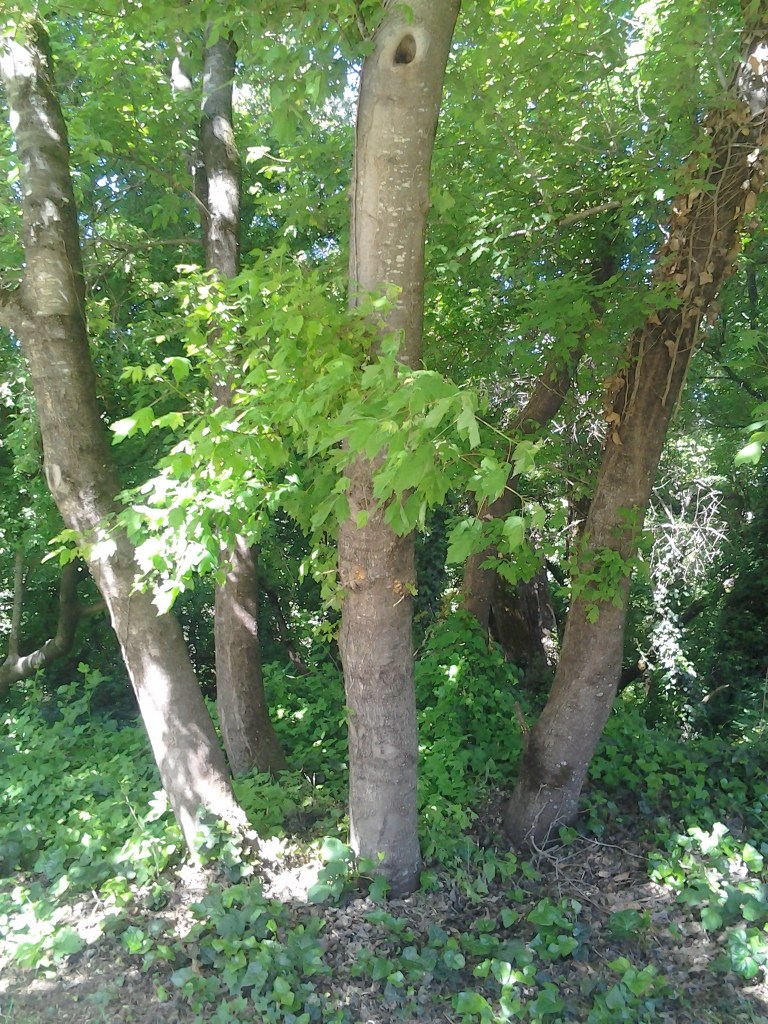
Buick Electra used to mean something. Chrysler Imperial and Lincoln Town Car did also. That was at a time when cars were still distinguishable. Instead of random numbers with a few letters, they had distinctive names. These names, although distinct, conformed to a standardized pattern. This pattern of naming was comparable to botanical nomenclature. 

According to botanical nomenclature, plants are identifiable by genus and species. Their ‘gen’us is a more ‘gen’eral designation than their ‘speci’fic ‘speci’es designation. A family is a larger and more general classification than genus, and in turn, fits into another more general group. Most of us are not concerned with the many classifications beyond family. 

For example, the botanical name of silver maple is Acer saccharinum. Acer is the genus. saccharinum is the species. Acer saccharinum is in the Sapindaceae family. (For botany, genus and species names are italicized, and species names are not capitalized.) Buick Electra is similarly in the General Motors family. Buick is its genus. Electra is its species.

Varieties and cultivars are even more specific designations within species. Some are the products of breeding. Some are naturally occurring. A cultivar is a ‘cultivated variety’ that does not perpetuate naturally like other varieties do. Most cultivars propagate by cloning. (Variety and cultivar names are capitalized and enclosed within single quotation marks.)

For example, Acer rubrum ‘October Glory’ is a cultivar of red maple. It exhibits a distinctly rounded canopy and foliar color in autumn that is superior to that of the simple species in the wild. It might compare to a Buick Skylark Gran Sport, which is essentially a cultivar of Skylark with a stronger engine. Botanical and automotive nomenclature are quite similar. 

Such similarities of nomenclature are no advantage. While cars forfeited their distinctive titles for mundane numeric designations, plants forfeited their species names for cultivar names. Such abbreviation of nomenclature interferes with accurate identification. Those unfamiliar with it may not know if Cercis ‘Forest Pansy’ is an Eastern or Western redbud, or something else.

Late Night Terror For Foliage

Snails and slugs really crave hostas.

Snails and slugs really enjoy all the new seedlings and fresh foliage that is growing in the garden while the soil is still damp from earlier rain, and the weather is getting warmer. They are neither too smart nor too fast, but they are very hungry, and do their damage at night when no one is watching. They hide before the sun comes up.

The same lush foliage that they eat is also where they often live. However, they also live among lily-of-the-Nile and some ferns that they do not damage very much, as if they think that no one will look for them there. They also hide under any sort of debris and in valve boxes. Removing such debris and unwanted weed foliage diminishes their habitat.

Pieces of damp cardboard intentionally left out in cool and damp spots in the garden overnight can attract snails and slugs as they seek shelter in the morning, and then be flipped over during the day to collect and dispose of the surprised snails beneath. It is sneaky, but effective. People who happen to be up late can hunt for snails while they are out and about. Otherwise, hunting for hiding snails and slugs by daylight takes a bit more diligence.

Saucers or plastic lids containing puddles of beer is supposed to keep snails and slugs out drinking until they get roasted when the sun comes up. The problem is that the beer gets washed away whenever the garden gets watered. Besides, it does not really kill very many victims. Salt around the most susceptible plants likewise gets washed away, and can be toxic to the plants that it is supposed to protect. Keeping water in drainage saucers below potted plants is a problem for drainage, and allows mosquitoes to proliferate.

Copper tape that can be purchased from nurseries or hardware stores is an effective barrier for snails and slugs, but only if the susceptible plants are completely surrounded, and only if leaves or stems that extend over the copper do not touch anything outside. Copper tape can be self adhesive or stapled to wooden planters. Bare copper wire is just as effective. If wrapped around tree trunks, copper tape or wire should have some slack to allow for growth. An extra bit of self adhesive copper tape pressed against itself to form a tab that it can be pulled apart as needed should work well. Copper wire only needs a small loop of extra wire.

Deadheading Spring Bulbs Conserves Resources

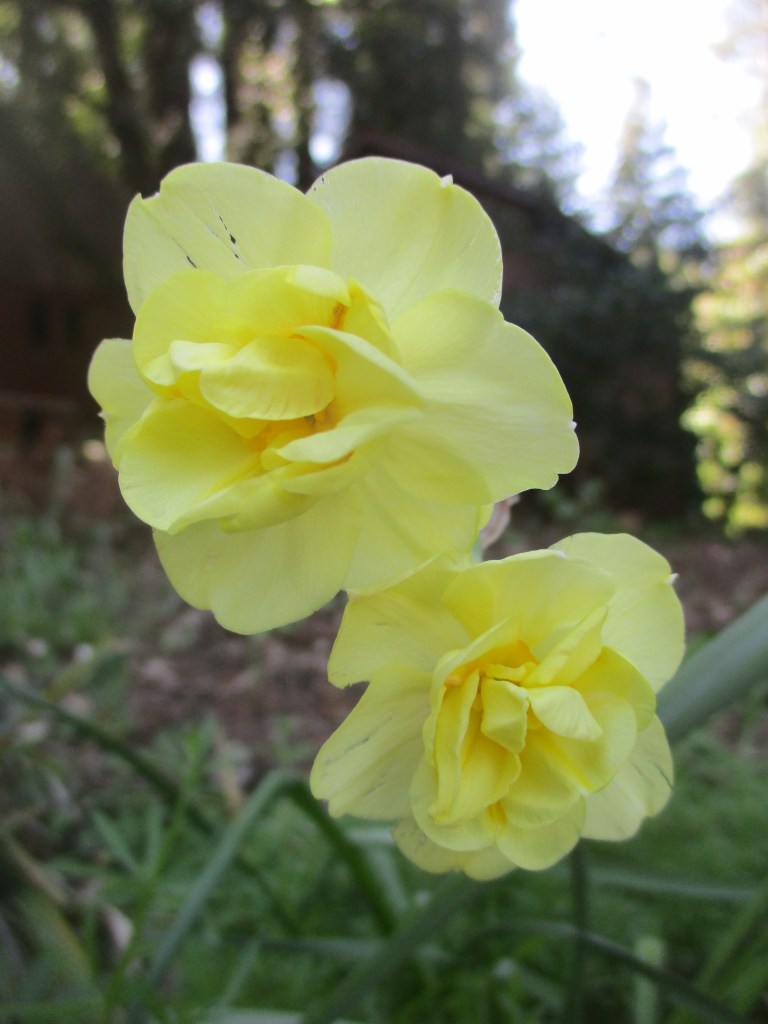
What happens when daffodils finish blooming?

Now that the various spring bulbs have finished blooming, or will soon, many will benefit from deadheading. The techniques are simple, and actually benefit many plants besides spring bulbs. In the most basic terms, deadheading is merely the removal of deteriorating flowers after bloom. Ideally, it should happen prior to the development of seed structures.

A most obvious advantage of deadheading is that it eliminates unappealing carcasses of finished flowers. This neatens the appearance of remaining foliage. The foliage of some spring bulbs shrivels soon after bloom, but remains intact through the process, to sustain development of new bulbs. It is easier to ignore without prominently shabby floral stalks.

Deadheading also conserves and redirects resources that would otherwise sustain seed production. Such resources can instead promote vegetative growth, including production of new bulbs to replace the old. Furthermore, depriving bulbs of seed provides an added incentive for vegetative regeneration. If unable to survive by one means, they try another.

Some bulbs are more reliant on deadheading than others. Grape hyacinth and snowdrop are too profuse with bloom for minor seed production to inhibit their performance. In fact, they produce viable and genetically stable seed, which could be an advantage if more of the same are desirable. Although seed production is limited, seed disperses extensively.

Dutch crocus are an example of sterile hybrids that are unable to produce viable seed, or waste associated resources on such efforts. Other extensively bred bulbs that are not so sterile may not be true to type. Consequently, their progeny are likely to be very different. Freesia do not require deadheading, but can produce feral seedlings with insipid bloom.

Lily, narcissus, daffodil, tulip and hyacinth are some of the popular spring bulbs that now are ready for deadheading. Summer bulbs and perennials will get their turn later. Canna, dahlia and perennials that continue to bloom through summer will be tidier, and perhaps bloom more abundantly with efficient deadheading. They need not wait until next year to express their gratitude.

Weeds Are Full Of Surprises

Pokeweed is rapidly becoming more common.

While it was busy naturalizing in Australia, South Africa and southern South America, the California poppy was getting forced out of parts of its own native range by more aggressive exotic plants that were also busy getting naturalized. Technically, any plant that is not native is exotic. Any exotic plant that becomes naturalized in a foreign environment is able to proliferate without any help, as if it were native. Naturalized exotic plants that get too aggressive become invasive weeds.

Weeds are plants where they are not wanted. This is a very broad definition that includes plants ranging from simple little dandelions in urban lawns to humongous bluegum eucalyptus in forests. Naturalized exotic weeds can be much more problematic than weeds that can only proliferate where they get watered in gardens and landscapes, because they can get established where they are not expected.

Water hyacinth that clogs the Sacramento and San Joaquin River Delta is not often a problem in terrestrial landscapes. However, giant reed, pampas grass, Acacia dealbata and blackberry brambles can infest home gardens just as easily as they infest wild lands. Because they do not need to be watered, they can get established and grow quite large in unused parts of the garden before anyone notices.

Many naturalized weeds somehow seem to much more aggressive and problematic than even the most prolific of native plants. Even the common native lupines are relatively docile compared to annual oat grass. Native blackberry may seem impossible to eradicate, but is actually neither as persistent nor as unpleasant to handle as the exotic Siberian blackberry!

Young weeds are easiest to pull now while the soil is still evenly damp, and young roots are only beginning to disperse. They will be more difficult to pull after roots are dispersed and soil hardens. Tree weeds and large perennial weeds that were cut down last year instead of pulled will likely need to be dug. Bermuda grass is a relatively low perennial grass that always seems to be difficult to dig. Mowing or cutting down annual grass weeds with a weed whacker will not eliminate them, but limits the development and dispersion of seed for the next generation. Burclover, sowthistle, bindweed, purslane, spurge and the various oxalis are some of the other common weeds that really get going this time of year.

Vermin Run Amok In Spring

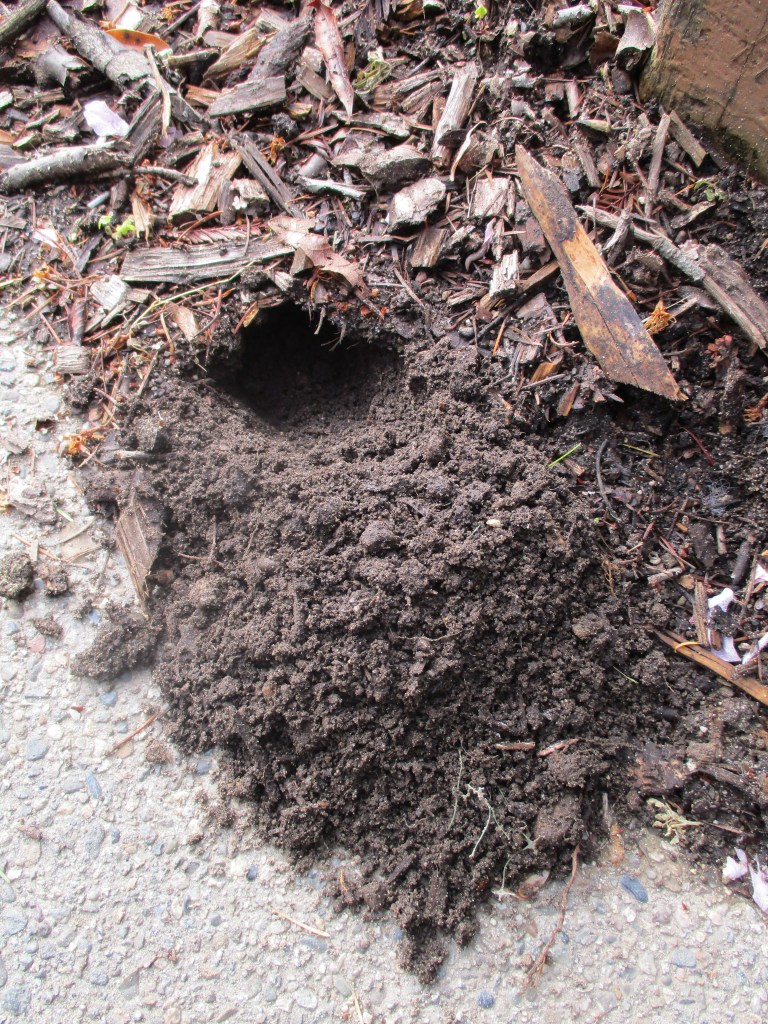
Gophers are busy with homemaking projects.

No one really hibernates here. Well, ground squirrels might, but they are unlikely to be a problem in refined home gardens. Winter weather is sufficiently mild for most of the most troublesome vermin to remain active, even if somewhat subdued. Some are more active in autumn before food gets scarce. They store food for later, and eat more to gain weight.

Now that it is spring, vermin are more active than they are at any other time of year, even autumn. Gophers, squirrels, rats and mice want to party like it is 1999; well, like spring of 1999. Although they all fattened up last autumn, and stored plenty of food for winter, they now want to exploit abundant spring vegetation. So do raccoons, skunks and opossums.

Generally most vermin, which most prefer to describe more politely as ‘wildlife’, are not a problem for home gardens. Some might be beneficial. Skunks may trench into lawns, but only because they want the grubs that would otherwise cause more damage from below. They also eat snails and slugs. Opossums eat snails and slugs too, as well as baby rats!

However, skunks and opossums can do more harm than good. They eat vegetables and fruits as they ripen, and pet food. Raccoons cause more significant damage, and can be very dangerous to pets. These three types of vermin are nocturnal, and therefore difficult to dissuade or confront directly. Fortunately, they are not very common in urban gardens.

Conversely, squirrels are everywhere except the harshest desert climates. Although they cause significant damage to new spring growth, and will later damage developing fruits, they are more tolerable than other vermin. Some people actually feed them to draw them to their gardens! Rats and mice are less tolerable, probably because they lack fluffy tails.

Gophers are likely causing more damage than other vermin now. Their growing families voraciously devour many of the fresh roots that disperse in spring. Now that their tunnels are not too muddy, gophers are remodeling to expand accommodations. Young gophers do not live with their parents for very long, so will eventually infest new adjacent territory. Lawns and vegetable gardens are most preferable.

The Spring Rush Is On

Pittosporum can be pruned aggressively now.

It is safe to say that any remaining frost damage can be pruned away. Frosted foliage and stems were only left through winter to help insulate inner stems from more damage by subsequent frost, and to avoid stimulating new growth that would be even more sensitive to frost. Now that there is no threat of subsequent frost, and surviving but damaged plants are growing anyway, there is no reason to retain unsightly frosted foliage. The few plants that do not regenerate probably did not survive.

Spring is the busiest time of year for most plants. By now, most have either bloomed or will be blooming soon. Early spring bulbs have already finished. Later bulbs will be blooming soon enough. Deciduous plants that were bare through winter are developing new foliage. Evergreen plants are likewise growing new foliage to replace older foliage that will get shed later in the year.

If necessary, flowering cherry, flowering crabapple, lilac, forsythia and mock orange (Philadelphus) can be pruned as they finish bloom. Flowering cherry should not need much; but flowering crabapple might be in need of aggressive structural pruning. Some of the older canes of lilac, forsythia and mock orange can be pruned to the ground, where their replacement canes are probably already emerging.

Overgrown or disfigured oleander, photinia, bottlebrush, privet, pittosporum and juniper that need restorative pruning can be pruned now. They recover most efficiently in early spring, and have plenty of time to develop plenty of new growth before they slow down again next autumn. If pruned much earlier, they would have stayed bare longer, since they would not have grown much through winter. Besides, almost all pittosporum are susceptible to disease if fresh pruning wounds are exposed to rainy weather.

Seed can be sown for any of the warm season vegetables and flowering annuals, such as zucchini, corn, okra, nasturtium, lupine and sunflower. Tomato, pepper, eggplant, petunia, marigold and busy Lizzie (Impatiens) can likewise be grown from seed, but are easier to grow from small cell pack plants. Cuttings of jade plant, iceplant, sedum and all sorts of succulents, as well as divided pups of aloe, agave and yucca, really get going well this time of year.

Cultivars Of California Native Plants

Some natives belong in the wild.

Native plants are obviously happy with local climates and soils. Otherwise, they would not be native. They had been living here long before the first landscapes. They survived without irrigation, fertilizer or any maintenance. Regional varieties adapted to regional environmental conditions. Some of such varieties became cultivars that are now familiar.
A variety is, more or less, a naturally occurring variant. Unnatural selection and breeding produced some varieties. Generally, varieties are genetically stable enough to replicate for at least a few generations. A cultivar is a cultivated variety. It is unable to replicate by natural processes, so propagates by cloning. All clones are genetically identical copies.
Most cultivars grow from cuttings. Some cultivars of exotic (nonnative) plants are grafts. (Not many natives are conducive to grafting.) Regardless of technique, propagation of all cultivars is vegetative (without seed). Seed of some cultivars can produce plants that are similar to the parents, but not indistinguishable. Some will likely be completely different.
Honestly, most native plants are not as appealing in home gardens as their cultivars are. Some are desert or chaparral plants, which can get scraggly through summer. Some are sparsely foliated with irregular branch structure. Like the majority of exotic plants, several native plants benefited from some degree of refinement. It is a fair aesthetic compromise.
This is partly why landscapes of native plants look nothing like forests or unlandscaped areas. The dense and strictly conical form of ‘Soquel’ redwood is very different from that of wild trees. ‘Carmel Creeper’ ceanothus is greener and more densely foliated than wild counterparts. ‘Ken Taylor’ flannel bush is likewise unnaturally dense, low and mounding.
The other primary reason that landscapes of native plants are so different from the wild is that they typically include species from other regions. Some of the penstemons that are popular as native plants throughout California are actually only native to the Siskiyous. Limiting landscapes to true regional natives would produce very different results.

Shopping Around For Various Nurseries

Real nurseries have the best plants.

The differences between nurseries and garden centers within big box type home improvement centers should be more obvious. Contrary to all the fancy marketing, a big box garden center really is just another of many departments within a larger home improvement center. A good nursery specializes in plants, and only plants. A sales representative in a big box store might have been selling paint or refrigerators last week. A nurseryman in a real nursery works regularly and more exclusively with horticulture.

It is probably safe and most likely significantly less expensive to obtain common and resilient plants from big box garden centers. Crape myrtles (ick!), oleanders, pittosporums, junipers and photinias seem to be healthy regardless of their respective origins. However, more unusual varieties of more unusual plants, or plants that are likely to be damaged by a bit of neglect, are either unavailable or likely to be of inferior quality in big box garden centers. Only the most common and resilient cultivars (varieties) of rhododendrons, flowering cherries, flowering dogwoods and fuchsias are marketed. If they get damaged, the damage may not be noticed by the possibly undiscriminating staff.

Nurseries are not only able to maintain their stock better, but can maintain a much more extensive selection of different types of plants. The more finicky types of ferns, columbines, azaleas and Japanese maples are no problem. Experienced horticulturists are familiar with the plants that they work with, and can make recommendations for those who might need help with selection. The prices are often more expensive, but are justifiable to those wanting specific plants that can not be found elsewhere.

A few wholesale nurseries that procure nursery stock for the landscape industry are open to the public for retail. Their retail (not wholesale) prices can be comparable to those of big box garden centers. The selection is different, which means that they lack many plants, but have a few others that the big box garden centers lack. They have plenty of horticultural expertise, but not much sales staff.

Garden Rotation Shares The Goodies

Beans produce better in new territory.

Certain parts of the vegetable garden are ideal for certain types of vegetables. Wire fences are perfect for pole beans to climb. Corn belongs at the northern edge where it will not shade lower plants. Vegetable gardening would be simpler if it were like permanent landscaping. Instead, vegetable plants are seasonal and very consumptive. They prefer fresh resources. Garden rotation gives them more of what they crave.

Garden rotation, or crop rotation, is growing vegetables where they have not grown recently. For the most efficiently planned gardens, it happens seasonally. Alternatively, some types of vegetables might be happy to grow repeatedly in the same soil for a few years. Some vegetable plants are more consumptive than others. Some soils are more susceptible to nutrient depletion than others. A few variables are involved.

Furthermore, the various vegetable plants deplete distinct sets of nutrients. Conversely, they allow other nutrients to replenish. That is why garden rotation is so effective. For example, if beans grow in the same location for too long, they deplete their favorite nutrients. The nutrients that they use less of secretly replenish. Tomatoes or corn might appreciate the replenishment, without craving so much of what is deficient.

Eventually, vegetable plants can return to a location where they grew a few years earlier. Again, a few variables are involved. Some might return after an absence of only a single year. Consumptive plants, such as tomatoes and beans, should avoid a previously used location for three or more years. So should related vegetables. Peppers and eggplants are related to tomatoes, so should avoid the same used locations.

Garden rotation can also inhibit proliferation of some soil borne pathogens. In other regions, this is a more serious concern. Soil borne pathogens that infest mildly during their first year might flourish with the same host material during a second year. Garden rotation deprives them of that.

Natives Are Right At Home

Some native plants should stay wild.

Long before people came here and imported exotic (non-native) plants from all over the world, native plants had been perfectly happy without any pruning, watering or fertilizing. They had always been perfectly happy with local soils, local climates and even occasional wildfires. Many are still happier in the wild than in seemingly more comfortable refined gardens and landscapes.

It really makes sense though. Most exotic plants need to be watered because they are from climates that naturally get more rain. Some want to be fertilized because they are from regions with different soil types. Some plants prefer cooler winters. Others want more humidity. They crave what they would get in their respective native homelands.

However, plants that are native to California are not necessarily native to here. California is a big place with all sorts of climates and soils. For example, the desert fan palm that is native to warm and dry Palm Springs would not be happy in cool and foggy San Francisco. Big leaf maple that likes the cool winters of the Siskiyous does not like the mild winters near the coast of Los Angeles. The best natives are those that are native to a particular region, or similar region.

Also, there are a few native plants that are not so easy to accommodate in every home garden. Both the giant sequoia, which is the biggest tree in the world, and the coastal redwood, which is the tallest trees in the world, are native to California. Even if the local climate is a good fit, the space available may not be.

One of the most difficult problems for so many natives though, is that they are sensitive to the regular watering that most exotic plants require. The regular watering that lawn needs just to survive is enough to rot the roots of plants that do not expect any water between spring and autumn.

Santa Barbara daisy, penstemon and various salvias are some of the favorite native perennials. Wax myrtle and the various ceanothus and manzanitas are interesting shrubbery. Western redbud and toyon can be big shrubs or small trees. California sycamore and various oaks are big trees for big spaces.