Cool Season Vegetables Begin Now

Kale is productive until spring warmth.

Warm season vegetables that started late last winter will be finishing their seasons soon. Cool season vegetables, or winter vegetables, should begin to replace them. This might sound familiar as the same scenario for warm and cool season annuals. After all, almost all vegetable plants are either annuals or biennials. Few perform for more than a season.

Just like annual bedding plants, different vegetable plants perform to different schedules. Some warm season vegetables begin to deteriorate as warm weather ends. Others may continue to produce until frost. Some cool season vegetables need an early start. Others can start late and grow through cool winter weather. Gardens need not transition quickly.

Besides, different phases of some types of vegetables begin and finish at different times. Although late phases of corn continue to grow, early phases are already done and gone. Although late phases of beet might begin months from now, early phases can begin now. Warm season vegetables, ideally, relinquish space as cool season vegetables require it.

Cool season vegetables grow slower than warm season vegetables. Also, more of them are true vegetables rather than fruit that contain seed. Many are distended roots, such as beet and carrot. Many are distended foliage, such as cabbage and chard. A few, such as broccoli and cauliflower, are distended floral bloom. Peas are actually fruiting structures.

All root vegetables should grow directly from seed. They are vulnerable to disfigurement if transplanted. Besides, they typically grow in significant quantities that are not practical for transplant. These include beet, carrot, radish, turnip and parsnip. Cucumber and pea, although conducive to transplanting, also perform better from seed. So do lettuce greens.

Heading lettuce, though, is more like cabbage and larger cool season vegetables. Since only a few are necessary, transplanting them as seedlings is practical. Besides, they are conducive to transplanting. Cell pack seedlings for cool season vegetables are available from nurseries now. Seed is always available. It can go directly into a garden or into cells for transplanting later, as summer becomes autumn, then winter.

Shear Abuse

an . . . extreme example

Rosemary happens to be one of the many plants that is perhaps too versatile to be respected. Low ground cover forms and sculptural upright forms are probably at their best without much attention. Shrubby forms can instead be shorn strictly into neat formal hedges.

The problem is that most rosemary eventually gets shorn and deprived of natural shape and texture, whether it needs it or not. Those that should be upright and sculptural become rounded over like bean bag chairs. Ground cover forms without their naturally soft texture are like flattened hedges. Those that should be shorn are seldom shorn properly for confinement, so become distended and obtrusive.

The many different kinds of juniper are similarly disgraced. Instead of becoming sculptural small trees, Hollywood juniper and Eastern red cedar more commonly get shorn into nondescript shrubs. Shrubby types get shorn so often that their appealing textures are  never appreciated. Only a few of the densely foliated and compact junipers are conducive to formal shearing.

Shearing is certainly practical where formal hedges are desired, and for plants that have sufficiently dense and finely textured foliage. Yet, it is still important to shear such plants properly. Hedges should be slightly narrower at the top and wider at the bottom, so that lower foliage gets good sun exposure. Vertical surfaces are acceptable; but hedges should not be wider on top and narrower on the bottom.

Hedged or shorn plants should not be allowed to sneak out of their confinement to become obtrusive to usable space. For example, hedges along a driveway should not become so deep (from front to back) that they occupy usable space where cars could otherwise park. They function just as well if three feet deep as they would if they were eight feet deep!

Most hedged plants that should not have been hedged can be salvaged with a bit or work. Unfortunately, the process can be quite involved and makes the shorn plants unappealing while they recover. Overgrown privet hedges can simply get cut back to bare limbs (late in winter) and allowed to sprout back. They should be cut back farther than they need to so that new growth has room to expand.

Overgrown photinias are not so tolerant to severe pruning, so need to be cut back selectively to allow sunlight into the interior. The largest and most obtrusive growth can be cut out completely at first, as long as some lower growth remains to sustain recovery and shade interior stems. As new growth emerges from within, more of the overgrown outer growth can get removed until it is replaced.

Alternatively, overgrown photinias, as well as oleanders, osmanthus, large junipers and some pittosporums can be allowed to grow wild on top if their obtrusive lower growth gets pruned away. Such overgrown plants often have appealing trunks within. The only problem is that hedges pruned up into rows of small trees do not obstruct lower views as they may have been intended to do, unless they get pruned up only on one side.

Remember that shearing is not the only option. Properly pruned plant are allowed to grow into some spaces, but not where they will get in the way. Natural growth habits should be exploited instead of oppressed.

Cool Season Annuals Return Annually

Many warm season annuals perform late.

Warm season annuals that started late last winter should be finishing their season soon. It might seem as if they replaced their predecessors, cool season annuals, only recently. This is the nature of annual bedding plants. They perform only for their particular season. It is now about time for cool season annuals, or winter annuals, to begin another season.

There is no need to hurry, though. The several different cool season annuals operate on different schedules. Only the earliest begin as small plants now, and even they can wait. Some prefer to begin later during autumn. Cyclamen and ornamental kale can even wait until winter. Only annuals that start as seed really must do so while the weather is warm.

Besides, some warm season annuals still perform too nicely for immediate replacement. Ideally, they are only beginning to deteriorate as they relinquish their space. Sometimes, some varieties are already grungy before their replacement. This facilitates their removal without guilt. However, some warm season annuals might continue to perform until frost.

Furthermore, some annuals, both cool season and warm season, are actually perennial. They merely function as annuals because their replacement is easier than their salvage. Busy Lizzie, for example, can remain mostly dormant through winter below new pansies. As the pansies finish in spring, the older busy Lizzie can regenerate for another season.

Sweet William and various primrose are cool season annuals that are actually perennial. Both can bloom until next spring becomes too warm for them. Then, they become mostly dormant until the following autumn. Any that remained dormant through last summer can regenerate and bloom this autumn. Perhaps they take turns performing with busy Lizzie.

Pansy and viola are the most familiar and reliable of cool season annuals. Marigold and snapdragon are popular now, but only as autumn annuals. They may not perform well for winter. Wax begonias might perform almost throughout the year with grooming after frost. Stock is the most fragrant of the cool season annuals. A few short varieties are available.

Proper Plant Selection

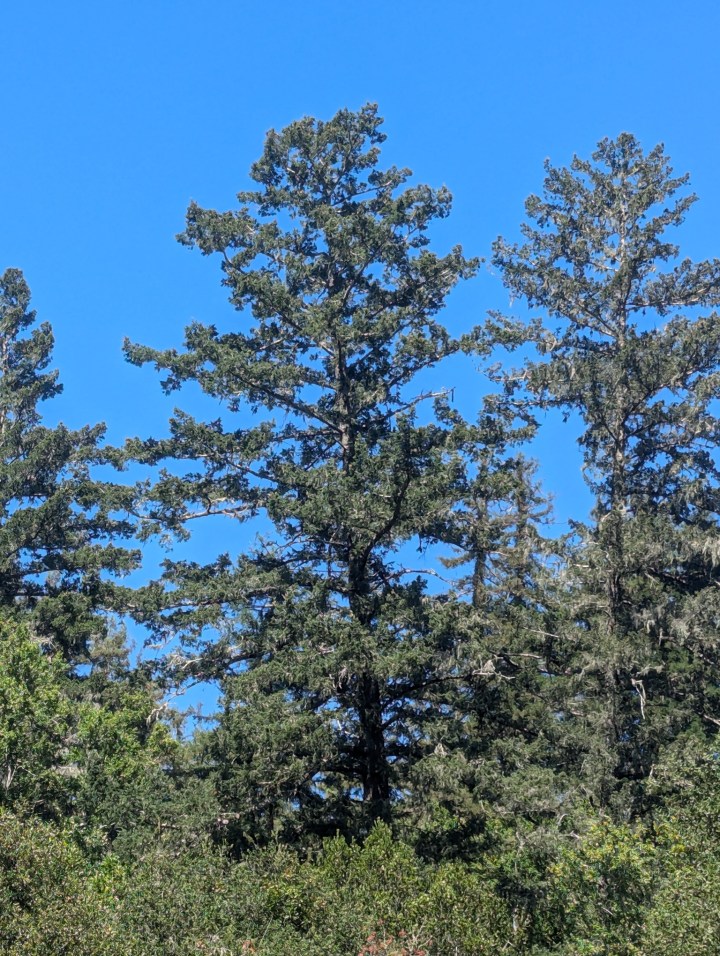
Redwoods grow much too tall for this particular application.

The worst part of getting stuck in traffic on the West Valley Freeway was actually not that I was without a Buick. It was the objectionable view of ridiculously dysfunctional landscaping that flanks newer section of the freeway south of Steven’s Creek Boulevard. After more than a decade and a half, it should be performing much better than it does.

Instead, it has developed far more problems than the older section to the north. Many of the purple leaf plums have been overwhelmed by their own green suckers. Some of the flowering pears also have serious suckers, or have been damaged by the harsh exposure they get on the side of a freeway. All sorts of plants have succumbed to irrigation problems.

The overly abundant micro-trees like purple leaf plums and crape myrtles are not proportionate to a freeway landscape. London planes will eventually be more proportionate, but are almost as useless for muffling the sound of traffic while they are bare through winter. The few functional features of the landscape are can only be seen in the background.

Meanwhile on the relatively old fashioned Junipero Serra Freeway, the landscape does what it was intended to do when it was planned in the late 1960’s. Where there is enough space, mature eucalyptus trees absorb ambient noise all year. Arizona cypress trees do the same where there is less space. Western redbuds and oleanders add a bit of color whether they get watered or not.

Home gardening may not always get the sort of planning that freeway landscapes need, but deserves the same sort of common sense. Much of what goes into the garden will be around for a very long time, so should be selected accordingly in order to function as intended with as few problems as possible. Yet, it is sometimes worth taking minor risks to get trees and plants that get the job done.

For example, crape myrtles have become much too common because they do not get big enough to cause many problems. They are used as street trees because they will not damage pavement; but they do not get big enough to make much shade or to get out of the way of trucks. Honey locusts may not seem like such a good choice because they may eventually displace pavement when they get older, particularly if watered too much while young; but they are more proportionate and out of the way.

Proper selection of plants simply makes the garden work better. Trendy plants like crape myrtles, London planes, carpet roses and dwarf Heavenly bamboos (nandinas) certainly work well in the right situations, but are not necessarily the best choices for every situation. Desired function, proportion (when mature), exposure, potential problems, maintenance requirements and landscape style are just some of the variables that should be considered when selecting new plants for the garden.

White Flowers Attract Pollinators Also

Phlox happens to excel at white.

Floral color attracts pollinators. Hummingbirds mostly prefer bright red, pink and orange. Butterflies mostly prefer bright orange and yellow. Bees prefer bright blue and purple, but are less discriminating than other pollinators. Of course, these are mere generalizations. Otherwise, the majority of pollinators might ignore species that bloom with white flowers.

Realistically, most flowers do not rely on pollinators for pollination. They rely exclusively on wind, so are just green or brown, and not visually prominent. These include flowers of grasses and conifers. Otherwise, small but prominently prolific white flowers are the next best option. They rely on either or both wind and pollinators for very effective pollination.

For example, firethorn bloom is very appealing to bees and other pollinators. It is also so prolific that some of its pollen disperses into the wind. Its tiny but abundant white flowers can not avoid pollination by one means or the other. Most orchard trees, such as apricot, plum, apple and pear, use the same technique. So do viburnum, photinia and elderberry.

This should not imply that white is a substandard color, though. After all, white flowers do attract pollinators. Several pollinators, such as nocturnal moths, prefer luminescent white flowers. More importantly, many pollinators see more than white. Several types of Insects see ultraviolet. What seems to be white to us can actually be elaborately colorful to them.

Furthermore, white needs no justification. It happens to be the best color option for some garden applications. It brightens visually dark situations, and mingles well with almost all other colors. A few types of flowers, particularly those with distinctive form, excel at white. Calla, camellia, lily of the valley and various lilies are only a few of numerous examples.

Cool season annuals for autumn and winter will soon replace old warm season annuals. White busy Lizzie, petunia, cosmos, alyssum, snapdragon and zinnia are finishing soon. White pansy, viola, dianthus and wax begonia may replace them. Later in autumn, white cyclamen will become seasonal. There are always enough white flowers to choose from.

Protecting Fruit From Birds and Squirrels

Squirrels can be quite destructive.

Ecological balance should be an asset to the garden. Good insects eat bad insects. Certain birds eat more bad insects. The problem is that some visitors to the garden are not so beneficial.

Besides the bad insects that can damage various plants in the garden, there are several types of birds and squirrels that compete for nuts and fruit. Birds and squirrels are much more aggressive in their tactics than insects are, and are often more difficult to control.

Some people like to provide alternate sources of food for hungry birds. However, birds that crave fresh berries are not so likely to be distracted by dry birdseed in a bird feeder.

Flash tape (which is strips of silver Mylar) or unwanted CDs hung prominently in fruit trees repels birds for a while, but  eventually fail to impress. Such bling should be put out in the garden only as fruit starts to become attractive to birds. If hung out too early, birds become accustomed to them and will not be deterred by the time the fruit ripens.

Flash tape or CDs should be placed where they will flutter in the breeze and can be seen from most perspectives, and may be more effective if moved every few days. Scarecrows are much more work to move about, but are no more effective. Besides, they can be unpopular with neighbors.

Bird netting is more effective to keep birds away. It can be installed over fruit trees a week or more before the fruit ripens. It should be tied around the trunk below lower branches or extend to the ground if birds are persistent enough to look for access through it. Netting should be removed when the fruit is harvested, so that stems to not grow through it.

Squirrels are more of a challenge. They have no problem getting through netting, and do not mind flashy bling. Squirrels may temporarily avoid dummy owls that repel pigeons and rats, but eventually realize that they are not a threat. Poison baits are dangerous to cats or dogs or anyone else that may be interested in poisoned squirrels, particularly since squirrels are so easy to catch as they succumb to poison!

Plastic rodent guards (or even sheet metal) wrapped around the trunks of fruit trees block access to squirrels because they are too smooth for rodents to get a grip into. Some types flare out too far for rodents to reach around. Others are too wide (from top to bottom) for squirrels to reach over. They should be located at least six feet above the ground so that squirrels do not simply jump past them from the ground.

However, rodent guards are only effective if all other access is also blocked. Lower limbs should be pruned about six feet above the ground, as well as six feet from roofs, fences, other trees or anything else that squirrels can jump from. This can be somewhat of a hassle when it is time to harvest ripe fruit that is out of reach.

Late Summer Flowers Bloom Now

Pot marigold is an autumn annual.

Spring is the season with the most flowers. Winter is generally the season with the least. That is, of course, a generalization. There are plenty of flowers that bloom exclusively for winter color. Plenty more bloom randomly throughout the year, regardless of season. For now, late summer flowers are the most prominently colorful. Autumn flowers will be next.

Realistically, no bloom is random. Even flowers that bloom randomly throughout the year do so only because they can. Such flowers are mostly from mild climates where they can disperse seed at any time. Any pollinators that they rely on are also active throughout the year. Many randomly blooming flowers can effectively conform to more distinct seasons.

Most flowers bloom within a distinct season because it is most convenient for them. Most bloom for spring to maximize the time for their seed to develop before winter. Many of the earliest are tiny but abundant because they rely on wind for pollination. Later flowers can be bigger and more colorful to attract pollinators. Late summer flowers are no exception.

Different flowers have different priorities. Some of the earliest spring bloom needs time to produce seed after bloom. Several late summer flowers conversely need time to develop their blooms. Then, they produce seed relatively quickly before winter. This is why some late summer flowers are bolder but less abundant than spring flowers. They require time.

For example, sunflowers with relatively small blooms may bloom as early as late spring. However, those with bigger and bolder blooms are more familiar as late summer flowers. Such big blooms do not grow quickly, but are ready for their late pollinators nonetheless. They compensate for their lack of abundance with spectacularly grand individual bloom.

Many late summer flowers happen to be related to sunflowers. They include coneflower, dahlia, zinnia, sneezeweed, aster, and cosmos. Dahlias with larger flowers are later than those with smaller flowers. Marigold and chrysanthemum will become more seasonable later and into autumn. Unrelated canna and various sages are blooming well about now.

Gophers

Do not underestimate the destructive potential of gophers!

Many of the yuccas that naturally live in deserts where forage may be scarce are equipped with an efficient defense system. Each leaf terminates with a nasty spine. Leaves are so abundant that the spines are impossible to avoid. It is amazing that these yuccas are as vulnerable as they are to gophers, who simple burrow below all the advanced defense technology to eat the starchy roots and any subterranean portions of stems.

Some of the techniques sometimes used to get rid of gophers are too dangerous to even discuss. Rodent poison (for rats and mice for example) is not only dangerous to other animals that may dig it up, but not often effective since gophers prefer to eat fleshy roots and stems. The only practical poisons can only be applied by licensed pesticide applicators.

New plants can be installed within ‘gopher cages’ that should exclude gophers from the root system at least long enough for the plants to get established. Gopher cages can be purchased ready-made, or can be constructed easily from chicken wire. They only need to be as deep as the planting hole, but can be wider for perennials that spread.

Gopher cages do not protect all roots, since some extend through the cage to disperse; but should protect enough roots to keep plants alive if outer roots get damaged. By the time the cages deteriorate, the plants within should be established enough to survive gopher infestation for a while; although even large plants can be killed by unrestrained gophers.

Properly used traps are the most practical means of controlling gophers. Traps should be installed in pairs, even though each pair typically catches only a single gopher. If possible, traps should be installed away from any gopher cages that may be present, since cages are difficult to work around, and nearly impossible to release from a sprung trap.

Once the entrance to a gopher run is found under a mound of freshly excavated soil, the entrance, which is typically filled with loose soil, should be excavated back as far as the main run, which extends perpendicularly to the right and left. The main run should be cleared of loose soil.

Each of the two traps can then be set and gently placed within the main run in each direction. A trap should be held by the spring end so that the claws and lever extend into the run. Wires attached to the spring end of the traps are easier and safer to pull the traps out with later, instead of digging the traps out. These wires can be attached to a stake to make them easy to find later.

The entrance hole should then be buried. Air circulation from outside will prompt the gopher to collect loose soil to plug the hole, and push the loose soil ahead, springing the trap prematurely.

The gopher within may not be interested in using the same entrance to expel soil, but will likely use the same run. Two traps are used because there is no way of knowing which direction the gopher will approach from. The unfortunate gopher can be removed in a day or so; so that the traps can be set into another run where fresh excavation has been observed.

Binding For Straighter Tree Trunks

Proper binding promotes straight trunk growth.

Staking is not quite the same as binding with stakes. It is more for the benefit of the roots than the trunks, which is what binding is for. Staking should support new trees only while such trees disperse roots for adequate stability. As trees do so, stakes become obsolete. Actually, stakes that remain for too long may be detrimental to healthy tree development.

Binding with stakes promotes straight trunk growth. It is particularly practical for trees that naturally develop crooked or multiple trunks. It is a technique that is quite common within nurseries, although not home gardens. However, many trees retain binding stakes when they arrive from nurseries. For a while after planting, some continue to benefit from them.

However, binding may be more detrimental than staking if it remains for too long. Trunks that become reliant on any sort of supportive stake remain weak or limber. Also, tape that binds trunks to stakes can become constrictive as trunks grow. It is important to remove it before it begins to interfere with trunk expansion. Looser tape can be useful if necessary.

For example, California pepper tree naturally develops a few irregular and limber trunks. To produce trees with single and straight trunks, nurserymen bind single trunks to stakes. They then prune out other trunks and low limbs until main trunks attain an optimal height. Because they are still limber, trees remain bound to their stakes while available for sale.

However, such stakes provide only support for trunks. They do nothing for stability while trees disperse roots into their new gardens. Additional staking with heftier stakes may be necessary for that. Such stakes must extend into undisturbed soil below the roots of such new trees. If possible, it is better to merely replace binding stakes with supportive stakes.

The next best option is to replace tape that binds young trunks to stakes with looser tape. This maintains the straight form of such trunks without inhibiting their growth. Supportive stakes, in addition to binding stakes, maintain their upright posture. Most trees need only supportive stakes, realistically. A few trees, especially new palms, need no stakes at all.

Sun Scald

Vegetation needs sunlight, but sunlight can be excessive.

It was sad to see the removal of a rather mature but unstable Italian stone pine from the neighborhood. Fortunately, the arborist who removed it was careful to avoid damaging the garden below. Yet, after all the effort, the garden did not remain undamaged for long. The healthy bear’s breech (acanthus) and young Australian tree ferns that had been shaded by the dense canopy of the pine got roasted by the first warm weather.

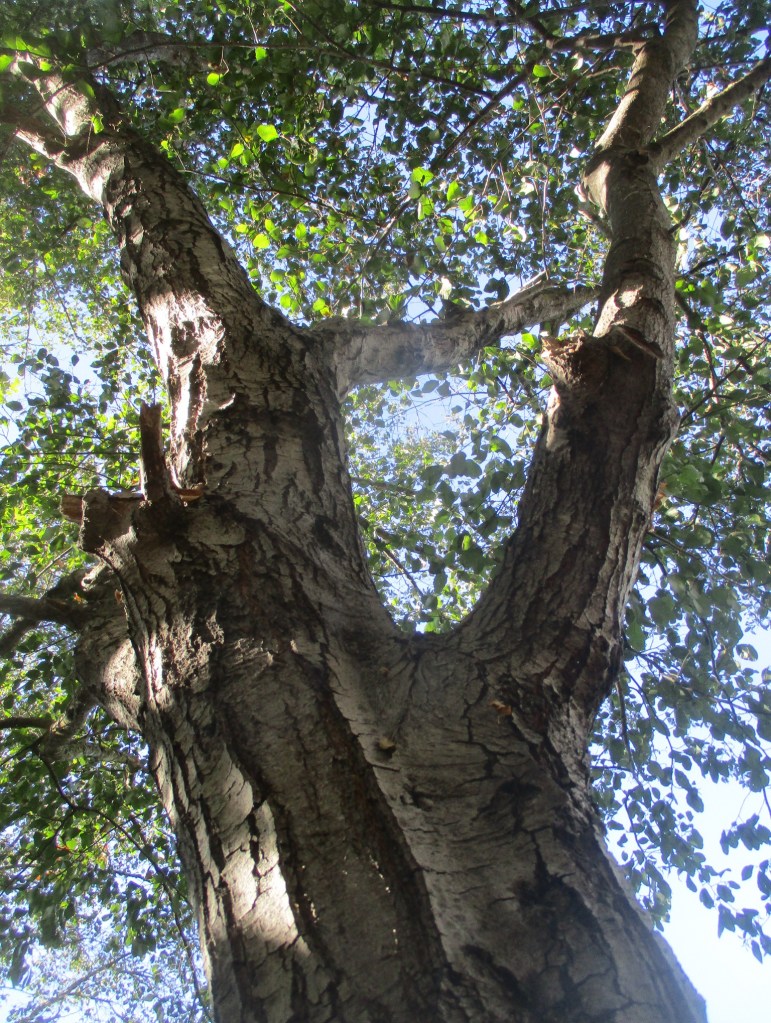
These perennials got roasted because they were adapted to shade, but could not adapt soon enough to exposure to direct sunlight. This illustrates one of the main problems of topping trees and exposing the interiors of formerly shaded canopies. (‘Topping’ is the disfiguring removal of major portions of the upper canopies of trees.) Like perennials on the ground, foliage as well as stems and main limbs within the canopies of topped trees gets damaged by increased exposure. Although most perennials eventually adapt and recover, topped trees are often damaged too severely to recover.

Foliage can be replaced, but stems and limbs are not so expendable. Deciduous trees and most evergreen trees will replace damaged foliage within the first year. Deciduous trees that get topped while dormant in winter actually do not exhibit foliar damage, since foliage that emerges in spring will be adapted to the exposure that they grow into. However, formerly shaded stems that suddenly become exposed by topping are easily damaged by sun scald, which is like sunburn of the bark.

Sun scald deteriorates into open wounds which leave inner wood susceptible to decay. Minor sun scald of small limbs can eventually be compartmentalized (healed over) before it becomes too much of a problem. Major sun scald can destroy main limbs and even trunks, causing additional disfigurement to trees that were already disfigured by topping! Even if sun scald does not develop, the open wounds left from topping are often too large to be compartmentalized, so remain open to decay.

Regardless of sun scald, topping is more directly disfiguring, by removing well structured limbs and trunks, and causing the development of disfigured and structurally unsound limbs. Secondary growth that emerges in response to topping or severe pruning is weakly attached to the mature limbs that it emerges from because it did not grow together with the mature limbs. It breaks away easily in wind, or simply because it grows too vigorously and soon gets too heavy for weak unions.

Topping actually causes more problems than it is thought to remedy. In some situations, it is actually more practical to remove potentially hazardous trees than to make them more hazardous by topping them.