Deciduous Fruit Trees Need Pruning

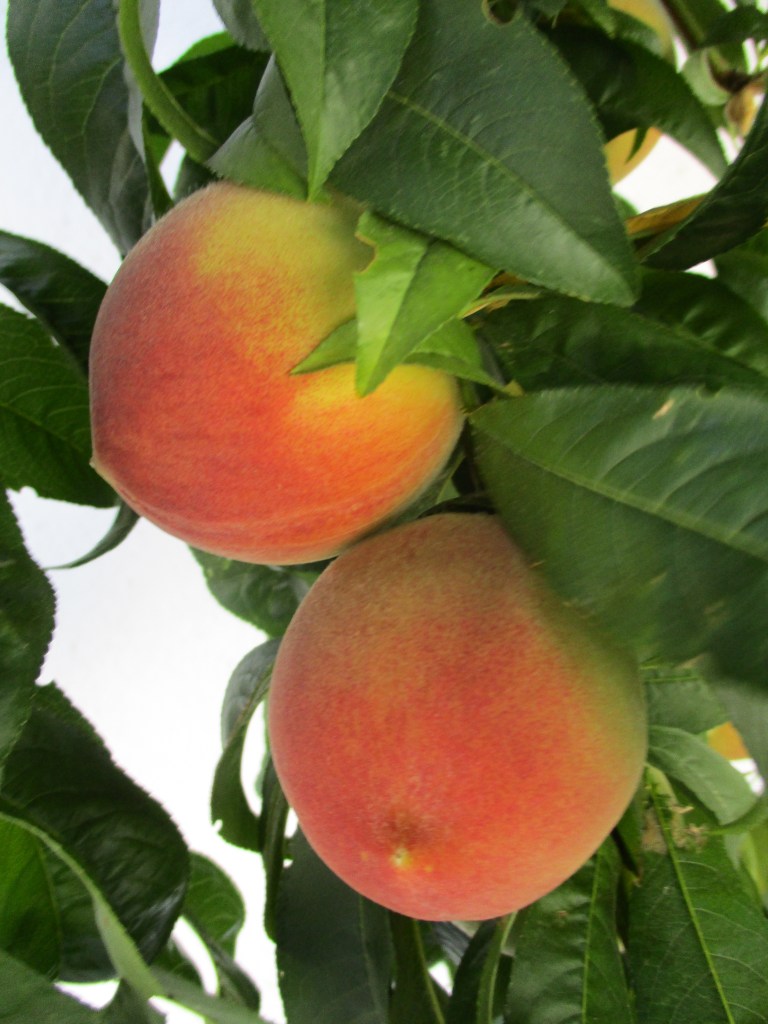
Prune now for better peaches later.

Many plants should get most of the pruning they need while they are dormant in winter. Such pruning is less stressful because it happens while plants are naturally sedated. Some plants that need aggressive pruning during their winter dormancy may need no other pruning until the following winter. Most deciduous fruit trees conform to this category. Their pruning is rigorous and specialized.

The innately aggressive pruning that deciduous fruit trees require may seem to be brutally unnatural, but is very justifiable. It is necessary to compensate for unnatural production. After centuries of selective breeding, most deciduous fruit trees produce more fruit than they can support. Their fruit is unnaturally abundant, unnaturally bulky, or both. Such improvement has distinct consequences.

Unlike their wild ancestry, many modern deciduous fruit trees would not thrive for long without intervention. The weight of their fruit eventually breaks and disfigures limbs. Such breakage exposes sensitive bark to sun scald, and leaves wounds open to decay. Insect and disease pathogens proliferate in deteriorating growth. Furthermore, messy excess and unreachable fruit attracts vermin.

Pruning improves the structural integrity of deciduous fruit trees so that they can support their fruit. It also concentrates resources into fewer fruits of superior quality, rather than allowing production of inferior surplus. Invigorated vegetative growth is more resilient to pathogens. Proper pruning removes dead, dying, damaged and diseased growth, the ‘four Ds’, as well as unreachable growth.

The main categories of deciduous fruit trees are stone fruits and pomme fruits. Stone fruits are of the genus Prunus. They include peach, nectarine, apricot, plum, prune, cherry, their hybrids, and almond. (Almonds are the ‘stones’ of their fruits.) Pomme fruits are apple, pear and quince. Peaches need more aggressive pruning than cherries, simply because their fruits are so much bigger.

Pomegranate, persimmon and fig also need specialized pruning while dormant through winter.

Prune Fruit Trees While Dormant

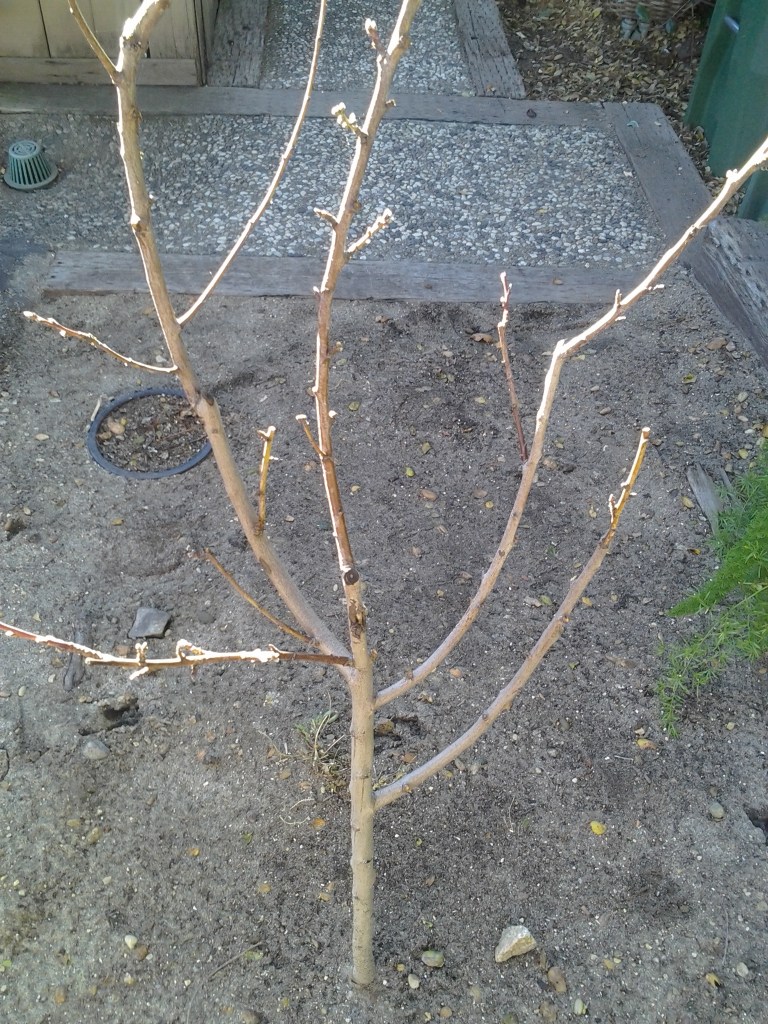
Dormant fruit trees should be pruned aggressively.

After centuries of breeding for abundant production of unnaturally large fruit, deciduous fruit trees have become dependent on specialized pruning while they are dormant through winter. Without pruning, most eventually become overgrown and overwhelmed by their own fruit. The weight of excessive fruit disfigures and breaks limbs. Pathogens proliferate within distressed foliage, crowded fruit and surplus fruit that falls to the ground.

Pruning not only improves the structural integrity of the limbs, but also limits the production and weight of the fruit that will be produced. Limiting production concentrates resources, so that there are fewer, but considerably better fruits, instead of too many inferior fruits. Concentrating the growth of the fewer new stems that develop in spring promotes vigorous growth that is more resistant to pathogens. Ideally, pruning also limits the height of fruit trees, so that much of the fruit develops closer to the ground.

Peaches, nectarines, apricots, plums, prunes, and cherries are all relates ‘stone’ fruits (of the genus Prunus), so require various degrees of similar pruning. Peach trees produce the heaviest fruit, so need the most aggressive pruning. Cherries trees produce significantly lighter and smaller fruit, so get pruned relatively minimally. Almonds (which are actually the ‘pits’ of a similar type of stone fruit) get shaken from their trees, so there is no advantage to keeping production close to the ground.

The ‘four Ds,’ which are ‘Dead, Dying, Diseased and Damaged’ stems should be pruned out first. Then the vigorous stems that grew last year should be thinned and cut back, but not removed completely. They are the stems that will bloom and develop fruit the following year. Pomme fruits, such as apples, pears and quinces, develop on similar newer stems that should likewise be pruned down, but many also develop on lower ‘spur’ stems that elongate so slowly that many spurs may never need to be pruned.

Most young deciduous fruit trees will need more pruning each year as they grow. Fortunately, pruning becomes more familiar with experience. Because pruning fruit trees is so specialized and important, it is worth studying more thoroughly.

Winter Is Time For Pruning

Pomegranate trees appreciate major specialized pruning.

Plants are unable to migrate to warmer climates for winter like so many migratory birds do. They are immobile for their entire lives. Only potted plants can move to more sheltered situations when the weather gets too cool for them. Some get to live inside as houseplants. Otherwise, they all must contend with seasonally changing weather. Most are impressively efficient with how they do so.

Most that do not adapt efficiently to cool winter weather are tropical species. Tropicals that are native to high elevations can tolerate cold weather. However, many of the familiar tropical species are from low elevations where they never experience cold weather. Frost damages or kills them. Warm season annuals do not tolerate cool weather either. They just die at the end of their season.

Otherwise, almost all other plants go dormant through winter, at least to some degree. Even evergreen plants, which may not seem to go dormant, grow much slower during winter, or do not grow at all. Deciduous plants are much more obvious about their dormancy, because they defoliate. While bare, they are less susceptible to damage from wintry weather. Dormancy is like hibernation.

This is why winter is the best time for pruning most plants. While dormant, they are less susceptible to distress associated with pruning. Some plants expect some degree of damage from wintery weather during their dormancy anyway. They wake in spring, with no idea of what happened while they slept, and resume normal growth. Winter pruning conforms quite naturally to their life cycles.

There are, of course, a few exceptions. Citrus and avocado should not be pruned during winter. Such pruning stimulates new growth, which is sensitive to frost. Maple and birch should have been pruned earlier. They bleed annoyingly if pruned late into winter. Flowering trees that produce no fruit, such as flowering dogwood and flowering cherry, should be pruned after bloom, late in spring.

Deciduous fruiting trees, such as apricot, cherry, plum, peach, apple and pear, require specialized pruning during winter.

Winter Is For Getting Bare

Bare root plants do not look like much . . . yet.

Even before the last of the Christmas trees vacate nurseries, bare root nursery stock begins to move in, and will be available through winter. As the name implies, ‘bare root’ stock has bare roots, without media (‘potting soil’) or cans (pots) to contain the roots. Many are temporarily heeled into damp sand from which they get dug and wrapped in newspaper when purchased. Others are packaged in damp wood shavings or coarse sawdust contained in narrow plastic bags.

Bare root plants do not mind the lack of media because they get dug, shipped, sold and finally planted into their permanent locations all while naturally dormant through winter. They were in the ground when they went dormant, and will be back in the ground in their new homes by the time they wake up in spring. Because they have not already developed a densely meshed root system within a limited volume of media, they happily disperse new roots directly into the soil where they get planted.

Because they lack relatively bulky cans, bare root plants need less space in nurseries. Many more varieties of deciduous fruit trees, grapevines, roses and berries can therefore be made available. They also cost about half as much as common canned nursery stock.

If bare root plants will not be planted immediately, their roots should be heeled into damp dense mulch (not coarse chips) or soil, and watered. They can be soaked in buckets of water if planting will be delayed only for a day or two. Packaged plants need not be heeled in, and can wait in the shade for more than a week.

Planting holes do not need to be any wider or deeper than the roots. If the soil is loosened too deeply, in will likely settle and cause the new plants to sink. Graft unions must stay above the surface of the soil. (Graft unions are evident where rose plants branch, or as kinks low on tree trunks.) If backfill soil is amended at all, it should be amended only minimally. Otherwise, roots may not want to disperse very far. New plants should be soaked twice in order to settle soil around the roots, but if it rains soon enough, they may not need to be watered again until they start to grow in spring.

Once planted, most bare root plants need some sort of pruning. Fruit trees typically have more stems than they need to maximize the options for their first structure pruning.

Christmas Trees Are Major Cut Foliage

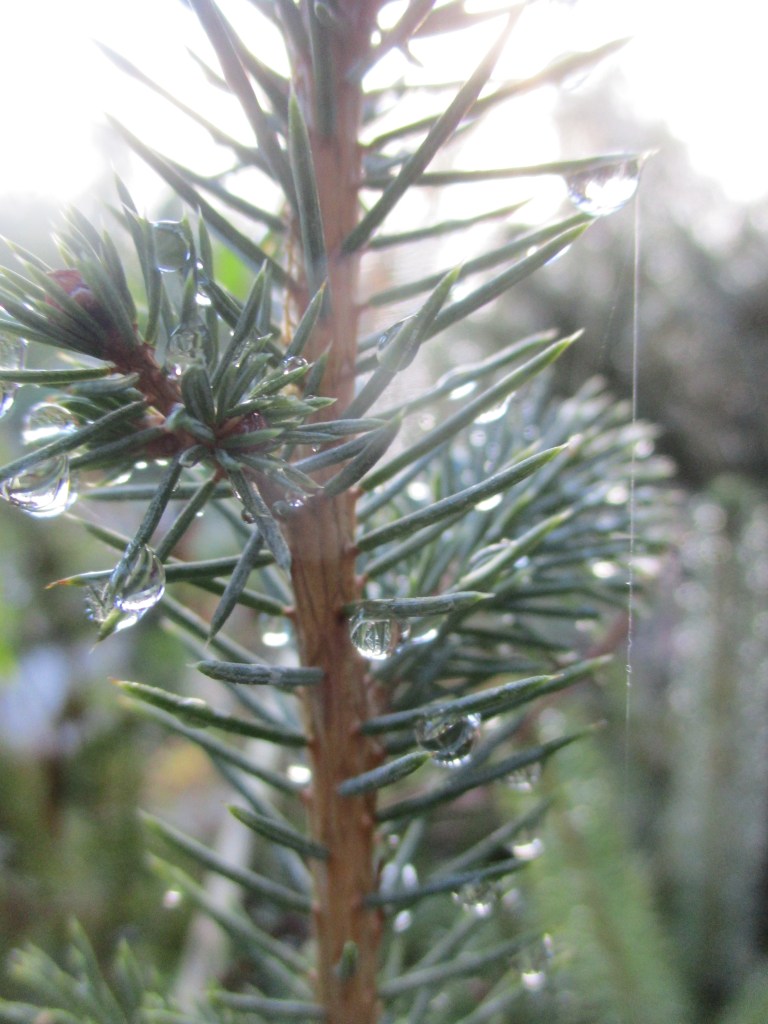
Few Christmas trees are naturally compact.

Cut foliage is a common ingredient of ready-made mixed bouquets. Bundles and individual stems of cut foliage are available with cut flowers from florists. Cut foliage is the primary component of most wreaths and garlands that are now so popular for Christmas décor. It is another horticultural commodity like cut flowers, bulbs or nursery stock. Cut foliage is like vegetables that no one eats.

Cut Christmas trees are extreme cut foliage. They just happen to be much larger than stems of cut foliage that become wreathes and garlands. They grow on plantations like other crops. Contrary to a rather popular belief, Christmas trees are a renewable resource. Furthermore, cut Christmas tree production is less detrimental to the environment than the production of live Christmas trees.

Time and space are the only advantages of live Christmas tree production. As they grow, they occupy less space for less time. Obviously, cut Christmas trees need more space and time to grow. However, they do not consume proportionate quantities of water and fertilizers. Nor do they necessitate the consumption of the various plastics and synthetic potting media that potted trees need.

Regardless of the best intentions, few live Christmas trees come home for Christmas after their first. They often get too shabby through warm and dry summer weather to bring back in. The small and inexpensive sort with attached decorations rarely survive potted for more than a few months. If live Christmas trees were less perishable, their consumptive production could be more justified.

Whether they retire after a single Christmas or several, live Christmas trees must recover from previous shearing. Only dwarf Alberta spruce are naturally densely conical. Pruning other species to strict conical form is unnatural and disfiguring. As they recover, live Christmas trees need space to grow. Many, such as Italian stone pine and Canary Island pine, get far too big for urban gardens.

Experienced arborists concur that many problematic trees were originally small and seemingly innocent live Christmas trees.

Jack Frost Nipping At Foliage

Yuck! Freezer burn!

It is impossible to deny that the weather has been unusually cold when tough perennials like ligularia and farfugium express symptoms of frost damage. Late autumn and winter are expected to be cold, but not as cold as it has been recently. Ligularia, farfugium and most tough perennials should recover as if nothing happened. Cannas will naturally die back or need to be cut back to the ground later, but their resilient rhizomes should be safe, and regenerate later as winter ends. Unfortunately, sensitive perennials like pelargoniums may have been killed if frost damage extended too far into lower stems and roots.

The best way to protect plants from frost is to grow only plants that are not so vulnerable to frost. The problem with this technique is that it is too limiting. Abstaining from the few most sensitive plants like bananas and angel wing begonia probably would not be a problem for most of us. However, avoidance of moderately sensitive plants would involve familiar plants like bougainvilleas, lemons and split leaf philodendron.

Many of the smaller sensitive plants like angel wing begonia, can be grown in containers that can be moved to more sheltered spots if and when necessary. They can be brought inside or moved onto covered porches. If they only need to be protected for a few days during the coldest weather, they can be moved into garages. The problem with this technique is that many plants get too big for containers.

Bougainvilleas eventually get big, and do not like to be grown in containers anyway. They should be planted in warm spots in the garden not only because their foliage can be damaged by frost in winter, but also because they like warmth during summer. A south facing wall with an eave above provides a nice warm exposure, a bit of protection from frost above, and a slight bit of ambient warmth from the building behind it. Even if the foliage gets frosted, the main stems within should be safe.

During the coldest nights, sensitive foliage can be protected by burlap, paper, plastic or any sheeting suspended above by stakes or any light framework. With this technique, only exposed foliage or foliage that touches the sheeting will be damaged. It is unfortunately not practical to tent large plants like giant bird-of-paradise.

Even though it is unsightly, unprotected foliage and stems that get damaged by frost should not necessarily be pruned away immediately. This damaged foliage insulates and protects sensitive stems below. Besides, such early pruning can stimulate new growth that will be even more sensitive to frost later.

Colorful Berries Brighten Wintry Gardens

Bright red attracts hungry overwintering birds.

It is no coincidence that so many colorful berries ripen in autumn as migratory birds migrate south for winter. Such colorful berries are intended for both migratory and overwintering birds. Rodents and other wildlife are welcome to take what they want as well. Most colorful berries are bright red, to get the attention of birds and wildlife. They are a convenient ‘grab and go’ size, and abundant.

Plants who produce colorful berries are pleased to provide in exchange for the dispersion of their seed. It is an ingenious system. Everyone involved does what they do best. Plants produce their colorful berries to exploit wildlife. Wildlife exploits the berries. Seed within the berries survives digestion, and gets ‘deposited’ elsewhere. Most types of berry seed germinate best after digestion.

Colorful berries are popular in home gardens either to attract birds, or because they are delightfully colorful for autumn and winter. Of course, many that should remain colorful attract birds instead. Fortunately, birds are good sports, and often leave colorful berries long enough to blet (age). Then, polite birds consume the berries before they get messy, and ideally take their mess elsewhere.

Various hollies are famous for their colorful berries. However, not many hollies reliably produce many berries here. Because they are dioecious (of separate genders), commonly available female plants are fruitless without rare male pollinators. Fortunately, modern hollies are becoming available in conjunction with pollinators. Otherwise, the best colorful berries are of the Rosaceae family.

Firethorn is the most profuse and most familiar of the colorful berries through autumn and winter. A few species and cultivars of Cotoneaster can be almost as prolific, but with more subdued color and stature. Toyon is a related native species that performs well in unrefined landscapes. English hawthorn produces similar colorful berries, but develops into a small and gnarled deciduous tree.

Unfortunately, none of these colorful berries are notably edible. In fact, some are mildly toxic.

Not So Merry Christmas Trees

Cut Christmas trees are just really big cut foliage, like what comes with cut flowers.

By now most people have already acquired their Christmas trees. Some are live trees in containers. Some are artificial. Most are cut firs, pines, or alternatively, spruces, cedars, cypresses or even junipers. For at least the next two weeks, these trees dutifully maintain their healthy green vigor to brighten our homes with Christmas cheer.

Cut trees should have no problem lasting from the time they were originally cut through Christmas, as long as they get plenty of water. Artificial trees do not have much choice in the matter. Live trees are probably more reliable than cut trees are in regard to freshness, but can be more awkward to accommodate in the home, since they are more likely to leak excess water that can damage floors. If they they get a bit dry, live trees can also be sensitive to relatively dry and warm interior air after spending autumn out in cool and humid garden environments.

The main problem with living Christmas trees though, begins after Christmas. Spruces and other compact evergreens that can work as Christmas trees for several years need to be returned to the garden and maintained until next Christmas. Retired living Christmas trees, including those common, small trees that can be purchased with a few decorations already wired to their stems, eventually need to be planted out into the garden. Circling roots (that grow around the perimeter of a container in search of a way out) need to be severed so that they do not get constricted as they mature.

Unfortunately, with few exceptions, living Christmas trees mature into significant trees when they get the chance to grow. Those common, pre-decorated trees are most commonly juvenile Italian stone pine or Canary Island pine, which become very large trees. Because they seem so innocent as small potted trees, they often get planted in very awkward situations where they do not have enough space to grow without damaging nearby features.

Planting such a tree out in a forest is not practical, since it will not survive through the first year without supplemental watering. Their roots are just too confined to reach out for moisture. Even if such a tree could survive, it would not be an asset to the forest, since it would be an exotic (non-native) species.

Planters Are Overrated But Functional

Some plants should always be confined.

Container gardening is overrated. The endemic soil here is not so bad that nothing will grow in it. What is now suburban gardens was formerly famously productive farmland! Soil amendments make the soil more comfortable to plants with more discriminating taste. Plants that are too discriminating are probably not worth accommodating. With few exceptions, planters are unnecessary.

Plants naturally want to disperse their roots into the soil. Drought tolerant plants disperse their roots even more extensively. That is how they find enough moisture to be drought tolerant. If deprived of such root dispersion, they are always reliant on watering. Plants prefer the insulation of soil too. Many types of planters can get uncomfortably cool in winter, and uncomfortably warm in summer.

Besides, planters clutter landscapes, and occupy space on hardscapes. Decks rot. Patios stain.

The main advantage of planters is their portability. Plants that are sensitive to frost can move to shelter before the weather gets too cool. Plants that are spectacular only while blooming can move for more prominent display during bloom. For those who have not settled into a permanent home, plants in planters are able to relocate. Planters on patios or decks can move about like furniture.

Houseplants obviously grow in planters because not many houses contain enough soil for them to live in. Houseplants can move about just like planters in the garden. That is helpful for those that need a better exposure for winter than they enjoy for the summer. Some might like to go into the garden during mild weather, or for a rinse in light rain. Cascading plants can hang from the ceiling.

Planters can effectively confine invasive plants as well. Montbretia is so invasive that some people will not grow it without containment. (Deadheading to prevent seed dispersion is important too.) Horseradish often grows in tubs for confinement, as well as to facilitate harvest. It is easier to dump the potting media from a planter, and separate the roots out, than to dig roots from the ground.

Potted Plants Need Work Too

Potted plants do not have much soil volume to work with.

Potted plants can be a problem any time of the year. Some want more water than get. Most get too much water or do not drain adequately. Large plants get constricted roots if pots are too small. The roots of some plants get cooked in exposed pots that collect too much heat from sunlight. Besides, too many pots just seem to be in the way in otherwise useful spaces on decks, patios and anywhere else trendsetting landscape designers want to put them.

Now that the weather is getting cool and rainy, potted plants are not as active as they were during warm weather. Many are dormant. Although few demand the attention that they got during warmer weather, plants still need to be tended to appropriately through autumn and winter.

Cool season annuals, which are also known as ‘winter’ annuals, should get groomed as long as they are performing in the garden, just like warm season annuals get groomed through summer. Deteriorating flowers should be plucked from pansy, viola, primrose, Iceland poppy, calendula, dianthus, stock, chrysanthemum and cyclamen because they can mildew and spread mildew to developing flowers and foliage. Unplucked cyclamen and calendula can develop seed which diverts resources from bloom.

Pots that are out in exposed areas will not need to be watered while they get enough water from rain. The problem is that many that do not drain adequately can get too much water from rain and stay saturated. Dormant and defoliated plants do not need much moisture at all. Even evergreen plants do not need as much as they do while active during warm weather, because cool and humid weather inhibits evapotranspiration (evaporation from foliar surfaces).

Potted plants under eaves also need less water while the weather is cool and humid, but need to be watered nonetheless because they are sheltered from rain. Plants in hanging pots typically drain and dry more efficiently, so probably want a bit more water. Even a few sheltered small plants in the ground may occasionally want to be watered during rainy weather if they do not extend enough roots where they can get moisture from rain beyond the sheltered area. Sheltered plants are actually the most likely to be neglected because watering does not seem so important when it is raining.