Watering Trees Is Still Important

50812thumb
Trees in lawns, even drought tolerant sorts, expect to be watered somewhat.

All the optimistic predictions of a rainy winter do not help with the drought yet. Nice warm weather only makes the garden even drier. Many of us have let our lawns dry out, maybe with plans to replace them later. Some have decided to replace lawn with artificial turf, hardscape or other landscape features.

The problem with this is that trees and other large plants that have dispersed their roots under the lawns are thirsty for the volumes of water that they had gotten while the lawns were well watered. They can survive longer than lawn does without watering, and will adapt to less water when they do get it, but they can not do without water completely.

It seems silly to water artificial turf or new decking, but it is sometimes necessary, especially for thirsty trees like willow, ash, elm and redwood. This is why some artificial lawns are outfitted with the original irrigation systems of the lawns that they replaced.

Drought tolerant trees, like certain oaks and most eucalypti, are more adaptable. Of course, those that were originally watered generously are greedier. Those that got only minimal watering may not notice if they get none at all. Regardless of their requirements, they all can be watered less frequently than lawns were, but should be watered generously when they do get watered.

Generous, but infrequent watering soaks into the ground better to satisfy deep roots. It is actually what most trees prefer. Lawn needs frequent watering only because the roots are so shallow. Generous, but infrequent watering uses less water not only because less evaporates from the surface of the soil, but also because less water gets used.

For example, watering weekly for 20 minutes is a generous volume of water, but is still less than watering for 15 minutes three times each week. It is only 20 minutes of watering compared to forty five minutes of watering.

Shade Trees Adapt To Urbanism

00819thumb
Traditional shade trees get quite large.

Modern urban home gardens are shadier and more confined than older suburban home gardens originally were. Modern homes are both taller and closer together on smaller parcels. Fences are also taller to compensate for the minimal proximity of adjacent homes. Less sunlight reaches the ground. There is not as much space available for shade trees. Nor is there as much use for them.

Huddled modern homes are simply not as exposed to sunlight as older suburban homes were. Sunlight is more of an asset than a liability. Walls, ceilings and windows are so thoroughly insulated that shade is less important. Solar arrays up on roofs must remain exposed to sunlight. Smaller and denser trees are more important for obscuring views of adjacent homes, rather than for shade.

Shade trees are still useful for rural and suburban homes. Shade helps to keep older and less energy efficient homes cooler through warmer summer weather. If strategically situated to the south, west or southwest, they shade homes during the warmest time of day. Well proportioned trees do not darken too much of their gardens. Deciduous trees allow warming sunlight in through winter.

The popularity of modern urban homes is directly proportionate to the popularity of small evergreen trees. Such trees fit into smaller garden spaces, and permanently obscure unwanted scenery. Big deciduous shade trees that are practical for larger garden spaces become obtrusive in confined spaces. Defoliation in winter reveals unwanted views, and deprives the landscape of privacy.

Some of the more practical of small evergreen trees are actually large shrubbery. English laurel, Carolina cherry, photinia, hopseed bush and various pittosporums can get high enough to obscure neighboring windows. All are conducive to pruning if they get too tall. If staked on single straight trunks, or pruned to expose a few sculptural trunks, they do not occupy much space at ground level.

Tristania laurina, and some melaleucas are naturally small to midsized evergreen shade trees. Some species of Podocarpus can be pruned as midsized trees.

Some Trees Are All Bark

P00613-1
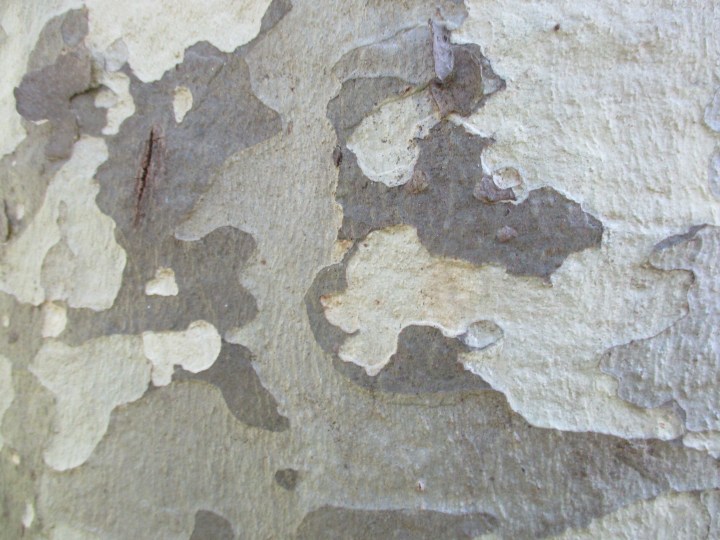
California sycamore bark is very distinctive.

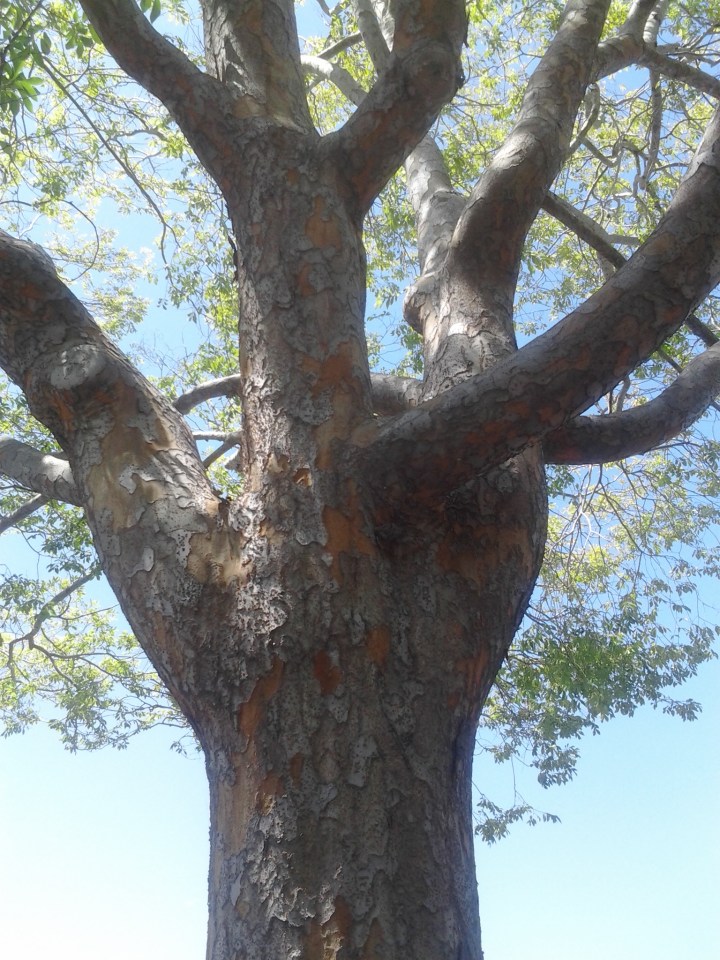
Flowers provide color and texture. So does foliage. What is less often considered is that the bark of many trees and large shrubbery can be aesthetically appealing as well. Bark is usually thought of merely as something to cover up the trunks and limbs of the plants that provide all the colorful and textural flowers and foliage.

Coral bark Japanese maple and red twig dogwood (and yellow cultivars, which are  selectively bred varieties) turn color as they defoliate for winter. However, the color is limited to the twigs and smaller stems. Red twig dogwood often gets cut back at the end of winter so that it will produce more twigs for the following winter. Mature stems and trunks are not as interesting.

Palms and yuccas do not actually have bark, but are still texturally interesting. Giant yucca trunks are weirdly sculptural. Mexican fan palm can be  ‘shaven’ to expose lean trunks with a finely textured exterior, but are more often adorned with the intricately patterned thatch of old petiole bases (leaf stalks). Windmill palm is uniquely shaggy with coarse fiber.

Arbutus ‘Marina’ is a madrone that was developed for home gardens. It is compact and symmetrical, with finely textured flaking bark that reveals strikingly smooth cinnamon-colored bark beneath. Larger manzanitas can be pruned up to expose similar bark on a smaller scale. Smooth Arizona cypress looks much like other cypresses, but with strangely  smooth bark on vigorous stems.

The bark of almost all eucalypti is interesting for one reason or another. Even the notorious blue gum, which  gives other eucalypti a bad reputation, peels away in very long strips to reveal smooth bark that fades from green to pink to tan to gray before peeling away to start the process over again. Some eucalypti have blotched bark. Red ironbark has rich brown bark that is uniformly furrowed.

Lemon gum (eucalyptus) and various birches have strikingly white bark. Lemon gum bark is smooth. Birch bark peels away like paper. Because the trees are so slender, they can be planted in groups so that there are more trunks to display the distinctive bark. These are only a few of the many trees that can impress with mere bark.

Woody Vines Need Constant Attention

00812thumb
Many woody vines have no limits.

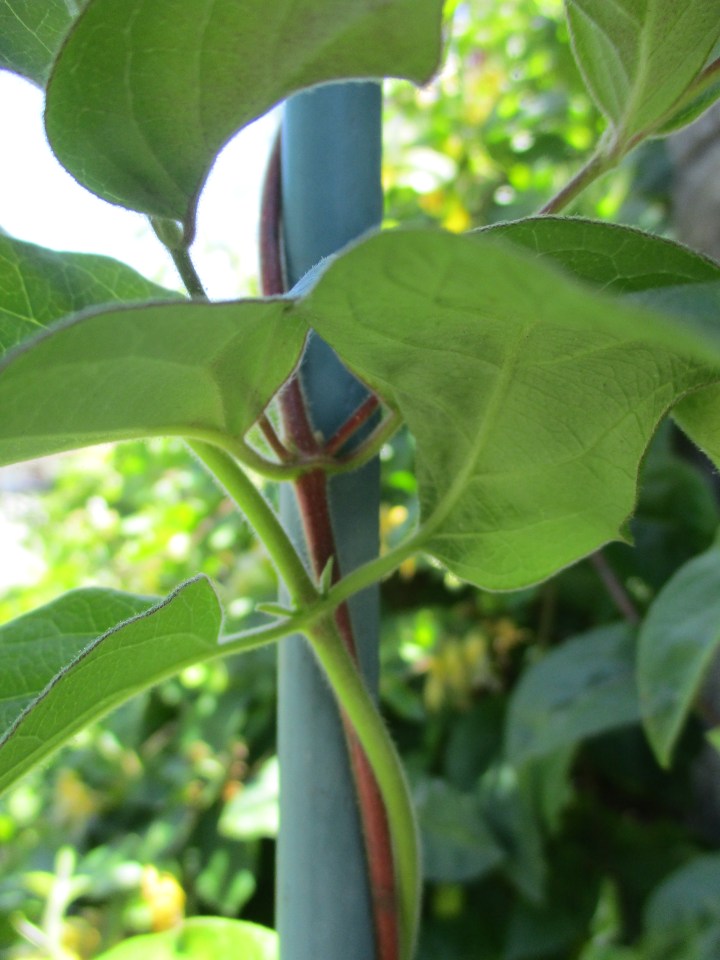
Grapevines that were not pruned aggressively enough last winter are tangled messes by now. Many grapevines that were pruned properly are tangled messes as well. That is their nature. Woody vines like grapevines grow rapidly and vigorously. They rely on other plants for support, and do what they must to get to the top. Woody vines are not concerned about the plants that support them.

Woody vines climb structures also. Some cling to stucco and siding with aerial roots or modified tendrils (holdfast discs), that ruin paint and promote decay. Woody vines with twining stems wrap around posts and beams, and then crush them as they grow. All sorts of vines can dislodge shingles, roof tiles, gutters, downspouts or window screens. Some sneak into basement or attic vents.

Even relatively docile woody vines can get out of control fast. Star jasmine performs well as ground cover, but can climb more than twenty feet up trees if neglected long enough. Pink jasmine, lilac vine and Carolina jessamine are tame enough for lattice, but get overgrown on top if not pruned down. American wisteria is much smaller than Chinese wisteria, but can still strangle small shrubs.

Woody vines are certainly worth growing. Chinese wisteria, autumn clematis, honeysuckle, bougainvilleas and various trumpet vines all have their attributes. They just require diligent maintenance and serious commitment. Most need more than just winter pruning. Some of the more vigorous sorts may need specialized pruning a few times annually. They also need serious accommodation.

Trellises and supportive structures must be resilient to the destructive forces of particular woody vines. For example, Chinese wisteria deserves a trellis or arbor of posts and lumber that its heavy vines will not crush. Boston ivy can climb bare concrete retaining walls, but must not attach to painted or wooden surfaces. No vines should climb on roofs, chimneys, vents, gutters or utility cables.

Just as importantly, woody vines require enough room to grow without crowding or climbing into trees or other plants.

Two Birds With Many Stones

50729thumb
Gravel and stone function like mulch.

Fads are not necessarily bad ideas. Some evolve out of good ideas. Others are recycled old ideas that worked. The current popularity of stone, gravel and artificial ‘dry creek beds’ is probably the result of the drought. Yet, they were becoming popular before the drought. This is not their first time around either. They were popular through the 1970s and the 1950s as well.

Stone and gravel obviously do not need to be watered. Therefore, more area occupied by stone, gravel or dry creek beds equates to less area occupied by plants that want water. Such areas are not as useful as pavement or decking, but are more appealing where space does not need to be useful, and work nicely where the ground it sloped too much for pavement.

Stone around the trunks of mature trees works like an insulating mulch so that lawn grass and groundcover plants can be kept at a safe distance. Otherwise, the water needed to sustain the grass or plants against trunks can cause root or trunk rot. However, stone should not be piled so deeply that it holds moisture or interferes with aeration.

Stone is actually better than mulch in some situations. It does not decay. Stones and larger gravel are not likely to be blown or raked away, although small gravel can be difficult to separate from debris while raking. Since stone does not need to be replenished, groundcloth can be installed beneath it to prevent weeds from growing through.

Artificial dry creek beds do not need to be completely dry all the time. They can actually improve drainage in low spots that get saturated during rain. Stone on groundcloth drains better than soil or plants do. Artificial creek beds that are only ornamental should stay in low spots anyway. They look even more unnatural in high spots that water would not naturally drain to.

A few plants can go a long way in larger areas of stone or gravel, and particularly in artificial dry creek beds. If the stone is done properly and is appealing enough, the plants merely add a bit of color, form and texture, without completely obscuring the stone. Drought tolerant plants are of course more appropriate if the intention of stone is to conserve water.

Collecting Seed For Another Season

00805thumb
From one year to the next.

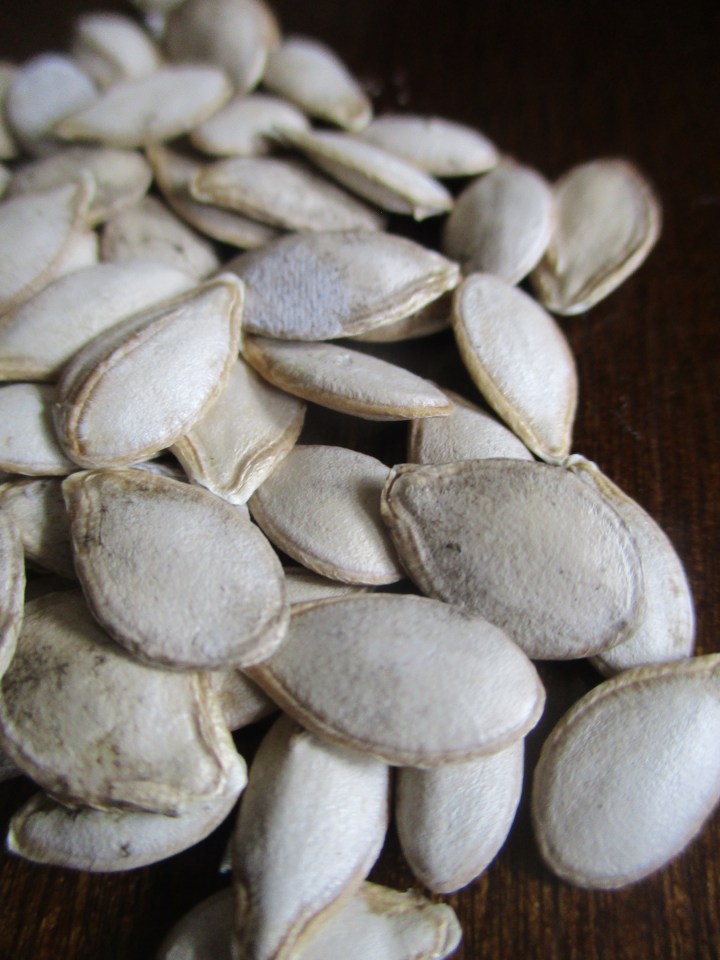
Seed that is available in hardware stores and nurseries came from somewhere. Plants just like those that such seed grows into produced it. Someone, or many someones, collected all that seed to make it available to others. Similarly, several plants in our own gardens produce seed. Anyone who is interested in collecting seed to grow more of the same plants could make good use of it.

After bloom, most flowers deteriorate and disappear into the landscape. Some leave behind desirable developing fruits or vegetables. Many of the flashiest flowers are too extensively hybridized to produce seed. Many produce some sort of seed structure that typically gets removed, or ‘deadheaded’. This diverts resources from seed production to subsequent bloom or vegetative growth.

If not removed, such seed structures can mature to produce viable seed. Those who enjoy collecting seed often intentionally leave a few seed structures for that purpose, instead of deadheading completely. For plants with long bloom seasons, this technique should involve the latest blooms. The same applies to vegetables that normally do not mature prior to harvest, like summer squash.

Such seed or fruiting structures, including vegetables, must be completely mature before collecting ripened seed from them.

Sunflower, cosmos, calendula, marigold, campion, morning glory, columbine, hollyhock and snapdragon are some of the easiest flowers for collecting seed from. California poppy, alyssum, phlox, and several other annuals are happy to self sow their seed, although collecting seed from them is not so easy. Nasturtium and honesty (money plant) seed is easy to collect, but self sows as well.

Collecting seed is limited only by practicality. Some plants, particularly hybrids and exotics (which are not native and may lack pollinators), produce no viable seed. Extensively bred varieties are likely to produce progeny that are more similar to the basic species than the parent. Once collected, some seed need special treatment in order to germinate. All seed should be sown in season.

California Native Plants Exemplify Diversity

00729thumb
Redwoods are the grandest native trees.

California native plants are logical options for the gardens and landscapes of California. It is only natural. They are already happy with the climates and soils here. They do not need to adapt quite as much as plants from other regions and climates do. After all, they lived here long before anyone else was here to water and maintain them.

Unfortunately, it is not that easy. California is a very diverse place. There are more climates here than there are within many other states combined, over a much larger area. Plants that are native to the Mojave Desert would not be happy in a rainforest of the Siskiyou Mountains. Coastal plants would be no happier high in the Sierra Nevada.

Within reason, California native plants for landscapes and home gardens should be either locally native, or native to similar climates. Plants from very different climates within California are about as exotic as plants from other continents. Just like foreign exotic plants, they may require special accommodation, such as irrigation, to survive here.

All plants need irrigation when first installed. Irrigation can be slightly complicated for plants that are native to climates with long and dry summers. They certainly need irrigation until they disperse their roots. However, a bit too much can rot their roots. California native plants can be sensitive like that. After all, they do not expect to be moist through summer.

Then, once established, many California native plants do not want frequent irrigation. Many want none at all. Chaparral plants like oak, manzanita, toyon, ceanothus and coyote brush tend to rot with too much watering. Plants that are native to riparian or coastal regions, like redwood, bigleaf maple, willow, cottonwood, elderberry and ferns, tolerate more irrigation.

Most California native plants that are from chaparral or desert climates do not perform well within the confinement of pots or planters. They prefer to disperse roots very extensively and directly into the soil, just like they do in the wild. Once established, they do not transplant easily.

Ponds Cannot Conserve Water

50715+
Aquatic plants provide shelter for goldfish who eat mosquitoes.

During a drought, there really is no way to use less water in a garden pond. Aquatic plants can not survive without adequate water; not to mention fish! Pumps that circulate water must stay submerged to operate properly, and to not get damaged by operating without water. Some degree of water needs to be added regularly to compensate for evaporation.

Water does not evaporate from below the surface of the water. Therefore, depth is irrelevant to water loss. The area of the surface of the water is more important. Sunlight and wind accelerate evaporation. So do fountains or pumps that broadcast water through the air for circulation. Aquatic plants that stand above the surface of the water lose water to evaporation from foliar surfaces.

Yet, most of us who enjoy gardening cannot resist growing aquatic plants if a pond is available. Not only do they provide distinctive foliage and bloom, they also provide shelter for goldfish or minnows that control mosquitoes. They keep water clearer by competing with algae.

Submerged aquatic plants, like anacharis, do everything in the water. Some do not even need soil to root into. Because they do not come above the surface of the water, they do not affect evaporation. None of the floating plants, like water hyacinth, water lettuce and duck weed, have any use for soil either, although some of the leafiest sorts can accelerate evaporation.

Water lilies and lotus are emergent aquatic plants, which naturally live in mud on the bottom of ponds, but develop foliage and flowers that emerge and float on the surface. Although they have the potential to affect evaporation, most are more likely to inhibit evaporation by keeping water shaded. In garden ponds, they must be potted, and should be under at least a foot of water.

Relative to other aquatic plants, bog plants such as cattails, aquatic cannnas, and blue or yellow flag iris consume the most water from saturated soil at or just below the surface of a pond. They produce the most foliage that stands well above the water. Like water lilies and lotus, bog plants need to be potted, but with the tops of their soil barely below the surface of the water.

Pots should be low and wide, and obviously do not need drainage holes. Unnecessary holes only spill a bit of soil, and allow roots to escape and grab onto the bottom of a pond. Good old fashioned soil (yes, dirt from the garden) is fine. Good quality potting soil merely floats away.

Nursery Cans Are Only Temporary

00722thumb
Nursery cans are not permanent pots.

Garden enthusiasts would understand the temporary nature of nursery cans better if they knew more about how plants grow in nurseries. Few plants actually grow in the retail nurseries that market them. They grow in production nurseries, where efficiency is a priority. Nursery cans, which retailers and consumers refer to as ‘pots’, are the most efficient means with which to contain the crops.

Most nursery cans are thin black vinyl. While plants are small, crowded ‘can to can’ arrangement shades the black vinyl so that it does not get too hot from sunlight exposure. Those on the western and southern edges of a crop might get shade from a temporary row of empty cans or a plank leaned against them. As plants mature and need more space, their growing foliage shades the vinyl.

As plants become marketable, they go from production nurseries to retail and wholesale nurseries. From there, they go to new landscapes and home gardens. Only then do they finally escape the nursery cans that they grew up in, to disperse their roots into real soil. The nursery cans have finished their job. Plants can not live in them forever, even if they continue to live in other types of pots.

Nursery cans are efficient, but not necessarily comfortable. By the time they are marketable, the plants that they contain are generally about as big as they can get within their cans. If they get any bigger, their roots will be crowded. If too exposed to sunshine, the black vinyl gets hot enough to cook the roots within. Plants prefer to be in the ground, or at least pots that are more comfortable.

Potted plants that will grow bigger should live in pots, planters or other containers that are bigger than the nursery cans that they grew in. Some will want even larger containers as they grow more later. Annuals and plants that will not grow much bigger are not so critical. However, all potted plants that will not shade their own pots appreciate containers that are better insulated than thin vinyl.

Clay pots, wooden planters and even concrete urns are as practical as they are appealing.

Pots Make More Out Of Less

00627-1
Half barrels are a bit elevated, and seem to show off their flowers better.

With conservation of water being so important right now, annuals are not a priority. Many of us are trying to use as little water as possible, and only to keep the more significant trees, shrubbery and perennials alive until winter. Lawn and annuals are usually the first to succumb, mainly because they use more water than anything else.

They are also somewhat expendable. Lawn is certainly expensive, but realistically, can be replaced as soon as water becomes available. Hopefully, new lawns will be more conservative with water, like they should have been since the last “drought” (and the one before that). Annuals are planted annually (duh), so they get replaced anyway.

Annuals as bedding plants over large areas were already somewhat passé before the last few dry winters. Even the more indulgent landscapes used annuals merely as relatively modest borders around or in front of more substantial, but less consumptive, perennials and shrubbery. Pots and planters are already more appropriate.

Some of the trendiest big pots are so ornate that they do not need flowers to provide more color. Besides, with a few striking perennials for colorful foliage or form, there is not much space left for annuals. What matters with annuals is that fewer in a pot can be flashier than more in the ground. Fewer annuals mean less water is required.

Elevated planters may not be as ornate, but display flashy annuals just as effectively. Petunia, million bells, lobelia and alyssum can cascade over the edges, to be colorful both on top and on the sides. Marigold, zinnia, celosia and any interesting foliar or sculptural perennials get a bit more height. It all helps to get a bit more out of less.

Pots and planters are not necessarily less work. They just need less water than larger beds, because they are smaller. Relative to their area, they actually need more water, and must be watered very regularly to sustain the confined roots within. Hanging pots need the most water. All confined plants benefit from fertilizer.