Bronze Is The New Green

00624thumb
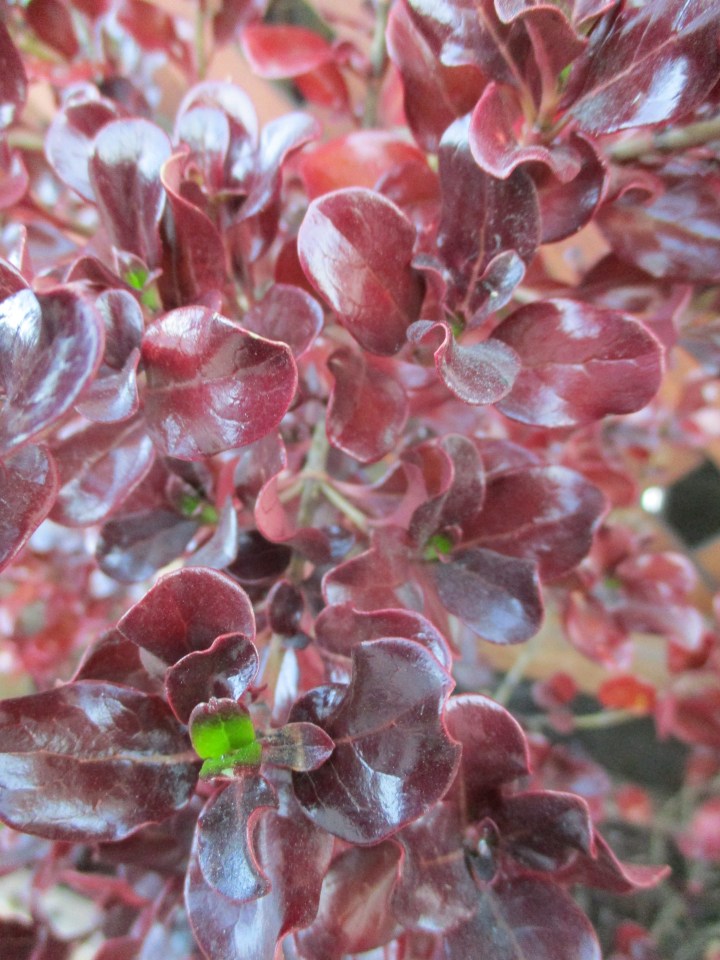
Color like this needs no bloom.

Bronze foliage will never actually replace green foliage. Even if there were enough variety of plants with bronze foliage to do so, too much bronze would look dreary. Bronze is just another option for foliar color in landscapes with significant vegetation. It is distinct from simpler green, and contrasts nicely with gold, blue, gray and variegated foliage. Some bronze foliage is variegated too.

There is all sorts of bronze foliage. Some is brownish bronze. Some is reddish. The most popular bronze foliage is rather purplish. It can be evergreen or deciduous. Annuals, perennials, shrubs, vines, trees and houseplants can provide bronze foliage. Most plants that provide bronze foliage are variants of plants that also provide bloom or fruit. Some are common. Others are rather rare.

Bronze foliage is not an advantage to plants that produce it. The most efficient foliage is green. Gray or bluish foliage has the advantage of reflecting some of the harsh sunlight that could scald it in severe climates. Otherwise, foliage that is a color other than green reflects more of the useful sunlight than it should. Incidentally, dark foliage also absorbs more of the sunlight that can scald it.

This is why many bronze plants are noticeably less vigorous than their greener counterparts. Although it would not be an advantage in the wild, diminished vigor makes some bronze plants more adaptable to compact home gardens. For example, the brownish bronze ‘Summer Chocolate’ silk tree will not get half as high and wide as the common silk tree. It can fit nicely into a cozy atrium.

Cultivars of purple leaf plum, Japanese maple and Eastern redbud are more familiar complaisant bronze trees. ‘Ruby Lace’ honeylocust is still quite rare. Bronze shrubbery includes smokebush, Chinese fringe flower, elderberry, barberry and ninebark. New Zealand flax, canna, houseleek, ajuga, mondo grass and coral bells are popular bronze perennials. Cordyline is a larger perennial.

Bronze foliage adds a bit more color than typical green foliage. In the right situations, it is appealing bold.
Summer Vegetables Like Warming Weather

00325thumb
Summer Vegetables Like Warming Weather

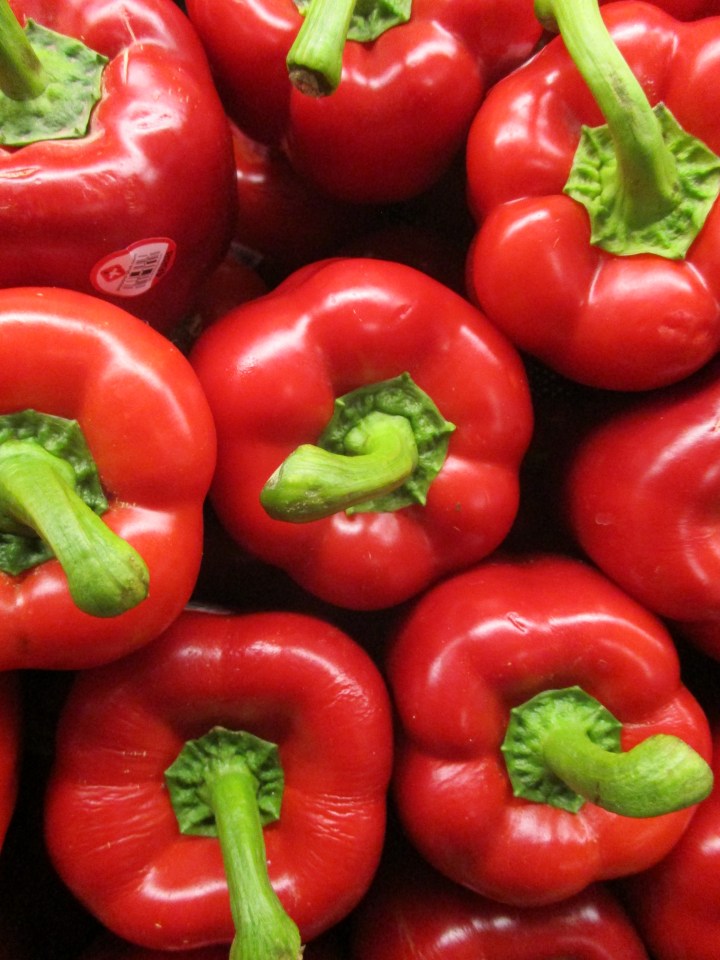
Tomato, pepper and eggplant plants should be out in the garden by now. They typically get planted only a few weeks after the last threat of frost, so that they can start to disperse their roots early. Growth above ground accelerates as the weather gets warmer. Fruit develops and ripens through summer.

These three types of vegetable plants get planted as seedlings for two main reasons. First, when they go into the garden, seedlings are bigger and more established than seeds that need to take time to grow are. Secondly, the cost of the few plants needed for an average garden is not much more than the cost of seeds.

Now, zucchini, melon and summer squash can be done either way. Not many plants are needed, so the expense of seedlings is minimal. However, seedlings are a bit more fragile than those of tomato, pepper and eggplant. Seeds grow so efficiently that they get established almost as readily as seedlings do, so are just as practical.

Regardless of how they get planted, the weather has been so odd this year that there has been only minimal advantage to planting seedlings and sowing seed on time. Tomato, pepper and eggplant plants that were planted early may not be much more mature than what could be planted now. Harvest will be delayed either way.

Bean, cucumber and corn all grow best from seed. Seedlings take more time to recover from transplant than seed take to germinate and grow. Besides, so many plants of each type are needed that seedlings would be expensive. A single package of seed is cheap and goes a long way, so is probably sufficient for an average garden.

Corn is one of those vegetables that produces on a rather tight schedule. Seed that gets sown at any particular time matures at the same rate, so that all the fruit finishes at about the same time. This is why corn gets sown in phases. If timed properly, a subsequent phase begins to produce as the preceding phase gets depleted.

Winter squash, including pumpkin, are similar to summer squash, although they are more tolerant of unusually cool spring weather. They too can either get planted as seedlings or sown as seed. They take their time to produce fruit that ripens by autumn, so have more time to catch up.

Hanging Planters Need Extra Attention

00617thumb
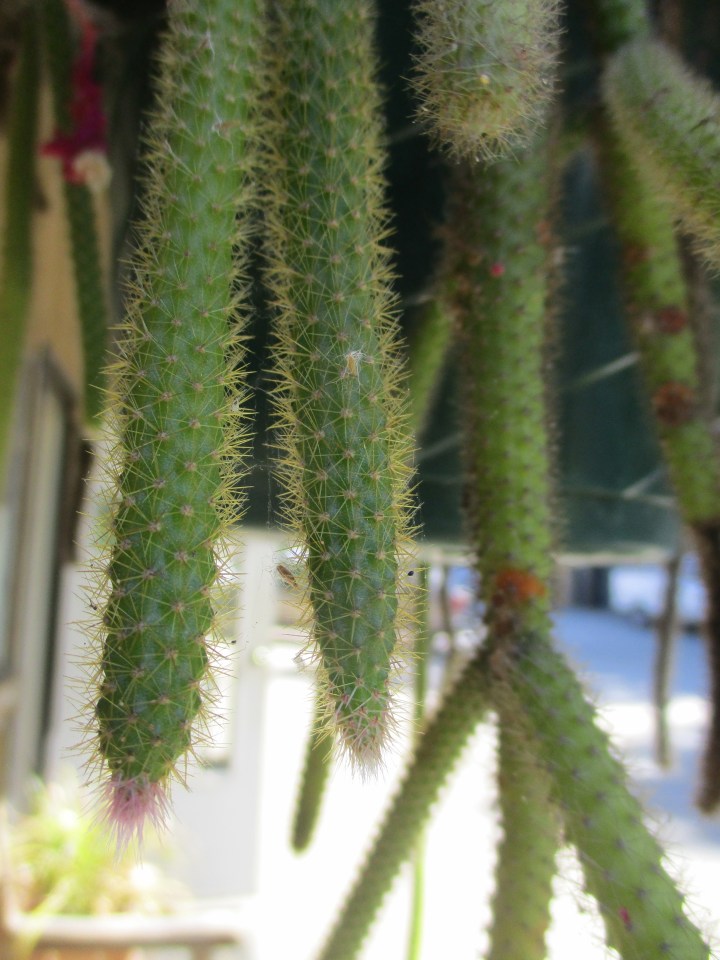
Some plants cascade nicely from pots.

With few exceptions, plants dislike confinement of their roots. They prefer to be in the ground where they can disperse roots freely. Houseplants stay potted because of a lack of other soil inside. Some plants live in pots for portability. Some plants just happen to look good in pots. Plants in hanging planters conform to any combination of these and other reasons. They serve their purpose.

Most hanging planters are simple pots suspended by three wires, chains or strands of plastic, jointed at a hook or loop. The hook or loop hangs from a hook affixed to a ceiling, eave, rafter, beam or tree limb. Hanging baskets are pot-shaped mesh or metallic baskets outfitted with fibrous lining to contain the medium within. Small plants or cuttings can grow from holes cut through the lining.

Of course, hanging planters for houseplants are generally pots instead of baskets, which are too messy for inside. They are likely also outfitted with big saucers for drainage. Hanging planters just happen fit well into spaces that are not useful for much else, such as up near a ceiling in a corner. Many of the most popular houseplants just happen to cascade splendidly from hanging planters.

Portability is another advantage of potted plants. Hanging planters that contain frost sensitive plants outside can spend winter in sheltered situations. Orchids and epiphylums that are prominently displayed during bloom can return to less prominent spots when finished.

Hanging planters are popular mostly because some plants simply look better in them. Cascading houseplants like Boston fern, pothos and spider plant, might look a bit mundane on flat surfaces. Many low growing bedding plants are more impressive if suspended at eye level than they are in the ground. Some bedding plants and small perennials excel at cascading from hanging planters.

However, hanging planters are very different from the ground. Because of limited root dispersion, potted plants rely more on regular watering than those in the ground. Because they are exposed to open air, they dry out fast, so crave more water.

Everything Is Coming Up Roses

P00509-6
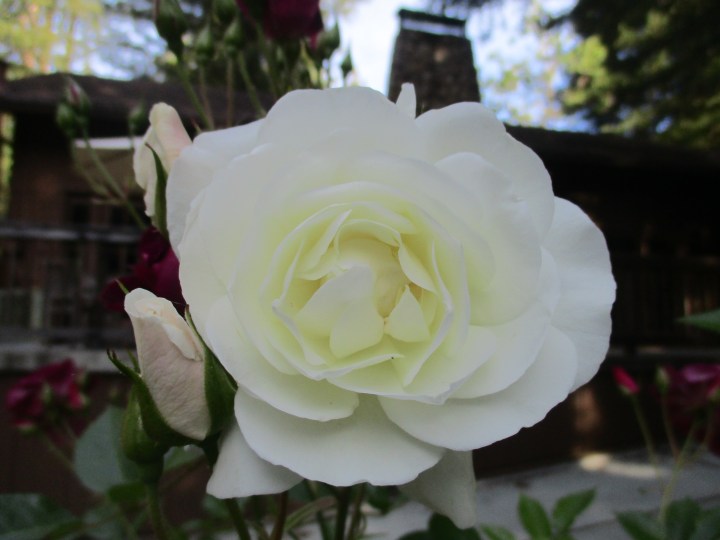
Grafting combines good scions with understock.

When an individual rose shrub blooms with two distinct types of flowers, it seems to be doing a little extra. It provides the big, bold and strongly stemmed roses that it is grown for, along with daintier dark red roses. Eventually though, the small red roses become more abundant, and can crowd out the more desirable roses.

Almost all of the older roses that are grown for cutting are grafted. This means that the stems that provide such excellent flowers above ground are attached to genetically different roots. When such plants were young, the graft union was more obvious, where the canes branched out from the single stem just above the roots.

The stems above the graft union are known as the ‘scion’. The roots below are known as the ‘understock’ or ‘rootstock’. The two are grafted together because the scion blooms so well, and the understock develops stronger and more efficient roots. Scions are not expected to grow roots any more than understock is expected to bloom.

Adventitious stems that develop from the understock below the graft union are known as ‘suckers’, probably because they suck resources that should go the scion. They should be removed as soon as they get noticed, before they can dominate the scion. They become more difficult to remove as they mature.

If possible, fresh new suckers should get broken off from their origin instead of simply pruned away. It sounds violent, but is actually more effective. Stubs left from pruning are much more likely to develop more suckers later. Suckers that get pruned back repeatedly can develop into significant burls.

Old rose shrubs that were planted with an abundance of organic soil amendments tend to sink into the ground as the soil amendments decompose. If a graft union gets buried, it can be difficult to distinguish between suckers and good canes that develop above the graft union.

‘Tree’ roses have two graft unions. The branched scion on top is grafted onto a straight stem of a different variety. The straight stem is grafted onto the understock at ground level. The trendy carpet roses and some other modern roses are not grafted, so will not develop suckers.

Stinky Flowers Serve Their Purpose

00610thumb
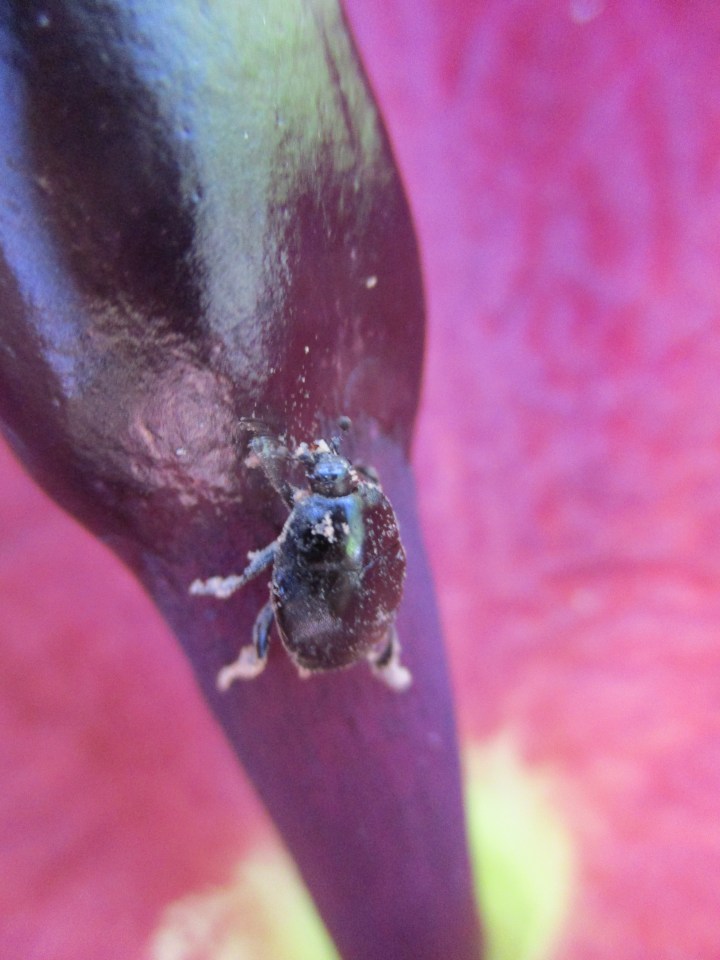
Some beetles like stinky flowers too.

From a human perspective, flowers should not be stinky. They should be pretty and colorful, and perhaps delightfully fragrant. Many flowers in landscapes and home gardens actually are. After all, they are grown for their appealing bloom. Many plants that provide only foliage produce wind pollinated flowers. They are not particularly pretty, colorful or delightfully fragrant, but not stinky either.

Flowers do what they must to pollinate each other. Since they are inanimate, they rely on pollinators or wind to disperse their pollen. Those that rely exclusively on wind produce an abundance of very fine pollen, but waste no effort on attracting pollinators. All other flowers use customized combinations of colors, patterns, textures, fragrances and flavors to attract their preferred pollinators.

There are all sorts of pollinators. Bees are the most famous. There are many other insects too. Hummingbirds and butterflies are very popular. Bats do their work at night while no one is watching. Of all the pollinators though, flies are likely the least popular. Many of the flowers that produce fragrance to attract them are not exactly popular either. Alas, fly pollinated flowers are stinky flowers.

Stinky flowers are naturally uncommon. Apparently, not many flowers want to rely on flies. Stinky flowers are even more uncommon in home gardens and landscapes, for the obvious reason. Paw paw and carob production relies on stinky flowers. A few of the various arums grown for dramatic bloom are stinky too. Philodendron bloom is quite stinky, but very rare among foliar houseplants.

Pear and hawthorn do not rely on flies, so are only incidentally and mildly stinky.

Fortunately, stinky flowers are not often a problem. Paw paw trees are rare here. Carob trees bloom somewhat briefly. If philodendrons bloom at all, they produce only a few flowers which can get pruned off. Regardless, fragrances of stinky flowers are generally not as strong as appealing floral fragrances. They neither disperse as efficiently, nor linger as long. Some are too faint to offend.

Fung Lum

P00530K
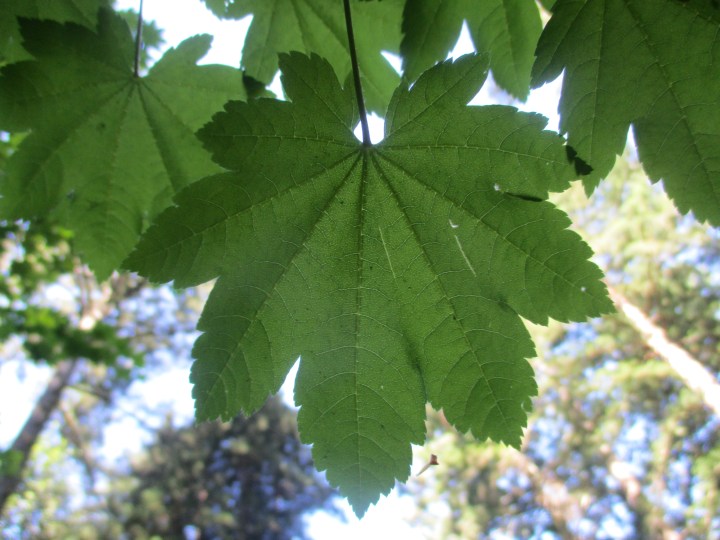
Acer robustum, Chinese maple?

Fung Lum was an architecturally imposing Chinese restaurant in Campbell years ago. It was more famous for the facade of the building than for the food. Although the food was purportedly excellent, not everyone ate there. Everyone in town knew the building though. It was prominently situated right on Bascom Avenue, at a time when the region was still somewhat suburban.

The meticulously pruned and groomed landscape in the minimal space between the ornate facade and sidewalk was mostly rather low so that it did not obscure the architecture. The tallest features were strategically situated to be unobtrusive. Except for only a few of what seemed to be big, sprawling but low profile Japanese maples, there were no other significant maple trees.

‘Fung Lum’ means ‘maple grove’. Commercials on the radio said so. When I was a kid, I therefore expected to see at least a few maples that grew as trees rather than low sprawling mounds in the associated landscape. I figured that the maple grove must be out back where the parking lot was. I sort of wondered if their maples were Chinese, and what Chinese maples were like.

I probably should have been content in believing that the mix of holly oaks, flowering pears and other common trees in the neighborhood were maples. No one else noticed a discrepancy. For all I know, the name referred to a maple grove in China. Maybe the Japanese maples out in front were the grove. They could have been Chinese. Maybe I put way too much though into this.

Now, I actually work with what is purported to be some sort of Chinese maple, perhaps Acer robustum. It really does resemble a Japanese maple. It produces the foliage that can be seen to the right in the last (sixth) picture that I posted early this morning. If it really is a Chinese maple, I would not be surprised if cultivars of this species were what lived in front of Fung Lum.

P00530-6
This is the sixth picture from this morning.

Mild Weather Is Still Problematic

50527thumb
Minimal frost delayed certain spring blooms.

It is amazing that so many orchards are so productive in California, and that so many similar orchards had formerly been productive in the urban areas in which so many of us now live. Nowadays, it takes so much work to care for just a few fruit trees in home gardens. Horticulture is not what it used to be.

Diseases and pests get transmitted all over the world at a rate unlike at any other time in history. It is just too easy to buy and sell infected plants online, and get them delivered without adequate inspection. Many varieties of plants that are so easily imported may not perform as reliably as the more traditional varieties.

Modern landscaping does not make fruit production any easier. Most deciduous fruit trees do not get pruned adequately or properly. Many get too much water. Almost all must live in crowded landscape conditions where diseases and pest proliferate. Sanitation (removal of infected plant parts) is rarely as efficient as it should be.

Then there is all this crazy weather! First, the winter does not get as cool as it should. Then, it does not get warm enough in spring. It is all so difficult to keep track of. Many plants do not know how to respond. Those that stay dormant through cool weather got an early start. Those that like warmth in spring started late.

The unfortunate deciduous fruit trees that need both a good chill through winter and nice warm spring weather are really confused. Early blooms were ruined by brief late frosts or brief rain showers. Some delayed blooms were not synchronized with pollinators. Some of the minimal fruit is developing slowly.

Even the fruitless or ‘flowering’ relatives of the deciduous fruit trees are annoyed by the weather. Many flowering cherry trees that should have bloomed profusely prior to foliation delayed bloom until lower foliage started to appear. However, both bloom and foliation are so slow and sporadic that upper stems stayed bare quite late.

Flowering crabapple trees, which generally bloom after flowering cherries, actually bloomed more reliably, and were not delayed as much. Hopefully, fruiting apple and pear trees, although late, will be more productive than so many of the cherry, apricot, plum, peach and nectarine trees will be this year.

Bedding Plants That Defy Seasons

00603thumb
Some seasonal annuals are really perennials.

Bedding plants that go into the garden in spring are generally warm season or summer annuals. They should perform through summer until the weather gets too cool for them the following autumn. Bedding plants that go into the garden in autumn are generally cool season or winter annuals. They should perform through winter until the weather gets too warm for them late the following spring.

That sounds simple enough. Each type of bedding plant performs best within a specified season. Since they are annuals, they complete their life cycles within a single season within a single year. Of course, it is not so simple here where seasons are as unique as they are. Winter is mild. Summer is arid. Some bedding plants that are annuals in harsher climates may survive as perennials.

For example, busy Lizzie and wax begonia are warm season annuals in most climates. They succumb to frost as weather cools in autumn. Locally, they can survive through winter if sheltered from mild frost. Any that survived through last winter can regenerate now. As bedding plants, they will not be as uniform as they were last year. However, their variability would be fine for mixed bedding.

If sheltered and warm enough, wax begonias may actually continue to perform right through winter. If they dislike the aridity of summer, they can even perform slightly better through winter than they do through summer. Their best performance is often about now and again in autumn, between the two extremes of summer and winter. They challenge their designation as a warm season annual.

Even some of the bedding plants that really are annuals may not behave as such. Alyssum and nasturtium can disperse seed to replace themselves before they finish. They are not true to type, so their progeny eventually revert. Nonetheless, simple yellow and orange nasturtium and white alyssum are splendid for many relaxed gardens. Nasturtium might perform better in summer or winter.

Bedding plants usually know more about what they should be doing than those who are managing and manipulating them.

Streets Are Cooler With Shade

P91124+
Parked cars stay cooler in shade.

There really is no such thing as a perfect tree. Some are not quite as messy as others. Some have better structural integrity than others. Some have gentle roots; and some stay proportionate to tight spots. However, without exception, all trees grow, drop leaves, and disperse roots.

This is an important consideration when selecting any tree, and especially when selecting a street tree for the narrow space between the curb and the sidewalk (which is commonly known as a park strip). Even where there is no sidewalk, or where the sidewalk is at the curb, most of the obstacles are the same.

Street trees should have reasonably complaisant roots that should not be likely to damage curbs, sidewalks or roadways, at least for several years. They should naturally develop reasonably high branches. They will need to be pruned higher than trucks that may park at the curb. Street trees must also tolerate harsh exposure.

Wider park strips can of course accommodate larger trees. Those that are only two feet wide or narrower are probably not wide enough for any tree larger than photinia, purple-leaf plum or English hawthorn, which are difficult to prune for clearance over roadways and sidewalks.

Messy leaves, flowers or fruit that might not be a problem within the garden might be more of a problem at the curb. It is not so easy to rake such debris if cars park over it. Trees that are commonly infested with scale or aphid are likely to drop sticky honeydew (scale and aphid poop) onto parked cars.

Unfortunately, those who get street trees do not always get to select them. Many municipalities assign specific trees to specific streets. Some streets have a few trees to choose from. Others have only one option. Home Owners’ Associations (HOAs) decide if and where new trees get planted.

Crape myrtle is probably the most common choice for a new street tree because the roots do not get big enough to damage pavement. However, the canopies are not very big either. They stay too low to be pruned above trucks. Crape myrtle is susceptible to scale infestation that can get bad enough to make sidewalks sticky.

For many years, London plane (sycamore) had been another popular street tree. Unfortunately, the voracious roots can damage pavement within only a few years. The messy foliage discolors and starts to fall before autumn.

Multi Trunk Trees Seem Natural

00527thumb
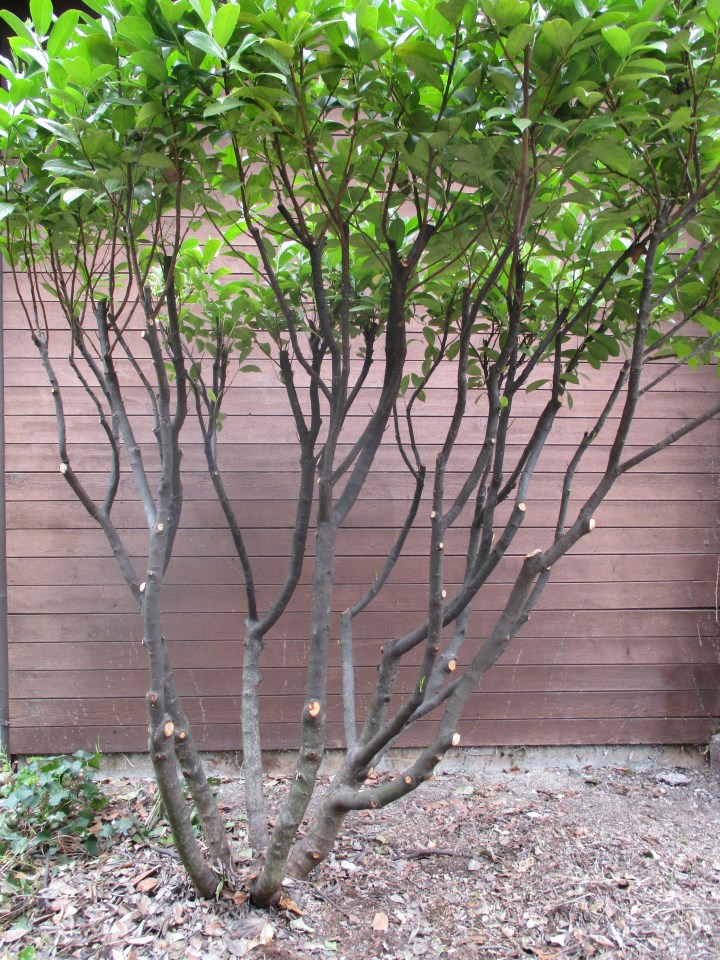
Overgrown shrubbery becomes multi trunk trees.

For several years in the late 1960 and early 1970s, European white birch were trendy. Most lived in ubiquitous groups of three. Where three did not fit, a single multi trunk tree, typically with three trunks, was a popular option. Each multi trunk tree provided as many trunks as a few single trunk trees. For these particular white birch, the elegant white trunks were their most appealing feature.

Multi trunk trees, which are popularly known as ‘multis’, are only structurally different from their counterparts with single trunks. Multi trunk crape myrtle are genetically identical to crape myrtle of the same cultivar, but with single trunks. The only difference is that multi trunk trees branch at ground level, instead of at the top of a single straight trunk. Each needs to be pruned to the desired form.

Multi trunk birch, paperbark and lemon gum exhibit appealing bark. More trunks display more bark than single trunks. Multi trunk strawberry tree, olive and oak exhibit appealingly sculptural form. Cork oak and crape myrtle provide both appealing bark and sculptural form. Silk tree, acacia and deciduous magnolia display their bloom more effectively with lower and broader multi trunk form.

Trees get help to develop into a desired form. European white birch, lemon gum and silk tree are more likely to develop single trunks naturally. Coppicing compels them to regenerate with several trunks. Conversely, olive, crape myrtle and strawberry tree develop a few trunks naturally. Single trunk trees need thinning to remove the superfluous trunks, and staking to straighten a single trunk.

In home gardens, multi trunk trees sometimes evolve from overgrown shrubbery. Pineapple guava may be shrubby for may years before lower growth gets pruned away to reveal sculptural trunks within. English laurel that gets too overgrown for containment pruning might become a delightful multi trunk tree instead. It will be pleased to grow freely from the top if lower growth gets pruned off.

Multi trunk trees are no more natural than trees with single trunks are, but they seem to be.