Bulbs Are Not Finished Yet

41015thumbIt might seem creepy to think about what spring bulbs are doing right now out in the garden. Like victims of a horror movie, they were buried in shallow graves last autumn. They were not dead though. They were undead but merely dormant. While no one can see what they are up to, they disperse roots and begin to push new foliage up to the surface of the soil. Some might bloom soon.
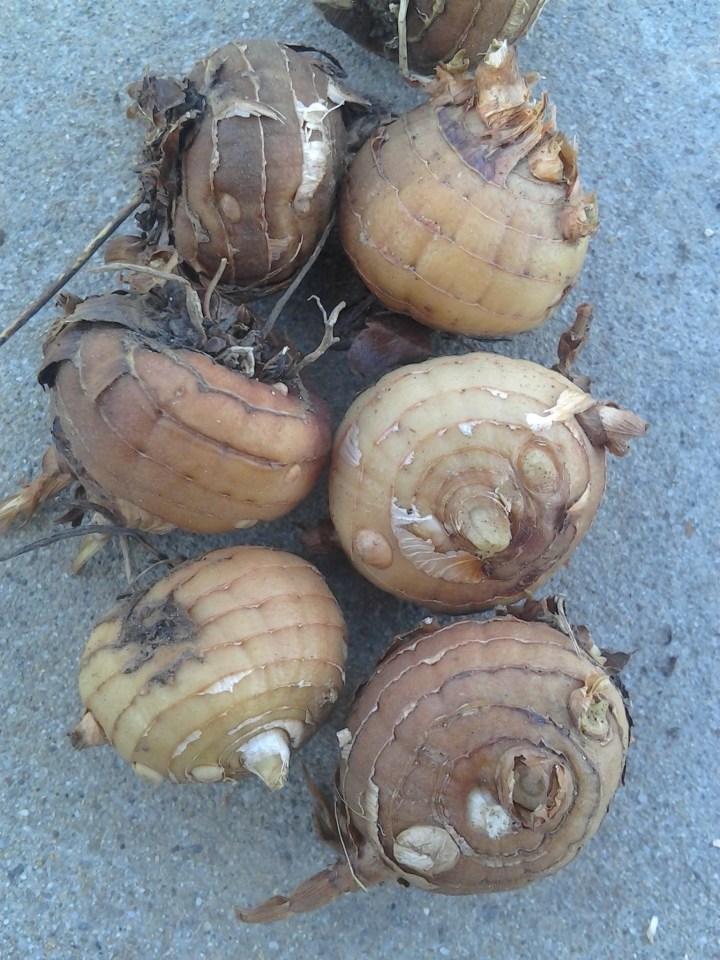
Now it is getting to be time for summer bulbs. Unlike spring bulbs, summer bulbs do not prefer to hang out in the garden through the cool and rainy weather of winter. If planted too early, they can start to grow prematurely, and could potentially get damaged by frost. If planted much too late after winter rain, they will need to be watered more carefully while young, and are likely to bloom late.

Just like spring bulbs, most summer bulbs are really corms, rhizomes, tubers or tuberous roots. Only a few are actual bulbs. Although they are very different physiologically, they perform the same function. They store resources from a previous season through dormancy in order to sustain growth for the next season. Some summer bulbs bloom more than once annually or with many blooms.

Dahlia, canna, crocosmia, hardy orchid (Bletilla) and the old fashioned big white calla are some of the easier to grow summer bulbs. Dahlia is the most colorful, but blooms late in summer or early autumn, and might only perform well for a single summer. With regular watering, canna can grow like a big weed, but in a nice way. The others can grow well enough to get invasive over the years.

Gladiolus and lily will probably bloom for only one summer, but are so colorful that those who enjoy them do not mind. Tuberous begonia is fussier, so is usually grown in pots. Allium, astilbe and maybe liatris have potential to thrive and multiply in the right conditions, but more often bloom for only a few years. Small colored callas are unpredictable too. They are showy but rarely prolific.

After bloom, deteriorating flowers should be pruned away to conserve resources while lingering foliage recharges bulbs for the next winter. This process is known as ‘deadheading’. Gladiolus, lily and any others bulbs that bloom only once obviously need to be deadheaded only once. Dahlia, canna and others that bloom over an extended season will want to be deadheaded a few times.

Colorful Berries Feed Overwintering Birds

80214thumbPlants compensate for their immobility by procuring the services of animals and insects. They bloom with flowers that attract pollinators with colors, fragrances and flavors. Their fruits use similar techniques to attract those who consume the fruits to disperse the seeds within. It is a pretty ingenious system. The animals and insects probably think that they are taking advantage of the plants.
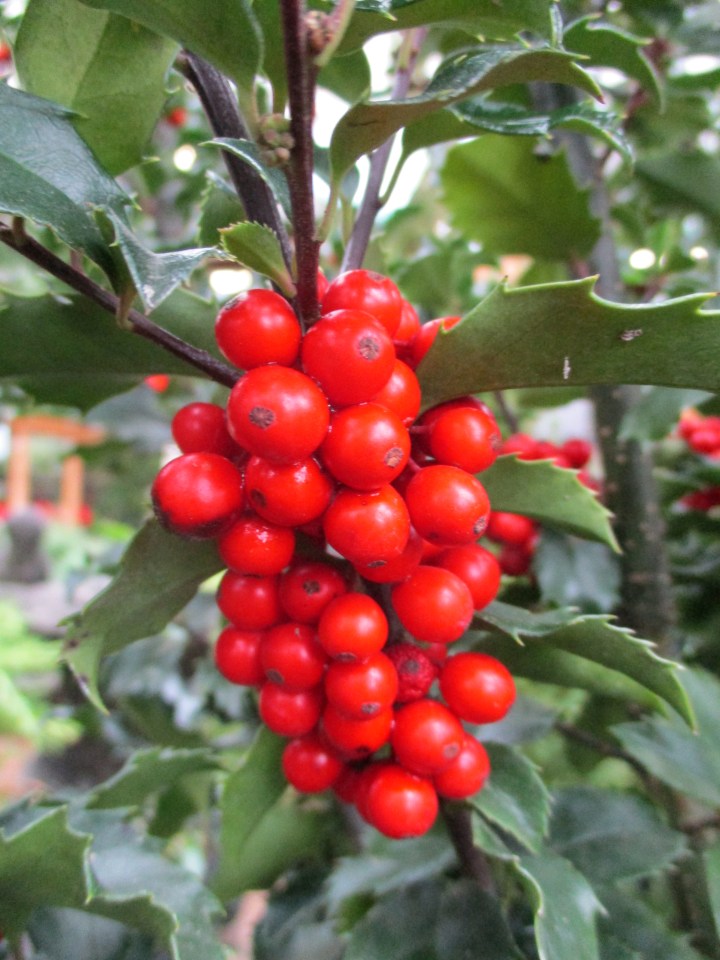
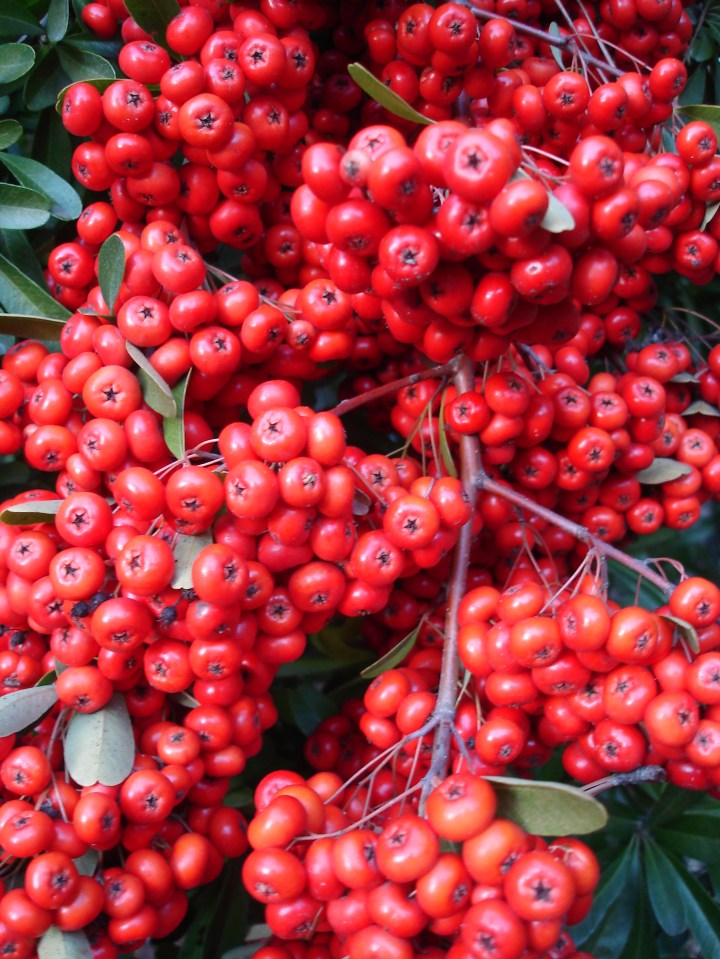
Firethorn, toyon, cotoneaster, English hawthorn and the hollies all produce profusions of small bright red berries that are designed literally for the birds. They are just the right size for birds to eat them whole. If they were smaller, birds might prefer other fruits. If they were any bigger, birds might eat them in pieces, and drop the seeds. The bright red color is a blatant advertisement to birds.

Firethorn is probably the most prolific with its berries. It might also be the most popular with the birds. If the colorful berries are not gone yet, they will be soon. Toyon berries seem to last longer, perhaps because they do not all ripen at the same rate. Because it gets big and takes some work to contain. toyon is more common in unrefined landscapes and in the wild than home gardens.

English hawthorn and cotoneaster are variable. Some varieties are more productive with berries than other are. Some types of English hawthorn are grown more for their bloom or foliar color in autumn. They are deciduous, so their berries hangs on bare stems. Late cotoneaster produces more berries than other cotoneasters, and somehow manages to keep its berries late into winter.

Holly is not related to firethorn, toyon, cotoneaster or English hawthorn, which are all in the Rosaceae family, although the bright red berries suggest that it should be. Because most holly plants are females that lack a nearby male pollinator, berries can be scarce. Some plants in nurseries are actually two plants together in the same pot, one male and one female, to ensure adequate pollination and berry production. Deciduous hollies are unfortunately rare.

Herbs Add Spice To Life

80207thumbOut in deserts, where vegetation can be a scarce commodity, cacti, agaves and yuccas protect themselves from grazing animals with thorns, spines, caustic sap and distastefully textured foliage. None of these defense mechanisms is perfect. They only need to be better than what the competing specie are using. Many plants find that objectionable flavor and aroma work just fine for them.

The funny thing about the objectionable flavors and aromas that some plants use to discourage grazing animals from eating them, is that these same flavors and aromas are what make so many of them appealing to people. It is ironic that what was supposed to make them distasteful to some is what makes them tasty to others. Yet, it also gets us to perpetuate them in our home gardens.

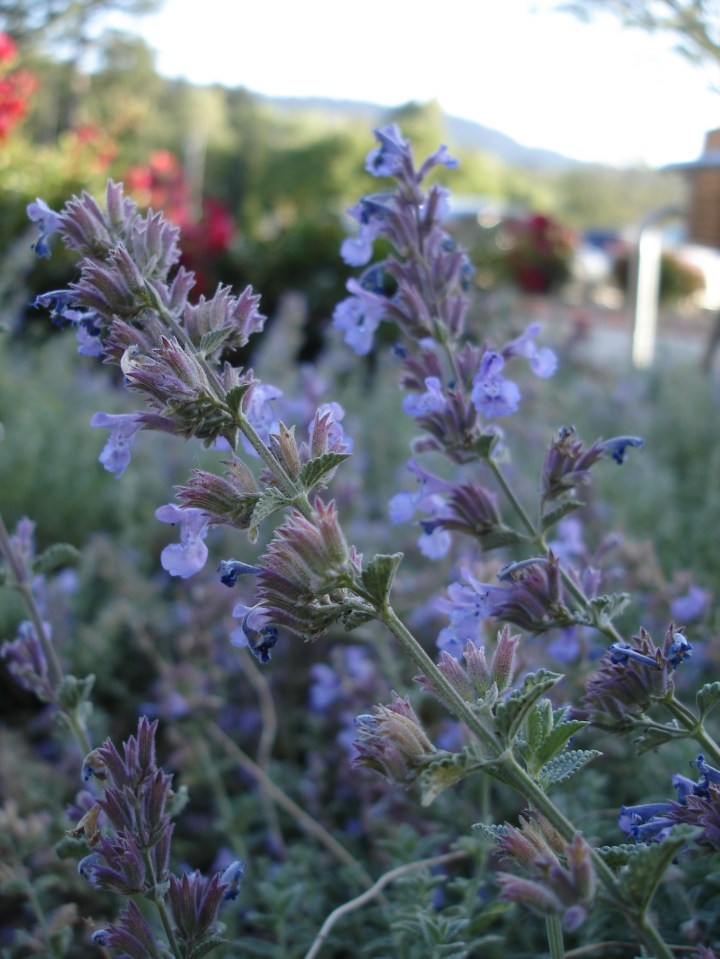
Mint, thyme, lavender, rosemary and sage, which all happen to be in the same family, are culinary herbs that also work well in the landscape. The mints need the most watering, and containment if their innate invasiveness is a concern. Thymes need less water, and some are nicely aromatic ground cover for small areas. Lavenders and rosemaries can survive with minimal watering here.

Both rosemary and sage are popular for landscaping anyway. Rosemary is most commonly grown as a ground cover that cascades nicely over low retaining walls, but some cultivars are shrubby. Sages are extremely variable. Some are showier than they are useful in the kitchen, with elegant and colorful flower spikes. Others are too strongly aromatic to cook with, but are used as incense.

Fennel and chamomile are often grown in vegetable gardens rather than out in the more refined parts of the landscape because they can get somewhat awkward. Fennel has such nice feathery foliage at first, but if not harvested, it gets tall, and then yellows after bloom. Chamomile gets tall and open in bloom, and then no one wants to ruin it by harvesting all the flowers if it looks too good. Chives are easier to work with. They have so many leaves that no one misses a few taken for the kitchen.

Rain Is Necessary But Messy

10914Water is no more scarce in California than it has been in recorded history. The problem with it is that it is a limited resource that must be shared amongst too many people. Likewise, rainstorms are no more torrential than they have ever been. Floods, erosion and wind are only more destructive now because there is so much more infrastructure that can be damaged than ever before.
Rain and wind are perfectly natural. Furthermore, it is natural for the weather to knock down limbs or entire trees. It only seems unnatural when these limbs or trees fall on houses, cars or anything else that gets in their way. Plants actually enjoy rainy weather much more than we do. Some like to be rinsed of dust and debris left from former infestations of mites, aphid, scale or sooty mold.

What plants do not like about rain is erosion. It is bad enough that so many plants in refined gardens are deprived of their own litter to insulate the surface of the soil. It is even worse if the bare soil gets eroded away from fine feeder roots at the surface of the soil. This is something that the rest of us would agree on. We do not want gullies carved into slopes, or drains clogged with mud.

Trees, shrubs and some stout perennials with aggressive roots are useful where the potential for major erosion is a concern, but might not do much for annoying surface erosion. Sprawling and spreading plants that form dense networks of low branches and surface roots are more effective. They soften the splatter of rain, slow the flow of drainage, and catch much of any dislodged silt.

Groundcover plants like ivy, gazania and iceplant are probably the best option for controlling surface erosion. Dense and low shrubbery that spreads over the ground and holds its own debris probably work just as well. These include low junipers, trailing rosemary and dwarf coyote brush. Larger shrubbery can help if it can drag its lowest limbs on the ground, and no one rakes below it.

Mulching limits erosion while new plants grow. Although new mulch needs to be added annually as old mulch decomposes, less will be necessary as plants grow and cover more area. Mulch is also effective where no plants are desired. For large areas, especially where plants are not expected to fill in, landscape cloth below ornamental bark inhibits weeds. However, coarse bark slowly shifts downhill, so replaces one kind of erosion with another, and will eventually need to be raked back uphill.

When Life Gives You Lemons

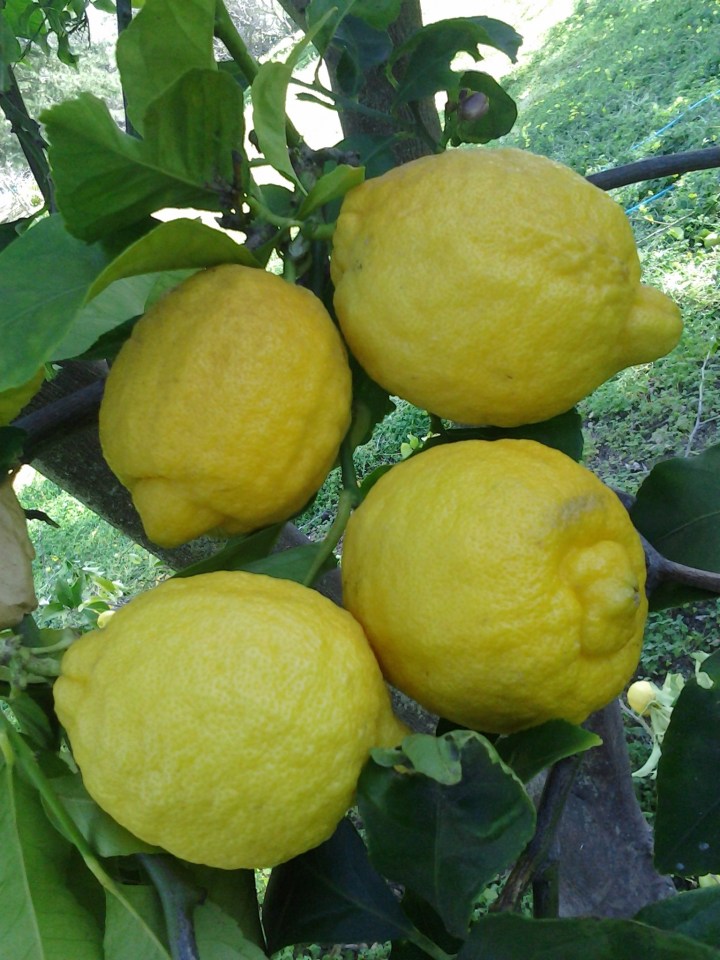
80131thumbWhen life gives you lemons, it is likely this time of year. Although, the most popular garden varieties of lemon, like ‘Meyer’ and ‘Eureka’, continue to produce at least a few more fruits sporadically through the year. ‘Lisbon’ lemon that is still used in orchard production, and is the ancestor of the household ‘Eureka’ lemon, produces almost all of its fruit in winter, and blooms shortly afterward.
Ripe citrus in the middle of winter impresses those in climates where winter is too cold for much to happen in the garden. They could not grow a citrus tree if they wanted to. Even here, frost can damage some of the more sensitive citrus varieties, like ‘Mexican’ lime. Unlike the fruits of summer, citrus fruits ripen slowly and are not so perishable, so do not need to be harvested right away.

This means that if it is raining, cold or just to wintery to go outside, citrus fruits can be left on the tree until the weather improves. Most of us prefer to pick them in small batches anyway. Ideally, fruit should get picked as it is consumed. Lemons and limes typically get picked individually as needed, until there are so many that some need to be bagged and shared with friends and neighbors.

Mandarin oranges are the most perishable of the citrus. Because their skins are so loosely attached to the pulp, the pulp can oxidize, lose flavor and eventually get dry and pithy. Incidentally, a ‘tangerine’ is merely a Mandarin orange that was developed in North or South America. A surprisingly sour (unknown) Mandarin orange might really be a ‘Rangpur lime’, which is not a lime at all.

Unlike most fruit that continues to ripen after harvest, or pears that actually delay ripening until after harvest, citrus fruits stop developing flavor once picked. It is best to taste them for confirmation of ripe flavor prior to harvest. Some Mandarin oranges may have slightly greenish blotches on them even when completely ripe. The best ‘Valencia’ oranges can look rather yellowish. Grapefruits might mellow if left in their trees past ripeness, but can also inhibit bloom.

Berries Are For The Birds

51125It is probably no coincidence that certain berries and small fruits are so colorful through winter while colorful flowers are relatively scarce. Like flowers, they want to get others to do something for them. Flowers use color, aroma, flavor and sometimes even texture to attract and reward pollinators. Colorful berries and fruits do the same to attract birds and animals who disperse their seeds.

There are not many colorful flowers blooming in winter to distract anyone from colorful berries and fruit. Those who want them are pretty intent on finding them anyway. There is not much else for overwintering birds to eat. Squirrels probably have plenty of acorns and nuts stored, but might enjoy a few berries too. No matter how abundant they are, there is serious competition for berries.

Most types of berries and small fruits that are so colorful through winter contain tiny seeds that get eaten along with the fruit. In this manner, the seeds get taken away from their origin as easily as birds fly away. They then get dispersed as birds do what birds do (that can be so annoying on a freshly washed car). Digestion only scarifies these seeds, which might not germinate otherwise.

This all might be much more information than necessary for home gardening. All we really need to know is that there are several plants that can produce colorful berries through winter while other color is limited. Although, it might be useful to be aware that these colorful berries are likely to eventually be depleted by the birds and any other wildlife that they are intended to be appealing to.

Then again, winter berries are popularly grown specifically to attract birds and wildlife to the garden. Either way, if berries are grown for their color or to attract birds, they have the potential to be messy. Those that do not get eaten eventually fall onto whatever is below them. Those that do get eaten fall (in ‘another form’) all over the neighborhood, and of course, onto freshly washed cars.

Coincidentally, most plants that produce colorful winter berries are related. They are of the ‘rose’ family, ‘Rosaceae’, and produce similar ‘pomme’ fruits that look like minute apples. Firethorn (pyracantha) is the most colorful and prolific. The various cotoneasters, including some low growing ground-covers, are similar, but not so prolific. Toyon is a colorful native that works nicely in unrefined landscapes. English hawthorn is a small deciduous tree.

Proper Bare Root Planting Technique

80124thumbBare root plants are less expensive, easier to handle, and easier to prune into a desired form than canned (potted) plants are. Also, they get established into the garden easier. Yes, even with less roots, they disperse their new roots directly into the surrounding soil more efficiently than secondary roots escaping from crowded roots that had been confined to cans of media (potting soil).

Bare root plants have no incentive to stay confined. They get planted while dormant, and wake up surrounded only by their new soil, with nothing else to get in the way. Canned plants might have been circling their roots within a limited volume of media for a while, trying to find a way out. Once they get in the ground, they may not like what they find there, and try to stay close to the familiar.

Bare root plants should not get too much of a good thing. The need only minimal soil amendment. They might like a bit of organic matter to retain moisture and to keep the soil loose while they get oriented to their new home. A bit of fertilizer would be nice too. Yet, new bare root plants should not get so much amendment that they do not want to disperse their roots beyond the planting hole.

Planting holes do not need to be very big at all. They should be wider than the roots can be spread, but not deeper. Loosing the soil and adding amendments below will cause new plants to sink. Graft unions of grafted plants must remain above grade. Plants with big roots, like fruit trees and roses, prefer their roots to be spread out over a cone of soil in the center of their planting hole.

Most bare root fruit trees are sold with more branches than they need, so should be pruned after planting. Some might get pruned by half. The superfluous stems are there both to cushion the trees in transport, and also to allow more choices for pruning. Some of us want to prune down to lower branches, while others want to prune up to slightly higher branches. Berry canes need very small planting holes, and get pruned back to only two or three buds above ground.P80115

Big Trees Really Need Arborists

41203thumbStormy winter weather always reminds some of us that our trees need some attention. Wind can break limbs. If the weather gets really nasty, trees can be destabilized by strong wind, particularly if the soil is moistened by rain. However, the truth is that arboriculture, which is the horticulture of trees, is important throughout the year. We just become more aware of it when weather threatens.

Not only is arboriculture important throughout the year, but it is also the most important aspect of horticulture in most gardens that are outfitted with trees. After all, trees are the most significant features of such landscapes. Their shade affects the homes and garden spaces around them. If they drop limbs or fall, they can cause significant damage. Many get far too big for us to maintain.

This is why we need arborists, the horticulturists who specialize in trees. Arborists can evaluate the health, stability and structural integrity of trees, and prescribe any necessary arboricultural procedures. In order to issue a permit to remove a tree, most municipalities require an inspection and report from an arborist who is certified by the International Society of Arboriculture, or ISA.

ISA Certified Arborists have passed an examination of their arboricultural expertise, and maintain their certification by continued involvement with ISA educational seminars, workshops and classes. The ISA is the standardizing resource for the promotion of the most important arboricultural technology, and maintains discriminating standards. ISA certification is quite a commitment.

www.isa-arbor.com, the website of the ISA, is an excellent resource for anyone in need of the services of a certified arborist. The registry of arborists can identify and find an arborist directly by name, or regionally by city or ZIP code. The site is also useful for information about proper arboriculture and trees, for those of us who maintain our own small trees, or want to select new trees.

Trusting the wrong professional to maintain trees can be very risky. Even gardeners who are proficient at mowing lawns and shearing hedges may not be adequately knowledgeable about proper arboriculture. Instead of correcting problems, improper pruning can disfigure trees and limbs, and actually compromise their structural integrity. Sadly, it is not uncommon for otherwise healthy, stable and well structured trees to be ruined by those hired to care for them.

Flame Vine

80117This is no timid vine! Flame vine, Pyrostegia venusta, is related to the lavender trumpet vine and blood red trumpet vine, and is just as vigorous. Although it can not be recommended for tight spaces or small refined gardens, it excels at obscuring concrete walls. It only needs wires or stakes to be convinced to climb. If it gets too big, it can be cut back after bloom to regenerate quickly.

Unlike the related trumpet vines that only bloom less but otherwise grow well in partial shade, flame vine really wants plenty of sunlight and nice warm exposure. Fertilizer can accelerate growth for new plants, but too much can inhibit bloom of mature plants. Occasional watering is all flame vine wants. Regular pruning may be needed to keep tendrils away from plants and painted surfaces.

Flashy drooping clusters of bright orange flowers bloom in autumn and winter, much to the delight of overwintering hummingbirds. Each floral cluster contains more than a dozen narrowly tubular flowers that are almost three inches long. The evergreen triofoliate leaves (divided into three leaflets) are quite lush through most of the year, but look a bit tired and sparse as they molt in spring.

Bare Root Stock Is Here

80117thumbChristmas tree lots at nurseries come and go at a good time. Cut and live Christmas trees become marketable just as retail sales of other items is declining. Although autumn is the best season to plant many things, not many of us want to be out in the garden as the weather gets cooler. As Christmas trees get sold and relinquish their space, bare root nursery stock becomes available.

Smaller bare root plants might be available first, because they can be brought in before leftover Christmas trees get recycled after Christmas. These include grapevines, currants, gooseberries, blueberries, blackberries, raspberries and perennials like rhubarb, asparagus and strawberries. Roses might be included too, but because they are so numerous, they often arrive with fruit trees.

Deciduous fruit trees are the majority of bare root stock. They include stone fruits, pomme fruits, figs, pomegranates, persimmons, walnuts and almonds. Stone fruits are of the genus Prunus, including apricot, cherry, plum, prune, peach, nectarine and almond. Pomme fruits are apple, pear and quince (pictured above). The flowering counterparts to some of these fruit trees may be available as well.

The flowering counterparts are those that are grown for colorful bloom rather than fruit production. Flowering stone fruit trees, such as the famous flowering cherries, produce no fruit. Flowering crabapples produce small and potentially messy fruits. Flowering quinces are actually a different genus than the fruiting types. Most are fruitless. Flowering pears are not often available bare root.

While dormant in late autumn, bare root plants are dug and deprived of the soil that they grew in. They get planted into their new homes before they wake up in spring. Some are packaged in damp sawdust. Others get heeled into damp sand. The advantages of bare root stock relative to canned (potted) stock are that bare root stock is less disfigured, lacks disfigured and circling roots, gets established in a new environment more efficiently, is easier to transport, and is significantly less expensive.