Even Houseplants Can Appreciate Rain

P71116Everyone is from somewhere. Not everyone is fortunate enough to be from California. Most of the various plants in our gardens, even if grown locally, are descendants of plants that were collected from all over the world. Most houseplants are from tropical regions. They perform well as houseplants primarily because they tolerate the sort of partial shade that they would get as understory plants in dense tropical forests.

Along with this advantage of tolerance to shade, tropical houseplants come with other disadvantages, such as an intolerance to frost. So, they are able to live inside the home, but are unable to live very long outside where winters are cool. Even areas of Southern California that do not get frosty can get cool enough to make many tropical houseplants uncomfortable. Consequently, they are confined to their homes.

That might seem to be acceptable to those who not think like plants do. Really, do houseplants even want to go outside? Maybe not. However, shelter from frost and cool weather also shelters them from other weather, such as wind and rain. Without wind and rain, any dust that collects on the foliage stays there. Mealybug and scale insects can proliferate and produce sticky honeydew, which also will not rinse away.

This is why some of us like to occasionally put our houseplants in a cool shower to rinse them off. It eliminates much of the dust, and clears out the stomata (respiratory pores). It does not kill mealybug or scale, but sets them back a bit, and rinses off the honeydew. Showering is also a good way to soak and rinse toxins from the soil. Only African violets, gloxinias and a few plants with fuzzy foliage should not be showered.

The only thing that works better than showering is rain. (Remember that wet stuff that starts to fall from the sky this time of year?) Rain is gentler, lasts longer than a shower, and is located outside where the mess of wet houseplants is not so bothersome. The only disadvantages of rain are that it can be cold, and is often accompanied by wind. A slight breeze would help agitate dirty foliage and dislodge dust, but strong gusts can knock houseplants over, and damage large leaves that are not adapted to any wind. Plants should be sheltered from both wind and direct sun exposure that might happen if the plants are not brought in before clouds clear after the rain.

Autumn Color That Proves It

71122thumbThere may not be a good time to talk about it this year. The late warmth really put a damper on some of the autumn foliar color. Some trees are dropping their leaves as soon as they start to turn color, leaving only fading green leaves in their canopies. Only the most reliable trees for autumn color, sweetgum, Chinese pistache, flowering pear and gingko, are trying to make up for lost color.

Now, just because these four trees happen to color well and reliably in autumn does not necessarily mean that they are the right trees for every application. No tree is perfect. Gingko comes close in regard to adaptability to a broad range of applications, but provides only bright yellow autumn color. Flowering pear can be an excellent tree in most regards, but it very susceptible to fire blight.

The other two eventually get too big for some applications. Chinese pistache gets broad with low branches, and old trees (that predate the selection of the standardized male cultivar) can be messy with tiny but profuse fruits. Mature sweetgum trees are notoriously messy with obnoxiously spiked mace-like fruits, and can develop serious and potentially hazardous structural deficiency.

There are certainly more trees and plants that can provide foliar color in autumn. These just happen to be four of the most reliable, and most brilliantly colored. Chinese tallow turns dark burgundy and almost purplish, but colors best in response to a sharp and sudden chill. Red oak turns a monochromatic brown like that of a paper bag, but of course, the color does not appeal to everyone.

Years ago, it was advisable to select flowering crabapples and flowering cherries while blooming in spring because that was the most accurate representation of their floral color. (Photographs were not what pictures are nowadays.) This is still good advice. For autumn color, it is probably better to observe trees around the neighborhood, and then identify those that are most appealing.

Once a few are identified, it is easier to research them to learn about their distinct characteristics, and to determine if they are appropriate for particular applications or situations. Some might be too big. Some might be too messy. Some are not as colorful as others. Persimmon has the added bonus of fruit. Crape myrtle blooms nicely in summer. It is better to know before planting them.

Trees Do Not Like Chimneys

P71027There are many reasons why fireplaces and their chimneys are not such a safety concern like they were decades ago. Only a few modern homes are even equipped with them. Installation of a new fireplace is outlawed in many municipalities, even if a fireplace gets damaged by an earthquake, and should be replaced. Urban sprawl has replaced almost all of the orchards and woods that once supplied affordable fuel.
Most of the few fireplaces and wood stoves that still get used are safer because their chimneys are outfitted with spark arrestors. Also, most combustible cedar roofs have been replaced by non-combustible roofing material. Nonetheless, chimneys can sometimes get overwhelmed by potentially combustible vegetation. Trees, large shrubbery and vines might need to be pruned for adequate clearance from the heat.

Vines like ivy, Boston ivy and creeping fig are sometimes allowed to climb chimneys because they do not damage bricks as easily as they damage painted surfaces. However, they can easily grow over the top of a chimney. Aggressive vines generate significant volumes of vegetation, and can accumulate even more from nearby trees. Because they are directly over chimney exhaust, they ignite as soon as a fir is lit below.

Trees that reach over chimneys take a bit more time to burn because heat dissipates somewhat in the space between the top of the chimney and the higher vegetation. Cypress, pine, eucalyptus, cedar and big junipers are very combustible. If they get close enough, ungroomed palms and yuccas can be even worse! Deciduous trees are mostly defoliated, and less combustible while it Is cool enough to use a fireplace.

Regardless, all chimneys need adequate clearance from vegetation. Trees and vines that were allowed to get too close while fireplaces were unused through summer will need to be pruned back before the first fire is lit to take the chill out of cooling autumn weather. Debris that collects behind (upslope from) chimneys should also be removed. It can be combustible while dry, and once dampened by rain, it can cause rot.

This is also a good time to start cleaning eaves-troughs (gutters) and downspouts. Yes, it may need to be done more than once if enough deciduous foliage continues to fall through autumn. Debris is easiest to clean out while dry (before it needs to be cleaned out), but unfortunately becomes messier with rain.

Plant Spring Bulbs In Autumn

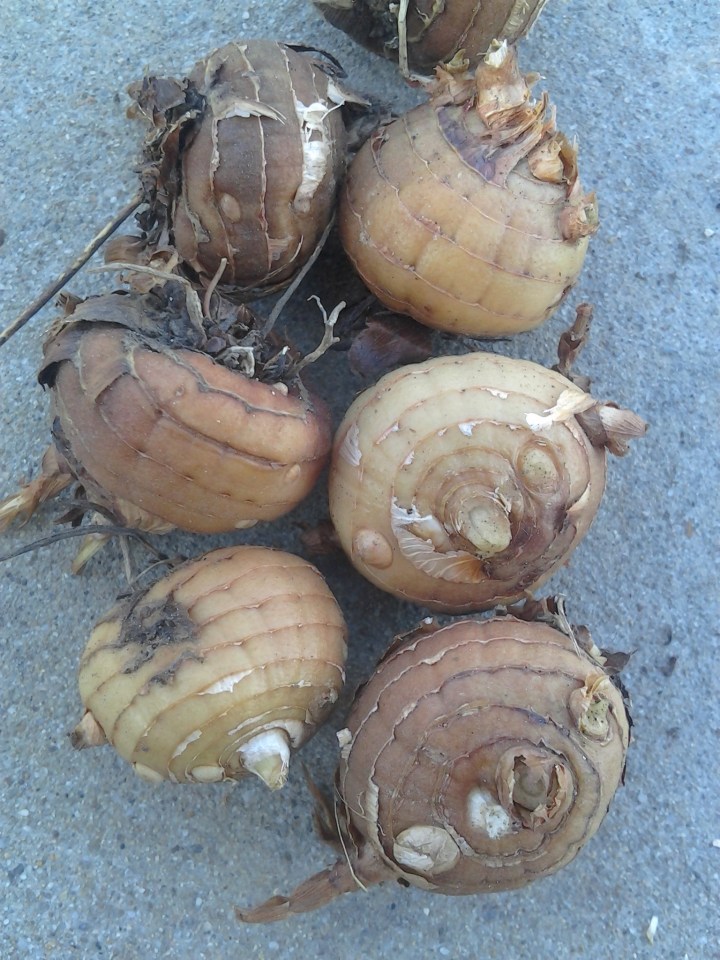
71115thumbOf all the gardening chores, planting dormant bulbs is probably the least gratifying. All we do is dig a hole to the required depth and width, set a few unimpressively dormant bulbs with the correct orientation and spacing, and then fill the hole with the same soil that was removed from it. The process gets repeated until all the bulbs are planted. Soil amendment and fertilizer might be added.

There is nothing to show for our efforts. When finished, only bare soil remains. We might want to plants flowering annuals or a light duty ground cover over the bulbs, or we might just spread mulch. If soil amendment is needed, it should be mixed into the soil at the bottom of the planting holes. Fertilizer can get dispersed over the surface of the soil after planting. There really is not much to it.

Planting bulbs is also a chore that is easy to forget about until it is too late. If we do not see them in nurseries, we might not think about daffodil, narcissus, hyacinth, grape hyacinth, freesia, tulip, crocus, lily, anemone, ranunculus, iris or other spring bulbs until we see them blooming next spring. Yet, this is when their dormant bulbs, corms, rhizomes, tubers and tuberous roots get planted.

Many types of bulbs become available in nurseries at the same time, and can be planted as soon as they become available. It might be too early to plant those that are not yet available. Gladiola, dahlia, allium, calla and canna are summer bulbs that will become available later because they likely should get planted later, although calla and canna do not seem to care when they get planted.

Daffodil, narcissus and grape hyacinth are probably the most reliable spring bulbs for naturalizing. Bearded iris is likewise very reliable, but needs to be dug, split and groomed every few years. Freesia and crocus may not naturalize as reliably. Lily, tulip, anemone, ranunculus and hyacinth are spectacular in spring, but are unlikely to naturalize because they prefer more of a chill in winter.

Some bulbs can be phased in their first year. For example, if freesia flowers are expected to last about a week, a second group of bulbs can be planted about a week after the first. A third group can be planted about a week after the second, and so on for a few weeks until the planting season ends. As the first group finishes bloom in spring, the second group begins to bloom, and so on.

Plants Grow Up So Fast

50429thumbShortly after germinating and producing their first few leaves, many seedlings start to produce foliage that is indistinguishable from the foliage that they will produce for the rest of their lives. Other plants might initially be outfitted with leaves that are smaller, thicker, or somehow slightly different from what will appear later. Then there are those that produce juvenile growth that is completely distinct from later adult growth.
There are many reasons for juvenile growth. It might be a competitive advantage for plants that live in dense forests. For others, it might deter grazing animals. Ivy actually has three phases, with juvenile ‘ground cover’ growth that creeps over the forest floor in search of a vertical support, adolescent ‘vine’ growth that climbs the support, and adult ‘tree’ growth that blooms and seeds when it gets to the top of the support.

Eucalyptus trees produce juvenile growth that is more pungently resinous than adult growth, in order to deter animals that would otherwise eat it. Adult growth develops when the main trunks have grown beyond reach of most of the threatening animals. Vigorous new growth that develops in response to breakage or pruning later in life is also outfitted with juvenile foliage so that koalas and other climbers leave it alone.

Avocado trees grown from seed produce no obvious juvenile growth, but without wasting their effort on blooming and fruiting, they grow very fast and lanky to compete with a dense forest canopy, whether real or imagined. For their first several years, they need to be pruned for structure and containment. They eventually produce adult branches, and start to bloom and produce fruit (although the fruit might be variable.)

Avocado trees obtained from nurseries are grafted so that they are genetically identical to a specific cultivar (for conformity of fruit), and so that they can start to produce right away. Their ‘scions’ (upper part of grafted trees) are obtained from adult growth of stock trees, so do not take several years to mature. The same technique works for citrus, which otherwise produce fruitless and wickedly thorny juvenile growth.

Sometimes, juvenile growth is preferred. Ivy gets pruned out of trees and off of walls to preserve the juvenile growth as an appealing and efficient ground cover plant, while also eliminating the potentially destructive climbing vines.51104

Arborists Are Physicians For Trees

71108thumbBefore the storms of winter get here, it might be a good time to make arrangements to get some help for big trees that need it. Smaller trees that can be reached from the ground may not need anything that we can not do ourselves. It is the big trees that have grown beyond our reach that may need professional help if they have problems. They are unsafe for us DIY garden enthusiasts.

Once late autumn and winter weather patterns start, storms can break limbs and destabilize trees. Identifying problems and executing necessary remedies can limit such damages before they happens. Disproportionately heavy or structurally deficient limbs can be pruned to reduce weight and wind resistance. Obtrusive limbs can be pruned for clearance from roofs and anything else.

Trees are the most significant and influential features of our gardens. They shade and extend their limbs over our homes and gardens. Not only can they cause serious damage by dropping limbs or falling, but they can also change how our home and garden are affected by their shade. They are worthy of proper maintenance, even when it is necessary to procure the services of an arborist.

An arborist is a horticulturist who specializes in arboriculture, which is the horticulture of trees. Arborists are essentially tree physicians, who evaluate the health, stability and structural integrity of trees, and make recommendations for maintenance, or to repair problems. Most municipalities require an ISA Certified Arborist report in order to issue a permit to remove an unsalvageable tree.

The ISA is the International Society of Arboriculture. Certified Arborists have passed an examination of their arboricultural expertise, and maintain their credentials by continued involvement with ISA educational seminars, classes and workshops. More information about the International Society of Arboriculture and local certified arborists can be found at the website, www.isa-arbor.com.

Arboriculture is not the sort of thing that gardeners should be expected to perform. It is completely different from the sort of mowing, shearing and pruning that they do. Sadly, much of the damage that arborists find in trees was caused by improper arboricultural procedures. Arboriculture also has the potential to be very dangerous to someone who lacks adequate training and equipment.

Gutters And Chimneys Need Attention

71101thumbThere is no time that is best to clean the gutters on the eaves. They should probably be cleaned early before the debris within them gets dampened by the first rains. However, they will only need to be cleaned out again after more foliage falls. If cleaned only after all the foliage falls, they will be grungier, and there will be potential for some of the debris to flow into and clog the downspouts.

Most of the fresh leafy debris that fell recently is relatively easy to clean out. Debris that has been accumulating through the year will be more decomposed and settled in. Evergreen trees are somehow messier than deciduous trees. They drop smaller volumes of debris in autumn, but they drop the rest throughout the year. Deciduous trees drop all their foliage within a limited season.

That certainly does not mean that deciduous trees can not make a mess. All that foliage has to go somewhere. If the weather gets cool slowly, foliage falls slowly, and for a longer time. Some deciduous trees innately defoliate slowly, and may even wait all winter to finish. Fruitless mulberry, tulip tree and poplars typically defoliate efficiently, making a big mess that gets cleaned up once.

Flat roofs that lack gutters collect debris too. So do the spaces behind chimneys and in roof valleys (where the slope changes direction). Even if this debris does not interfere with the function of gutters and downspouts, it promotes rot in roofing material. Trees and vines that touch a roof are likely to be abrasive to roofing material if they move in the breeze, or hold debris against the roof.

Trees and vines must be kept clear of chimneys, not only because they can interfere with ventilation, but also because they can be cooked by exhaust from the fireplace below, and ignite! Fan palm beards (dead foliage that accumulates on trunks), pine, cypress, spruce and cedar are particularly combustible. Clinging vines can separate brick from mortar, which is another fire hazard.

Working on the roof and gutters is of course potentially dangerous. It might be best to get a professional for these sorts of jobs, especially if trees need to be pruned. While that is being done, there is plenty of raking and other gardening for us to do (without a ladder). Raking leaves is an important job too, since fallen leaves can shade out lawn, ground-cover and flowering annuals.

Annuals Come And Annuals Go

71025thumbJust like warm season vegetable plants in the vegetable garden, flowering warm season annuals get replaced this time of year. Although the weather is still warm, cool season annuals should be planted now so they can disperse roots before the weather gets too much cooler. Except for a few short term annuals and perennials, most should perform until the weather gets warm next spring.

Pansy, viola, Iceland poppy, sweet William, calendula, stock and the various primroses should get down to the business of blooming rather efficiently, and hopefully compensate for the removal of deteriorating warm season annuals. Ornamental cabbage and kale, as well as cyclamen, can be a bit later because they are a bit more sensitive to warmth, but not slowed much by cool weather.

Nasturtium and alyssum can work as either or both warm and cool season annuals. Both are annuals, so individual plants do not last more than a few months. In hot spots, they may perform well in winter, but then get roasted in summer. In cold spots, they may do exactly the opposite. In the right situations, they self sow and bloom all year. Tired old plants should be groomed out if unsightly.

Chrysanthemums are the most prominent of seasonal color for autumn, and come in all sorts of colors that are ideal for an autumn palette. They are actually perennials that are grown as annuals. Unfortunately, they are usually grown as very short term annuals, that are allowed to bloom only once, and then replaced with something more wintry, like cyclamen or ornamental cabbage or kale.

Like cool season vegetable plants, most flowering cool season annuals should be planted as small plants in cell packs. Chrysanthemum, as well as cyclamen and ornamental cabbage and kale that get planted afterward, are the exceptions that should be planted as four inch potted plants, but they are expensive anyway. Primroses can be planted from either cell packs or four inch pots. (Primroses can cause a serious skin allergy, just from contact.) Nasturtium and alyssum should be grown from seed sown early.

Vegetables Grow All Year Here

71018thumbThe difficult part is pulling up the warm season vegetable plants while they still seem to be productive. It gets much easier after that. Putting new cool season vegetable plants back into the garden is much more gratifying. Vegetable gardening never stops here. One season starts before the previous season ends. If cool season vegetable plants get a late start, they take longer to produce.

If there is enough space in the garden, the cool season vegetable plants can go somewhere else, while the warm season vegetable plants finish with what they might still be working on. Tomatoes might last until frost. Even when it get too cold for the foliage, green fruit can still ripen on the vine, and a bit more on the kitchen windowsill. Green tomatoes remaining after that can be pickled.

If the soil does not need too much amendment, and the spacing works out well, new cool season vegetable plants can be planted in with the warm season vegetable plants so that they can start to grow and disperse roots while the warm season vegetables finish. By the time the warm season plants succumb to cooling weather, the new cool season plants will already be maturing nicely.

This technique does not work so well with last season’s tomatoes only because they are so greedy with nutrients. Fertilizer might compensate for plants that seem slow where tomatoes had been previously. A bit of amendment can be added to the soil when new cool season plants get planted, and more can be added between them when old warm season vegetable plants get removed.

Broccoli, cabbage and cauliflower should all be planted as seedlings, so can work nicely with interplanting with aging warm season vegetable plants. Since only a few of each type are needed for a well outfitted garden, one or two cell packs of six or eight plants each should be sufficient. Each cell pack does not cost too much more than a packet of seed. Seedlings get established quickly.

Beets, carrots, lettuce, spinach and peas should be grown from seed sown directly into the garden, so do not work so well with interplanting. Too many individual plants of each type are needed. It just would not be practical to grow them from cell pack seedlings. Besides, they grow so efficiently from seed. Kale can be grown either from seed of seedlings. It might be too late for cucumbers.

Why Autumn Is Also Fall

71011thumb.jpgThe calender says that it is now autumn. The weather does not necessarily agree. Some of the trees are dropping their leaves. However, the leaves are not falling because the weather is getting significantly cooler. The leaves got cooked during that weird heat wave a few weeks ago. If the weather can be this confusing here in our very mild climate, it must be really crazy everywhere else.

It is hard to make sense of what trees are dropping leaves in response to the earlier heat. Coast live oak, which normally tolerates heat quite well, was really annoyed by the heat in some areas. Cottonwood and other poplars are expressing their discomfort too, but that is to be expected from them. Sycamores, which are normally sensitive to weather anomalies, are not overly concerned.

All this means to us, the janitors of our trees, is that some of us might be raking leaves earlier than expected. These leaves will not be the nice colorful sort that we like to see in autumn. Those will come later. It is still too early to know how the weather will affect autumn color. All we know so far is that some trees will have less foliage for coloring. Sweetgums are hinting at a colorful autumn.

Leaves should be raked as they fall. However, because no one wants to clean the eave gutters any more than necessary, they can be cleaned only a few times, or maybe only once if trees shed efficiently. They are easiest to clean before the rain starts and the wet leaves start to decay. Unfortunately, most deciduous trees continue to drop their leaves well into the rainiest part of winter.

Lawns and shallow or dense groundcovers really do not like to be shaded by fallen leaves for too long. To perform through winter like we expect them to do here in our mild climate, they want as much sunlight as they can get while the days are shorter and the sun is lower on the horizon. Besides, fungal pathogens like mildew and rot, are more likely to proliferate under damp fallen foliage.

Finely textured leaves under low shrubbery and coarsely textured groundcover that ‘eats’ fallen leaves is a nice mulch, so does not need to be raked. If it can not be seen, and is not too abundant, it is probably not a problem. The exceptions are fallen leaves of roses, grapes, cane berries, deciduous fruit trees, and any plants that are susceptible to diseases that overwinter in fallen leaves.