Regardless of their individual innate requirements for water, new plants need to be watered very regularly immediately after they are installed into a landscape. As they mature and disperse their roots, the regularity of supplemental watering becomes less important, and ‘drought tolerant’ plants may not need to be watered at all. Maturing larger trees generally get what they need from the landscape around them.
Automated irrigation systems that are designed for new landscapes are designed for what the plants need while the landscapes are new. As the landscapes mature, the irrigation systems may need to be adjusted accordingly. Drip irrigation or bubblers that were needed to water new trees while they were young and confined should be moved farther from the trunks of the trees as roots disperse, and should eventually be removed and capped.
This is very important, since water applied directly to the trunks of some maturing trees will promote rot and other disease. For some, it promotes buttressing of roots that can displace concrete or other landscape features. If nothing else, it is just a waste of water.
Whoever installed the irrigation to this young London plane tree knew how to do so properly. The bubbler was likely over the confined root systems of the formerly canned tree just after it was installed. It is installed in such a manner that it could have been moved over as the tree grew, replaced with some sort of drip irritation hose to curve around the tree (if such a device had become necessary), or simply removed.
Now that the tree is as mature as it is, the bubbler should simply be removed, and the riser (where the white ‘L’ is) should simply be capped. The tree gets what it needs from the rest of the landscape around it, and really does not need much water anyway. It could probably survive without any supplemental irrigation at all. The bubbler is really just wasting water.
However, because so-called ‘gardeners’ are what they are, the bubbler remains, attached to an unsightly bit of exposed pipe, and wasting water on the base of the trunk of the sycamore. Because this tree and associated bubbler are right next to a parking spot in a parking lot, the pipe is very likely to get stepped on and broken every once in a while. In fact, the fresh Teflon tape on both ends of the pipe suggest that it was repaired quite recently, rather than removed.
Fortunately, the sycamore will not likely be damaged by water applied directly to the base of the trunk.
Pantry
Birds do some odd things. They seem to know what they are doing. The odd things that they do make sense. Nonetheless, some of what they do out there is just plain odd.
I mean, who was the first woodpecker who thought it might be a good idea to bang his head against a tree? What prompted the first sapsucker woodpecker to bore through bark of a healthy tree to lap up the sap from the cambium within? Why do other woodpeckers bore into rotting dead trees for grubs, and to make nests? The different types of woodpeckers seem to be related, but they are after different things. Did one just accidentally bore into the wrong sort of tree, and discover something more than what was expected?
Various species of woodpeckers are surprisingly omnivorous. Those who eat termites also eat other insects, nuts, acorns, berries and fruit. Sapsuckers also eat insects, berries, small nuts and such.
Many woodpeckers are social, and live in significant communities. Those who bore into dead tree tops to nest prefer to live where there are several dead trees tops to bore into, probably because too many nests in the same tree would compromise the structural integrity of the already decaying trunk. Besides, if they all lived in the same dead tree, they would all become homeless at the same time if the tree fell down.
Colonies of some species of woodpecker store nuts or acorns in rotting dead trees. They can store quite a bit in each tree because the holes bored to hold the individual nuts and acorns are not as big as the holes that they nest in, so do not compromise the integrity of the trees as much. Besides, it is easier to defend many acorns and nuts in a few trees than it is to defend them in many trees. Squirrels who want the same acorns and nuts are very sneaky!
The problem with putting all their eggs in the same basket, or all their acorns in a few trees, is that when one of such trees falls, it takes a significant portion of their stored nuts and acorns with it. Once on the ground, it is impossible for them to defend it from squirrels and rats.
This particular rotting ponderosa pine fell and needed to be removed from the roadway that it fell onto before woodpeckers could recover the acorns that they so dutifully stored in it. The precision with which the holes were carved to custom fit each acorn that they hold is impressive. The woodpeckers who did this really know how to manage their pantry.
Nature For Sale
Gardening is unnatural. Yes; quite unnatural. So is landscaping. It all involves planting exotic plants from all over the World that would not otherwise be here, including many that are too extensively and unnaturally bred and hybridized to survive for long even in the natural ecosystems from which their ancestors were derived.
Unless they grow on their own, even native plants are not natural. Those that are native to the region may not be native to the specific site. Many that are grown in nurseries are unnaturally selected varieties or cultivars. To complicate matters, much of what seems to be natural out in forests and wild lands are invasive naturalized exotics.
The weather above and most of the soil below are natural, but both are commonly enhanced for our gardens. We water our gardens and landscapes as if the weather is insufficient. Soil amendments and fertilizers compensate for what we perceive to be inadequacies of the natural soil. Insects, deer, raccoons and disease are all natural too, but we put quite a bit of effort into excluding them from our gardens.
Bees and other pollinators are all the rage now, even though many are not native or natural here. We provide them with weird and confusing new cultivars of flowers that likely produce nutritionally deficient pollen, and that distract them from naturally native plants that rely on them for pollination. It all gets so confusing!
These potted annuals and flowering perennials at the supermarket are pretty and might provide the illusion of bringing a little bit of nature closer to the home. Yet, there is nothing natural about them. They are all unnaturally bred and hybridized from unnaturally exotic plants, and were provided with synthetic fertilizers and artificial irrigation, while they were grown in synthetic medium, contained withing synthetic pots.
Six on Saturday: Presbyterian Horticulture
Subjects for more than just a few of my illustrations are found in the simple landscape of Felton Presbyterian Church. Until the last year or so, I had been able to participate in more of the seasonal work days, when we do most of the maintenance of the landscape, as well as a few other chores. No one seems to mind that I am Catholic.
The biggest and best trees, including the big coast live oak, Quercus agrifolia, out front (which I should have gotten a picture of) are native, and were there before the site was developed. Smaller trees of the same species have appeared since then. Also, a nice big catalpa, Catalpa speciosa, appeared right out front, just to the south of the big coast live oak. Otherwise, most of the landscape is an odd mix of what various parishioners contribute to it.
1. Naked lady, Amaryllis belladonna, bloomed late last summer, just before the foliage started to develop in autumn. They are blooming again! Now I know where fake roses come from.
2. Breath of Heaven, Coleonema pulchrum, has a name that is more appropriate to a Church than ‘naked lady’. The flowers are tiny, and not very impressive, but are pretty against the very finely textured foliage.
3. Pot marigold, Calendula officinalis, has been modestly naturalized here for years. There are just enough to be pretty, without being invasive. Goodness! Naked ladies and pot!
4. Flowering maple, Abutilon spp., was contributed by a parishioner who has many growing wild and blooming in a variety of colors at here home in the same neighborhood where I work. She gave us many of the same.
5. Dock, Rumex crispus, has a cool name, but is really just a weed. I have been trying to kill this one for years! It will not die. The root is mixed with tree roots. Now, it looks so fat and happy that I sort of want to leave it.
6. Lichen (which I can not identify with a Latin name) on the limbs of the crape myrtle featured last week got noticed enough for it to get a close up picture this week. I don’t understand the allure. I’m not lichen this one.
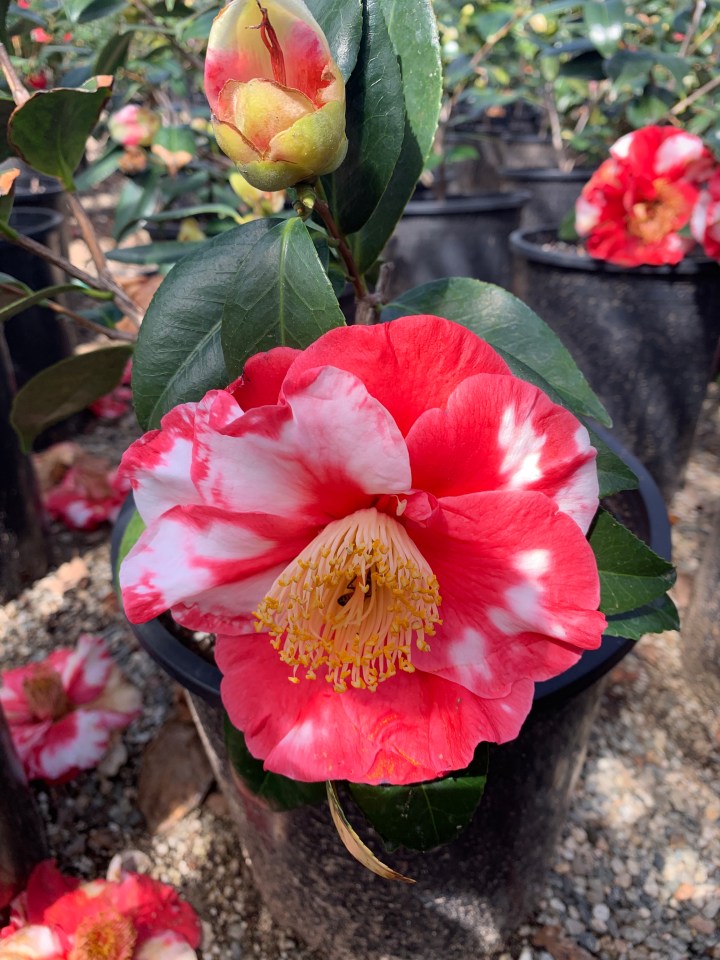
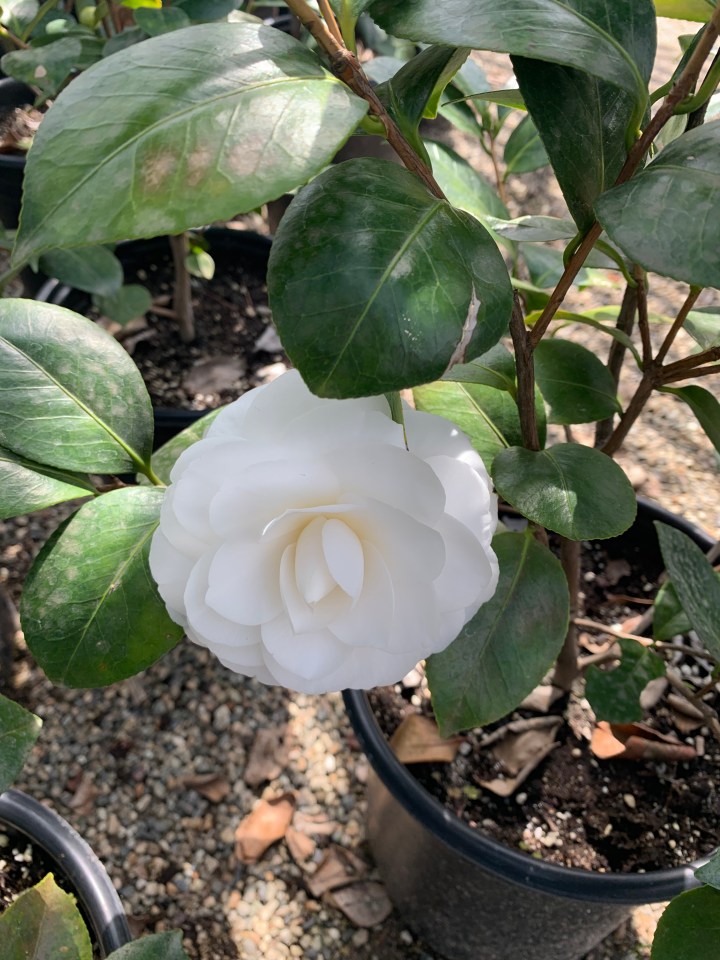
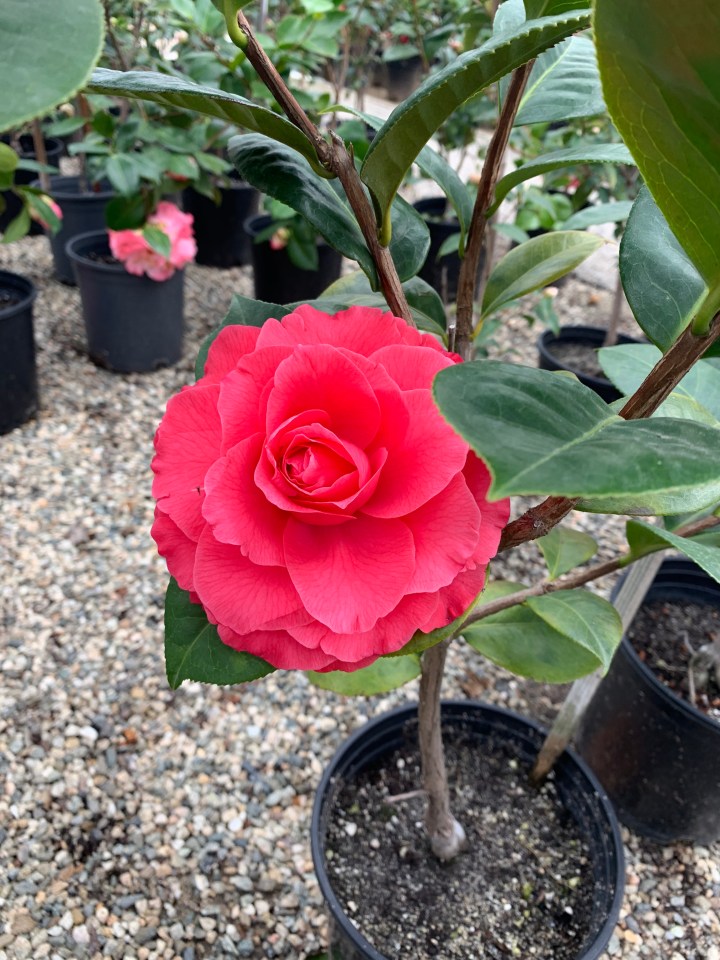
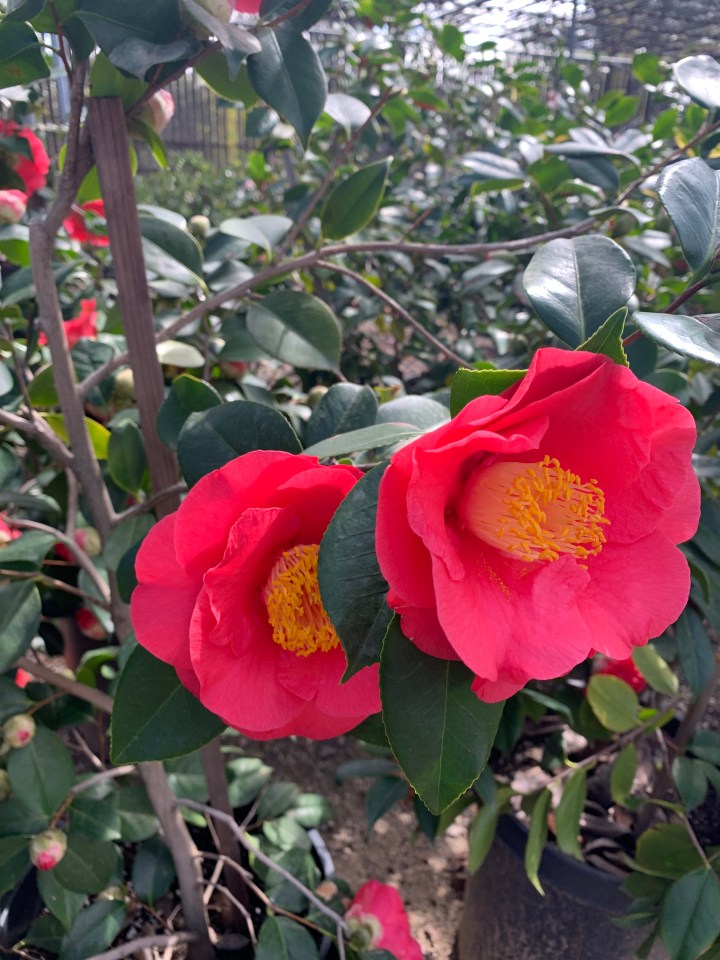
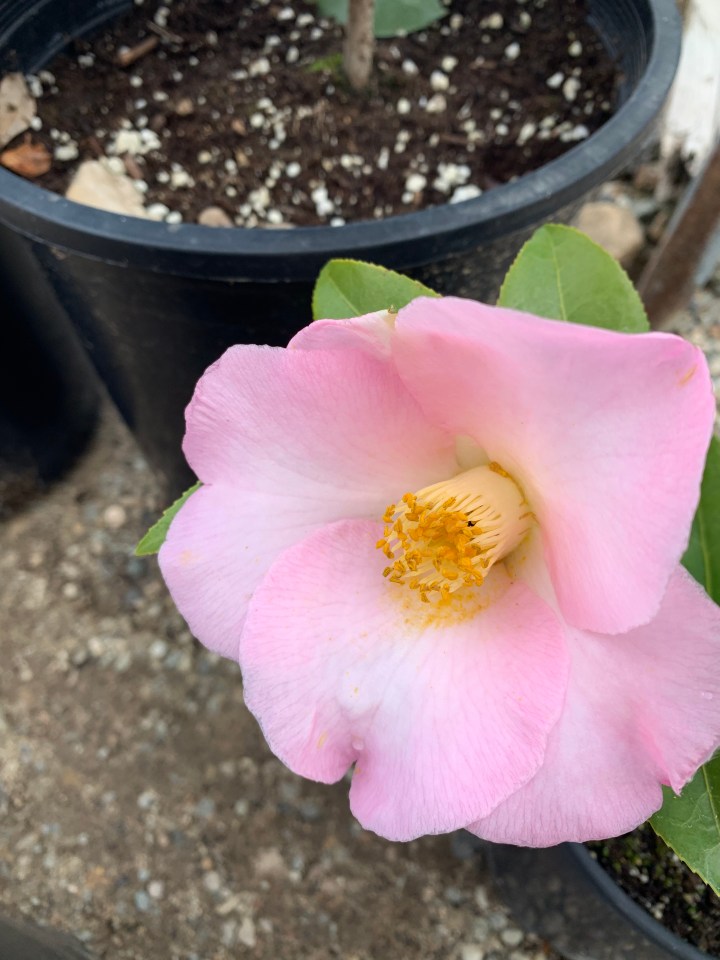
Since I did not use any of the pictures of camellias from Nuccios’ Nursery in Altadena that Brent sent to me (that I mentioned last week), I will try to share them next week, even though they finished blooming already.
This is the link for Six on Saturday, for anyone else who would like to participate:
https://thepropagatorblog.wordpress.com/2017/09/18/six-on-saturday-a-participant-guide/
Horridculture – B & B
B & B, formally known as ‘balled and burlapped’ nursery stock, was expected to be the next big ‘thing’ in nursery commodities here in California back in the late 1980s. As those outside of California know, it is field grown plant material that gets dug and marketed with its roots wrapped in burlap. It was more common in other regions, so was expected to become more common here as more nursery stock was to be imported from Oregon.
However, growers in Oregon started growing more of their stock in cans like we do in California, and then did not send as much of their B & B stock to California as predicted. Only certain slow growing commodities and large items are still field grown, and then dug and ‘balled and burlapped’ for export. Of these, arborvitaes, rhododendrons and various deciduous shade trees are the more commonly available locally.
B & B stock from Oregon is typically of exceptional quality. Horticulture is taken more seriously there.
Because B & B is still a foreign concept in California, it is typically canned to be more familiar to local consumers. It does not take long for it to root into the little bit of extra potting medium and fill out the cans. There is no need for the roots to be unwrapped, since the burlap decays as fast as the root disperse and expand. The now canned but formerly B & B arborvitaes in the picture above are exemplary.
Yet, they are not perfect. The problem with B & B stock here is that there are not many horticultural professionals here who know how to work with it, or even care to do so properly.
The picture below shows how shallow the B & B root systems of the arborvitaes are relative to the squat #15 (15 gallon) cans that they were purchased in. They obviously did not get enough time to root into their potting medium after they were canned. This is not due to a lack of horticultural expertise. This is either (and hopefully) a mistake in scheduling, or merely a lack of concern. But hey, no bother. They are still excellent specimens.
At least they seemed to be. A potentially serious problem was revealed when they were installed and the loose potting medium fell away from the burlap.
Many years ago, the burlap containing the balled root systems of B & B stock was bound with biodegradable jute twine. It rotted away before it could do any damage. Since then, nylon twine became more commonly used. Those who are familiar with B & B know to simply cut and remove the nylon twine before planting.
Whomever processed and canned these arborvitaes are either (and hopefully) not familiar with B & B, or just do not care. The nylon twine was still tightly bound and tied. If these arborvitaes had rooted into their potting medium and held it intact, this twine would not have been visible. Because it is wrapped a few times around the main trunks as well as wadded up burlap, it could have girdled the main trunks as they grew and expanded!
In a way, it was fortuitous that the potting medium fell away to expose the nylon twine, which was cut to allow for expansion of the main trunks. These exemplary B & B arborvitaes from Oregon should live happily ever after.
The Davey Tree
This is no common Douglas fir. It is the ‘Davey Tree’, named after the tree service that so diligently prunes it for clearance from the utility cables above. Yes, I can see as easily as you can how disfigured it is. The plan is to cut it down before it falls apart. At least that is the excuse for cutting it down. It is relatively short an stout, so is likely quite able to support its own weight, regardless of this disfigurement. We really just want it gone because it is so unsightly.
Most who see the Davey Tree are quick to blame the disfigurement on those who prune it for clearance. They do not consider that without such pruning, the utility cables would eventually be ruined and unable to deliver the electricity that so many of us use. Those who prune the trees do what they must to keep the electricity and other utility cables operational. Unfortunately, such work sometimes ruins trees.
As an arborist who sometimes works with other arborists who must perform clearance pruning, I am more likely to blame other landscape professionals. Some landscape designers design landscapes with trees that get too tall or broad within utility easements. Heck, many designers do not even designate where such easements are on the drafts of their landscape plans. Some so-called ‘gardeners’ plant such trees in utility easements with no plan at all. For what they all charge for their services, landscape professionals should know better than to put inappropriate trees into situations where they will eventually need to be mutilated or removed. Not many think that far ahead, or even care.
Anyway, the inappropriate location and disfigurement of the Davey Tree really can not be blamed on anyone. It is a wild tree that grew there from seed.
Sugaring Season
There is no sugaring season here. Spring comes on too suddenly. By the time sap starts to flow, buds are already swelling.
Bigleaf maple, Acer macrophyllum, happens to be native here, although it is not common. It is the sugaring maple of the Pacific Northwest. A tree next to my driveway gave me enough sap to boil about four ounces of maple syrup a few years ago. That was all I needed to make the point to my colleagues who insisted that it could not be done that it really could be done.
Box elder, Acer negundo, is also native, and in riparian zones, is much more common than bigleaf maples is. I am told that is provides sap for sugaring just like any other maple does. Some say the sap is of inferior quality, or boils to cloudy syrup. Others say that it is comparable to that of any other maple.
Now that I made my point about getting a tiny bit of syrup from a bigleaf maple tree, I have no intention of sugaring again. However, sugaring season is still something that I need to be aware of. It is when I can not prune the maple trees. I can prune them earlier in winter or later in summer, but not while they are most vascularly active during sugaring season. Otherwise, they don’t stop bleeding. Even if the bleeding is harmless, it is unsightly if it stains the trunks and becomes infested with sooty mold as the weather warms.
The same rule applies to birch trees.
I pruned a few of the European white birch, Betula pendula, at work last week, believing that it was still too early for them to be too active. It was not much at all, and involved only a few small upper limbs and two significant lower limbs that had been disfigured by pruning for clearance from adjacent utility cables. I did not notice bleeding from the small stubbed limbs that I pruned from high in the canopy with a pole saw. Yet, the sap started to pour from the pruning wounds before I finished cutting away the two larger lower limbs that happened to be on the same tree. They are still bleeding now. In fact, they are bleeding so much that I feel badly that the tree is losing so much sap. If I had known how much sap would bleed, I could have put a bucket under each of the two wounds to catch the sap to make a small bit of syrup as is done in Alaska.
Six on Saturday: Picture Dump
No topic. No excuse. I just have these few pictures that I have no other use for. Some are sort of interesting, depending on perspective. Some are weird. #5 is just plain unsightly.
I considered sharing six pictures of camellias from Nuccios’ Nursery in Altadena that Brent sent to me, but I did not want to totally dismiss these pictures. Besides, Brent takes really lame pictures. I might share them next week just so we all can see how lame they are. I believe that most are different from the camellias at work that I shared pictures of last year, but I really do not know.
1. Arum italicum, which is also known simply as Italian arum, is something that I had always dismissed as a naturalized and sometimes invasive exotic species. In other words, I thought of it merely as a weed. Then, I noticed others using the foliage with cut flowers. It never occurred to me how pretty it is. I am not sure if this is the real deal, but it is what grows here. Some of the garden varieties that others have shared pictures of are more intensely variegated. It seems to me that another species that is not variegated might live here too, but I can not remember where I saw it.
2. It never rains in Southern California. This is not Southern California. Besides, contrary to popular belief, it really ‘does’ rain in Southern California. Anyway, the incessant and abundant rain has been damaging a few of the spring blooming flowers, although most are doing quite well. This odd bearded iris bloom seems to be melting. Those that bloomed immediately afterward are doing just fine. The stems seem to me to be unusually slim for bearded iris, but I am no expert.
3. WHAT IS THIS?!? I believe it to be Kerria japonica, which is also known simply as Japanese kerria. . . . sort of like Arum italicum, which is also known simply as Italian arum. I thought it was something completely different until it bloomed. I will not say what I though it was, because my assumption was about as lame as Brent’s camellia pictures, and we can’t have that.
4. Clematis armandii, which is also known simply as Armand clematis (I bet you didn’t see that one coming.) is more popularly know here as evergreen clematis. It grows like the weed that it is, and climbs into the lemon tree that it is next too. It always seems to be very vigorous and healthy, but many of the leaves have crispy tips. Those at the top of the picture are about half dead! The vine does not get any fertilizer, although it probably reaches where other plants are fertilized. The damage is attributed to the water.
5. Lagerstroemia indica, which is NOT also known simply as Indian lagerstroemia, is the familiar crape myrtle. Some might disdainfully spell it without the first ‘e’. I am none to keen on it either. Actually, I am none too keen on its overuse! It is everywhere, and very often in situations that it does not belong in. This one is under larger trees, so does not get enough sunlight to bloom well. Prior to pruning, it was more disfigured than it is now. Since it can not grow as tall as it would like to be, it should be pollarded annually. As it matures and develops knuckles, some of the superfluous stems can be removed. As much as I dislike crape myrtle in bad situations, I want this tree to be pollarded properly. ‘Crape murder’ is unacceptable! There are MANY in the region that are indiscriminately hacked by so-called ‘gardeners’, who leave nasty stubs and unsightly stubble.
6. Eureka lemon originated as a ‘sport’, or mutant growth, of Lisbon lemon. The only difference between the two is that Lisbon lemon produces all fruit within a limited season, while Eureka lemon produces a bit less within the same season, and then continues to produce a few additional fruit sporadically throughout the year. Lisbon lemon works well for orchards that produce lemons for lemon products. Eureka lemon is better for home gardens, where it is always happy to provide lemons whenever they are desired. I got this picture of a single ripening fruit because there are not many others on the tree right now. That means the tree is doing its job; and people who work here are using the lemons.
This is the link for Six on Saturday, for anyone else who would like to participate:
https://thepropagatorblog.wordpress.com/2017/09/18/six-on-saturday-a-participant-guide/
Horridculture – Fads
This is why I do not grow hellebores in my own garden. The specimen in the pictures above and below are about as good as they get here. Most are quite a bit worse. Some put out only one or two flowers. Some do not survive their first year in the garden.
No one seems to know why they don’t do well here. It might be the lack of chill in winter, although they do better in even milder climates. It might be the minimal humidity, although they generally do no better in the damp redwood forests where the specimen in these pictures lives. Those that might get too much sunlight do no better or worse than those that get too much shade. They are simply not happy here.
My solution to this ‘problem’ is to not grow them in my own garden. I do not particularly like them anyway. Even those that look ‘good’ look like huge African violets dipped in paraffin. Those in the landscapes that I work with now are the colors of worn vinyl upholstery of 1970s Chryslers. Yup, I will pass on hellebores. ‘Problem’ solved before it happened.
That ‘solution’ does not work for everyone.
Some landscapers get what they can from the few growers who will grow them here, and plant them in all sorts of landscapes that they just do not belong in. Some will do it because they read somewhere that hellebores do well in shade, which is technically true, but only in regions where other environmental conditions are appropriate. Some do it because they saw pretty pictures of them, and read a nice article about them in some gardening magazine that features such articles about what does well where the respective magazines are published.
Sadly, many do it because hellebores are a fad here, and something that many landscapers with something to prove like to brag about. They are like dawn redwood and unusual varieties of Japanese maple that are so often installed into inappropriate situations just so the landscaper can add pictures of them to their portfolios. Fortunately, hellebores merely struggle or die without causing any other damage to the landscape.
There are a few kinds of fads, and some of them actually make sense, but good landscape designers should use fads responsibly and with discretion.
Oregon
If California is the most excellent state in the entire Unites States of America and surrounding Universe, and Oklahoma is the second most excellent, then Oregon might be number . . . hmmm . . . fourteen or fifteen . . . or maybe like twenty or something. However, in MY (very important) opinion, Oregon is like the third most excellent state, and almost ties with Oklahoma! That makes it even slightly more excellent than Pennsylvania, Vermont and Arizona! Yes, it is THAT excellent!
Even the state tree of Oregon is excellent. It is the Douglas fir, pseudotsuga menziesii. That is like the second most excellent of the state trees, right after the coastal redwood of California. If California did not claim the coastal redwood as the state tree, Oregon is the only other state that can claim it as a native, since the native range of coastal redwood extends ever so slightly into the very southwest corner of Oregon.
There was a time when redwood was the main timber tree here, but that was only because it was the most readily available. As the supply was depleted, it was reserved for fences, decks, structural lumber that is in contact with concrete foundations, or any other situation in which its innate resistance to decay was important. Douglas fir became the most common lumber, and is still what homes are built from now.
Besides all that, Douglas fir is one of the grandest of trees in North America.
Then there is the state flower of Oregon. Well, it is not so much to brag about, although it is still better than the state flower of Oklahoma, which happens to be mistletoe. (Okay, that is another subject for later.)
Oregon grape, Mahonia aquifolium, blooms late in winter with these bright golden yellow, but otherwise unimpressive flowers. The few small black berries that develop over summer are mostly taken by birds before anyone notices. The glossy and prickly dark green foliage is quite appealing, and happens to do well in partial shade, but this is the state flower, not the state foliage.