Splat!

P90310There are a few consequences to all this excellent rain. Gutters are flooding. Trees are falling. Mud is sliding. As much as we should be grateful for what we are getting while we are getting it, it is getting rather old. Clear and sunny weather that is forecast after today will be a welcome relief from all this muddy sogginess.
Almost all of the flowering cherries have somehow postponed bloom. It has not been unusually cold. It is as if the trees somehow know better than to bloom while so much unusually heavy rain is falling. Otherwise, they might have bloomed only briefly before the blossoms got knocked off. The buds are so fat that I expect they will begin to bloom by the middle of the week.
Only one flowering cherry that always blooms significantly earlier than the others bloomed on time, and is already finished. Considering how heavy the rain was during that time, the light duty bloom actually lasted impressively well.
Daffodils tried to delay their bloom as well; but some could wait no longer. Many were not bothered by the heavy rain. Others were knocked flat, and needed to be propped with small hoop stakes. Only some of those that were planted late in the planting season kept their buds closed this late.
I should be pleased that these hyacinth bloomed at all this year. They are the sort of bulbs that bloom only once in their first year, but then do not get sufficient chill in winter to bloom again. They must be in a cold spot. Unfortunately, it is also a shady spot. The floral stems stretched so much in the shade that they were easily knocked down by the heavy rain. Now they lay there like they have fallen and can’t get up.

Sci-Fi

P90309KThere are thousands of them, these weird motionless caterpillar like ‘things’, in big herds under all the cottonwood trees. They make a squishy mess in the rain, and stain concrete. They may not look like much from a distance, and are merely ignored as a minor nuisance that must be swept from pavement, but on closer inspection, they really look unworldly, like something from another planet, or a bad Japanese science fiction movie.
They are just male catkins of the native cottonwoods. At least I believe they are. If there are female flowers mixed in, I would not know it. Nor would I know if they really are from another planet. I know that the cottonwoods will later make quite a mess with their cottony fluff that carries their seed away on the wind, so they must do what it takes to generate seed, which generally involves flowers of both genders. I just never look that closely. Their privacy should be respected in such matters, even if they choose to do it out in the open. Those that dropped this . . . whatever it is . . . were doing . . . whatever they were doing . . . right out in the big lawn of Felton Covered Bridge Park!
Why must cottonwood trees bloom so profusely? They must know what they are doing. Maybe they expect most of their tiny seed to get eaten by small seed eating birds. Perhaps all but a few of their seed stay in the same riparian situations from which they came, or blow far enough away to land in other equally hospitable riparian situations. Otherwise, almost all land in situations that are too dry for them to survive long after spring. It is difficult to know what their potentially nefarious motives are.

Six on Saturday: Mudslide


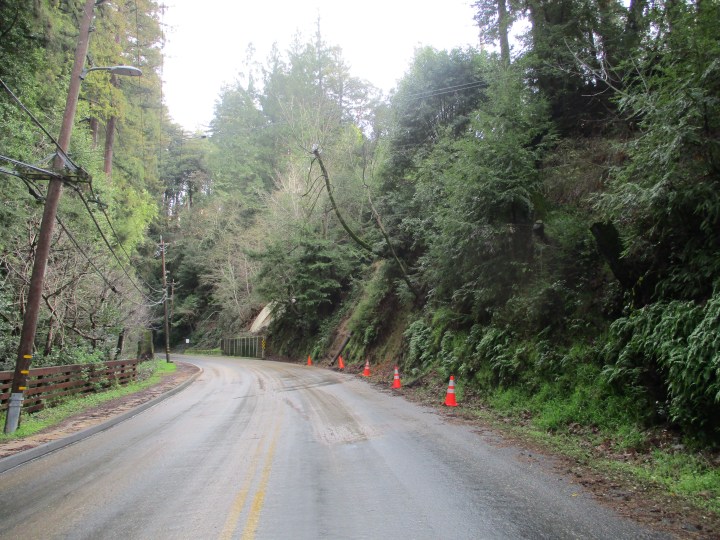
With all the rain, it was no surprise. Mudslides are somewhat common here, and they sometimes close roads. In fact, we were sort of expecting a small mudslide almost in this particular spot right when we got the call about it. The only slight surprise was that it was right next to where we expected it to be. The cliff that we expected to make this sort of mess was still intact under the tarps put over it to deflect some of the rain.

Fortunately, it was a small mudslide that blocked only one lane. We were able to direct traffic through the other lane while the blocked lane was cleared of debris by a small bulldozer.

The top of the cliff slid to the bottom along with a stump of a Douglas fir that was cut down many years ago. The Douglas fir was cut down so that it would not destabilize the soil that it was rooted into as it moved in the wind. However, The soil was destabilized as the Douglas fir roots that held it together decayed. This is actually a common dilemma, since trees sometimes need to be cut down before they cause such problems, but the death and decay of the roots of such trees ultimately cause the same problems.

The sorts of trees that could be coppiced do not do so well in the dry soil on top of cliffs. Otherwise, we could plants willows, cottonwoods or something of the sort, and cut them down as they get too big, without killing the roots. They would be happy to regenerate and continue the process. The sorts of plants that prevent surface erosion do not do much to stabilize the soil. Otherwise, we could put something as simple as freeway iceplant (Carpobrotus chilensis) on top, and let it cascade downward over the unstable area.

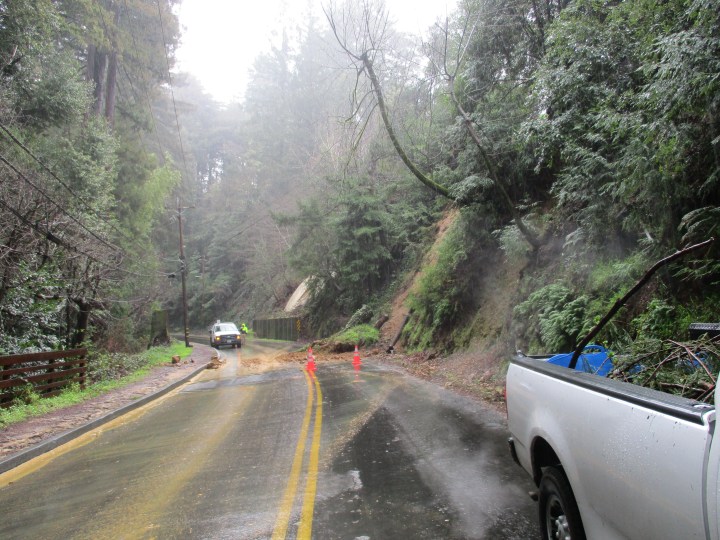
1. It was nothing too serious, but just enough to block the inbound lane. Tarps over the cliff that we expected to make this sort of mess are visible above the retaining wall just beyond. My work pickup in the lower right corner of the picture blocked the inbound lane with its headlights and hazard flashers on. I directed incoming traffic around it into the clear outbound lane as it was available. The young man off in the distance moved his pickup out of the outbound lane, and also directed traffic accordingly. When necessary, he stopped traffic while incoming traffic used the outbound lane. We communicated by radio and hand signals.P90309

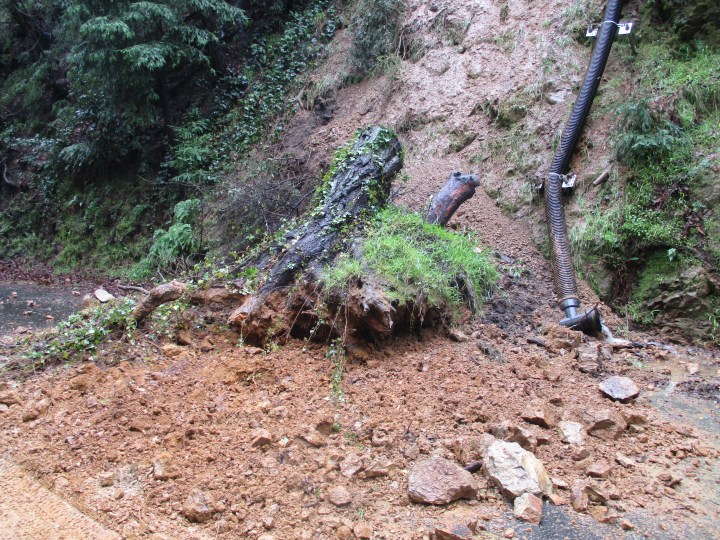
2. This is the stump of the Douglas fir that was cut down so that it would not dislodge the soil and cause a mudslide. A decayed stump of a smaller madrone tree is to the right. Their rotting roots and the English ivy were insufficient to stabilize the top of the cliff.P90309+

3. These significant mudstone boulders on the far side of the road could have done some serious damage to a car if one had gotten in their way.P90309++

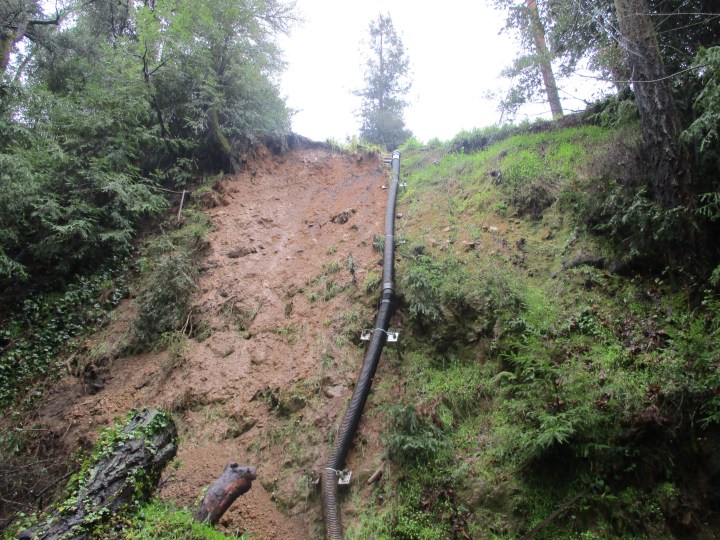
4. That is where the Douglas fir stump came from, just to the left of the drainage pipe. It did not get very far. That is it at the lower left corner.P90309+++

5. We arrived about ten. By noon, there was not much evidence of what had happened. We left the cones because the road was slippery with mud.P90309++++

6. This is supposed to be a gardening blog, so here is an unidentified fern that witnessed the whole ordeal from a stable portion of the same cliff. There is slightly more flora to this story than two dead stumps and a bit of ivy.P90309+++++

This is the link for Six on Saturday, for anyone else who would like to participate:

https://thepropagatorblog.wordpress.com/2017/09/18/six-on-saturday-a-participant-guide/
Horridculture – Ivy League

P90306English ivy, Hedera helix, is probably the nastiest and most aggressively invasive exotic species that I work with. It climbs high into redwood trees and overwhelms understory plants (that live below the trees). It invades many of the landscapes, and worst of all, it climbs building where it ruins paint and causes rot. It grows faster than we can keep up with it.

English ivy is actually a nice ground cover plant for refined landscapes. I grew it at my home in town. Contrary to popular belief, it does not root into and parasitize the trees that it climbs. Actually, it rarely overwhelms and shades out large trees. It prefers to keep them alive for support, from which it disperses its seed. However, it does promote decay in the trunks that it climbs, particularly where it retains moisture at ground level. Native trees are not accustomed to that.

We try to remove as much English ivy at work as possible, which includes removing it from trees and buildings. So far, with a few exceptions of small bits of ivy that broke off high in the trees that it climbed, I have been able to remove all ivy from the trees and walls that I have worked on.

Others were not so fortunate. When quick and efficient removal of ivy from the bases of as many mature trees as possible is the priority, ivy is more often severed down low, and left to die on the trunks of the infested trees. It looks shabby to say the least, and takes many years to deteriorate and fall away. In the picture above, dead ivy that was severed within the past few years is already being replaced by new ivy, which will also need to be severed.

The same technique happens with ivy on buildings. It gets cut at the foundations, but left on the walls to shrivel and turn brown. The dead ivy in the picture below was reaching upstairs eaves when it was severed, and remains there a few years later.

What annoys me so much about this technique is that it does not take much extra effort or time to tug quite most of the lower ivy from trees and walls. For most situations, all ivy can be dislodged, although tiny aerial roots remain. It is much easier to dislodge while fresh than after it is dried and crispy.P90306+

Bullwinkle II

P90303What makes this Bullwinkle worse than most is that I pruned it like this myself. What makes it worse than worse is that it did not need to be pruned in this disfiguring manner for clearance from utility cables like the last one I wrote about was. https://tonytomeo.com/2018/08/08/horridculture-bullwinkle/ It is instead an attempt to renovate an overgrown hedge that was behaving something like a fat hedge. https://tonytomeo.com/2018/06/06/horridculture-fat-hedges/

In fact, the only reason it did not qualify as a fat hedge is that it had plenty of space for all of its superfluous bulk The side to the left was only beginning to encroach into the driveway on that side, and was easily pruned back to the curb, which for now, is adequate confinement. The side on the right was only beginning to encroach into the upstairs balconies, and was likewise easily pruned back for reasonable clearance.

The problems with this hedge were within and on top. It had been shorn back only for minimal confinement for so long that all the foliage on the sides was within a thin external layer. Pruning any farther back would have exposed a thicket of necrotic stems in various degrees of deterioration that had been accumulating within the interior for many years. Almost all growth was directed to and concentrated on top, which shaded the interior and lower stems even more than the accumulation of necrotic crud within did. Since the top had always been pruned down to the same height, all subsequent growth after pruning on top was above where it had been pruned previously, which was of course above the height where it was wanted, and consequently removed when the hedge was pruned again. There was no incentive for lower foliage to develop.

The hedge is there to obscure the view of a building on the left from the windows of the building on the right. The most important foliage for that purpose is the lower foliage, which is precisely what is lacking. Almost all resources were going to the upper foliage, which was contributing nothing, while shading out the lower growth. Although the inner thicket of necrotic stems was partially helping to obscure the unwanted view, it was also inhibiting healthier lower growth.

The illustration shows what remains after the useless top and necrotic interior were removed. After the picture was taken, the left and right sides of the hedge were pruned lower to eliminate the useless upper foliage that was not contributing to the function of the hedge. As unsightly as it is, it partially obscures the view of the building on the left from the building on the right, and will obscure it more as new foliage develops. Now that the interior is exposed, new growth should develop within the interior, and lower to the ground. Because the area is partially shaded by nearby redwoods, the exposed interior limbs are not likely to be damaged by sun scald.

After the new interior growth is established and obscuring the view, the external sides that are there now can be pruned back farther and sloped inward toward the top so that the lower growth of the hedge gets more sunlight. The hedge certainly does not need to be as wide as it is. It would be easier to maintain if it were narrower and so close to the allowable boundaries. Ultimately, with appropriate pruning over the next few years, this old hedge should be restored.

Looks Like Rain

P90202KSupposedly, all this rain has not been too terribly excessive. It seems to have been raining more frequently than it normally does, with only a few days without rain in between, and more often, many consecutive days of rain. The rain also seems to be heavier than it normally is. Yet, the total rainfall is not too much more than what is average for this time of year, and well within a normal range.
The volleyball court at Felton Covered Bridge Park looks more like a water polo court at the moment. The pair of ducks out of focus on the far side seem to dig it. The water is not as turbulent at it is the San Lorenzo River where they live.
Speaking of the San Lorenzo River, it has been flowing very well and at a relatively continuous rate. It came up high only for a short while. None of the heaviest downpours lasted long enough to keep it very high for very long. The ivied log laying in the river in the middle of the picture below was an upright cottonwood tree only recently, but fell into the river as many riverbank cottonwoods do when the ground is softened by rain and higher water.P90202K+
When things get as soggy as they are now, this great blue heron strolls the lawn at Felton Covered Bridge Park, probably because the San Lorenzo River is too turbulent, and also because the worms that live in the lawn come to the surface as the lawn gets saturated. He or she is never in a hurry, but just strolls about slowly, occasionally prodding the muddy soil. However, when it wants to move fast, it is quick enough to catch small frogs. Supposedly, this great blue heron caught and ATE a small gopher!P90202K++

Six on Saturday: Another Day At The Office


There is no rush to leave the office and shop when the weather is cold and rainy. We have been getting quite a few of the inside chores done. When we do go out in the rain, I do not like to take the camera out from under my rain gear; so I do not take many pictures. Besides, since most of my work involves pruning right now, I have not been working much around what is blooming or other interesting subjects.

1. Sitka spruce brought back from near Smith River within their native range are now happily canned in the recovery nursery at our shop. They look as if they were grown here, or are on a bench in a production nursery. They will eventually go out into the landscapes.P90302

2. Staghorn fern that the same colleague with the Sitka spruce brought back from his grandparents’ home in Orange County are not so happy. They were desiccated on arrival. Now that they are getting much more rain then then need, they are just rotting. The specimen that is still attached to the plywood on the left is probably beyond salvage. The specimen that broke its wire and fell onto the deck to the right is only partially viable. The viable portion will probably be separated from most of the rotting necrotic portion when it is attached to a new slab.P90302+

3. Colorado blue spruce and a young coast live oak are adjacent to the deck where the Sitka spruce and staghorn fern reside. This is not a good picture, but shows how the young oak to the left is crowding the older spruce to the right. Their main trunks are only about two feet apart at grade. The spruce was planted back in the middle of the 1980s, and would be a more desirable tree, but is very distressed, and is not likely worthy of salvage. The native oak grew from seed within only the past several years, and is not particularly remarkable, but happens to be quite healthy and well structured. It is not easy to decide which tree to cut down. I sort of suspect that the oak will win, and the spruce will need to go. Those are cruddy box elders in the background.P90302++

4. Bucket of rain water is impressively full next to the spruce and oak . . . and other spruces and staghorn ferns. There is an open recycle bin nearby that is also full. It must have been somewhat dark rather early in the morning for the flash to operate when I took this picture. I do not know if it ruined my selfie or just made it more artistic.P90302+++

5. Wild plum is still blooming in some spots. These survived all the rain rather well by delaying their bloom somehow. It will be raining again by the time you see this after midnight on Saturday morning, so this bloom will not last long. There may be others that bloom even later though, and with one exception, the flowering cherries have not started their bloom yet. That darkness in the background is the trunk of a big redwood tree.P90302++++

6. Wild plum close up shows the detail of the blossoms, and the unfocused silhouette of the redwood trunk in the background.P90302+++++

This is the link for Six on Saturday, for anyone else who would like to participate:

https://thepropagatorblog.wordpress.com/2017/09/18/six-on-saturday-a-participant-guide/

Horridculture – Good Design / Bad ‘Maintenance’

P90227From a distance, this landscape does not look so bad. It seems to have been only recently installed, and features the sort of material that was likely intended to not necessarily obscure the sleek architecture of the building behind it, but to eventually soften the starkness of it.

Let’s analyze the landscape. A glossy privet hedge in back should grow up into an informal screen to provide some substantial green against the wall, but with a bit of proper pruning, should not become too obtrusive. A lower hedge of variegated tobira (Pittosporum tobira ‘Variegata’) in front can be pruned into a semi-formal hedge to obscure the bases of the trunks of the glossy privets, which will undoubtedly shed lower growth as they mature. The lightly colored variegated foliage of the tobira contrasts nicely against that of the dark green privets. The blue festuca in front of the variegated tobira hedge provides even more contrast of color, as well as contrast of form, and also ties in with the same blue festuca elsewhere in the landscape. The only two ‘intentional’ interruptions of the simple sleekness of this landscape is where a pair of grapevines flanking a doorway await the installation of an arbor, and a single ‘Icee Blue’ yellowwood is expected to provide additional contrast of form and color in front of the glossy privets. Both features are well situated, and balanced within the symmetry of the landscape. Yes, it is all quite well designed.

And yes, this is Wednesday; the day for my ‘Horridculture’ rant. So, let’s look closer.

Firstly, this is not a new landscape. It has been here long enough to mature better than it has so far. The so-called ‘gardeners’ know that allowing the material to grow means that they will need to put more effort into maintaining it. They would prefer to just keep the glossy privet hedge down low where it does not produce much debris, rather than allow it to grow most of the way up the wall, where it should be by now. A row of cinder block painted green would work just as well, and not need to be shorn at all. The ‘Icee Blue’ yellowwood should likewise be larger than it is now, and looking like a small and neat but informal tree. It actually seems to be growing slowly, which is no fault of the so-called ‘gardeners’.

The pair of grapevines have the opposite problem of the privet hedge. They are not being contained enough. Without the arbor that has yet to be built, they have no place to go, so are just being pruned as rampant and fat shrubs that will fall over as soon as their old stakes rot at the ground. If an arbor is ever built, all that congested and disfigured growth should be cut to the ground in winter, and started over from the ground up. However, it is unlikely that the so-called ‘gardeners’ would maintain them any better on an arbor than they do with them within reach; so it is probably just as well that they are in the ridiculous situation they are in.

That low spherical shrub in the front and center of the landscape, which is just to the left of the lower center of the picture, and is the unintentional interruption to the simplicity of the otherwise well designed variegated tobira hedge that I alluded to earlier, is a variegated Pittosporum tenuifolium. It is so ridiculously shorn and abused that I can not identify the cultivar. I can only guess that it is the common and overly popular ‘Marjorie Channon’. Apparently, one of the variegated tobiras died and needed to be replaced. Hey, it happens. A so-called ‘gardener’ knew that the necessary replacement plant needed to be variegated. He also knew that it needed to be a pittosporum, which is probably more than most so-called ‘gardeners’ could ascertain. The problem was that he went to a nursery and grabbed the first variegated pittosporum that he found, which, as you can plainly see, does not match the tobiras. It assumed a different form, flopped forward as they often do when shorn in such an inappropriate manner, and continues to be shorn into the ‘shape’ seen here now . . . as if it is somehow an asset to this otherwise well designed landscape. The blue festuca that it landed on gets shorn right along with it.

The only feature in this well designed landscape that does not have a serious problem, except for its one member that was clobbered by the single disfigured pittosporum, is the blue festuca, and that is only because the so-called ‘gardeners’ do nothing to it.P90227+

Wild Turkey

P90224This is a relatively new development. The first few arrived here only two years ago. By last year, a few more arrived to make a significant herd that split into two smaller herds. Now these two smaller herds are quite significant. If they continue to proliferate as they have been, they will become more of a problem. They are already shredding flowers and colorful berries that are within their reach, and digging up flexible irrigation hoses.
They are not really wild turkeys, since they are not native here. They are actually feral turkeys that escaped into the wild and naturalized. They may have moved in from surrounding areas, or they may have escaped locally. Turkeys have been roaming parts of Scott’s Valley and my neighborhood in the Los Gatos Hills for a few years. Much larger herds roam other regions, particularly the Diablo Ranges east of the San Francisco Bay Area.
My former neighbor knew how to select the good ones. They all look the same to me. When they showed up on the road at my home, I could just chase them to the neighbor’s home, where he would take what we wanted. They were so stupid that he probably could have grabbed the good ones rather than shoot them. It is amazing that they could survive in the wild so stupidly.
I suppose that it was good that they survived to keep the meat fresh. However, I am now concerned about how these exotic and prolific birds might affect the ecosystem. Are they taking food from other wildlife? Are they dispersing seeds of the fruits they eat differently from other birds who eat them and fly away to other areas? Are they providing too much food for predators, and allowing them to proliferate more than they should naturally?P90224+

Redwoods Are Family Oriented

P90223KCoastal redwood, Sequoia sempervirens, are remarkable stable trees. They rarely fall, which is how they get to be thousands of years old. They prefer to live in groups, where they mesh their roots together, and shelter each other from wind. Those that live outside of a group stay shorter than forest trees, and typically develop multiple trunks that function as a group.

However, they are also remarkably weak in regard to their structural integrity. Limbs are easily broken away from their vertical trunks by wind. Snow, which is rare within their natural range, causes significantly more damage than wind, which is probably why their natural range does not extend into snowy climates. Trees with co-dominant leaders (double trunks that divide from single trunks above grade) have potential to split at the union of the double trunks. Such unions are typically at such acute angles, that the trunks press against each other rather than fuse together through impenetrable compressed bark.

Leaning redwoods such as these that were shown earlier this morning, are potentially hazardous, not because they are likely to fall over, but because they might be likely to break. The trunks are designed to support weight vertically. The asymmetrical distribution of weight supported by these two trunks exerts inordinate lateral tension on the trunks. To make matters worse, the trunk to the left is divided into two co-dominant leaders, although the union does not appear to be at a typically acute angle. (The lower trunk is now behaving more as a big limb than as a secondary trunk.)

I would guess that these two trees are genetically identical trunks from the same root system. Such seemingly pliable trunk structure is uncommon, and it is very unlikely that two such similar trees would just coincidentally appear within such minimal proximity to each other. Redwoods often develop multiple trunks from the same root system, particularly as they regenerate after harvest.

The good news is that these two trunks have survived like this long enough to develop ‘reaction’ wood, which is just like it sounds; a bit of extra wood to compensate for compression on the inside of the bend. Also, they are sheltered from wind by the other redwood in the forest around them.