 Winter is for pruning. Any good native of the Santa Clara Valley knows that. It starts as soon as the first deciduous fruit trees defoliate and continues to the last minute rush to finish before the buds start to swell at the end of winter. It may seem like there would be no last minute rush now that all the orchards are gone, but there is so much in landscapes to prune that prioritizing and scheduling pruning takes a bit of effort. Just like we know that apples and pears can be pruned slightly later than apricots and prunes, in the landscape, we know that sycamores might be delayed until the birches are done. Naturally, I feel compelled to prune the flowering cherries and fosythias, but am almost content to wait until after they finish blooming in early spring. Of course, I cringe as I write this.
Roses are getting pruned now. I first finished a few scrawny hybrid tea roses, including a few ‘tree roses’. They really should be relocated to a sunnier spot, but not this year. Afterward, I did a row of climbing roses that are not exactly climbing the fence that they were planted against. They really should be moved too, but like the others, not this year. I still need to prune a bank covered with modern carpet roses. I am none too keen on them. Actually, I rather dislike them. However, of all the roses, they are the only ones that happen to be in the right situation, and are doing a nice job.
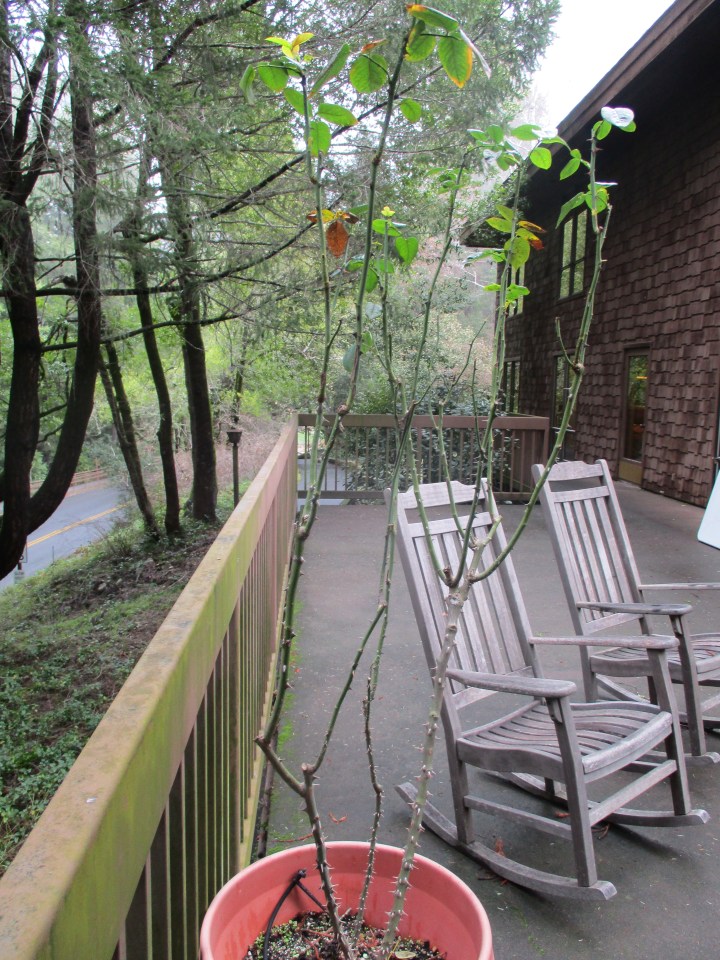
Just before I started with the first batch of hybrid tea roses, I pruned a single potted hybrid tea rose that is all alone on a deck across the street. I wanted to get it done when I thought about it so that I would not forget about it in the process of pruning everything else. It had bothered me for some time because it was so tall. I mean, I could not reach the top of it. The blooms up there were closer to upstairs windows than to anyone wanting to seem them from ground level. The supporting lower canes were bare of foliage, but well armed with nasty thorns. Honestly, I thought that the deck would have been more inviting without it.
Pruning it was rather simple; just three major cuts. Since the rose is where people mingle, I chopped the thorns just so that they are not so sharp. The remaining three canes were older than one year, but did not seem too terribly old. In fact, there was still a bud to cut back to on one of the canes. For the other two, I had to cut back to old petiole scars, expecting that dormant buds are still in there. That was about it.
The problem that I was not aware of is that the rose was left that tall intentionally because a former gardener liked it that way! Now I feel badly. I really thought that it had just been neglected. Like I mentioned, the canes did not seem to be several years old. They must have replaced older canes in just the last few years. Regardless, I can not put it back. In the partial shade there, it will probably grow back as tall within the year. I hope that the former gardener does not find out about it before then. I know that if someone did that to a roses that I had pruned in a specific manner, I would be really angry about it.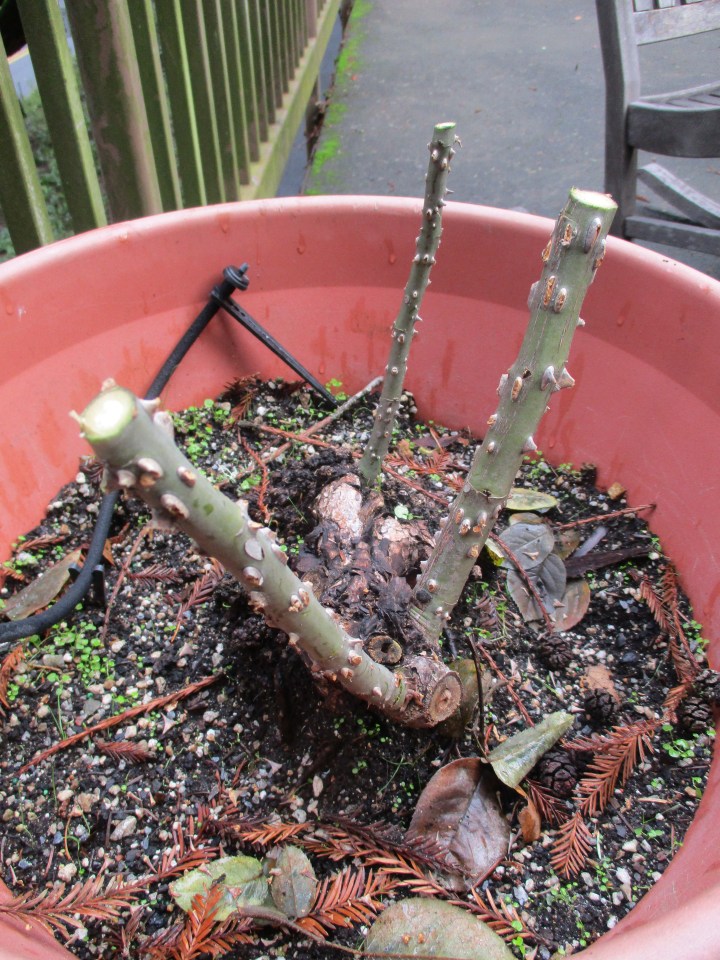
Litter
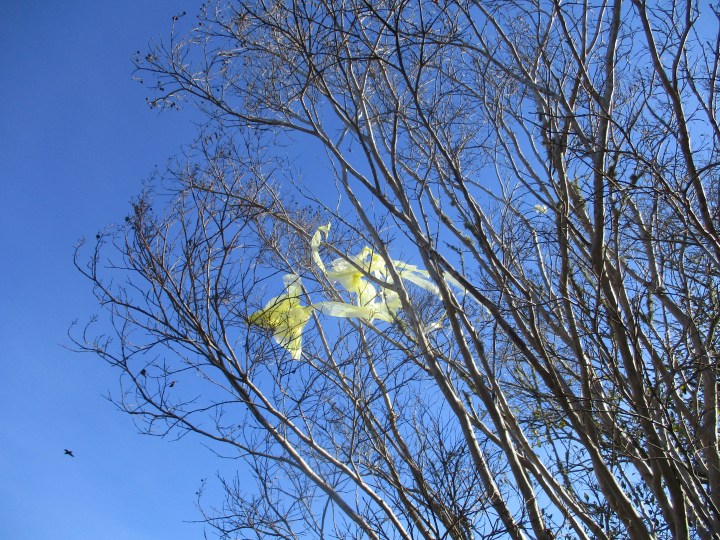 Those of us who work in public landscapes find litter in the strangest of places. It gets everywhere. It is not necessarily put everywhere. It just has a sneaky way of getting everywhere. By nature, litter blows about and gets washed into creeks and rivers that flow out to the bays and oceans.
Of course, there is much more litter in public spaces with the most traffic, such as city parks, than there is out in remote places where fewer people go, such as hiking trails in state parks. People are not necessarily slobs, and most put their trash into the appropriate receptacles. There just happens to be more litter where people are because that is where most of the trash that becomes litter happens to originate. Most litter that accumulates on the sides of roadways was blown there from the open beds of pickups. Not much is discarded out there intentionally.
One of the projects where I work is designing trash receptacles that wildlife can not get into. Racoons, which some of us know as ‘trash pandas’, are notorious for distributing large volumes of trash into the forest. Squirrels tend to be a bit more selective in taking mostly biodegradable bits of discarded fruit, and by unwrapping their finds before taking them away. Crows are actually worse than squirrels because they will take larger bits of trash merely because they find it to be amusing. Once out of the receptacles designed to contain it, trash gets blown about by the wind. In fact, wind alone can blow trash out of some types of trash receptacles, such as those fancy cylindrical steel mesh receptacles that suspend trash bags within, like those that are so common downtown in many cities. Litter is naturally an unnatural consequence of modern civilized society.
Six on Saturday: Forsythia Division
Stems that develop roots to grow into new plants as they lay on the ground are known as ‘layers’. Because cane berries develop tall vertical canes that seem to leap as they arch over to touch the ground and root in, the new plants that develop where they do so are known as ‘leapers’. I sort of think that ‘layers’ sounds more like reliable hens than self propagating plants. I also sort of think that ‘leapers’ just sounds funny.
A big forsythia at work had become overgrown with several layers or leapers. I am not really sure which they are, but there was quite a mess of them. We needed to remove the superfluous plants. Also, we wanted a few forsythias in other parts of the landscape. Well, you can figure this out. We decided to kill two layers with one stone . . . or something like that. We decided to pull up the unwanted layers or leapers in one area, and plant them where they were actually desired. We decided to get it all done just prior to a big storm that would help settle the new plants in.
1. Forsythia before division.
2. Forsythia after division. The entire left half of the original clump, which happens to be the original plant, as well as a few small layers or leapers, were removed. This remaining portion of the clump was not pruned yet. It will be pruned after later winter or very early spring bloom. This picture is approximately in the same position as the previous picture #1.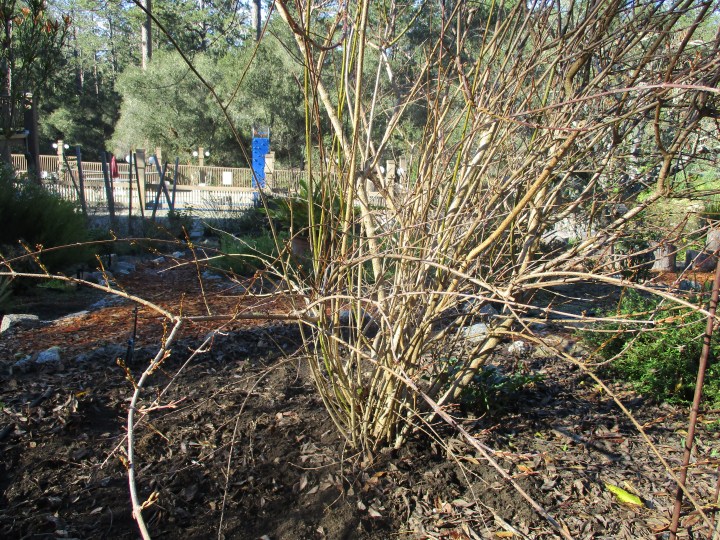
3. This largest of the new plants to be divided from the main plant was actually the original plant. The label was found on one of the old canes. Four smaller layers or leapers are to the right. The four smallest that are shown in picture #5 are not visible here. Because they needed to be pruned back to compensate for the root damage associated with the process, these plants were pruned almost as they would have been after bloom, which will unfortunately limit bloom in their first season.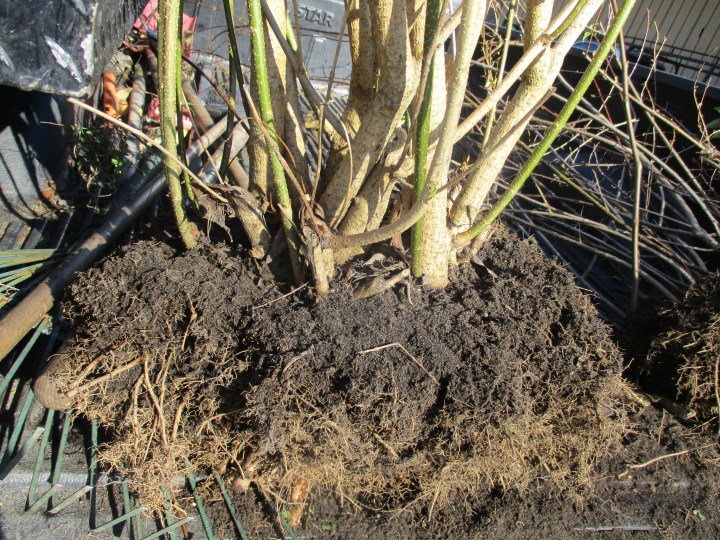
4. This is the same largest clump in picture #3 after getting pruned and installed into another part of the landscape just before the rain. If it does not get pruned after bloom this year, the big older caned will be cut to the ground after bloom next year. By that time, there will be plenty of basal stems to replace them. Ideally, it will be pruned annually after bloom by a process known as ‘alternating canes’, which involved removing old canes to favor newer canes. Individual canes last no more than a few years before getting pruned out.
5. After the largest of the freshly divided plants were installed directly into the landscape, the four smallest layers or leapers were canned and put into the nursery, just because we could not think of a place to plant them directly right away. A layer in the hand is worth two in the bush, and four in the nursery is even better.
6. Another unassociated forsythia bloomed in the nursery at the shops early last year.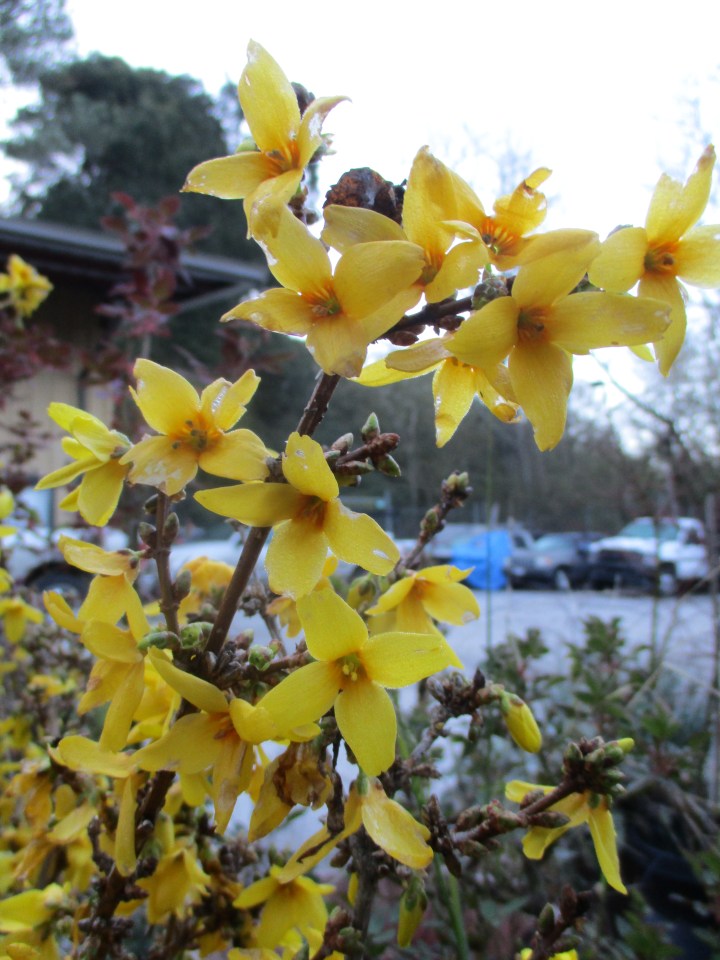
This is the link for Six on Saturday, for anyone else who would like to participate:
https://thepropagatorblog.wordpress.com/2017/09/18/six-on-saturday-a-participant-guide/
Horridculture – Miss Congeniality
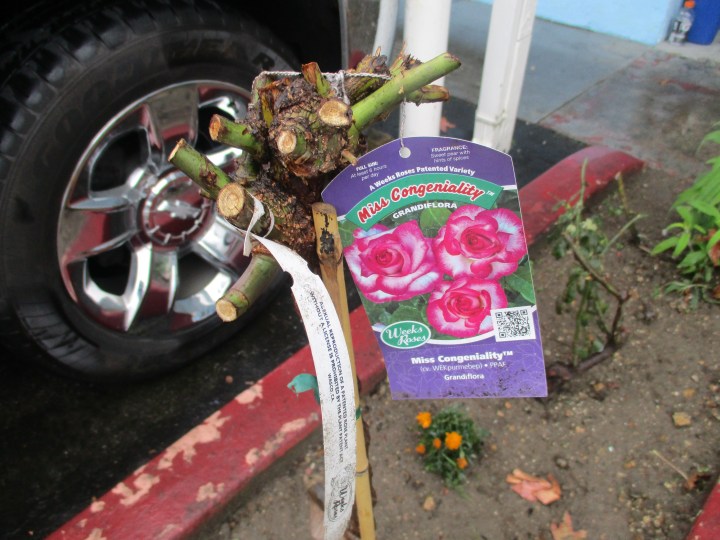 Now, before I commence with my rant and long list of problems with this picture, I should mention that this seemingly abused rose tree does seem to be appreciated. All the roses in this landscape seem to be very healthy, and they bloom constantly between spring and autumn. Their performance suggests that they are regularly fertilized and deadheaded.
The unusually brutal pruning may be an attempt to keep this particular rose tree as compact as possible, within very limited space. It is not how I would do it, but perhaps it helps. The size of the burl suggest that this rose tree has been pruned effectively like this for a few years, although the lack of weathering of the labels indicate that it is not more than several years old. Older canes really do seem to be getting pruned off annually as they should. Even though the remaining canes are stubbed much too short, the end cuts are done properly. I can not help but wonder of pollarding back to the main knuckle would be just as effective, and neater.
The labels seem to be retained intentionally. In fact, the smaller white label to the left is attached to a new cane. Either the label was removed from an older cane that was pruned away, and attached to a new cane intentionally, or the rose tree was planted only last year rather than a few years ago, as mentioned earlier. I do not know why this uninformative label would have been retained; but the other larger label might be there for anyone who wants to know the name of the rose when they see it blooming in season. It happens to be in a very trafficked spot, where people walk by it constantly.
Rather than snivel about the (seemingly) very bad pruning, and the retention of the (trashy looking) labels, I should just say that this apparently appreciated rose tree should have been planted somewhere else in the garden, or not at all. That wheel in the background really is in a parking spot that is bordered by the red curb. A tiny bit of another red curb on the opposite side of this very narrow space is visible in the very lower right corner of the picture. (I can not explain why the curbs are red.) This really is a very narrow spot between a parking space and a walkway! Those mutilated stems to the right are another shrubbier rose. Thorny rose canes could really be a bother for those getting out of or into a parked car, or walking by on the walkway. The seemingly useless stake might be there so that the rose tree does not get yanked over when it grabs onto someone. To make matters worse, this rose is a grandiflora, which wants to grow bigger and wider than most other types of roses. Defoliation during winter dormancy is no asset either. The pathetic marigold on the ground really does not help much.
The point of all this is that more thought should have gone into planting this rose tree here.
Even Miss Congeniality, who so proficiently adapts to the most unfamiliar of situations, has certain limitations; and this situation demonstrates the worst of them.
Unplanned Green Roof
 The last green roof that I wrote about was planned, although not in a typical manner. https://tonytomeo.com/2017/11/25/green-roof/ It is still my favorite green roof. Otherwise, I am none too keen on the fad. Very few buildings benefit from green roofs, and green roofs really do take more work than conventional landscapes in the ground.
The sort of green roof pictured here was most certainly not planned. It could have been the result of a an uncleaned gutter. All sorts of weeds can grow in the damp debris that can wash off of roofs, particularly in damp and foggy coastal climates where moisture so often drips from the edges of roofs. This gutter is just a short distance from the beach in Santa Cruz. The willows in the San Lorenzo River are next door.
Knowing what I know about this particular type of willow, I would guess that the cleanliness of the gutter, or lack thereof, was not really the problem. These aggressive willows can germinate in the slightest bit of debris, even under a single leaf that did not get rinsed or blown away fast enough. Once germinated, their finely textured roots are experts at clinging to anything that might otherwise get rinsed away. If there is not enough debris and dirt for them to grow in, they simply collect their own. Now that it has started the process, it will continue to collect debris and expand its root system until it gets removed or ruins the gutter. It seems to have already collected enough debris to share with a few grassy weeds nearby. It is mostly dormant now, and might have defoliated in the rain since this pictures was taken a few days ago. However, if it stays, it will resume aggressive growth as winter ends.
Addendum
 There is much more to the landscapes at work that I wrote about earlier this morning at https://tonytomeo.com/2019/01/05/six-on-saturday-cabin-fever/ . Otherwise, my job would be quite boring.
I do not climb big trees; so any work that the redwoods need must be done by someone else. The big redwoods, as well as the ponderosa pines, Douglas firs and various oaks, are of course the most prominent and memorable features of the landscapes. There are also a few other exotic trees that were added to the landscapes years ago. My primary work with those that have grown beyond my reach is identifying problems for other arborists to correct or remove.
However, there is plenty at ground level to keep us very busy.
Our landscapes are simple and somewhat unrefined. They take as much work as they do because they are so big and dispersed over a large area. There seems to be only a few small beds of flowering annuals, but collectively, these flowering annuals cover quite a significant area. There are likewise only a few roses here and there, but they add up to quite a big collection.
This firethorn lives in one of the landscapes that we maintain that is more than a mile away from the pictures that I posted earlier this morning. It is an area forested with big ponderosa pines and chaparral plants. Unlike the deep and dark redwood forest, this area is warm and sufficiently well exposed for all these bright red berries to develop. It is a completely different climate zone, soil type, and landscape style. Because it is within the context of a much larger and rustic landscape, I do not notice it like I should. Now that it got my attention, I got its picture before the birds take all the berries.
Six on Saturday: Cabin Fever
Seriously! The flu!, or something like it. I was totally sick for days, with an awful fever. As if that were not bad enough, it happened while I was supposed to be relaxing and on vacation!
Neither was planned. Getting sick never is. The vacation was a total surprise too; a Christmas gift from one of the guys at work! It was totally rad, even if I was sick for it.
You see, we work at one of the most excellent places in the entire universe, where people come from all over for restorative retreats. That by itself is totally rad. What is radder is that we can rent unused rooms or cabins for out-of-town guests or for ourselves if we like. It is very affordable, and like vacationing at work. That may not seem like much fun for those who do not enjoy their work like we do, but like I said, this is one of the most excellent places to work in the entire universe.
So, my colleague got me nine nights in what is classified as an ‘economy’ cabin, but by my standards was very luxurious. I had stayed in a smaller newly remodeled cabin for two nights, and a hotel like room for a night, but had done nothing like this; nine nights in secluded luxury! If one must get sick, this is the way to do it!
Anyway, this is where my six pictures for this week came from.
1. This is the upward view from the front door. The black margin at the top of the picture is the edge of the eave. The trees to the left are canyon live oaks and a tan oak. The trees to the right are towering coastal redwoods.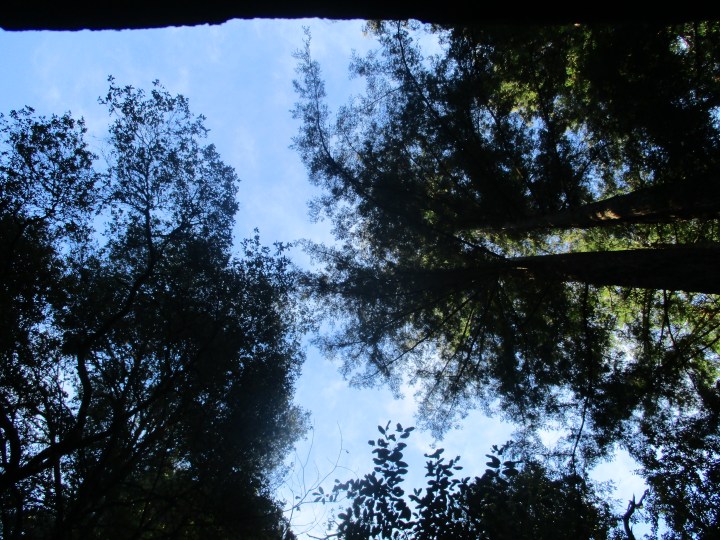
2. This is the same spot. Instead of looking straight up, this is looking outward from the front door. There is no refined landscaping here; only the native trees with the exotic English ivy that is cascading slightly over the old stone wall.
3. These towering coastal redwoods are outside a bedroom window.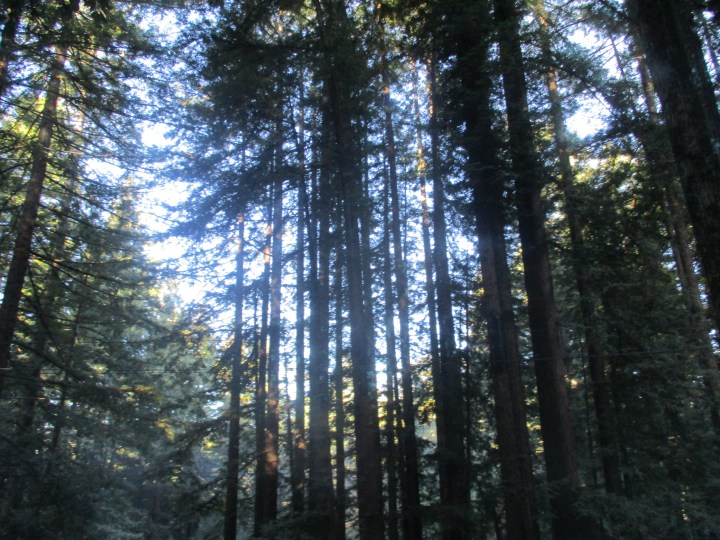
4. These towering and somewhat darker coastal redwoods are outside the bathroom window.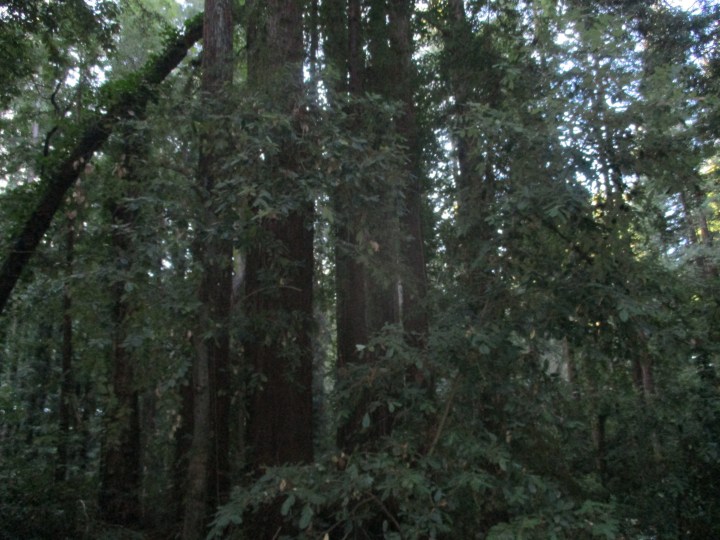
5. The artwork on the interior walls are mostly pictures of the local flora and wildlife. Most are rather artistic. Some are pictures of common but exotic flora that, although probably appealing to those who do not recognize them, are not the sort of subject matter that I would have selected. For example, one of the big framed photographs in the bedroom is a closeup of the summery foliage of London planetree, Platanus X acerifolia. Ick! I took this picture of three pictures that I found to be amusing. On the left, we have some interesting lichens and a bit of moss on what seems to be an apple tree. Okay. In the middle, we have foliage of California bay tree, Umbellularia californica. Odd, but again . . . okay. On the right, we have maces from the exotic sweetgum, Liquidambar styraciflua. Now, I would say that is weird, but it really is a cool picture!
6. Rhody was not supposed to be on the bed.
This is the link for Six on Saturday, for anyone else who would like to participate:
https://thepropagatorblog.wordpress.com/2017/09/18/six-on-saturday-a-participant-guide/
Horridculture – Clearance
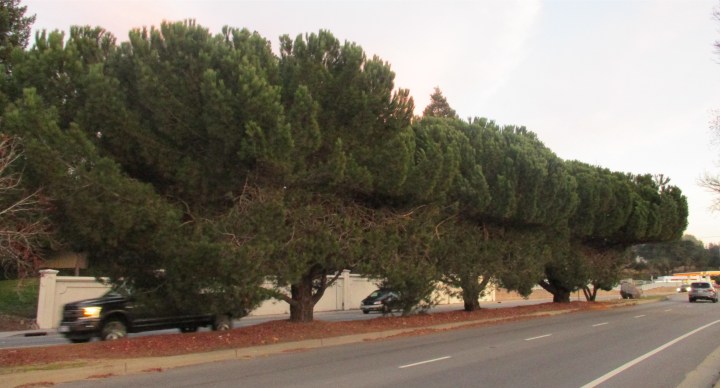 Many arborists mark certain lengths on their pole saws and pole pruners. When stood upright, these marks designate the standard heights for minimal clearance pruning. Not so many need to mark the height of minimal clearance for walkways, since they will prune away anything that is within reasonable reach with hand tools from the ground. The minimal clearance above parking spaces is not so easy to guess at, so is more likely to be marked on poles. So is the minimal clearance over roadways, where the lowest limbs must be high enough to be out of the way of campers and freight trucks.
Clearance to the sides is determined by the location of the curb, but even that might need to be modified at sharp turns, or where the roadway slopes significantly away from the center. Clearance must similarly be a bit higher over dips in a roadway, where the height of long freight trailers would be affected by the elevation of the wheels in front and back (outside of the dips). Clearance around street lighting, roofs, utilities and such is determined by the object that requires clearance, so no marks must be made on the poles for such work. (Clearance pruning of high voltage cables is only performed by those who are qualified to do so.)
Clearance pruning is serious business for arborists. They do not want their trees to hurt anyone, or to damage vehicles. Nor do they want their trees to be damaged by vehicles. Obtrusive limbs can be torn away by freight trucks. Even if not torn away, limbs that are regularly battered by freighter trucks are rather unsightly.
As someone who used to drive the delivery truck, I can tell you that clearance pruning is also important for some of us who use the roadways.
These three young Italian stone pines are healthy specimens that are probably well structured inside all of the outer foliage. It is hard to say, since I can not see inside through all the disfigured lower foliage that has been continually battered by truck traffic. They probably only need to be pruned for clearance above and away from the traffic. If pruned to establish a minimal ceiling just two feet or so above the obvious damage, and to remove all the lower growth to the side, they would be excellent street trees for many years. They will eventually need to be pruned again, as maturing branches sag from their own weight, but that is to be expected. The main trunks and bulky limbs within would probably be quite sculptural if they were to be exposed by pruning that is necessary anyway. It really would not take much.
Electric Snow
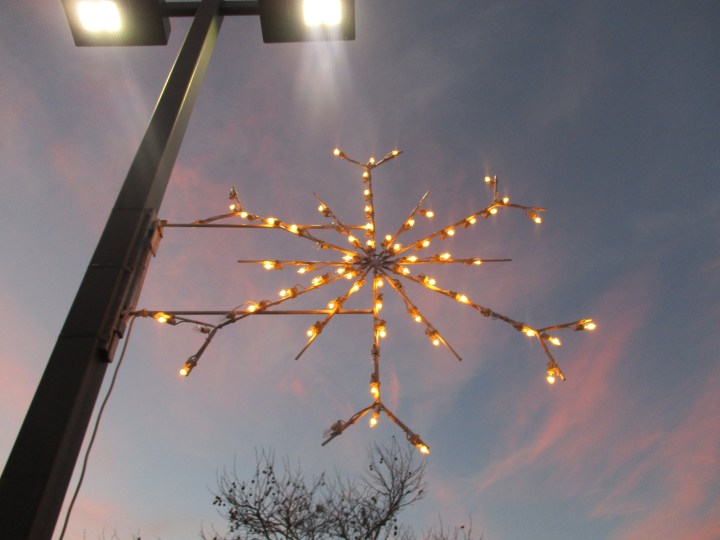 It was one of the more common types of snow in the Santa Clara Valley in the early 1970s.
In school, we made paper snow by folding paper squares in half and then into thirds (so that they were folded into sixths), and then cutting notches and slices out of them. They unfolded into the prettiest and laciest snowflakes!
In Westgate Mall, snow was blown by small fans about the new models of Singer sewing machines that were magically suspended in big acrylic spheres. We children could not get into the spheres, so were left wondering if the snow within was as cold and wet as we were told it was, and why it was necessary to demonstrate that the new sewing machines were resistant to weather. Our mother did her sewing inside.
We sort of suspected that the snow around the Nativity at Saint Thomas of Canterbury and other local parishes might be artificial because it looked like the stuffing of a pillow, which is something that all children seem to be familiar with. We said nothing about it, just in case our parents were not aware of the potential deception. However, it was rather disturbing to see so much of the same sort of snow at Christmas in the Park in San Jose. At that point, we accepted that either it must be genuine, or that we were committed to just going along with it.
Snow that was sprayed onto Christmas trees was rather interesting. It was neither wet nor cold, and sometimes it wasn’t even white. It could be pastel blue or pink, and was often sparkly with glitter! Wow!
Off in the distance, we could see snow on top of Mount Hamilton. Sometimes it was just on top. Sometimes, it was spread out from left to right, along the ridge. On rare occasion, snow appeared on the ridge of the East Hills, in front of the Diablo Range that Mount Hamilton is part of. We never saw who was up there folding and cutting all that snow, but they must have been VERY busy!
Snow on top of the Santa Cruz Mountains, right behind our part of the Santa Clara Valley, was closer to home, but did not look like much. The greenish blue of the forest was just a lighter hue of blue, with more mottling. It was exciting anyway.
Then, on February 5 in 1976, it actually SNOWED on the floor of the Santa Clara Valley!
It really was as awesome as snow was supposed to be. It was cold. It was wet. It was white. It was fun to wad up and throw at each other. It accumulated just like it would in a blizzard, and got almost an inch deep!
. . . but . . . was it really SNOW?
Windows Of Heaven
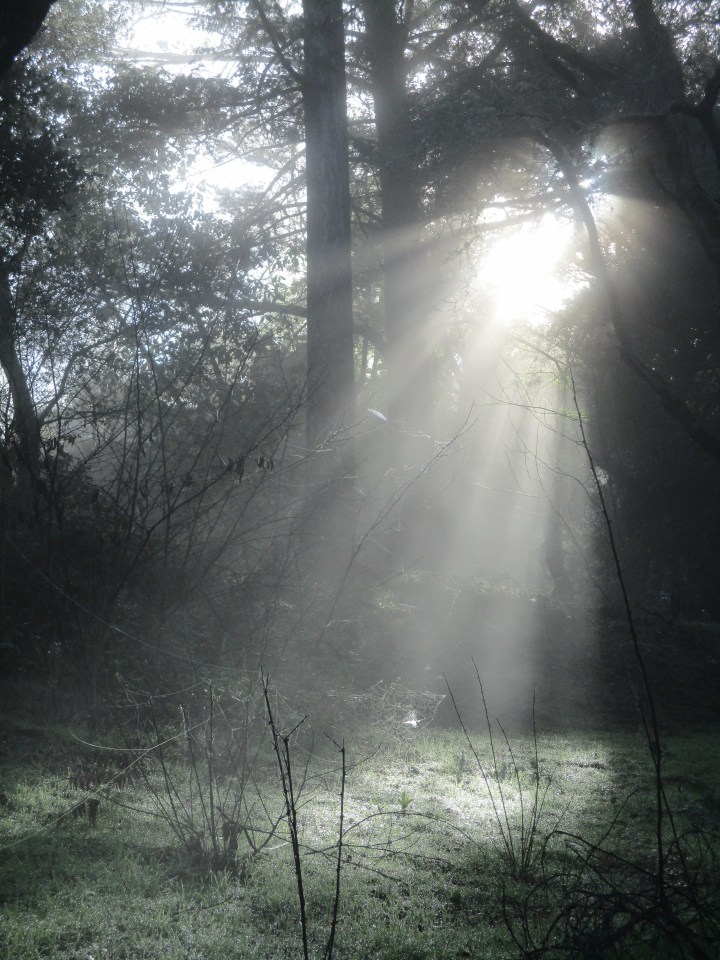 Or . . . a close encounter of the third kind. Let’s just go with the former rather than the latter.
I am no photographer. The pictures that I post are merely illustrations for articles from my gardening column, and other articles. This picture just happened to make itself available while I was getting the first of the six pictures of the earlier ‘Six on Saturday’ post. The location is nothing special. It is not really out in the forest like it seems to be. A lodge building of six suites is directly to the left. A big ‘housekeeping’ building is to the right. There is a road in the background above, as well as below, from where the picture was taken.
Even the flora in uninteresting. The most prominent straight trunk in the middle is that of a young Douglas fir. The slightly leaning trunk with upward reaching branches to the right is some sort of cypress. There are a few nice small coast live oaks to the left. Most of the other trees to the right are black locusts that I really should cut down. The small shoots in the foreground are watersprounts from black oak saplings that were already cut down. There are some California bay trees in there somewhere, probably off in the background to the very far left.
The deteriorated colony of oak root rot fungus, Armillaria mellea, that was described too graphically in the earlier post was located in the foreground of the lodge building to the left. https://tonytomeo.com/2018/12/02/the-humongous-fungus-among-us/ . There was not much left of it then, so there would be even less now. . . fortunately.
Well, isn’t this way more information than necessary? I should have left this (too artistic for my ability) picture with just the title.

