Six on Saturday: Unexpected

Horticultural dysfunction can be, from one to six, annoying, frustrating, very infuriating, entertaining, confusing and pleasantly surprising. Much of this is more natural than it is dysfunctional.

1. Arundo donax, giant reed is not as giant as expected. Four potted specimens look like big grassy weeds amongst these lily of the Nile. They will be removed if they do not grow as fast as they famously should. They are here only temporarily for this summer anyway.

2. Rosmarinus officinalis ‘Prostratus’ creeping rosemary is not as prostrate as expected. I thought that it would cascade more limbry from the top of the wall rather than become fluffy but barely pendulous shrubs on top of the wall. In a row, they look like Soul Train.

3. Agapanthus orientalis, lily of the Nile are expected to bloom for summer. Here on the edge of a trafficked walkway, they are too tempting to kids with sticks. Fortunately, their evergreen foliage is a nice border even without bloom. We try not to be too discouraged.

4. Agapanthus orientalis, lily of the Nile is trying to bloom a bit more than expected, by fasciation. Perhaps it is trying to compensate for the destruction of so much other bloom nearby. Ultimately, a fascinated bloom will be no more substantial than a normal bloom.

5. Echinops sphaerocephalus, globe thistle is unexpectedly solitary. This is the first that I have grown since my second summer after high school, so I do not remember how they typically bloom. Yet, I expected a branched bloom stem. Maybe that is what it does next.

6. Helenium autumnale, sneezeweed was expected to bloom later in summer. This is the first for me, so I can neither complain nor question its timing. Two other varieties bloom red and orange. They, the globe thistle and others came from Tangly Cottage Gardening.

This is the link for Six on Saturday, for anyone else who would like to participate: https://thepropagatorblog.wordpress.com/2017/09/18/six-on-saturday-a-participant-guide/

Chameleon

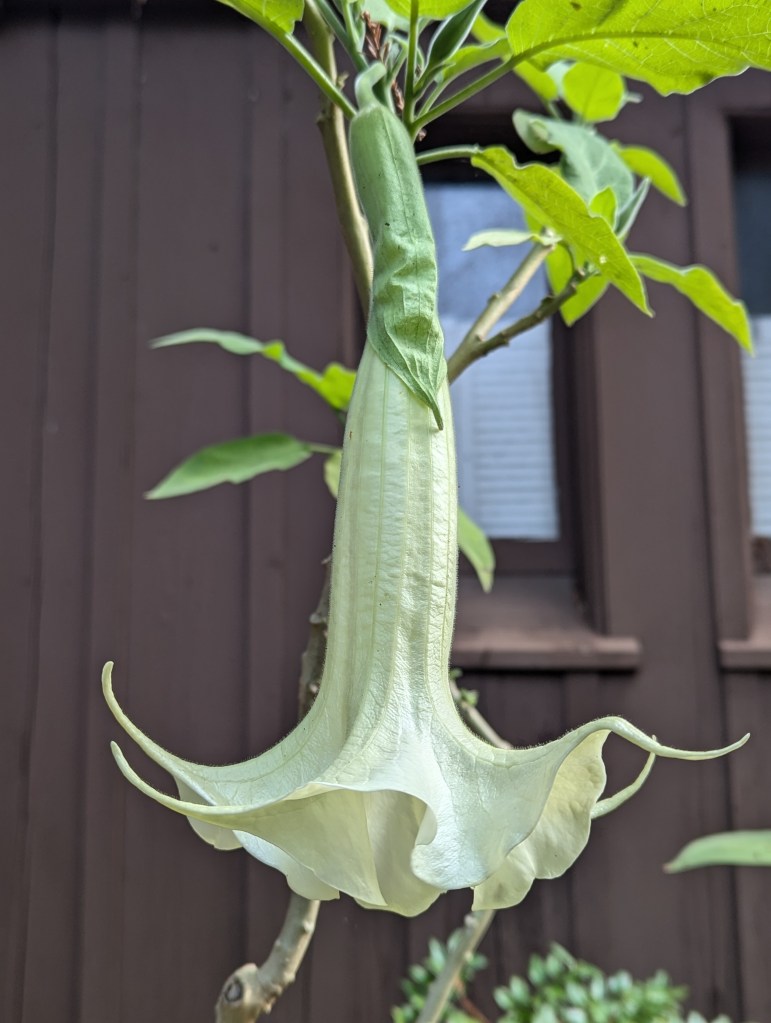
What color is this? It looks pink to me. A day earlier, though, it looked peachy orange. At various times last year and the year earlier, this same angel’s trumped bloomed more orangish orange, yellow and even white. I can not remember its schedule now, but I know that it has been weirdly variable. It is one of four cultivars of angel’s trumpet here, but the only one that will not decide on a color for its bloom.

One of the other four angel’s trumpets here blooms with double white flowers. My favorite, although relatively diminutive, blooms with single white flowers. The most vigorous is ‘Charles Grimaldi’, which blooms with single yellow flowers. A formerly fifth cultivar with big single pink flowers unfortunately rotted without replacements over winter a few years ago.

This particular angel’s trumpet grew from scrap that I took from a green waste pile at the curb of a job site in eastern San Jose several years ago. I took it because I found the pastel orange foliar color of the specimen that it was likely pruned from to be appealing. I had no idea that it would bloom with so many other comparably appealing floral colors.

Six on Saturday: Not Yet Summer Bloom

Too much is blooming now for pictures of foliage, bark, trees, vines, shrubs or any other horticultural subject matter. I got these pictures before yesterday, so they are technically still spring bloom.

1. Gladiolus X hortulanus, gladiolus looks silly alone. It was the first to bloom. All others are in small colonies that developed from reliably perennial bulbs, which were originally components of a mixed batch. I would not have expected any to be so reliably perennial.

2. Lavandula angustifolia, English lavender has similarly lasted longer than expected. It was already a few years old several years ago, when I predicted its natural demise within two years. A feral specimen of Spanish lavender coincidentally grew from a seed nearby.

3. Antirrhinum majus, snapdragon is also feral. All within its colony bloom white. Those of another feral colony all bloom yellow. However, the parents of both colonies bloomed with mixed colors of the same variety. I can not complain, but I wonder what happened.

4. Celosia argentea, plumed cockscomb blooms with these red, orange or yellow flames. The chartreuse foliage in the background is coleus. They are a good example of why I do not procure annuals at work. I have difficulty with such striking color, texture and form.

5. Abutilon X hybridum, Chinese lantern is an awkwardly lanky shrub that will not stop blooming. I would like to prune it down to perhaps improve its density, but do not want to interfere with its bloom schedule. It has been here for many years, and might be feral.

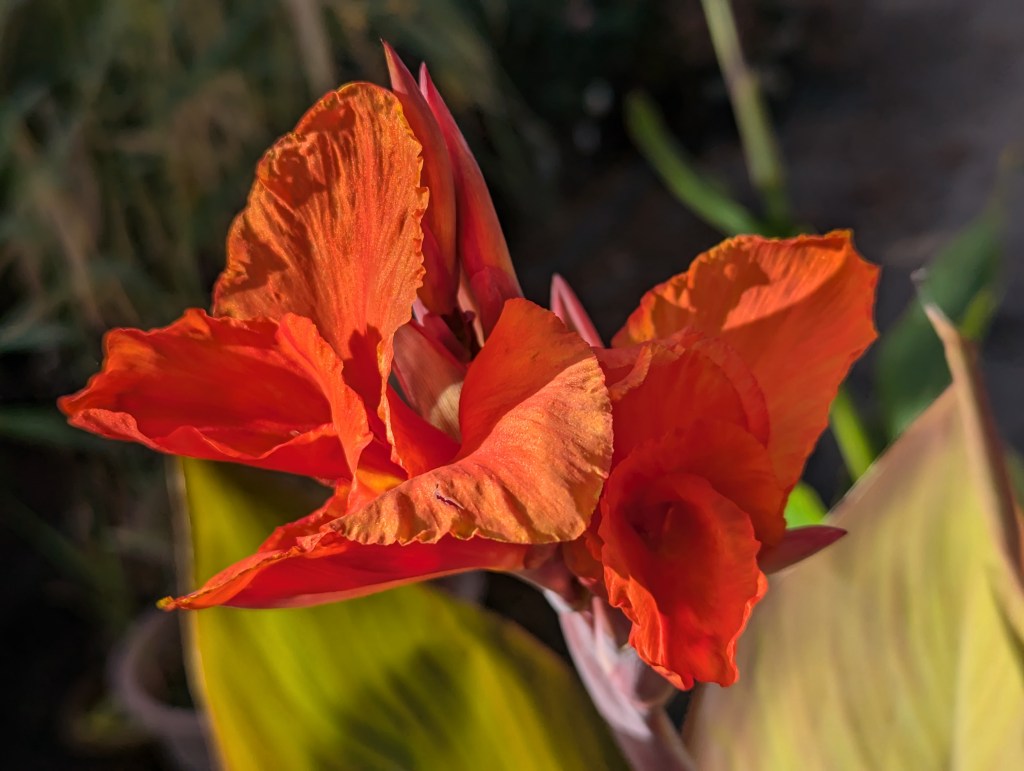
6. Canna ‘Cannova Mango’ canna is not my favorite cultivar, but has too many attributes to discredit. It begins blooming before any other canna here. It blooms more abundantly than any other canna here. I know of no one else who dislikes this color as much as I do.

This is the link for Six on Saturday, for anyone else who would like to participate: https://thepropagatorblog.wordpress.com/2017/09/18/six-on-saturday-a-participant-guide/

Almond / Almond

Pote-8-o or pote-aht-o? Tome-8-o or tome-aht-o? Ape-ricot or app-ricot? Pee-can or pi-kahn? What about “almond”? This is different from the distinction of plums and prunes. It is a matter of pronunciation. Is “almond” pronounced like “salmon” or “common”? Those who grow them, and likely know better than the rest of us, commonly pronounce it like “salmon”. Most of the rest of us pronounce it like “common”. The nuts are harvested by machines that shake them from their trees, which supposedly shakes the ‘ell out of them, which sort of makes sense. Although the “l” is silent within both pronunciations, it might be slightly more so within the “common” pronunciation. Everything associated with almonds prior to harvest, such as their orchards, trees, bloom, unharvested nuts and their collective industry, commonly employs the “salmon” pronunciation, in which the “l” may be slightly less silent. Everything associated with harvested and processed nuts and their products, which are what most of us are familiar with, more commonly employs the “common” pronunciation. For the pair of trees in my garden, I use the “salmon” pronunciation. For their nuts, I use the “common” pronunciation.

Six on Saturday: Making Up For Lost Time

A few late bloomers are making up for lost time. Hydrangea, although late, is somewhat earlier than it typically is. Bluegum is not blooming, but contributes its own sort of color with bark.

1. Eucalyptus globulus, bluegum remains canned because it grows too big too vigorously to go into the ground. Ultimately, it will likely need to be destroyed. For now, it provides both aromatic juvenile foliage and pretty adult foliage. It also has pretty watercolor bark.

2. Yucca recurvifolia, curve leaf yucca is known as Yucca gloriosa var. tristis now. What was wrong with its former botanical name? Its boring common name should be changed instead. Anyway, I am impressed that it is blooming so soon after relocation last winter.

3. Hibbertia scandens, guinea gold vine grew like a weed from a cutting last year, and is now beginning to bloom for the first time. This is the first of many flower buds to unfurl. Its bloom was expected, but its profusion is unexpectedly impressive. It remains canned.

4. Hemerocallis fulva, daylily was similarly expected to bloom and is similarly blooming with unexpected profusion. I have no idea what cultivar this is, but I suspect that it may be the straight species. We grow just one other daylily cultivar, and it is relatively docile.

5. Begonia semperflorens-cultorum, wax begonia had languished for years in its planter box full of aggressive redwood roots. It now grows much more happily in its new planter box within its old planter box, which is elevated on cinder blocks above an empty space.

6. Hydrangea macrophylla, hydrangea typically blooms later on axillary stems because I prune the terminal buds off with winter dormant pruning. My concern was that, if I left the canes intact as I should, they would flop over. They are flopping, but it was worth it.

This is the link for Six on Saturday, for anyone else who would like to participate: https://thepropagatorblog.wordpress.com/2017/09/18/six-on-saturday-a-participant-guide/

More White Trash

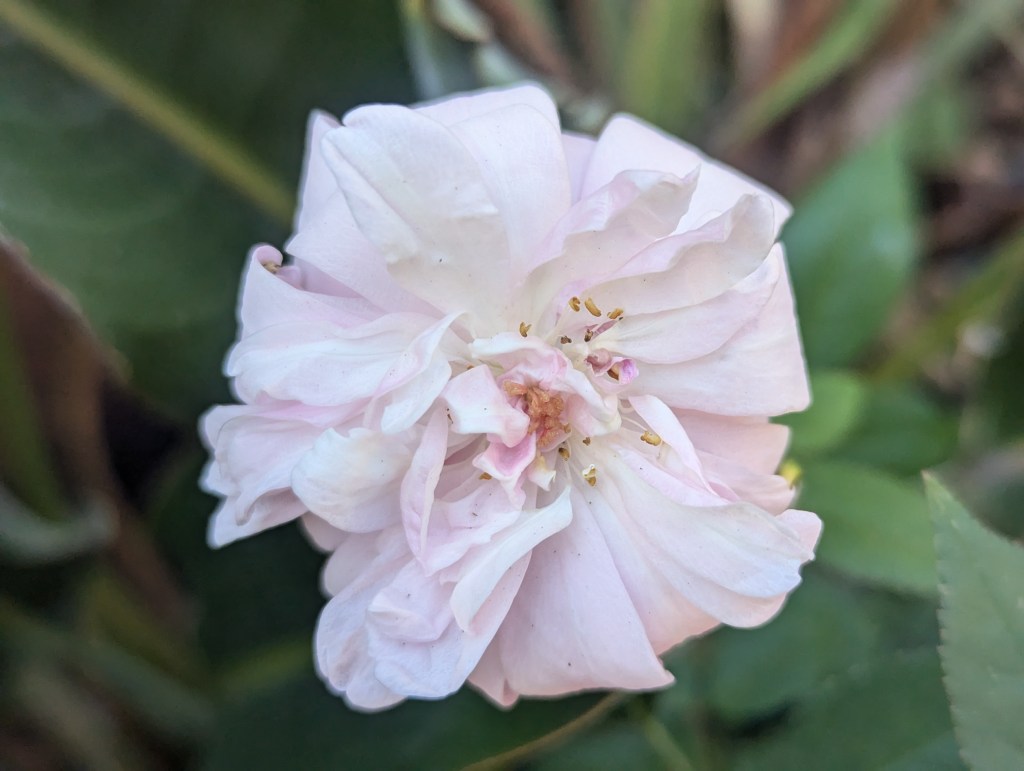
White is my favorite color. It is not the best color for all flowers, but it is the only color that I allow within the White Garden, which is really just the meager landscape of the Mount Hermon Memorial Chapel. Creamy white, such as white nasturtium and white canna, are not white enough. I am adamant about this. After replacing a few blue lily of the Nile with a white hydrangea, I needed to remove the hydrangea as it began to bloom with a slight pinkish blush. About that time, two winters ago, we added a white climbing rose. It was a perfect fit, and produced a straight cane that extended from the top of an original cane to the eave during its first summer. Because it was still young and small, it bloomed mildly but sufficiently. More importantly, it bloomed white. It got pruned over winter. Now that it is a bit larger, it is blooming a bit more fuller. However, it no longer seems to be blooming pure white! Young flowers unfurl with a creamy pale yellow blush before fading to white. It is too pretty to remove, especially without a replacement. This could become a major dilemma!