This Is No Food Blog

P71129There are not many things that will grow in my zone that I will not at least try to grow if I have the space and resources to do so. I really like to grow fruits and vegetables, particularly those that I am familiar with from when I was young. They are just as productive now as they were then. The only problem is that I do not know how to cook. I can freeze, can or pickle large quantities of produce, but cooking is something that I leave to experts.

I notice that almost all garden columns or blogs include recipes for the produce grown in home gardens. Mine does not. Except for a few recipes for pickles, jams and jellies, I just do not have any recipes that I would share.

When I get big winter squash, I really do not know what to do with them. I sometimes give them away to those who will cook them. Sometimes, I just cut them up, cook them, and then freeze what I can not eat. They are fun to grow, and I really like how I can keep them around for such a long time before I get around to cooking them; but they would be so much easier to work with if they were small like summer squash.

This weird squash was on the kitchen counter for a long time. Before it was cooked, it was very smooth, without any lumps, bumps or beady eyes. It was not ridiculously big. In fact, I only cut in half and ate it in two days. At the time, I was in a situation where I had a microwave oven in which to cook it, so I did so for several minutes. With a bit of butter, the first lower half was quite good, and separated nicely from the outer skin. I cooked the upper half in the same manner on the second day. It was making weird noises as it cooked, as if it were very unhappy about something. It was hissing and spitting for the several minutes that it was in there.

When I opened the door, this is what I found staring back at me from a small puff of steam! It looked angry! Apparently, it did not like to be cooked that way; or perhaps it was just a hateful squash. Regardless, it was rather creepy, and difficult to enjoy. I peeled the outside away and discarded it, but could not help to think that it was still watching me from the trash can with those beady tan eyes and crooked mouth! I do not think that I will be growing this variety again.

Franklin Canyon Park

P71126Because I sometimes go to Brent’s jobs sites while in the Los Angeles area, people sometimes ask me if I see many famous actors. Well, I try to stay out of everyone’s way, so rarely see anyone at the sites. If I see anyone famous about town, I would not know it. I do not watch enough television or movies to recognize many of them.

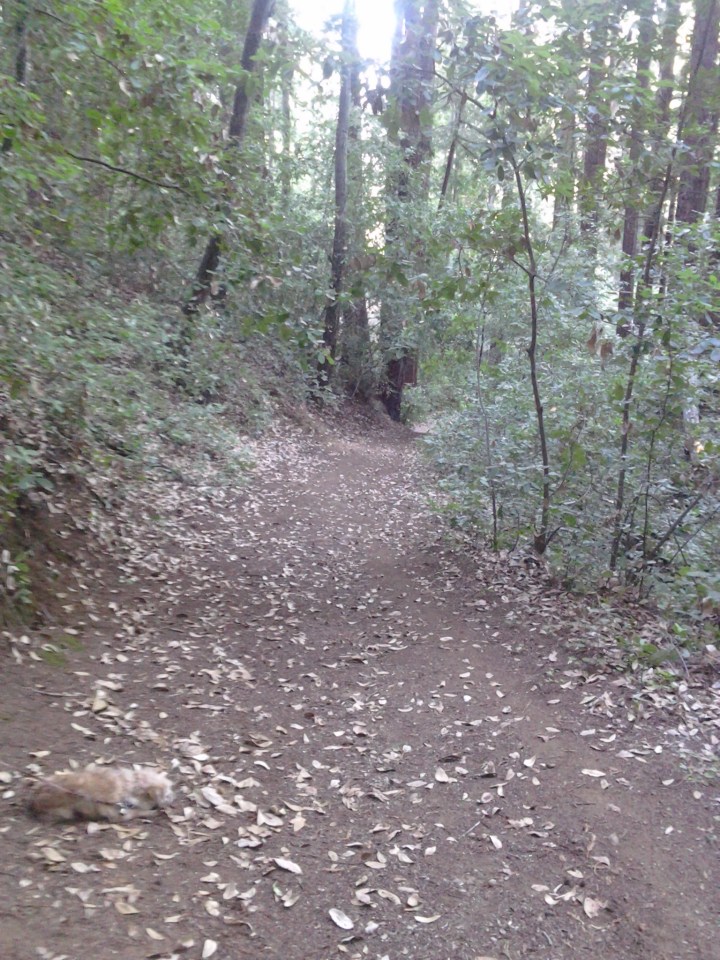
However, I did recognize this famous actor from my childhood as the renowned Wile E. Coyote of Looney Tunes. He was just out for a stroll in Franklin Canyon Park in the Santa Monica Mountains above Beverly Hills. It happens to be one of my favorite places in the Los Angeles Area, and has an interesting history.

Even those who have never been to Franklin Canyon Park might have seen it on television and in movies. Franklin Canyon Reservoir was Myers Lake on which Opie Taylor was skipping stones on the Andy Griffith Show. It was also a pond near the Ponderosa on Bonanza, and near where Daniel Boone lived, and on various far away planets on Star Trek. Even the Creature from the Black Lagoon lived there!

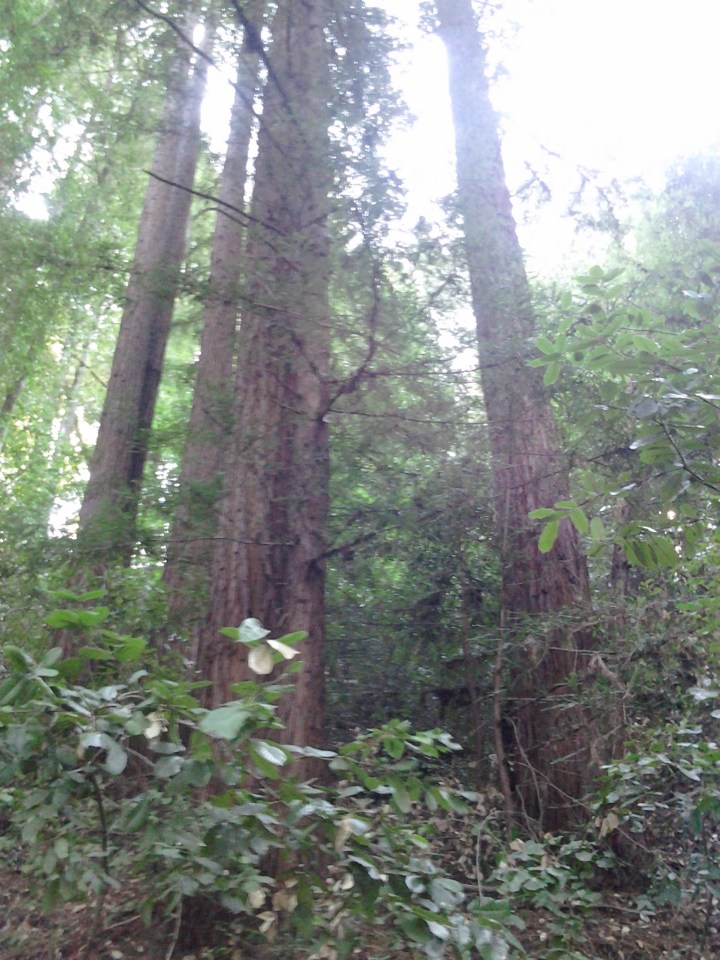
There are a few exotic plants that were planted there over the years, and a few that have naturalized. The familiar deodar cedars are of course exotic. So are the few coastal redwoods from farther up the coast. Yet, most of the flora of Franklin Canyon Park is native, and shows what the Santa Monica Mountains were like before the surrounding area became so developed. Large sycamores and cottonwoods live in the riparian area at the bottom of the Canyon. The upper slopes and ridges are much more open, with smaller trees and all sorts of scrub. There were a few toyons, which are also known as ‘California holly’ scattered about. I can not help but wonder if there were more of them decades ago when Hollywood(land) was named after them. I know that there is now more vegetation than there was when fires burned the area more frequently, and some plants are less competitive than others. It is fascinating nonetheless. Sometimes, it can be difficult to imagine that there was ever anything natural in Los Angeles. I am sorry that I have no better pictures.

Green Roof

P71125Is this a bad idea for a green roof?

Is it a houseplant that got too big?

Is it a wheelchair accessible tree-house?

None of the above. It is just weird architecture, designed to preserve a rare Chilean wine palm. The tree was probably planted in the front garden of a Victorian home that was on this site before the site was redeveloped. Chilean wine palms were more popular back then; and this one seems to be about that age. Although it seems to be healthy now, the constriction in the trunk indicates that it had been stressed by the redevelopment, which undoubtedly covered much of the established root system. The time it took for the length of trunk above the constriction to grow coincides with the estimated age of the building below. The tree very likely had better access to rainwater before.

Because it is a palm, the trunk will not get any wider than it is. Because the trunk is so stout, it probably does not move much in the wind. However, the blue tarp around the trunk indicates that there is a problem with the roof leaking around the trunk. It is obviously difficult to get a good seal.

It is impossible to determine from this picture if the building is built on a slab or a simple foundation. A foundation would be a bit healthier for the tree. Perhaps it is more accurate to say that a foundation is less detrimental to the tree than a slab would be. It probably would be better for the building too, since a slab could have been displaced by new roots emerging from the base of the trunk.

Perhaps all this discussion is pointless. This weird but creative idea works. Although distressed and very likely embarrassed, the tree was preserved, and shades the building below.

Is That A Body?!

P71118

It seems that changes in fashion are sometimes partly motivated by rebellion against what they are changing from. The comfortably loose and pendulous ladies outfits of the 1920s that were so unflattering to the human form while revealing more of it than ever before were probably a rebellion to the impractically uncomfortable and strenuously refined ladies fashions of the late Victorian period that were designed to enhance the ideal of feminine form while also obscuring it. The simple and squared landscapes of the 1950s that were so neatly tailored that they would be considered to be bleak by modern standards were replaced through the 1970s and into the 1980s by a much more relaxed and curvaceous style with sculptural trees, shaggy foliar textures, hills and boulders. Ah, the boulders. They were still cool when Brent and I were studying horticulture at Cal Poly. We had to get some.

While Brent’s friend William was visiting from Los Angles, we drove out behind campus, and into the narrow and rocky Poly Canyon. Big serpentinite rocks often fell down the hillside above and into and sometimes blocking Poly Canyon Road. We found the smaller of the two rocks collected that day almost immediately and still within view of the campus. The second and much larger boulder was obtained closer to the gated end of the narrow one lane road. It took all three of us to get it into the trunk of the old Dart. We could not close the tailgate with the rocks back there, so we covered the rocks with an old wool army blanket from the Korean War, and tied the tailgate down against the rocks with an old hemp rope. We drove to the end of the road where we could turn around, and started to return home with out boulders.

We did not get far before we encountered a dusty white Maverick coming into the canyon. We simply pulled off into a turnout to let it by. Instead, the Maverick stopped next to the front of the Dart so that we could not leave, and the driver got out. She was an earthy looking hippie with long and flowing chestnut hair and lots of brown wooden beads that she clutched out of her way as she walked towards us. She looked concerned. She came over and asked loudly and seriously in an almost rude fashion (and none of us three will ever forget this) “Is that a body?”.

Now, consider this. On a secluded road without any witnesses around, a thin young lady encounters three healthy young men who she thinks have a body in their trunk . . . and she stops.

I was dumbfounded. Seriously, I could not say anything because I did not know how to respond to here craziness. It took me a moment to comprehend what she was asking. Brent’s response was exactly the opposite. He yelled at her to get out of the way, and that we only had a rock in the trunk, and then continued to say that if it were a body, that she would end up back there with it. William could only laugh, and laugh, . . . and laugh out loud uncontrollably. I was still trying to figure out what was going on.

To make matters worse, the hippie went to the rear of the car and started to untie the tailgate! Brent got out and tried to get here to stop literally by trying to shoo her away like a naughty dog. She was persistent and said that she wanted to make sure we were not dumping a body, and even told Brent, “I thought I saw it move.”. The crazy thing about it is that she seemed to be serious. Brent finally pulled the army blanket back enough to show her that it really was a rock. Brent continued to express his annoyance by shouting how stupid she was as she went back to her car and drove away. William was still laughing uncontrollably. I was still dumbfounded.

After all that drama, the big rock broke into smaller components when I unloaded it into my mother’s garden. They are nice pretty rocks nonetheless, and represent my little pieces of San Luis Obispo. The rock in the picture is one of the pieces of what my mother knows as the ‘body rock’. Incidentally, just in front of the rock are bits of the ‘Yellow Karma’ iris from ‘The Colors Of Karma’ at https://tonytomeo.wordpress.com/2017/09/12/the-colors-of-karma/ . The little terrier who is obviously unimpressed by any of this is Bill.

Oklahoma

P71119Standin’ on the corner in Winslow, Arizona, specifically on the corner of West Second Street and North Kinsley Avenue, there was this bronze statue of someone famous. I am still not certain who he was. A statue of Glenn Frey was added nearby later, and might have replaced this one, but I could not find much news about it. The new statue does not look anything like this statue, which was the only one there when we stopped to get our picture taken there five years ago on our way to Oklahoma.

We did not plan the trip very well. We did not plan it much at all. We were in a less than ideal situation at home, so loaded up a tired old Blazer and went on our way. I sort of planned on staying for a few days or maybe two weeks, and then returning alone to Felton, and then tending to some work near Hilo in Hawaii by early December. Steven and Gayle who are with me and the bronze guy in the picture were to stay in Oklahoma. Of course, even these meager plans did not go as planned. I stayed much later, and all three of us, Bill the terrier and Darla the kitty all returned to Felton on the last day of 2012.

What a trip! It was the farthest I had ever gone from the West Coast, and the longest time I had ever been out of California. It was my first time in another time zone, and then another! I actually ‘lived’, albeit temporarily, in Oklahoma; and I got to drive through Arizona, New Mexico and a small part of Texas to get there!

I had always wanted to go to Oklahoma because I had heard so much about it growing up. My maternal grandmother was an Okie, so much of what I learned about horticulture was from that background. To me, it was one of those magical places where great grandparents lived and grew tons of fruits and vegetables in the rich red soil on their farm. It was where the wind comes sweepin’ down the plain, and the fragrant wheat sure smells sweet . . . okay, so maybe not that part.

Oklahoma certainly did not disappoint. It was exactly as I knew it would be, but was completely fascinating anyway. Pecan, black walnut and various hickory trees grew wild, as well as American persimmon, Eastern red cedar, redbud, honeylocust and blackjack oak. Vacant parcels were overrun with native red mulberry, campsis, honeysuckle, Arkansas yucca and sumac. I collected seed from more specie than I can remember.

The funny thing about all this is that the Okies did not understand my interest in all their flora. Much of it was the sort of stuff that they cut down and burn. The Eastern red cedar, honeylocust, red mulberry, campsis and sumac were quite unpopular for their habit of growing into rangeland. Even less invasive plants did not impress those who had always been around them. To them, redwood, big oaks, avocado, citrus and all the cool exotic specie that we grow in California are much more interesting. It was a matter of perspective.

September 11 Remembrance Garden, Winslow, Arizona

P71118The main complaint about this Remembrance Garden is that there is no garden. Two steel girders from the destroyed World Trade Center stand vertically on pedestals within a concrete slab shaped like the site of the World Trade Center. The pedestals are set within squares of stones that correspond to the outlines and locations of the of the World Trade Center Twin Towers #1 and #2 within the World Trade Center Site. The outlines and locations of the other buildings of the World Trade Center are designated by darker concrete within the slab. There is no real synthetic landscape. Only a few ash, cottonwoods, pines and junipers are scattered about.

This might be the most perfect landscape I have ever seen.

Please don’t get me wrong. I appreciate good landscapes that do what they were designed to do. Most of the prettiest are designed to make spaces more appealing. They make our homes more homey. They make our offices more comfortable. They shade streets and parks to make them cooler during warm weather. Whatever landscapes are designed to do, they should do it well. That is precisely what is demonstrated so perfectly by the landscape, or lack of synthetic landscape, at the September 11 Remembrance Garden of Winslow in Arizona.

This is not a comfortable space. It is not intended to be. A bit of shade might be nice during the hot summers in Winslow, but would detract from what this space is set aside for. The starkness and harshness are important here. There is nothing to distract, nothing to obscure, nothing to interfere with what the Remembrance Garden is designed for.

The Remembrance Garden is located outside of the eastern edge of town and on the western edge of the Painted Desert. It might have benefited from more of a synthetic landscape if it had been located in town. A few trees and evergreen shrubbery might have been useful to soften any urban surroundings. Actually, the girders were temporarily located in a lightly landscaped area when they first arrived in Winslow, and then moved to this site a bit later. Despite the complaints of a few insensitive tourists, it is hard to believe that this setting and landscape were not very thoughtfully planned out.

P71118+

Epiphyte

P71108A plant that clings to another plant for support without parasitizing it is an epiphyte. Some do it to get a bit more sunlight closer to the ceiling of a dense forest. Others do it to get up off of the forest floor to avoid competition with conventionally terrestrial plants. Maybe some just want to avoid grazing animals. It is often difficult to determine why plants do what they do.

Spider plants, ephiphyllums and many types of orchids, bromeliads and ferns are some of the more familiar epiphytes. Most do not actually cling to trees. They instead live in the crotches of limbs where debris from the foliar canopy above accumulates. Either way, they do not need much organic matter in which to disperse their roots, and some need none at all. Many collect what they need from the air and precipitation.

This is not about an epiphyte.

It is about a Mexican fan palm that thought it was epiphyte.

You might have though that the picture above depicts a common Mexican fan palm next to a surly London planetree. With closer inspection, you will notice that the palm lacks a trunk at ground level. The utility pole visible below the palm is not attached to it, and does not support it. Yet, the palm does not just hover there. It grew from a cavity in the London planetree.

Most of us know how many plants self sow in weird places. Sometimes they appear where they are welcome. Usually, they end up in pots with other plants, too close to pavement, or in rain gutters that have not been cleaned out enough. Of course, big trees commonly appear under utility cables. Once in a while something self sows in a decaying cavity of a tree.

Most of us have enough sense to remove self sown trees and plants that appears where they can not live for long without causing problems. Those of us who hire gardeners tend to trust and hope that the gardeners would exhibit the same sort of common sense. After all, that is part of what they are payed significant money for.

Unfortunately, Mexican fan palms are not epiphytic. They are just too heavy, even when young.

P71108+

GREEN

P71112

GREEN – Greening Residential Environments Empowering Neighborhoods – allocates resources, procured from both municipal funding and private donations, to the installation, maintenance and protection of trees in public spaces within the collective urban forest of Los Angeles, and to the enforcement of environmental justice.

How is that for a mission statement?

It is no coincidence that GREEN is also Brent’s last name. He is quite vain. Really though, it works.

Brent has been planting street trees since we were in school in the 1980s, and did his first big project of thirty trees in the median of San Vicente Boulevard on his thirtieth birthday in 1998. This January, twenty years later, he will be planting fifty more trees.

Here and there, I will be writing more articles about these projects. They are too involved to write just one article about. For now, I would like to mention the Facebook page for GREEN, at https://www.facebook.com/GREEN-1518459741733375/. I am sorry that I can not devote more attention to it. I really should be writing more articles about what GREEN does.

There is more to it than just planting. Trees also require staking. Street trees need pruning for clearance above the roadways that they shade. Some trees needed to be injected with systemic insecticide for homopteran insect infestation. When mature Canary Island date palms were being stolen from the embankment of the Santa Monica Freeway and sold into other neighborhoods, GREEN was there to stop it, and to get at least one of the trees returned (although the neighborhood is still waiting for other reparations). GREEN has organized neighborhood clean-ups and graffiti abatement.

GREEN is in Los Angeles, but could be duplicated in other municipalities that could use more trees, or that already have trees that need maintenance. So many trees in America have tree preservation ordinances, but some of the biggest cities need to enforce their ordinances more diligently.

If you continue to read my blog, you will be reading more about GREEN. Again, the Facebook page is at https://www.facebook.com/GREEN-1518459741733375/

Arachnophobia

70927lthumbsparePerhaps I should see this movie. I hear that it is pretty lame. I sort of wanted to see it because it was filmed in Cambria, about thirty miles to the northwest of where Brent and I were in our last year of studying horticulture at Cal Poly in San Luis Obispo at the time. Yet, I never select movies. I always leave that up to whomever I am seeing the particular movie with. None of my friends ever wanted to see Arachnophobia. The one friend who you would think would want to see it because of where and when it was filmed wanted nothing to do with it. You see, Brent, the famous horticulturist and landscape designer who works outside where spiders live, is afflicted with Arachnophobia.

About a year before the filming of Arachnophobia began, in early 1988, Brent lived in Sequoia Hall at Cal Poly to the north of San Luis Obispo, and I lived south of town, about twenty minutes away. Brent called me up early one morning as I was getting ready to leave for school to tell me about a spider in his dorm room. Perhaps “tell” is not the best word to describe his frantic panic. I mean, he was totally freaked out!

I told him to wake up Jerry, his roommate who usually slept in a bit later, and have him remove the spider. He got even more frantic and told me that Jerry was up in the room. Well, . . . if Jerry was up in the room, and Brent was not with Jerry, I just had to ask, “Where are you?!” “I’m calling from the payphone in the lobby!”, Brent explained frantically. (Telephones were hardwired in 1988.) Okay, so this complicated things a bit. He actually ran from the room and down from the third floor before stopping long enough to use a telephone? I told Brent that he should go back up to his room and have Jerry remove the spider. He really freaked out, and exclaimed, “Are you not listening?! THERE IS A SPIDER UP THERE!!”

Somehow, after explaining that Jerry did not answer the telephone when he had tried to call a few time before calling me, Brent convinced me to rush over and stop by before class to remove the spider for him. Brent was in his pajamas without slippers when I met him in the lobby and proceeded up to his room, where Jerry had just woken up to find Brent gone and the door wide open. We both went to the lower left sill of the window where Brent had seen the terrifying spider, and found it, dead. Yes. . . dead. I rushed over there, parked in a red zone, rushed upstairs, all to kill . . . a dead spider.

Well, it was not exactly a dead spider. It was the molted exoskeleton of a spider. In retrospect, I should have told Brent either that it was a dead spider, or that we had found and killed it. You see, Brent and I studied entomology together, so we knew how this molting process worked for certain insects. Arachnids like mites and spiders use a similar technique. As they grow too large for their external skeletal structure, they shed it, and then hide out somewhere while their new exterior hardens into a new exoskeleton. So when I told Brent that we found the molted exoskeleton, he freaked out all over again knowing that the spider was still hiding in his room, and that it was BIGGER!

I do not remember how Jerry and I got Brent to go home the following evening. Perhaps his second best option was to come to my house, where spiders were quite common. We never actually saw the spider.

Contact

P71019

It worked before, so I thought that I would try it again. This picture of Rhody is no more relevant to what I need to say than is to horticulture. It is just here to get you to stop and read what I need to say. Apparently, it worked.

This blog is new to me, and I am learning how it operates as I go. I started writing this blog as a place to put all of the gardening articles that I write for various newspapers on the Central and South Coasts of California, as well as other ‘elaborative’ articles. I also thought that it would make it easier for anyone who reads my articles to contact me with gardening questions or concerns, or suggestions for the gardening articles. All I had before was my e-mail, and for those in Santa Clara County, my telephone number. It was somewhat awkward because different newspapers allow different taglines to display the contact information, and some have none at all. Anyway, I thought that the ‘contact’ option on the blog would simplify all of that.

The problem is that I did not know how it all worked. I knew that my e-mail was getting clogged with messages informing me about every sort of activity on the blog. I got a message every time someone liked an article, liked a comment, made a comment, replied to a comment, liked a like, or whatever. Anything and everything came across as a message to my e-mail. I deleted almost all of it. I still can not figure out how to stop it from doing that.

Unfortunately, in the process, I deleted ALL of the messages telling me that I had messages since the beginning of September! I was wondering where they were going. I seriously did not intend to be so negligent about my correspondence.

I am very sorry for the inconvenience. Anyone who sent me a message can certainly resend it. I will be more careful about responding.