The problem with growing the same reliable plants that I have been growing for so long is that I rarely get to try something new. Seriously, my rhubarb was in the garden long before I was born, and will be around long after I am gone. I will probably never grow a different variety of rhubarb. The same goes for my lily-of-the-Nile, geraniums, many varieties of bearded iris, all nine apple varieties and all fourteen fig varieties! Sustainability can be such a bother. Only on rare occasion, I grow something from seed that I do not already have available. I do it in moderation; and I do not feel too guilty about it.
California is the best place in America for gardening, but ironically, we do not have as much variety of vegetable seed to choose from as other regions do. We can get all sorts of weird kale and heirloom tomatoes, including some that were recently developed to exploit the heirloom tomato craze; but if it is not a hip new fad, we might not have access to it. (Yes, ‘new’ ‘heirloom’ varieties) I still get my favorite simple and common vegetable seed from the local hardware store like I did when I was a little kid. There is not much in between. Most vegetable seed here is either very simple and common, or hip and trendy.
Baker Creek Seeds is one of my favorite seed suppliers, both for the formerly common varieties that I grew up with, as well as varieties that might be common in other regions, but not available here. I know it sounds silly, but we just do not have much variety of collards, okra, beets and turnip greens to choose from. The catalog of Baker Creek Seeds, which can be found at rareseeds.com, has it all. If you can not find it in their catalog, you probably do not need it. Although I cringe to say so, Baker Creek Seeds has more heirloom varieties than any other supplier I can think of.
I cringe at the term ‘heirloom’ because I do not like fads or crazes. Baker Creek Seeds does it differently though. Their heirlooms are legitimate and documentable, with nothing to prove, even if some of them look like the ordinary modern varieties. The tomatoes do not need to be blotched, striped, wrinkled, black, purple, ugly, or whatever it takes for them to be marketed as ‘heirloom’, although a few of them are. Some were developed by the Amish. Some were developed by Early American settlers. Some Baker Creek Seeds are heirloom in other cultures, but new introductions here. You just need to take a look at what they have.
All of Baker Creek Seeds are ‘pure’. This means that they are NOT genetically modified. This is their ‘Safe Seed Pledge’:
“Agriculture and seeds provide the basis upon which our lives depend. We must protect this foundation as a safe and genetically stable source for future generations. For the benefit of all farmers, gardeners and consumers who want an alternative, we pledge that we do not knowingly buy or sell genetically engineered seeds or plants. The mechanical transfer of genetic material outside of natural methods and between genera, families or kingdoms, poses great biological risks as well as economicc, political, and cultural threats…”
This makes their work significantly more difficult. Any seed that fails to meet their strict standards can not be marketed. Sadly, some heirloom corn varieties are no longer available because they became contaminated by pollen from genetically modified corn. While so many unscrupulously exploit the ‘sustainability’ fad with products that are contrary to sustainability, Baker Creek Seeds is the real deal. They can be found at rareseeds.com.
 I have very few reservations about using chemicals in my garden. I bet you did not expect to read that. It is the quick and easy explanation about my philosophy on garden chemicals. Almost all chemicals that are available to the general public are reasonably safe if handled and applied properly. I am actually more concerned about the larger volumes of chemicals used in the landscape industry, and applied by technicians who can not read the labels or write their use reports. Yes, it happens. Anyway, some of the sugars, salts, preservative and other components of some of the food I eat is more dangerous than chemicals I use in the garden.
 Horticultural industries are full of them; those who changed their respective careers half way through to do something ‘green’. We hear it all the time. “I used to be a ______ (Fill in the blank.), but I got so tired of ______ (Fill in the blank again.) and decided to get into landscaping.” Really?!? That is what you think of the landscape industry? Anyone who flunks out in your industry can ‘easily’ make it in landscaping?
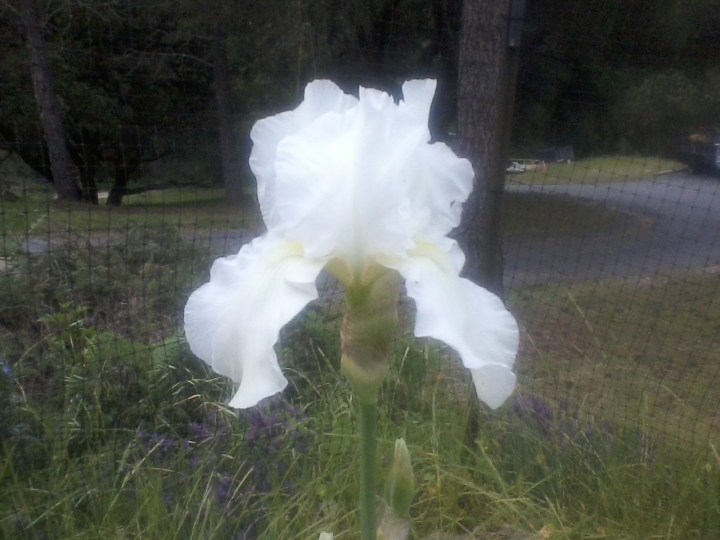 The statute of limitations allows me to discuss this now. It happened thirty years ago, in the spring of 1987. The famous landscape designer, Brent Green, was my roommate in the dorms at Cal Poly, San Luis Obispo. As the bearded iris started to bloom, Brent immediately noticed a bed of uniformly pink bearded iris off the edge of a lawn in the inner campus. He watched it bloom from beginning to end, and occasionally updated me on the progress. During the process, he convinced me that these iris were very rare. Neither of us had ever seen pink bearded iris before. We had no idea that they could easily be purchased from mail order catalogs or nurseries.