 To a little kid, it really had the potential to be a scary movie. I did not understand all of it, but I got the important parts. Mars was red, so was probably near Oklahoma. Apparently, the people from Mars had big scary machines that destroyed anything and anyone that was in their way. I did not perceive much of a threat because my parents let me watch the movie. (We children could not watch really scary movies.)
Shortly after watching War of the Worlds, I went for a long walk with my older sister and some of her friends into the last remnant or orchard that was such a prominent part of our world. We went out onto a new section of roadway beyond where our street used to end, and turned east on a completely new street that was not there before. The fresh new pavement and neat curbs seemed so flat and desolate . . . and expansive compared to the orchard that it now divided. I wondered how the trees got out of the way of this thing. Obviously, some moved to the left, and others moved to the right.
We eventually arrived at a larger clearing off to the left of this new street. Within this clearing, there were huge concrete rectangles with short pieces of rebar sticking up from their perimeters. One of the concrete rectangles lacked rebar, but was outfitted with four tall poles that curved on top. They looked something like those scary weapons on top of those machines that came from Mars. My sister confirmed my suspicions by explaining that the big concrete rectangles where where the flying machines landed when they arrived. Now I was getting a bit scared.
A few days later, we started to hear strange noises coming from the orchard. I was not allowed to go that far into the orchard without my sister, and was too afraid to go investigate anyway. The noises were mechanical and metallic, mixed with the sound of what seemed to be a big diesel engine and wood breaking. I dismissed them as not ‘too’ terribly threatening at first; but by the next day, they were closer! Each day, they got closer, until I could actually see motion through the trees. Something yellow was moving around in there, and small puffs of black smoke sometimes squirted out above the trees. I was terrified! I told my mother that the mean people from Mars were out there destroying everything like in the War of the Worlds!
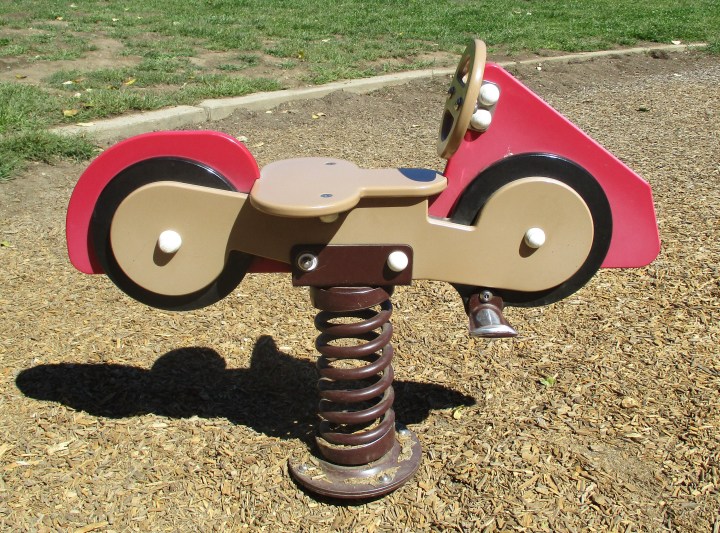
She explained that there were no mean people from Mars in the orchard, but that a new park was being built on the site. Well that did not help much. What is this ‘park’? My mother explained that it would be a place where kids could play and run around and climb things and play games . . . and you know. Well duh, that is what the orchard is for. She said that it would be better. I wondered what could possibly be better than the orchard. This is something that I need to see!
Well, for the next two days or so, as they tore out the last two rows or so of trees, it became apparent that they yellow machines from Mars that spurted out black smoke were bulldozers gouging the trees right out of the ground. No one even bothered to cut up the firewood to leave on the side of the road like was typically done. The trees were unceremoniously piled up and burned. I was no longer terrified. I was saddened and confused. I could not understand why anyone would want to do this to the most important part of our world.
The big concrete rectangles with rebar protrusions were not landing pads for the flaying machines from Mars. They were the foundations and floors of the Recreation Center for the new park. The concrete rectangles with the four curved poles that seemed to be an assembly site for the weaponry from Mars simply became two basketball courts. The curved poles were outfitted with backboards and hoops. The orchard, devoid of trees, was leveled in most areas and mounded in others, and mostly covered with a vast lawn. New trees were planted around the perimeter and within landscaped areas around the Recreation Center. I suppose as far as parks go, it was a nice one.
The only problem with it was that we did not know what to do with it. The new trees were too small to climb or hide behind or really to do anything with. The lawn was nice, but there was way too much of it. The Recreation Center was nice inside, but we wanted to be outside. Eventually, we learned how to enjoy our park, and it really was nice; although it will never be an adequate substitute for an orchard. Our suburban (or some might say ‘rural’) world was invaded and, unlike in the movie, conquered by a more urban culture.
I would not say that one culture is any better than the other. However, I will say that I believe that there was a certain advantage to knowing the orchard and some of the nearby undeveloped wildlands the way that we did. I really believe that it was more educational than the refined and synthetic landscape of the new park. The maintenance of the park certainly required some degree of horticulture. There are trees, lawn and all sorts of shrubbery and perennials. The orchard had only trees and mustard. We interacted with it differently somehow. This is something that I can not explain adequately. It can only be experienced.
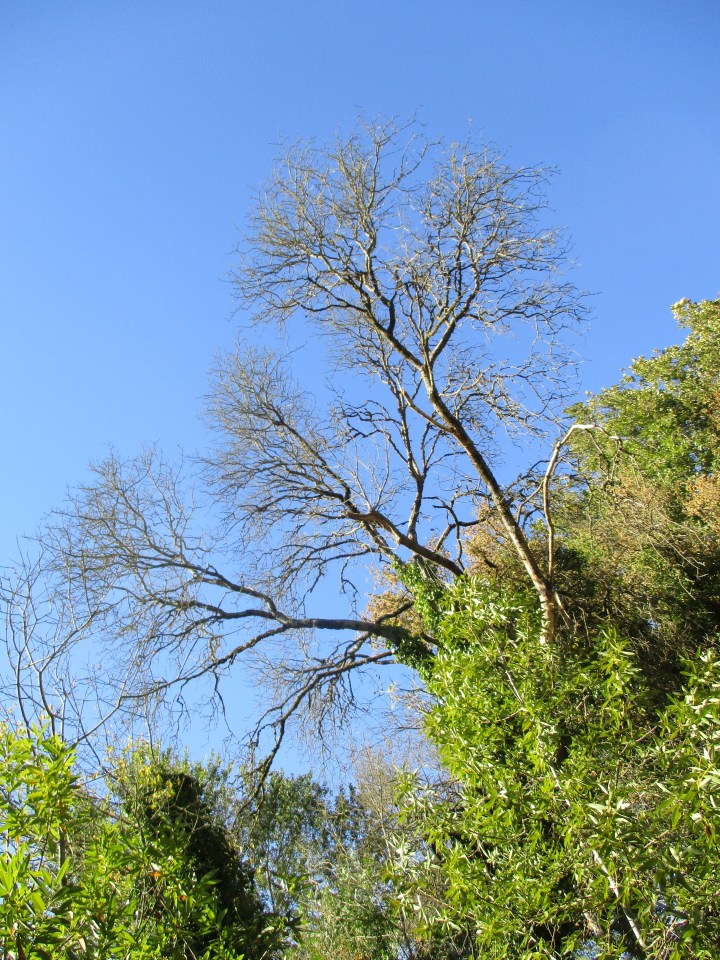 Remember our concern about the mistletoe? (https://wordpress.com/view/tonytomeo.wordpress.com) You might think that everyone would be pleased to see it gone. Yet, there is the concern that whatever killed the mistletoe might kill something else. That is what happened when the SODS killed so many coast live oaks after being ignored for a long time in the tan oaks. We were aware that the tan oaks were dying, but because the trees were so unpopular, we were not too concerned about it.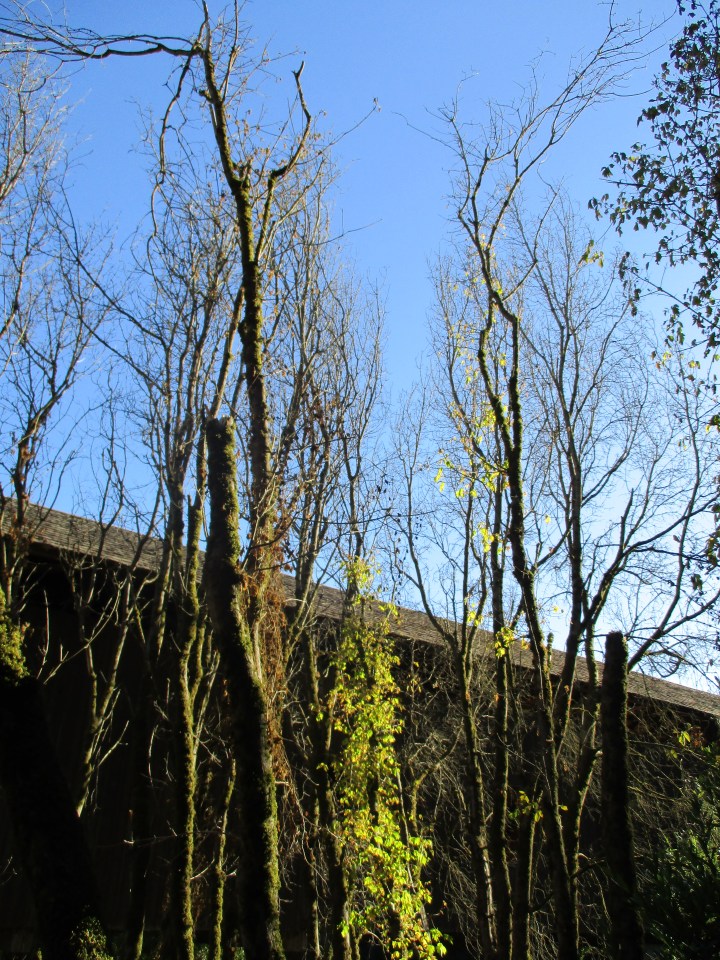
 Somewhere in the San Lorenzo Valley, there is a little old lady who is stitching a blue quilt. It is made of all the blue ribbons that she wins every year at the Jelly and Jam Contest of the Santa Cruz Mountains Harvest Festival. I do not know who she is, but I recognize her squiggly writing on the fancy labels. It is barely legible. Her hands are worn and tired from three quarters of a century off picking fruit, processing it into jelly and jam, and then stitching all her blue ribbons together. She probably giggles as she works, and thinks about everyone who wins only red or white ribbons.
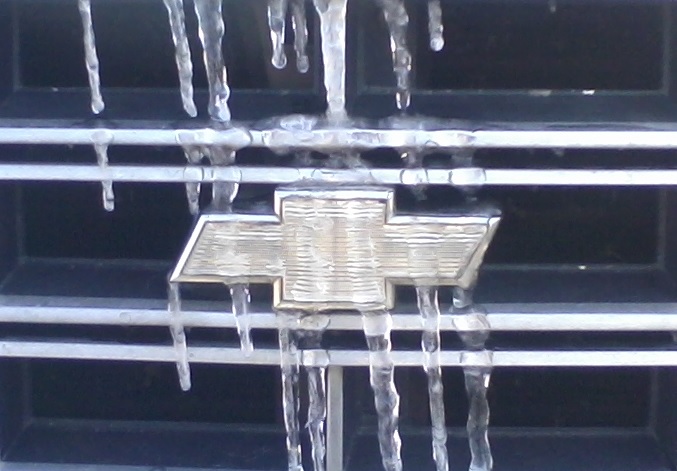 The nomenclature of horticulture, or the ‘naming’ of plants, is very similar to that of automobiles. All those confusing Latin names work just like the names of cars, with species, genus and even family. The Electra is made by Buick, which is a subsidiary of General Motors. I write an article about this every so often. It probably made more sense back many years ago, when both cars and plants were simpler.
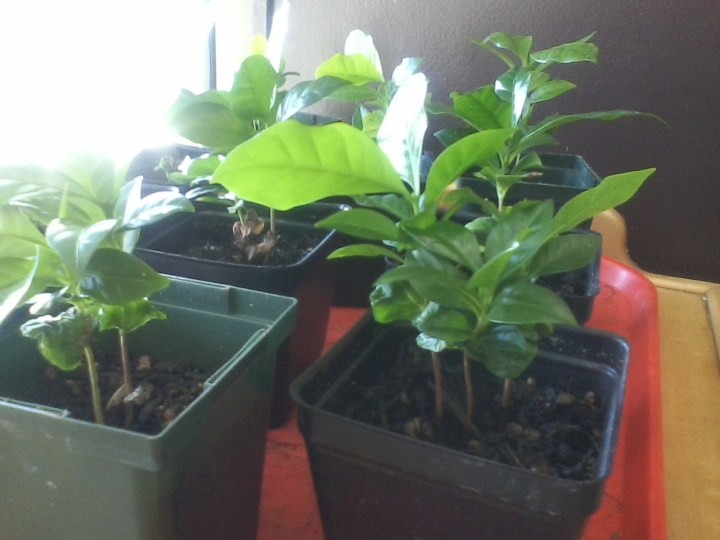 There are certain things that we expect to find in a coffee shoppe. Mainly, we expect to find . . . coffee. Yes, coffee, . . . duh. We can get all sorts of coffee beverages; hot, chilled, steamed, infused with things that have no business going into coffee. They have all sorts of cool sounding but strangely irrelevant Italian names that white people enjoy telling people of Italian descent how to pronounce. Yes, my name is Tony Tomeo; and I don’t want twenty cups of coffee with bread. Well, besides the coffee beverages, there are plenty of coffee beans; all sorts of roasts. I do not know of any coffee shoppe that grows any of the beans that it sells, but there is nice coffee shoppe in Felton, The Mountain Roasting Company, that grows coffee trees.
 This has very little to do with gardening; but like I said in the description of this blog, anything goes when it comes to the ‘Elaborations’ category. Anyway and furthermore, I do not like to write about garden sculpture, garden art, or any of those knick-knack fads that involve putting more than plants and the necessary infrastructure to sustain them into the garden. I do happen to like certain tasteful garden statuary, like Saint Francis, or Saint Fiacre (the rarely seen ‘real’ patron saint of gardening) or any of the saints; but only if I have a suitable space for them. This is nothing like that; but is just excellent enough that I wanted to mention it.
 Brent and I met in college, when we were assigned to the same dorm room in Fremont Hall at Cal Poly in San Luis Obispo. Our similarities were remarkable. He came two hundred miles north from west of Los Angeles. I came two hundred miles south from west of San Jose. We were both the middle of three children, although I had just acquired an extra younger sister the year before. While the other boys we grew up with were playing with Hot Wheels, Brent and I were busy planting miniature trees around the miniature roadways. His childhood dog was Speckles. Mine was Freckles. We were weirdly similar prior to September of 1986, but have been perfecting our differences since then.
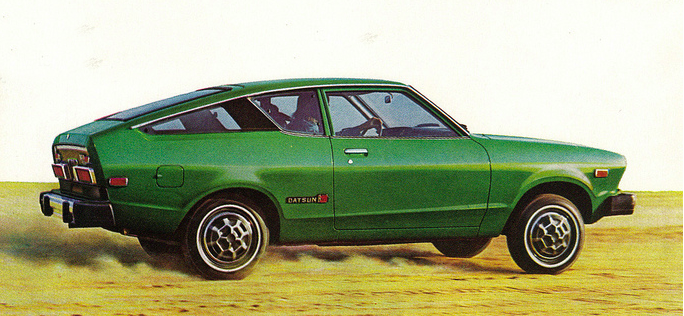 Sir Isaac Newton had something to say about an apple that was a victim of gravity. My high school physics professor was even better. He taught us all about velocity, force, inertia, vectors and much of what he had to teach us about physics with the help of a very ripe persimmon . . . and an insipid green 1976 Datsun B210.
 Many people have a favorite color. I learned how seriously some people can take their preference for a particular color when I was in high school, and taking care of the yardwork for a few homes in the neighborhood. There were three tract homes next to each other. One was grayish blue, with a silvery blue Sedan deVille in the garage, and a garden of blue flowers. The middle house next door was soft amber yellow, with a buttery yellow Oldsmobile 98 in the garage, and a garden of exclusively yellow flowers. The house next door to that was iron oxide red, with an exquisite rich red Electra in the garage, and a garden of, you guessed it, red flowers.
