Six on Saturday: a Week of Flowers

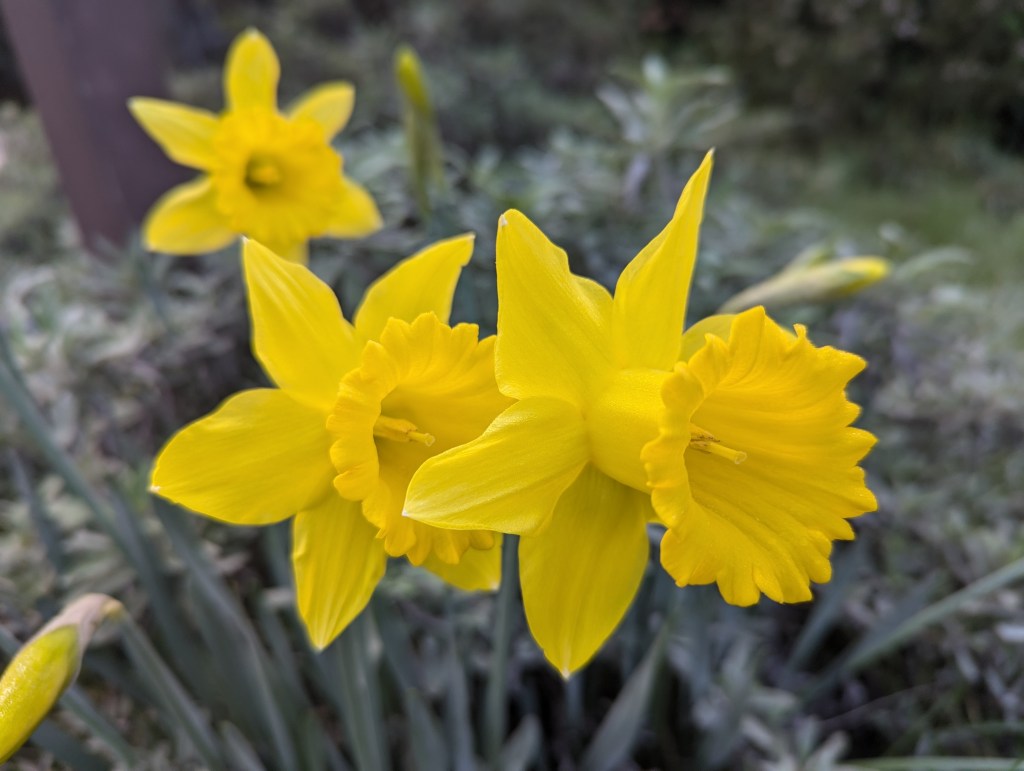
‘A Week Of Flowers’ at ‘Words And Herbs’ reminded me that I really should share more floral pictures. These are from yesterday, though, not all year.

1. Salvia chiapensis, Chiapas sage blooms as long as the weather is warm. Then, it takes so long to realize that the weather is no longer warm that, by the time it finishes the last of its bloom, the weather is beginning to get warm enough for it to resume bloom again.

2. Cestrum fasciculatum ‘Newellii’, red cestrum blooms about as continuously. It should have finished blooming about a month ago, but will likely continue until more sustained cool weather just like it did last year. After pausing briefly, bloom resumes before spring.

3. Rosa spp., carpet rose will eventually stop blooming and defoliate just long enough to get pruned back to the ground. It grows back like weeds, but such vigorous growth takes some time to decelerate enough to bloom, which might not be until the middle of spring.

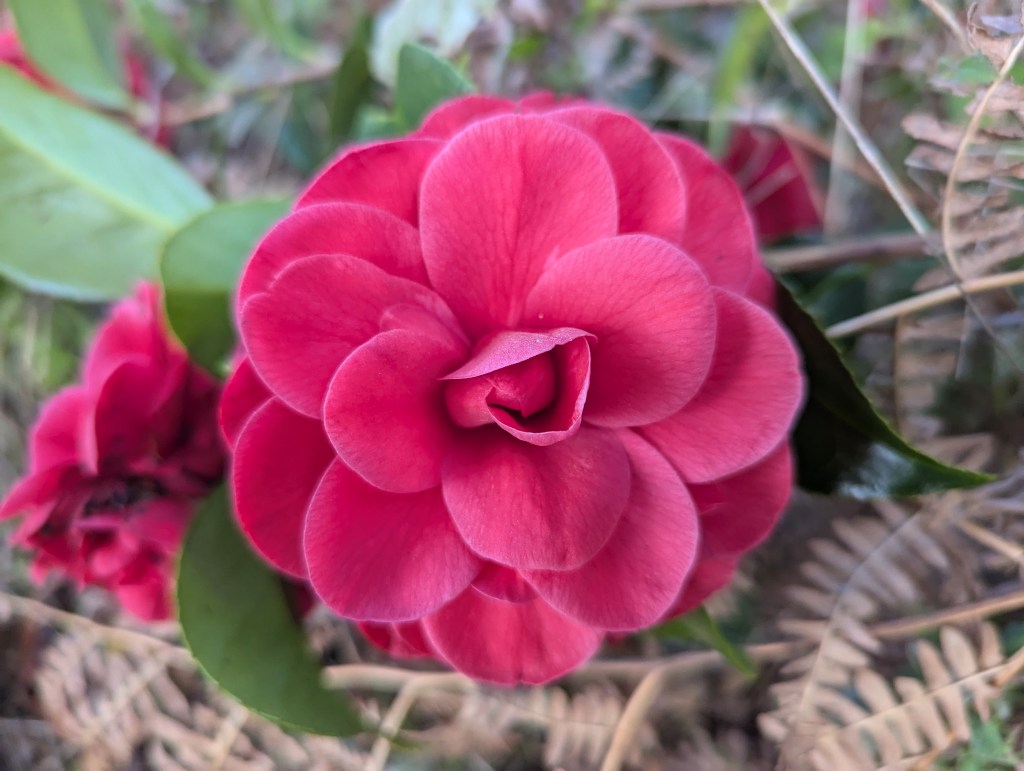
4. Camellia sasanqua, sasanqua camellia has become more of a small tree than a shrub. These flowers are too high up to appreciate individually, but are impressive in profusion. I thought that it is ‘Navajo’, but it now does not seem pink enough, and is a bit too ruffly.

5. Iris X germanica ‘Rosalie Figge’, unlike any other bearded iris here, blooms whenever it wants to, even during the coldest or rainiest weather, with ruins such bloom. I am not certain of its identity. Someone here on Six on Saturday suggested this name, and it fits.

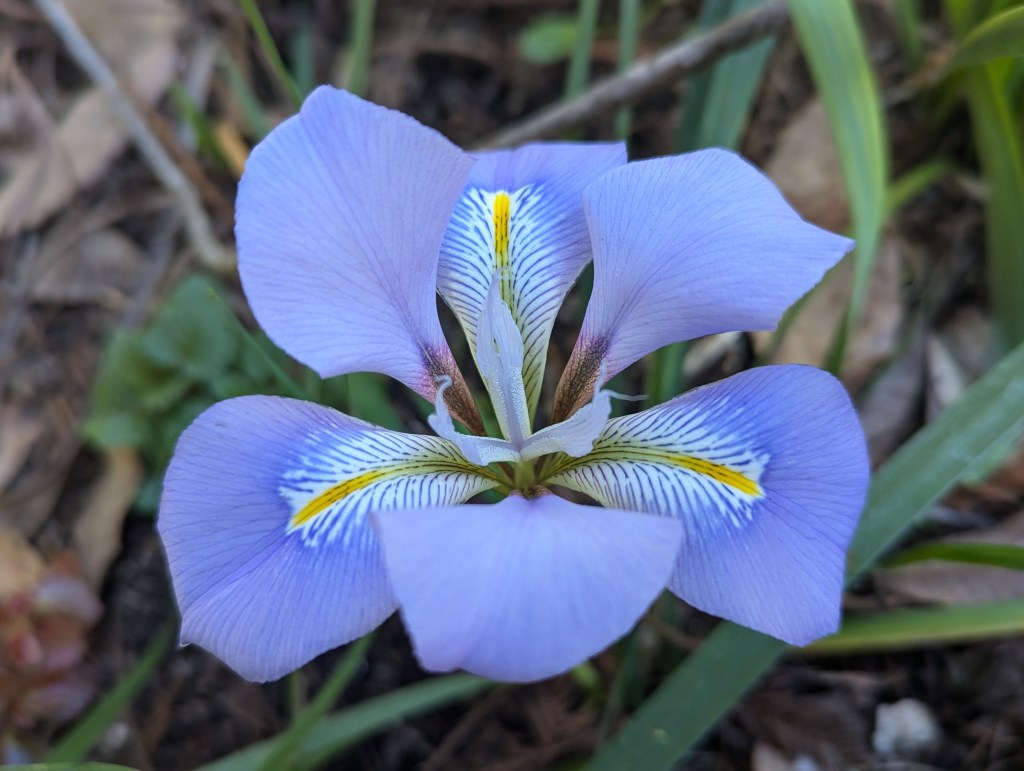
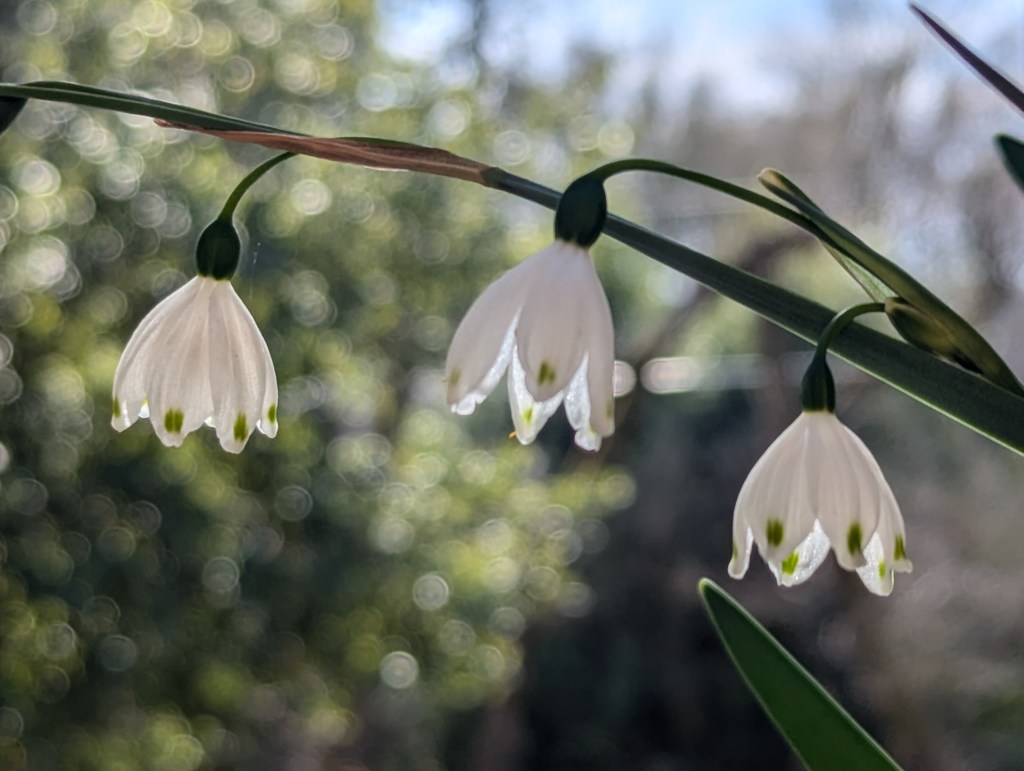
6. Iris unguicularis, Algerian iris from Skooter’s garden, which is perhaps more properly known as Tangly Cottage Gardening, is now blooming to prove that it actually is winter. I am very pleased that it is such perfect blue, without purple, and blooms during winter.

This is the link for Six on Saturday, for anyone else who would like to participate: https://thepropagatorblog.wordpress.com/2017/09/18/six-on-saturday-a-participant-guide/
Horridculture – Deferred Road Maintenance

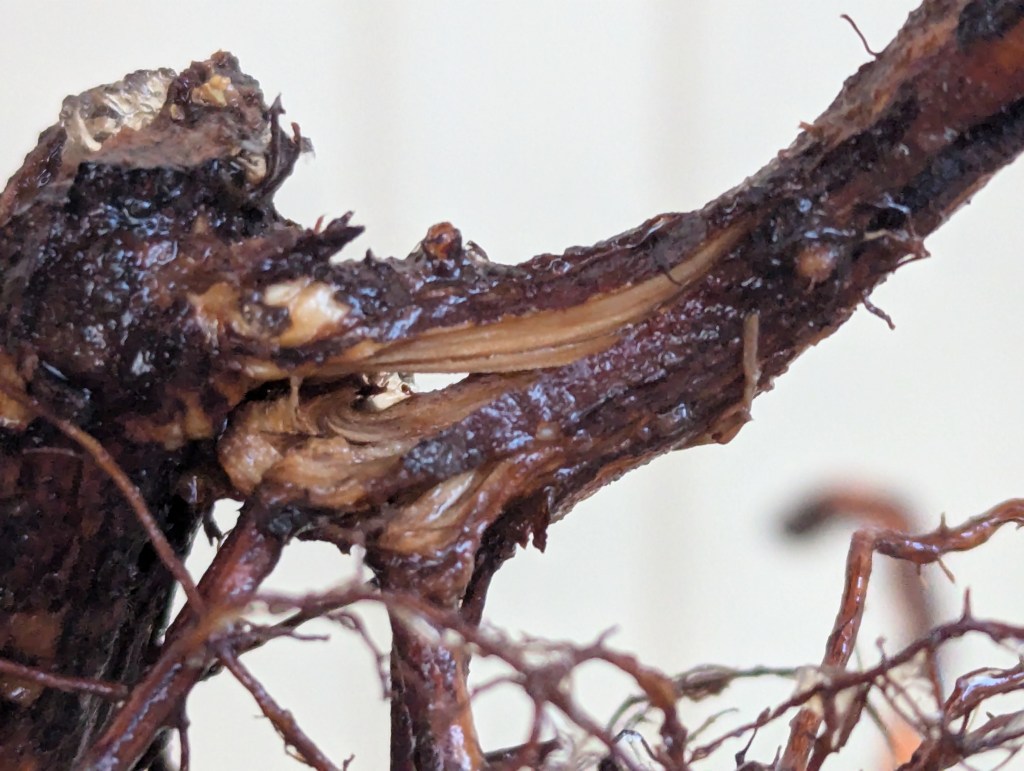
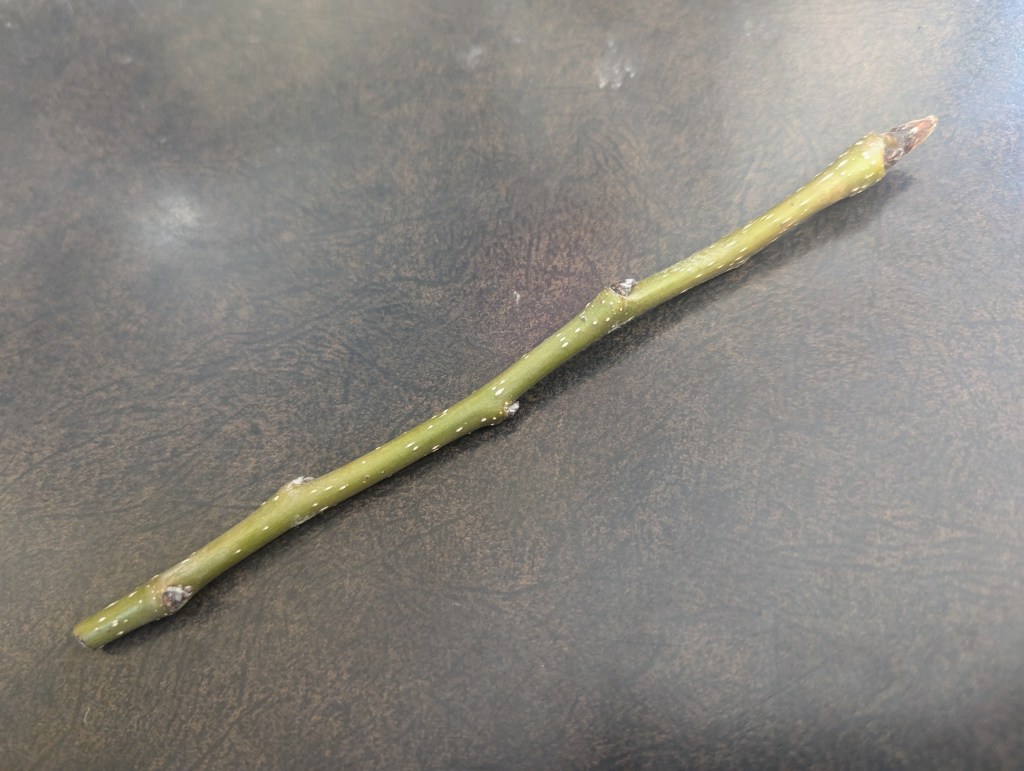
It is not on the road yet, but will be soon. This box elder has been deteriorating for several years. Only a few viable watersprouts remain within about ten feet of the ground. All limbs above are gone, leaving only this decomposing trunk. Several more similarly deteriorating trunks, with more or even less of their associated canopies remaining, are barely standing nearby. Most succumbed to an unidentified pathogen a few years ago. Some were dead prior to that. This one is special because such a significant portion of its upper trunk has broken off, and now remains suspended by the unbroken portion of the same trunk and the collective canopy of adjacent bay trees. This would not be such a concern if this broken portion of the trunk was not suspended so closely to the busy road below. (The picture above shows where the trunk broke. The picture below shows its proximity to the road below.) I suspect that when the broken portion of trunk eventually falls through the canopy of bay trees, the heavier basal end will fall first, and guide the lighter upper portion to land closer to the base of the remaining trunk, and safely away from the road, but I can not be certain until it actually happens. Those who maintain the road will not remove the broken portion of trunk until this does not actually happen, and the debris instead falls into the road. I can do nothing about it because I can not direct how the broken portion of trunk will fall once it is dislodged, and the traffic on the road is nearly constant during the day. It would be safer with a crew to stop traffic while the trunk is removed, and even better if they remove all of the several decaying trunks.

Which Houseplant?

Peperomia obtusifolia?

Peperomia obtusifolia, baby rubber plant is what I suspect this to be. I can not be certain. I do not work with houseplants. I can barely remember that we studied only a few cultivars of Peperomia that happened to be popular back when we were in school during the late 1980s’. The modern cultivars that are popular now were not even developed back then. I do not remember ever getting acquainted with the simple species, which this seems to be. That makes it even more perplexing. Where did someone get this copy of the simple species that has become so rare relative to popular modern cultivars as well as formerly popular cultivars? The rarest of modern cultivars is not as rare as this original. It is an exemplary specimen, too. It is at least two feet wide and stands more than a foot tall in its wide but shallow pot. Someone has maintained it meticulously for several years. Perhaps it grew as a cutting from an even older specimen that was grown before it became so rare so long ago. Perhaps someone appreciated this original simple species as it was losing popularity to more colorful modern cultivars back then. Realistically, without any of the fancy variegation of modern cultivars, the simple green original is undoubtedly more vigorous, and perhaps significantly so. It is therefore more sustainable than cultivars, and more likely to survive and perpetuate itself by cutting for many years. Alternatively, it could have originated as a reversion from a modern cultivar. Someone may have been impressed enough by its relatively vigorous simple green foliage to grow a copy from a cutting. Perhaps relatively vigorous simple green growth merely overwhelmed and replaced original but less vigorous variegated growth. These are merely guesses about its identity, which remains a mystery.

Which Mesquite?

Prosopis velutina, velvet mesquite?

Prosopis velutina, velvet mesquite is supposedly the most popular mesquite within landscapes, such as the landscape in Surprise in Arizona in which I encountered this mesquite. This particular specimen conforms to the description of the species. However, both Prosopis glandulosa, honey mesquite, and Prosopis pubescens, screwbean mesquite, are also somewhat popular within landscapes, and, except for the distinctly twisted beans of screwbean mesquite, both are visually similar to velvet mesquite. All three species are native to the region of Surprise. Because beans that I collected from below this particular specimen were merely somewhat warped, rather than distinctly twisted, I doubt that this specimen is a screwbean mesquite. Also, because the leaflets are relatively short with relatively rounded tips, I doubt that this specimen is a honey mesquite. Therefore, I suspect that this really is velvet mesquite. Although I would prefer to grow honey mesquite, I would be quite pleased to alternatively grow velvet mesquite, or realistically, any mesquite that is useful for smoking. I do not smoke enough vegetables or meats to be so discriminating about the sources of the smoke involved. Besides, if I were so discriminating, I could purchase honey mesquite seed online. For now, I will grow the seed that I collected from below this particular mesquite tree, regardless of its species. The handful of beans that I collected must contain several seed. I have no idea of how many of them will be viable, but will find out. Some of the beans have small holes in them from larval insects who undoubtedly ate some or all of the seed within, but I collected them regardless, merely because they were available. Because the seed are difficult to separate from their beans, I may not bother. I suspect that they will germinate and grow through their bean pods as the pods decay under a shallow layer of medium. Scarification of seed supposedly accelerates germination, but there is no rush. I do not even know where to plant any seedlings that might eventually grow. Although no mesquite are native here, velvet locust, as well as the other two species that this could possibly be, are surprisingly native to nearby counties. Because they are also native to harsh desert climates, I suspect that they prefer the drier and warmer of local climates. I therefore intend to grow them in exposed ridgetop areas with well drained and perhaps somewhat sandy soil.

Six on Saturday: White Saturday

Black Friday was yesterday. White Saturday seems appropriate today. Actually though, I lacked six pictures after a two week commitment from which I returned less than a week ago. These six were cut flowers where I was at. It is a long story. Apologies for this lapse of any personally relevant horticultural topics.

1. Gladiola is one flower that really excels at white! Except for the few at work, I have not grown them in many years. I grew some in yellow and orange in the old neighborhood in 2000 or so. They were fancy hybrids like this, so were not reliably perennial for too long.

2. Peruvian lily was one of the first cut flower crops that I worked with after my first year of college, for the summer of 1986, when they were new and trendy. White had not been developed back then. I am impressed by how white this variety is, with only minor spots.

3. Carnation is one of the most ubiquitous of cut flowers, but is also the only one of these six that I have never grown. I have worked with only bedding types and sweet William in landscapes at work. I did not get close enough to notice how fragrant this carnation was.

4. Rose is the most popular of cut flowers, although it does not seem to be as ubiquitous as carnations do. I can not remember ever not growing them. I acquired some that are in my garden now while I was in high school in about 1984 or 1985 and brought them here.

5. Chrysanthemum that grow in the landscapes at work were formerly potted plants that were left with us to be recycled. We selected none intentionally. They might be more fun like that. Anyway, this particular cut white chrysanthemum is impressively humongous!

6. Lily was a secondary cut flower crop that I worked with for the summer of 1986, along with the primary crop of Peruvian lily, which is not actually a lily. We grew Asiatic lilies, and we grew white lilies, but not white Asiatic lilies such as this. I am happily impressed.

This is the link for Six on Saturday, for anyone else who would like to participate: https://thepropagatorblog.wordpress.com/2017/09/18/six-on-saturday-a-participant-guide/
Horridculture – Saturation

Saturation is almost a universal problem within almost all of the landscapes that I inspect that are ‘maintained’ by mow, blow and go ‘gardeners’. Without exception, all of such landscapes are outfitted with automated irrigation systems. Some of such systems are scheduled to apply much more water than they should for more time than they should. More typically, irrigation is applied much too frequently. Sometimes, irrigation is both too abundant and too frequent. Such excessive irrigation maintains unhealthy saturation within the soil. Roots are unable to disperse their roots into such saturated soil, and many roots that try ultimately rot. Some trees try to compensate by dispersing roots close to the surface of the soil, but because they are unable to disperse their roots deeply, they lack stability. Also, their shallow roots damage pavement and compete with other vegetation. What is even more egregious about saturation within ‘maintained’ landscapes is that, almost without exceptions, the so-called ‘landscape’ companies that ‘maintain’ them, likely after installing them, brag about their ‘water-wise’ and ‘sustainable’ landscape maintenance techniques. They install irrigation systems that could be quite efficient if they were to operate properly, but then never operate them properly. They install drought tolerant species that can survive with minimal irrigation, but then kill them with excessive irrigation. They replace the deceased plant material, only to kill and replace it again. They do not mind wasting water that their clients pay for, any more than they mind wasting plant material that their clients pay for. In fact, replacement of plant material is profitable for them, since they get paid for procedures associated with removal and installation. Realistically though, they are probably as oblivious to the profitability of their technique as they are to proper technique. In other words, they simply do not care.

Parasite

Cuscuta spp., dodder

Dodder is likely the second most common parasitic vegetation here. Only mistletoe is more common. Yet, it is very rarely encountered within home gardens. When it does appear, it seems to do so spontaneously, with its source difficult or impossible to identify. Its many species can also be difficult to identify, since most are so visually similar. This species seems to be a bit greener than most, which are typically somewhat yellowish or even orangish. Only its genus of Cuscuta is known. If its wiry twining stems resemble those of bindweed, it is because the two are related. Unlike bindweed, dodder lacks, leaves, roots and perhaps a few other otherwise important parts that it does not need because it draws resources from its hosts, which, for this example, is red yucca. Most are yellowish or orangish because they do not need chlorophyll to photosynthesise for themselves while they rely on their hosts to do so for them. Dodder looks like something from science fiction. Not only does it parasitize its hosts, and exploit them for their resources, but it is also very invasive and persistent. Like mistletoe, it is difficult to remove completely from its hosts, and any small bits that remain regenerate efficiently. Its seed remain viable for many years. Even if visible dodder growth is completely eradicated, it may have tossed seed that can grow two decades later! Because dodder is parasitic and mingles so thoroughly with its hosts, herbicides are impractical for its eradication. Sometimes, infested host vegetation is too thoroughly infested to be salvaged. Dodder has an extensive host range, so can infest other species in the landscape even after original hosts are removed. Dodder may look interesting, but should not be allowed to grow wild. When removed, it should be disposed of rather than composted.

Ocotillo Cuttings

Fouquieria splendens, ocotillo

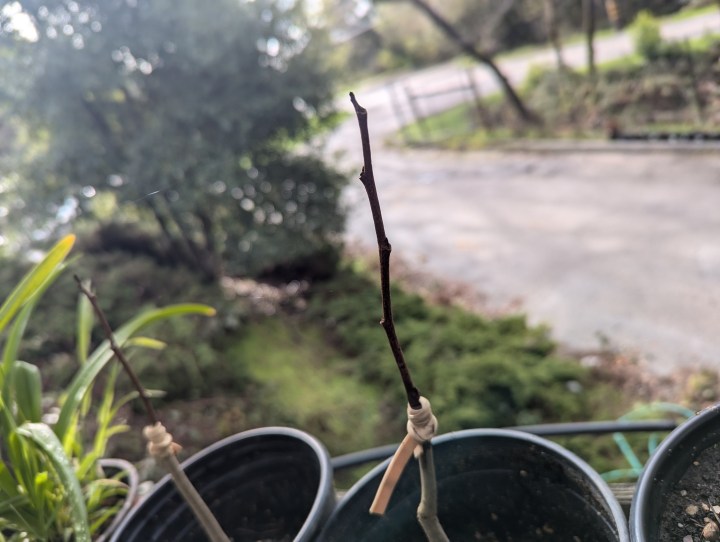
Fouquieria splendens, ocotillo has been an elusive species that I would like to try to grow, even if only to determine that it will not survive for long in my climate. I suspect that there are a few reasons why I have never observed it outside of desert or warm chaparral climates. I know that it is very susceptible to rot if irrigated even slightly excessively, and within some climates, any irrigation may be excessive. If I can grow cuttings, I will put them in stony and very well drained soil on an exposed ridgetop above my garden, where they will get no irrigation. The piece of cane that was given to me a few days ago, and that I mentioned this morning, is about three feet long, with a single offshoot that is a few inches long. Cuttings should supposedly be between four and six inches long. I tend to make short rather than long cuttings, so would be inclined to cut them four inches long, for a total of about ten cuttings, including the offshoot. I am tempted to cut thirteen cuttings, three inches long, but will try to confirm with the recommended four inch minimum. I do not leave many cuttings out for their ends to dry, but will make an exception for these, since that is what is recommended. I will refrain from scarifying the sides of the proximal ends of the cuttings, just because the stems are somewhat wide, with correspondingly wide basal cuts. Rooting hormone powder will be applied, also as recommended. Fortunately, winter is the best time for starting such cuttings. However, they develop roots slowly, so may not be ready for plugging for two years. I can wait. I will continue to maintain these ocotillo cuttings until they either root or rot.

Six on Saturday: Weeding & Pilferage

Pilferage annoys me. I certainly do not want to annoy anyone else with it. Fortunately, I only want to pilfer weeds that should be removed from their landscapes anyway. Several of these six were unwanted feral seedlings, which technically qualify as weeds. Seed that was not removed could have grown into more feral seedlings if I had left it. Although the red yucca pup was not a weed, it was crowded. Ocotillo was a gift, so was neither a weed, nor pilfered. Now, I have even more to grow.

1. Hesperaloe parviflora, red yucca produces quite a bit of seed. I found some which the gardeners neglected to deadhead. I wrapped it too neatly to unwrap to get a picture of it.

2. Hesperaloe parviflora, red yucca should be easier to grow by division. Unfortunately, this one shoot that I managed to divide is almost totally rotten from excessive irrigation.

3. Calliandra californica, Baja fairy duster is the only species in this bundle of seedlings that I can identify. It is the biggest one which extends to the upper right. The bundle also includes seedlings of both or either Parkinsonia florida, blue Palo verde and or Prosopis velutina, velvet mesquite, as well as a single seedling of an unidentified species of palm.

4. Parkinsonia florida, blue palo verde is easier to identify when it larger than seedlings. However, because I am unfamiliar with it, I am still uncertain if these are actually them.

5. Prosopis velutina, velvet mesquite left these seed pods on the ground. Small holes are from insect larvae that ate some of the seed within. A few viable seed would be adequate.

6. Fouquieria splendens, ocotillo was a gift, so was not pilfered. This cane is about three feet long, so can become several cuttings when I determine how long cuttings should be.

This is the link for Six on Saturday, for anyone else who would like to participate: https://thepropagatorblog.wordpress.com/2017/09/18/six-on-saturday-a-participant-guide/

Horridculture – Queen Nefertiti

Ancient Egyptian influence within a modern landscape

Queen Nefertiti, during the fourteenth century BC, was the most famous and most influential Queen of Ancient Egypt. She wore a cool hat too. It was sort of cylindrical shaped, but also tapered so that it was wider on top, sort of like a funnel. So, not only was Queen Nefertiti very influential during her time, but she remains influential in modern mow, blow and go gardening. So-called ‘gardeners’ everywhere still shear shrubbery into the shape of Queen Nefertiti’s cool hat! Not many species of shrubbery are exempt. Just about any get shorn into a sort of cylinder shape that is wider on top, sort of like a funnel, but also tilted in one direction or another, just like Queen Nefertiti’s hat tilts toward the back. Such shearing typically deprives blooming shrubbery of its bloom, but bloom is apparently not a priority, as long as the ancient Egyptian form is maintained. The picture above includes four oleanders, a Texas sage and what seems to be two trailing lantana. The Texas sage and trailing lantana are more cylindrical than hat shaped, but the hat shape of the three oleanders is impossible to deny. It is such a universal technique that is performed so precisely wherever vegetation is maintained by mow, blow and go gardeners that it seems to be taught in classes as standard procedure. I am significantly more educated in horticulture than most mow, blow and go ‘gardeners’, but I somehow missed this in my curriculum. Instead, I learned that vegetation should be allowed to exhibit its natural attributes, such as form, texture, bloom and so on. If I wanted a herd of ancient Egyptian hats in my garden, I would probably construct something that resembled ancient Egyptian hats from an inert material that never needs shearing or irrigation.

the Original
a modern version of an ancient Egyptian fashion show