Santa Cruz II

Begonia boliviensis ‘Santa Cruz’

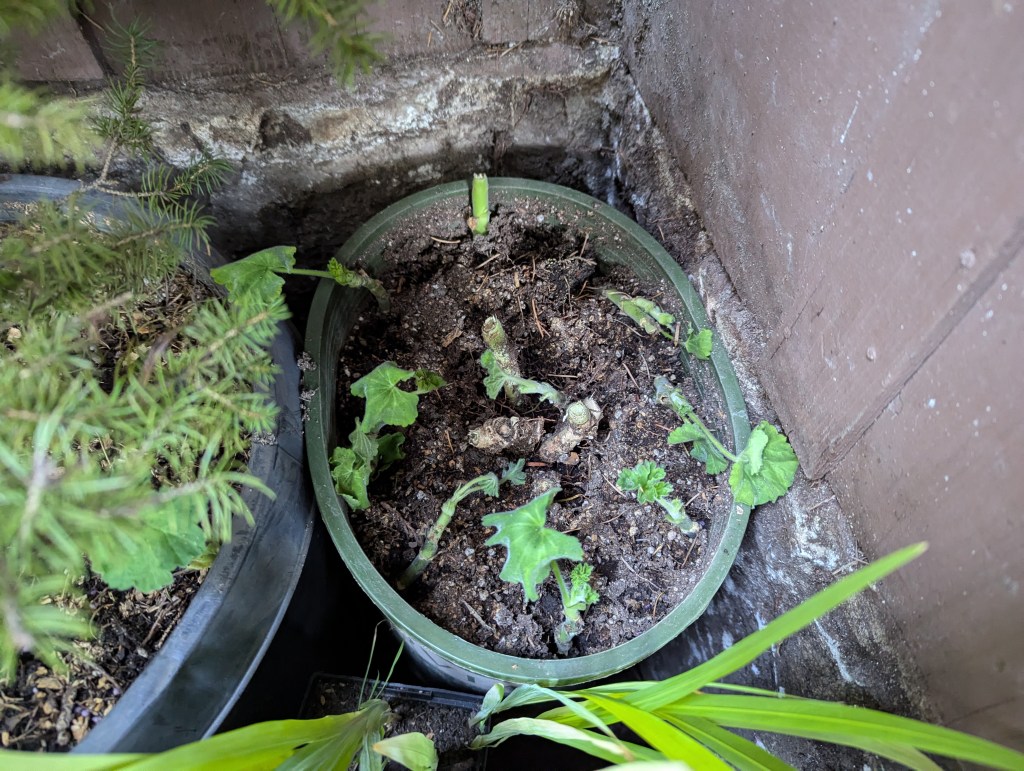
Begonia boliviensis ‘Santa Cruz’ is significantly bigger than it was when I wrote about it three months ago. If I had known that it would have performed so well, I would have groomed it for better form. It grew upright at first. I just let it do so because I wanted to make a cutting from the tip when it got pruned back. However, because it leaned over and branched as it should, it did not get pruned back. It could have developed a better and lower form if I had tended to it better, but I am too pleased with it now to complain that it is a bit more upright than it should be. I do not mind that I did not get a cutting from the primary stem that I did not cut back because there are now many more stems that I can get cuttings from, simply be grooming out a small bit of superfluous growth from within. I could get many more than I want if I were to actually prune this specimen back for winter. It is getting to be too exemplary to cut back for winter, though. Nor do I want to leave it out to get frosted, as I might do with other begonias. The horticulturist who procured it will shelter it from frost, and perhaps groom it a bit after winter, but otherwise try to retain as much of this growth as possible for a head start next spring. I am curious to see what it does. Will it shed most of this growth as it resumes growth from below next spring; or will it grow from near the tips of where it stopped growing this year? I did not expect to be so impressed by this modern cultivar of Begonia.

SQUIRREL!

This is no ordinary squirrel. It is likely a ground squirrel, since, as such a designation and its presence on the ground suggest, it likely lives in the ground. That divot on the ground in front of it seems to be a burrow, presumably where it lives. It seems to be rather plump for a ground squirrel. Perhaps it could be a common squirrel who lives on or under the ground because it is too plump to live in trees. I have no idea. We did not get any more acquainted than necessary for me to get this picture from a significant and what I considered to be safe distance. Although a squirrel like this could inflict major injuries, I doubt that it can move very fast. It reminds me how fortunate that we do not contend with such large rodents at work. Gophers are small but very destructive to the vegetation within our landscapes. I do not want to know how much damage this squirrel or whatever it is is capable of. It must consume a considerable volume of roots, foliage or whatever it wants to eat. Supposedly, such squirrels, whether in trees or in the ground, are not as destructive as gophers, but I do not know what to believe. I suppose that some wildlife is more obviously worse. Fortunately for us, deer avoid our landscapes, though we could do nothing to exclude them. No one knows why. Much larger herbivorous wildlife that inhabit other regions, such as the Pacific Northwest are more voracious than deer. I can not imagine the extent of damage that just a single moose is capable of. Nor do I know how such wildlife can be excluded from landscapes. It seems to me that a moose can probably go wherever it wants to.

Six on Saturday: Away Again

It is a long story. To be brief, Rhody and I are again far away from work and home, near Phoenix in Arizona, without time to write.

1. Prosopis velutina, velvet mesquite is supposedly the most common mesquite here and is also native. It develops sculptural form, but only light shade, which seems to me to be substandard for such a warm climate. Perhaps it is common because it is undemanding.

2. Parkinsonia florida, blue palo verde is also native like velvet mesquite, but is only one of the two most common palo verdes here. Foothill palo verde is the other. Both develop sculptural form and light shade, also like velvet mesquite, and are a bit more sculptural.

3. Lantana montevidensis, trailing lantana is the same common type that I occasionally work with at home, but seems to be happier and more colorful here, even while shorn as these weirdly compact globs, and humiliatingly deprived of its naturally sprawling form.

4. Calliandra californica, Baja fairy duster seems to be more prevalent here than it is in California. Of course, Baja California is a very big and very diverse region to the south of the State of California that I am familiar with. I suspect that this is a hybrid or a cultivar.

5. Leucophyllum frutescens, Texas sage, like so much of the flowering shrubbery here, is shorn too abusively to bloom as well as it likely should. Its silvery gray foliar color is also compromised. I can not even guess what its natural form or branch structure should be.

6. Rhody is so tolerant of my interest in unfamiliar vegetation. His only interaction with it involves just ‘claiming’ it. I absconded with a handful of seed pods and three seedlings of velvet mesquite, and a seedlings of Baja fairy duster (which will get a different name).

This is the link for Six on Saturday, for anyone else who would like to participate: https://thepropagatorblog.wordpress.com/2017/09/18/six-on-saturday-a-participant-guide/

Horridculture – Trash Talk

Public trash receptacles are a good concept. Without them, some of us would be more likely to litter. Contraptions such as this are most likely a good concept too, since they are somehow more visually appealing than exposed trash cans. Also, they are unlikely to fall over and spill as exposed trash cans sometimes do. Originally, one half of this receptacle was designated for trash, and the other half was designated for recyclables. This is another good concept, but was very unfortunately discontinued because it is so commonly ignored that someone must sort through less than efficiently sorted trash and recyclables. The only obvious component of this device that may not have been such a good concept is the planter box that hovers above it. Once outfitted with a nice collection of succulent perennials, it was left to survive as well as it can, which has not been very well. Succulents were likely selected for this particular application because they are supposedly ‘drought tolerant’. However, only some are drought tolerant, and only because they extend their roots as they must in order to find moisture, which they are unable to do while confined to this hovering planter box. Although they have been surviving, they have not been very happy about it. I suspect that someone must sometimes give them water, but these succulents want a bit more. Realistically, they would be happier in the ground behind the trash receptacle. There is certainly plenty of vacant space for them there, and they would be more visually appealing where they would actually be more visible than they are above average eye level. If some sort of vegetation is desirable above the trash receptacles, small shrubs or vines in the ground next to them would be happier than succulents above them. It would have been better to maintain the space that is already in need of maintenance than to add more.

Not So Spicy

Jamaican allspice, Pimenta dioica, is rare here. I am beginning to learn why. Because it is tropical, it is vulnerable to even very minor frost. Actually, it is not so keen on chill either. It is rated for climates that are no cooler in winter than Zone 10. This is Zone 9. It seems to grow reasonably well in the Los Angeles region, where I collected my cuttings from Brent’s Jungalow Garden, but it is rare there also. That could be because it is not much to look at. Its foliage is no more interesting visually than that of common privet. Although the foliage is splendidly aromatic, only those who are familiar with the species, or become acquainted with its aroma while pruning it, would know. Its bloom is neither prominently colorful nor fragrant. What is worse is that the bloom is dioecious, with male or female flowers on different specimens. Single specimens have no problem blooming, but can not produce allspice fruits without a mate. Single male specimens are fruitless for obvious reasons. Single female specimens are fruitless without pollination. Not many people who grow the very rare single specimens are aware of this, although most are satisfied with the delightfully aromatic foliage. New specimens only very rarely become available in nurseries, and when they do, all of them were likely grown from the same stock specimen, so are genetically identical and of the same gender. Only seed grown specimens are random in regard to their respective genders, and even among them, their genders are unknown until they eventually bloom. The potential for growing both genders is proportionate to the number of seedlings. For example, one seedling will be of one gender. Two seedlings are as likely to be of the same gender as they are to be of different genders. Three are more likely to include one of another gender. Several or many are proportionately less likely to be of the same gender. All of my several cuttings were from the same specimen, so would have been genetically identical. It does not matter much now anyway, since only one survived, and even it is still rather wimpy. It has developed only two new leaves, and retains a trimmed portion of one of its original leaves. I am pleased with it regardless of its gender, and will be satisfied with only its aromatic foliage.

Please Do Not Pick the Flowers

Am I that predictable? How did whoever posted this sign know I would be here? I do not want their stupid flowers anyway. Besides, only that dinky twig of some random species that I can not identify is blooming on the far right. Is that all they got? What I really want, or more accurately, what I would want if I did not find them to be either uninteresting or redundant what is already in my garden, is stem bits of the succulents for propagation. I suppose that I am not the only one who might want that, which is why the sign, although slightly irrelevant to such desires, became necessary. Actually, I have direct experience with pilferage of bits of succulents from my small planter box downtown, so I am aware of why such signs might be useful. I would not install any such sign within my planter box because such a sign would be bigger and more prominent than any of the flowers that it would be intended to protect. If I were to grow more flowers, I would prefer those that are so abundant that no one would miss a few that might get pilfered. The most abundant flowers are also smaller than less abundant flowers, so they would not be as tempting to those who might want more impressive flowers. For example, the bearded iris within my downtown planter box blooms with only a few big and bold floral stalks. Not only are the flowers tempting and easily taken, but when they are taken, there are no more to replace them. Anyway, I do not actually mind if those who want copies of my succulent perennials take a few bits if only they do so properly. It may happen more often than I am aware of, but of course, I am not aware of it if otherwise useless bits are taken from below the visible growth, or where they should be pruned away anyway. That is how I justify what you likely know I will mention next. Yes, only about a hundred feet from this urn filled with succulents and the sign that requests that I refrain from doing as such, even if it does not mention the subject matter and procedure directly, I ‘borrowed’ a few bits of stem from the underside of a shabby specimen of what seems to be ‘Roman Red’ Salvia guaranitica that should eventually get pruned back for winter anyway.

Six on Saturday: Day Out

Rhody and I were in Capitola to attend to a few important tasks. Consequently, I did not take any pictures from home or work. My ‘Six’ for this week are therefore totally random without a theme.

1. Liquidambar styraciflua, sweetgum does not require much chill to exhibit exemplary foliar color for autumn. This deep garnet red is almost too dark to be visually appealing. It looks like it should be in Vermont rather than here on the Central Coast of California.

2. Archontophoenix cunninghamiana, king palm is more common closer to Los Angeles than here. I know of only a few here, and almost all are somewhat shabby like these are. King palm is less tolerant of slightly excessive chill than sweetgum is of inadequate chill.

3. Eucalyptus citriodora, lemon gum is also more common in Southern California, likely because it prefers warmer winters. Although these are reasonably happy here, not many are so happy within the Santa Clara Valley on the other side of the Santa Cruz Mountain.

4. Cortaderia jubata, pampas grass is the aggressively invasive sort which is naturalized so wickedly on the West Coast of California and Oregon. This is not a good picture, since it shows only its bloom peeking above the edge of the cliff, with foliage concealed below.

5. Eucalyptus globulus, blue gum is another aggressively invasive naturalized species. It has a completely different personality, though. Where it competes with other tall trees, it grows very high, and is very combustible. This exposed tree is relatively short and stout.

6. Carpobrotus edulis, Hottentot fig, which most of us know incorrectly as ice plant, was imported from South Africa more than a century ago, and is now so abundant that some believe that it is native. Technically, it is invasive too, but it is not easy to dislike as such.

This is the link for Six on Saturday, for anyone else who would like to participate: https://thepropagatorblog.wordpress.com/2017/09/18/six-on-saturday-a-participant-guide/

Horridculture – Headless

Appropriately, this picture was taken on Halloween. The ‘DEAD END’ sign and cemetery beyond, which are visible to the lower left of the picture, were also coincidental. The several headless redwood trees are the primary topic. Obviously, they were decapitated because of the electrical cables above. Otherwise, redwoods with such healthily plump trunks would be rather tall by now. After all, coastal redwoods are the tallest trees in the World. Unfortunately for them and those who are now appalled by their disfigurement, reliable and safe electrical service is more of a priority than poorly situated trees. It is no fault of the trees. Nor should this atrocity be blamed on those who executed it. Their only better option would be complete removal of the subjects, and perhaps replacement with smaller trees that will not grow tall enough to get too close to the electrical cables above. Maintenance of clearance of the vigorously upright redwoods from the cables above is a chronic problem that must be morally challenging for the arborist who must perform the necessary procedures. However, removal of several such significant trees would be very objectionable to the Community, which is very likely why these trees remain, regardless of their severe and irreparable disfigurement. Application for permits for their removal requires posting of such intentions on the trunks of the subject trees, to which neighbors would very likely protest. None of this would be such a problem now if only trees that are more appropriate to this particular situation were installed instead! Did the landscape designer who designed this landscape even visit the site during the design process, or was it all done on paper in a remote studio? Why did those who installed these trees not foresee this problem and modify the landscape plan and species selection accordingly?

Red Alert

Acer platanoides

Acer platanoides ‘Schwedleri’, is Schwedler’s maple, which is an old fashioned cultivar of Norway maple. It is not a red maple. However, because its new foliage initially emerges with deep burgundy red color, it is often mistaken for red maple, particularly where red maple is uncommon. Its deep burgundy red foliar color does not last long before developing deeper purplish bronze color, with tiny contrastingly greenish yellow flowers. For autumn, the foliage turns yellow. Schwedler’s maple was a common street tree for the many large tracts of suburban homes that were built within the Santa Clara Valley during the late 1950s. Although it has not been available from nurseries for the past few decades, at least two similar but more modern and darker bronze cultivars of Norway maple are becoming more available. Modern cultivars are generally sterile, so are not invasive like the simple species has been within some ecosystems that are more favorable to naturalization than that of the Santa Clara Valley. The Norway maple in the picture above is not ‘Schwedleri’ but looks very much like it.

Acer rubrum is the real red maple, not just because of its often bright red autumn foliar color, but primarily because of its red floral buds that emerge immediately prior to foliation in spring. However, prior to autumn, its foliage is simple green. Red maple was rare here prior to 1990, and by the turn of the Century was still only mildly popular in the Santa Clara Valley. It could be more popular than it is, and realistically, performs better as a street tree than cultivars of Norway maple. Although not as colorful as bronzed cultivars of Norway maple are through summer, its vibrant yellow, orange and typifying red autumn foliar color is superior, even in response to only mild chill.

Acer rubrum

Taking Sides

This is what taking sides looks like. The right side was taken completely off, leaving only the left. The view from the other side would show that the left side was taken completely off, leaving only the right. It is not such a good picture because it is difficult to distinguish the extent of the damage from what is going on in the background. Realistically though, a better picture would be even worse, since the extent of the damage would be more obvious. The justification for such damage here is more obvious, since, obviously, this is a bad situation, with no room for balanced growth. Although survival is possible, this is not what nature intended. Natural growth should be an asset, and efficiently directed to where it can be useful, which would most likely be much more balanced than this. Incidentally, this is a coastal redwood, which is the Official State Tree of California. This sort of pruning would be just as damaging to Western hemlock, Douglas fir or blue spruce. For that matter, it would be just as damaging to longleaf pine, Western white pine or Ponderosa pine. Ultimately, it is bad technique for any tree in any situation.