Messy Mast

This is the mess that remains after acorns get raked or blown off pavement.

Masting is a technique that oaks and many other genera use to both outsmart and exploit squirrels and other wildlife that both consumes and disperses their seed. For several years, oaks here produce enough acorns to sustain a population of squirrels that is limited by their production of acorns. It may not seem to be very effective, since the squirrels consume almost all of the acorns, leaving very few or none to grow into new trees. Then, every several years, the same oaks collectively produce a ‘mast’, which is a crop of acorns that is too excessive for the limited population of squirrels to consume as thoroughly as they typically do. Squirrels instinctually bury many of the surplus acorns anyway. Because they do not return to dig and eat all of their buried acorns, some acorns grow as new trees. This is how the oaks sustain those who disperse their seed, but also get them to disperse their seed without eating all of it. Mast crops of acorns supposedly typically precede exceptionally rainy winters. So far, the mast this year is only coinciding with a messy situation with drippy nut disease. It is caused by bacterial infection of wounds that are caused by filbert weevils, filbert worms or other insects that damage developing acorns. Consequently, squirrels are ignoring many of the unusually abundant but damaged acorns, leaving icky messes of infected acorns and the goo that they exude. When it eventually arrives, the first rain will make this mess even messier. Later rain should rinse some of it away. It is impossible to know how successful this mast will be, since it is impossible to know how many viable acorns will actually contribute to the abundance and grow later, and how many will merely contribute to this unusually messy mast.
Six on Saturday: Firsts & Lasts

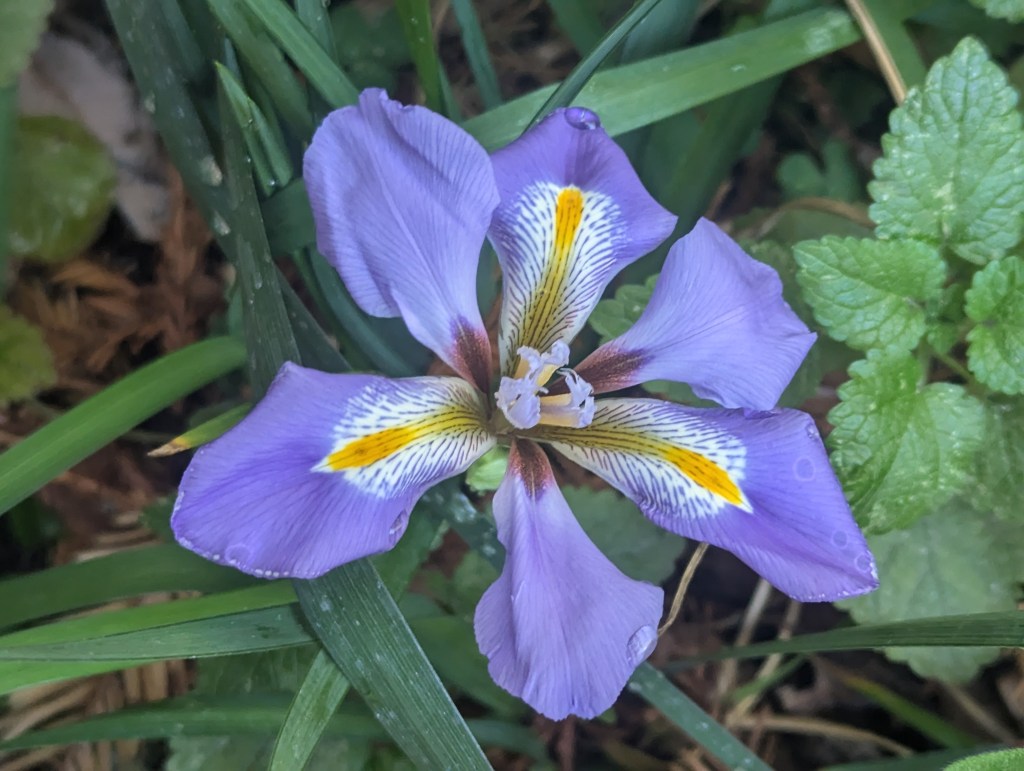
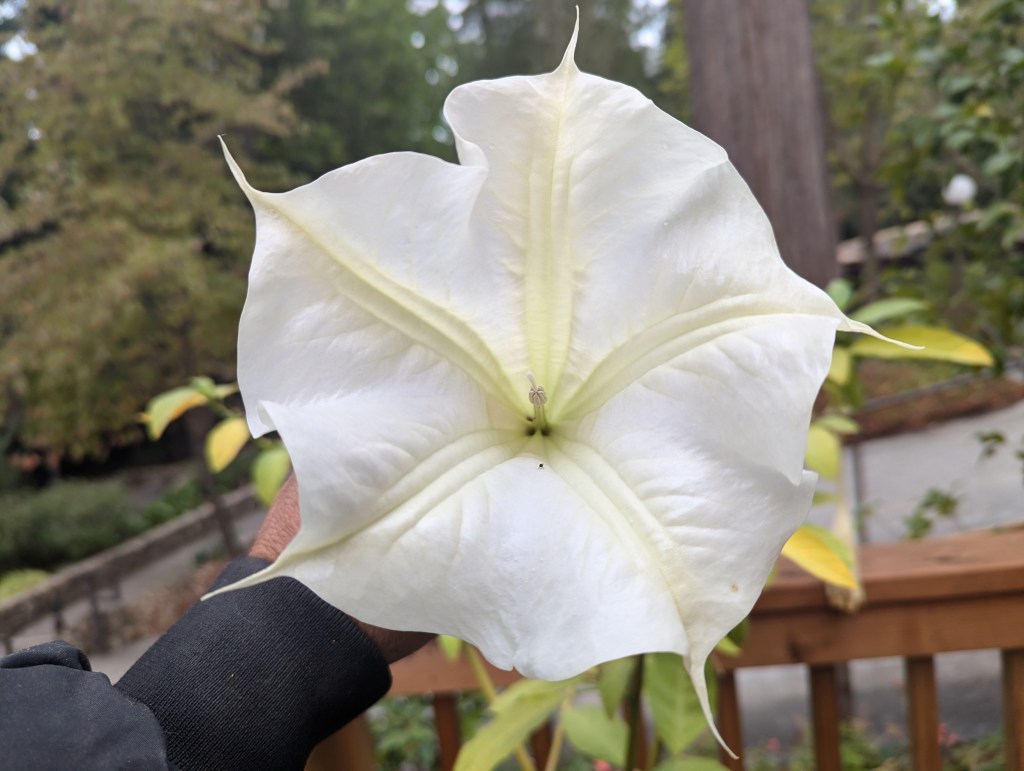
Angel’s trumpet should be finishing bloom by now. Instead, and even while their foliage is fading with cooler weather, their bloom continues. Only the unidentified cultivar with single pink flowers currently lacks open flowers, but even it is budded for potential later bloom. (I neglected to get a picture of a flower of ‘Charles Grimaldi’ angel’s trumpet only because two pictures of angel’s trumpet is sufficient.) While angel’s trumpet is finishing, Algerian iris and ‘Peach Delight’ ginger lily are blooming for their first time here and red butterfly ginger is generating bulbils for its first time here. I was not aware that this sort of ginger generates bulbils. Otherwise, I could have allowed the other gingers do so also.

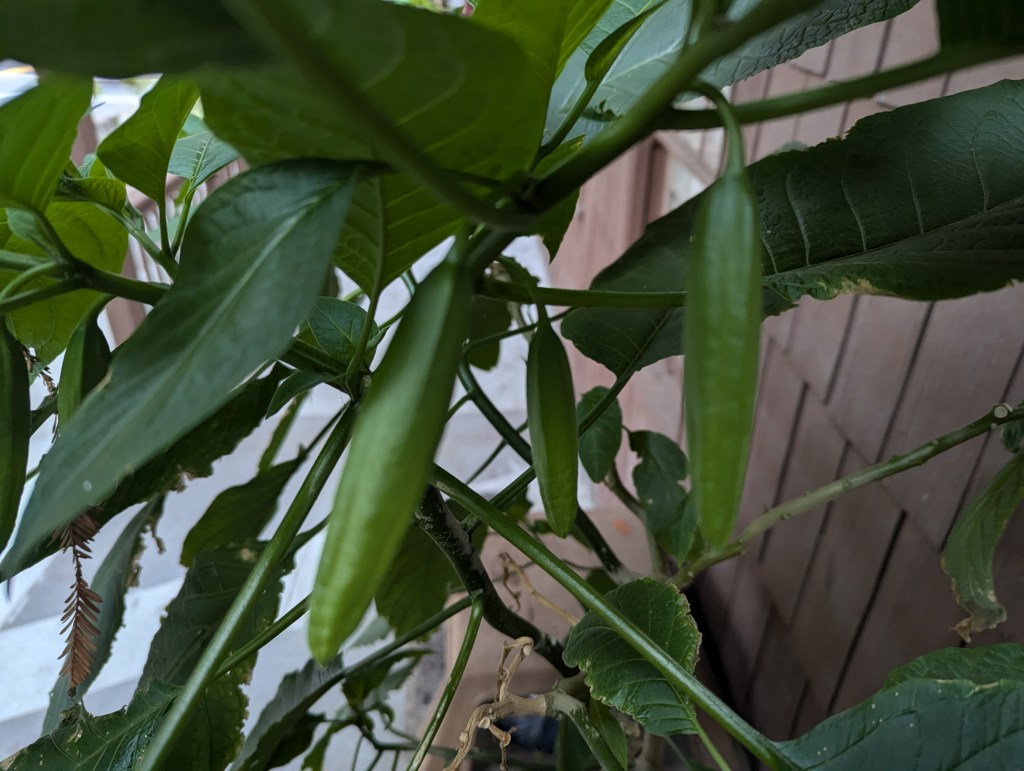
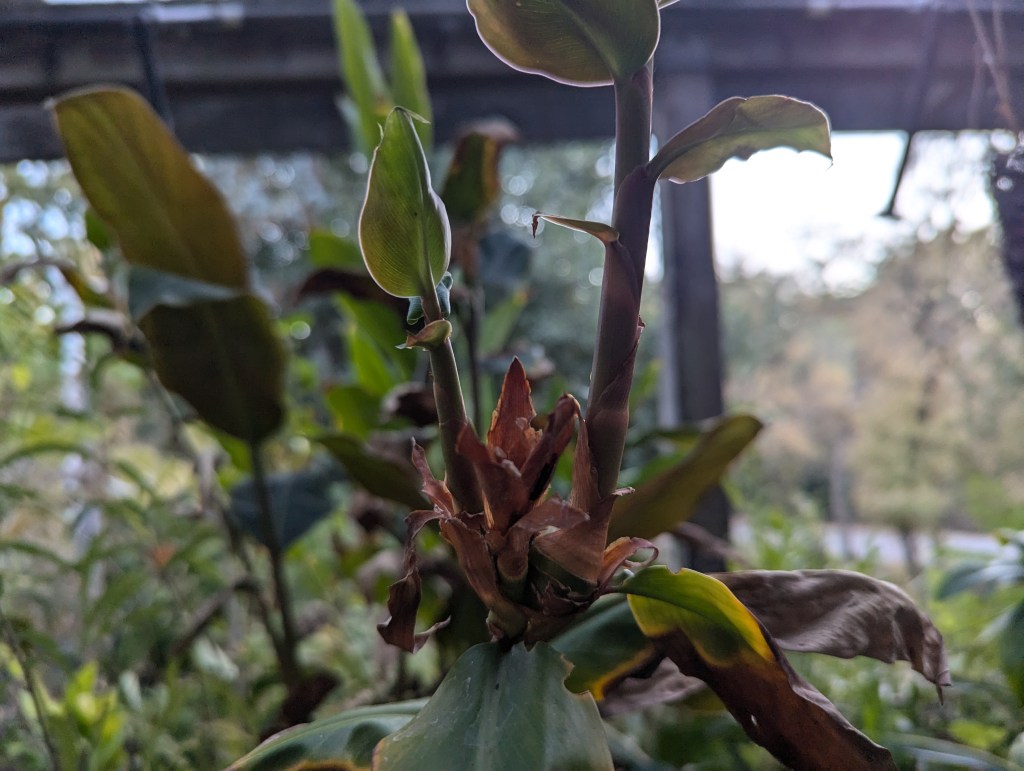
1. Hedychium greenii, red butterfly ginger is making bulbils! I did not know that it knew how to do so. I am now glad that I refrained from pruning the bloomed canes out earlier.

2. Hedychium coccineum X cornonarium ‘Peach Delight’ ginger lily started to bloom so late that I did not expect for it to actually show this much color and confirm its identity.

3. Iris unguicularis, Algerian iris is also blooming for the first time here, since its arrival from Tangly Cottage Gardening. It should bloom more for winter. Is it blue or purplish?

4. Brugmansia, angel’s trumpet of an unidentified cultivar, species or perhaps hybrid, is trying to bloom with its last big single pink flowers of the season, and it just might do so.

5. Brugmansia insignis ‘Single White’ angel’s trumpet is my favorite in regard to bloom, but not one that I recommend. It is blooming nicely though, now that its season is done.

6. Brugmansia candida ‘Double White’ angel’s trumpet also intends to bloom until it no longer can. It bloomed only sporadically since spring, but better than the ‘Single White’.

This is the link for Six on Saturday, for anyone else who would like to participate: https://thepropagatorblog.wordpress.com/2017/09/18/six-on-saturday-a-participant-guide/

Horridculture – Pave Paradise

pavement within pavement within pavement

The Santa Clara Valley really is, as it was formerly known, the Valley of Heart’s Delight. A long time ago, it was famous for vast orchards that thrived in its exemplary climate and soil. The climate is still here, but so are nearly two million people who now live where orchards formerly were. Not so much of the formerly productive soil remains exposed, and almost none is appreciated for its potential. Urban development continues to expand to occupy more of it. At a strip mall in the Berryessa District of San Jose, I noticed what appeared to be gravesites of small patches of once exposed soil that died slow deaths after all other soil around them was developed. The concrete pavement outside of and below the yellow curbs was likely the original parking area, walkway and paved patio, which were separated from each other by what was likely small landscaped patches of exposed soil within and at the same level as the yellow curbs. Sometime after the area outside of the curbs were paved, most of what was likely exposed soil within was also paved with exposed aggregate concrete, leaving only what was likely three smaller square patches of exposed soil, perhaps for trees to survive in. Eventually, even these three smaller square patches of exposed soil were also paved with simpler concrete. It is impossible to say why all this concrete pavement was necessary, or why exposed soil was so objectionable. Perhaps the dirt was dirty. Perhaps it was infested with weeds. Perhaps all this concrete is some sort of Brutalistic art. Regardless, the good soil below is now useless. The patio now lacks shade from trees. A little bit more of the Santa Clara Valley can not sustain any vegetation. A little bit more of Paradise is paved.

Brutalism?

Off Color – Reversion

‘Siam Ruby’ banana started to display bronze foliar color before it seemed to revert to chartreuse.

Of the two dozen or so cultivars of banana here, ‘Siam Ruby’ is one of only two that are merely ornamental. It and ‘Zebrina’ produce fruit that is too seedy to be reasonably palatable. Both are instead grown more for their colorful foliage. ‘Siam Ruby’ develops bronze foliage with yellowish green spots. ‘Zebrina’ develops darker bronze or brown color mixed with more but darker green. Since their distinct foliar colors are their primary attributes, I was initially disappointed when ‘Siam Ruby’ seemed to revert to chartreuse green without any bronze foliar color. I was informed that it is typically chartreuse while very young or if shaded, but develops bronze foliar color as it matures with adequate sun exposure. However, I still suspect reversion because it started to display broad bands of bronze foliar color earlier, but became exclusively chartreuse green afterward. While inquiring about the potential for reversion with this particular cultivar, I learned that ‘Margarita’ originated as a reverted sport of ‘Siam Ruby’ with exclusively bright chartreuse foliage, just like the specimen of ‘Siam Ruby’ here that I suspect reverted. So, I may have indirectly acquired a fake copy of ‘Margarita’, which should contrast splendidly with the bronze foliage of both ‘Siam Ruby’ and ‘Zebrina’! The grower who sent the original pup of ‘Siam Ruby’ already sent a replacement. Now I want to see what the original pup does. If it recovers its bronze foliar color, there will be two copies of ‘Siam Ruby’ here. If it does not, I will consider it to be ‘Margarita’, which is still a rare cultivar. In a way, I sort of hope that it does not recover. A glitch such as this is a good excuse to try something that I would not try otherwise. Actually, we already have plans for it.

New foliage of ‘Siam Ruby’ banana is exclusively chartreuse green, without any bronze.

Off Color

Borage can bloom pink, although it should fade to blue.

Borago officinalis, borage blooms almost exclusively with blue flowers. Those that bloom with white flowers are a naturally rare variant, although a slightly less than natural white blooming variety is available. Although white is my favorite color, I wanted to grow the more common sort that blooms with blue flowers merely because, to me, blue seems like the more natural color for the species. Besides, white borage flowers look rather bland. Actually, I am not much more impressed with blue borage flowers, but wanted to grow borage just to see what all the fuss was about. Though they were not expected to be viable, I was pleased that someone shared some expired seed with me. Because I expected none of them to grow, and expected that even less than none would grow if I delayed sowing them until after winter, I tossed the seed into the cans of other plants in the recovery nursery. I figured that if one or a few grew, I could pull them up and can them separately. Only a few days later, they all seemed to be germinated and growing! I extracted and plugged them into one more six-pack than a full flat of cells, which is forty-two seedlings! The problem is that summer is over, and borage does not overwinter well, even here. I am pleased with them nonetheless, and am confident that some can survive with shelter. I figured that with so many seedlings, that one or more might possibly bloom with white flowers. I noticed floral buds a while ago, so was watching for my first borage bloom. I was not expecting this! What is weirder is that all are blooming like this. Apparently, it is normal for borage to bloom with pink flowers that fade to blue during autumn.

Six on Saturday: Red Flag Warning

A Red Flag Warning that began Thursday night continues at least until five this evening. Arid wind severely increases the risk of wildfire during this time. The strong wind can be hazardous, even without fire. Big trees become big problems.

1. Wind developed soon after sunrise yesterday. I tried to get a picture of foliar debris as it fell from the forest canopy, but took only this. Sequoia sempervirens, coastal redwood makes the background, with Quercus agrifolia, coast live oak in the lower left quadrant.

2. Turkeys should hide from such wind. This one was alone and in a hurry, likely to find a sheltered situation with others, and just as likely, after shredding the red berries of the firethorn, Pyracantha coccinea. I saw no others as the wind continued through the day.

3. Sequoia sempervirens, coastal redwood is remarkably stable but structurally deficient where exposed to wind, which is why it grows in dense and mutually sheltering colonies. These big fractured limbs are very heavy, and fell with deadly velocity from very high up.

4. Umbellularia californica, California bay is often destabilized by structural deficiency. In other words, although its trunks and limbs are generally not structurally deficient, rot often compromises the structural integrity of the roots, which then become destabilized.

5. Two California bay trunks that destabilized and blocked the road in the picture above are obscured on the ground by their own foliage here. The fractured trunk that is visible was not structurally deficient, but was pulled down by the other two as they destabilized.

6. Hedychium coccineum X coronarium ‘Peach Delight’ ginger is likely too late to finish blooming. I would like to see it bloom to confirm its identity, but may need to wait until next year. Although irrelevant to the wind, I thought I should feature at least one bloom.

This is the link for Six on Saturday, for anyone else who would like to participate: https://thepropagatorblog.wordpress.com/2017/09/18/six-on-saturday-a-participant-guide/

Horridculture – Pilferage

Cuttings could have been taken more neatly than this.

Aeonium arboreum, tree houseleek and a few other succulents within my tiny downtown garden are very important to me. They are from the former garden of a friend who passed away years ago. They have performed very well for this particular application since their arrival. They are resilient and undemanding, and provide delightful foliar color and form. The darkest bronze cultivar of tree houseleek that I ever grew arrived with them, but over a few months, was stolen until none of it remained. As the first few cuttings grew enough to become prominent, they were either taken completely, or deprived of their upper foliar rosettes. Any remaining rooted but bare stems eventually succumbed as any subsequent foliar rosettes that they generated were also taken. The surviving succulents remain only because they are both less popular, and too numerous for complete depletion. Actually, I would not mind if those who find these succulents to be appealing sometimes take a few pieces. I merely find their lack of tact to be annoying. I expect them to know better than to take the last of something. Also, I expect that they should have enough sense to take bits from where they would not be missed, and to do so neatly, without leaving broken stubs. Quite a few stems are sometimes overgrown or extending awkwardly outside the planter box, so should be removed anyway. Many stems that are overwhelmed by upper growth could be removed without compromising collective visual appeal. That might actually be a common occurrence that I am not aware of because it is done properly. Stems of these succulents can be easily broken neatly at their unions, without leaving stubs, so pruning shears are not even necessary. Fortunately, these damaged tree houseleeks will recover like they and other succulents always do.

The Hedge on the Ledge – Update

The Hedge on the Ledge continues to develop. Nothing has been added or subtracted from it since its previous update late last July. The vegetation has only grown and been moved about a bit. Perhaps that is an understatement. It has grown more substantially than it should have been allowed to within a situation that it should not actually be in. The only other change is that the pair of parakeet flower pups and the pair of banana pups switched places. It is so overgrown that it obstructs sunlight that would otherwise brighten the associated window. That was not so bad during warm weather of summer. It might not be so desirable as weather cools for autumn. Besides, all of this overgrown vegetation should relinquish its space to smaller vegetation that can benefit from the sheltered position and associated but presently unused heating mat through winter. After all, shelter from minor frost and access to electricity for a heating mat were the original justifications for the installation of this silly shelf below only the half of its window that opens. If I had known that it would still be here, I might have constructed it as a window box instead of an exposed shelf, so that the black vinyl cans and their faded old labels would not be so prominently visible. Eight #1 cans fit neatly onto the shelf, with three 4″ pots nestled into the spaces between them. An elastic strap holds them firmly in place so that they do not get blown off. The vegetation includes:

4 – #1 Solandra maxima ‘Variegata’ cup of gold vine – back row closest to window

2 – #1 Musa acuminata ‘Golden Rhino Horn’ banana – left and right corners of front row

2 – #1 Heliconia psittacorum (unidentified) parakeet flower – middle of front row

2 – 4″ Cucurma longa (unidentified) turmeric – left and right between rows

1 – 4″ Agapanthus africanus ‘Peter Pan’ lily of the Nile – middle between rows

Seventh on Saturday . . . and Eighth and Ninth – Omissions

Six on Saturday is, as should be obvious, limited to six. Therefore, I omitted a few of the pictures of colorful berries that I took last week. The first of these three of the omissions is likely the most important, but was omitted because its berries are not quite as colorful as they will be as they ripen a bit later. The other two were omitted because they actually justify omission. I mean that they are nothing to brag about. However, I did not want to delete their pictures that they were polite enough to pose for without sharing them here.

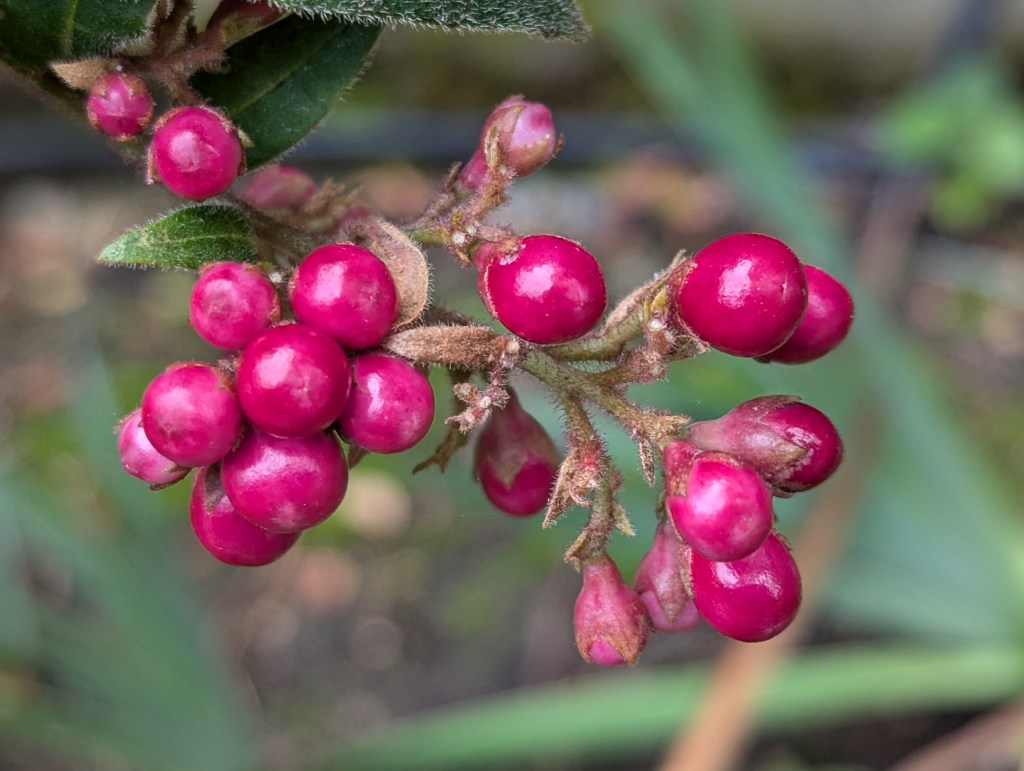
7. Callicarpa americana, American beautyberry was one of several gifts from Woodland Gnome of Our Forest Garden. I had never encountered it prior to its arrival, but wanted to grow it for years! These berries will soon ripen to a slightly purplish but bright bubble gum pink. Although I am typically not so keen on such bright color, I find their oddness to be very appealing. There is a white cultivar, and I do typically prefer white, but I want to grow the typical sort that grows wild within its natural range, rather than any cultivar.

8. Viburnum tinus, laurustinus fails to impress me. I realize that it is popular elsewhere, and that I should learn to appreciate it, but nonetheless, its allure somehow escapes me.

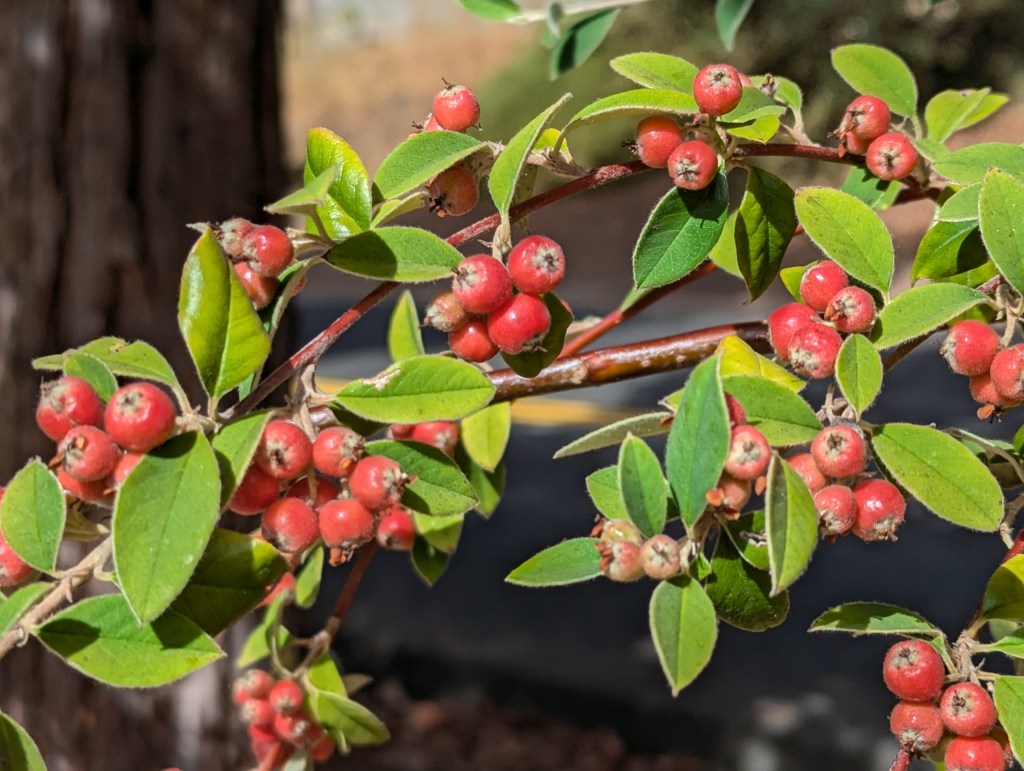
9. Cotoneaster pannosus, silver cotoneaster, to me, is even more unimpressive, perhaps because it is a weed locally. Berries are not colorful for long before turkeys destroy them. What is worse is that turkeys do not seem to eat the berries. They just shake them off the stems, and just leave them to decay on the ground. Berries that manage to ripen are not as vibrant red as firethorn berries, but are a somewhat grungy brownish or orangish red.

This is the link for the original Six on Saturday, for anyone who would like to participate: https://thepropagatorblog.wordpress.com/2017/09/18/six-on-saturday-a-participant-guide/

Six on Saturday: Berries

Brightly colored berries are ripening for both migrating and overwintering birds who are enjoying the abundance.

1. Rosa californica, California wild rose produces nice small hips, but then defends them within a thicket of very thorny canes. Birds have no problem flying in from above to take all they want. I get only what is left when it is time to cut the thicket down during winter.

2. Sambucus cerulea, blue elderberry is one of only two of these six that is designated as a berry by its common name, but is the only one of these six that is not a berry. Its fruits are drupes. Its jelly wins ribbons every time I bring it to compete at the Harvest Festival.

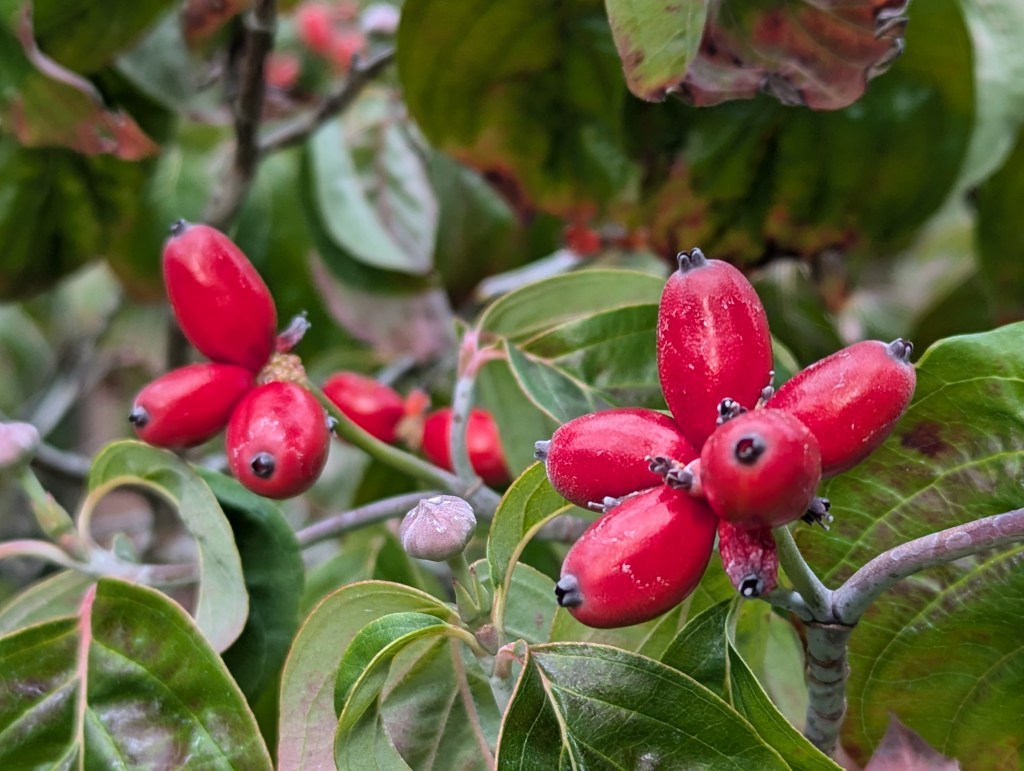
3. Cornus florida, flowering dogwood should stay almost fruitless. Yet, it produces more berries than the red flowering currant produces. It and the red cestrum are the only two of these six that are not native here. Rhody says it is dogwood because the ‘bark’ is ‘ruff’.

4. Ribes sanguineum, red flowering currant should produce more berries than flowering dogwood, but this is about as abundant as it gets. The berries do not even look appealing enough to collect. Their flavor is no more impressive than their oddly grayish blue color.

5. Cestrum fasciculatum ‘Newellii’ red cestrum berries are toxic, like those of snowberry and flowering dogwood. However, they are not toxic to birds who sometimes eat them as soon as they become colorful enough to be pretty. Birds can be pretty in the garden also.

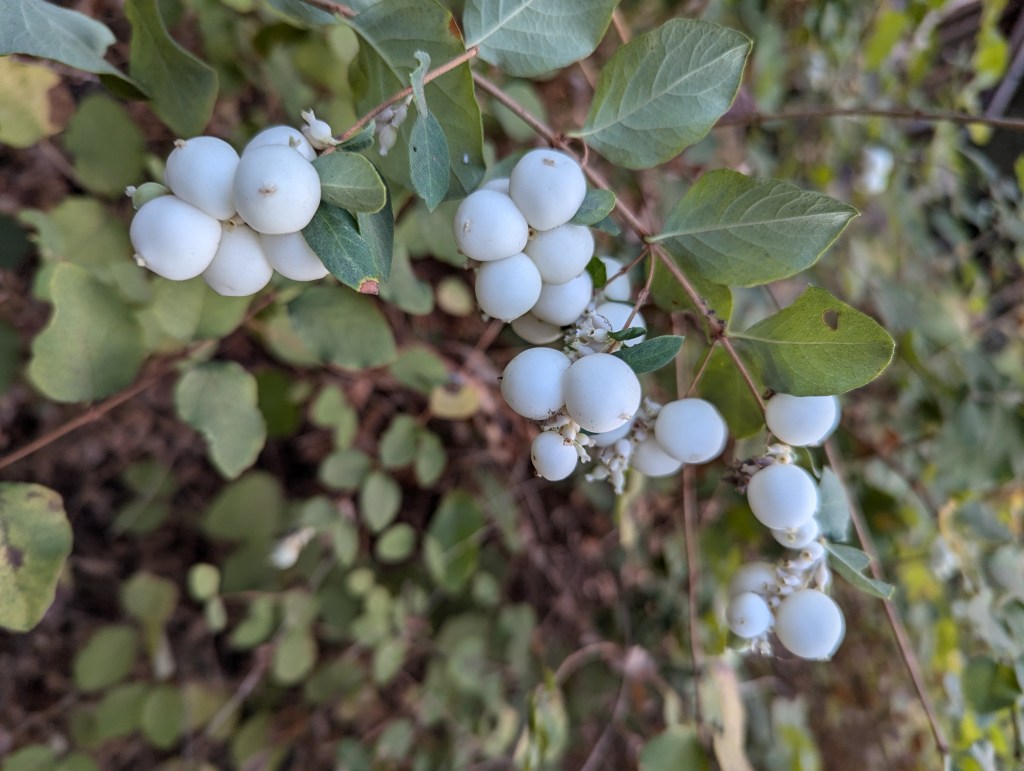
6. Symphoricarpos albus, snowberry is a rather skimpy species. Its thin and wiry stems form low and sparsely foliated thickets. It only stays because it produces these unusually white berries. It might be prettier and more prolific if coppiced during winter dormancy.

This is the link for Six on Saturday, for anyone else who would like to participate: https://thepropagatorblog.wordpress.com/2017/09/18/six-on-saturday-a-participant-guide/