Horridculture – Keep Out!

Gilroy City Council does not endorse this landscape.

Corner lots can be challenging. Even if paths do not get worn diagonally through front lawns, vegetation between curbs and sidewalks is likely to get trampled. The pavement in the foreground of this picture connects the sidewalk to crosswalks for the two associated streets. (I realize that this is not a very good picture, and the blotched out poster for a candidate for Gilroy City Council could not be erased completely, but I took it from a car while stopped at a stop sign.) Vegetation for this particular application must be durable, and perhaps deterrent to trampling. This particular vegetation certainly conforms in that regard. However, there is no polite way of saying how extremely dysfunctional this landscape is. Firstly, from the get go, it is very dangerous to anyone who might simply trip and fall as people sometimes do. Secondly, this landscape will become more dangerous as it matures. Although most of the already crowded agaves seem to be a somewhat compact cultivar that should not reach very far over the sidewalk, the specimen at the center of the bottom of the picture seems to be a variegated common century plant, which has potential to reach halfway across the sidewalk. Thirdly, the entire hot mess will be hideous as it soon needs to be pruned for clearance. The sago palm will soon reach the sidewalk like the common century plant. Pruning will destroy their foliar form. The Mexican fan palm should eventually grow upward and out of the way, but will eventually prevent the streetlamp from illuminating a portion of the sidewalk close to the corner, where illumination is relatively important. Fourthly, this collective herd of wickedly hateful vegetation will soon be too congested to remove litter or weeds from; and curbside landscapes such as this innately collect litter.

Redwoods & Gravity

Physics are dangerous!

Sequoia sempervirens, coastal redwood is the Official State Tree of California, and the tallest species of tree in the World. One large specimen can contain more lumber than many acres of Douglas fir (really). While some trees ensnare kites, redwoods collect satellites. Redwood lumber can be delivered anywhere in western North America simply by aiming a tree in the direction of delivery while cutting it down. Redwood shadows reach Japan at dawn and New England at dusk. The moon is covered with craters because it could not dodge the growing redwoods while orbiting over California. You can see for yourself how tall redwoods are just by looking in this direction from wherever you are in the World. Unfortunately though, not all of the debris that falls from the huge canopies of redwoods burns up in the atmosphere on its way down. Such huge canopies generate a lot of debris. Almost all of it is finely textured foliar debris. Some is twiggy detritus. The worst of it are significant branches. The descent of most of such branches is slowed by lower branches and foliage that they encounter on their way down. However, the lowest branches of some canopies are very high up, and falling branches resume acceleration after falling past them. Also, some falling branches fall outside of their canopies. Even branches that weigh only a few pounds can be extremely dangerous. Many falling branches weigh many pounds, and some are as big as trees. The fallen branch in the picture above is only several feet long and about three inches wide, (and happened to fall through the only three inch wide plank in a pedestrian bridge. The replacement plank needed to be custom cut.) I am annoyed by this relatively minor damage, but also relieved that it was not worse.

Nix

Buick / Lincoln

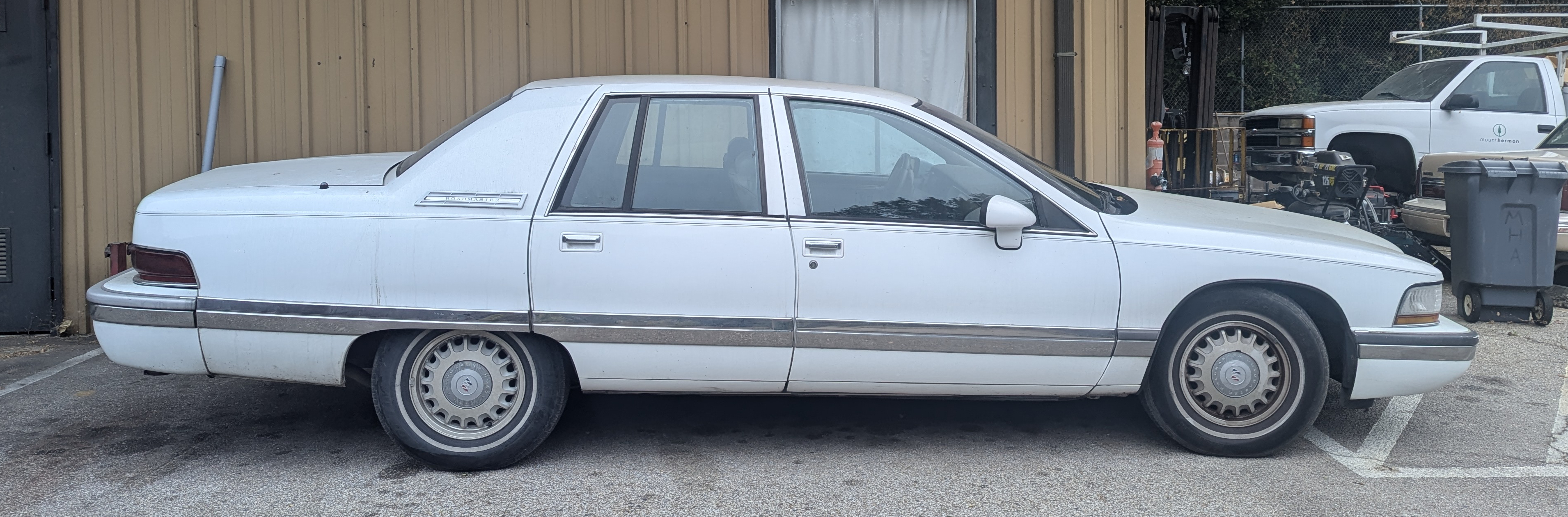
Carson, Rhody’s Roady, is a 1994 Roadmaster. Although Chevrolet Caprice, Oldsmobile Ninety-Eight and Cadillac Fleetwood are the same sorts of contemporary sedans, Buick Roadmaster is somehow designated as the last great American Sedan. All are very rare, likely because they were already so old fashioned when they were new. Finding Carson was no easy task. In the process, and to be a responsible consumer, I investigated other options, including Mercury Grand Marquis from about the same time. Ultimately, I really wanted a Buick, which is a bit more refined than a Chevrolet, but not quite as vain as a Cadillac. Although all options were very tempting, I have been completely pleased with Carson. A few weeks ago though, this 1992 Lincoln Town Car was acquired by the fleet at work. Because most of who work here are young people who lack appreciation for real sedans, particularly such totally awesome luxury sedans, this Town Car will be sold. Because such sedans are even more old fashioned than they were when they were new decades ago, it will not be sold for much. Goodness! It is extremely tempting. Town Car is the luxurious Lincoln version of the Mercury Grand Marquis. This particular Town Car is of the Cartier Edition, which would be a bit too froufrou for me if I could see what identifies it as such. I believe that his name is Nix, but I just refer to him as the Town Car to avoid getting too familiar or attached. His trunk is nearly as spacious as Carson’s, so can bring more plant material back from Southern California or the Pacific Northwest than a modern compact pickup, which was one of the justifications for investing in a sedan that I have no practical use for rather than a modern pickup.

Six on Saturday: Fake Autumn

Daylight does not last quite as long as it had earlier in summer. Shadows stay noticeably longer. Summer actually ended about two weeks ago. For now it is early Indian summer.

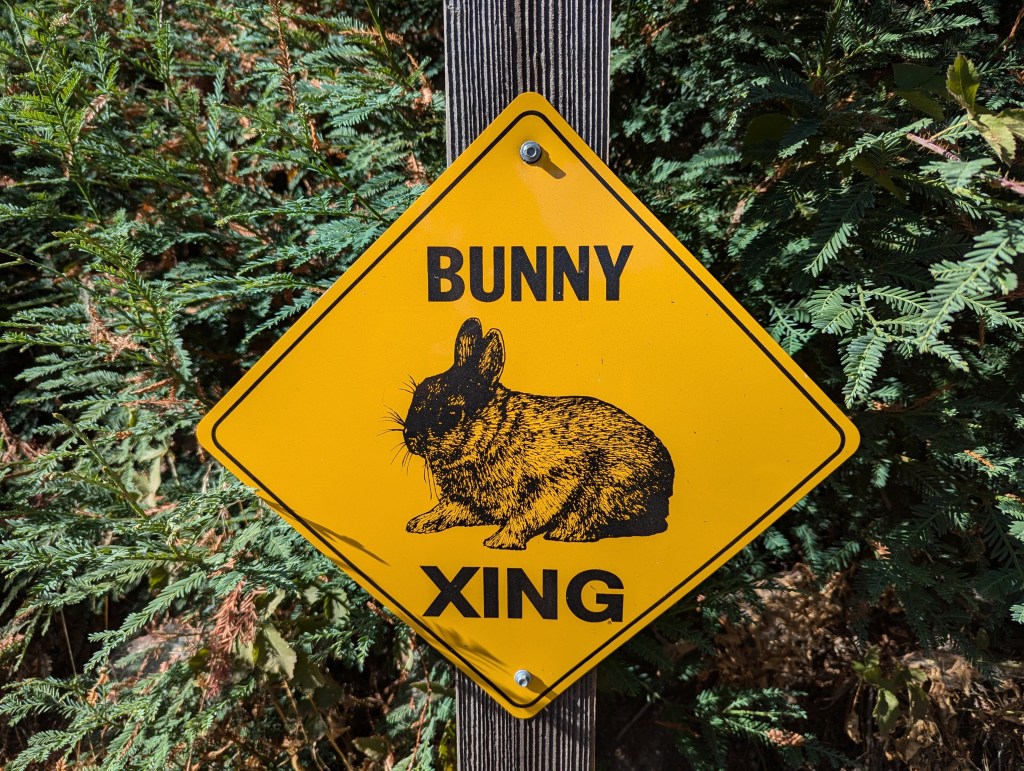
1. “Bunny Xing” is as irrelevant to autumn as it is to Charing Cross Road in Los Angeles. I just found it to be amusingly odd that a neighbor seems to be protective of wildlife that can be so detrimental to some gardens here. Bunnies fortunately do not bother us much.

2. Juglans nigra, Eastern black walnut or Juglans nigra X hindsii, royal walnut, yellows early, more likely because it is tired of summer heat than because it anticipates autumn. Both walnut tree types naturalized from understock that sustained old walnut orchards.

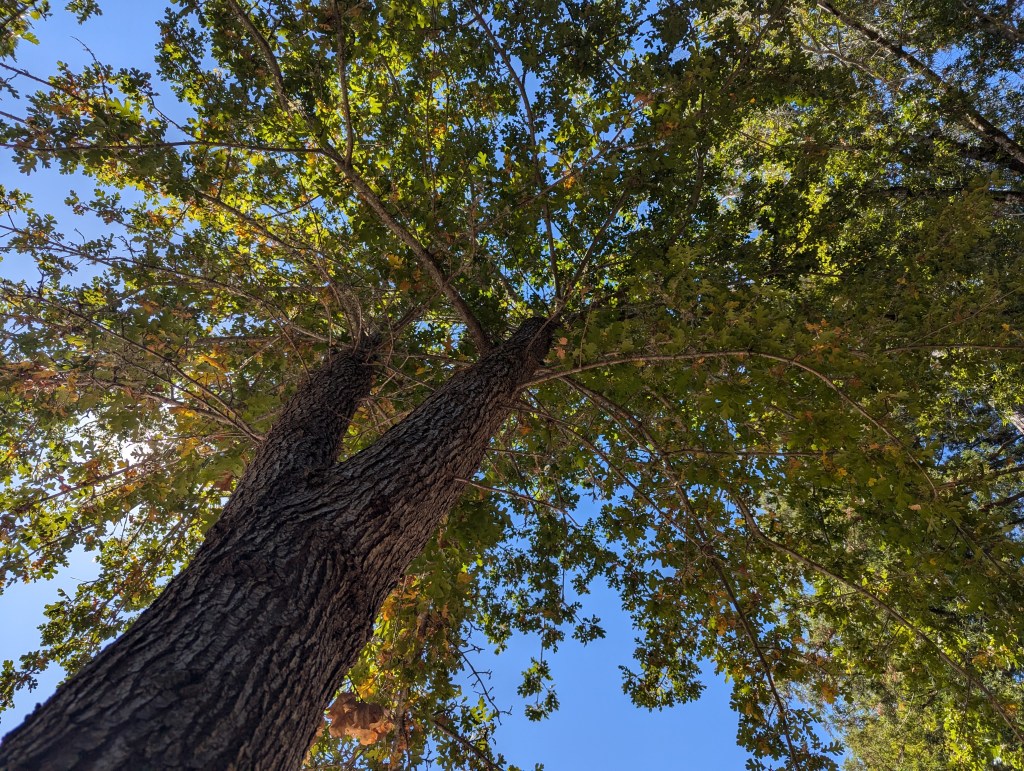
3. Quercus lobata, valley oak typically but not always begins to brown after walnut trees yellow. This yellowish color is likely a result of the weather cooling a bit before warming again. This species is native nearby, but may have naturalized here after getting planted.

4. Acer rubrum, red maple is likely only coloring because it is distressed by confinement of its roots within its big clay pot. Recent and suddenly warmer weather after seasonably cooler weather may have accelerated the process. I really want these trees in the ground!

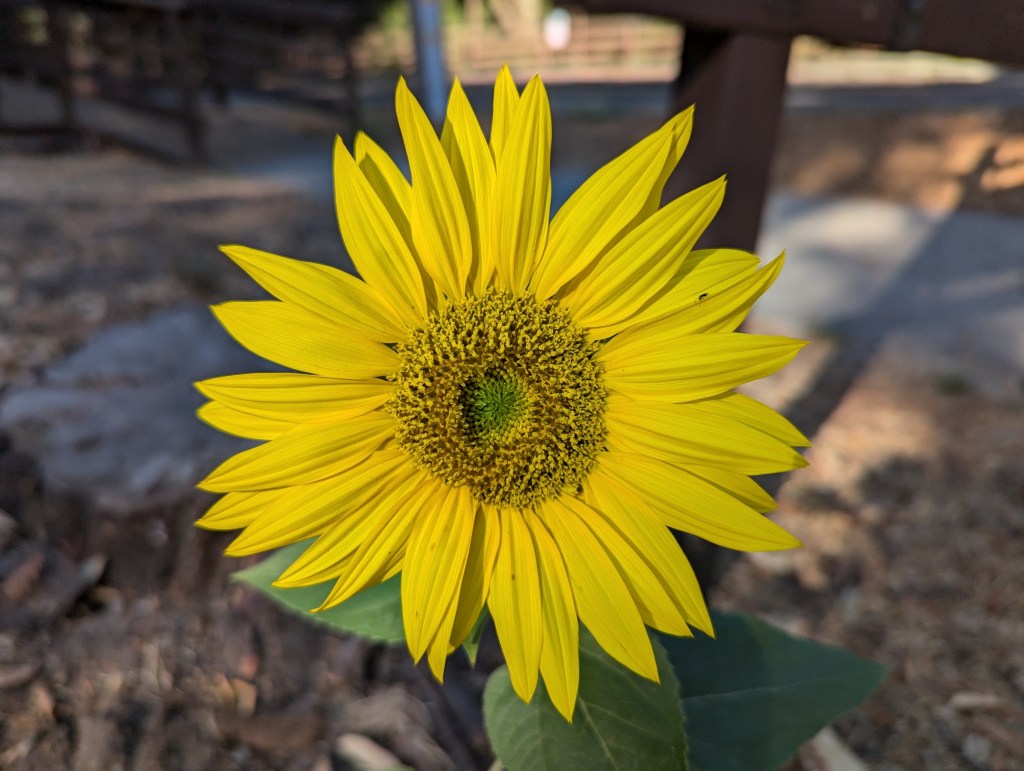
5. Helianthus annuus, sunflower mysteriously appeared precisely where we should have but neglected to grow sunflowers this year. This is the only one, but it is enough to show us what we are missing because of our lack of diligence. It is only a bit early for autumn.

6. Rhody is ready for autumn. More specifically, he is ready for cooler weather. Although it was scarcely more than ninety degrees yesterday, and only for a few hours after noon, it seemed to be unseasonably warm, after earlier weather was already beginning to cool.

This is the link for Six on Saturday, for anyone else who would like to participate: https://thepropagatorblog.wordpress.com/2017/09/18/six-on-saturday-a-participant-guide/

Horridculture – African

Delegates from Arabia, Africa, Germany Pakistan and (almost) Turkey

‘The Rescuers’ is an animated movie for children from 1977 that features the Rescue Aid Society, which is an international organization of mice. (I am trying to be very brief with this description. Besides, I do not know much about it.) Delegates of the Rescue Aid Society represent various countries, such as Arabia, Germany, Pakistan, Turkey and Africa. Yes, ‘Africa’. Although one can assume that ‘Arabia’ refers to Saudi Arabia, it could refer to the entire region, which includes several countries. Similarly, although one can assume that ‘Germany’ refers to West Germany, it could refer to both West Germany and East Germany, which were still separate countries in 1977. ‘Africa’, though, is not so easily dismissed. It is an entire continent, which includes more countries than any other continent. Horticulturally, Africa does not get much more regard. African sumac, African daisy, African iris, African violet and African tulip tree are all from Africa, but their names reveal no more than that about their origin. Italian cypress, English holly, French lavender, Norway spruce and Grecian bay all have names that are more descriptive about their European origins. Similarly, the names of Japanese boxwood, Chinese elm, Korean fir, Burmese honeysuckle and Indian laurel describe their Asian origins. The names of California fan palm, Oregon grape, Virginia creeper, Texas bluebonnet and Arizona cypress are even more descriptive, by designating individual States within the United States of America, which is within the continent of North America. Here in California, some common names are even more regionally descriptive, such as Monterey pine, Santa Cruz cypress, Santa Barbara daisy, San Francisco campion and Montara manzanita. Although most of these examples are unknown or rare beyond their native ranges, a few are quite common elsewhere. Yet, somehow, most of what was exported from Africa is merely ‘African’.

Karpooravalli

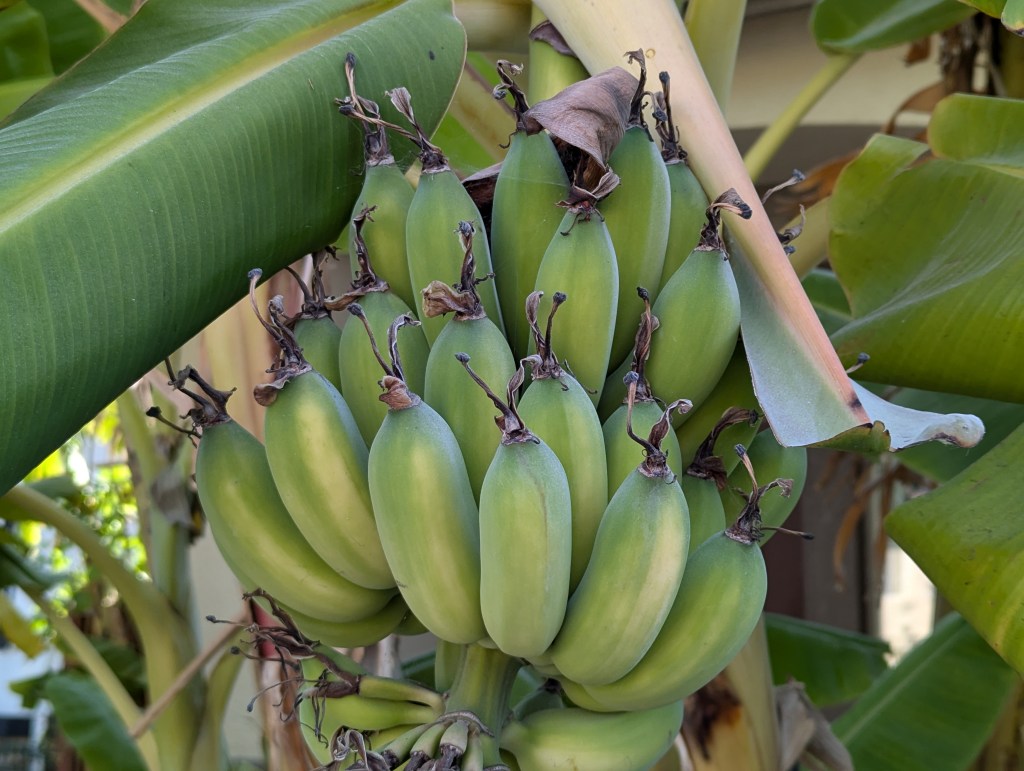
Karpooravalli bananas after removal of their edible male flowers below.

Pronunciation is only slightly easier than when I first tried to read it. Spelling still necessitates cheating, which I do not feel at all guilty about. Karpooravalli is a big name! I must get acquainted with it though, since it will likely be with me for the rest of my life.

Yes, it is another cultivar of banana, which is something else that I do not feel at all guilty about. I have no intention of retaining all of the other twenty or so cultivars that are already here. In the future, I will likely give away most of them to colleagues, without retaining pups. I actually already have plans to install at work the two that are least likely to produce edible fruit, and never grow either in my own garden again.

Karpooravalli banana pups

These four new pups of Karpooravalli arrived last Monday, just two days after eight unidentified pupping pups and a single pup of ‘Blue Java’ which is also known as the ‘Ice Cream’ banana. Like these previously most recent acquisitions, as well as another ‘Blue Java’ pup and another unidentified pup that were acquired together last year, these four pups of Karpooravalli are from a private garden. All of the other cultivars here are from nurseries, and most were tissue culture plugs that never actually grew in soil.

That is the dilemma. Cultivars from nurseries are expendable. I can give them away without retaining any copies and not miss them. However, cultivars from private gardens have history, even if I am unaware of it. They are important to someone.

I can give away the recently acquired pup of ‘Blue Java’ only because another pup of it from another important source is already established here, and I knew when I took it that it would not be staying. Also, I can give away almost all of the other unidentified pups that came with it because there are already too many to retain. However, I will retain at least one of them because I know that the cultivar was important to the person who shared it. Likewise, I will retain my first copy of ‘Blue Java’ and the unidentified pup that came with it because they are important to the person who shared them.

Karpooravalli is fortunately one of the more reliably productive cultivars here, and provides sweet fruit with remarkably rich flavor. It is gratifying to know this now because I will grow it for as long as I can tend the garden. This particular Karpooravalli is very important to the person who grew it in her garden for a few decades before sharing it with me, so it is important to me now. I know that I will eventually need to share it with others as it multiplies in the future, but I will prefer to share it with those who respect its importance.

Before I was in kindergarten, I acquired my rhubarb from my paternal paternal great grandfather, and my Dalmatian iris from my maternal maternal great grandmother. Both are growing well in my garden now, and always will. I acquired my common lily of the Nile and the first of my common zonal geranium a few years later. Much of what inhabits my garden now has been with me for many years. Yet, I acquired my first Japanese iris, persicaria and goldenrod as recently as late last winter from Tangly Cottage Gardening. Perhaps it is never too late to start another important tradition.

Karpooravalli bananas

Docile Wisteria

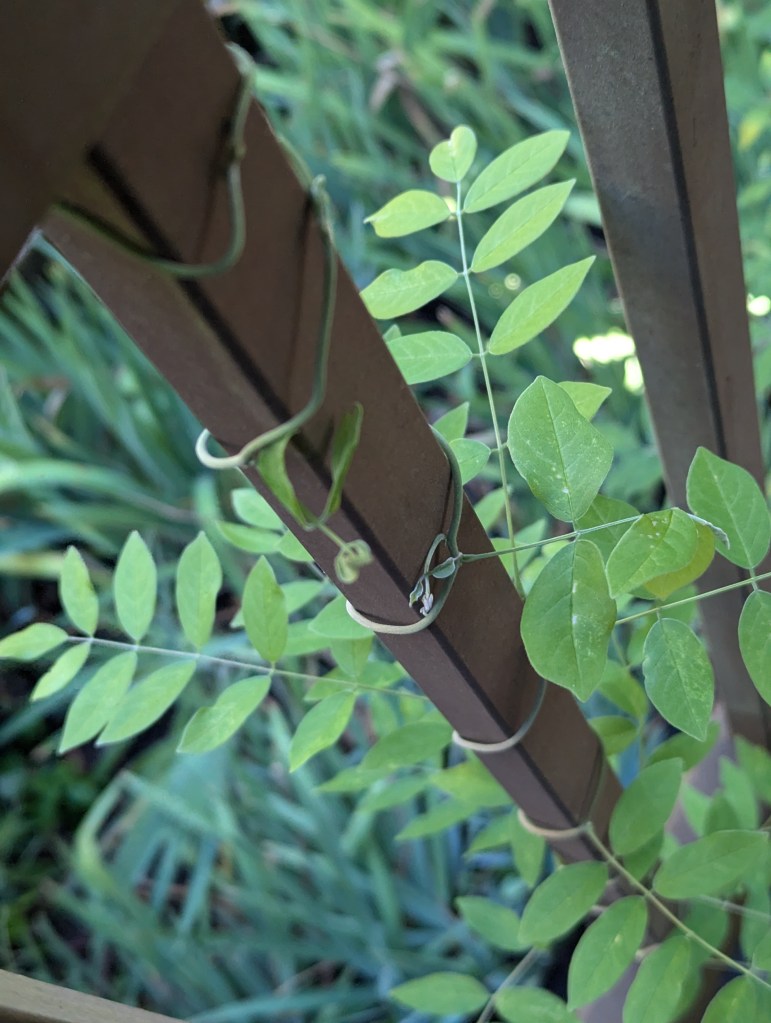
Wisteria frutescens, American wisteria

Chinese wisteria is an aggressive vine! A few that have gone wild near here have climbed high into redwoods, or spread over large areas of forest, or both. Some may have been planted intentionally, and then been abandoned. Some may be feral. Japanese wisteria may have potential to do the same, and perhaps some have already done so without being recognized as a different species from more common Chinese wisteria. Both species are spectacular while blooming within refined landscapes, but can be difficult to accommodate within the often neglected or partially forested landscapes here. That is why I am so pleased to try the much more docile American wisteria, Wisteria frutescens. I do not remember the name of this particular cultivar, but it blooms with bluish lavender floral color that is comparable to that of the more traditional Chinese wisteria. Like Chinese wisteria, other cultivars can bloom white or more purplish, and supposedly even pink, although I have yet to see even pictures of it blooming pink. It is not as spectacular, primarily because it is so much more docile, so does not grow nearly as large. Also, the floral trusses are relatively short, stout, and cylindrical in form, so protrude more rigidly outward like bottlebrush bloom, rather than more pendulously like the familiarly elongated and conical floral trusses of Chinese wisteria, or the more elegantly elongated floral trusses of Japanese wisteria. Kentucky wisteria, Wisteria macrostachya, is supposedly quite similar, but blooms later with more bluish color, rather than lavender. ‘Clara Mack’ is a cultivar that blooms white. After I see how American wisteria performs here, with its traditional wisteria colored bloom, I would also like to see how ‘Clara Mack’ Kentucky wisteria performs here. It could be a delightfully docile alternative to traditional Chinese wisteria for the White Garden.

Six on Saturday: Copy Machine

This is not about a machine that makes copies. It is five pictures of copies and a machine that Rhody could make very good use of.

1. Citrus paradisi ‘Marsh’ grapefruit was doing well until some sort of caterpillar that ate much of the foliage off of the passion fruit vines found it. This is an ungrafted cutting, so could eventually grow into a humongous shade tree if it survives this late without leaves.

2. Santolina virens, lavender cotton needed to be removed from one of the landscapes. I did not want it all to go completely, but none of it was salvageable, and I had not grown copies of it earlier. Happily, I found that this single dinky copy somehow got left behind.

3. Kniphofia uvaria, red hot poker is one of those common perennials that I had wanted to grow, but never did. Fancy cultivars are now more common than the common simple species. Finally, I managed to acquire three pups from an old and abandoned landscape.

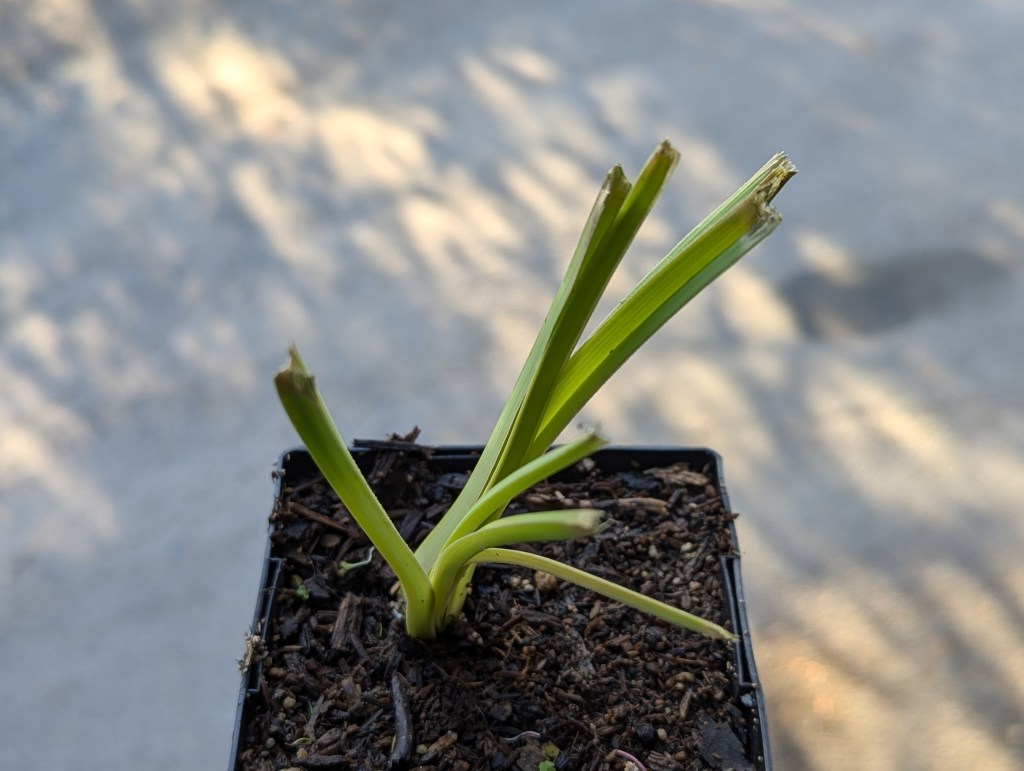
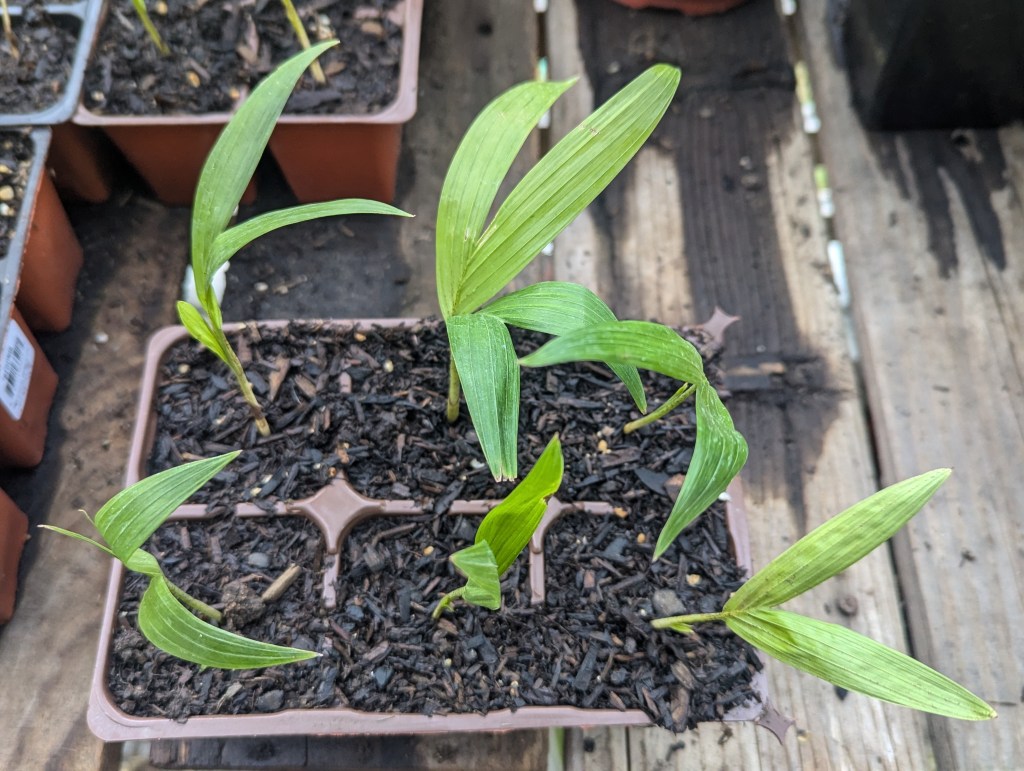
4. Archontophoenix cunninghamiana, king palm, or bangalow palm or piccabeen palm, is one of the popular palms of coastal Southern California that I would like to grow here. Naturally, but just as naturally without any plans, I procured about two dozen seedlings.

5. Musa acuminata ‘Golden Rhino Horn’ banana pups have grown like weeds since their arrival last June, and now, one of this pair is generating either another pair of pups very closely together, or a single pup that is already extending its first frond away from its tip.

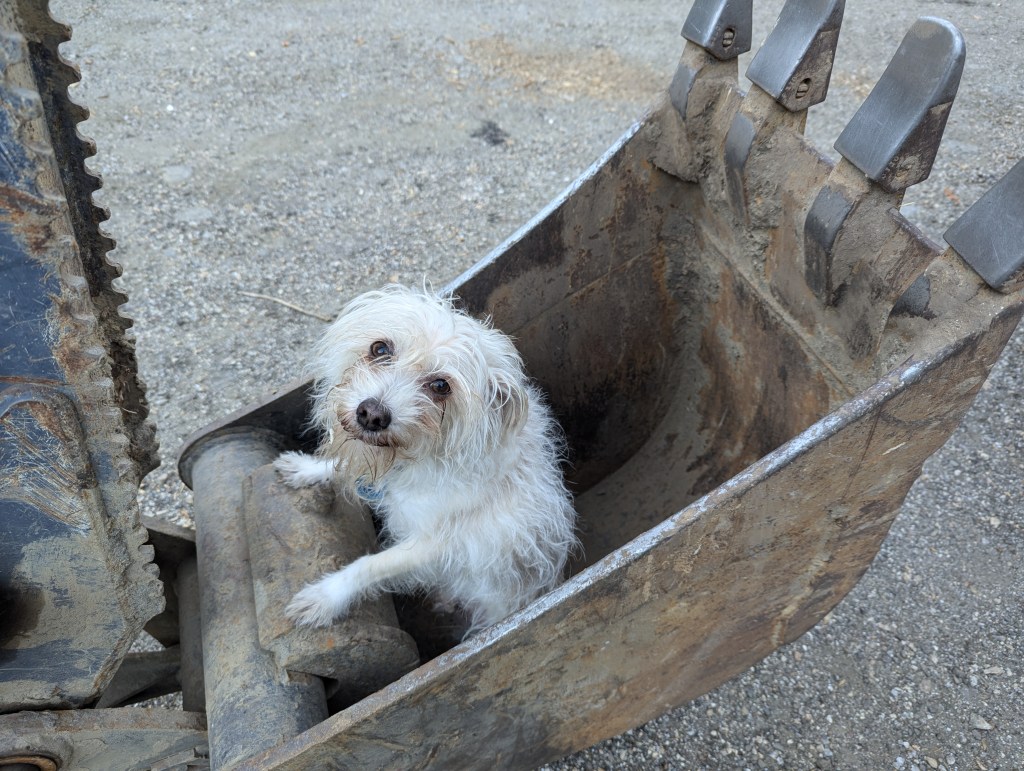
6. Rhody is a terrier. In other words, he is terrestrial. Instinctively, he wants to dig in the earth. His type was bred for pursuit of terrestrial vermin, such as gophers. They need no excuse to dig, of course. Furthermore, Rhody requires no justification for his technique.

This is the link for Six on Saturday, for anyone else who would like to participate: https://thepropagatorblog.wordpress.com/2017/09/18/six-on-saturday-a-participant-guide/

WWF

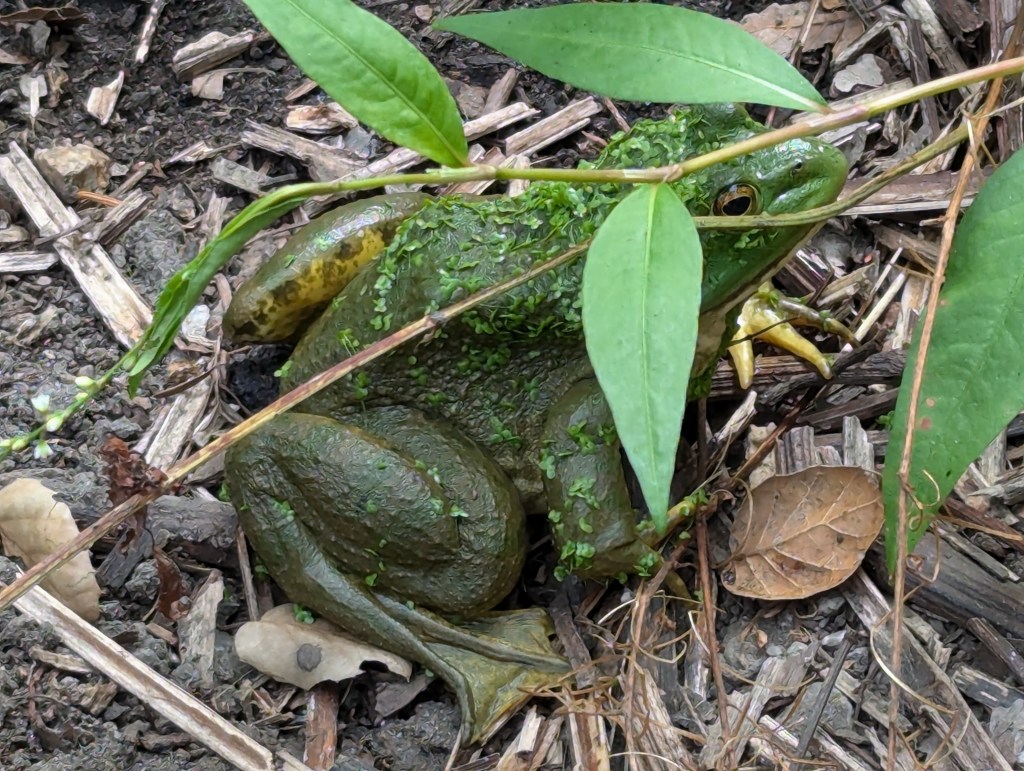
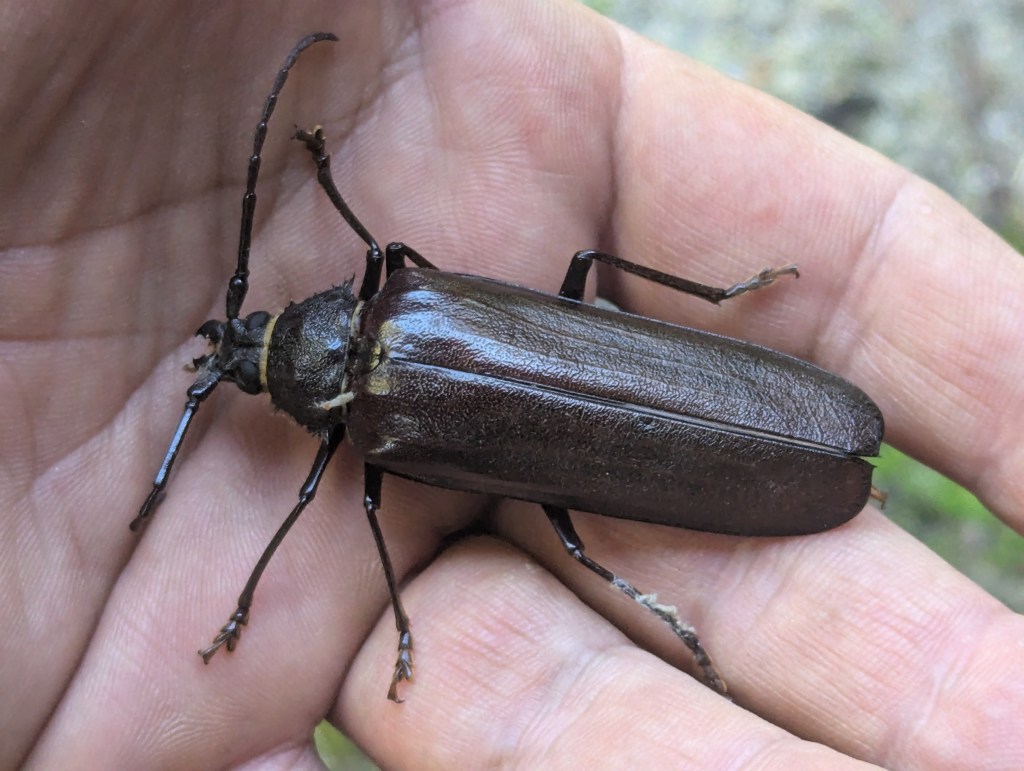
The World Wrestling Federation is now known as World Wrestling Entertainment because the World Wildlife Fund was already known as the WWF. The dude in the picture above could go either way. Apparently, he, or she, is some sort of aggressively invasive exotic bullfrog. Nonetheless, he or she still qualifies as wildlife, and now inhabits the drainage pond that is within a cultivated landscape that is adjacent to natural forest ecosystems. I mentioned his or her presence to a biologist who then informed me of how much damage this particular species can do to any natural ecosystem that it infests. I then realized that the tree frogs that had been so loud through spring had been silent all summer. Although they naturally get quiet by summer, they are not normally so completely silent. I am now concerned that the bullfrog might eat small fish who might inhabit the pond. Duckweed obscures activity below most of the surface of the pond. I would not mind if the bullfrog ate the duckweed. He or she probably does, but there is just too much of it. This species of bullfrog is omnivorous, so will eat anything that it can get its big mouth around, including mollusks and insects. That could be beneficial, but might also include beneficial insects. Actually though, I am more concerned about any baby fish than insects. Besides, when I met the insect in the picture below, I was actually somewhat concerned about the unwelcome bullfrog. I do not want his or her demise to be as violent as the appearance of this insect suggests it could be. I have no idea what this insect is, but it looks like it should have a Volkswagen hood ornament. Getting it together with the bullfrog could be an event for the WWF!

Banana Republic

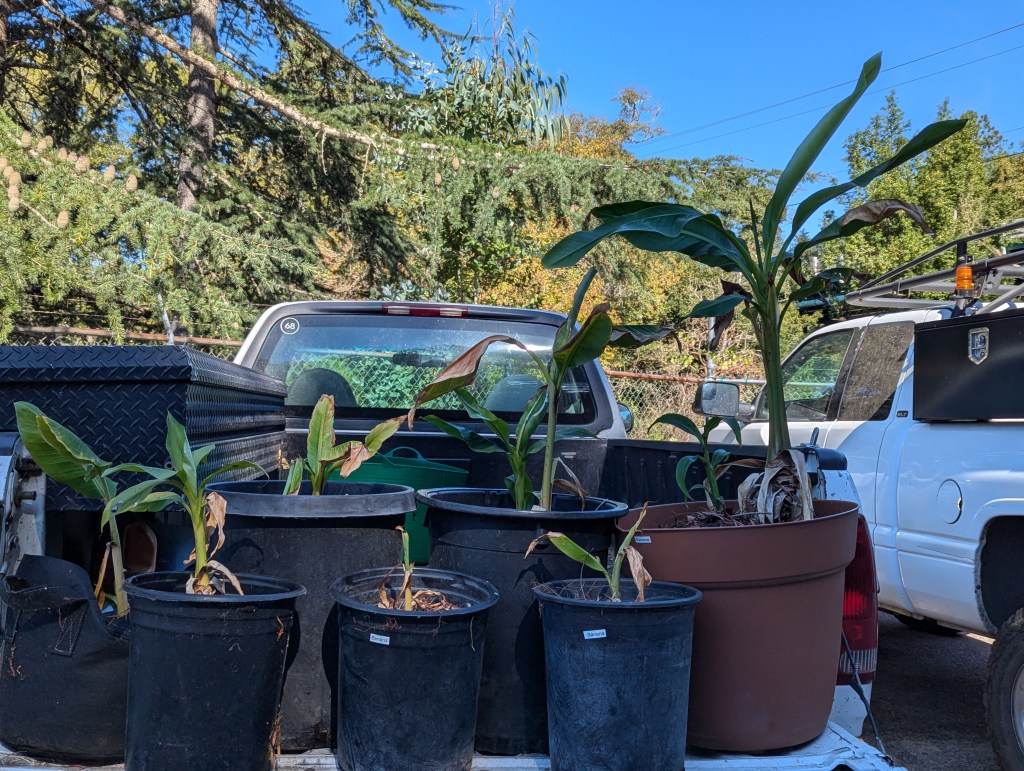
Yes! We have more bananas! I can explain. Although there are as many as twenty cultivars of banana here, almost all are individual pups or tissue culture plugs. (Of these twenty, three are unidentified. Of these three, one is likely a redundant copy of one of the other cultivars, one seems to be completely necrotic without possibility of recovery, and only one is notably distinct.) All but a few arrived earlier this year, so have not yet generated pups. ‘Double Mahoi’ has doubled by generating a single pup. ‘Golden Rhino Horn’ arrived as a pair, and one of the pair is only now beginning to generate another pair of pups. Otherwise, there are no spare pups to share. The only spare pups of ‘Double Mahoi’ and ‘Golden Rhino Horn’ (the one which lacks new pups) may be leaving in the next few days. Whatever remains of these two will most certainly go to another colleague at the end of winter. Another colleague would like to add any spares, regardless of cultivar, to his garden. However, until just now, I could not help in that endeavor. The few in the picture above just arrived from Gilroy because they were in need of a new home. The pup to the far left is ‘Blue Java’, which is also known as ‘Ice Cream’, is redundant to a copy that is already here, so can be shared with a colleague. The others, which are sufficiently numerous for all of us to get copies, are unidentified, which merely means that if they produce fruit, it will be a surprise. Even if their fruit is not palatable, their foliage is good for forage and compost. For the colleague who would like to add any spares regardless of cultivar, they can live in a riparian area of his garden that is too steep, damp and shady for gardening. These pups may not look like much in the picture, but their corms are quite plump, so will provide an abundance of foliage after they get into the ground and the weather warms after winter. Soon afterward, they will generate more pups, but we can worry about that later.